Election Day By the Numbers: 2020 Features High-Stakes Races and High Voter Turnout

Heading into election day, over 95 million Americans have already voted according to the U.S. Elections Project. This record level of early voting is indicative of one of the most hotly contested and divisive elections in U.S. history. 

The election has also been complicated by COVID-19. States and localities have had to scramble to find the resources, money, and people needed to hold a high-turnout election safely. In many states, the solution was to expand mail-in and early, in-person. This adds a new level uncertainty as the different levels of government attempt to deal with the unprecedented levels of early voting. This could also lead to delayed election results, as certain states allow ballots to be received after election day. 

In America, election administration is given as a state duty by the constitution. This results in many different systems and rules based on the location. Also, as the election is playing out, many lawsuits have been decided or are being litigated to decide which ballots will count. This uncertainty has many on the left worried that the president will use this uncertainty to claim victory with a lack of any evidence. 

What is clear is what’s at stake on this election day: Democrats are on offense with a chance to claim a trifecta (Control of the House, Senate, and Presidency) at the federal level. Starting with the House, FiveThirtyEight (a data-focused news outlet that predicts election results based on polling and other variables) gives the Democrats a 98 percent chance of keeping control of the chamber. The Senate is a little tougher but still has Democrats optimistic. FiveThirtyEight gives Democrats a 76 percent chance of holding on to the chamber. And finally, at the presidential level, the site says Joe Biden has a 90 percent chance of winning the presidency. It should be noted that the forecasts do not factor in judicial challenges to the results. 

Presidency

At the presidential level, Joe Biden is squarely in the lead, and unless there is an unprecedented polling error, President Donald Trump will have to run the tables in all the battleground states. 

How Trump Could Win: To win, Trump will have to make up a large deficit in the polls to Biden, and he will have to rely on key demographics in swing states to reach 270. First Trump has to hold onto the states that he didn’t think he’d have to defend. Most major pollsters show races in Texas, Georgia, Iowa, and Ohio are close to a dead heat in polling; Trump carried these states handily last time. If Trump doesn’t hold on to all four of these toss-ups, the race is over for him. On top of that Trump will also have to win in three swing states in the South, as well as North Carolina, Arizona and Florida. Without these three states the president has little chance of prevailing. And finally, on top of all of that he would have to come from behind to win in Pennsylvania where the most recent New York Times poll has Biden leading by six points. While it may be easy to count the president out, it was only four years ago when the political outsider shocked the world by crushing his predictions and winning the White House.

How Biden Could Win: Biden’s path to 270 electoral votes isn’t complicated or nearly as hard as Trump’s. Simply put, out of the eight competitive states (Pennsylvania, Ohio, Arizona, Georgia, Florida, North Carolina, Iowa and Texas), Biden needs to win one. If he is able to capture just one of these states he will win the presidency. Despite what seems like an easy task, the left is still haunted by their false optimism four years ago.

Senate 

The outcome of the senate will have a large effect on the governing success of whomever wins the White House. Right now, the Senate is composed of 53 Republicans and 47 Democrats. And Democrat Doug Jones of Alabama is very unlikely to win reelection. This means that to control the senate, the Democrats will need to gain four seats if Biden wins and five seats if he doesn’t win. (The reason for this difference: the Vice President would cast the deciding vote in a tie, meaning that Democrat Kamala Harris would add another vote if Biden wins). 

Democrats are favored to take back seats in Colorado, Maine, North Carolina and Arizona. They also have a nearly 50-50 chance of taking two seats, in Georgia and Iowa. They also have an outside shot of picking up seats in Montana, South Carolina, Alaska and Kansas. There will also most likely be a runoff in Georgia for its second Senate senate seat later this year (a runoff occurs when no candidate reaches 50 percent in the first election, then the top two candidates face off.)

House

For the Republicans to even have a chance to win the House, there would need to be a massive polling error, in which the news media dramatically misrepresented the views of the American public. The Democrats are almost certain to retain a majority in the house.

The Bottom Line

While each individual race is local and has many issues that depend on the state, the stakes at the national level are clear: if Biden wins on election night and Democrats retake the Senate while holding on the House, the Democratic Party will have a trifecta for the first time since Barack Obama’s first term. 

Written by Max Fisher

The 2020 Crisis Around the World

From China to Yemen to Lebanon and more, the events of 2020 have affected others in the world

With everything that has happened so far this year, it’s not a stretch to call 2020 a crisis. It has been filled with unexpected events, such as COVID-19, racial justice protests, and even murder hornets. The rest of the world has not had it easy either and not just because of the pandemic. Yemen, Lebanon, and China have also experienced tragedies. Lebanon’s tragic event was abrupt, but what is going on in Yemen and China has been going on for years. 

On August 4 in Beirut, Lebanon, at least 154 were killed, and thousands were left injured, in a gigantic explosion at a warehouse in the Port of Beirut. The force from the blast left vast amounts of damage to the surrounding buildings and neighborhoods and produced a mushroom cloud of fumes and debris, a lot of which was harmful to breathe. The explosion was so powerful it could be felt 150 miles away. The explosion was caused by an ignited cache of ammonium nitrate, according to The Wall Street Journal. Ammonium nitrate is a chemical compound commonly used in fertilizers, but it can also be used to make explosives.  It was held at the site for over six years.

The ammonium nitrate was originally on a ship that was supposed to be delivered to the country of Georgia in 2013. Due to technical difficulties with the boat, it had to be docked in Beirut, and it was later abandoned there. The ammonium nitrate was stored in the warehouse that was supposed to dispose of the chemical safely. Officials at the port are now under house arrest as the investigation continues, according to The Wall Street Journal. 

More than a million Uighur Muslims and other Muslim minority groups are being held in the Xinjiang region of China. Uighurs are a Turkic speaking minority ethnic group originating from the general region of Central and East Asia. There has been conflict with China and Uighurs since 1931. China is referring to these sites as transformation camps. A woman named Gulzira who told her story to PBS Frontline said she was surrounded by mesh, barbed wire, cameras, and brutal treatment. She said that twice she had to sit on a hard chair for 24 hours and use the bathroom where she sat. She also told PBS, “If you exceeded two minutes in the toilet, they hit our heads with an electric prod.” 

Jeffersonville High School special education teacher David Russell taught in China for a while and has first hand experience seeing the work of the Chinese government. 

Russell says China likes the idea of complete conformity. “Any nail that sticks up is hammered down,” he says. That is why China has targeted those who follow certain religions. “I witnessed anti-Christian persecution. People got arrested for going to church. Their form of anti-Islam is just not conforming,” Russell says. “It’s Orwellian, and it’s gotten worse.” It will take many Chinese activists because many websites reporting on it are shut down, and the people running them are being arrested. However, Russell says that he doesn’t want to reflect poorly on the Chinese since he enjoyed his time living there, and he enjoyed the people he met.

Yemen is also harshly affected by the events of 2020, but it’s an existing problem that has become worse in their case. According to Islamic Relief USA, for about five years, Yemen has been in a famine. Famine is the extreme scarcity of food and is often caused by droughts. More than 85,000 children have died from the famine as of 2018. In May of 2020, UNICEF described Yemen as the most massive humanitarian crisis in the world. They are already starved, and as COVID-19 sweeps the area, their ability to find resources has worsened. Over 24 million people are in need. Hospitals often have no staff, no equipment, or even electricity. The doctors are so overwhelmed that they have to turn people away. Yemen’s child malnutrition rates are some of the highest in the world. About half of the children under five years old are growth stunted. 

Yemen is also a war-torn country where civil war has taken a terrible toll on the resources and infrastructure necessary to keep people healthy. This civil war resulted from continued violence and unrest from the Arab Spring (2014), where the people rose and tried to create a democracy.

Even as America is hit hard with COVID-19 and all the other challenges of 2020, often it is easy to forget the many other challenges happening all across the world. 

Written by Marni Scholl

GCCS Board Approves Revised Spring Semester Calendar

During last night’s meeting of the Greater Clark County School Corporation Board of School Trustees, school board members approved a revised calendar for the second semester of the 2020-2021 school year. The approved calendar is similar to what had been previously approved by the board — with the same dates for semester start, semester end, graduation, and spring break — but with the addition of seven additional e-learning days. 

The e-learning days will be asynchronous and will take place every other Friday. According to a message sent to parents and staff, these built-in days will “allow GCCS staff the ability to increase parent communication, hold in-person assessment opportunities for online students, and receive ongoing professional development.” 

In presenting the calendar to the board, Superintendent Mark Laughner called the plan a “very good compromise” and noted that the district is “trying to balance the needs of all stakeholders, which in this situation is very difficult.” He also noted that the Clark county health department or the state could require the district to switch to e-learning at any time.

The approved calendar preserves a two-week spring break starting March 22. The calendar does not call for e-learning over spring break. 

The majority of the discussion prior to voting was not about the dates on the calendar, but rather about how much notice and involvement parents should have in the calendar approval process. Board members commented that they had received two kinds of input leading up to the meeting: some parents and businesses asked for a quick decision on the calendar so they could make plans, while others pushed for more time to review the proposal before a vote. Laughner noted that with the exception of COVID-19 and moving to a balanced schedule, “we typically do not survey parents.” In the end, the board was split on their vote but did approve the calendar as submitted.

As for Jeff High students, they see good and bad sides of the plan. Junior Abby Napper said, “I wish they would’ve kept the 2 weeks on, and 1 week off, but I like it the way it is now.” Junior Benjamin Broady says the smaller number of e-learning days would be okay “if they weren’t so scattered in nature.” However, Broady noted, “I guess it makes more room for more instructional time.”

Written by The Hyphen News staff

Jeff High’s Confusing First Quarter

As students wrap up the first quarter, the hallways are much less crowded than in years past.

As the first quarter nears the end, Jeffersonville High School students are wrapping up a first nine weeks like none before. The school year began with a virtual week and there have been non-stop changes ever since. On September 25, Jeff High will complete its first quarter with more than one-third the days being e-learning and more than half of the student body working through MySchool Online. 

While the year has been abnormal, Jeffersonville High School Principal Pam Hall is proud of how the students have handled the changes. “I have been so pleasantly surprised,” says Hall. You [students] all have been so compliant, behavior has been wonderful. You all had a lot of changes thrown at you.” 

Hall also feels that the school has dealt with the challenges well and was well prepared for the situation. She says they are constantly getting guidance from the health department, and they have a well-tested system in place.

When Hall is informed of a positive test of a Jeff High student, she asks the student a series of questions to better understand their activities and how to proceed with contact tracing. This includes retracing the infectected person’s location to assess who they were in close contact with and to find others possibly infected. Then she lets the central office know of the case. The nurse determines the contact tracing time frame, and then in building personnel find and alert students that have been in close contact.

One of the most dynamic aspects of this school year is the decision-making on in-person schooling. While the decision is made at the district level, Hall says they decide based on the quality of work students would receive. For example, she cites the school closure for the week of August 17-21. For this week, many teachers were out for legitimate reasons and in looking at the numbers they came to the decision that students would be better academically served by an e-learning week. 

Despite cooperation from students, parents, teachers, and staff, some aspects of high school are impossible to replicate at this point in time. And for Hall, that’s what makes her most disappointed especially for the seniors. 

Looking forward, Hall would love to get back to a normal school environment, saying, “I miss the excitement. I miss all the things that come with school.” But she acknowledges the reality of this year.  “I don’t know if after this school year it will ever look like it did before.”

Jeff High Graduate Virginia Moore: “Shocking” Fame Provides a Platform to Help Others

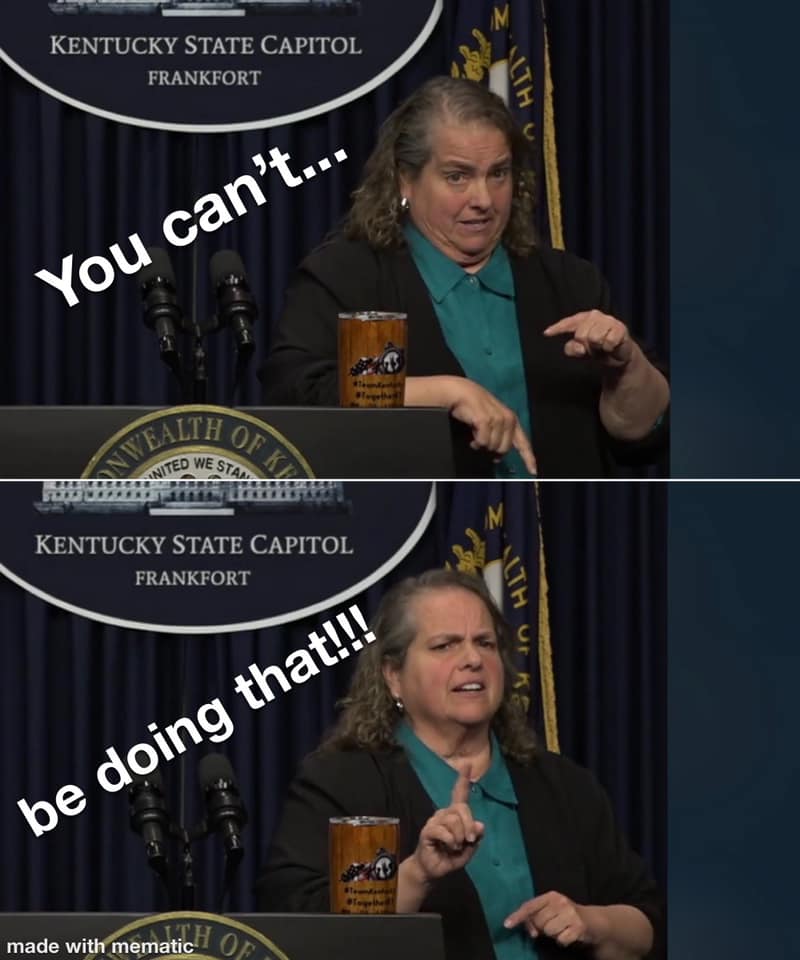
For many people in our area, Kentucky Governor Andy Beshear’s daily COVID-19 briefing became a staple of their daily routines. The briefings inspired virtual meet-ups, catchphrases like “you can’t be doin’ that” and even a meme group on Facebook that grew to more than 200,000 members. One aspect of the briefing — and the memes — that got a lot of attention is the sign language interpreter, Virginia Moore. However, most don’t know Moore is a Red Devil.

Moore grew up with both of her parents and two of her siblings being deaf. “My first language was sign language,” she says. However, leaving Jeff High she never thought her career would involve Sign Language, and after graduating in 1980 she attended Michigan State to study criminology.

Her plans changed when she came home from MSU after her father was involved in a car accident. She opted to complete her degree at Indiana University, and to pick up some extra cash she began interpreting for students. After going between different jobs, she would find her career path.

She became the interpreter for the Executive Director of the Kentucky Commission of the Deaf and Hard of Hearing. Over the years she worked her way through the agency, eventually becoming the Executive Director. The main operation of the agency is to provide advice to the governor’s office on policies affecting the deaf and hard of hearing communities.

However, it was only recently that Moore entered the spotlight as she began interpreting for the Governor at his COVID-19 briefings. 

virginia-meme
Jeffersonville High School graduate Virginia Moore gained meme-worthy fame as sign language interpreter for Kentucky Governor Andy Beshear.

While most of the attention she receives is for her interpretation, Moore and the agency continue to advocate for the deaf and hard of hearing during the pandemic, and it’s at times like these that their work is most important. 

Often, the needs of these communities are not factored in. For example, as the prison system was adapting to the pandemic they began issuing masks. However, many deaf and hard of hearing individuals rely on lip reading to understand others. So Moore and the agency advocated to provide clear masks.

While she has been busy, Moore has noticed the fame she has acquired, “It has been a little bit shocking,” she says. But Moore sees this publicity as more of an asset than anything else. “As COVID is a very horrible virus…there’s this little gold nugget. What we’ve been able to accomplish in the last three months is more than I’ve been able to accomplish in the twenty years prior,” she says.

Over the course of the pandemic, she says she has identified one thing more effective than any other: unity. Moore says, “In order to get something accomplished there is no Republican or Democrat… we can’t have these divisions at the beginning of something like this.”

But through it all she maintains an optimistic view, especially for students. Speaking to the Jeff High graduates and students she says.”This generation of graduates are truly the most creative… This is the one generation that everyone will remember.”

Governor Holcomb closes Indiana Schools for the Remainder of the 2019-2020 School Year

On April 2, 2020, Indiana Governor Eric Holcomb announced all schools in the state of Indiana will remain closed for the rest of the 2019-2020 school year. Schools are required to complete 160 total instructional days (20 more after April 2). 

Students attending any schools in Indiana are still heavily encouraged to follow the social distancing measures and complete their e-learning work when assigned. As of April 2, there have been 78 total Coronavirus deaths and over 3,000 confirmed cases of the virus in Indiana. The best way to fight the sickness, Holcomb stated is to continue to socially distance as much as you can, and to avoid going outside unless for necessary means. An announcement from Greater Clark County Schools is expected Friday, April 3.

Indiana Governor Eric Holcomb Announces The Closure of Indiana Schools Until May 1

Holcomb will also suspend all state testing for the school year

Updated March 19 at 3:52

At a press conference on Thursday, March 19, Indiana Governor Eric Holcomb announced that all Indiana schools will be closed until May 1, 2020. Holcomb also announced that state testing, including ISTEP10 and ILEARN will be cancelled.  These changes come as a result of the spread of COVID-19, also known as the coronavirus.

The governor also noted the possibility of not being ready to return by May 1, and said, “If, and I stress if, by some miracle, we get students back this year, we’ll use that time in class for instruction. So I’m cancelling Indiana’s student assessments for this school year.” 

After Holcomb, Indiana Superintendent of Public Instruction Jennifer McCormick expanded on some of his proposals. 

“School closure to May 1… this is the first step,” McCormick said, “There may be a need to come back and revisit that.” McCormick also noted that it is just state testing being cancelled and not other non-mandated testing.

 McCormick said, “Our goal is to graduate (high school) seniors.” However, she noted that decisions for certain ceremonies will be made on a local level. 

On March 19, Greater Clark County Schools announced their plans for the time off. Weeks will alternate between eLearning weeks and Closed Days. On the weeks that students are off, they may continue to work on submitting assignments from the eLearning week before, but no new work will be assigned.

According to the Indiana Department of Health, there are currently 56 reported cases of the coronavirus in Indiana as of March 19, 2020. 

Story by Greta Reel and Max Fisher

Straight From the Source: Jeffersonville High School principal Pam Hall Discusses the Coronavirus

On March 13, 2020 Greater Clark County Schools, lead by Superintendent Mark Laughner, announced GCCS’s plan in response to the global pandemic, COVID-19 (Coronavirus). 

The plan states Greater Clark County schools will have:

  • e-learning until Spring Break (March 16 – 20)
  • regularly scheduled Spring Break (March 23 – 27)
  • no school (March 30 – April 3)

GCCS will also not have to make up the week without school following Spring Break. Indiana Governor Eric Holcomb has waived 20 days for all Indiana schools. This means the 5 days used  by GCCS the week of March 30 will be excused. 

Looking forward GCCS will make a decision for the week of April 6 – 10 by April 2. 

While the decision to close was made at the district level, Jeffersonville High School principal Pam Hall says her staff was already doing what they could to keep students safe. “Our custodial staff have been consistently using chemicals that would kill the virus,” Hall says,  “We’ve made a very calculated and very rigid routine of cleaning in between passing times…Making sure that those very common areas are being wiped down consistently.” She also noted that that the custodial staff will do a “top-to-bottom” clean of the school during the break. 

Jeffersonville High School Principal Pam Hall says the E-learning days should be like those done before at Jeff High, “It should just be very short assignments, no more than 15- 20 minutes.” Hall also noted that teachers like usual will be available to help during the course of the day. 

While district and other administrators have only made a decision for the next three weeks, many Jeff High students have expressed their concerns for future events. Whether it’s prom, graduation, or spring sports. Students are wondering what will happen following the three weeks. 

Hall says the administration hasn’t made any official plans that far forward, but she hopes to be able to deliver these experiences for her students. “I think that there are certain things that a student at any high school looks forward to,” says Hall, “We know that graduation and prom are two really big things…  and it is certainly something that we want to make sure happens for our kids. So they have that full high school experience.” Despite this, Hall says there are no concrete plans in place at the moment. For sports, Hall believes a lot of the decisions will be influenced by the IHSAA (Indiana High School Athletic Association.) But Hall, a former athlete and former coach herself, hopes for the best after the three weeks. 

When asked about the reaction to COVID-19 Hall doesn’t think the plan by GCCS is an overreaction. She says when looking at all the angles, “This makes sense.”

And Then There Were Three

Former Vice President Joe Biden takes the lead in the 2020 Democratic Primaries, while multiple candidates drop out of the presidential race.

Former Vice President Joe Biden has appeared to take the lead in the 2020 Democratic primaries following his surge on what is known as Super Tuesday. 

On Tuesday, March 3, 14 states (Alabama, Arkansas, California, Colorado, Maine, Massachusetts, Minnesota, North Carolina, Oklahoma, Tennessee, Texas, Utah, Vermont and Virginia) and one United States territory (American Samoa) held primaries and caucuses for the Democratic candidate in the 2020 presidential race. 

Biden surged, winning Alabama, Arkansas, Massachusetts, Maine,  Minnesota, North Carolina, Oklahoma, Tennessee, Texas and Virginia. Meanwhile, Sen. Bernie Sanders (I-Vt.) won Colorado, Utah and his home state of Vermont. Former New York City mayor Michael Bloomberg won American Samoa. Rep. Tulsi Gabbard (D-Hawaii) held one delegate.

According to The Washington Post, in order to win the Democratic nomination, a candidate needs 1,991 delegates. Each state has a certain number of delegates based on the population and the weight in the Democratic party. Based on the number of votes they receive, the candidate wins the delegates. 

Bloomberg dropped out on Wednesday, March 4. After failing to win any states, Sen. Elizabeth Warren (D-Mass.) dropped out of the race on Thurs., March 5.  Gabbard still remains in the race.

On Tuesday, March 10, primaries were held in Idaho, Michigan, Mississippi, Missouri, North Dakota and Washington.  According to The Washington Post, Biden took the lead in Idaho, Michigan, Mississippi and Missouri, while Sanders took the lead in North Dakota. Washington has yet to be called.

Biden has received endorsements from former candidates Pete Buttegieg, the former mayor of South Bend, Ind., Sen. Amy Klobuchar (D-Minn.), Bloomberg and as of March 9, Sen. Cory Booker (D-N.J.) and Sen. Kamala Harris (D-Calif.). It is currently unclear who Warren will endorse.

The presidential election between current President Donald Trump and the Democrat nominee will be on Nov. 3, 2020.

Story by Greta Reel

Coronavirus Spread Sparks Fears Worldwide

The coronavirus is becoming a worldwide pandemic and it is spreading fast. According to ABC News, the virus has already reached many as twenty-seven countries around the world such as China, Britain, Finland, France, Italy, and Australia. According to the New York Times, the coronavirus is a respiratory illness that began infecting people in Wuhan, China, and then spread across the world. According to the New York Times, the coronavirus started when people in Wuhan, China began eating certain types of poultry, seafood, and wild animals. Certain types of these foods have been known to carry viruses and diseases.

This is how people first started getting infected by the coronavirus in China. The other way the coronavirus has been affecting people in China is that it is forcing them to close transportation, schools, and major festivals. Not much is known about the coronavirus right now. Not even doctors or scientists know how easily the virus can be transmitted or how it can kill you. Doctors just know the virus is in your system for a long time before you start to show symptoms. The symptoms of the coronavirus are fever, severe cough, and difficulty breathing.

According to the Washington Post, the coronavirus has killed more than 1,000 people and has made over 28,000 people sick – with the number rising every day. The way people in China are trying to reduce the risk of getting the virus is by wearing masks that filter the air coming in. The coronavirus is such a problem that the Chinese government is rushing to build a hospital in ten days to care for the number of patients they are about to have. Meanwhile, those heading back to the United States from China have faced quarantine. As the virus spreads, fears about it affecting large numbers of Americans vary.

Rachel Lowe, a Jeffersonville High School sophomore, says, “I don’t think we need to worry about it being a major problem in the USA. Though many people have died and it is affecting a lot of people, I do not see a reason to freak out and think that I am going to get it. But I do think we need to learn how to minimize it.”

Hannah Taylor, a Jeffersonville High School sophomore, says, “It is a very scary and traumatizing incident because of the other flu and viruses going around scaring the nation.” Governments around the world such as Britain are sending scientists and doctors to China to help contain the virus and stop it. Scientists around the world are testing out different medicines on animals to see how the medicine responds to animals and the virus before they test it on humans. The drug doctors are using is called Remdesivir.

This antiviral medication has appeared so far to be effective against coronavirus in animals. The advances in technology and medicine are going to make it possible to stop the coronavirus faster. The world doesn’t know that much about the coronavirus yet, but doctors and governments are working together to solve this new virus as soon as possible.

Presidential Primary Season in Full Swing

The Democratic Primary season has begun with the first two states (Iowa and New Hampshire) in the book and “Super Tuesday” states tallying votes. The Primary process will finish in Milwaukee on July 13-16, where Democrats will nominate their opponent to battle incumbent President Donald Trump in the general election. (As of right now, the Republican Primary is almost a lock for Donald Trump. The President has high numbers within his own party, and it should be an easy primary season for the incumbent.)

To win the nomination a candidate must amass 1,991 delegates by the end of the process. While early, if there continues to be no clear consensus candidate, this opens the possibility to a contested convention. In this case, if no candidate is elected in the first round of ballots, delegates will be free to choose whoever they please as the nominee. With many contests to go, only time will tell.

Joe Biden

Age: 77 Education: University of Delaware, Syracuse University Law School Former Offices Held: New Castle County Councilman (1970 – 1972), Senator from Delaware (1973 – 2009), 47th Vice President of the United States (2009 – 2016)

Strengths: • high name recognition • reputation from working with Obama, who is extremely popular in the Democratic Party •  black voters will help him in the south Weaknesses: • poor debate performances • prone to political gaffes and blunders

Bernie Sanders 

Age: 78 Education: Brooklyn College, University of Chicago Former Offices Held: Mayor of Burlington, Vermont (1981 -1989), Vermont Representative (1990 – 2006), Senator of Vermont (2006 – current) 

Strengths: • solid base of support from the 2016 campaign • huge amounts of grassroots fundraising • extremely well with young voters 

Weaknesses: • recently suffered from a heart attack • little support from within the Democratic party

Elizabeth Warren 

Age: 70 Education: University of Houston, Rutgers University, George Washington University Former Offices Held: Chief Advisor of the National Bankruptcy Review Commission (1995 – 2005), Chairman of the Congressional Oversight Panel (2008 – 2010), Special Advisor to the Secretary of the Treasury on the Consumer Financial Protection Bureau (2010 – 2011), Senator from Massachusetts (2012 – current) 

Strengths: • regarded as one of the smartest candidates in the Democratic race • experience and policy statements have gained her the catch-phrase “I have a plan for that” • hopes to be a more palatable progressive choice to party moderates. 

Weaknesses: • multiple controversies over her over exaggeration of her Native American roots • potential to be everyone’s second choice 

Pete Buttigieg

 Age: 38 Education: Harvard University, University of Oxford Former Offices Held: Mayor of South Bend (2012 – 2020) 

Strengths: • seen as fresh and new in the political world. 

Weaknesses: • little experience and low name recognition • poor numbers within the black community

Amy Klobuchar

 Age: 59 Education: Yale, University of Chicago Former Offices Held: Hennepin County Attorney (1999-2006), U.S. Senator from Minnesota (2006 – present) 

Strengths: • from the Midwest, a key battleground area in presidential elections • well-spoken and has a prosecutor’s quick wit 

Weaknesses: • lower name recognition than other top-tier candidates • rumors of poor treatment of staffers early in the campaign, which Klobuchar has denied

Others Three other major candidates are running on the Democratic side. Michael Bloomberg (10.0%), Tom Steyer (1.6%) and Tulsi Gabbard (1.4%) are all still in the race. While these candidates have yet to earn any delegates, the primary season is long and prone to upsets and meteoric rises to the top. *Polling Averages According to Real Clear politics 

Safety vs. Reason

On the morning of Thursday, February 5, you hear the sighs of many students as Pam Hall, Jeff High’s interim principal, announces that starting Monday, February 10, backpacks and “large” purses will not be permitted in classrooms.

The rule has always been in effect for backpacks, yet not all teachers enforced it. Now, there has been an addition to the rule: Large purses will not be permitted either.  According to Ms. Hall, a “large purse” is defined as something that can hold a Chromebook or an iPad, but the size of iPad was not specified.

Many students voiced their complaints with the reinforcement of the rule. Some have taken to social media and made public complaints about the rules. According to sophomore Victoria Jade Worrall, “The [enforcement of these] rules on bags make my space more cluttered, and it makes it easier for me to lose assignments or entire folders.” When asked if the rules made her feel safer, she states, “Not really… If someone wanted to commit a crime, they would do whatever they needed to do to go through with it. You could fit a weapon practically anywhere.”

Sophomore Brooklyn Parish says she hears many students complain about the rules. “I hear how a lot of kids fall down the stairs from having their school stuff in their arms.” She goes on to say, “I can see why the school added this rule. It’s to keep us safe. If the school is worrying about someone wanting to hurt people, then they should listen to their students.”

When students are passionate about something, they typically don’t let go of the issue. In the next few days or weeks, students will still be voicing their complaints. All students can do is hope for a change or silence their complaints and deal with it.