Photos by Gabriella Kraft and Isaiah Stewart.
Photos by Gabriella Kraft and Isaiah Stewart.
Photos by Shelby Keesee.
by Noah Keserovic
| Birthday: May 6, 1999 Hometown: Corydon, Indiana Favorite sport: Softball Favorite food: Pasta Favorite movie: “Iron Man“ Favorite music genre: Pop music Hobbies: Reading, arts and crafts Time spent teaching: Two years. |
Biology and PLTW Human Body Systems teacher Karson Cecil sits at her desk, checking emails and grading assignments as the students in her seventh period Human Body Systems class work, constructing an origami diagram of a bone. A Louisville Police badge sits on her desk in a case.

One may walk past Cecil’s classroom without a second thought, just thinking that she is any ordinary science teacher; however, that isn’t the case here.
At a first glance, no one would know that she once worked as a crime scene technician for the Louisville Police.
“My experience as a crime scene technician was fantastic; it was a fulfilling job and it was always something new each day. I left that position due to the schedule being too chaotic,” Cecil said.
However, one may wonder why she would take up such a job, with so much danger and unpredictability.
“I just applied and showed up. But the biggest influence is ‘Criminal Minds’, the show,” Cecil stated.
After quitting her job as a crime scene technician she took her career in a completely different direction.
“I chose science because my degree is in science, and it’s my favorite subject,” she answered.
Despite the troubles and annoyances of being a teacher, she has still decided to stick with this career as a science teacher.
“I like getting to help students find something that’s interesting to them and discover that science can be pretty fun.”
Cecil had to take various different classes in high school and then college in order to be able to pursue her career in teaching, biology, and human anatomy.
“In high school I took Advanced Science classes and then in college I took a lot of biology and chemistry classes. I also took an education class, not with interest in teaching, just to fill a space, but then I went to grad school and took anatomy classes,” Cecil said.
Cecil is still a new teacher, at least compared to others, having chosen to teach at JHS for a simple reason.
“Yeah, because it’s close to my home and they were looking to hire a science teacher,” Cecil stated.
Her students have had many positive impacts on her life.
“My students impact my life by brightening my day and they always keep me learning too, they teach me new things which are important. They teach me slang, and I’ve learned some TikTok dances,” she said.
However, Cecil has also had impacts on the lives of her students as well.
“I say she’s taught me a lot and helped me learn a lot of information I need to know for my career,” said sophomore Haylee Schwarz, a student in Cecil’s PLTW Human Body Systems class.
Cecil has also been an inspiration for her students.
“She inspires me to be a better person because of the way she teaches,” stated sophomore Layla Dizdar, another PLTW Human Body Systems student.
Cecil thinks that science is a very important subject, especially in today’s world.
“Science explains the world and how it’s always changing. It is also important that people are able to keep up with new information,” she stated.
Some may find biology and human anatomy to be boring, so one may wonder how Cecil keeps her class fun and interesting.
“I try to incorporate different styles of learning and different games,” she said.
But, do her methods really work at all?
“I find it fun because I like learning the stuff but I find it interesting because of the people,” said Schwarz.
Cecil also has a way to motivate her students to work efficiently.
“Knowing we can have fun after our work is done is a big motivator for everyone,” said Dizdar.
Many people seem to have a positive opinion of Cecil as well.
“I think she’s a very funny and kind individual,” stated Dizdar.
Despite Cecil having a rather chaotic history, and teaching such an important and complicated subject, she has one, very simple goal in her life.
“My biggest goal in life is to have a small hobby farm with miniature cows.”
by Akiya Flynn
Principles of Biomedical Science and Biomedical Innovations instructor Charles Patton works hard to teach a wide range of scientific material in his classroom. Patton uses his genuine persona to engage his students.
“The way he teaches is understandable, and he goes into detail and makes things make sense,” said freshman Gem’maica Hunter-Lawrence.
No one would have guessed that Patton had prior work experience in science before teaching it.
“I worked in various healthcare systems in the Atlanta healthcare market for about 15 years, and four years prior to teaching, I was with a healthcare startup system called VillageMD,” said Patton.
Patton has been teaching for two years; he is currently in his third year.
“You kind of grow and learn and make changes in real time. Changes as needed,” he stated.
Patton keeps a healthy classroom environment and uses patience.
“I try to be as approachable and honest as possible.”
Patton actively works to build a relationship with each student. He uses the students’ work as a way to learn, understand, and even help them.
“There’s a lot of depending on how the day goes; there is no set schedule,” he stated. “Some days are more controlled than others.”
Patton conducts his classroom based on the behavior of the students in it. He prefers to work with the students rather than against them.
“He’s nice and seems like a genuine person,” according to freshman Elise McCormack.
“I love science. I think that science is something that brings us tons of experiments and some sort of truth at the end.”
Principles of Biomedical Science and Biomedical Innovations Teacher Charles Patton
Patton sees his students as more than just students; he sees them for far more than what they write down on a paper.
“I like that he is bubbly and lights up a room. He listens and tries to put his feet in your shoes,” said freshman Harmoni Staton.
Because Patton cares so deeply for his students, he intends to welcome them with the same warm, welcoming personality every day.
“Everyday is what you make it, and the positive feedback from the kids keeps me going,” he stated.
Seeing the impact he makes on the students during the duration of teaching keeps Patton eager and ready to come back and work. He has a deep love for science and hopes to share a little of that scientific truth with his students.
“I love science. I think that science is something that brings us tons of experiments and some sort of truth at the end.”
Photos by Isaiah Stewart and Parker McCloskey.



Photos by Malachi Conrad.

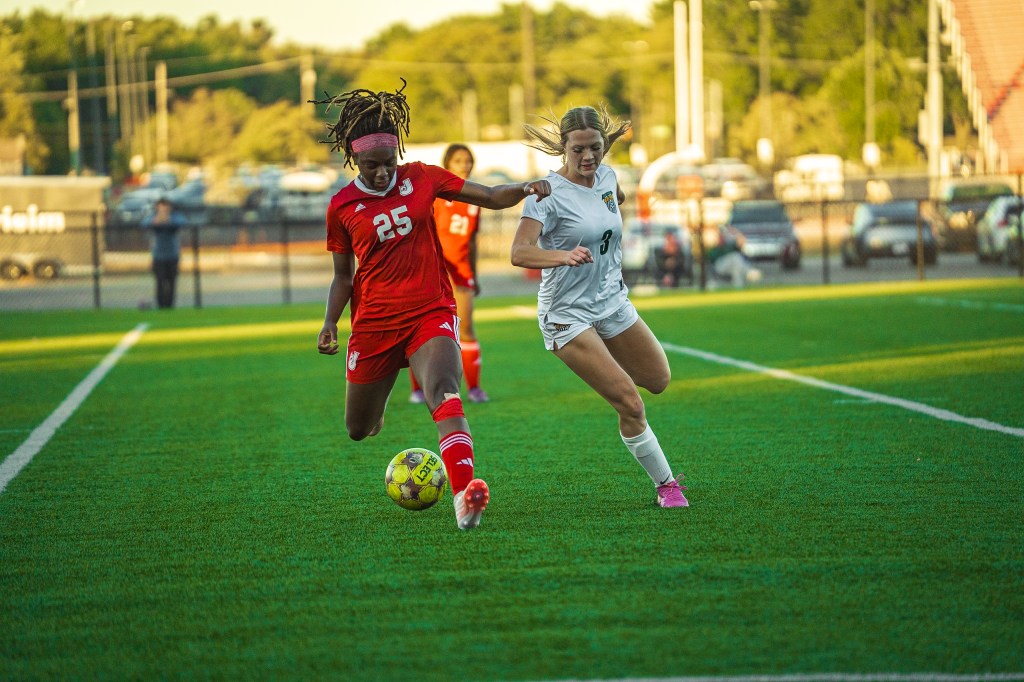
by Isaiah Gatton and Elijah Lahrman
The foundation of the cross country team was established as a strong program, but the team has had to adjust to recent coaching changes.
The team is now under the guidance of Coach Carlis Phillips, who has a background in sprinting and hurdles, bringing a new perspective to the program and enhancing it with the experience he has accumulated throughout the six years he has worked at Jeff High.
“I’ve been coaching for some time. I have been at Jeff for the last six years, working as the sprint coach for 4-5 years. I have a sprint background, hurdle background; I’m up for the challenge to try and build our little distance and cross country team to be as competitive as our sprinters,” he said.
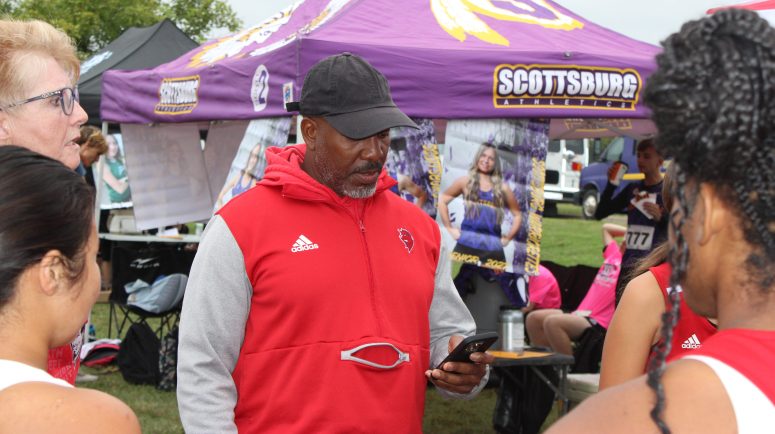
His goal for the rest of the season is to get the cross country team in a competitive mindset, having the hunger to push past limits and barriers.
Phillips has also introduced new expectations for the team, including recommending runners purchase watches to track their mileage and implementing mile warm-ups and cool-downs. He views the season as an educational journey as he continues to guide the team.
“It is an educational thing, what a high performing cross country team looks like,” he said. “Just recently I recommended that they should invest in a running watch. Tracking is a big part of running. There are some foundation pieces that I’m implementing as well. Giving them information and knowledge about what a successful cross country runner looks like. I’m going to coach everyone in here like a champion. I do want them to be challenged, feel the tug and pull of what a successful runner looks like.”
With the change in coaching has come a change in training. Compared to previous seasons, runners have noticed more intervals, sprinting, and strength-focused workouts.
“We do a lot more intervals instead of just long-distance runs,” sophomore varsity runner Micah Nef said. “A lot of it is just focusing on speed work instead of distance.”
For some runners, the new training has been challenging but has provided an opportunity to develop different skills. Senior varsity runner Nathan Scovanner said he likes the balance between speed and endurance.
“I like that part, because we do need to build up some speed,” Scovanner said. “If we mix in both speed and endurance, we’ll become better runners overall, because we’ll have that speed and still be able to keep our speed going through our races.”
Junior Marcus Baker has also started to enjoy the new sprint-focused workouts. Having previously run sprints in middle school, Baker said the new practices have brought back something he enjoyed.
“I feel like every day when we’re on that track, he pushes us,” Baker said. “It feels good running sprints.”
However, not every runner has found the transition easy. Some athletes said they preferred aspects of former Coach Sam Mull’s approach, particularly his emphasis on endurance and the mental side of running. They are adjusting, though.
“I think it’s weird having a different coach, but it’s good to learn different things from multiple people,” Nef said.
Nef said her times felt faster when the team focused more on endurance training, although she acknowledged the new training has been more challenging.
Senior runner Lizeth Gonzalez said she sees value in both coaching styles.
“I like both of them,” Gonzalez said. “Whenever you do compete in a 5k, you do need the strength to push yourself. But at the same time, when you do long mileage, the three miles start becoming easier in a way.”
For Gonzalez, one of the biggest differences between Mull and Phillips is how they approach athletes mentally.
“Coach Mull taught us in more of a mental type of way, but also physical, and Coach Phillips is more of a physical type of coach,” Gonzalez said.
She said she would like to see the strengths of both coaches combined.
“I would enjoy having, of course, Coach Mull back, and have both of them as coaches,” Gonzalez said. “I know both of them could allow us to become better athletes because they both can focus on our weaknesses and strengths.”
The coaching change has also affected some of the traditions and activities that helped bring the team together. Nef said Mull was known for organizing additional activities that were not necessarily required but helped create connections among teammates.
“He was really good at getting things done and doing extra things that weren’t necessary,” Nef said, referring to activities such as a 24-hour relay that has been recently canceled.
Despite the changes, Nef said the team has remained close, with the team captain helping maintain that connection.
“We still have a good team captain, so we’re still close,” Nef said.
Other runners are looking toward what Phillips’s experience could bring to the program. Phillips’ background in track has given him experience working with athletes who specialize in speed, something that some runners believe could help the cross-country team develop.
“I do think so,” Scovanner said when asked if Phillips’s reputation would help the program. “I think it will bring some more people to the team, possibly. He also does have some experience, but cross country is a new thing to him, I’m sure that’s not going to affect him.”
Gonzalez also believes Phillips’s experience could bring more recognition to the program.
“I believe we are going to get more support,” Gonzalez said. “I feel like Coach Phillips has a good history with training athletes, sending them to state, and being able to train them. And I believe it will allow us to get a little bit more recognition as a team.”
For Scovanner, the transition has been a process. As a senior running cross-country for his second year, he said he initially had concerns about what the coaching change would mean for the team.
“At first, I was a little skeptical,” Scovanner said. “I didn’t know how everything was going to play out. I had a lot of doubts in my mind.”
As the season has progressed, however, Scovanner said he has become more comfortable with Phillips’s approach.
“I had faith, and so far, everything’s turned out really well,” Scovanner said. “I really like everything that’s been going on.”
While athletes have different opinions about the new direction, the team is continuing to adjust as the season progresses. Phillips’s emphasis on speed, strength, and competitiveness has created a different training environment, while runners continue to carry lessons from previous seasons.
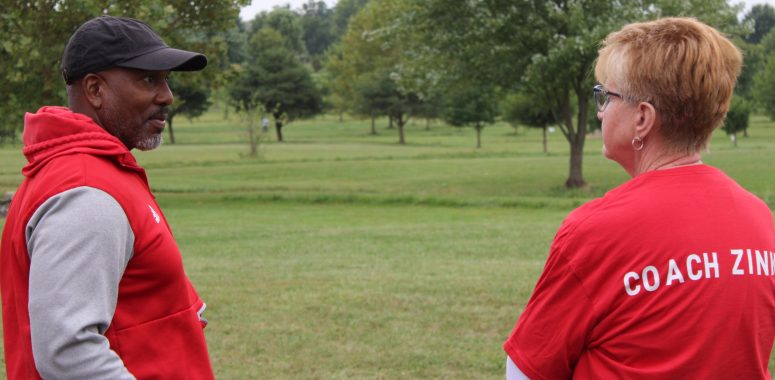
by Lorelei Bingham
As Friday morning begins, students gather before school, ready to start their day off with breakfast, games, and conversations about their faith.
For members of the Fellowship of Christian Athletes (FCA), these Friday mornings are more than just a way to start the school day. They are an opportunity to connect with their peers and grow closer to God.
“FCA means quite a lot to me. It’s a time for me to connect with my peers, play games, eat breakfast, but it is also so much more. I’m able to grow closer to God even at school, and I look forward to every Friday morning for this exact reason,” stated senior Macyn Jackson.
Through games and discussions, FCA gives students opportunities to grow both as athletes and in their faith.
Main sponsor Pamela McCoy shared, “FCA is about athletes being able to come together to practice teamwork and commitment. Being able to have a space to gather together, pray, and learn about Jesus is important. We meet as a group for FCA, but the hope is that it will go out to the teams. FCA’s goal is to see the world transformed by Jesus Christ through the influence of coaches and athletes.”
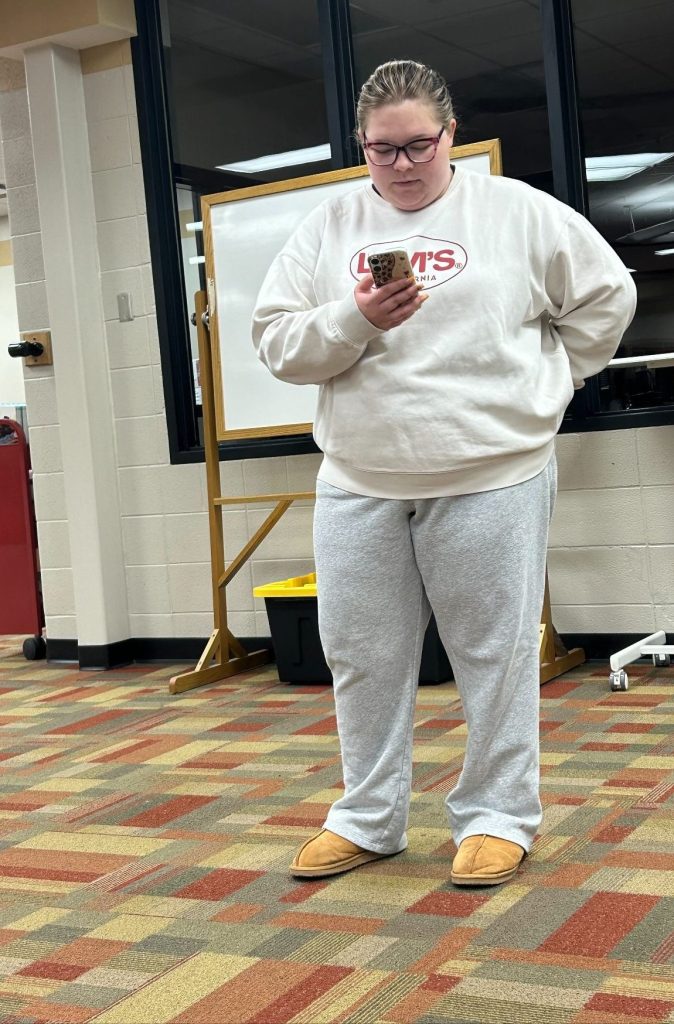
Although FCA centers around sports and faith, every student has a different reason for being involved.
Freshman Eli Smith said that joining FCA has helped strengthen his relationship with God while helping him become a better person.
Jackson shares a similar reason for joining FCA. “I joined FCA because this is a community of people I can always have for support, and I’m there to support them too. I also knew joining would help me grow to be a better person all around.”
Student leaders play a big role in FCA. They grow in their faith while helping others grow theirs.
“Being a student leader is challenging, but I love it,” said junior Clara Theriault. “I go through my Bible, make devotionals, and questions from scratch, so it really tests my knowledge, but I get to share that with my fellow peers who may not know what I’m talking about. That part makes it all extremely rewarding.”
The student leaders contribute to making FCA meaningful for its members.
“My favorite part of FCA is getting to hear our high school leaders talk about my religion and what it means to be Christian. It’s so meaningful to hear people my age or younger speak about the Bible and the connections we can make to our high school life. It shows me that even at school, I can be living through Christ,” Jackson shared.
Members also encourage their peers to attend, saying they can experience the community and learn about their faith.
McCoy explained, “At FCA we want to try and invite others to come to know more about Jesus and to form a community of peers that can join together and share their faith with each other.”
For some members, Friday mornings have become a meaningful part of their week.
Theriault said, “My favorite part about FCA is being able to devote every Friday morning to God and spreading the gospel.”
FCA allows students to strengthen their own faith while encouraging them to share it with others.
McCoy hopes that message continues beyond the Friday morning meetings.
“I hope that they come away knowing that Jesus loves them and that they can take that and share it with other students,” shared McCoy. “I also hope that they invite others so they can know more about Jesus as well.”
by Erin Osterhout
Dr. Bonnia Fouts roams around the classroom, watching as her students work on their volcano project and rushing to anyone in need.
Most people would assume that Fouts is merely a normal science teacher if they did not know her story.
However, this is never the full story.
Few would look at Fouts and assume that she had two degrees.
“I had part-time jobs, but most of them involved teaching. My first job was a P.E teacher. I have two degrees — one is in physical education and health, and the other one was speech and drama,” she said.
Fouts dreamed of being a teacher as a young girl.
“I wanted to be a teacher ever since I was 8 years old. I actually started teaching my neighbors and helped them with their homework, and I loved it.”
Fouts then admitted that she had originally retired but came back after some time.
“Well, I actually retired in 2012 but I came back and this is now my 41st year of teaching. I got the ExCel award for best teacher of the year in Greater Clark County like Mr.Santry did. In 2005 I was the runner-up when I competed for best teacher of the year,” stated Fouts. “I got a bunch of neat stuff.”
Fouts loves working with students in the classroom and motivating them.
“I try to build a relationship with them and get to know them because you can’t motivate them if you don’t know them much,” she explained. “I will do anything for a student.”
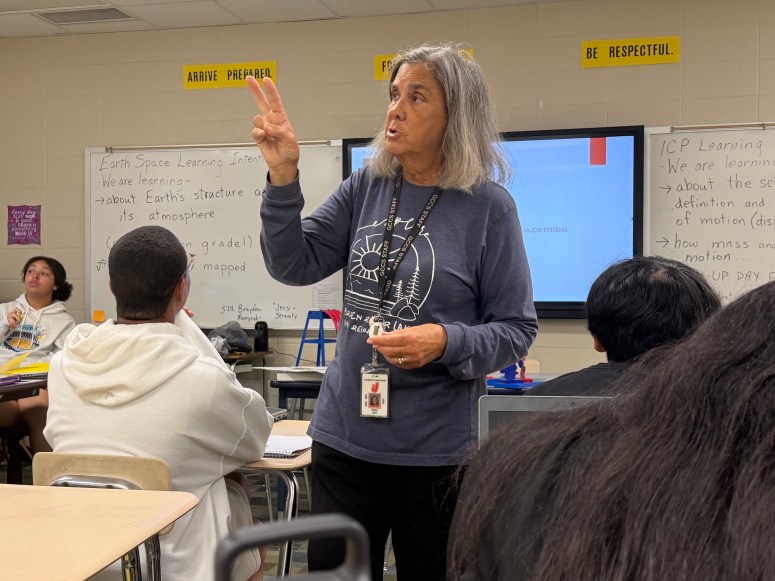
Sign language interpreter Angela Liebert said Fouts makes her lessons fun and interactive.
“Mrs. Fouts is very hands on with her lessons; she makes them come alive out of the book. The textbook is the resource, but the way she teaches allows the concepts and things the students learn about come alive. She cares about the students and she cares about her job and profession. She really takes it to heart.”
Liebert said Fouts’s personality mixes into her lessons and interactions with colleagues.
“Mrs. Fouts is a very compassionate person. She is my friend. I can honestly say that Mrs. Fouts is my coworker and friend. We shared a lunch together. She’s always checking on you, and she is an example of a true true friend.”
Senior Breayden Eugene Duncan also described Fouts as as someone who genuinely cares about her students in the classroom. She has been helping him succeed for two years.
“Last year I learned ICP I was in there specifically for physics, and this year I’m learning earth/space. She always kept me focused in class and basically kept me concentrated and focused on work,” Duncan explained. “Honestly (she is) great at explaining and doing notes and stuff like that. Does easy assignments and overall is really nice and has helped me all last year and this year.”
Fouts’s ultimate goal is to help her students succeed. As she said, “I am an advocate for my students.”
by Anicko Griffin
Counselor Shelby McCorkle greets her students with a smile, answering questions they and others may have for that day.
“Hey girl! How can I help?”
McCorkle carries herself like any other person at Jeff High. Most people would never notice the hundreds of students’ pain, dilemmas, and anger she carries with her every day.
Although it seems difficult, McCorkle completes her job with a positive demeanor.
Some may see McCorkle as just another staff member. It’s invisible to the blind eye that she has been a school counselor for just over 14 years, finding her job the most enjoyable and important thing to her after her two kids.
“I love working with kids. It’s never boring, and you all bring something new to the table every day. Are there things I would change about it? Yes, but I wouldn’t trade it for the world,” stated McCorkle.
McCorkle plans on being a JHS counselor until retirement.
“I genuinely want to help every student who comes through my door and help change their life for the better.”
McCorkle’s father was in education as well. She also took the counselor career path.
“Now more than ever, a lot is going on with family, school, and teachers, and it’s important for everyone to have their safe space,” said McCorkle.
Her students appreciate her dedication.
“She always makes my day better,” said junior Brooklynn Weston. ”No matter what the topic is, she always knows what to say.”
McCorkle is always trying to gain students’ trust and give them a safe space. She genuinely values her job, and helping students with their next big step is a priority to her.
“I love helping students figure out what path they want to take when they get out of high school. The person they are changes so much between 14 and 17, and I love being able to be there every step of the way.”

by Nehri Lewis
Science teacher Francesca Hernandez works to make biology meaningful and fun for her students by connecting what they learn in her classroom to the outside world.
“I think science is important, and if I can help others to understand the world around them more, then that’s a win in my book,” said Hernandez.
Her interest in biology started when she was in high school and had a teacher who made learning fun for her.
“I loved biology in high school. I had a fun teacher who took us on a bunch of field trips, and I wanted to be just like her. Shout out Ms. Lyvers,” said Hernandez.
Because of her own experiences as a student, Hernandez believes students should be able to learn science in ways they can remember.
“I’m a hands-on person. If I hear something, I forget it; I try to make sure my lessons have some level of hands-on work so that it sticks in their brains.”
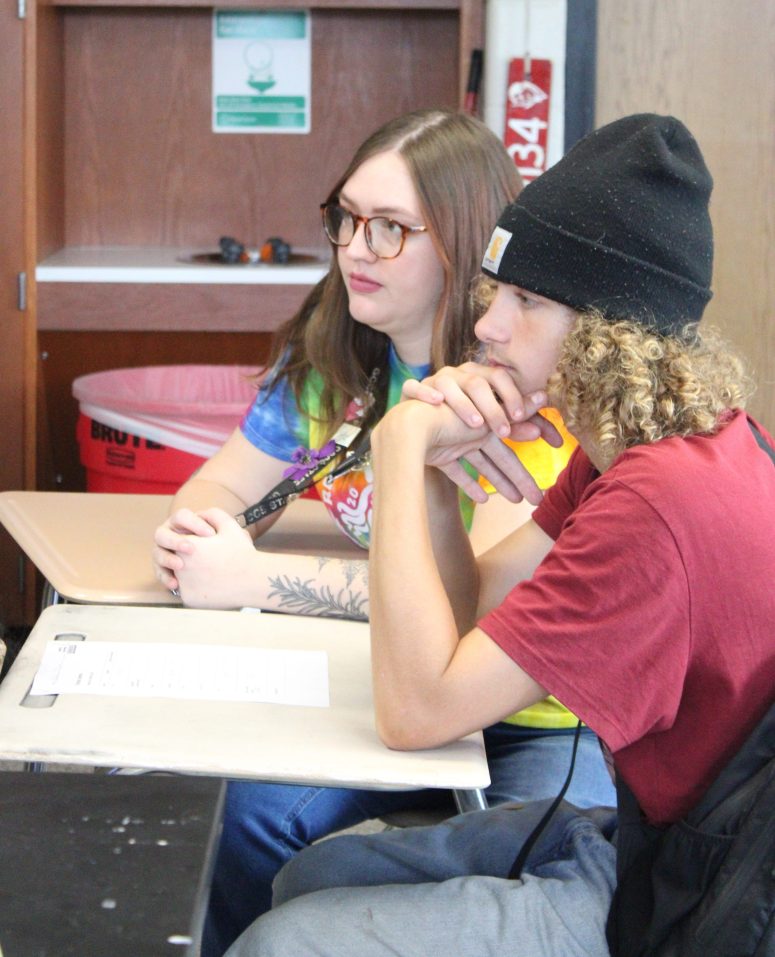
Her teaching also focuses on helping students understand the environment around them and their responsibility toward it.
“The hardest part is getting students to understand that everything is relative; every action we make influences our world in some way. It’s up to us to choose how we handle that responsibility.”
Her students learn this sense of responsibility during her lessons
“She makes biology interesting by applying some of the real-world experiences to the science she teaches,” said freshman Akiya Flynn. “She breaks down the topic and puts it into more understandable terms for her students.”
“I describe her teaching as she shows everything on her board and helps us understand things we need more help with by shortening it into easier forms for us to understand,” said freshman Rhaya Nord.
Environmental science is especially important to Hernandez because she believes students can better appreciate the world when they understand it
“People can’t care for the world if they don’t understand it, and they can’t understand it if they don’t know it exists.”
Hernandez also enjoys having a new classroom this year where she has more room to teach through activities and labs.
“I love my new classroom. I have windows, and I also have more space to do more labs.”
Hernandez wants her students to see that biology is more than just a class they have to take at school.
“I want the readers to pay attention to their science classes because I promise it applies to them in some way.”
by Zihan Lin
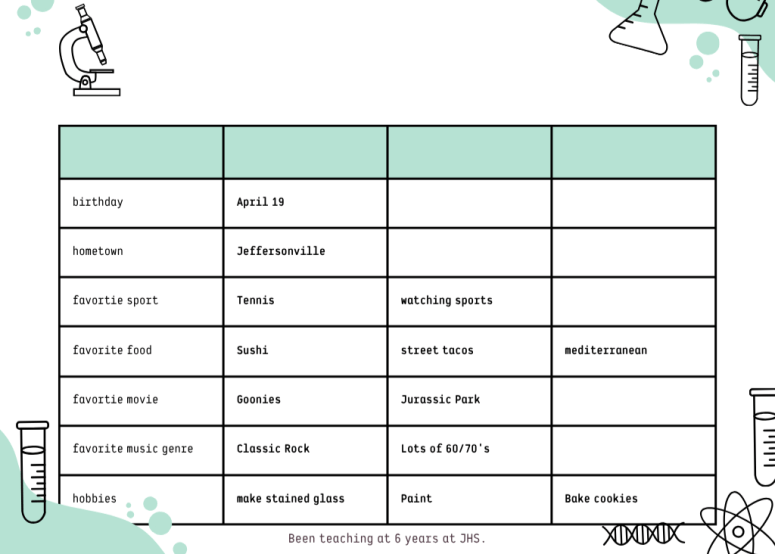
Chemistry teacher James Huffman walks behind his desk, capturing everyone’s attention with his voice. He flips through the slides on the board until he stops at a conversion equation; the students focus on him, waiting expectantly for him to demonstrate how to convert the units.
For Huffman, problems like these are more than just a chemistry lesson. He enjoys working through problems himself, but he also enjoys helping others find their way through difficult questions.
“Yeah! I like solving problems, and I like to help other people solve problems, specifically in chemistry but life in general,” Huffman said.
His approach to problem-solving is something his students notice in the classroom. Rather than just giving students an answer, he encourages them to understand how to arrive at it step by step.
“He taught us to remember formulas and learn how to do problems by putting them into steps,” junior Danna Lopez, a former student, stated.
Junior Rachel Santos also remarked that Huffman encourages students to approach difficult problems in different ways, especially when working with stoichiometry or other smaller subjects where they can’t seem to grasp the idea.
“He taught us to break down problems and try different methods, especially with stoichiometry,” Santos said.
Being a teacher isn’t what he always wanted; it wasn’t his first goal. Being an engineer was his first goal, but he wanted his life to revolve around helping people, no matter the problem.
“I would probably be an engineer. That was my first goal as a student, or I would be going the exact opposite, like I do now and be a social worker, like helping people with their problems, like life, versus solving problems as an engineer, which you know is much different.”
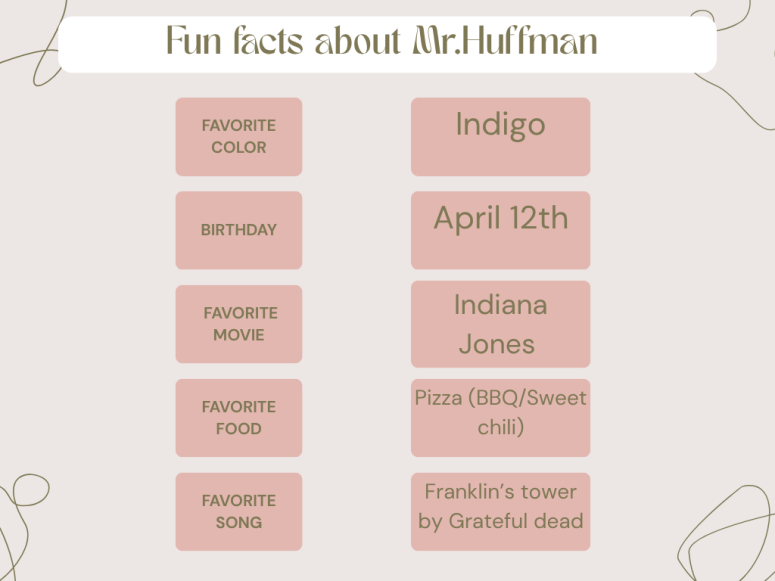
Although engineering was once Huffman’s goal, his interest in chemistry led him towards working with chemicals rather than engines. His experiences in his chemistry class, particularly the hands-on labs, helped him realize what he enjoyed most about the subject.
“Had an awesome teacher; I loved the labs. I loved being able to prove something with chemicals. I wasn’t as much—I don’t like to work on engines. I like to work with individual chemicals. I found that out from my chemistry teacher from high school,” he said.
His high school teacher not only helped shape his interest in chemistry, but also influenced the way he approaches teaching with his own students.
“I would say mostly due to the awesome teachers I had as a student. I had some really good teachers, and because of those good teachers. I want to do the same thing as they did.”
In Huffman’s classroom, every problem has a solution—and sometimes, the solution is simply to keep trying.
“Remember (Chem)(Is)(Try),” he said.

