Regarding family-style dining, Buca di Beppo is a name that often stands out. Known for its vibrant atmosphere and hearty Italian-American dishes, this restaurant promises a ballad of flavor nostalgia, and communal dining. But does it truly deliver on its reputation? I visited Buca de Beppo, and here’s what I discovered.
Buca di Beppo: A Taste of Italy with a Side of Nostalgia
Buca di Beppo is a restaurant that knows how to make an impression from the moment you walk through the door. With its warm, inviting ambiance and quirky décor that celebrates Italian-American culture, it’s the kind of place that feels like stepping into the home of a big, boisterous Italian family.
Ambiance
The décor is over-the-top, with walls covered in vintage photographs, posters, and eclectic knickknacks. Strings of lights and checkered tablecloths create a fun, nostalgic vibe. The layout features family-style dining rooms and even a “kitchen table” for those who want a behind-the-scenes experience. While the atmosphere is lively and vibrant, it may feel noisy for those seeking an intimate or quiet dinner.
Service
The service is friendly and accommodating, with staff members eager to explain the family-style menu concept. They are attentive without being overbearing, ensuring drinks are refilled and dishes arrive promptly.
Food
Buca di Beppo specializes in Italian-American classics, and their portions are designed for sharing. Here’s a breakdown of some highlights:
• Appetizers: The Fried Mozzarella and Bruschetta are crowd-pleasers. The mozzarella is perfectly crispy on the outside, gooey on the inside, and paired with a robust marinara sauce.
• Pasta Dishes: Their Spaghetti with Meatballs is a signature dish, and it doesn’t disappoint. The marinara sauce is tangy and fresh, while the meatballs are tender and flavorful. The Fettuccine Alfredo is creamy and indulgent, though it can be a bit heavy for some palates.
• Entrées: The Chicken Parmigiana is a standout, with its crispy breading and generous layer of melted cheese. The Eggplant Parmigiana is also a great vegetarian option, though it leans on the richer side.
• Desserts: The Tiramisu and Chocolate Chip Cannoli are decadent and satisfying, making for a perfect sweet ending.
Family-Style Concept
The family-style dining experience is both a strength and a potential drawback, depending on your party size and preferences. Large groups will love the communal feel, but smaller parties may find it challenging to justify ordering multiple large dishes.
Price
While the portions are large, the pricing can feel a bit steep, especially if you’re dining with a smaller group. However, for the quantity and quality, it’s a reasonable value for those looking to indulge.
Overall Experience
Buca di Beppo is a fantastic choice for celebrations, family gatherings, or casual dinners where you want to enjoy hearty Italian comfort food in a fun, lively setting. While the noise level and portion sizes may not suit every diner, the restaurant’s charm and bold flavors make it a memorable dining experience.
The girls’ team placed third overall at the swimming and diving Sectional last Saturday at Highland Hills Middle School.
Senior Maggie Nifong finished first in the 200 IM and the 100 Fly, three-peating in the 100 Fly. Diver Eva Ellis advanced to diving regionals based on a third-place finish.
Click on photo gallery bellow. Photos by Romier Hunter-Lawrence.
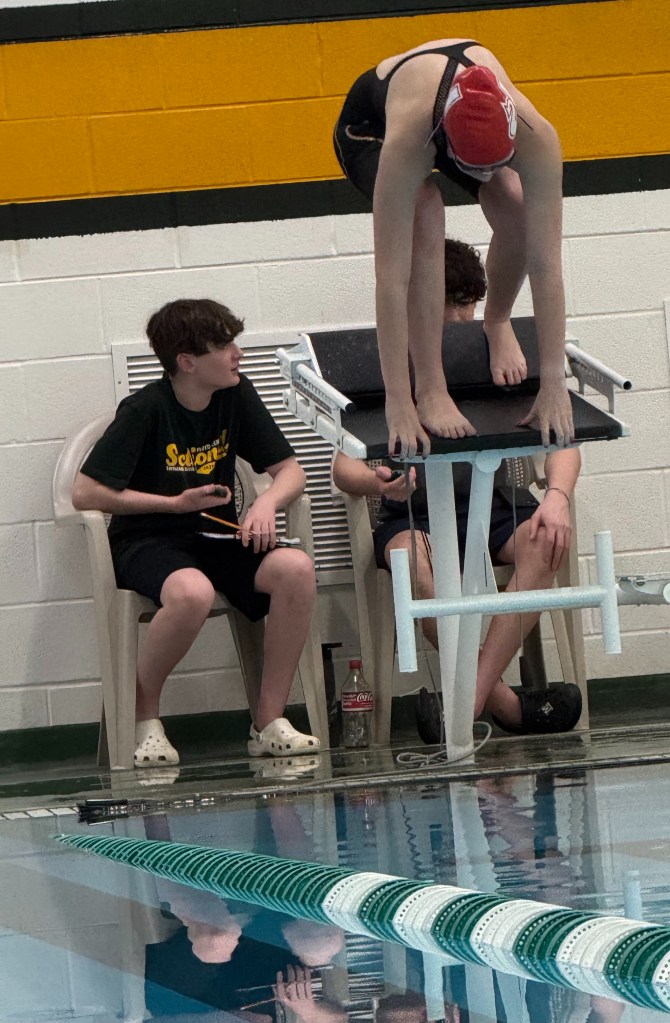
Senior Maggie Nifong hugs mother and father, Missy and Brad Nifong, as they hand her the award for winning the 200 IM at sectionals in 2:15.77. Photo by Romier Hunter-Lawrence. Senior Maggie Nifong stands on the award podium at Sectional after winning the 200 IM with a time of 2:15.77, a 3.83-second drop from prelims and beating second place by over 2.5 seconds. Photo by Romier Hunter-Lawrence. Seniors Maggie Nifong and Kaya Arnold stand on the podium for the 100 Fly. Nifong placed first with 59.79 seconds, dropping 2.37 seconds from prelims. Arnold placed fourth with a time of 1:03.58. Photo by Romier Hunter-Lawrence. Junior Litzy Rubio goes off the block for the 400 free relay as senior Kaya Arnold swims and hands the race over. Photo by Romier Hunter-Lawrence. Junior Lauren Peters gets ready to race in the 500 freestyle. Photo by Romier Hunter-Lawrence. Sophomore Stella Siewert does the backstroke start as she prepares to race for the 200 medley relay. Photo by Romier Hunter-Lawrence. Members of the boys’ and girls’ swimming and diving teams pose together at the end of Saturday’s girls’ Sectional at Highland Hills Middle School. The boys dressed as senior citizens to creatively support the girls’ team. The girls’ team placed third overall. Senior Maggie Nifong finished first in the 200 IM and the 100 Fly, three-peating in the 100 Fly. Diver Eva Ellis advanced to diving regionals based on a third-place finish.
Senior guard Shawn Boyd and senior forward Raijon Baird sport commemorative jerseys during an interview to honor the legacy of Taylor High School on Friday, Feb. 7. JHS will honor Taylor High School at the Jennings County game at 7:30 p.m. on Saturday, Feb. 15. The game and ceremony will cap off a busy week for the Red Devils, who face rival New Albany at Johnson Arena this Tuesday, Feb. 11. Photo by Trista Denny.
The JHS boys’ basketball team has been racking up wins against strong competition, but after this weekend’s 63-46 win against Mishawaka Marian, they still have their biggest game of the year against local rival New Albany this Tuesday.
“This is one of the toughest games we play all year psychologically, especially due to the rivalry. Two big things are your ability to focus on getting done what you need to get done from a preparation standpoint and you have to understand the magnitude of this game with it being one of the biggest rivalry games in the state. If we can do those things we will find success in the game,” said head coach Sherron Wilkerson.
New Albany comes into this game 14-2 and 4-0 in the Hoosier Hills Conference with five straight wins. Jeff enters the game 12-5 and 4-0 in the conference with six straight wins. Tuesday’s game is for sole possession of first-place in the HHC.
“This game is important because they’re cross-town rivals. They are a really good team. This is also for the best record in the conference,” said guard Cornelius Weobong.
The coaching staff knows this game is going to be competitive. They are going to have to leave their best on the court to be able to win.
“We are hoping to be able to guard the basketball and rebound it at a very high level. I think if we take care of the basketball and have good shot selection we could have a very good chance to win,” said Wilkerson
The players also know this is a big game and they know what they need to do in order to secure a victory.
“If we guard them and force them to take shots they don’t want to take, we can win,” said starting center and senior Tre Singleton
The Red Devils have won five straight games, but coaches are trying not to let that affect their style of play.
“Our winning streak affects the way our players play, but we try to combat that by telling the guys we are more concerned with the process than the results for us, we have 23 games and we focus on winning 92 quarters,” said Wilkerson.
Senior Michael Cooper is recognized for his 1000-point career achievement with coach Sherron Wilkerson at the Floyd Central game. JHS won 92-54. The Red Devils (12-5) play rival New Albany (13-2) next Tuesday, Feb. 11 at 7:30 p.m., followed by Jennings County (8-8) on Saturday, Feb. 15. Photo by Madison Pritchard.
The rivalry is one of the biggest aspects in this game, but Coach Wilkerson doesn’t want it to change the way the team normally plays.
“Our goals are always the same – guard you, rebound you, take care of the basketball, and take good shots. It doesn’t matter who the team is, we will always do these things,” said Wilkerson
JHS has had this game marked on their calendars since the schedule came out and has been preparing since summer for it.
“We have done a lot of scout work. We know how they play very well and we know how to stop them,” said Singleton.
The fans have also been anticipating this game since the season began.
“This is going to be a good game I think. Jeff has played good these past few games. They have been shooting well,” said freshman fan Carter Glotzback.
The Red Devils take on The Bulldogs Tuesday at 7:30 p.m. in Johnson Arena. The coaches and players feel the advantage of a home game in a pivotal matchup like this.
“I think playing at home, being in your own gym, and being with your own fans is a huge advantage. From an emotional standpoint, it’s a home-court advantage. We have our own sixth man in the crowd,” said Wilkerson.
Senior Tre Singleton drives against Providence defenders during the JHS-Providence game on Jan. 18. The Red Devils beat the Pioneers 41-29. JHS will face New Albany and Jennings County next week. Photo by Sophia Goforth.
The 2024 Game of the Year Awards was a tough contest. Three of the best games I’ve played in a long time were nominated for the prestigious title, but one stood above the rest: Metaphor: ReFantazio.
Although it didn’t win Game Of The Year 2024, Metaphor: ReFantazio won multiple awards at The Game Awards 2024, including Best Narrative, Best RPG, and Best Art Direction. It is critically acclaimed for its beautiful art style and story.
The king’s assassination is causing anxiety in the kingdom because he is assumed to have no heir. Unbeknownst to the public, the prince was put under a curse many years ago. He is alive, but he has been unconscious since the curse was cast. A good friend of the prince, Will, and his closest confidant, Gallica, are tasked with finding a way to reverse the curse and return the prince to the throne. At the royal funeral, the late king’s magic manifests as a stone island large enough to block out the sun bearing his face. He announces that the people will decide on the next king. Will decides to win the throne in the prince’s place.
Characters and their arcs are handled beautifully by this game’s narrative. The world feels expansive, and it’s easy to get invested in the problems facing this world.
It won Best Art Direction at The Game Awards 2024, and it earned that title. The menus take on a painted style. The art and character designs are visually stunning. The mix of 3D and 2D makes the visuals compelling throughout the entire experience.
The cast is easily one of the most likable. The party includes characters from a variety of fantasy races, and their race and upbringing play an obvious role in how they see and interact with the world.
The voice acting in this game is one of the most impressive aspects of the game. The English voice cast features largely unknown actors, each of whom excellently brings the characters to life. The variety of accents creates the impression of a vast world.
Metaphor: ReFantazio is a step above its competition in the JRPG genre. Few other games have gripped me in the same way. I highly recommend anyone who is a fan of JRPGs check it out.
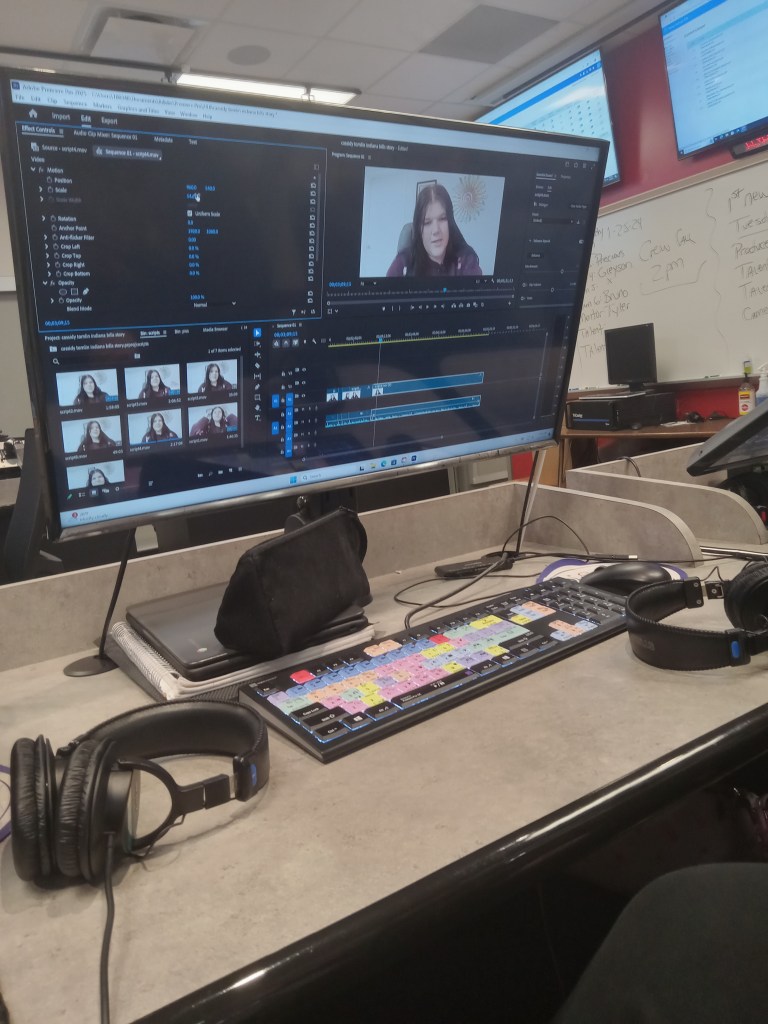
Junior Cassidy Tomlin works on a project in the WJHI studio. She said, “I’ve learned a lot, how to be professional, make eye contact, be a technical director who switches all the cameras, and more.” Tomlin’s favorite part is to do games because they’re intense. One thing she finds hard is keeping up with the news. Photo by Izzy Wemes.
As I walked through the doors of WJHI for the first time, I was struck by the sight of collaboration and hard work that filled the space. It was clear that this was a supportive learning environment, where students were not just classmates, but active partners in each other’s academic journeys.
I observed how they assisted one another, sharing ideas and insights as they worked together on different projects. This collective spirit showed a strong sense of teamwork and community, making the atmosphere inviting and dynamic.
After settling down for a conversation with WJHI faculty adviser Fred Cowgill, our discussion turned to skills that students in the program acquire, emphasizing the importance of pushing beyond their comfort zones.
WJHI is dedicated to skill-based learning, which includes interviewing, trusting other environments, and communicating with others.
What exactly do they learn? According to Cowgill, they master video editing techniques, which are crucial for creating eye-catching commercials.
Additionally, they dive into the exciting world of sports review, which happens after school for JHS games and not only sharpens their analytical abilities but also opens doors to promising career opportunities in broadcasting for those inspired to make a career in this thriving field.
Wednesday, Jan. 22 was the Academy Fair for freshmen. I visited the WJHI Radio and Broadcasting booth and learned what happens in different fields in the program.
The various fields include radio, being a director, and putting things up on the TV. They showed what the atmosphere would look like during a game and how they would communicate. Students can also work the cameras.
Students in the program say it’s a great learning environment and the teachers help them understand everything from learning how to do radio and communicate. When it comes to radio and broadcasting, communication is key.
Students I’ve talked to said they have a lot of fun, have learned many new skills, and are excited to see what the future holds.
Junior Jaga Pagva said he’s learned a lot of video editing skills. Pagva’s favorite part is just being a part of the program. He likes being in WJHI because everything is coordinated. Pagva said, “There’s a lot of skills people have to master.” Photo by Izzy Wemes.
Bright lights, dozens of different aromas, and chatter all around. From the early 80s to the late 90s, malls were the place to hang out with friends. From grabbing a bite to eat to shopping for clothes and electronics, the mall was the place to go.
With the rise of online shopping and social media, the need for in-person shopping drastically declined, along with the popularity of malls. This raises the question: Are malls still popular?
Saturday is the busiest day for Mall St. Matthews in St. Matthews, Kentucky. With over 150 different stores, it is no wonder so many people want to visit.
The smell was the first thing that hit me after walking through the automatic sliding doors leading straight to the food court. My boyfriend, two friends, and I arrived around 11:30 a.m., only 30 minutes after the store opened. I was surprised to see that there were already dozens of people there sitting down and enjoying their food.
Looking around I was drawn in by the free samples the employees were passing out. I only tried two samples before I knew what I wanted to eat. The large portion of sweet and tangy orange chicken and the vegetable lo mein from Chinese Gourmet Express was delicious. It was hot and fresh and it only took about two minutes for my order to be completed, including the time it took for me to be rang up and checked out. The staff was also very nice and the food was cheap. There were many places to sit in the food court and it was spotless.
After we finished eating we visited numerous stores. The St. Matthews Mall has a wide variety of stores and all kinds of merchandise. They even have places that can fix your watches, jewelry, and even your phone all while you shop. We went to the smaller stores, which surprised me with the amount of stuff they were able to keep inside.
Each store we went into had clothes and toys all up and down the walls. I had trouble getting things down because they were just out of reach, so I had to have my boyfriend hand me the clothes that I wanted. This was a bit bothersome, but it is something that I have to deal with in most stores. Some of the stores were so small that they felt very cramped and packed in, especially some of the more popular ones.
Walking through the mall itself it was wide and open with enough room for everyone to spread out and walk around. Surprisingly the lights weren’t blinding and they had a few large skylights instead. The St. Matthews Mall has a lot of interactive areas for all ages such as a large lifesize chess board with moveable pieces built into the floor and the indoor water fountain where people toss coins into. There are even designated areas for children and tots to run around and play. The mall has both stairs and ramps for easier access for families with strollers and wheelchairs.
One main issue that I had was the bathrooms being hard to find and they were extremely smelly. Large signs were hanging from the wall that said “restroom,” but they were hidden behind other shop signs, and the restroom itself was down a very dim and hardly lit hallway. I was scared that I was in an “employee’s only” area, but then I stumbled across the restrooms. When I opened the restroom door an intense odor of urine hit me and it was so bad that I was turned away from the bathroom altogether.
Luckily there were multiple other restrooms around that were much cleaner without any bad odors. A good thing about the restrooms is that they have a family room along with other full restrooms that also allow for more accessibility.
Around 3 p.m. more people had shown up and it was getting hectic, so we headed back to the food court for one last time. There, an employee from King Gyros, a Greek restaurant, was passing out samples of their lamb. Once again we fell in love with the sample and decided to get it to go. My boyfriend and I chose to get the lamb platter to share, which came with rice and a creamy tzatziki sauce smothered over the top. The to-go box was heavy from the amount of food they packed into it and we left very satisfied.
The overall experience of visiting Mall St. Matthews left me wanting more. I loved the food, the clothes, and the experience, which is why I have no doubt the store is so popular. I am eager to return and visit the other stores I have yet to see and I highly recommend going out and visiting for yourself.
LEGO has hit varieties of different age groups. People play with them or have them as collector’s items. Whatever you do with them, they are an amazing item to make your life fun.
LEGO began in 1934 in the carpentry workshop of Ole Kirk Kristiansen, a skilled carpenter who made wooden toys. Kristiansen prided himself on high quality craftsmanship. He eventually chose the LEGO name for his company, wanting to focus on child development through quality play.
Ever since then, LEGO has become one of the most popular hobbies in the world. It is truly amazing, because you can build or collect what you want to collect.
LEGO has many different options to choose from based on your interests. The most popular sets include Icons, Ideas, and Star Wars. Star Wars partnered with LEGO back in October 1999, and ever since these sets have been a hit.
When you see people’s collections, you’ll see many Star Wars sets. There is a reason for this: they are just great sets to keep sealed or on display. They have over a thousand retired or new sets. Some popular ones include the Millennium Falcon, R2-D2, Luke Skywalker’s Landspeeder, and many more. Star War sets are truly such great sets to have; heck, I wish I had some.
LEGO Ideas launched in 2014, with the first set being called Shinkai 6500 Submarine. To become a LEGO Ideas set it needs 10,000 votes, and then LEGO will look at it to see if they want to make it. These sets are truly great, and most of the sets relate to real TV shows or movies, like the Winnie the Pooh set or The Office. If you are wanting to get into LEGOs, you definitely need to pick up an Ideas set. I highly recommend the Winnie the Pooh set, as it’s incredible to have on display.
LEGO Icon released in 2010, with only 142 sets available, where most sets came out in 2024. Ideas and Icon sets are more expensive, but they are really worth it. This brand has to be my favorite, because they have many really cool sets, like the Atari 2600, Optimus Prime, Bumblebee, McLaren MP4, and more. If you were to get a set, this is really where you get one; they are just fantastic sets.
When a LEGO set retires, it’s possible that that set could go for thousands of dollars. LEGO collection is a great way to make money. The set’s lifespan lasts up to three years before it retires. If it’s in good condition, it’s worth more, and if it is open it’s worth less. The most expensive set ever is the San Diego Comic-Con 2013 Spider-Man.
If you are wanting to get into a hobby, choosing LEGO isn’t a bad way to go.
Seniors Violet Fondrisi and Jackson Callis work during the Mock Congress in Drew Davis’s first-hour AP Government class. Photo by Kaiden Helton. AP Government teacher Drew Davis gives instructions to his first-period class, including senior Cooper Turk-Gagel during their Mock Congress. Photo by Kaiden Helton. Seniors Collin Crouch, Jonas Newland, Hayden Smith, Evan Cooper, and Emily King take notes on legislation during the Mock Congress in sixth-hour AP Government Thursday afternoon, Jan. 30. Photo by Elliot Swincher.Senior Tristan Darvin, elected Speaker of the House, leads the Congressional ceremonies in Drew Davis’s sixth-hour AP Government class. Students in Davis’s classes were creating a Mock Congress. Photo by Elliot Swincher.
My favorite club Liverpool FC, known as ‘the Reds,’ has a rich history that spans over 120 years.
Founded in 1892, the club has become a symbol of excellence in the world of football. With passionate support from fans and a commitment to the game, Liverpool has seen numerous triumphs, including multiple league titles and Champions League victories.
This review explores the key elements that define Liverpool FC’s legacy, including its historical successes, recent performances under management, and the unique culture cultivated by its fans.
Historical Background
Liverpool FC has a storied past marked by the likes of Bill Shanky and Bob Paisley, who paved the way for the club’s success. Shankly transformed Liverpool into a dominant force in English football during the 1960s, while Paisley carried on the club’s legacy, securing multiple championships. Fans remember these iconic moments, which established a winning mentality that resonates to this day.
Recent Performances
Under the leadership of Jürgen Klopp, who took over in 2015, Liverpool FC has experienced a golden era. The club won the premier league in the 2019-2020 season after a 30-year wait, along with the UEFA Champions League title in 2019. Klopp’s tactics focused on intense pressing and pressing play, having revitalized the team, making them a force to be reckoned with in natural competitions.
But recently, the discussion around tactics has shifted with the interest in emerging managerial talent, particularly Arne Slot, who has gained a reputation for his innovative strategies while managing Feyenoord. Though not directly at Liverpool, his approach to developing young talent and playing attractive football lends itself to how clubs like Liverpool can evaluate managerial styles in the future.
Fan Culture
One of the most remarkable aspects of Liverpool FC is its vibrant fan culture. The famous anthem “You’ll Never Walk Alone (YNWA)” echoes through Anfield, fostering a deep sense of community, unity and passion among supporters. We the fans not only celebrate victories, but also stand by the team during tough times, creating an atmosphere that is unique to Liverpool.
Conclusion
Through its rich history, a commitment to excellence, and a strong fanbase, Liverpool FC continues to leave a significant mark on the world of football. As the club moves forward. It embraces a legacy that inspires both current players and future generations. The journey with the Reds is not just about the trophies won, but it is about the lasting impact on and off the pitch.
Liverpool FC remains a platform that promotes unity and inspiration and will continue to remain such as the club progresses.
In the original story, it is written that she is as white as snow. But in reality, if her skin was as fair as it, that could mean only one thing: she is dead.
How long have I heard that snow is cold but fun? You can make snowmen and battle with snowballs and warm yourself up by the fire with hot cocoa.
Hear me out, I don’t hate snow. I find it cute. The way it falls on the ground and the way it looks when you have one on your finger is breathtaking and is such a sweet dream. But in reality, snow is a nightmare, though I believe it is partially good.
But once it starts melting, all the bad things start to come out – dead leaves, dirt, sand, and corpses of bugs that didn’t make it through the storm. Along with that, the floor becomes slippery and looks very dirty.
Winter is supposed to be cold, but because of the snow it was terrifyingly freezing and going out some days was more of a punishment than a part of an active life. I don’t know why it has to be this cold, but my body cannot handle this temperature.
I lived my whole life in an african country, called Senegal and just like you would imagine it, there, cold weather is a myth. And now I suffer from the inverse of an oven. I am so used to being in warm places that my body was not ready for such a change.
The coldest I had seen so far was chilly; and there is a big – no, colossal – difference between “Oh, it’s cold, I need a jacket,” and, “Hark, the heavens themselves unleashed the tempest of divine wrath upon our heads!”
Coming to school is exhausting, going out of the school is overly tiring because it is so cold outside you cannot stand more than a few seconds before feeling your blood freezing. My toes are frozen to death. I almost got frostbite on my finger. But at least snow is cute, right? I am so done with this season already; please, let’s switch.
If it came to seasons, for the moment fall is my favorite because winter is too weird, going from hot to cold back and forth. Like, chill. You good, man. No need to make life this hard.
But, yeah, at least I can tell my friends from back home that for one day I have been an angel…a snow angel.
David Lynch’s cinematic journey stands as a beacon of astounding creativity, one that upends conventional narrative structures and delves deep into the subconscious. The legacy of Lynch is not one of straightforward storytelling but of visceral exploration — an investigation into the fragility of the human mind, the intersection of dream and reality, and the unsettling presence of evil in the most seemingly banal spaces.
Lynch’s filmography — spanning over four decades — is defined by an unwavering commitment to the surreal and the unsettling.
“Eraserhead” (1977), Lynch’s debut feature, set the tone for his career: a nightmarish, industrial landscape full of unsettling imagery, where the line between horror and absurdity is perpetually blurred. It is a film that rejects traditional narrative coherence, instead opting for mood and atmosphere that tap into primal fears.
From the strange, awkward, and seemingly benign characters, to the grotesque imagery of the mutant child, Lynch forces his audience to confront the unknown and the unnerving forces lurking beneath the surface of everyday life.
The television series Twin Peaks television series, which first aired in 1990, only solidified Lynch’s place in the pantheon of modern filmmakers. It blended soap opera tropes with a deep exploration of existential dread, creating a show that was as addictive as it was enigmatic. The mystery of Laura Palmer’s death was only the surface of a much deeper narrative — one that confronted ideas of duality, the nature of evil, and the loss of innocence. The surreal, dreamlike sequences of the Red Room and its iconic inhabitants, like Bob and The Arm, remain some of the most iconic and haunting images in television history.
Lynch’s films “Blue Velvet” (1986) and “Mulholland Drive” (2001) further expanded his exploration of the darkness lurking beneath the shiny surfaces of suburban and Hollywood life.
“Blue Velvet,” in particular, exemplifies Lynch’s knack for juxtaposing beauty with horror: the image of a pristine, picturesque suburban neighborhood shattered by the sadistic Frank Booth, whose violent rampage through the American dream is both shocking and yet eerily familiar.
“Mulholland Drive,” often regarded as Lynch’s magnum opus, continues to haunt viewers with its disjointed narrative, melding elements of noir, psychological horror, and identity exploration, all set against the glitzy but decaying backdrop of Los Angeles.
“But even more than that, Lynch’s legacy lies in his ability to make us question the nature of life itself. In an age where audience expectations for clarity and resolution often outweigh the desire for artistic exploration, Lynch stands as a defiant figure, unafraid to push the boundaries of cinema.”
Lynch’s films possess a distinctive quality of being elusive, of being part of a larger puzzle that refuses to be solved. And yet, this refusal to provide clear answers is part of his genius. His works are best appreciated not for their plot, but for the feelings and thoughts they provoke. Lynch allows us to experience the depths of human depravity and beauty simultaneously, offering no clear moral conclusions but forcing us to reckon with the complexity of human existence. His cinematic world is one of paradoxes — dreams and nightmares, love and violence, beauty and horror — all wrapped in an aesthetic that is unmistakably his own.
Lynch’s influence extends far beyond the confines of film and television. His legacy also includes his contributions to sound and music. The work of composer Angelo Badalamenti, most notably on “Twin Peaks,” became inseparable from Lynch’s aesthetic. The haunting, ethereal tones of the “Twin Peaks” theme evoke a sense of nostalgia, melancholy, and dread — three emotions that are central to Lynch’s worldview. The collaboration between Lynch and Badalamenti, which spanned several projects, gave Lynch’s world an auditory texture that deepened the emotional resonance of his visuals.
Lynch’s work “Inland Empire” was the culmination of what he had been doing in film for decades. The surreal atmosphere, the almost completely nonsensical story, and the fact it’s shot on a camcorder make it by far the weirdest thing he had done. It’s a beautiful testament to abstractions in art.
Lynch’s refusal to adhere to traditional filmmaking paradigms has cemented his status as a pioneer. His ability to manipulate time, space, and emotion in ways that defy explanation is his most significant contribution to cinema. What is often called Lynchian — a term now synonymous with his distinctive style — refers not just to the visual and auditory choices he made, but to the worldview his films communicate: one of fractured realities, psychological trauma, and the impossibility of true understanding.
If “Inland Empire” was the culmination of Lynch’s work as a filmmaker, then “Twin Peaks: The Return” is the culmination of Lynch’s work as an artist. Everything comes together and is perfected in this limited series. Every single element that makes the art of filmmaking is perfected. The music, the writing, the visuals, the sound, and the dialogue culminate in this monumental work of art.
His influences go far and wide. Monumental filmmakers such as Stanley Kubrick loved David Lynch. He went as far as to say “Eraserhead” was his favorite film. Underground filmmaking legends like Gregg Araki, who made the wonderful “The Doom Generation” cited “Twin Peaks: Fire Walk With Me” as an influence. Contemporary indie filmmakers love him such as Jane Schoenbrun, who made “I Saw The TV Glow.”
To me Lynch’s films made me realize that film was an art. It doesn’t have to just have a deep story. In fact, it doesn’t need to have a story, it can be a collection of visuals. That’s what the power of film is. To tell a feeling through image and sound.
But even more than that, Lynch’s legacy lies in his ability to make us question the nature of life itself. In an age where audience expectations for clarity and resolution often outweigh the desire for artistic exploration, Lynch stands as a defiant figure, unafraid to push the boundaries of cinema. His films demand a particular kind of engagement — a willingness to embrace ambiguity, to sit with discomfort, and to venture into the unknown.
In the end, David Lynch’s films aren’t about finding answers. They are about catching a dream and finding the meaning through interpretation. It’s far too often people search for direct answers. They want the explanation fed to them. Lynch is someone who stood against that and made people think about what it could all mean for themselves.