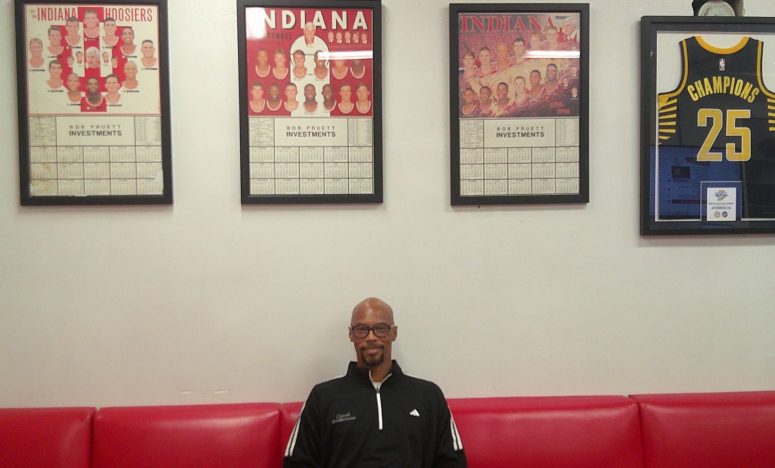
Head boys’ basketball coach Sherron Wilkerson scans the hallway by the lunchroom, looking for problems to solve. Most students know him as the coach behind the game plan for JHS players.
“I coach basketball to teach kids and get to help them and teach them the things teachers and others don’t really get to teach them,” said Wilkerson.
Wilkerson played basketball at Jeff High before he ever coached here, as he was on the 1993 state championship team. He has carried what he learned from playing in that game through college and now to his players.
“Everything I learn from college I teach all at the high school level to show them what it takes, because if you’ve never been there before, you don’t know what it takes to be there.”
Those who know Wilkerson describe him as a good person and role model, saying the way he chooses to teach his players is a view of his character.
“Sherron cares a lot about the kids, making sure to teach them life lessons and put them on the right path in life. People just see his intensity, not how much he cares and helps the kids, and the kids that come back after graduation, he still helps them,” said safety and security officer Brian Mitchell.
Junior and varsity player Shyne Scruggs agreed. “Coach Wilkerson is very serious and a hard worker when it comes to basketball and very smart and intelligent.”
Wilkerson wants his players to succeed on and off the court. He also supports them when they leave for college.
“He is always thinking about coaching when he’s not coaching, also making sure the kids are good and taken care of at home and if they need something to let him know,” said Mitchell.
Wilkerson demonstrates the ability to bring out the best in every athlete, pushing them to reach their full potential and setting them up for success for success in the way he views losses.
“We don’t judge off our losses; we judge off performance and growth.’’ said Wilkerson.
Boys’ basketball coach Sherron Wilkerson. Photo by Natalia Martinez.
Louder Than Life is one of the largest rock and metal festivals in America. Every year, thousands of people travel to Kentucky to watch their favorite band perform in the cooling days of September. However, it wasn’t always as popular as it is now. The history of Louder Than Life is quite a rich one.
Louder Than Life started in 2014 in Champion’s Park, founded by Danny Wimmer Presents, and debuted as a two-day event with their headliners being Judas Priest, Korn, Stone Temple Pilots, and Limp Bizkit.
In 2015, the WWE COO Triple H announced that Louder Than Life would feature in-ring WWE NXT Superstar matches, selling the show out. The headliners that year were Rob Zombie, ZZ Top, Lynyrd Skynyrd, and Godsmack.
A few years later, in 2019, the event extended into three days and was moved to the Highland Festival Grounds after flooding the previous year. The headliners then were Slipknot, Guns N’ Roses, Disturbed, and Marilyn Manson.
In 2021, the event expanded again into the four-day event we now know. Additionally, that year, Snoop Dogg canceled his appearance at the festival and was replaced by the band Falling in Reverse, with headliners being Korn, Metallica, Nine Inch Nails, and Machine Gun Kelly.
In 2023, Louder Than Life broadened their music genre based on fan-requested headliners, dipping more into the alternative and punk lineup, with the headliners being Foo Fighters, Tool, Avenged Sevenfold, and Green Day.
2024 was the celebration of the 10-year anniversary since Louder Than Life opened, with a record of over 140+ booked bands. The headliners that year were Slipknot, Mötley Crüe, Korn, and The Offspring.
In 2025, the event relocated again, now to the Kentucky Exposition Center, expanding the footprint to 2.8 million square feet, with festival passes now including free rides at the adjacent Kentucky Kingdom amusement park. The record attendance was broken for a second time, totaling about 240,000 fans. The headliners that year were Slayer, Avenged Sevenfold, Deftones, and Bring Me the Horizon.
Louder Than Life happened on Sept. 17, 18, 19, and 20th, so what did people think of the show?
It was sophomore Braylen Martin’s first year going, saying, “I went for the fun of it and that; if given the chance, I wouldn’t be able to choose a favorite band to see because of my love for music.”
Senior Gabe Collens said that it was also his first year going and that his favorite band he saw was BABYMETAL.
“The mosh pit was crazy, and their music is incredible,” he said.
Collens went because his friend had a free ticket for him. He said that he would want to see Mom Jeans if given the chance.
Junior Grace Bentley is a repeat goer. Out of all the bands she’s seen at Louder than Life, her favorite was Weezer.
“It made me very emotional; it was really good. It sounded like the studio recording. It changed me,” said Bentley.
Bentley went to see My Chemical Romance, and she would want to see the band Norma Jean.
English teacher Patrick Wentworth did not go this year, but he’s been going to Louder than Life for decades.
“While I like Shinedown, Slipknot, all those bands, I got to see Kiss on their final tour, and it was electric. They have great showmanship,” he said.
He skipped this year because of the previous year, describing it as getting “a little rough during Bad Omens” and “no longer the local experience.” He added that it’s also gotten expensive. Though if he had to choose a band to see, he would want to see either Pink Floyd or Led Zeppelin. He said that Led Zeppelin has more music he’d choose from, but Pink Floyd is a band he’d constantly put on.
Despite the expenses being raised and the experience no longer being a local one, Louder than Life is a concert experience that everyone can appreciate and find something enjoyable in it. With all the years that have gone by, there’s always something for people to appreciate; whether it be the lineup or the food, there’s something for everyone.
Walking past science teacher Chris Bradley’s classroom, students would see a room full of dinosaurs.
“Earth and space are important, and it’s something we deal with every day,” stated Bradley.
Walking around JHS or to class, students might see Bradley or his classroom. Not many underclassmen would know him, but most upperclassmen do.
For example, junior Shyne Scruggs stated, “His class is enjoyable, and it’s good to know about fossil fuels, and it’s also an easy class, and I love an easy class.”
“I think upperclassmen are more mature, and they know what they want to do in a classroom and outside of school,” said Bradley. “They’ve become more dependent on technology. They’re more willing to ask questions.”
Bradley enjoys the students he teaches, and he finds the subject interesting.
Bradley’s wife, Jodi Bradley, who teaches PE, stated. “I do think this is his dream job because he likes kids and dinosaurs.”
Bradley somewhat agreed with his wife.
“I don’t know if it’s my dream job, but I do enjoy it. I like the kids, and what I teach is interesting.”
Bradley’s main class is teaching dinosaur science as an elective; he was teaching earth and space science at first, but after a while he was also able to teach his dinosaur elective class.
“Earth and space science is what I’m certified in, but I teach dinosaurs because it’s an area of interest for some students.”
Students in his classes say Bradley adapts the subject to keep it interesting and understandable.
“I adapt to Bradley’s teaching style by listening to what he says in class, and I read and look over notes,” stated Scruggs.
Upperclassmen continue to come back to take Bradley’s class because of his teaching style and his expectations for his students, which Bradley finds rewarding.
“Seeing kids after I taught them and seeing what they do with their lives makes me feel that I did something right,” he said.
The sixteenth-century Spanish card game, Ombre, has shaped the style of card games as we know it within Western society, from its revolutionary Entrada and Vuelta bidding mechanics to its exact, unforgiving calculation of cards needed to win. These aspects of Ombre have influenced other well-known classics such as poker, blackjack, and even newer card games such as Yu-Gi-Oh.
While students aren’t able to find Ombre within the walls of JHS, they’re still able to find many other popular games that have derived from it at Games Club, including Pokémon TCG, Magic: The Gathering, Dungeons and Dragons, and even Yu-Gi-Oh.
JHS math teacher Cory Densford takes note of his younger and older students’ insights and interests, which were used to create Games Club.
“13 years ago, I was teaching an Algebra I class, and we had a ton of free time at the end of the year,” said Densford. “A student brought in the card game Yu-Gi-Oh and asked me to play. I instantly found it extremely fun! So when the next year came around, we started what’s now known as Games Club.”
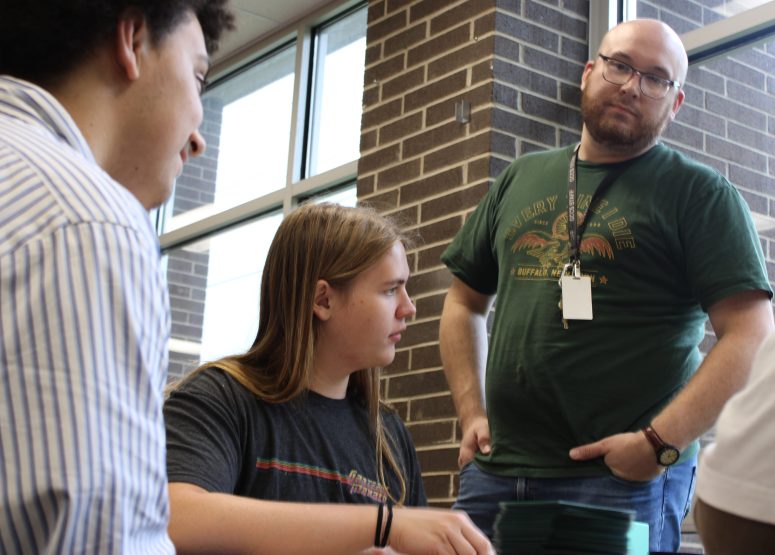
Math teacher Cory Densford talks to sophomore Maxwell Semones and sophomore Elijah Hatfield during Games Club. Photo by Ashton Walcott.
Densford said the best part of the club is getting to know students better.
“My favorite part of Games Club is getting to know the kids in a non-classroom setting and getting to understand them on a better level. We don’t have a whole lot of downtime while in class, so I feel like this is a great way to connect with them more.”
Games Club is a friendly and inviting environment. Densford is always looking for more participants. Students who may be just starting or have been involved in these games for years are welcomed. Many students already involved in this club enjoy getting to know their peers outside of a classroom and making friends with similar interests.
Junior Samuel Stifler, who is a one-year veteran at Games Club, gave his insight into the nature of the club.
“I love that it allows aspiring gamers to come together, play games as a group, as well as learn about other games. I do wish there were a little more game variety, but that is a change planned for the future.”
Stifler said the club interested him from the beginning.
“As a freshman, I noticed that the club was an option through the school Pride Slides, and I was instantly interested. I had a group of friends that wanted to start a DND session, and now I can easily contact the group and play a game of our choice. Games Club provides a perfect place to meet with friends outside of school and build a world that we can all be a part of.”
Junior William Ponsford, who’s a former Games Club member, stated the club helped him meet fellow gamers.
“I joined Games Club because I wanted to meet new people and socialize through games; I find it very enjoyable to game, and I can socialize with my peers around me while expressing myself through gaming.”
Ponsford said the atmosphere of the club is a bonus.
“What I personally like and find the most enjoyable is how much game variety there is. You’re able to be very open-minded, express your ideas freely, and there were a lot of different people with unique personalities. I loved Densford as a teacher and president of Games Club because he is a very kind and warm person,” he said.
Ponsford said the club helps members be more creative, too.
“My favorite part is that it’s a place where many people, no matter their social status, are able to meet up, have fun, express creative ideas, expand game culture, socialize, and really open people’s minds to different games in general,” said Ponsford.
Junior Kenneth Norton, who’s in his second year of Games Club, agreed that Games Club is a wonderful place to meet new people.
“I love that this club allows me to play games with the people that I like, as well as people that I haven’t ever met before,” said Norton. “I’ve gotten to learn and experience games with other amazing students that I didn’t know very well beforehand.”
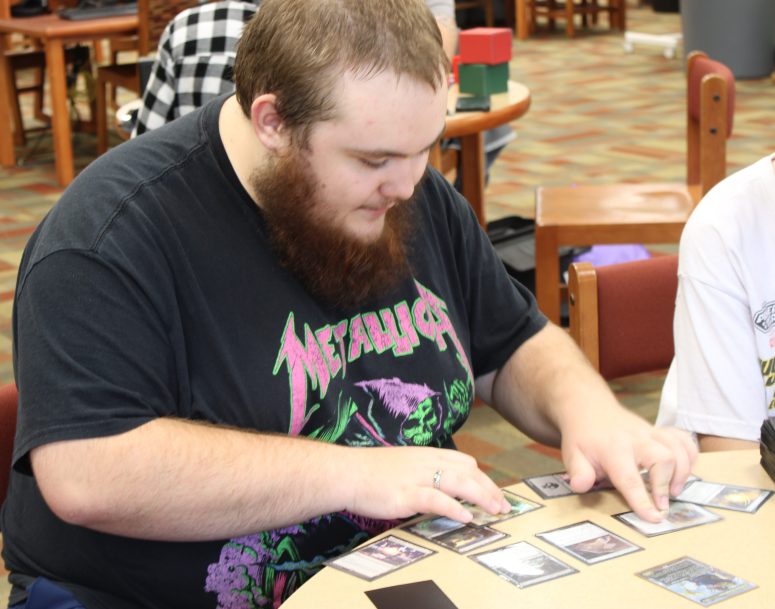
Junior Kenneth Norton plays Magic The Gathering during a Games Club meeting in the media center. Photo by Ashton Walcott.
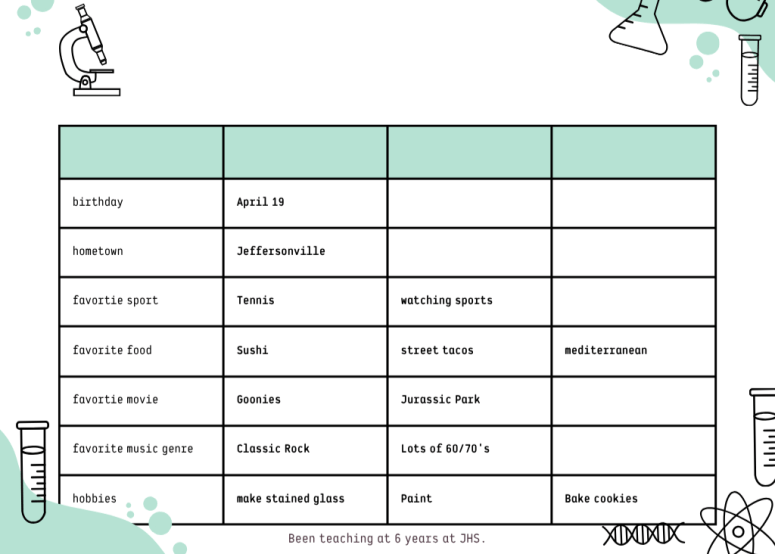
Birthday: May 6, 1999 Hometown: Corydon, Indiana Favorite sport: Softball Favorite food: Pasta Favorite movie: “Iron Man“ Favorite music genre: Pop music Hobbies: Reading, arts and crafts Time spent teaching: Two years.
Biology and PLTW Human Body Systems teacher Karson Cecil sits at her desk, checking emails and grading assignments as the students in her seventh period Human Body Systems class work, constructing an origami diagram of a bone. A Louisville Police badge sits on her desk in a case.
One may walk past Cecil’s classroom without a second thought, just thinking that she is any ordinary science teacher; however, that isn’t the case here.
At a first glance, no one would know that she once worked as a crime scene technician for the Louisville Police.
“My experience as a crime scene technician was fantastic; it was a fulfilling job and it was always something new each day. I left that position due to the schedule being too chaotic,” Cecil said.
However, one may wonder why she would take up such a job, with so much danger and unpredictability.
“I just applied and showed up. But the biggest influence is ‘Criminal Minds’, the show,” Cecil stated.
After quitting her job as a crime scene technician she took her career in a completely different direction.
“I chose science because my degree is in science, and it’s my favorite subject,” she answered.
Despite the troubles and annoyances of being a teacher, she has still decided to stick with this career as a science teacher.
“I like getting to help students find something that’s interesting to them and discover that science can be pretty fun.”
Cecil had to take various different classes in high school and then college in order to be able to pursue her career in teaching, biology, and human anatomy.
“In high school I took Advanced Science classes and then in college I took a lot of biology and chemistry classes. I also took an education class, not with interest in teaching, just to fill a space, but then I went to grad school and took anatomy classes,” Cecil said.
Cecil is still a new teacher, at least compared to others, having chosen to teach at JHS for a simple reason.
“Yeah, because it’s close to my home and they were looking to hire a science teacher,” Cecil stated.
Her students have had many positive impacts on her life.
“My students impact my life by brightening my day and they always keep me learning too, they teach me new things which are important. They teach me slang, and I’ve learned some TikTok dances,” she said.
However, Cecil has also had impacts on the lives of her students as well.
“I say she’s taught me a lot and helped me learn a lot of information I need to know for my career,” said sophomore Haylee Schwarz, a student in Cecil’s PLTW Human Body Systems class.
Cecil has also been an inspiration for her students.
“She inspires me to be a better person because of the way she teaches,” stated sophomore Layla Dizdar, another PLTW Human Body Systems student.
Cecil thinks that science is a very important subject, especially in today’s world.
“Science explains the world and how it’s always changing. It is also important that people are able to keep up with new information,” she stated.
Some may find biology and human anatomy to be boring, so one may wonder how Cecil keeps her class fun and interesting.
“I try to incorporate different styles of learning and different games,” she said.
But, do her methods really work at all?
“I find it fun because I like learning the stuff but I find it interesting because of the people,” said Schwarz.
Cecil also has a way to motivate her students to work efficiently.
“Knowing we can have fun after our work is done is a big motivator for everyone,” said Dizdar.
Many people seem to have a positive opinion of Cecil as well.
“I think she’s a very funny and kind individual,” stated Dizdar.
Despite Cecil having a rather chaotic history, and teaching such an important and complicated subject, she has one, very simple goal in her life.
“My biggest goal in life is to have a small hobby farm with miniature cows.”
Principles of Biomedical Science and Biomedical Innovations instructor Charles Patton works hard to teach a wide range of scientific material in his classroom. Patton uses his genuine persona to engage his students.
“The way he teaches is understandable, and he goes into detail and makes things make sense,” said freshman Gem’maica Hunter-Lawrence.
No one would have guessed that Patton had prior work experience in science before teaching it.
“I worked in various healthcare systems in the Atlanta healthcare market for about 15 years, and four years prior to teaching, I was with a healthcare startup system called VillageMD,” said Patton.
Patton has been teaching for two years; he is currently in his third year.
“You kind of grow and learn and make changes in real time. Changes as needed,” he stated.
Patton keeps a healthy classroom environment and uses patience.
“I try to be as approachable and honest as possible.”
Patton actively works to build a relationship with each student. He uses the students’ work as a way to learn, understand, and even help them.
“There’s a lot of depending on how the day goes; there is no set schedule,” he stated. “Some days are more controlled than others.”
Patton conducts his classroom based on the behavior of the students in it. He prefers to work with the students rather than against them.
“He’s nice and seems like a genuine person,” according to freshman Elise McCormack.
“I love science. I think that science is something that brings us tons of experiments and some sort of truth at the end.”
Principles of Biomedical Science and Biomedical Innovations Teacher Charles Patton
Patton sees his students as more than just students; he sees them for far more than what they write down on a paper.
“I like that he is bubbly and lights up a room. He listens and tries to put his feet in your shoes,” said freshman Harmoni Staton.
Because Patton cares so deeply for his students, he intends to welcome them with the same warm, welcoming personality every day.
“Everyday is what you make it, and the positive feedback from the kids keeps me going,” he stated.
Seeing the impact he makes on the students during the duration of teaching keeps Patton eager and ready to come back and work. He has a deep love for science and hopes to share a little of that scientific truth with his students.
“I love science. I think that science is something that brings us tons of experiments and some sort of truth at the end.”
As Friday morning begins, students gather before school, ready to start their day off with breakfast, games, and conversations about their faith.
For members of the Fellowship of Christian Athletes (FCA), these Friday mornings are more than just a way to start the school day. They are an opportunity to connect with their peers and grow closer to God.
“FCA means quite a lot to me. It’s a time for me to connect with my peers, play games, eat breakfast, but it is also so much more. I’m able to grow closer to God even at school, and I look forward to every Friday morning for this exact reason,” stated senior Macyn Jackson.
Through games and discussions, FCA gives students opportunities to grow both as athletes and in their faith.
Main sponsor Pamela McCoy shared, “FCA is about athletes being able to come together to practice teamwork and commitment. Being able to have a space to gather together, pray, and learn about Jesus is important. We meet as a group for FCA, but the hope is that it will go out to the teams. FCA’s goal is to see the world transformed by Jesus Christ through the influence of coaches and athletes.”
On Sept. 4, 2026, sophomore Alyssa Anderson talks about loving one another and putting differences aside to come together at a morning meeting of the Fellowship of Christian Athletes in the library. Photo by Lorelei Bingham.
Although FCA centers around sports and faith, every student has a different reason for being involved.
Freshman Eli Smith said that joining FCA has helped strengthen his relationship with God while helping him become a better person.
Jackson shares a similar reason for joining FCA. “I joined FCA because this is a community of people I can always have for support, and I’m there to support them too. I also knew joining would help me grow to be a better person all around.”
Student leaders play a big role in FCA. They grow in their faith while helping others grow theirs.
“Being a student leader is challenging, but I love it,” said junior Clara Theriault. “I go through my Bible, make devotionals, and questions from scratch, so it really tests my knowledge, but I get to share that with my fellow peers who may not know what I’m talking about. That part makes it all extremely rewarding.”
The student leaders contribute to making FCA meaningful for its members.
“My favorite part of FCA is getting to hear our high school leaders talk about my religion and what it means to be Christian. It’s so meaningful to hear people my age or younger speak about the Bible and the connections we can make to our high school life. It shows me that even at school, I can be living through Christ,” Jackson shared.
Members also encourage their peers to attend, saying they can experience the community and learn about their faith.
McCoy explained, “At FCA we want to try and invite others to come to know more about Jesus and to form a community of peers that can join together and share their faith with each other.”
For some members, Friday mornings have become a meaningful part of their week.
Theriault said, “My favorite part about FCA is being able to devote every Friday morning to God and spreading the gospel.”
FCA allows students to strengthen their own faith while encouraging them to share it with others.
McCoy hopes that message continues beyond the Friday morning meetings.
“I hope that they come away knowing that Jesus loves them and that they can take that and share it with other students,” shared McCoy. “I also hope that they invite others so they can know more about Jesus as well.”
Shelby McCorkle strives to help her students every day
by Anicko Griffin
Counselor Shelby McCorkle greets her students with a smile, answering questions they and others may have for that day.
“Hey girl! How can I help?”
McCorkle carries herself like any other person at Jeff High. Most people would never notice the hundreds of students’ pain, dilemmas, and anger she carries with her every day.
Although it seems difficult, McCorkle completes her job with a positive demeanor.
Some may see McCorkle as just another staff member. It’s invisible to the blind eye that she has been a school counselor for just over 14 years, finding her job the most enjoyable and important thing to her after her two kids.
“I love working with kids. It’s never boring, and you all bring something new to the table every day. Are there things I would change about it? Yes, but I wouldn’t trade it for the world,” stated McCorkle.
McCorkle plans on being a JHS counselor until retirement.
“I genuinely want to help every student who comes through my door and help change their life for the better.”
McCorkle’s father was in education as well. She also took the counselor career path.
“Now more than ever, a lot is going on with family, school, and teachers, and it’s important for everyone to have their safe space,” said McCorkle.
Her students appreciate her dedication.
“She always makes my day better,” said junior Brooklynn Weston. ”No matter what the topic is, she always knows what to say.”
McCorkle is always trying to gain students’ trust and give them a safe space. She genuinely values her job, and helping students with their next big step is a priority to her.
“I love helping students figure out what path they want to take when they get out of high school. The person they are changes so much between 14 and 17, and I love being able to be there every step of the way.”
Science teacher Francesca Hernandez works to make biology meaningful and fun for her students by connecting what they learn in her classroom to the outside world.
“I think science is important, and if I can help others to understand the world around them more, then that’s a win in my book,” said Hernandez.
Her interest in biology started when she was in high school and had a teacher who made learning fun for her.
“I loved biology in high school. I had a fun teacher who took us on a bunch of field trips, and I wanted to be just like her. Shout out Ms. Lyvers,” said Hernandez.
Because of her own experiences as a student, Hernandez believes students should be able to learn science in ways they can remember.
“I’m a hands-on person. If I hear something, I forget it; I try to make sure my lessons have some level of hands-on work so that it sticks in their brains.”
Science and biology teacher Francesca Hernandez helps a student on a map for the class assignment on Thursday. “I’ve been teaching for six years and I love getting everyone interested and involved in their environment and natural world,” she said. Photo by Kayleen Alvarado.
Her teaching also focuses on helping students understand the environment around them and their responsibility toward it.
“The hardest part is getting students to understand that everything is relative; every action we make influences our world in some way. It’s up to us to choose how we handle that responsibility.”
Her students learn this sense of responsibility during her lessons
“She makes biology interesting by applying some of the real-world experiences to the science she teaches,” said freshman Akiya Flynn. “She breaks down the topic and puts it into more understandable terms for her students.”
“I describe her teaching as she shows everything on her board and helps us understand things we need more help with by shortening it into easier forms for us to understand,” said freshman Rhaya Nord.
Environmental science is especially important to Hernandez because she believes students can better appreciate the world when they understand it
“People can’t care for the world if they don’t understand it, and they can’t understand it if they don’t know it exists.”
Hernandez also enjoys having a new classroom this year where she has more room to teach through activities and labs.
“I love my new classroom. I have windows, and I also have more space to do more labs.”
Hernandez wants her students to see that biology is more than just a class they have to take at school.
“I want the readers to pay attention to their science classes because I promise it applies to them in some way.”
Chemistry teacher James Huffman walks behind his desk, capturing everyone’s attention with his voice. He flips through the slides on the board until he stops at a conversion equation; the students focus on him, waiting expectantly for him to demonstrate how to convert the units.
For Huffman, problems like these are more than just a chemistry lesson. He enjoys working through problems himself, but he also enjoys helping others find their way through difficult questions.
“Yeah! I like solving problems, and I like to help other people solve problems, specifically in chemistry but life in general,” Huffman said.
His approach to problem-solving is something his students notice in the classroom. Rather than just giving students an answer, he encourages them to understand how to arrive at it step by step.
“He taught us to remember formulas and learn how to do problems by putting them into steps,” junior Danna Lopez, a former student, stated.
Junior Rachel Santos also remarked that Huffman encourages students to approach difficult problems in different ways, especially when working with stoichiometry or other smaller subjects where they can’t seem to grasp the idea.
“He taught us to break down problems and try different methods, especially with stoichiometry,” Santos said.
Being a teacher isn’t what he always wanted; it wasn’t his first goal. Being an engineer was his first goal, but he wanted his life to revolve around helping people, no matter the problem.
“I would probably be an engineer. That was my first goal as a student, or I would be going the exact opposite, like I do now and be a social worker, like helping people with their problems, like life, versus solving problems as an engineer, which you know is much different.”
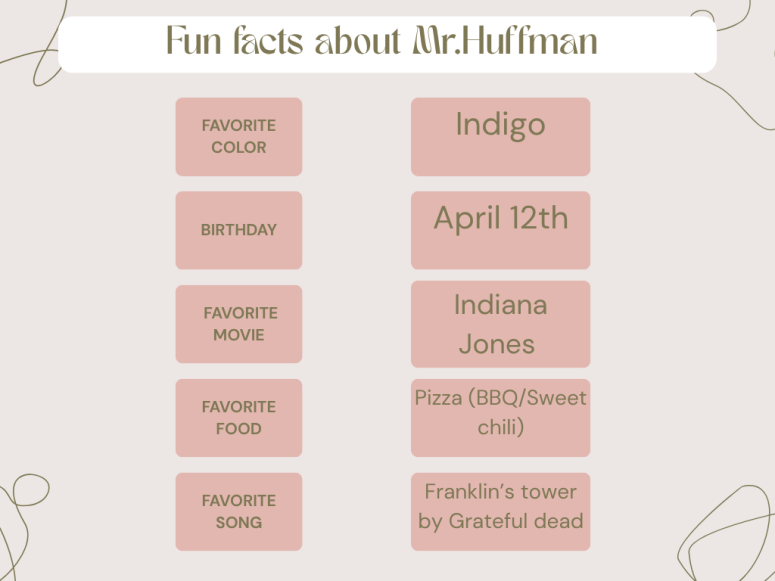
Graphic by Zihan Lin.
Although engineering was once Huffman’s goal, his interest in chemistry led him towards working with chemicals rather than engines. His experiences in his chemistry class, particularly the hands-on labs, helped him realize what he enjoyed most about the subject.
“Had an awesome teacher; I loved the labs. I loved being able to prove something with chemicals. I wasn’t as much—I don’t like to work on engines. I like to work with individual chemicals. I found that out from my chemistry teacher from high school,” he said.
His high school teacher not only helped shape his interest in chemistry, but also influenced the way he approaches teaching with his own students.
“I would say mostly due to the awesome teachers I had as a student. I had some really good teachers, and because of those good teachers. I want to do the same thing as they did.”
In Huffman’s classroom, every problem has a solution—and sometimes, the solution is simply to keep trying.
New art teacher Hayleigh Gnagie instructs her fourth-hour class on shading and showing value in their artwork.
She has been making art her whole life and has always wanted to teach and help other students express their creativity and emotions through art.
“Yes, art is something I have been passionate about since elementary school, and I want to share it with everyone else,” said Gnagie.
Because of Gnagie’s strong passion for art, she intends to share it with her students.
For example, junior William Ponsford shared what he has learned in art because of Gnagie, specifically, “how shading and hue can give art more depth perception and detail.”
Gnagie’s background includes experience with children of various age groups.
She substitute taught for several months, including for GCCS at Jonathan Jennings and Charlestown Elementary before working at Franklin Square Elementary as a specialist. Now she teaches at JHS.
“Elementary kids don’t know how to handle their feelings as well as high school kids know how to communicate their feelings well and show if they don’t understand the assignment and how I can help them understand it more,” she stated.
“By passing down art to future generations, we help ensure the human creativity, history, and ability to imagine a better world are preserved and celebrated.”
Art Teacher Hayleigh Gnagie
Gnagie also had influences growing up who helped her pursue her career and motivated her to pursue art.
“My high school art teacher made me see that I can pursue my career.”
Her students have also had a positive impact on her life.
“They make my day better by showing me different perspectives of life,” she said.
However, Gnagie has also had an influence on her student artists.
Junior Danna Lopez, an artist in Gnagie’s fourth-hour class, appreciates “the way she explains techniques, like how to grab a pencil correctly for shading.”
Art is not just a subject in school; it is a way to express and understand the world. It allows people to share their feelings, ideas, and experiences without always needing words. It can bring people together, tell stories, show different cultures, and inspire others. Gnagie said makes art more than just drawing or painting — it is a way of communicating and connecting with others.
“It’s the easiest way to express yourself without talking; also, you can use color to express your emotion,” she stated.
Since Gnagie is new this year, students shared their first impressions and what they think of her as a teacher.
“The energy I got when I first met her was that she was going to be a very creative and calm teacher,” said Ponsford.
Lopez added, “She seemed outgoing and chill.”
Gnagie feels that art is dying, so she wants to teach it to the youth so it does not.
“By passing down art to future generations, we help ensure the human creativity, history, and ability to imagine a better world are preserved and celebrated.”
Gnagie has been creating art her entire life and hopes to inspire future generations on how important art is.
“If I could give young artists one piece of advice, I would say each artist’s journey is unique – embrace yours and keep growing.”
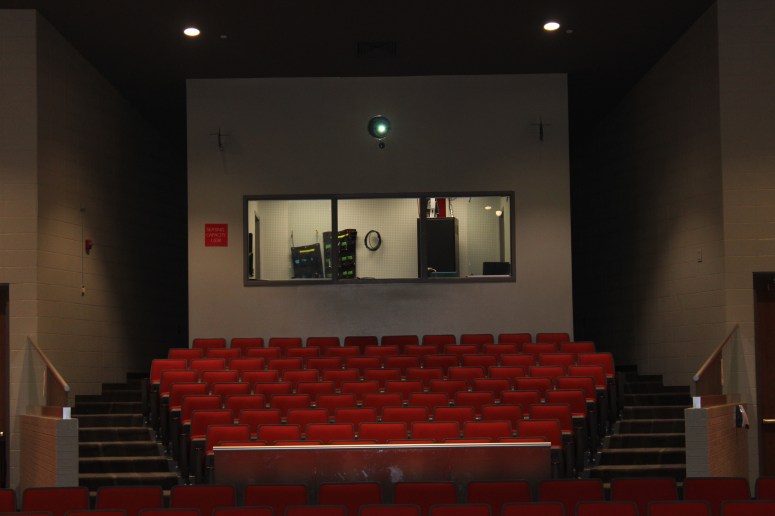
From the lights, to the set, to the props, to the costumes. The technical aspects of any performance are extremely important, and take time. There are so many parts and pieces that go into a theatrical performance.
At JHS, there are many opportunities for arts to shine. Under the stage lights lit by the crew, performances benefit from the tech department, which is student led and full of different ways to help light up the stage.
Photo by Raven Baker.
“I see it as a way to supplement what actors do on stage. They’ve done all their prep work leading up to the show and then tech comes in that last week to make sure all their work is seen and heard,” said senior Tristan Cooley, who has done tech for shows both at JHS and in the community.
Cooley said his favorite show he’s worked as a tech for is “All Shook Up” performed at Clarksville Little Theatre.
“It was my first show I got to design lights for, and I was really proud of that,” said Cooley.
Cooley said his favorite moments of a show are often when the set is completed prior to the performance.
“After all the set is made and everything is ready, I love walking into an empty theatre and feeling the space, it’s peaceful and magical,” he said.
Junior Lindsay Austin, who has worked as part of the tech crew since her freshman year, said a lot of work goes into building the sets.
“You have to be a very dependable person in tech because every rehearsal counts,” she said, explaining her favorite show to work on was “The Ballad of Little Jo.”
“I also enjoyed making the bed for ‘Once Upon a Mattress,’ said Austin. “That’s when I first met some of the now sophomores and became friends with some of them. It was also one of the last shows I got to do with a former senior, Cheyenne.”
Senior Blessing James Vonsenden, who has worked tech and acted on stage, said she enjoyed being the stage manager for “The Ballad of Little Jo” “because I was so involved — I got to know a lot more people and see the whole scope.”
Lighting is an important part of any performance. “I did the light board for “Once Upon a Mattress” last year and I really enjoyed that,” said sophomore Nataly Barragan.
Theatre teacher and director Derrick Ledbetter said tech work brings shows to life on stage.
“I think it’s like the backbone of a live show. It brings the story to life. It’s often invisible when done right,” he said. “Tech also can help build self confidence. Sometimes there are students that don’t shine physically or academically, but tech gives them that chance to shine. I think it creates a diverse extracurricular ecosystem, and it’s a place where people can explore, make friends, and feel welcome.”