Raising Cain

Story by Tristan Jackson

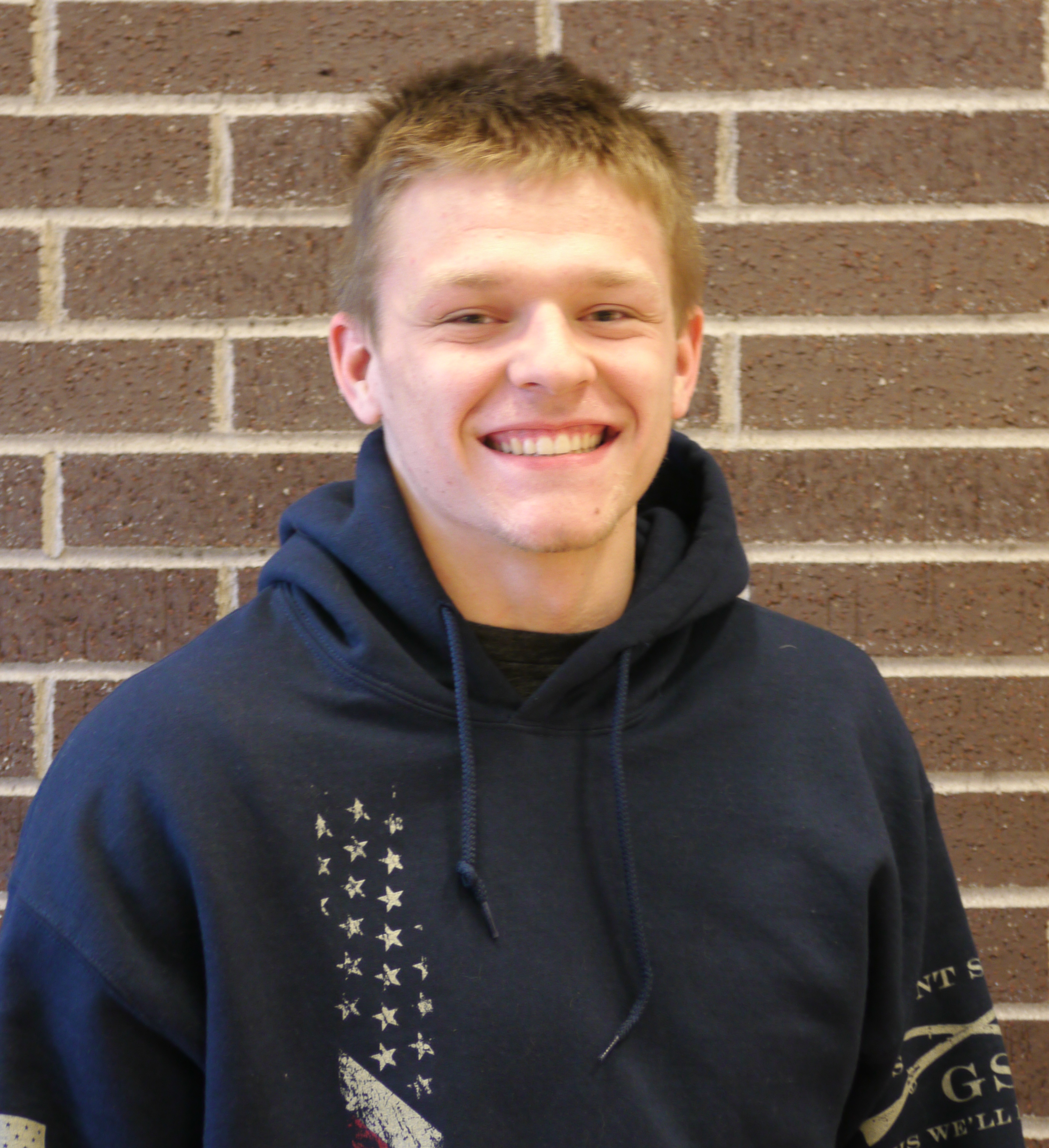
Jeffersonville High School has a new state champion.

Camyle Cain, a wrestler in the 138-pound weight class on the female circuit, won the Indiana state competition on Jan. 19 — just one year after the first-ever state competition for girls, in which she placed second against Alara Boyd, the second-ranked female wrestler in the world in her weight class.

“I’ve never felt something so exciting,” Cain said on her experience at the state tournament. “Everyone is so welcoming and nice. Even if you’re going against the girl, she’ll help you warm up.”

Cain was convinced to join the wrestling team by head wrestling and strength & conditioning coach Danny Struck, who has been coaching at Jeff for over 20 years. While she excels on the mat, Cain’s first love was the football field.

“I didn’t want to originally,” Cain said on joining the wrestling team. “Struck would ask me everyday to come. He would say ‘if you don’t like it, don’t come back. Just try it.’ I didn’t like it the first week, but I kept going, and a month down the road, I realized I really liked this sport.”IMG_0070

Cain joined the football team her freshman year, and played under head coach Lonnie Oldham. During her first year, she built relationships with her coaches, including Alfonzo Browning, who would eventually go on to become the head coach.

Cain’s wrestling coaches have helped pave the path to a state title, and her football coach would end up accompanying her to the state championship

“It meant a lot to me, especially after everything we’ve been through over the last four years,” said Browning, on taking Cain to State. “I was honored to be able to take her up there.”

While Cain enjoyed the experience, a high school athlete’s goal is to win a state championship. Her hard work got her all the way to the championship match after winning the first two matches in the competition.

Cain went into her final match with a 8-0 record against female opponents, including a first place finish in the USA preseason national tournament and regional champion.

In dominating performance, her first two wins of the tourney would come by the way of pin. As the favorite, Cain would eventually make her way to the championship round, where she would face off against Westfield High School’s Melody Barrows.

During the final, she continued her impressive display, pinning her opponent less than two minutes into the match.  

“When I won I couldn’t even control myself,” Cain said. “I really didn’t know how to act.”

The win is not only a tremendous accomplishment for Cain herself, but a groundbreaking accomplishment for the girls who could potentially follow down the same path.

“She improved both physically and mentally,” Struck said. “She’s grown up and she’s much better at keeping her emotions in check.”

It’s safe to say the win brought a lot of attention to Cain, and she has received an abundance of support from the students and teachers around the building.

“Every time Coach Browning sees me, he’ll say ‘what’s up champ’,” Cain said. “Everyone is so excited for me.”

Although Cain won a state championship, there will always be people who doubt and hate excellence, especially as a female exceeding in a predominantly male sport. Cain is no exception.

“I do get some crap for it. Some people say, ‘You didn’t really win state because you’re a girl,’” Cain said. “I don’t really know why. I guess they are just jealous.”

Regardless of the naysayers, Cain shined on her way to a state title, utterly dominating her competition.

“She’s got a runner-up against the second-ranked wrestler in the world and a state title; that’s a nice resume for when she goes for the All-Marine team,” Struck said.

With the backing of her coaches, teammates and classmates, Cain made her championship dream come true.

“I can’t believe I won state,” Cain said. “That’s something every athlete dreams to do.”

Cain finished her high school career on top, but it’s not the end of the road for the outstanding Red Devil. Although she has yet to pick out a college, Cain fully intends on wrestling post-high school, and the school that she decides to attend will be getting a girl who is ready to work.

“I just want to get better,” Cain said. “Get better for when I further it.”

Effects of Mental Illness on Women

She seems happy at school. She talks to her friends, eats her lunch, and does her work.

Unfortunately, it all changes as soon as she opens her front door to return home.

She starts to take off all her makeup, then just stares at herself in the mirror. She sighs and walks to her room, where she just sits on her bed. She has a feeling she is about to cry, but no tears come out.

Instead, she just sits there, staring into the nothingness she lives every day.

This is a normal day for sophomore Riley Brown, who suffers from anxiety, obsessive compulsive disorder (OCD), and depression.

“It feels like when you’re outside on the icy ground and you slip, but you catch yourself, except it keeps happening and it never actually stops,” says Brown. “The medicine helps. Instead of worrying 24/7, (now) it’s more like 12/7.

According to mentalhealthamerica.net, one of the nation’s leading websites on mental health, around 12 million (roughly one-in-eight) women experience some form of clinical depression every year.

Compared to their gender counterparts, women seem to experience depression at twice the rate of men. Specifically, girls aged 14-18 years have higher rates of depression than males around this age.

“Men often display their depression with anger and overworking, while women suffer in silence,” says Allison Puckett, a former Wellstone Hospital employee. “They do, however, seem to experience more support.”

According to Puckett, someone who shows signs of depression may just need someone to open up to.

“It’s really important to talk about depression. You won’t cause someone to commit suicide just by asking if they’re okay,” Puckett said. “If the signs are there, you should ask. People need to know to never give up. There’s always hope.”

Signs of depression include increased feeling of tiredness or insomnia, overeating or loss of appetite, excessive crying, loss of interest in activities, and outbreaks of anger.

“I encourage someone who is having negative thoughts to go to a trusted adult, coach, or counselor,” says Jeffersonville High School counselor Tyler Colyer. “If someone is showing signs, be supportive, aware, and tell a trusted adult.”

Now that Riley has started taking her medication she seems happier and less anxious. When she recognized the symptoms she confided in someone she knew cared about her.

That changed her life.

“I promise things do get better,” Brown says. “It might just take some time.”

Jeff High’s newest club is all about inclusion and acceptance

This time last year, junior Matthew Begin was talking to his friend Noah Fetter, who attends Silver Creek High School.

While their talk encapsulated many different topics, unity and acceptance of others was at the forefront.

As their conversation continued, they began discussing the possibility of creating a club to unite different LGBT friendships, and educating students on mental health that is not taught in the traditional system.

Begin asked assistant principal Marianne Fisher her thoughts on starting up a club at Jeff, and she helped him through the initial process. Sophomore Ryan Curry overheard Begin and Fisher talking about it one day, and thought the idea was great and wanted to contribute.

Thus, the team of students created the Jeffersonville High School Gay-Straight-Trans Alliance.

All the club had to do was find a sponsor, and space to have their meetings. Mrs. Virginia Herfel, a counselor, was glad to take the responsibility. The group had their first meeting in the AP conference room on Dec. 6.

The kick-off meeting was met with support, and the members discussed future goals and achievements.

“We are trying to get more sponsors so that we can do things like community service projects,” Begin said. “We also have recently been discussing the possibility of a dance.”

The clubs two main goals are to have fun, and educate the community on the differences of the LGBT and the challenges that they face everyday.

“We want to normalize queer people and not isolate them and make sure that they know it’s okay to be yourself,” Curry said.

Their motto is “providing education and advocation for equality and understanding.”

Begin says that all student are welcomed, even if you would just like to come and support , or attend a meeting to see what they are about. The members are very excited to have this opportunity, and are anxious to see where they go.

“No means No”

Story by Chloe Treat

Harvey Weinstein, Al Franken, Kevin Spacey, and Matt Lauer — these names are just a few of the many well-known men accused of sexual misconduct in, or out, of the workplace.

While all of these men have varying jobs (producer, Senator, actor, and national news anchor), they all hold one thing in common — power.

For years, there has been harassment and assault in the workplace that has gone unnoticed, simply wiped under the rug due to fear and shame. But recently, dozens of accusations have surfaced.

After a crime such as sexual assault, victims are left feeling small, vulnerable, and full of fear. The severity of the attack, and the person that commited the crime can be a major factor in deciding whether or not to come forward. Men of power, such as the names mentioned above, were people whos crimes didn’t come to light for months — some even years.

For these victims, coming forward changes their lives forever. It is important to understand that making accusations, especially towards men in powerful positions, does not benefit these victims. There is no closure, only the hope that it will never happen to anyone else.

Another common misconception is that sexual assault and sexual harassment is something that only happens against women by men, but that is not the case.

Men can be abused by women, or even other men. It is said that about one-in-six men will be sexually assaulted in their lives, a fact that is too often overlooked. Actor Kevin Spacey has been accused of more than a dozen assaults against other men, some even teenagers at the time.

While it might not turn physical, another too-often overlooked problem (and perhaps most prevalent) is sexual harassment. It is something that has possibly happened to your mother, your sister…maybe even you. It happens in schools, in stores, and even on city streets. As a teenage girl, I know I’ve experienced it myself.

Cat-calling, one of the most known examples, is not okay. It might seem to some as if it isn’t a big deal, but for women and girls everywhere, it destroys self-esteem and creates an overwhelming amount of discomfort.

Coming from a female’s point of view: whistling, or calling out, to girls as they walk past, whether it’s because of what they’re wearing or because of how they look, is never a compliment.

As a publication, and as the future leaders of our country, we must take a stand and make a change. Whether it’s speaking up when witnessing this take place, or even just being there for anyone you know that’s gone through these horrific crimes, there are many ways you too, can be an advocate for speaking against sexual assault.  

If there’s anything that you’ve taken away from this, hopefully you realize how far behind our country is in terms of sexual misconduct, and hopefully you do as much as you can to prevent it.

Tully and Treat’s High School Help

What is it like to grow up as a female in today’s society?

Chloe’s Answer:

Being a girl in general is not easy, but being a teenage girl is even harder. It feels like there’s a constant expectation that has to be met: look this way, feel that way.

When I started high school, I was always comparing myself to other girls, and sometimes I still do. If you live your life trying to be like someone else, nothing will ever feel right.

Our high school years are some of the hardest mentally, too.

Obviously gender doesn’t determine whether or not one suffers from depression or anxiety, but it is more common in teenage girls than boys. Some doctors say this is due to girls maturing faster; therefore we are more vulnerable to these feelings.

For me, I think it has a lot to do with the social stresses put on girls. As humans, we want validation and acceptance from those around us, and that can affect our self esteem and confidence in a  major way. For us girls, I think we try really hard to be good enough, pretty enough, and smart enough.

For as long as women can remember, they have been seen as inferior to men. This has caused women to have to prove themselves to anyone that sees them as different. You’re only a teenager for so long, so you can’t waste your time trying to prove yourself to people who probably don’t even care.

I think you have to reach a point where you love yourself for who you are, and you realize that you are good enough, in every way.                                                      


Emily’s Answer:

Growing up as a girl in today’s age is obviously easier than it was for the women that came before us. We don’t have to fight for the right to vote, for equal education, or any “real” barriers keeping us from our male counterparts.

However, this does not mean that growing up as a young girl is a walk through the park. There are a plethora of societal barriers that are holding young girls back from their full potential.

Throughout my entire life, I’ve felt a pressure about having to be a certain way. I have to be smart and level headed, but not smart enough to threaten my femininity. I have to wear clothes that are in style and that are flattering and feminine, but I have to make sure I’m not showing too much of any part of my body.

It took me awhile to actually realize these inconsistencies in the standards for boys and girls. I can thank my parents for that, for always encouraging me to be unapologetically me, and to not necessarily have to fit to these stereotypes.

Just because I was in this environment at home, doesn’t mean that it’s like that everywhere. Some of my earliest memories of this unfamiliar judgement were in a school setting. Being told to act “ladylike” was a very common statement that was pushed upon myself and my friends.

At the time we were embarrassed and ashamed. Were we not ladies anymore because we would rough-house and play pretend outside?

It’s taken me an extended amount of time to realize that women, as a whole, are held to societal standards that are dangerous and detrimental to one’s vision of themselves.

One of my favorite sayings is, “There is no wrong way to be a woman.” I try to remind myself of this consistently and empower myself and other girls to continue to encourage each other to be the best we can be at whatever we want.

No matter the connotation it comes with.

The Definition of Feminism

Feminism, noun – the theory of the political, economic, and social equality of the sexes.

Imagine being a person that has to face a field of injustices daily. You wake up every morning and go to a job that doesn’t pay you the same amount as your co-workers…who perform the exact same tasks.

While at work, you are subjected to unsettling and uncomfortable conversations with your co-workers, or those in charge — conversation topics that aren’t appropriate in the workplace.

Suddenly a hand placed on your lower back. And it stays there longer than you want.

Following all of that, you leave work — only to travel far and wide for adequate healthcare. On the way, you are subjected to whistles and catcalls, and are at a statistically higher risk of being physically assaulted.

You finally get to the doctor, only to be greeted by protesters, shaming you for getting treatment. In fact, you have to be escorted by security to ensure your safety.

You get home, only to have to wake up and face something similar in the morning.

For many women, this imagination is their reality. They are expected to be subjected to this actuality, and stay silent about it.

For as long as women can remember, there is a long road of inequality between the sexes. Women did not always have the right to an adequate education, the right to vote, or even access to equal paying jobs. Among these inequities between genders come societal pressures placed upon women that leave them with fewer opportunities, making it harder for women to rise above them.

Now, in 2018, women have a different variety of setbacks than those who came before them. Some will take these differences and proclaim that being a woman in the 21st century is easy – nothing worthy of discussion.

Unfortunately, this is not the case. Struggles that today’s women face are simply different than earlier endeavors. However, this does not mean that the inequalities between men and women were fixed completely.

Societal pressures upon the female population are more prevalent than ever – pressures to look, and act, in a manner that is pleasant to men around them, yet not to speak out against injustices they face in daily lives.

Women still earn an estimated 83-percent of what their male counterparts earn. Women of color earn statistically less than white women, too. This can still be seen today. Despite the Equal Pay Act, a law that demands equal pay without gender discrimination, E! News anchor Catt Sadler was making less than half of what her male co-host made.

Sadler, an Indiana native, grew up in a city very similar to ours. Our mothers, daughters, sisters, and friends face these blatant gender biases even today. Despite laws being passed to prevent them, these biases still run rampant in a woman’s life.

The definition of feminism has changed between the time of suffragettes. Then, female activists fought for the right to vote. Now, women are able to be a candidate for the United States presidency.

Women no longer have to fight for equal rights, but instead for equal opportunities. Today’s feminism is also more inclusive when it comes to race, sexuality, and gender identity.

But for some, the word “feminism” is the only thing noticed in a society full of wrongdoings and inequality. Those who speak down to women, and claim that “it’s what men do” claim that the movement is about the superiority of women, or putting men down. As there are extremists in most ideals – predominantly religion – there, too, are those who take the idea of feminism, and twist it into something of their own.

In today’s social climate, more and more stories of sexual assault and abuse are coming to light, exposing some of the world’s most trusted household names as perpetrators.

As a society, we have created the environment that holds half of the population back from their full potential, and lets the wrongdoers hide behind the notion that women overreact or were asking for it. Why?

As a society, we must right our wrongs and do better to allow everyone in our country the rights of life, liberty and the pursuit of happiness.

In this issue of the Hyphen, we explore the topics of feminism, and what it’s like to be a woman in today’s society – struggles, inequalities, empowerment – all tales that are connotated with womanhood.

As a staff, we believe in the theory of the political, economic and social equality of the sexes. We hope that by reading this issue, we can encourage you to empower everyone around you – no matter their gender.


The kings and queens of Chess Club

story by Madeline Paul

With the 2017-18 school year starting, now is the perfect time to get involved in the many extracurricular programs Jeff High offers.

JHS houses several regionally/state ranked teams, including the Chess Team. In the past year, the team has been ranked No. 1 in the Louisville Metro area, and competed at both state and national championships.

Although differing from the Chess Team — which is reserved for advanced players — the JHS Chess Club is welcome to all students, regardless of level of expertise. This program offers the opportunity for growth within both the club and the school. Research has shown that playing chess increases problem-solving skills and other brain functions.

“The strict rules of chess requires you to think out of the box,” chess team member Thomas Beimrohr said. “I’ve found myself thinking of common problems in my life through new eyes, often finding better ways to get through them.”

Interested in joining? Chess Club meets in room C113 at 2:35 p.m. every Thursday.

Restoring History: the story of the Schnatter-Nachand Fieldhouse

story by Kyle Sanders

At 601 E. Court Ave in downtown Jeffersonville sits one of the city’s most historic buildings: the Nachand Fieldhouse.

This building, which used to hold Jeff High’s basketball games until 1971, is now seen as a place for friends to have a great time and hangout. However after being around for 80 years, the Fieldhouse has fallen in need of renovation.

The city of Jeff had visions of saving the historic gym, but would require major work, both inside and outside of the building, that would cost upwards of $1.8 million.

While this goal seemed impossible months ago, a recent donation from one of Jeffersonville’s most famous citizens has turned this pipedream into a reality.

“This location (the Fieldhouse) holds a special place in my heart,” said John Schnatter, JHS alumni, and founder and CEO of Papa John’s Pizza. “I grew up watching sports here as a kid, including local legends like Indiana’s Mr. Basketball, Mike Flynn. Jeffersonville has been good to me and I wanted to show my support for the community.”

Schnatter’s donation of $800,000 brings the Fieldhouse closer to meeting its goal of $1.8 million. Once this amount is reached, it will be renovated by the Jeffersonville Parks Department’s workgroup, Save the Fieldhouse.

The workgroup plans to use the money to pay for exterior brick work, restoration of the front facade, replacement and upgrades to both electrical system and bathroom, as well as replacing the heating system while adding air conditioning.  

“I think it’s wonderful,” said Charlie Nachand, son of former Jeff Parks Director Charles Nachand. “Without a donation like this, we would have no chance of reaching the $1.8 million we need to.”

Thanks to Schnatter’s donation, the Jeff Parks Department chose to add the southern Indiana native’s name to the historic fieldhouse, which will now be known as the John H. Schnatter-Nachand Fieldhouse.

We were tasked to determine the fate of the John H. Schnatter-Nachand Fieldhouse,” explained Bill Burns, president of the Jeffersonville Park’s Authority. “At our first meeting, we knew the only option was to restore the building. Out of that, (the) workgroup born the thought of a private-public partnership to raise the money to restore the Fieldhouse.

“This project has been one of the most rewarding project I have had the privilege to work with,” Burns continued. “I never dreamed that the Fieldhouse had touched so many lives.

According to the Parks Department, the Fieldhouse serves more than 15,000 people annually. Through the basketball and volleyball leagues, summer programs and Zumba lessons, the Fieldhouse still is in use to this day.

“I go to the Fieldhouse all the time,” said senior Tyler Wheeler. “These renovations are (going to) help bring in more people to play basketball with, and make the Fieldhouse even better than it already is.”

The John H. Schnatter-Nachand Fieldhouse is a historic building in Jeff that’ll continue to live on, and is expected to remain open throughout the renovations.


For The Culture

story by Emily Tully and Aaleiah Winford

At a time when the nation needs it the most, a new organization has formed within the confines of Jeffersonville High School: a club celebrating and embracing the diversity of our school.

Formerly known as the Black Student Union, now called ‘For the Culture,’ the club had their initial meeting on Aug. 15. The group’s initial goal was to promote a better understanding of different cultures, and raise awareness of diversity.

‘For the Culture’ started as an idea from senior Jakayla Bendermon and junior Tyra Malone, which gained support from foreign language teacher Suzanne Siebert, before finally becoming an established club at Jeff High.

“First and foremost, we strive to be a club that’s very inclusive, and to get as many people as we can involved,” Siebert said of the club. “We want to build a community of like-minded students with the goal of supporting one another and becoming future leaders.”

For the first meeting, roughly 40 students, along with Siebert, gathered together in C104 to discuss issues that affect different races in their daily lives, based upon their surroundings in today’s society. The club also brainstormed ideas towards getting involved in school and community projects.

“My goal (for the club) is to empower students to be future leaders, produce awareness for things that are happening in our society,” said Malone, the club’s vice president. “I feel that it’s amazing on how many people came.”

As the posters around the school state, ‘For the Culture’ is not just for black students. The club welcomes all races and genders, in addition to anyone who has an open mind or wants to learn about cultural differences.

However the young club has already faced struggles early in their tenure at JHS.

Some of the struggles included remaining inclusive, yet embracing diversity within cultures. For the Culture faced this issue after discussion regarding the club’s former title, the Black Student Union.

Bendermon, president of For the Culture, explains that the name change was purely an act that supports the union’s idea of inclusiveness.

“We simply decided, as a whole, to change the name, for the culture,” Beldermon said. “‘For the Culture’ represents something that we all can relate to.”

Jeffersonville High School is made up of more than 2,000 students, and is full of different orientations that make the school diverse. One of the club’s main goals is to educate students about the varying cultures within the student body.

“We really want to bring all the cultures together and educate one another on the different humanities that we are surrounded by every day,” Beldermon explains. “A big part of our union is providing a safe place for anyone to talk about their feelings and problems regarding themselves and their lifestyle, and express themselves without repercussions or judgement.”

Anyone that attends Jeff High can join ‘For the Culture,’ as it’s open to all colors and creeds. In fact, the club’s officers encourage all students who are interested to join for a meeting.

For anyone that is weary of the idea, Siebert urges those who have dispositions to come as well.

“Come on in, we’re going to have a good time,” Siebert said. “We have a lot of events planned, such as guest speakers. Please join us for one or two meetings in order to educate yourself.”

The club meets every Tuesday, with meeting locations currently varying from week to week.  


‘The Devil’s Parlour’

story by Tomi Clark

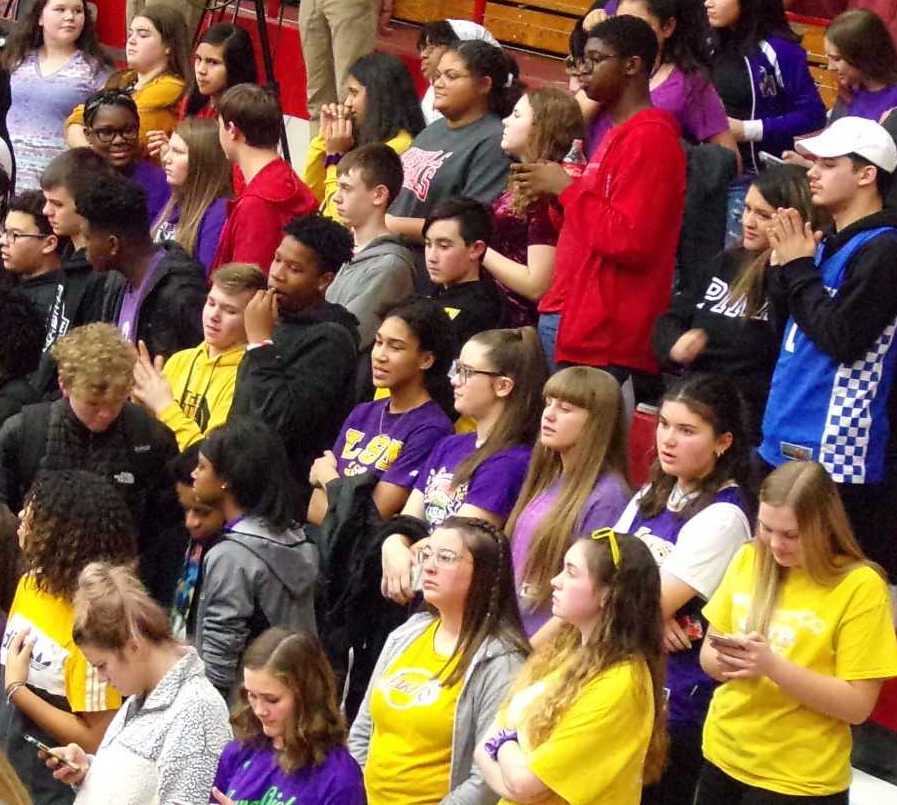
Enthusiastic chants and shouts echo from the stands where Jeff High pride shines through, blindingly bright. The stadium lights add a spotlight on the field, which highlights the players running the field.

Jeff High’s new student section, The Devil’s Parlour, holler and laugh with one another when a touchdown, or an infallible pass, is made.

After teaming up with Parlour, one of downtown Jeffersonville’s newest restaurants, the student section is looking to make Friday night lights a bit more fun for everybody. Parlour is a new pizzeria located in downtown Jeff, near the base of the Big Four Walking Bridge.

In order for the student section to bear the pizzeria’s name, The Devil’s Parlour, the exchange was that in return, Parlour will provide discounts on pizza every once in awhile for the students.

“We’re partnering with them, and trying to get multiple years of going with them, to get the student section better,” said senior Trey Bottorff. He, along with seniors Gerrin Moore and Jay Williams, were responsible for organizing and getting this endeavor off of its feet.

For two weeks, student section shirts were sold for $15, but are now unavailable for purchase.

The purpose of the shirts is so students can rep them at games and around school; if they can’t follow the weekly football theme, the shirt is the perfect alternative.

“It’s something to center around,” Moore said of the sponsorship. “Once people get there, then they realize what a great thing it is, so it’s just bringing more attention to it so that more people can get out there and eventually realize how great of a thing we have here at Jeff.”

Their main goal is to convince more students to attend football games. Moore hopes if they give students a satisfactory outlet to come to, then more will frequent the student section.

“I want to give students a reason to come to the game and enjoy themselves, and I feel that partnering with someone like that will allow us to get more things for our students in order to bring them to the games,” Moore said. “And once you start getting kids to the games, then they can enjoy themselves, have fun and want to keep coming back.”

student section
The Devil’s Parlour, with the cheerleaders, at the Jeff vs Floyd game.

Here 2 Stay?

story by Carlos Molina 

It is known as the Deferred Action for Childhood Arrivals, or DACA.

In short, it was a program for illegal immigrants who entered the country as minors to receive a renewable two-year window of deferred action of deportation and eligibility for a work permit.

This program, which was passed in June 2012 by the Barack Obama administration, protected over one million children from being deported after they were brought to the United States illegally with their parents. Those children, nicknamed “Dreamers”, were eligible for work permits and the chance to learn (and succeed) in this nation.

Fast forward five years, and major changes are on the horizon for the program.

On Sept. 5, 2017, the Donald Trump administration ordered the Department of Homeland Security to stop processing new applications, all but halting the program. In addition, Trump has since given Congress six months to come up with an idea for those children, or they will face deportation.

image1

In a statement made by General Attorney Jeff Sessions, he used controversial language calling these children “illegal aliens,” saying they have “victimized millions of American citizens with this unfair system.”

These words have offended many DACA recipients, including students at Jeffersonville High School. Senior Mayra Hielo-Venzor is a “Dreamer” and the program has allowed her to live life as a normal American teen until recent events.

“We call ourselves ‘Dreamers’ because that is what we are — we dream of having an opportunity in America,” Venzor said. “(DACA) was policy that enabled immigrants to study, have a job and simply be able to feel safe here. I say ‘was’ because that has now been taken away from us.”

With the end of the program, the impact will not only affect over 800,000 Dreamers nationwide, but could also hurt the United States’ economy if they are sent away.

“Many argue that DACA is unconstitutional, that we can’t just come to a country, and demand things. We were children and teenagers who came with family members,” Venzor said. “We didn’t do anything criminal. Instead, we went through background checks and biometrics. Now we contribute over billions of dollars to the economy.”

Even American citizens, like senior Adrian Blair, don’t see eye-to-eye with DACA’s removal.

“We, as Americans, should welcome those who wish to live and thrive in our great country,” Blair said. “Illegal citizens come to our country to have a better life. We should not make it hard for them because they are a different color, or come from a different lifestyle.”

The new order could also impact those currently enrolled in college, as well as others contributing to the work force. Children brought at young ages remember either little or nothing from their parent’s country.

”I believe that DACA should not be rescinded because it could potentially be detrimental to participating individuals and families, as well as to the United States,” said foreign language department chair Jenna Felix. “They are contributing to this country in a very positive way.  Without DACA, they would not be able to make these contributions.

“This country was built by immigrants,” Felix continued. “DACA recipients are, by definition, immigrants who arrived as children, therefore, the United States is their country and their home.”

In the upcoming months, Congress will have their hands full with creating a solution for the “Dreamers.” If not, millions of people could be forced to leave a place they’ve called home for their entire lives.

“We have the same dream as any American, only difference is that they have the resources and we do not,” Venzor said. “We are your neighbors, your doctors, your teachers, your military. We are your Dreamers.”

all photos submitted