Most Recent

COVID-19 Casts a Shadow Over Winter and Spring Sports Prep

Jeffersonville High School athletes are trying to keep in shape and healthy even as there are some concerns about how things will unfold this year with COVID-19.

Basketball, a winter sport, presents many challenges specific to the sport such as physical contact, touching the same ball, and being played inside. Sophomore boys basketball player Conner Lyons has some concerns but is ready to start the new season. He says his most pressing concern is “guarding people and close contact,” but Lyons’ concerns are overpowered by his drive to get back out on the court. “It’s always been my dream and that’s what I want to do when I get older,” he says. As of right now, the first game for Jeffersonville boys basketball is scheduled for December 5.

Members of the Jeff High baseball team, who have already lost their spring season this year, are trying to stay positive but realistic despite losing some senior talent. Baseball also has the benefit of being a more spaced out game that is played outdoors. Sophomore baseball player Sam Whallen isn’t getting his hopes up, saying, “we might not end up playing this season because of COVID.” The Jeff High baseball team’s first game is scheduled for April 2. 

Members of the Jeff High softball team are also trying to prepare for a spring season in 2021. Senior Danielle Monroe says the team is beginning winter workouts, which are different this year because of social distancing. Still, she feels like the effort will pay off in the spring. “I’m hopeful. I think we’ll have a season,” Monroe says. “I really hope so because it’s my senior year.”

The Indiana High School Athletics Association (IHSAA) has said the organization is committed to letting students play, saying they believe it is “essential to the physical and mental well-being of student-athletes to return to organized physical activity and build team relationships with their peers and coaches.”

Although every sport has its own precautions for the safety of players, coaches and fans, they have one thing in common: in the age of COVID, athletes are optimistic but unsure about the future.

Story by Caleb Vincent

GCCS Board Approves Revised Spring Semester Calendar

During last night’s meeting of the Greater Clark County School Corporation Board of School Trustees, school board members approved a revised calendar for the second semester of the 2020-2021 school year. The approved calendar is similar to what had been previously approved by the board — with the same dates for semester start, semester end, graduation, and spring break — but with the addition of seven additional e-learning days. 

The e-learning days will be asynchronous and will take place every other Friday. According to a message sent to parents and staff, these built-in days will “allow GCCS staff the ability to increase parent communication, hold in-person assessment opportunities for online students, and receive ongoing professional development.” 

In presenting the calendar to the board, Superintendent Mark Laughner called the plan a “very good compromise” and noted that the district is “trying to balance the needs of all stakeholders, which in this situation is very difficult.” He also noted that the Clark county health department or the state could require the district to switch to e-learning at any time.

The approved calendar preserves a two-week spring break starting March 22. The calendar does not call for e-learning over spring break. 

The majority of the discussion prior to voting was not about the dates on the calendar, but rather about how much notice and involvement parents should have in the calendar approval process. Board members commented that they had received two kinds of input leading up to the meeting: some parents and businesses asked for a quick decision on the calendar so they could make plans, while others pushed for more time to review the proposal before a vote. Laughner noted that with the exception of COVID-19 and moving to a balanced schedule, “we typically do not survey parents.” In the end, the board was split on their vote but did approve the calendar as submitted.

As for Jeff High students, they see good and bad sides of the plan. Junior Abby Napper said, “I wish they would’ve kept the 2 weeks on, and 1 week off, but I like it the way it is now.” Junior Benjamin Broady says the smaller number of e-learning days would be okay “if they weren’t so scattered in nature.” However, Broady noted, “I guess it makes more room for more instructional time.”

Written by The Hyphen News staff

Jeff High’s Confusing First Quarter

As students wrap up the first quarter, the hallways are much less crowded than in years past.

As the first quarter nears the end, Jeffersonville High School students are wrapping up a first nine weeks like none before. The school year began with a virtual week and there have been non-stop changes ever since. On September 25, Jeff High will complete its first quarter with more than one-third the days being e-learning and more than half of the student body working through MySchool Online. 

While the year has been abnormal, Jeffersonville High School Principal Pam Hall is proud of how the students have handled the changes. “I have been so pleasantly surprised,” says Hall. You [students] all have been so compliant, behavior has been wonderful. You all had a lot of changes thrown at you.” 

Hall also feels that the school has dealt with the challenges well and was well prepared for the situation. She says they are constantly getting guidance from the health department, and they have a well-tested system in place.

When Hall is informed of a positive test of a Jeff High student, she asks the student a series of questions to better understand their activities and how to proceed with contact tracing. This includes retracing the infectected person’s location to assess who they were in close contact with and to find others possibly infected. Then she lets the central office know of the case. The nurse determines the contact tracing time frame, and then in building personnel find and alert students that have been in close contact.

One of the most dynamic aspects of this school year is the decision-making on in-person schooling. While the decision is made at the district level, Hall says they decide based on the quality of work students would receive. For example, she cites the school closure for the week of August 17-21. For this week, many teachers were out for legitimate reasons and in looking at the numbers they came to the decision that students would be better academically served by an e-learning week. 

Despite cooperation from students, parents, teachers, and staff, some aspects of high school are impossible to replicate at this point in time. And for Hall, that’s what makes her most disappointed especially for the seniors. 

Looking forward, Hall would love to get back to a normal school environment, saying, “I miss the excitement. I miss all the things that come with school.” But she acknowledges the reality of this year.  “I don’t know if after this school year it will ever look like it did before.”

Opinion: We Are Reaching a Breaking Point

Opinion by The Hyphen Staff

Editor’s note: This piece was written collaboratively by the 14 members on The Hyphen staff. Since this group makes up 0.0067 percent of the student population at Jeff High, we aren’t exactly a representative sample. That being said, our job is to serve as the voice of the students — and we’ve done our best to represent every single one of you.

The alarm goes off at 6:00 a.m. Or maybe it’s noon. Or maybe there is no alarm at all.

The Google Classroom is overflowing with dozens of to-do items. Or maybe it’s just a few. Or maybe it’s none.

The agenda for the day is to log in to four Google Meet sessions. Or maybe it’s just two. Or maybe it’s none.

By the end of the day, we will have completed eight hours of work. Or maybe it’s just a few hours. Or maybe it’s none.

If there is one thing consistent about the experience of a Jeff High student during Coronavirus, it is inconsistency. Specifically, we have noted inconsistencies in:

  • Amount of work
  • Whether the class has live Google Meets
  • Whether Google Meets are required
  • When the Google Meets take place
  • When the assignments are due
  • Whether work can be turned in late

The result is that we are constantly dealing with conflicting priorities — and we are overwhelmed, exhausted, and confused.

Yes, we realize there are bigger issues. Because of Coronavirus, some students don’t know how they will get their next meal. Some are in abusive situations at home that they can’t get away from. Some are dealing with depression and anxiety made worse by isolation.

We can’t fix everything, but we can suggest some changes the school district could consider as a way to lessen stress and increase motivation:

1 – Standardize expectations. Do teachers have Google Meets or not? Are they required or not? Are assignments due in an hour or a day? Are office hours for My School students or everyone? When do office hours happen? What’s the best way to reach out to my teacher?

2 – Respect the block. Although opinions on block scheduling are mixed, we agree that it does help us focus. Please avoid posting to-do items for classes on their “off” day or having a Google Meet during another class period.

3 – De-emphasize writing. We are used to showing what we know in class, not just writing all day. Writing takes longer than speaking or thinking, and it is challenging for a lot of people who are otherwise good communicators. If there’s a way to have us show what we know without writing (for instance, draw something and snap a picture), please do that. It is more work to do everything in writing, and it just gets repetitive after a while.

4 – Keep our other commitments in mind. During a typical school year, students have other obligations that keep them busy: jobs, sports, household responsibilities. It’s no different with Coronavirus. In fact, many students are working more hours because their workplaces see “online” as “on call all the time.” Many are also taking on more responsibility for watching siblings and helping around the house. 

5 – Consider the impact of last spring. The entire fourth quarter was a dud for students. For more than a month, students were not expected to keep the same level of academic focus as we are used to. Most students didn’t even take final exams. Due to this, many are more likely to struggle. 

6 – Be kind. A lot of students are going through a really tough time. They don’t show it. They don’t say it. Yes, sometimes we let you down. Sometimes we get overwhelmed and can’t keep up. Please show forgiveness and kindness. We’re all trying to get through this and get back to “normal” (whatever that is). 

These times are not normal. It’s important to realize that the student body is simply a reflection of the world. We’re just as overwhelmed, exhausted, and confused about our future as adults are. We are just as eager for rays of hope, for a light at the end of the tunnel, for life “after all this is over.” 

Also, we know that our teachers are overwhelmed and stressed, too. We aren’t placing all the blame there. In fact, we want to say thank you to some of the people who make this difficult time a little easier. 

  • Mr. Densford, Ms. Paul, Miller and Martinez: Thank you for caring about how we are doing, not just what we are doing.
  • Mr. Hornickel: Thank you for keeping us engaged and active.
  • Mr. McDonald, Ms. Johnson and Mr. Robinson: Thank you for being clear and consistent.
  • Mrs. Rector, Mr. Wigginton, and Mr. Dench: Thank you for always reaching out and making sure everyone’s up to speed. 
  • Principal Hall and the Assistant Principals: Thank you for everything you are doing to keep us safe.

Jeff High Graduate Virginia Moore: “Shocking” Fame Provides a Platform to Help Others

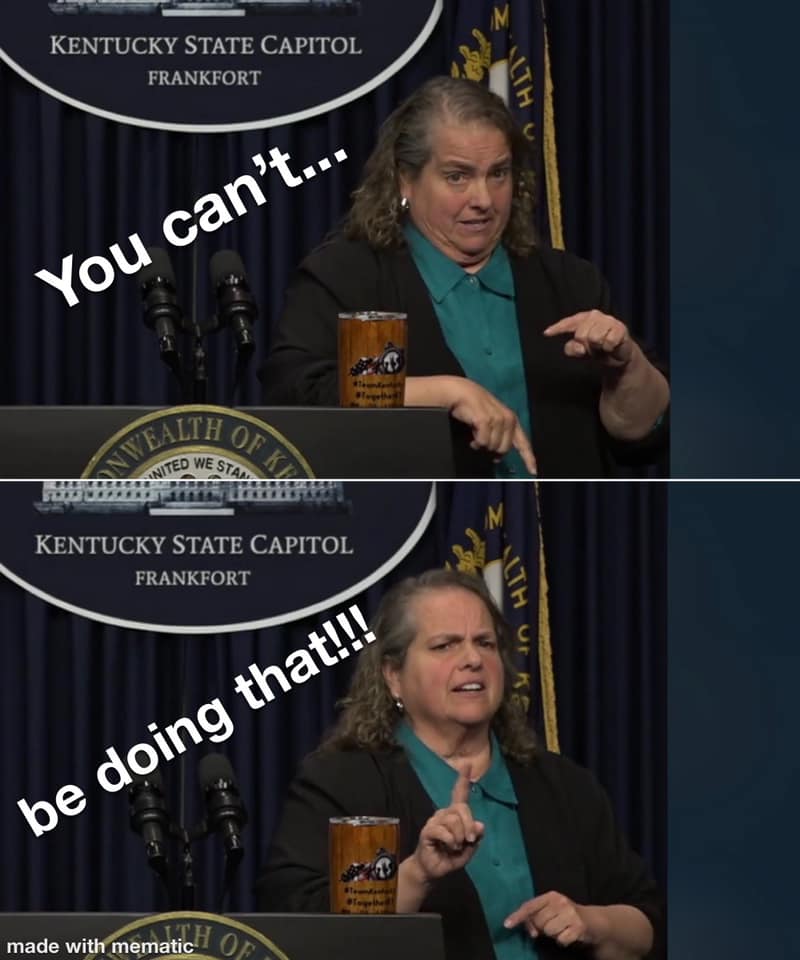
For many people in our area, Kentucky Governor Andy Beshear’s daily COVID-19 briefing became a staple of their daily routines. The briefings inspired virtual meet-ups, catchphrases like “you can’t be doin’ that” and even a meme group on Facebook that grew to more than 200,000 members. One aspect of the briefing — and the memes — that got a lot of attention is the sign language interpreter, Virginia Moore. However, most don’t know Moore is a Red Devil.

Moore grew up with both of her parents and two of her siblings being deaf. “My first language was sign language,” she says. However, leaving Jeff High she never thought her career would involve Sign Language, and after graduating in 1980 she attended Michigan State to study criminology.

Her plans changed when she came home from MSU after her father was involved in a car accident. She opted to complete her degree at Indiana University, and to pick up some extra cash she began interpreting for students. After going between different jobs, she would find her career path.

She became the interpreter for the Executive Director of the Kentucky Commission of the Deaf and Hard of Hearing. Over the years she worked her way through the agency, eventually becoming the Executive Director. The main operation of the agency is to provide advice to the governor’s office on policies affecting the deaf and hard of hearing communities.

However, it was only recently that Moore entered the spotlight as she began interpreting for the Governor at his COVID-19 briefings. 

virginia-meme
Jeffersonville High School graduate Virginia Moore gained meme-worthy fame as sign language interpreter for Kentucky Governor Andy Beshear.

While most of the attention she receives is for her interpretation, Moore and the agency continue to advocate for the deaf and hard of hearing during the pandemic, and it’s at times like these that their work is most important. 

Often, the needs of these communities are not factored in. For example, as the prison system was adapting to the pandemic they began issuing masks. However, many deaf and hard of hearing individuals rely on lip reading to understand others. So Moore and the agency advocated to provide clear masks.

While she has been busy, Moore has noticed the fame she has acquired, “It has been a little bit shocking,” she says. But Moore sees this publicity as more of an asset than anything else. “As COVID is a very horrible virus…there’s this little gold nugget. What we’ve been able to accomplish in the last three months is more than I’ve been able to accomplish in the twenty years prior,” she says.

Over the course of the pandemic, she says she has identified one thing more effective than any other: unity. Moore says, “In order to get something accomplished there is no Republican or Democrat… we can’t have these divisions at the beginning of something like this.”

But through it all she maintains an optimistic view, especially for students. Speaking to the Jeff High graduates and students she says.”This generation of graduates are truly the most creative… This is the one generation that everyone will remember.”

The History and Legacy of Jeffersonville’s Taylor High School

A forgotten piece of history stands at 821 Wall Street in Jeffersonville, Indiana. The two-story building is boarded up, the red bricks slowly losing their color. Over the entrance of the building are the cracked white words “City School.” To passerbys, this may not look like anything special, just a decrepit structure that has worn away over time.

This building is Taylor High School, Jeffersonville’s former African-American school. Built in 1891 and initially named City School, the school was renamed after Robert Frank Taylor (its first principal) in 1924. This building has seen the Great Depression, weathered the Great Flood of 1937 and was a school for the black children of Jeffersonville throughout segregation.

Though Taylor High School had the words high school in its name, it enrolled grades one through 12. The building was basic compared to the all-white Jeffersonville High School and it did not have indoor plumbing or heating.

Flora Clipper, age 97, attended the school from 1936 to 1940. “All of our education was segregated,” Clipper said. “We were always angry (and) unhappy at the difference between Taylor High School and Jeff High. We had no kind of gym, we had no kind of extracurriculars….We were always very unhappy about the condition of segregated schools….We wanted an education equal…to the white schools.”

While education changed as necessary for Jeffersonville High School, it did not evolve for those who were enrolled at Taylor High School. “Education had changed for the white kids,” said Clipper. “We were expected to keep with the same model that was started in 1892.”

In January and February of 1937, the Ohio River flooded and in the Louisville area, the river gauge levels rose to 57 feet. In Jeffersonville, 90 percent of homes were flooded. The majority of buildings had water up to the second story.
Because of the damage from what is now known as the Great Flood of 1937, many of Taylor High School’s students were hopeful that they would get a new school.

“There were many of the young people who said, ‘Now we gonna get a new school. I know we gonna get a new school,’” Clipper reflected. “They were disheartened when…we did not get a new school. Some of the boys never did come back after the flood. Because…they had to try to get work to help out with the families at home.”

For the black students, graduating from Taylor High School didn’t make a difference when it came to searching for jobs. “One of the difficult things was that, in those days, when you graduated from high school, that didn’t make any difference as far as your employment was concerned,” Clipper explained. “And I can remember the boys in our class used to always complain about that. Because at Jeff High…they were having other things that would make them employable.”

In 1952, two years before the Supreme Court case Brown v. Board of Education ruled that segregation of schools was unconstitutional, Jeffersonville’s school system was integrated. According to an article by the Courier-Journal that was published in 2009, the building was turned into Wall Street Elementary school, a school that enrolled both African-American and white students. However, the elementary school closed in the 1970s.

As reported by the Courier-Journal, on April 4, 2009, a historical marker was put in front of the building. Tom Galligan, the mayor of Jeffersonville at the time, declared the day Taylor High School Day. Later, Taylor High School was made a site on the Indiana African-American Heritage Trail.

The building stands neglected now, with the marker offering a brief summary of the decades of history the structure contains and represents. While it is easy to put off issues such as segregation as long ago, Taylor High School is a reminder of the past and a reminder of the injustices that African-Americans experienced.

Story and photos by Greta Reel
Archival research by Greta Reel and Jaida Bell

This slideshow requires JavaScript.

PDF: May 5, 2020

This year, everyone at Jeff High had plans for how the rest of the year would go. Freshmen looked forward to raising baby chicks in Mr. Reilly’s class and playing on a high school sports team for the first time. Sophomores looked forward to seeing their friends and performing in the spring musical. Juniors looked forward to their ring ceremony and prom. Of course, seniors had the most to look forward to, with all of the rituals involved in saying goodbye to high school and starting the next phase of their lives. We all had plans for the days, weeks and months ahead – and suddenly, those plans all went away.

From the beginning, we planned to end the year with our annual Senior Issue, featuring columns by current and former staff members of The Hyphen. Yes, the cover is inspired by the video chats we’re all part of lately. Yes, there is some coronavirus news, as well as an in-depth report on the science of conspiracy theories. However, from start to finish, it is what we planned all along: a tribute to the Jeff High Class of 2020. Enjoy.

Download PDF

Governor Holcomb closes Indiana Schools for the Remainder of the 2019-2020 School Year

On April 2, 2020, Indiana Governor Eric Holcomb announced all schools in the state of Indiana will remain closed for the rest of the 2019-2020 school year. Schools are required to complete 160 total instructional days (20 more after April 2). 

Students attending any schools in Indiana are still heavily encouraged to follow the social distancing measures and complete their e-learning work when assigned. As of April 2, there have been 78 total Coronavirus deaths and over 3,000 confirmed cases of the virus in Indiana. The best way to fight the sickness, Holcomb stated is to continue to socially distance as much as you can, and to avoid going outside unless for necessary means. An announcement from Greater Clark County Schools is expected Friday, April 3.

Indiana Governor Eric Holcomb Announces The Closure of Indiana Schools Until May 1

Holcomb will also suspend all state testing for the school year

Updated March 19 at 3:52

At a press conference on Thursday, March 19, Indiana Governor Eric Holcomb announced that all Indiana schools will be closed until May 1, 2020. Holcomb also announced that state testing, including ISTEP10 and ILEARN will be cancelled.  These changes come as a result of the spread of COVID-19, also known as the coronavirus.

The governor also noted the possibility of not being ready to return by May 1, and said, “If, and I stress if, by some miracle, we get students back this year, we’ll use that time in class for instruction. So I’m cancelling Indiana’s student assessments for this school year.” 

After Holcomb, Indiana Superintendent of Public Instruction Jennifer McCormick expanded on some of his proposals. 

“School closure to May 1… this is the first step,” McCormick said, “There may be a need to come back and revisit that.” McCormick also noted that it is just state testing being cancelled and not other non-mandated testing.

 McCormick said, “Our goal is to graduate (high school) seniors.” However, she noted that decisions for certain ceremonies will be made on a local level. 

On March 19, Greater Clark County Schools announced their plans for the time off. Weeks will alternate between eLearning weeks and Closed Days. On the weeks that students are off, they may continue to work on submitting assignments from the eLearning week before, but no new work will be assigned.

According to the Indiana Department of Health, there are currently 56 reported cases of the coronavirus in Indiana as of March 19, 2020. 

Story by Greta Reel and Max Fisher

Straight From the Source: Jeffersonville High School principal Pam Hall Discusses the Coronavirus

On March 13, 2020 Greater Clark County Schools, lead by Superintendent Mark Laughner, announced GCCS’s plan in response to the global pandemic, COVID-19 (Coronavirus). 

The plan states Greater Clark County schools will have:

  • e-learning until Spring Break (March 16 – 20)
  • regularly scheduled Spring Break (March 23 – 27)
  • no school (March 30 – April 3)

GCCS will also not have to make up the week without school following Spring Break. Indiana Governor Eric Holcomb has waived 20 days for all Indiana schools. This means the 5 days used  by GCCS the week of March 30 will be excused. 

Looking forward GCCS will make a decision for the week of April 6 – 10 by April 2. 

While the decision to close was made at the district level, Jeffersonville High School principal Pam Hall says her staff was already doing what they could to keep students safe. “Our custodial staff have been consistently using chemicals that would kill the virus,” Hall says,  “We’ve made a very calculated and very rigid routine of cleaning in between passing times…Making sure that those very common areas are being wiped down consistently.” She also noted that that the custodial staff will do a “top-to-bottom” clean of the school during the break. 

Jeffersonville High School Principal Pam Hall says the E-learning days should be like those done before at Jeff High, “It should just be very short assignments, no more than 15- 20 minutes.” Hall also noted that teachers like usual will be available to help during the course of the day. 

While district and other administrators have only made a decision for the next three weeks, many Jeff High students have expressed their concerns for future events. Whether it’s prom, graduation, or spring sports. Students are wondering what will happen following the three weeks. 

Hall says the administration hasn’t made any official plans that far forward, but she hopes to be able to deliver these experiences for her students. “I think that there are certain things that a student at any high school looks forward to,” says Hall, “We know that graduation and prom are two really big things…  and it is certainly something that we want to make sure happens for our kids. So they have that full high school experience.” Despite this, Hall says there are no concrete plans in place at the moment. For sports, Hall believes a lot of the decisions will be influenced by the IHSAA (Indiana High School Athletic Association.) But Hall, a former athlete and former coach herself, hopes for the best after the three weeks. 

When asked about the reaction to COVID-19 Hall doesn’t think the plan by GCCS is an overreaction. She says when looking at all the angles, “This makes sense.”

And Then There Were Three

Former Vice President Joe Biden takes the lead in the 2020 Democratic Primaries, while multiple candidates drop out of the presidential race.

Former Vice President Joe Biden has appeared to take the lead in the 2020 Democratic primaries following his surge on what is known as Super Tuesday. 

On Tuesday, March 3, 14 states (Alabama, Arkansas, California, Colorado, Maine, Massachusetts, Minnesota, North Carolina, Oklahoma, Tennessee, Texas, Utah, Vermont and Virginia) and one United States territory (American Samoa) held primaries and caucuses for the Democratic candidate in the 2020 presidential race. 

Biden surged, winning Alabama, Arkansas, Massachusetts, Maine,  Minnesota, North Carolina, Oklahoma, Tennessee, Texas and Virginia. Meanwhile, Sen. Bernie Sanders (I-Vt.) won Colorado, Utah and his home state of Vermont. Former New York City mayor Michael Bloomberg won American Samoa. Rep. Tulsi Gabbard (D-Hawaii) held one delegate.

According to The Washington Post, in order to win the Democratic nomination, a candidate needs 1,991 delegates. Each state has a certain number of delegates based on the population and the weight in the Democratic party. Based on the number of votes they receive, the candidate wins the delegates. 

Bloomberg dropped out on Wednesday, March 4. After failing to win any states, Sen. Elizabeth Warren (D-Mass.) dropped out of the race on Thurs., March 5.  Gabbard still remains in the race.

On Tuesday, March 10, primaries were held in Idaho, Michigan, Mississippi, Missouri, North Dakota and Washington.  According to The Washington Post, Biden took the lead in Idaho, Michigan, Mississippi and Missouri, while Sanders took the lead in North Dakota. Washington has yet to be called.

Biden has received endorsements from former candidates Pete Buttegieg, the former mayor of South Bend, Ind., Sen. Amy Klobuchar (D-Minn.), Bloomberg and as of March 9, Sen. Cory Booker (D-N.J.) and Sen. Kamala Harris (D-Calif.). It is currently unclear who Warren will endorse.

The presidential election between current President Donald Trump and the Democrat nominee will be on Nov. 3, 2020.

Story by Greta Reel