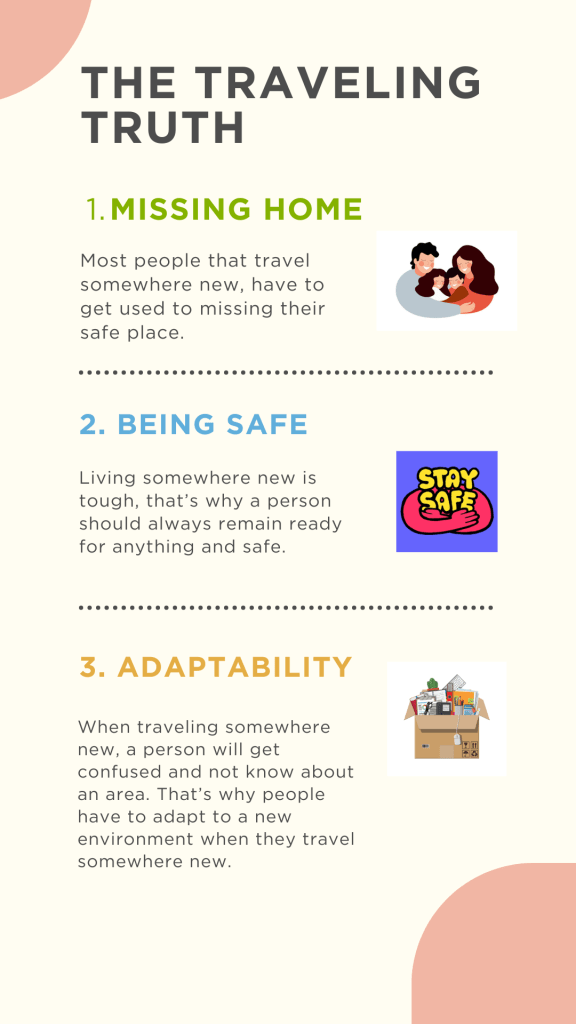
When I was younger, I yelled at my parents for not getting me what I wanted. Now, looking back at it, one can realize how much time has passed since then. Traveling to a new foreign place is tough, but going through it alone is even tougher. That’s why people should cherish the time they have, although they may not get along with someone else. Moreover, as a student who had to travel to a new continent, there are many key elements to be aware of. These key elements include being homesick, being safe, and getting used to the new environment.
A home is considered a safe place, or the people that make a person feel safe. And when a person travels somewhere else, they’ll miss their home and culture. Home is what makes a person feel warm and happy because they’ll always know that they have somewhere to go.
However, moving somewhere new takes that feeling away because a person will find out that it’s never going feel the same way it did. Additionally, that’s why most people get homesick the minute they step into a new place because they know it will never replace the feeling of home, which is why when a person travels to somewhere new, they need to be aware of getting homesick and being safe and getting used to what’s around them.
It’s important to be safe. An article by the United Nations states, “More than 50,000 migrants die in search of a better life.” From this article, we know that even though people travel for new opportunities, they should still consider the myriad amount of risks that come along the way.
Furthermore, people should also be aware when traveling, because it’s hard to predict what will happen that day. This is only to ensure the safety of people that travel somewhere new because it’s hard to get somewhere far away. This is why people should prioritize their safety when it comes to traveling and getting used to somewhere new.
Despite getting older, people still keep familiar habits. The National Library of Medicine states, “Creating a healthy home environment in infancy is critical, as home characteristics in early infancy (six months) may remain constant into toddlerhood.”
This could signify that traveling and living somewhere new can be compared to a baby getting used to their home. Additionally, when people travel somewhere new, there can be new experiences they haven’t felt before, which will give opportunities for people to erudite in new places. Because, in some places, there could be certain foods that aren’t the same as back home, and temperature and culture may be different. This is a feeling many travelers feel when they travel somewhere new to live in because in most cases they either travel to experience a new feeling or to do it for the benefit they desire.
In conclusion, traveling can be a tough experience. This is because traveling can make a person feel a thrill, along with many other feelings as well. On the other hand, key elements to look out for when it comes to traveling include being homesick, being safe, and getting used to the new environment. Additionally, moving somewhere completely new can be fun, but one should always be cautious no matter the circumstance.
Censorship, the most complex and confusing matter of the modern day. All of our life, we’re told that we have a voice. But in reality, do we?
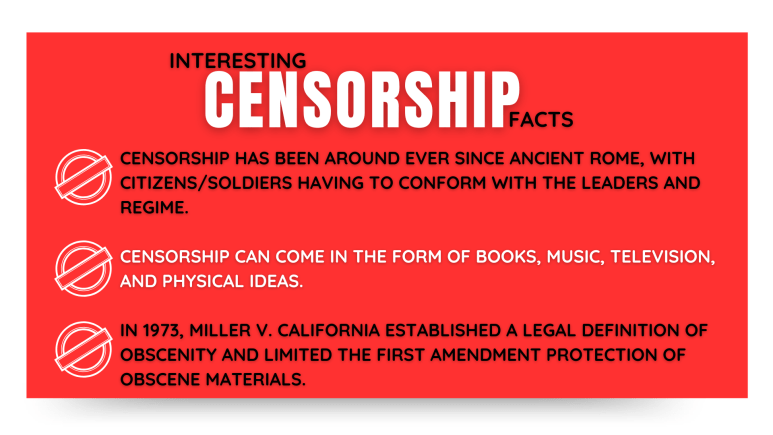
In the past millennium, so much has changed. In this new day and age, the media has changed so much. Over 5 billion people are on the internet at any given time, no matter the time of day. Ever since the internet was created in 1983, it has been monitored heavily, just like all other forms of media at that time.
All forms of media are under watch. And to a certain extent, it makes perfect sense, Freedom of speech and expression does not condone illegal activities. But, is it illegal to have the freedom of creativity and expression?
Youth have less and less of a voice everyday. The only way to change is to make people realize that our voices are just as important as anyone else’s.
In 1985, a group called the PMRC (Parents’ Music Resource Center) was created to monitor music and educate parents on what their children listen to. But, it wasn’t just a suggestion. It seemed more like a law. Headed by former First Lady Tipper Gore, all of the music coming out at the time had to pass through them.
Bands like WASP, Def Leppard, Prince, and Twisted Sister were no match for this organization. And to combat the oppression, some of these artists took to the stand to try and sway their opinion.
Twisted Sister singer Dee Snider was one of the most important and famous cases of the artists trying to take back their music. Twisted Sister’s song “Under The Blade” was the song in question that was going to have his album banned, for allegedly having topics the PMRC thought kids should not know about.
And sadly, all of the fighting was for nothing. They had all decided beforehand their final verdict. The music of the accused wouldn’t be banned, but parental advisory stickers were added to every CD deemed “Nasty” by the PMRC. This is an instance of censorship terribly backfiring.
Kids all over the United States were going out and purposefully buying albums with Parental Advisory stickers. Being a part of the youth today, I would agree that the advisory sticker is eye-catching; it makes me very curious about the material of the album.
Ironically, this almost 40-year-old incident still has relevance because it has not changed.
In March of 2023 in Boise, Idaho, an art exhibit was censored, and teens were told they could not testify in some legislative hearings.
Adults silence teenagers and young adults, telling them what they can or cannot see and listen to. And when young people try to say something about it, we are ignored and told we do know what we’re talking about.
I think there’s a stereotype that teenagers are not knowledgeable enough to speak up. Adults have lived longer than us, but we have the right to live our own lives. No one should have to conform to a certain idea or belief, yet censorship is a growing problem.
“We are seeing tremendous attacks on First Amendment freedoms across the country right now, at all levels of government. Censorship is proliferating, and it’s deeply troubling,” said Joe Cohn, legislative and policy director with the Foundation for Individual Rights and Expression.
And now, we can even be censored for being ourselves.
“This year, we’re seeing a wave of bills targeting drag performances where simply being gender nonconforming is enough to trigger the penalty,” Cohn said.
It’s understandable to dislike or disagree with someone’s idea, but being censored for being ourselves is becoming a serious issue, and it should not be. It’s no one’s business what I wear, what I say or who I am.
We have changed in the United States over the years. Youth have less and less of a voice everyday. The only way to change is to make people realize that our voices are just as important as anyone else’s.
No matter who you are, you have a voice. No one can tell you differently.
The recent Hurricane Helene destruction affected many places, including a town very close to my heart.
Chimney Rock, located in Chimney Rock State Park North Carolina, is a small village near the summit of one of many large mountains in the state. It is home to all kinds of wildlife, from King Snakes to Box Turtles; its large establishment has become a home for many animals and takes the necessary precautions to keep them safe.
Chimney Rock actually began with the Morse family, which owned the land the park stands on. After being privately owned for many years, the state of North Carolina decided to buy it from the family to be able to open it up to the public. With its gorgeous views and peaceful trails, its lively town, and welcoming staff, why not share it with other families too, and let them enjoy its wonders?
That is actually what motivated my family and I to visit it for ourselves. My father had actually talked so often about its beauty that we decided that the next time we visited NC, we had to go. And with that, we packed up our bags and hit the road. We had gone with some relatives who lived nearby, and I vividly remember looking outside at the nearby forests, the summer sun peaking through the tree leaves, its warmth on our faces with the sunroof open.
When first entering Chimney Rock, you get to drive past Lake Lure Beach where kids have fun all summer long, many kinds of different shops and restaurants where you can buy all sorts of souvenirs. You see families all hanging out, having fun, enjoying summer, and oblivious to how little time they have left to spend at such a captivating site.
Visiting Chimney Rock was the highlight of my 2024 summer break, and for a good reason, it gave us so many great experiences. The fun trails where my cousins and I laughed as we played silly games and talked about our lives. The waterfall where my sister fell and a kind worker cleaned up and aided her scraped knee. Or the cute shops near the beach where we spent our allowances trying to get all the fun souvenirs. And to top it all off, a delicious ice cream from a nearby restaurant after walking for hours exploring the park.
Everyone in my family had fun, which is why it came as a big surprise when a couple of weeks ago news broke out that the village of Chimney Rock was completely destroyed and gone.
What was once a lively town is now nothing but sludge, where vast amounts of water completely wiped it out.
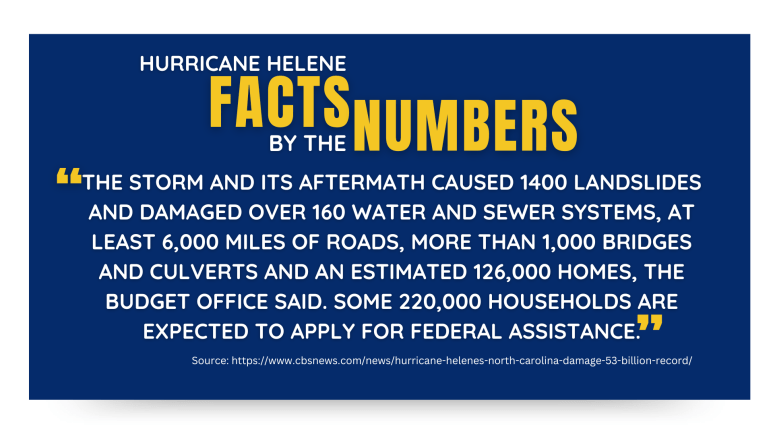
Hurricane Helene was a tropical storm that made its way across the southeast coast of the U.S. and into the Carolina states. According to an online article in the Economist, it was so devastating that in just the city of Asheville, NC, 35 people passed away and at least 600 residents are missing. WBTV stated that an estimated 20 homes were lost in the disaster, as well as 40 businesses.
Not only did it take the people and their homes, but it also trapped the survivors in its dangerous remains. Chimney Rock’s main roads and river banks were all flooded with debris, blocking any access to or from the outside world. In the same feature on WBTV, Mayor Peter O’Leary spoke of the irreversible damage and its lengthy recovery.
But this didn’t just happen in Chimney Rock. All around North Carolina towns were devastated by Helene. In a recent report by Axios Charlotte, North Carolina Governor Roy Cooper talked about the damage caused during the hurricane’s rampage, with around 30 and a half billion dollars worth of damage from flooding and winds, as well as a total estimated of about $53 billion, the largest monetary cost for a storm in the state’s history.
Hearing the news, my heart sank knowing that such a large portion of my family lived so nearby. Our home became a mess of phone calls and text messages trying to get through to someone, anyone, to see if they had heard back from my cousins.
We didn’t get a secure line until three days after the hurricane struck.
During the past weeks, there has been much commotion about the hurricane and the chaos surrounding many coastal communities. But what about the missing people, the wiped out towns, the lost families and homes of other states like North Carolina?
In early October the NC Department of Public Safety published a column depicting the aid the state has been receiving. It talks about search and rescue efforts that are ongoing in Western North Carolina, alongside coordinated efforts to restore essential infrastructure and deliver urgently needed food, water, and supplies to communities affected by Hurricane Helene.
While these efforts help aid needy communities, there is still so much more that can be done. There are hundreds of nonprofit organizations that you can donate to, not just for NC but to all communities in need of your help. Fannie Mae, World Vision, The Salvation Army, and the Kiplinger Foundation are all excellent examples of involved and effective organizations that specialize in the helping of others.
It is thanks to the help of the outside world that people like my cousins can stay in contact with us, they can live in a comfortable environment with food and shelter. It is thanks to the help and generosity of others that they can begin to try to regain a sense of normalcy in their lives, going back to the way things were before they were inundated by Hurricane Helene.
Just a simple act of kindness could help facilitate the lives of those in need.
As of Oct. 18, 2024, that is how much time we have left until our climate clock hits zero. Our carbon budget would be depleted and the possibility of devastating global climate impacts would be colossal.
The biggest contributor to climate change is the use of fossil fuels. They account for over 75 percent of all greenhouse gas emissions and just about 90 percent of carbon dioxide emissions globally. These gasses wrap around our Earth and trap the sun’s heat inside the atmosphere. This, in turn, raises our global temperature, causing global warming.
With the rise of global warming comes intense heat waves, melting of glaciers and ice sheets, and rising sea levels. These things directly affect us and our daily lives.
Just this past month there have been three hurricanes and one intense tropical storm in the Northern Hemisphere. Since Oct. 28, the storms have collectively caused at least 372 fatalities and more than $190 billion in damages. As the years go on and global climate change worsens, the destructive potential of these natural disasters will continually increase.
The effect that global warming has on the economy will also affect us negatively.
The social cost of carbon is an estimate, in dollars, of the economic damages that would result from emitting one additional ton of carbon dioxide into the atmosphere. It is currently used by local, state, and federal governments to inform billions of dollars of policy and investment decisions in the United States and abroad.
Studies by Adrien Bilal and Diego Känzig estimate that by the year 2050 climate damages could amount to 10-20% of GDP, with a social cost of carbon exceeding $1,000 per ton. Preventing future climate change is far cheaper than coping with its costly damages, but what can we do?
Climate change is a serious issue we all face today, but luckily there are many different solutions we can do to help reverse it before its effects become too much.
Keeping fossil fuels in the ground, investing in renewable energy, and restoring and protecting nature are all ways we can fix the climate issue. For some people, these solutions might seem too difficult and overwhelming but there are simpler options for everyday people.
Recycling and reducing the consumption of single-use plastics can be a great way to help stop pollution that causes global warming. We can also slow down how much we consume things like fast fashion, certain food products, and our transportation. Switching to electric vehicles and minimizing plane travel will not only help stop climate change, it will reduce air pollution too.
Doing these simple tasks can help keep our planet alive for many generations to come but we can’t do this alone. Only working together can make a difference, so why not give it a try?
“Coming together is a beginning, staying together is progress and working together is success.” Henry Ford
Music is everywhere. It is in the streets, our homes, concerts, radios, and our phones. But, why not in school? Schools should be one of the many places where music is allowed and even encouraged.
Music is an integral part of our lives. From riding down the freeway to washing the dishes, we can find music almost anywhere atany time. I have used music my entire life to calm myself and focus on tasks that may be hard or difficult. When it comes to music, it is very important to me and my overall well being to the point where I can hardly focus in class without it.
Did you know that exposure to music can improve learning and increase a positive classroom atmosphere?Active engagement in music promotes how the brain functions. It sharpens and refines language and speech.
Music has also shown that it has the ability to help children learn how to read. In addition several studies have proven that calming and engaging music reduces stress, anxiety, and aggressive behavior. Teachers need to take this into consideration next time they have a student that has trouble paying attention or getting work done on time.
The type of music also matters; students perform better when listening to music they perceive as calming rather than music that is perceived as more aggressive. By considering these elements, teachers can find intentional and responsive ways to integrate music into their classrooms effectively.
Regardless of your prior experience with music, there are many exciting possibilities for having music into your learning environment. Whether it is working to create a calm mood for focused work, liven up a lesson on poetry, or build community, music can be used to positively shape the classroom environment and support student thriving.
Having been chosen as an exchange student, people put high expectations on my adaptability, on my desires to open myself to people and be presentable to my fellow American neighborhood and people of other ethnicities.
It would be a lie to say that this adventure isn’t scary to me, to be all alone in a big English world, a world that isn’t mine nor made to be mine, but from the first time I took the flight to come here I should have known everything wouldn’t be easy.
After more than 24 hours of traveling with a connection to Belgium, in which I couldn’t rest because of the tumultuous plane that kept moving around (answer the call of Gotham was the best part of the trip, as having to binge three DC movies was so much fun). However, eating during the flight was a terrible idea — my stomach ache was my biggest misery of that adventure. But the real difficulty was to say bye to my family and friends.
This exchange isn’t about the school at any point, but if there was something I wasn’t ready for, it’s how American high schools really are.
American high school isn’t like in the movies, but it makes it even more authentic, even more realistic, even more loveable, and I cherish every minute I pass between JHS walls.
Exchange Student Sarah Baloucoune
Are American schools better than schooling in Senegal? Coming from a foreign country, the first thing that had me rolling on the floor was the reality of the American high schools, which are immensely different from how they are in the movies.
All over the world, an image is spread of the “perfect school” where everything is good and sweet with music, dances, and love stories. But in fact, it is much more complicated and different than that – and a lot more stressful, too. This makes it closer to my school in Senegal and the whole Senegalese education system than to the fantasy they want us to believe.
Senegal is a country within Africa that was marked by the colonization of the French empire. As a result, the school organization of that West African nation is inspired by the ancient French school system and modified to accommodate the Senegalese government’s desires, even if some of the lessons we are taught are more than unnecessary.
The differences between the American curriculum and overall coordination and the Senegalese school structure are multiple. One of them is that in America (or maybe just in the United States) the students have to walk through the hallways to get to their next classes. This was very weird and confusing at first because of this school’s immensity and the numerous rooms, making finding my way impossible without help or previous knowledge.
In contrast, in my home country, students are placed in the classroom with people based on their grade, and the teachers move each class period instead of the students. Teachers bring their material and teach their subject, sometimes with bags or nothing. It wouldn’t be a lie to say that the students prefer this format and take great pleasure in staying alone in the classroom when the educator is late or off duty.
Another academic divergence between the two schools is the usage of Chromebooks, which is revolutionary to a student used to writing on paper and can be seen as a blessing as much as a curse to everyone else. The positive side is that it minimizes the number of books and notebooks, and it makes rapport between the teachers and the students easier and the usage of the internet for research more practical than using books. This is pretty much better than the written notebooks, except that the computer needs to be charged to be useful.
To be honest, the usage of Chromebooks gives me “toxic boyfriend” vibes: I want to have it, it’s fancy, fast and looks so professional; however, when using it, I am much slower than with a pen. I need help to learn everything about it because there is nothing to make you understand it and without advice, you don’t learn anything. It’s just a mess to have to learn how to use a computer when people are teaching their subjects.
All those highlights of the not-so-important differences are here to show the actual gap between those two systems, being the whole organization of the schools. The biggest and most internationally known of them are the graduation system and the classes’ curriculum, those two being deeper problems covered by the Senegalese government and school accomplices.
In Senegal, to successfully graduate high school, you must pass an exam named Baccalaureate, just like in the French school system. The funny part is that to get into high school, you also have to do an exam called BFEM (brevet de fin d’étude moyenne); this time passing it or not doesn’t have a big impact on the high school experience but totally changes the university experience.
This exam was my nightmare because even before I started the ninth grade, people started putting pressure on me about it. Being constantly reminded of this left a bitter taste on my tongue, and the real preparation begins when there are 100 days left before the three days of suffering in the exam centers. It is more fierce and stressful than all of the middle school years. I succeeded in that exam, but I won’t forget how badly people put stress in my heart for an exam I was confident about for the whole school year.
The coordination of those national exams is pretty long but relatively simple since in most of the schools you don’t get to choose all your classes. As an example, in high school, you have to make one of the biggest choices of your life that will change your whole school experience, being the choice of the series. Students either choose the series S (in which you get to work more on the sciences and study the reality of the matters), or the series L (mostly turned to literature and philosophy or the study of human civilizations). Once students choose their series, most of the classes are already chosen for them.
I was placed in the scientific side but switched at the beginning of the 10th grade (first year of high school in Senegal); this was the best idea I had in a while. I may not be as good in mathematics as I would have been in series S, but my grades thank me greatly for that choice, and my mind and heart were still at ease by the end of the year. That change made me lose some school classes, but, hey, I did great that year, so that’s fine anyway (that’s also a reason why I am struggling in precalculus even if I had straight A’s my whole grade).
With all those realities, most Senegalese students fantasize about the so-called “main character high school” with all its dramas and romance, but even more because it got the reputation to be easier than in some other countries, not to say most of them. After all this intellectual talk, let me end this comparison with a little emotional note – there are a lot of more differences that I didn’t tell you about like the usage of the phones, which is forbidden in my school; the American cafeteria and its catalog of food that gives the students the choice of what to eat for lunch, which is totally different in most of my home country schools; and the freshmen who are still in middle school in the Senegalese organization.
I really am enjoying school in America, but I miss my home country school. I miss my friends and family even more, but I love this experience.
American high school isn’t like in the movies, but it makes it even more authentic, even more realistic, even more loveable, and I cherish every minute I pass between JHS walls. I will never forget the people I met here (big up to my sweet Senegalese friends all over the states and my incredible host family here).
Having been chosen as an exchange student, people put high expectations on my adaptability, on my desires to open myself to people and be presentable to my fellow American neighborhood and people of other ethnicities.
It would be a lie to say that this adventure isn’t scary to me, to be all alone in a big English world, a world that isn’t mine nor made to be mine, but from the first time I took the flight to come here I should have known everything wouldn’t be easy.
After more than 24 hours of traveling with a connection to Belgium, in which I couldn’t rest because of the tumultuous plane that kept moving around (answer the call of Gotham was the best part of the trip, as having to binge three DC movies was so much fun). However, eating during the flight was a terrible idea — my stomach ache was my biggest misery of that adventure. But the real difficulty was to say bye to my family and friends.
This exchange isn’t about the school at any point, but if there was something I wasn’t ready for, it’s how American high schools really are.
American high school isn’t like in the movies, but it makes it even more authentic, even more realistic, even more loveable, and I cherish every minute I pass between JHS walls.
Exchange Student Sarah Baloucoune
Are American schools better than schooling in Senegal? Coming from a foreign country, the first thing that had me rolling on the floor was the reality of the American high schools, which are immensely different from how they are in the movies.
All over the world, an image is spread of the “perfect school” where everything is good and sweet with music, dances, and love stories. But in fact, it is much more complicated and different than that – and a lot more stressful, too. This makes it closer to my school in Senegal and the whole Senegalese education system than to the fantasy they want us to believe.
Senegal is a country within Africa that was marked by the colonization of the French empire. As a result, the school organization of that West African nation is inspired by the ancient French school system and modified to accommodate the Senegalese government’s desires, even if some of the lessons we are taught are more than unnecessary.
The differences between the American curriculum and overall coordination and the Senegalese school structure are multiple. One of them is that in America (or maybe just in the United States) the students have to walk through the hallways to get to their next classes. This was very weird and confusing at first because of this school’s immensity and the numerous rooms, making finding my way impossible without help or previous knowledge.
In contrast, in my home country, students are placed in the classroom with people based on their grade, and the teachers move each class period instead of the students. Teachers bring their material and teach their subject, sometimes with bags or nothing. It wouldn’t be a lie to say that the students prefer this format and take great pleasure in staying alone in the classroom when the educator is late or off duty.
Another academic divergence between the two schools is the usage of Chromebooks, which is revolutionary to a student used to writing on paper and can be seen as a blessing as much as a curse to everyone else. The positive side is that it minimizes the number of books and notebooks, and it makes rapport between the teachers and the students easier and the usage of the internet for research more practical than using books. This is pretty much better than the written notebooks, except that the computer needs to be charged to be useful.
To be honest, the usage of Chromebooks gives me “toxic boyfriend” vibes: I want to have it, it’s fancy, fast and looks so professional; however, when using it, I am much slower than with a pen. I need help to learn everything about it because there is nothing to make you understand it and without advice, you don’t learn anything. It’s just a mess to have to learn how to use a computer when people are teaching their subjects.
All those highlights of the not-so-important differences are here to show the actual gap between those two systems, being the whole organization of the schools. The biggest and most internationally known of them are the graduation system and the classes’ curriculum, those two being deeper problems covered by the Senegalese government and school accomplices.
In Senegal, to successfully graduate high school, you must pass an exam named Baccalaureate, just like in the French school system. The funny part is that to get into high school, you also have to do an exam called BFEM (brevet de fin d’étude moyenne); this time passing it or not doesn’t have a big impact on the high school experience but totally changes the university experience.
This exam was my nightmare because even before I started the ninth grade, people started putting pressure on me about it. Being constantly reminded of this left a bitter taste on my tongue, and the real preparation begins when there are 100 days left before the three days of suffering in the exam centers. It is more fierce and stressful than all of the middle school years. I succeeded in that exam, but I won’t forget how badly people put stress in my heart for an exam I was confident about for the whole school year.
The coordination of those national exams is pretty long but relatively simple since in most of the schools you don’t get to choose all your classes. As an example, in high school, you have to make one of the biggest choices of your life that will change your whole school experience, being the choice of the series. Students either choose the series S (in which you get to work more on the sciences and study the reality of the matters), or the series L (mostly turned to literature and philosophy or the study of human civilizations). Once students choose their series, most of the classes are already chosen for them.
I was placed in the scientific side but switched at the beginning of the 10th grade (first year of high school in Senegal); this was the best idea I had in a while. I may not be as good in mathematics as I would have been in series S, but my grades thank me greatly for that choice, and my mind and heart were still at ease by the end of the year. That change made me lose some school classes, but, hey, I did great that year, so that’s fine anyway (that’s also a reason why I am struggling in precalculus even if I had straight A’s my whole grade).
With all those realities, most Senegalese students fantasize about the so-called “main character high school” with all its dramas and romance, but even more because it got the reputation to be easier than in some other countries, not to say most of them. After all this intellectual talk, let me end this comparison with a little emotional note – there are a lot of more differences that I didn’t tell you about like the usage of the phones, which is forbidden in my school; the American cafeteria and its catalog of food that gives the students the choice of what to eat for lunch, which is totally different in most of my home country schools; and the freshmen who are still in middle school in the Senegalese organization.
I really am enjoying school in America, but I miss my home country school. I miss my friends and family even more, but I love this experience.
American high school isn’t like in the movies, but it makes it even more authentic, even more realistic, even more loveable, and I cherish every minute I pass between JHS walls. I will never forget the people I met here (big up to my sweet Senegalese friends all over the states and my incredible host family here).
On May 4th, 2023, Governor Eric Holcomb signed the House Bill 1608 into law; this was after the bill got a vote of 65 to 29. Once 1608 was signed, it was put into effect on July 1st of the same year. Some may hear this and think that it isn’t important to mention this specific bill, but to those it directly attacks, well, they would beg to differ. House Bill 1608 was originally written as Indiana’s version of Florida’s “Don’t Say Gay” bill, yet it was changed once in court and dropped most of its parts that closely aligned with Florida’s original version, specifically changing the necessary consent for a name change. Sadly, that doesn’t mean that members of the LGBTQ community are safe from attack. For now, this bill specifically targets trans youth and their right to a private identity. It has now put children in possible danger, though the publishing group would like to say they only care about keeping the kids ‘safe’, and has even gotten rid of many people’s only public safe space. To numerous individuals, this is a ridiculously unnecessary law which ultimately does more harm than any possible good. And the problem isn’t just for trans individuals, but also people who just prefer to be called a shortened name.
The passage of House Bill 1608 truly shines light on a frustrating pattern of hits against LGBTQ rights and individual autonomy. While the advocates might try and argue that this bill is about child protection and prioritizing their safety, yet a slightly closer look, or even an interaction between these groups of people, reveals a thinly veiled attempt to undermine the personal rights of a vulnerable demographic. When interviewing someone, who would like to remain unnamed, they echoed the same sentiments of many, that since this law was put in place, they have felt more in danger than before because of how the notification of their chosen name being revealed could lead to harmful reactions from their parents (going against the entire supposed purpose of this bill). The publishing group’s claims of ‘protecting kids” ring hollow as their actions take away an essential lifeline for many. By stripping away this seemingly minor act of personal preference, the legislation highlights a bigger concern – the intrusion of the state into the private matters of their citizens.
By targeting trans youth and their right to a private identity, the legislation inadvertently perpetuates an environment of fear and discrimination, thus pushing these young individuals further into the shadows. The impact goes beyond just hypothetical issues, but it directly affects the sense of safety and community for LGBTQ youth in every aspect. The bill’s passage effectively erases what was once a sanctuary of self-expression – a public safe space where these individuals could seek refuge and affirmation, for once one section of the community is forced to take a step back, the others will surely be dragged behind as well. All of the people who were interviewed all stand against what they see as an unjust and harmful measure. The battle line has been drawn, and the discourse with the legislation, heard from people around our school, will undoubtedly shape the future of LGBTQ rights within schools and the state.
In the end, House Bill 1608 stands as a stark reminder that even in an era of progress, there are those who would willingly turn back the clock on personal freedom and equality. The consequences of this bill go far beyond its original intent, sparking debates about individual autonomy, safe spaces, and the fight for justice in a society that should be moving forward, not backwards.
Imagine this: you’re mindfully strolling through life in a cheery manner. All is well until you are met with an unwelcoming memory, a memory from the past that you look back on with regret, cringe, or even resentment.
The negative memory can be a variety of events. Was it about you saying some hurtful things to someone when you were in the heat of anger? Or was it that bitter time of feeling socially rejected by your fellow classmates at school? No matter the situation, it’s something that seems to follow you like a shadow. Frequently, the image pops into your mind and leaves you emotionally defeated.
This incident is, what I call, subconscious trauma, and from personal experience, it’s definitely not an enjoyable time when having its discouraging episodes. Fortunately, through time, I’ve found a solution in how to cope with these negative thoughts.
When feeling an episode starting to come on – i.e. thinking about a memory and sensing my emotions toward the subject: I seclude myself to a quieter room, sit down and close my eyes, turn on meditation music through my phone, and begin talking to myself.
Firstly, I admit the negative emotions I’m feeling and the trauma I’m having. Then, I focus on navigating myself through the situation by talking about a potential solution to the problem and remind the positives about myself.
The sessions of mine are usually a tremendous success with moving forward.
Of course, there are other plentiful methods in coping through such a problem, and this is evident through the several students of Jeffersonville High School I had the chance to interview.
The following Q & A is from my interview with a Jeff High Senior:
Q: Do you have any bad memories that haunt you? If so, would you mind sharing?
A: Honestly, when my dog passed away. It really affected me.
Q: I’m sorry for your loss. What was your dog’s name?
A: His name was Shadrach. It’s a biblical name. He was the best dog I’ve ever had.
Q: How does it make you feel when the memory pops up?
A: It makes me upset and reminisce on the good times we had together.
Q: How do you cope with this bad memory?
A: Whenever I’m upset about the memory, I write. It’s very peaceful and relaxing. Whenever you write, it’s like being in your own world.
In my interview with a Jeff High Junior, the student expressed how there was indeed a negative memory that haunts them in life, and how they feel upset and even humiliated when reflecting back on the moment. In their copings, they found journaling and communicating with another person to be the most therapeutic.
These different techniques of different students show how there is no official “right” way to cope through a personal crisis. Everyone is unique, but we struggle similarly at the same time, and that should be a comforting fact to know of.
Another helpful mechanism that many also look to is seeking mental evaluation through a professional (counselors, therapists, psychologists, etcetera).
If one’s subconscious trauma appears more severely dire, or struggling with unhealthy coping habits, this solution is the most appropriate for that situation.
Mental health still carries a plethora of stigma. It isn’t easy for one to reveal their vulnerability to others or even themselves.
However, today’s climate has become more accepting in acknowledging such problems, and its door is something that will most likely continue to open as time progresses.
June 2022: It was a dark time for many Americans across the nation, as on the 24th of that month, the Supreme Court had issued a decision concerning the Dobbs v. Jackson Women’s Health bill, overturning Roe v. Wade. The protection to the legal right to abortion was eliminated; with this, numerous states had begun to ban the rights and access to abortion.
On September 15th, 2022: The state of Indiana, my home-state, fell victim to this deadly decision of a bill. The mere exceptions of legal access in Indiana are in the the cases of rape, incest, fatal fetal abnormalities, or to preserve the life and physical health of the person who is pregnant before 10 weeks after conceivement.
I vividly remember the time it had all occurred. Ads, social media posts, news segments, and YouTube videos capturing images of those fighting in protest, or in support of this controversial bill. I recall many clinics being ushered to shut down in response, and the unwavering sound of victory at my evangelistic church. In addition, my church has recently implemented a drive to donate infant products and necessities to a pro-life organization for “mothers in desperate need”.
I am here to express my anguish and disgust at such passing of a bill, how morally wrong it is in many ways, and how this option in mind must be the pregnant woman’s decision, not the government’s.
Many opposers will try to express how abortion is the murderous hunting of innocent unborn children. How the women who are proceeding with abortion are selfish, cold-hearted vipers. How clinics such as “Planned Parenthood” are greedy corporations who are unapologetically open about eliminating unborn life.
According to “KFF’s ‘Key Facts on Abortion in the United States’”, data before the Dobbs decision had gathered that a vast 92% of abortions occur during the first trimester of pregnancy. With this knowledge: we know that in the first trimester in a woman’s pregnancy, the embryo or fetus is a clump of biological molecules undergoing chemical reactions. Therefore, this leads us to the idea that this “baby” is not considered truly living.
Those who seek abortion as an option are a whole spectrum. They go through the procedures all for differing reasons. It is an immense injustice to label them and envision them in a negative light. “Planned Parenthood’s ‘Our Abortions, Our Stories’” shares the anecdotes of women from around the US, giving their reasons as to why they chose the path they did. One woman said in the article, “My stepfather abused me from age 8 to 17. At 15 I became pregnant and lied to my mother that it was my boyfriend’s. I had an abortion because the mental and physical abuse continued afterwards…”. Another lady said, “When I was 20 I had an abortion. Being so young and barely getting by financially, I was in no position whatsoever to have a child…”. A third said, “…At age 31, I had a 3 ½ year old son and was pregnant with my second child… My husband and I found that the baby had several heart defects. We went to see several specialists to see if his heart could be fixed after he was born. They told us that he would live and grow in utero, but would die after birth… We decided to spare him the suffering and interrupted the pregnancy at 22 weeks.”
“Planned Parenthood” is a health organization that has a 3% abortion service, with the majority of their work consisting of STD testing and treatment, cancer screenings, infertility services, and offering sex education. To get an abortion through them, the organization has you meet with your doctor, nurse, or health counselor to discuss whether abortion is the best decision for you. Even if one is adamant about going through the procedure, they emphasize that they will halt everything if you change your mind, even as far as the surgical removal. With these facts, it shows how precise and supportive Planned Parenthood is, and always looks to the best interest no matter what one decides.
“Capital B”’s Kenya Hunter gave insight on a reproductive rights group launching a campaign, and also gave how they advocate that abortion bans are racist against the Black community in America. The group, known as “Unite for Reproductive and Gender Equity” or “URGE”, had its Georgia organizer say, “We aren’t just strictly coming from a lens of what’s happening with our wombs or with our uterus,.. [Abortion bans] have a trickle-down effect. People with low income have to bring in another child that they can’t afford. The point of the ‘Abortion Bans Are Racist’ campaign is to make sure the conversation isn’t just about abortion… but how does this further create disparities within our communities?”. Additionally, their campaign had researchers who predicted to them that with more people forced to carry out their pregnancy, this will result in increased risks in bad maternal health. As a Georgia-based news organization: Hunter points out how the state’s Black women are already three-times more likely to die from pregnancy-related complications than White women.
As of 2023, only three US states have the right to abortion in full status. These states being California, Michigan, and Vermont.
I, like many others, find this decision from our Supreme Court to be disappointing and discouraging. This is a reminder that our country still has room for improvement regarding a human’s right.
We cannot change the mind’s of every individual, but if we can show the Supreme Court the dangers to this passed bill, perhaps they can reconsider this injustice.
Fortunately, we are not alone in this protest. As Kenya Hunter had discussed, URGE’s ‘Abortion Bans Are Racist’ campaign is just one of many groups fighting against this ban.
This isn’t based on a viewpoint that is politically-motivated, and with the harms that this ban is capable of as mentioned: it is unavoidable to point out its concerning flaws. Kaelea Lucas, the Georgia organizer for URGE, said it best; “The decision of what somebody does with their body and whether or not they are going to get an abortion ultimately should be between that person, family, and maybe a medical provider if that’s what feels comfortable to them,… But who should not be involved is the government. There should be no political reasoning for anything like abortion bans.” Banning the right to abortion sends the wrong message to so many. It silences voices, gives misinformation about clinics like “Planned Parenthood”, gives ignorance to the idea that “babies” are being “killed”, and drastically affects the Black community in health and finances. With this ban and absurd claims continuing to be established, we are going to do more harm than good toward women and their overall health.
Getting into the arts can be a challenging quest, whether it’s getting the ideas or actually putting said ideas into the world. In this time of confusion, I believe that having a rubric of restrictions can be the support that lifts creativity to its highest form. Having a set of rules to follow can help ideas flow, it can be a more relieving position, and help the artist try new things.
Many can agree that one of the most difficult parts of the arts is creating the idea, yet when you have to work your way around certain things, then it can be an easier way to find the path that will lead you to a fall of ideas. Restrictions put in the building blocks, then the artist can complete the designed task, and after they are able to push certain aspects (that aren’t restricted) to make the piece their own. It can also help cut down on decisions that are put in the artist’s hands, so they don’t get overwhelmed and burned out as quickly by the overflow of creative ideas. As stated by Thomas Oppong in his article about creativity, on Inc., “With constraints, you dedicate your mental energy to acting more resourcefully. When challenged, you figure out new ways to be better.” Having a specific direction for where your energy can go can help you get more ideas and thus the artist goes through a slower decline in their rate of ideas.
Instead of having total freedom and being surrounded by stress from blankness in the creative department, you are able to get a new point of view which can help you get a better understanding of different techniques for a new set of tools. Some may say that with restrictions, it can be difficult to fully shine because of the choices being so limited, and they aren’t entirely wrong. When creative rubrics are too restricting, it can lead to the same amount of problems that having too much freedom contains, extra stress to stay in the lines and lack of related ideas. It’s just like everything else, too much of anything is bad. Yet when these placements are done right, it can be extraordinarily beneficial for the artist. As said by Jason Bell, an Associate Professor of Marketing at Saïd Business School, “When well placed, constraints can force us to step out of our mental comfort zone and connect a schema to something new. This can very often lead to innovative ideas”.
Unclear directions and the fear of experimentation can hold many people back, including the need for near perfection is a craving that many artists, whether new or old, chase after for years. When using restrictions in your craft, it will give you clearer directions, help you be forced to try something new, and it can push you to slowly become ok with not reaching the status of perfect perfection. A batch of restraints can not only force you to try something new, it can also help you focus and create better ideas then you would have before. An article published by the official Harvard Business Review helps to support this claim by stating, “Constraints, in contrast, provide focus and a creative challenge that motivates people to search for and connect information from different sources to generate novel ideas for new products, services, or business processes”.
With all these reasons, it is clear that adding in restrictions can be extremely beneficial. From how it helps increase idea flow, how it leads to less pressure, and finally how it can help artists try new ideas that the artist normally wouldn’t try otherwise. So if you are ever stuck, try adding in some restrictions, and don’t be afraid to try something new.
Jeffersonville High School’s lunch is not the best thing in the world. I have heard many things about their lunch, and many say it’s equivalent to prison or jail food. I believe that JHS can improve their lunches in many ways. So in my article, I will be sharing my, and others, opinions on how they can improve their lunch. I will also talk about the price of lunches and why everyone’s lunch should be free.
One big issue with the food that they serve us students is the overall quality of the food. To start off, the chicken patties that they serve are very dry and bland. Secondly, the fries they serve us are usually half frozen still and undercooked. And the biggest problem, the food is either undercooked or overcooked. Though, not all things are bad about their food, their pizza is one of the better things they serve, and seems to be one of the more popular things amongst students. Finally, we serve the same thing everyday, except for the experimental kitchen line, but they serve the same thing in that line as well.
Now, I’m going to share some opinions of students, and my own on how they could really improve what they do and make. For me, I think if they actually paid attention to how long they keep things in their ovens, the food would turn out a whole lot better. One of the things people told me was to add variety, one of the foods people said they wanted to see a lot more was chicken nuggets and tacos, which I can agree on. Cainen Skaggs, a sophomore said, “Use fresher ingredients and food.” This is a very great idea, since many people complain about the food being bland, adding more seasoning and such would greatly improve the food. A fellow friend of mine, Cooper Pickles, said, “Adding more lines, so food can get to us faster.” One main problem is how long the pizza line can take, and many people on Monday are eager for Papa Johns, so having maybe 2-3 lines for pizza would be amazing. A senior I questioned said, “Letting students sell our own snacks” Letting students sell their own snacks would be cool, it could tie along to having more variety of what you can eat, and students would really like it.
“Lunches are equivalent to gas prices” this quote describes the price of lunches best. A lot of students in the school are enraged to say the least about lunches costing more. For some students in the building, lunch is the only meal they may get to eat, and they may not have money to pay for their food. I know that some students get their food for free, but why can’t EVERYONE get their food for free in school?


 thehyphennews.com