Column: Bleak generative AI cannot replace genuine handmade media

by Sam Ottinger

AI has had an ever increasing prevalence since OpenAI’s introduction of DALL-E in January of 2021, and ChatGPT in November of 2022. It has been a popular addition to company websites, search engines, and social media platforms.

The presence of artificial intelligence is nothing new, for Tik Toks “For You” page is able to be what it is due to the use of AI to personalize recommendations for each user. This is similar to X, formally known as Twitter, that also uses this same type of algorithm-based timeline, starting all the way back in 2016.

Yet the current use of generative AI, now not just relying on analyzing existing data, but instead using this data to “create” text or images, is more invasive than it has ever been.

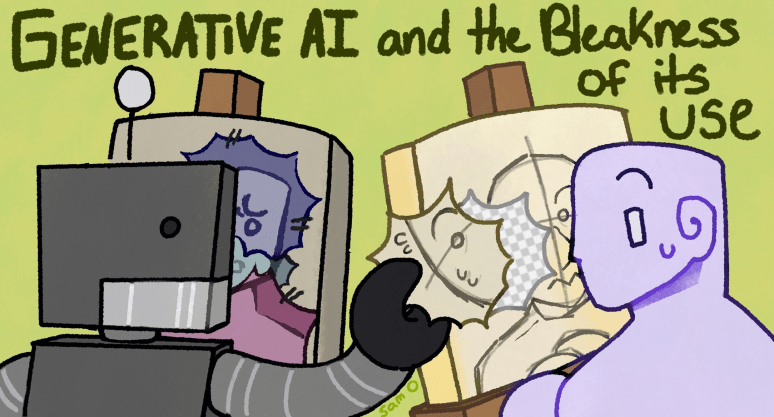
Art by Sam Ottinger.

It’s hard to go onto any major platform without running into generative AI being implemented within it. Search engines like Google have Gemini, website creators like Squarespace have Squarespace AI, and social media companies like Meta have Meta AI.

Many of these inclusions come with a lesser known contract to those that use it. For some companies, this use of AI features gives them permission to use the users data to train their AI models.

Even those that don’t use these tools, or specifically opt out of this use, can still have their work used against their will.

This has been a major problem for many creatives, especially with the presence of popular generative AI websites like DALL-E 2, Midjourney, Craiyon, and recently ChatGPT. Each using datasets, often scrapping images and artworks from artists and photographers all over the internet, in order to produce images that try to replicate their human creation.

Generative AI isn’t just used by a subset of individuals; it’s also found its home through different social media trends.

Some have participated in generating turnarounds from an image, also known as the microwave trend, while others have used it to turn themselves into dolls, mimicking the style and packaging of Barbies or classic action figures. Yet most recently there has been a trend of turning images into the style of Studio Ghibli, using ChatGPT.

This latest trend has caused the most controversy. Hayao Miyazaki, a co-founder of the aforementioned studio, has been outspoken of his dislike of AI since all the way back in 2016. In a documentary called “Never-Ending Man: Hayao Miyazaki,” he comments on an AI-generated demo shown to him, stating that AI’s use is “an insult to life itself.”

This dislike of the technology producing these images has caused many Ghibli fans to be concerned about the disrespect of using AI to copy the hand drawn and intricate style of the real Studio Ghibli – only producing a cheap soulless copy.

The hate on generative AI isn’t only for the stealing from others’ works; it’s also the way its presence has been used to put down the creatives that made it. Many who swear by AI-generated images boast about the quick generating speeds and how it puts out near “perfect” products in that shorter time frame, ignoring the true meaning of creating something through your own living hands.

Without genuine human creation in the world, there would be no data for these AI models to rely on, showing the hypocrisy of this belief that generative AI will somehow ever replace the value in handmade media.

Review: The Doors’ debut album achieves perfection from top to bottom

by Tyler Conley

Before the release of the first album, way before the legacy and creation that The Doors became, no one, not even the band themselves, would realize the lasting impact they would have on the music industry and rock and roll as we know it today.

The Doors first got their kicks of being a band in 1965, playing small venues, with nervous frontman Jim Morrison turning his back on the audience as he sang to avoid stage fright. Also included were Ray Manzarek at the helm of keyboard bass and organ, Robby Krieger laying down chords and bluesy solos, and John Densmore putting down rhythms unmatched and unheard of at the time. This lineup would stick together until the eventual breakup of the band. 

When 1967 struck, it was time to record the first record. For 10 thousand dollars a 4- track recorder was purchased. With the help of Paul A. Rothchild, the band began their sessions for their self-titled debut. Rehearsal outtakes were recorded of songs that would appear on later records, but the first actual songs recorded were “I Looked at You” and “Take It as It Comes.” 

Graphic by Tyler Conley.

With the combined power and input of all band members, the band completed recording. “Light My Fire” became an instant success, reaching #1 on Billboard charts, along with “Break on Through (To the Other Side.)” At the time The Doors arrived, rock was in absolute infancy, especially when compared to today’s standards for what “rock” is. With a mixture of blues, soul, rock, and everything in between, this album is a gem for anyone a fan of those genres. 

Morrison’s lyricism is a big factor in what makes the music magical. His outlook on life, his expressions of feelings and ideas are perfect. The final song on the record, an 11-minute epic, details fighting past trauma and getting over the past. Most of the love songs the Doors would write on this record and many more are about Morrison’s longtime girlfriend, Pamela. 

Over Morrison’s life, controversy has played a big part in how people perceive him. People label the singer as a drunk, and stupid. But behind those bad, vulnerable moments is a person who was caring and compassionate. Back in the 60s, mental help wasn’t as easily accessible as it is now.

This album changed my life when I first heard it. The beautifulness of “The Crystal Ship” And “End of The Night,” and the killer tunes of “Break on through (To the Other Side)” and “Twentieth Century Fox.” These songs, and much more, make up one of the best debut albums of all time.

And if that alone isn’t enough to pique your interest, artists like Jay-Z and Lauryn Hill have sampled The Doors’ music in their works. The Doors are respected by every genre, and heavily influential.

The Doors are engraved into the heart of rock and roll, and the music industry as a whole. Jim Morrison, and all members respectively, are like cosmic brothers, and their music is there for the listener whenever they need it. When people are strange, music will always be waiting with open arms, and this album is no exception. Top to bottom, perfection.

Column: Hateful rhetoric paints immigrants in an unfair light

by Ifrah Daber 

In the past few months, anyone who is paying attention to the news has seen how the conversation surrounding undocumented immigrants has been stealing headlines. Sadly, these discussions have been another example of loud misinformed hate-filled rhetoric from people who attempt to paint a group of individuals as the main problem with America. 

Immigration, even when done through the legal process, has always been a hot-button issue. Still, with mass deportations and debate as to whether undocumented immigrants should be afforded the same rights as “real” Americans, the quiet part that racist people have been screaming about for years is finally out in the open:

“You aren’t a person unless you look and act like me.” 

People might call me dramatic, but this has been how America has set up its immigration policy for decades now. The Immigration Act of 1924 was an immigration plan that set quotas and heavily restricted immigration from Asia and certain European areas. Why was this? A fear of change, and a fear of those who are different steers this mentality of sweeping racist ideology. 

And this hasn’t changed, it’s simply been repackaged. An immigration policy in 2017 that is commonly referred to as the “Muslim ban” made it so that countries that were majority could not travel to America. But it has been repurposed again in the current Trump Administration with a colored tier list for which countries can and cannot travel to America.

Those who have seen the list will note just how strict the travel ban is – and that the majority are from Muslim countries. These restrictions that feed the mentality of danger that those from these countries are inherently more harmful than others are insulting. 

Many claim other reasons for why they think undocumented immigrants, or just high immigration in general, is harmful to America. Immigrant restrictionists claim that undocumented immigrants are a drain on the economy, but this is simply an unfounded belief. 

The American Immigration Council found that undocumented immigrants paid around 90 billion dollars in taxes. The research found by Congress in “Effects of Immigration on the Economy” from 2024 shows that in the long term, immigrants help the workforce and lead to innovation. The Council of Foreign Relations even found that the “nonpartisan Congressional Budget Office estimates that increased immigration could reduce the U.S. federal budget deficit by some $897 billion over the next decade.” 

So those who claim that immigrants are a detriment to the U.S. economy simply do not actually understand the immense benefits that immigrants bring by boosting the economy and doing their part for society just like anyone else. 

The other main argument against undocumented immigrants is that they are criminals and are coming here illegally. That statement in itself is incorrect. 

Entering the country without proper documentation is not a crime. It is a civil violation, so immigrants are not “illegal.” Some may call that semantics, but if you are stopped for speeding, you would probably care to know that it’s not a criminal charge. 

This second idea that all or most undocumented immigrants are criminals is a fear-mongering tactic that people are falling for and have been for centuries. 

The American Immigration Council used data from the FBI and the U.S. Census Bureau and did not find any correlation between higher levels of immigration and an increase in crime levels. In addition, the National Institute of Justice presented a study that argued that undocumented immigrants are less likely to commit crimes when compared to native-born citizens, or citizens born in America. 

So where did the idea that immigrants were violent or dangerous come from?  Well, there are multiple factors, but in the end, it all boils down to two things: racism and the logical fallacy of hasty generalizations. 

Society sees one person of color or undocumented committing a crime and they believe that somehow is a representation of all undocumented immigrants. However, this is partly the fault of the media and the way that immigrants and people of color are portrayed. Often when a person of color commits a crime, the first thing in the headlines is their race. Crimes are a reflection of the person, and yet people expect their whole race and demographic to pay the price for it. 

The last ethical fallacy is the “breaking into my house” analogy, that those who enter America without the proper documentation are unwelcomed guests in their home, and that if they were to “break in” to another person’s country or home that they would have to leave.

Here’s why neither of these examples works. First, if you were to destroy someone’s home, and then they came to you asking for housing from the destruction you caused, I believe you would have a moral obligation to house them. That’s a more accurate description of the situation that America is in. America has taken resources from other countries for years and yet now acts shocked when these countries’ citizens are suffering and wish to leave. 

The other issue with the comparison of “if I was just going to another country” is the same reason there is a difference between the man who steals to buy a new phone and the man who steals to feed his family and survive. If someone goes to another country just to have a fun vacation and overstays their visa or commits a horrible crime and they get deported, I’ll cry no tears. The problem is distinguishing who is here with good intentions and who is not. ICE and the whole Trump administration have shown time and time again that they aren’t taking the proper steps to give each immigrant the due process he or she deserves to hear each case out. 

But why does this matter? Well, as I said at the beginning, if you have been paying attention to the news there is a clear rise of immigrant hate in America. This is happening for all the reasons I have stated, and it’s why people are cheering when people are being thrown in cages. It’s why people who have every legal right to be in America are treated like criminals, and it’s why people argue if undocumented immigrants deserve basic fundamental American rights – because all the issues I’ve described circle back to the dehumanization of immigrants. 

For some invisible reason, many believe documented and undocumented immigrants do not deserve due process, a right that is guaranteed under the Constitution. Too many believe that young immigrant children do not deserve lawyers to defend themselves, and that they are guilty until proven innocent. 

The direction that America is going to take is scary for anyone who chooses to care. Undocumented immigrants are not criminals – they are afforded all the same rights that any other person would receive. They are human, and that should be enough to make us feel horrible for what is happening. The fact they are human should be enough. 

Column: Make Mother’s Day count with love and time

by Brian Juarez

As the second Sunday in May approaches, so does one of the most cherished holidays of the year: Mother’s Day. Set for May 11 in 2025, it’s a time to pause our busy lives and reflect on the women who raised us, guided us, and sacrificed for us in countless quiet ways.

Mother’s Day isn’t just about flowers, cards, or brunch reservations (although those are always appreciated). At its core, it’s about appreciation—real, deep, and personal. It’s about taking a step back and recognizing everything our mothers and mother-figures have done, often without thanks or fanfare. From sleepless nights to being our biggest cheerleaders, mothers show up in ways big and small every day.

This year, maybe it’s worth asking ourselves how we can make the day more meaningful. A phone call or a thoughtful letter might matter more than an expensive gift. Recreating a childhood memory, cooking her favorite meal, or simply spending time together without distraction can be just as powerful.

For those who no longer have their mothers with them, this day can carry a quieter, more emotional weight. Lighting a candle, sharing stories, or visiting a special place can be ways to honor their memory. Grief and gratitude often live side by side on Mother’s Day.

It’s easy to take for granted the steady love of a mother, but this day reminds us to hold it a little closer. No matter how old we get, there’s something grounding about a mother’s voice, her advice, or just her presence.

As the saying goes: “A mother is she who can take the place of all others, but whose place no one else can take.” – Cardinal Mermillod

Let’s make this Mother’s Day count—not just with gifts, but with genuine love and time.

Column: Reading is beneficial for the brain

by Daysha Gray

Hypothetically, open a book. Read a few sentences. Did it benefit the brain?

We all know that reading is good for people in general and helps us understand words and different scenarios, but how does it positively affect our brains?

Reading is the process of looking at written symbols and letters and understanding their meaning. It exposes us to new knowledge and vocabulary in our minds. It introduces us to a new world, sparking creativity and fostering cognitive thinking. 

Taking out 15 minutes of the day to read at least 25 pages a day strengthens our brains and critical thinking skills. According to the Boston Children’s Hospital, reading can rewire the brain, create new neural networks, and strengthen the white matter in the corpus callosum, which enhances communication between the two brain hemispheres. This allows us to process information more efficiently, allowing us to learn faster.

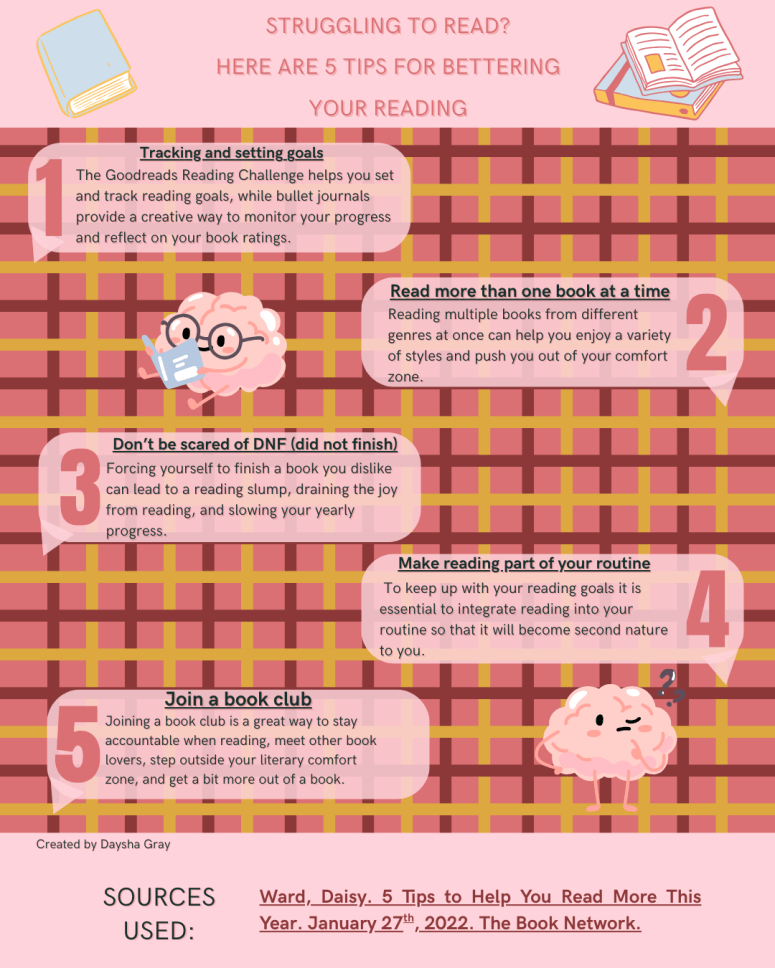
Here are 5 tips for how we can better our reading:

Column: The solution to problematic people is for all of us to be kinder

by Breann Jackson

Problematic people are the most annoying people you will ever meet and hear from in this world.

What is a problematic person?  According to the Dictionary, problematic is when someone is tending or likely to elicit objections or disapproval, or offensive. It can come from other people, for example, your friends, influencers, or a president. Being problematic is being a toxic person, especially when there are people out there who tell you that you are but you don’t care. 

These people can be easily marked as the most common trait, negativity. But most of them don’t make it obvious. Of course, when you’re having a conversation with someone, you would want to make your first impression with positive vibes,  but the more you build your relationship with the person, the more it starts to crumble.

Problematic people mostly come from being manipulative. They see the relationship we build with them as a waste of time, so they’ll just play a selfish action and start to use us. They are lying, feeling dry whenever they’re near, tricking our minds, and blaming us for things they did. 

You may not have experienced this but you can see it through TV and movies and how it is portrayed through characters. For example, Angelica Charlotte from the cartoon show, “Rugrats.” She is a 3-year-old spoiled brat who’s rude to the main characters and manipulates them into bad behavior but acts like an angel in front of the adults. Edward Cullen, from the movie, “Twilight,” doesn’t take the main character’s feelings seriously or set boundaries. 

Being problematic doesn’t have a specific place or time, it can happen whenever we go. If we’re going to work, school, a restaurant, or inside a store, someone could be seen as problematic by their actions. Since there are billions of people around the world, there is no chance that we will avoid these types of situations. But we can solve it.

How can we treat people better? We can try to be nicer and kinder. Being rude is going to cause more problems and make you similar to the person of this topic.

Column: Year-end projects create stress for students

by Sophia Waldridge

In middle school teachers will tell students that high school will be a lot harder and feel longer because of how much work is assigned; and they are not wrong. JHS students are starting to feel the pressure and are realizing how hard school really gets towards the end of the year. 

Freshman Mahalia Smith said the work is getting so hard that she is far behind. “Teachers assign so much work all at once with such a short amount of time to do it before the due date, and it causes students to panic and give up with getting work done; it’s too much.”

However, English teacher Eric Watson disagreed, saying, “Having many assignments all at once allows the students to practice essential skills like time management, multitasking, and prioritization; students should test their limits. It’s good for the mind.”

With personal experience I can agree with both sides of this argument, but I myself am stressed with the workload that the teachers have put on students the last couple of weeks left in school. I feel teachers should have meetings where they agree to do a week-long project in each class until the very last week of school; not all at once.

Another freshman, Calob Somoro, agreed with Watson. “All the assignments the teachers have assigned are easy. Most of them are just slideshow projects that take no longer than a day to complete.”

English co-teacher Michelle Houchin is one of the teachers that sees the situation from a student’s point of view, but since she is also a teacher like Watson, she thinks that a student should never give up on getting assignments done.

“I understand that students receive numerous projects and homework assignments daily. Knowing this and the fact that many students have after-school obligations, I do not assign big projects or any homework, and I communicate with my classes,” said Houchin.

In my honest opinion, I do not think that teachers assign too much work, but I do think that they make the work a little too hard sometimes and they expect students to get it done in less than a week. 

I struggle with keeping up with work a lot of the time, so I can truly relate to these students  and their concerns, but I also try my hardest and know that students should trust their teachers and remember that they’re not here to hurt us, but just to make us better and help us learn more for when we’re older.

Column: White House group chat reveals what we should really focus on

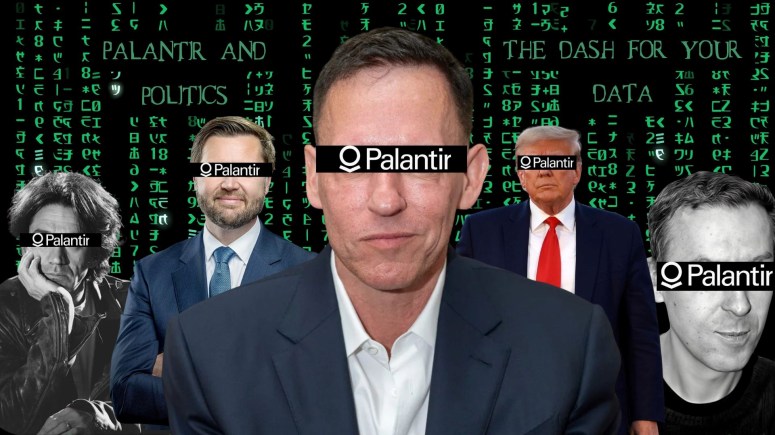
Art by Sam Ottinger.

by Tyler Anthony

Once again the fascistic phenomenon that is the Trump administration has made headlines with its incompetence. On March 24, Jeffery Goldberg — former IDF prison guard and editor-in-chief of The Atlantic — reported that he had been added to a Signal group chat containing members of the Trump Administration. 

The group chat discussed the bombing of the Yemeni supposed terrorist organization “The Ansar Allah,” also known as “The Houthis.” Goldberg assumed it was nothing but a prank until the bombs actually started falling. 

The Atlantic article and other large media corporations responded to this situation by attacking the incompetence of the administration. Yes, it is incredibly ignorant management, but the texts themselves should be subject to scrutiny. 

The media has not responded to the plain-as-day texts that speak of a situation that involved bombing a suspected terrorist’s girlfriend’s entire complex, only the boyish behavior exhibited in their words. None of these media organizations have responded to the casual bombing of civilians. Therefore, none of the media should be trusted.

It should go without saying that the situation in the Middle East is extremely nuanced and should only be approached with an understanding of each of these group’s actions, goals and effects they have on and within the region. 

So, who are these groups?  

The American and Israeli governments, and Hamas and Ansar Allah, who have all exploited the Yemeni and Palestinian people, through ruthless violence and extremist ideology.

The media remains very removed from the Ansar Allah, referring to them by the name of their now dead ideological figurehead, Hussein al-Houthi. We must ask ourselves: Why does the media so simply write off one group as the terrorists? Why do corporate media conglomerates swing radically to the right, but swing only moderately to the left? What changed in our culture to incite this?

Of course these questions are all indicative of wider systemic issues, but the skepticism should still hold when dealing with how we identify groups of people. Why do the masses accept that the Ansar Allah are simply radical terrorists, while our government and its allies are not. 

But how could I say this? Well, let’s define some terms.

The United Nations classifies terrorism as “criminal acts, including against civilians, committed with the intent to cause death or serious bodily injury, or taking of hostages, with the purpose to provoke a state of terror.”

Merriam-Webster defines “radical” as something relating to the root or origin, fundamental, extreme, or favoring extreme change, often used in political or social contexts. 

The Ansar Allah is an insurgent group in Yemen. The attacks they have perpetrated on cargo ships in the Red Sea — often referred to as simply “The Red Sea Crisis” — are from their point of view to stand in solidarity with Palestine and the genocide in Gaza. However, the U.S. government frames them as terrorists. 

The claim from the U.S. government, in Donald Trump’s own words, is that the Ansar Allahs “piracy, violence, and terrorism” had cost “billions” and put lives at risk, that it is Iran who is funding them. Iran denies this, claiming purely ideological support. Notice how the first concern was the money. 

In the text messages within the White House group chat, these infantile men casually gloat and exchange emojis, while talking about the bombing of a suspected terrorist’s girlfriend’s apartment. How could you say this isn’t inflicting terror? So many lives were devastated and taken in an attack on someone who was suspected a radical terrorist and judged as such.

My point isn’t to moralize the Ansar Allah, but to compare what they are being labeled as to the U.S. government. And, yes, I am talking to you, the average U.S. citizen. I do not acknowledge the oppressive actions and propaganda of our government as indicative of my true beliefs of Truth, Liberty and Peace. 

These ideals are not utopian or naive. They are the future, a future we can all start building to. 

Column: Cultural grants are essential to building bridges between nations

by Sarah Yves-Baloucoune

When politics starts touching social life, it doesn’t always turn out well.

From his Jan. 20 Inauguration to the writing of this article, Donald Trump has signed 75 executive orders, primarily focusing on government reform, immigration, border security, and more. 

His policies started with the legal recognition of only male and female genders by signing executive orders proclaiming that only birth assigned sex matters. Ever since the beginning, he had the idea and opened a manhunt for immigrants, even citizens if they have no proof of citizenship on them at the moment, but also Native Americans because the tribal IDs don’t count as proofs to Immigration and Customs Enforcement (ICE).

His actions were questionable, like firing and un-firing nuclear workers, but in this article, let me present to you one of the lesser known but still present realities of people being put at risk due to the cutting of funds. 

 In a society built on money, we will always find a group in need of support. In a world built on international relations, we will always find a country that is overlooked, such as the less rich and popular developing countries like mine, Senegal, but also more famous ones like Argentina.

The funds given by the government were financing non-profit organizations like Child Protective Services, as well as scholarships and grants.

Cultural grant students are students chosen by the host country to share their cultures and impact their local communities in order to create bonds and make friends and families around the world. 

However, exchange students are in great dread. 

The funding cuts have affected the lives of thousands of students in high schools and colleges. The system of grants for students depends on government funds.

“Cultural grant students are students chosen by the host country to share their cultures and impact their local communities in order to create bonds and make friends and families around the world.” 

They create bridges between countries and communities, opening people’s minds to diversity and helping people know and discover the unity of each culture and take the best of each to make life better.

What if these bridges didn’t exist? 

The world would be doomed. In a world like ours, making peace with everyone is the only way to survive. 

What if a country with a lot of resources decided to collaborate with a country that has a lot of knowledge? Two spirits making one strong body is the best way to improve and make life easier. 

The development of the world would have been pretty much slower if the relations between countries weren’t as good as they are now. As an example, people around the world have access to plastic, which was created in Belgium, or petroleum, which is from Saudi Arabia.  

Without these diplomatic exchanges between them all, there would be no long and cheap conservation of products with plastic containers, no fuel for the cars and machines with petroleum, nor a lot of small objects we all have in our lives like scissors, gardening tools and sewing equipment.

But with the new policies, nothing is sure. The kids who were supposed to be connections between two lands and create a friendly bond between the two countries might never come.

As a result, the home country and host country might not work together again and, even worse, stop acknowledging the existence of one another. 

Until today, the future of the grant student programs is unknown, and this may be the last time we will see grant students in the U.S.

Column: Fascism slowly seeps into America — What is to be done?

by Tyler Anthony

There is an oligarchical, absurd, and distinctly American phenomenon that has been plaguing this country. U.S. Fascism is the biggest danger to societal freedoms and signifies the fraudulence of “The American Dream.” We must recognize this. This is the road our leaders have walked us down, but by letting go of their guidance we can forge a path to far more individual freedoms and real liberty.    

The U.S. Empire was built on the back of exploitation. The moment the pilgrims began their slaughter of the Native Americans, the spirit of U.S. Fascism was born. The pilgrims needed a class to oppress to contribute to the British Imperial machine.

120 years after that, slaves were brought in from Africa for the first time. 160 years after that the U.S. invaded Mexico. 15 years after that the country was so split on slavery that they warred over it. Hundreds of thousands of people lost their lives because the rich didn’t want to give up their free laborers. The rich couldn’t stop themselves from engaging in the cruelest of human behavior in exchange for the gain of capital. 

The one institution that separated the power of capital from the power of politics was democracy. That separation has become smaller and smaller with every passing year, and now we’ve found ourselves fully submerged in a Fascist Oligarchy. A country that once revolted against the powers of imperialism now stands as the biggest imperial force on the face of the planet. Our ruler is a venture capitalist who conned himself into the presidential role, then was bought out by Elon Musk.

Over $250,000,000 was donated to the Trump campaign. To the average person, that money would completely change the course of their and their families’ lives. To Elon this was just .07% of his wealth. How could you be the single most powerful man in America and still be for the people. The answer? Elon is not. Trump is not. 

Feux-Populist rhetoric has elevated the status of Elon Musk and Donald Trump among Republicans to working class heroes. They have an iron grip on the government and culture and are inching us closer to World War III. This is a scary thought, yes, but it’s time to consider the fact that this may really be the road we’ve gone down. 

In fact, during the creation of this column there have been two major events that have dipped us further into fascism — Trump’s trapping of Zelenskyy and his aggression against Greenland. Inviting Zelenskyy to be disrespected at the White House was anything but a subtle tell of whose side he’s on. Nor is his praise of Russian Oligarchs as “Very nice people.” 

This poses the NATO question. What does Europe do if America leaves NATO? Europe has been very vocal in support of Ukraine. If America secedes from NATO then nothing stands in its way. Trump has been very open in his imperialist rhetoric. His talk of taking Greenland “One way or another “ should strike fear into the hearts of our politicians, but as long as the heavy wealth of the lobbyists lines their pockets, no one will take a stand. 

We can’t rely on politicians; we have to rely on the community. We need to take America back from the ground up.  Put aside our grievances with each other and fight fascism. Politics has become far too much of a popularity competition. It’s time to retake it as the people’s voice. 

Become involved in your community. Write articles for it. Get involved in homeless shelters, even run for office — anything to have some real populist control in this country.

The rapid escalation of Trump’s presidency into a fascist oligarchy has happened at such an incredible rate that we have got to put away social differences to fight this or we will all pay. Except the ones who have the money.

Column: Government vs Business: a Look at Elon Musk in Government

by Ifrah Daber

Elon Musk, standing as the current richest person in the world. His wealth amounts to over 300 billion dollars, according to the Bloomberg Billionaires Index as of February 2025. He found his success in companies like Tesla, SpaceX, xAI, and Xcorp, along with the social media app, formerly known as Twitter. 

Due to this success, his strong shift into politics and especially his outspoken support for President Donald Trump in this most recent election was sudden, especially given his moderate views in the past. He tweeted in 2018. “To be clear, I am not conservative.” He stated that he was independent and voted for Democratic candidates for many years. So when he opened his wallet to give over 250 million dollars to Trump and his allies campaigning last year, it was directly opposed to his past words and opinions.

These new opinions and support, also came with a new position in government, a brand new department, focused on making the governments spending more efficient. Appropriately, they named it The Department of Government Efficiency, DOGE for short. 

Given Musk’s new position in the Department of Government Efficiency, some Americans have seen this as exactly what the government needs to handle the high costs of living and lower their taxes. However, others see this as completely unethical and a blatant disregard for middle-class Americans in favor of the 1%. 

To understand both sides, one has to understand exactly what both sides believe and how Musk’s actions are perceived, along with what exactly he has been doing since his appointment as a special government employee. 

A special government employee is a role in Congress that allows branches of government to bring in employees temporarily for specific roles. They are usually used as consults and can only work for no more than 130 days in a year. 

So what power does that give Musk? Mostly, he is the same as any government employee. He can be given information, including sensitive information, if it is relevant to his job. So he was fully in his right as a special government employee to have access to the Treasury Department payment system, since he’s employed to try to find out how to make the government, specifically the economic side, more efficient. 

Some lawyers are concerned about this role for Musk, especially given the possibility of him breaking the rules and laws of his position. Specifically, critics worry about the Hatch Act, a federal law that was created in 1939 that prohibits any department employees, including special government employees, from engaging in partisan political activity while performing their duties or on federal property. 

On Feb 11, Musk went to the Oval Office wearing a “Make America Great Again” hat, which might have been a violation of the Hatch Act. However, the Office of Special Counsel, which would be the one to enforce the law, has not made an official announcement on Musk’s choice of hat wear.

However, the Government Executive, a news site, has quoted Laura Nagel, an employment lawyer who represents federal employees, to say that she views the use of “political paraphernalia” as a violation of the Hatch Act. So there is a debate on the topic, but nothing official has come of it so far. 

But Musk’s wardrobe aside, most of his supporters care more about what he has promised and not what he chooses to wear. Musk has taken the responsibility and his focus on cutting waste, using the Department of Efficiency as his way to do so. At the first Trump Cabinet meeting, Musk spoke of how the American debt is unsustainable and that America will go broke without some sort of drastic change. 

“That’s the reason I’m here,” Musk stated in regard to the national debt. He said he was confident that he could find 1 trillion in savings. He claimed that his efforts were motivated by saving money for the taxpayers. 

This position is one that many hear and naturally support, especially given the rising cost of living for average Americans. A poll done by J.L. Partners in late February found that around 60% of Americans viewed their tax dollars as wasted by the government, and 67% supported DOGE’s purpose to save their tax money. In addition, a Harvard Caps/ Harris poll found that over 70 percent of Americans support the U.S. Government Agency focused on the efficiency initiatives, and along with 60 percent believe that DOGE is helping cut major government spending. 

However, 58% of voters in Harvard Caps/Harris say that DOGE should not have access to sensitive information on Americans that benefit from government programs, such as names or social security numbers.

DOGE has claimed to make large progress in this; they posted receipts on their website “doge.gov” having a total of 65 billion dollars in savings, but there are discrepancies in the actual amount that has been saved, including mislabeling amounts, claiming they saved 8 billion in ICE contracts when it was 8 million, as well as reportedly listing the same 650 million savings from a contract with USAID multiple times as new savings. Along with other inherent errors, many were called out by media organizations like CBS and Politico. 

Musk has prided himself for being transparent, which is the original reason he created the website. He acknowledged these errors at the Oval Office: “Some of the things I say will be incorrect and that should be corrected.” 

Despite these inconsistencies, he still praises his organization and himself. He spoke at the Conservative Political Action Committee, wielding a gifted chainsaw, claiming it was a metaphor for how he would “take a chainsaw to bureaucracy.”

So, what exactly have DOGE and Musk accomplished?

Starting early, Musk started using tactics that are similar to when he took over Twitter, now “X”. He immediately tried to downsize, to get rid of any employees and programs that were deemed to be a waste, it being “obvious,” he’s quoted as saying. He sent out emails demanding that employees of multiple departments list the tasks they completed, as well in some instances revealing names and titles of people that he wants to cut, making them public targets for the people. Musk and Trump have also tried to freeze Congress-approved funds, an illegal act. 

But what likely is the most controversial is that it’s clear that those who support DOGE want fast change and are willing to deal with the “temporary hardships” that Musk stated would come for ordinary citizens. A perfect example of the “ends justify the means” is that even if there are some mistakes, to many, it is seen as a necessary investment. 

Though there are still many against Musk and DOGE, many of their reasons are through the lens of political ethics and the possible red tape that DOGE has crossed in pursuit of it’s goal. 

 New Mexico representative Melanie Stansbury spoke out directly about how she condemned the actions of DOGE. She said in her opening statements at a Subcommittee meeting, “Donald Trump and Elon Musk are recklessly and illegally dismantling the federal agencies, shuttering federal agencies, firing federal workers, withholding funds vital to safety and well-being of our communities.” 

Other Representatives, such as California representative Robert Garcia, said, “We should not stand by as the richest man on the planet gives himself and his companies huge tax cuts while the American people get absolutely nothing.”  

Many of these ethical concerns are made worse given how much Musk’s companies have received in funding from the government, along with how closely his companies work with the government. Elon Musk has reportedly received at least 38 billion in federal contracts, loans, subsidies, and tax credits, according to data from the Washington Post, including a reported 456 million dollar loan from the Department of Energy. Throughout the years, the amount of money he’s received has grown.

The White House Press Secretary, Karoline Leavitt, when asked about the possible conflicts of interest, simply said that Musk would determine for himself if there are potential conflicts with his business. With very few checks and balances, many are anxious that Musk could run rampant with no one to stop him.  

This has led to many states suing Musk and President Trump on the basis that the authority he had over DOGE was unconstitutional. 

Arizona Attorney General Kris Mayes even referred to DOGE as “the whims of a single unelected billionaire.” Mayes argued that the Appointments Clause of the Constitution was violated when Trump created DOGE since the agency was created without congressional approval and gave Musk too much power as a special government employee. 

“He has transformed a minor position that was formerly responsible for managing government websites into a designated agent of chaos without limitation and in violation of separation of powers.”

Currently, 14 states have sued Trump and Musk over what they believe is an abuse of power. The large concern for them is clear: the idea of such a wealthy man in government is unethical, and he is given too many privileges. 

There is also controversy of the programs he’s already cut, from slashing over 80 independent research contracts at the Institute of Education Science, firing FEMA (Federal Emergency Management Agency) workers, the explanation being that the organization was allegedly spending money on housing migrants in hotels. DOGE also fired workers at the National Institute of Health that focused on dementia research. 

The USAID organization, that is focused on providing humanitarian resources around the world, was targeted by DOGE, Musk claiming it to be a criminal organization,  and that funds are used for deadly programs. Though many of USAID’s programs that are frozen greatly impacts millions around the world. This including but not limited to, clinics in Africa for HIV patients, and the “Safe Mobility Offices” in many South America countries, a plave were migrants could apply to be legal citizens.

Though DOGE’s said goal is to get rid of waste and corruption, many who oppose Musk would argue that these programs are anything but waste, that they are vital to those who depend on aid from the United States.

Which side you stand on depends on how you view Musk, how you view his position, and if you believe that he can make ethical decisions given his position. It’s clear that the people need a change, that there is frustration in the cost of living, but is DOGE the answer to that? Or is this hatchet style of cutting funding going to do more harm in the long run for the people?  We the people will just have to wait and see.

Column: Loving the single life: Fun ways to celebrate Valentine’s Day solo

by Brian Juarez

Valentine’s Day isn’t just for couples — it’s the perfect time to celebrate self-love and independence. While the world may be filled with heart-shaped chocolates and romantic dinners, being single doesn’t mean you have to miss out on the fun.

This day can be an opportunity to treat yourself, spend time with loved ones, or indulge in activities that make you happy. Whether it’s a solo adventure, a night of relaxation, or a gathering with friends, there are countless ways to make the day special.

So, instead of dreading Feb. 14, here’s  a list to do on Valentine’s Day single:

  • Buy yourself a gift, whether it’s chocolates, flowers, or something you’ve been wanting for a while.
  • Run a bubble bath, do a face mask, and watch your favorite movie with a glass of wine or tea.
  • Go to your favorite restaurant or coffee shop, or take a fun adventure like a museum visit or scenic walk.
  • Binge-Watch a series or movie marathon – Watch rom-coms, thrillers, or anything that makes you happy.
  • Host a Galentine’s or Bro-entine’s Party – Gather your single friends for a fun night with food, drinks, and games.
  • Cook or Bake Something Special – Try out a new recipe or bake some festive treats just for you.
  • Take a break from all the Valentine’s posts and focus on yourself.
  • Read a book, paint, write, play an instrument — do whatever brings you joy.
  • Buy yourself something special because you deserve it!
  • Take a Short Trip or Staycation – Visit a nearby town, book a hotel room, or explore a new place.
  • Write Yourself a Love Letter – List all the things you love about yourself and what makes you amazing.

Being single on Valentine’s Day is just another reason to celebrate yourself. Do whatever makes you feel happy, loved, and fulfilled.

No matter how you choose to spend Valentine’s Day, remember that love isn’t just about romance — it’s about celebrating yourself, your happiness, and the people who make life special.