Column: Israel and Palestine — Why This ‘War’ is Truly a Genocide

by Tyler Johnson

Humanity has once more found itself at a critical moment. Future generations will look back on our reactions and judge us accordingly. The Israel-Palestine conflict is no ‘war’; it is an ethnic genocide perpetrated by a settler colonial state. History will not absolve us for our compliance in this act of inhumanity. We must disassociate ourselves with it and disavow it.

It must be first stated that you are not anti-Semetic for questioning Israel’s actions. This idea that protests are anti-Semetic is perpetrated by the media to manufacture consent to violate the First Amendment rights of protestors. There are plenty of Jewish figures who disavow the actions of Israel as well, such as Holocaust scholar Norman Finkelstein, political intellectual Noam Chomsky, and Marxist economist Richard Wolff. 

But how do we begin to question Israel? We must first remove ourselves from bias. It is time for us to take a sobering look at the situation in Gaza. It is what could be considered an “open air prison”; many would also refer to this as a concentration camp. This may seem like a rough term, but let’s look at the facts of the situation. The Gazans are walled in on the Israeli border. The Palestinian people were slowly pushed out of their own land into a smaller and smaller area. In this area, Israel has complete control over their water, food, and electricity. The Gazans cannot escape across the Egyptian border, as Egypt refuses to take them. This is a completely controlled place where the people have no escape and are ruthlessly terrorized, making it by definition a concentration camp.

These are not livable conditions; these are not humane conditions, and these are not conditions we should be okay with. They have been trapped in this space and ruthlessly bombed. Homes, schools, churches, hospitals, all bombed in the name of fighting terrorism. Is this not terrorizing? 

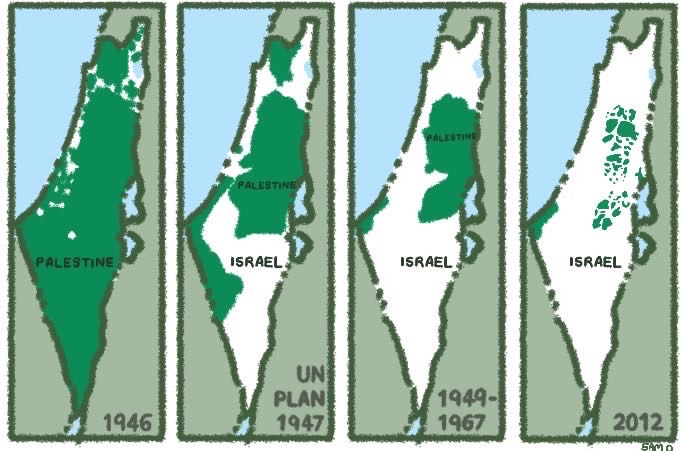
It hasn’t always been like this. Palestine used to consist of a much larger area before 1967. But then, the Israeli settlers asserted they had a biblical claim on the land and began to colonize it. Subsequently, over the decades, the Palestinians have been pushed out of their own land. If the situation were reversed and it had been the Palestinians claiming Israeli land, westerners would have asserted it to be a radical jihad. Why is that the Israelis get to do this free of scrutiny? Why do we act surprised when the oppressed begin to fight back in radical ways?

Art by Sam Ottinger.

The uncomfortable truth of the situation lies in its all too familiar excuse of “fighting terrorism.” As Americans we know what it’s like to be affected by terrorism. But we also know what it’s like to lie for the sake of imperialism. When Colin Powell lied about Iraq having WMDs to justify invasion, the public began to distrust government powers, and we need to bring this skepticism to Israel.

Yes, October 7 did happen. Yes, it was a tragedy. But this could have been avoided. The decades of the Palestinian people’s oppression bred this hatred. To terrorize a people and be surprised when they retaliate in a violent and radical way is ridiculous. It is not to say Hamas’ actions are justified or that they are a group of freedom fighters. It is to say that the hatred and violence they perpetuate was born from their own history of being oppressed and terrorized. The Israeli government has then weaponized this tragedy against the Palestinian people. There is absolutely zero justification for the murder that has occurred in Gaza. 

46,009 people, including 17,492 children, have been massacred, and more than 11,000 are missing. How could you say that this is all done in the name of counter-terrorism? Israel can say it’s limiting casualties, but it is clear as day right in front of our eyes that they are not, as Israel designated safe zones in Gaza and then proceeded to bomb those as well. Israel denies, denies, denies, and relies on the weaponization of October 7 to substantiate these lies.

But what is to be done about this tragedy? Well, it’s hard to say, as the West stays a strong ally to Israel. Especially America, with Israel being essentially an extension of American interests in the Middle East. 

The best course of action is the use of the First Amendment to rally more people to this issue. We must show the government that we will not stay silent for genocide. We cannot repeat the mistakes we made in the 30s and 40s. 

We can find solidarity as a people and fight back against imperial forces. To free Palestine is to free everyone.

Column: Populism vs Policy — Why Bernie was the only chance against Trump

by Tyler Johnson

With another Donald Trump presidency on the horizon, many Democrats and even establishment Republicans are finding themselves asking how this could happen. To find the answer to this we must go back eight years to the 2016 election cycle and examine the monumental paradigm shift in American politics that was the Trump campaign. 

Trump’s rise to public favor was heavily supported by his debate tactics. Gone were the days of Obama-Romney era civil arguments. Trump would usher in the age of personal insults and populist rhetoric. In the Republican primaries there was a now-iconic moment in which Trump addressed the audience of lobbyists, calling them out, insisting he did not need their help. This is, of course, completely false as he has taken from a plethora of bourgeois donors like Elon Musk, the McMahons, and Timothy Mellon. 

Art by Sam Ottinger.

It wasn’t about the facts. It was about the appeal to the American public. By the time Trump secured the Republican nomination he was in full attack mode. He repeatedly called on Hillary Clinton to be arrested. He infamously brought the many sexual assault accusers of Bill Clinton to the presidential debate. He was not running on policy; he was running on populism. He was able to convince millions of hard working Americans that immigrants were stealing their jobs. He was going to build a wall between America and Mexico with Mexico’s money. Does it matter that the wall just abruptly ends and has been proven scalable?  Does it matter that American taxpayer money is what funded it? No, it doesn’t. What mattered was that someone was “fighting the system.”

The Democratic Party has refused to acknowledge the growing resentment of the upper class in this country. They continuously fight on behalf of the establishment. Politicians like Bill Clinton condemn working class Democrats for supporting Palestine. These politicians can act as if they are for the people, but actions show otherwise. Kamala Harris can say she’s for the legalisation of marijuana, but in her stint as district attorney she won more than 1900 marijuana prosecutions. It is precisely this hypocrisy that repeatedly costs Democrats these elections.

There is one man who could have posed a challenge to Trump in the 2024 election. Bernie Sanders is the Vermont senator who has fought on behalf of the working class of America for half a century at this point. Politicians of the Democratic Party have repeatedly torn this man down for years. But as you can see in the 2016 debate his rhetoric is very similar to Trump’s. He wants to fight for the American people. He wants to tax business owners. He wants to raise the minimum wage. The key difference in the two candidates lies in policy. Sanders had very clearly defined policy and plans for the American people, whereas Trump merely had, in his own words, “Concepts of a plan” and left many of his policies such as the repeal of Obamacare and the unfinished border wall, unfulfilled. 

Even in the 2024 election Sanders did all he could to support the Democratic Party, which wouldn’t support him back. Sanders released a video in which he empathized with voters who were against Harris for her support of the Israeli government’s actions in Gaza. He fought for what he thought was best for the American people, even when it meant supporting those who tore him down.

Both Bernie and Trump shared a base of support predicated on rhetoric as opposed to policy, including Joe Rogan who was an outspoken Bernie supporter before moving to the right and even platforming Donald Trump. Other podcasters such as Theo Von have platformed both of them and expressed the sentiment that they are the only two who fight for the working class.

The only way Democrats can win back this growing voting block is by opposing the upper class. If there’s one lesson Democrats could learn from this loss it is that they must not only appropriate the populist rhetoric of Donald Trump, but have the policy to back it up. They must appeal to the people of this country. They must not lecture the public. They must empathize. 


Exchange student compares U.S., Senegalese schools

by Sarah Baloucoune

Having been chosen as an exchange student, people put high expectations on my adaptability, on my desires to open myself to people and be presentable to my fellow American neighborhood and people of other ethnicities. 

It would be a lie to say that this adventure isn’t scary to me, to be all alone in a big English world, a world that isn’t mine nor made to be mine, but from the first time I took the flight to come here I should have known everything wouldn’t be easy. 

After more than 24 hours of traveling with a connection to Belgium, in which I couldn’t rest because of the tumultuous plane that kept moving around (answer the call of Gotham was the best part of the trip, as having to binge three DC movies was so much fun). However, eating during the flight was a terrible idea — my stomach ache was my biggest misery of that adventure. But the real difficulty was to say bye to my family and friends. 

This exchange isn’t about the school at any point, but if there was something I wasn’t ready for, it’s how American high schools really are.

American high school isn’t like in the movies, but it makes it even more authentic, even more realistic, even more loveable, and I cherish every minute I pass between JHS walls.

Exchange Student Sarah Baloucoune

Are American schools better than schooling in Senegal? Coming from a foreign country, the first thing that had me rolling on the floor was the reality of the American high schools, which are immensely different from how they are in the movies.

All over the world, an image is spread of the “perfect school” where everything is good and sweet with music, dances, and love stories. But in fact, it is much more complicated and different than that – and a lot more stressful, too. This makes it closer to my school in Senegal and the whole Senegalese education system than to the fantasy they want us to believe.

Senegal is a country within Africa that was marked by the colonization of the French empire. As a result, the school organization of that West African nation is inspired by the ancient French school system and modified to accommodate the Senegalese government’s desires, even if some of the lessons we are taught are more than unnecessary.

 The differences between the American curriculum and overall coordination and the Senegalese school structure are multiple. One of them is that in America (or maybe just in the United States) the students have to walk through the hallways to get to their next classes. This was very weird and confusing at first because of this school’s immensity and the numerous rooms, making finding my way impossible without help or previous knowledge. 

In contrast, in my home country, students are placed in the classroom with people based on their grade, and the teachers move each class period instead of the students. Teachers bring their material and teach their subject, sometimes with bags or nothing. It wouldn’t be a lie to say that the students prefer this format and take great pleasure in staying alone in the classroom when the educator is late or off duty.                      

Another academic divergence between the two schools is the usage of Chromebooks, which is revolutionary to a student used to writing on paper and can be seen as a blessing as much as a curse to everyone else. The positive side is that it minimizes the number of books and notebooks, and it makes rapport between the teachers and the students easier and the usage of the internet for research more practical than using books. This is pretty much better than the written notebooks, except that the computer needs to be charged to be useful.                            

To be honest, the usage of Chromebooks gives me “toxic boyfriend” vibes: I want to have it, it’s fancy, fast and looks so professional; however, when using it, I am much slower than with a pen. I need help to learn everything about it because there is nothing to make you understand it and without advice, you don’t learn anything. It’s just a mess to have to learn how to use a computer when people are teaching their subjects.        

All those highlights of the not-so-important differences are here to show the actual gap between those two systems, being the whole organization of the schools. The biggest and most internationally known of them are the graduation system and the classes’ curriculum, those two being deeper problems covered by the Senegalese government and school accomplices. 

In Senegal, to successfully graduate high school, you must pass an exam named Baccalaureate, just like in the French school system. The funny part is that to get into high school, you also have to do an exam called BFEM (brevet de fin d’étude moyenne); this time passing it or not doesn’t have a big impact on the high school experience but totally changes the university experience.    

This exam was my nightmare because even before I started the ninth grade, people started putting pressure on me about it. Being constantly reminded of this left a bitter taste on my tongue, and the real preparation begins when there are 100 days left before the three days of suffering in the exam centers. It is more fierce and stressful than all of the middle school years. I succeeded in that exam, but I won’t forget how badly people put stress in my heart for an exam I was confident about for the whole school year.                                                                

The coordination of those national exams is pretty long but relatively simple since in most of the schools you don’t get to choose all your classes. As an example, in high school, you have to make one of the biggest choices of your life that will change your whole school experience, being the choice of the series. Students either choose the series S (in which you get to work more on the sciences and study the reality of the matters), or the series L (mostly turned to literature and philosophy or the study of human civilizations). Once students choose their series, most of the classes are already chosen for them.                              

I was placed in the scientific side but switched at the beginning of the 10th grade (first year of high school in Senegal); this was the best idea I had in a while. I may not be as good in mathematics as I would have been in series S, but my grades thank me greatly for that choice, and my mind and heart were still at ease by the end of the year. That change made me lose some school classes, but, hey, I did great that year, so that’s fine anyway (that’s also a reason why I am struggling in precalculus even if I had straight A’s my whole grade). 

With all those realities, most Senegalese students fantasize about the so-called “main character high school” with all its dramas and romance, but even more because it got the reputation to be easier than in some other countries, not to say most of them.  After all this intellectual talk, let me end this comparison with a little emotional note – there  are a lot of more differences that I didn’t tell you about like the usage of the phones, which is forbidden in my school; the American cafeteria and its catalog of food that gives the students the choice of what to eat for lunch, which is totally different in most of my home country schools; and the freshmen who are still in middle school in the Senegalese organization.                                                                                                                                         

I really am enjoying school in America, but I miss my home country school. I miss my friends and family even more, but I love this experience.

American high school isn’t like in the movies, but it makes it even more authentic, even more realistic, even more loveable, and I cherish every minute I pass between JHS walls. I will never forget the people I met here (big up  to my sweet Senegalese friends all over the states and my incredible host family here).

Exchange student compares U.S., Senegalese schools

by Sarah Baloucoune

Having been chosen as an exchange student, people put high expectations on my adaptability, on my desires to open myself to people and be presentable to my fellow American neighborhood and people of other ethnicities. 

It would be a lie to say that this adventure isn’t scary to me, to be all alone in a big English world, a world that isn’t mine nor made to be mine, but from the first time I took the flight to come here I should have known everything wouldn’t be easy. 

After more than 24 hours of traveling with a connection to Belgium, in which I couldn’t rest because of the tumultuous plane that kept moving around (answer the call of Gotham was the best part of the trip, as having to binge three DC movies was so much fun). However, eating during the flight was a terrible idea — my stomach ache was my biggest misery of that adventure. But the real difficulty was to say bye to my family and friends. 

This exchange isn’t about the school at any point, but if there was something I wasn’t ready for, it’s how American high schools really are.

American high school isn’t like in the movies, but it makes it even more authentic, even more realistic, even more loveable, and I cherish every minute I pass between JHS walls.

Exchange Student Sarah Baloucoune

Are American schools better than schooling in Senegal? Coming from a foreign country, the first thing that had me rolling on the floor was the reality of the American high schools, which are immensely different from how they are in the movies.

All over the world, an image is spread of the “perfect school” where everything is good and sweet with music, dances, and love stories. But in fact, it is much more complicated and different than that – and a lot more stressful, too. This makes it closer to my school in Senegal and the whole Senegalese education system than to the fantasy they want us to believe.

Senegal is a country within Africa that was marked by the colonization of the French empire. As a result, the school organization of that West African nation is inspired by the ancient French school system and modified to accommodate the Senegalese government’s desires, even if some of the lessons we are taught are more than unnecessary.

 The differences between the American curriculum and overall coordination and the Senegalese school structure are multiple. One of them is that in America (or maybe just in the United States) the students have to walk through the hallways to get to their next classes. This was very weird and confusing at first because of this school’s immensity and the numerous rooms, making finding my way impossible without help or previous knowledge. 

In contrast, in my home country, students are placed in the classroom with people based on their grade, and the teachers move each class period instead of the students. Teachers bring their material and teach their subject, sometimes with bags or nothing. It wouldn’t be a lie to say that the students prefer this format and take great pleasure in staying alone in the classroom when the educator is late or off duty.                      

Another academic divergence between the two schools is the usage of Chromebooks, which is revolutionary to a student used to writing on paper and can be seen as a blessing as much as a curse to everyone else. The positive side is that it minimizes the number of books and notebooks, and it makes rapport between the teachers and the students easier and the usage of the internet for research more practical than using books. This is pretty much better than the written notebooks, except that the computer needs to be charged to be useful.                            

To be honest, the usage of Chromebooks gives me “toxic boyfriend” vibes: I want to have it, it’s fancy, fast and looks so professional; however, when using it, I am much slower than with a pen. I need help to learn everything about it because there is nothing to make you understand it and without advice, you don’t learn anything. It’s just a mess to have to learn how to use a computer when people are teaching their subjects.        

All those highlights of the not-so-important differences are here to show the actual gap between those two systems, being the whole organization of the schools. The biggest and most internationally known of them are the graduation system and the classes’ curriculum, those two being deeper problems covered by the Senegalese government and school accomplices. 

In Senegal, to successfully graduate high school, you must pass an exam named Baccalaureate, just like in the French school system. The funny part is that to get into high school, you also have to do an exam called BFEM (brevet de fin d’étude moyenne); this time passing it or not doesn’t have a big impact on the high school experience but totally changes the university experience.    

This exam was my nightmare because even before I started the ninth grade, people started putting pressure on me about it. Being constantly reminded of this left a bitter taste on my tongue, and the real preparation begins when there are 100 days left before the three days of suffering in the exam centers. It is more fierce and stressful than all of the middle school years. I succeeded in that exam, but I won’t forget how badly people put stress in my heart for an exam I was confident about for the whole school year.                                                                

The coordination of those national exams is pretty long but relatively simple since in most of the schools you don’t get to choose all your classes. As an example, in high school, you have to make one of the biggest choices of your life that will change your whole school experience, being the choice of the series. Students either choose the series S (in which you get to work more on the sciences and study the reality of the matters), or the series L (mostly turned to literature and philosophy or the study of human civilizations). Once students choose their series, most of the classes are already chosen for them.                              

I was placed in the scientific side but switched at the beginning of the 10th grade (first year of high school in Senegal); this was the best idea I had in a while. I may not be as good in mathematics as I would have been in series S, but my grades thank me greatly for that choice, and my mind and heart were still at ease by the end of the year. That change made me lose some school classes, but, hey, I did great that year, so that’s fine anyway (that’s also a reason why I am struggling in precalculus even if I had straight A’s my whole grade). 

With all those realities, most Senegalese students fantasize about the so-called “main character high school” with all its dramas and romance, but even more because it got the reputation to be easier than in some other countries, not to say most of them.  After all this intellectual talk, let me end this comparison with a little emotional note – there  are a lot of more differences that I didn’t tell you about like the usage of the phones, which is forbidden in my school; the American cafeteria and its catalog of food that gives the students the choice of what to eat for lunch, which is totally different in most of my home country schools; and the freshmen who are still in middle school in the Senegalese organization.                                                                                                                                         

I really am enjoying school in America, but I miss my home country school. I miss my friends and family even more, but I love this experience.

American high school isn’t like in the movies, but it makes it even more authentic, even more realistic, even more loveable, and I cherish every minute I pass between JHS walls. I will never forget the people I met here (big up  to my sweet Senegalese friends all over the states and my incredible host family here).

How Do We Deal With Subconscious Trauma?

By: Lacy Blanton

Image: “Mind Vomit” by Saira-Jayne Jones, the Perspective Project

Imagine this: you’re mindfully strolling through life in a cheery manner. All is well until you are met with an unwelcoming memory, a memory from the past that you look back on with regret, cringe, or even resentment. 

The negative memory can be a variety of events. Was it about you saying some hurtful things to someone when you were in the heat of anger? Or was it that bitter time of feeling socially rejected by your fellow classmates at school? No matter the situation, it’s something that seems to follow you like a shadow. Frequently, the image pops into your mind and leaves you emotionally defeated.

This incident is, what I call, subconscious trauma, and from personal experience, it’s definitely not an enjoyable time when having its discouraging episodes. Fortunately, through time, I’ve found a solution in how to cope with these negative thoughts.

When feeling an episode starting to come on – i.e. thinking about a memory and sensing my emotions toward the subject: I seclude myself to a quieter room, sit down and close my eyes, turn on meditation music through my phone, and begin talking to myself.

Firstly, I admit the negative emotions I’m feeling and the trauma I’m having. Then, I focus on navigating myself through the situation by talking about a potential solution to the problem and remind the positives about myself. 

The sessions of mine are usually a tremendous success with moving forward.

Of course, there are other plentiful methods in coping through such a problem, and this is evident through the several students of Jeffersonville High School I had the chance to interview.

The following Q & A is from my interview with a Jeff High Senior:

Q: Do you have any bad memories that haunt you? If so, would you mind sharing?

A: Honestly, when my dog passed away. It really affected me.

Q: I’m sorry for your loss. What was your dog’s name?

A: His name was Shadrach. It’s a biblical name. He was the best dog I’ve ever had.

Q: How does it make you feel when the memory pops up?

A: It makes me upset and reminisce on the good times we had together.

Q: How do you cope with this bad memory?

A: Whenever I’m upset about the memory, I write. It’s very peaceful and relaxing. Whenever you write, it’s like being in your own world.

In my interview with a Jeff High Junior, the student expressed how there was indeed a negative memory that haunts them in life, and how they feel upset and even humiliated when reflecting back on the moment. In their copings, they found journaling and communicating with another person to be the most therapeutic.

 These different techniques of different students show how there is no official “right” way to cope through a personal crisis. Everyone is unique, but we struggle similarly at the same time, and that should be a comforting fact to know of.

Another helpful mechanism that many also look to is seeking mental evaluation through a professional (counselors, therapists, psychologists, etcetera). 

If one’s subconscious trauma appears more severely dire, or struggling with unhealthy coping habits, this solution is the most appropriate for that situation. 

Mental health still carries a plethora of stigma. It isn’t easy for one to reveal their vulnerability to others or even themselves. 

However, today’s climate has become more accepting in acknowledging such problems, and its door is something that will most likely continue to open as time progresses.

Abortion: A Woman’s Choice or In the Hands of Our Government?

  By: Lacy Blanton, Guest Journalist

June 2022: It was a dark time for many Americans across the nation, as on the 24th of that month, the Supreme Court had issued a decision concerning the Dobbs v. Jackson Women’s Health bill, overturning Roe v. Wade. The protection to the legal right to abortion was eliminated; with this, numerous states had begun to ban the rights and access to abortion. 

On September 15th, 2022: The state of Indiana, my home-state, fell victim to this deadly decision of a bill. The mere exceptions of legal access in Indiana are in the the cases of rape, incest, fatal fetal abnormalities, or to preserve the life and physical health of the person who is pregnant before 10 weeks after conceivement. 

I vividly remember the time it had all occurred. Ads, social media posts, news segments, and YouTube videos capturing images of those fighting in protest, or in support of this controversial bill. I recall many clinics being ushered to shut down in response, and the unwavering sound of victory at my evangelistic church. In addition, my church has recently implemented a drive to donate infant products and necessities to a pro-life organization for “mothers in desperate need”. 

I am here to express my anguish and disgust at such passing of a bill, how morally wrong it is in many ways, and how this option in mind must be the pregnant woman’s decision, not the government’s.

Many opposers will try to express how abortion is the murderous hunting of innocent unborn children. How the women who are proceeding with abortion are selfish, cold-hearted vipers. How clinics such as “Planned Parenthood” are greedy corporations who are unapologetically open about eliminating unborn life.

According to “KFF’s ‘Key Facts on Abortion in the United States’”, data before the Dobbs decision had gathered that a vast 92% of abortions occur during the first trimester of pregnancy. With this knowledge: we know that in the first trimester in a woman’s pregnancy, the embryo or fetus is a clump of biological molecules undergoing chemical reactions. Therefore, this leads us to the idea that this “baby” is not considered truly living.

Those who seek abortion as an option are a whole spectrum. They go through the procedures all for differing reasons. It is an immense injustice to label them and envision them in a negative light. “Planned Parenthood’s ‘Our Abortions, Our Stories’” shares the anecdotes of women from around the US, giving their reasons as to why they chose the path they did. One woman said in the article, “My stepfather abused me from age 8 to 17. At 15 I became pregnant and lied to my mother that it was my boyfriend’s. I had an abortion because the mental and physical abuse continued afterwards…”. Another lady said, “When I was 20 I had an abortion. Being so young and barely getting by financially, I was in no position whatsoever to have a child…”. A third said, “…At age 31, I had a 3 ½ year old son and was pregnant with my second child… My husband and I found that the baby had several heart defects. We went to see several specialists to see if his heart could be fixed after he was born. They told us that he would live and grow in utero, but would die after birth… We decided to spare him the suffering and interrupted the pregnancy at 22 weeks.”

“Planned Parenthood” is a health organization that has a 3% abortion service, with the majority of their work consisting of STD testing and treatment, cancer screenings, infertility services, and offering sex education. To get an abortion through them, the organization has you meet with your doctor, nurse, or health counselor to discuss whether abortion is the best decision for you. Even if one is adamant about going through the procedure, they emphasize that they will halt everything if you change your mind, even as far as the surgical removal. With these facts, it shows how precise and supportive Planned Parenthood is, and always looks to the best interest no matter what one decides. 

“Capital B”’s Kenya Hunter gave insight on a reproductive rights group launching a campaign, and also gave how they advocate that abortion bans are racist against the Black community in America. The group, known as “Unite for Reproductive and Gender Equity” or “URGE”, had its Georgia organizer say, “We aren’t just strictly coming from a lens of what’s happening with our wombs or with our uterus,.. [Abortion bans] have a trickle-down effect. People with low income have to bring in another child that they can’t afford. The point of the ‘Abortion Bans Are Racist’ campaign is to make sure the conversation isn’t just about abortion… but how does this further create disparities within our communities?”. Additionally, their campaign had researchers who predicted to them that with more people forced to carry out their pregnancy, this will result in increased risks in bad maternal health. As a Georgia-based news organization: Hunter points out how the state’s Black women are already three-times more likely to die from pregnancy-related complications than White women.

As of 2023, only three US states have the right to abortion in full status. These states being California, Michigan, and Vermont. 

I, like many others, find this decision from our Supreme Court to be disappointing and discouraging. This is a reminder that our country still has room for improvement regarding a human’s right. 

We cannot change the mind’s of every individual, but if we can show the Supreme Court the dangers to this passed bill, perhaps they can reconsider this injustice. 

Fortunately, we are not alone in this protest. As Kenya Hunter had discussed, URGE’s ‘Abortion Bans Are Racist’ campaign is just one of many groups fighting against this ban. 

 This isn’t based on a viewpoint that is politically-motivated, and with the harms that this ban is capable of as mentioned: it is unavoidable to point out its concerning flaws. Kaelea Lucas, the Georgia organizer for URGE, said it best; “The decision of what somebody does with their body and whether or not they are going to get an abortion ultimately should be between that person, family, and maybe a medical provider if that’s what feels comfortable to them,… But who should not be involved is the government. There should be no political reasoning for anything like abortion bans.” Banning the right to abortion sends the wrong message to so many. It silences voices, gives misinformation about clinics like “Planned Parenthood”, gives ignorance to the idea that “babies” are being “killed”, and drastically affects the Black community in health and finances. With this ban and absurd claims continuing to be established, we are going to do more harm than good toward women and their overall health. 

School Lunches

Written By: Bradley Prather

Jeffersonville High School’s lunch is not the best thing in the world. I have heard many things about their lunch, and many say it’s equivalent to prison or jail food. I believe that JHS can improve their lunches in many ways. So in my article, I will be sharing my, and others, opinions on how they can improve their lunch. I will also talk about the price of lunches and why everyone’s lunch should be free.

One big issue with the food that they serve us students is the overall quality of the food. To start off, the chicken patties that they serve are very dry and bland. Secondly, the fries they serve us are usually half frozen still and undercooked. And the biggest problem, the food is either undercooked or overcooked. Though, not all things are bad about their food, their pizza is one of the better things they serve, and seems to be one of the more popular things amongst students. Finally, we serve the same thing everyday, except for the experimental kitchen line, but they serve the same thing in that line as well.

Now, I’m going to share some opinions of students, and my own on how they could really improve what they do and make. For me, I think if they actually paid attention to how long they keep things in their ovens, the food would turn out a whole lot better. One of the things people told me was to add variety, one of the foods people said they wanted to see a lot more was chicken nuggets and tacos, which I can agree on. Cainen Skaggs, a sophomore said, “Use fresher ingredients and food.” This is a very great idea, since many people complain about the food being bland, adding more seasoning and such would greatly improve the food. A fellow friend of mine, Cooper Pickles, said, “Adding more lines, so food can get to us faster.” One main problem is how long the pizza line can take, and many people on Monday are eager for Papa Johns, so having maybe 2-3 lines for pizza would be amazing. A senior I questioned said, “Letting students sell our own snacks” Letting students sell their own snacks would be cool, it could tie along to having more variety of what you can eat, and students would really like it.

“Lunches are equivalent to gas prices” this quote describes the price of lunches best. A lot of students in the school are enraged to say the least about lunches costing more. For some students in the building, lunch is the only meal they may get to eat, and they may not have money to pay for their food. I know that some students get their food for free, but why can’t EVERYONE get their food for free in school?

Meander Into the Manosphere

Clawing for meaning gets people scratched

by Tristan Darvin

hyphenarticle1.jpg

Internet star and former kickboxer Andrew Tate.

“What colour is your Bugatti?”

That was a rhetorical question said by Andrew Tate. Rhetorical questions such as this one serve as jabs at the logic or moral fiber of an opponent. With the question of money and cars being used as a moral criticism, the question is based on the idea that money is morality and greed is good. In being based on such an idea, it brings a lot of questions about those who are asking it.

What created this void of meaning that’s been filled by this nasty materialism, who is this void in, and how is it better filled?

To take a look at the father of the aforementioned rhetorical question to get some insight, the phrase was coined by internet celebrity, kickboxer, self described misogynist, and likely human trafficker Andrew Tate. Tate was raised on an estate in Luton, England by his chessmaster father and his catering assistant mother, with Tate gaining television and kickboxing fame; Tate’s fame was short-lived due to a leaked video of him beating a woman with a belt. But Tate clawed out of his exile as the rising star of the online ‘Manosphere’.

An online coalition of disenfranchised men known as the ‘Manosphere’ has raised a myriad of pro-male figures into stardom from Andrew Tate to Jordan Peterson. The members of this coalition dwell in their own world, rejected by all else, that even has its own slang and lingo. These men often cite unfair rejection and mistreatment from others, especially women, for their behavior of sexual harassment and sexism. Whether or not those complaints are valid or a strawman is debatable.

The manosphere often leaves the internet to affect the material world. Elliot Roger, killer of six and self-described “supreme gentleman”, subscribed to these defeatist ideas of loneliness and despair and used them to justify his rampage. However, his behavior as described by himself and others had shown him not as a lonely soul, but one who drives others away while blaming them for leaving him behind. This demonstrates not the state of victimhood these men describe, but a state of hostile misogyny that makes everyone miserable and these men hateful.

However, with all of this in mind, one thing escapes us: how do we solve this?

Andrew Tate, just like the entire subculture he dwells in, spreads via shocking and rule breaking content. They take hold on the minds of men via scandal and unleashing repressed desires. They take hold, but they can be shaken off. We can be better, but we have to do some things.

Just like romance, communication is key in deradicalization. By unsealing the lid on these emotions by normalizing conversations about loneliness as opposed to ‘tolerating masculine solitude’ we may give these feelings an escape valve that isn’t as dangerous as when they come bursting out directed by muscled misogynists. Just as one can be pulled in, one can be pulled out by openness and acceptance of the other. And thus, the other may cease to be so terrifying and the hate may be quelled in the end.