Retired police officer Chuck Adams finds fulfillment in life of helping others

by Jackson Anderson

Retired Clark County police officer Chuck Adams fondly remembers his days working in law enforcement and now spends his days hanging out with grandkids, fishing, and talking with long-time friends.

Adams added that he had wanted to become a police officer since he was a boy. ”As a young man I liked the fact that they helped people and got people through rough times,” he stated. 

“I just feel like I helped a lot of people in my career, and I can’t just think of one individual great accomplishment that stands out,” Adams continued to say about his career in law enforcement. 

His daughter, Shannon Anderson, backed up this claim by stating, “I would just say he is honest, fair, motivated by doing the right thing and not the popular thing, but most importantly he treated everybody as a human being and not like a criminal, or not like the bad guys.” 

Before joining the Clark County Police Department, Adams’s first jobs included pumping gas at the age of 14 at a truck stop, and working at McDonalds, Jeffboat, and Ford Motor Company. His service to the public had already begun at an early age.

Adams stated, “I have lived in Clark County my whole life, long time Clark County resident.”

Best known for his sense of humor, he is always ready to tell a joke or a tall tale to brighten someone’s day.

Anderson recalled two tall tales he told: ”How he wound the old Colgate clock and he hung the railroad lights by hand.” 

Adams’ ex- wife, Faye Briley, described how she met him in 1983 on a blind date and has known him for 41 years. 

Briley described how he is outgoing, friendly, kind of loud, and just a good person. 

“I started dating him because I just thought he was the man I always wanted; he was the whole package. He was dependable, hard working, kind, and the fact that he was nice looking didn’t hurt,” Briley explained.

Briley and Anderson have both said very inspiring and nice things about their experience around Adams. 

Briley said, “He has turned out to be a good ex-husband, a good dad, a good friend, and someone I can count on up until this day.” 

Anderson described her father to be a very good person and stated, “Overall,I would just say that he is quite the unique individual, and if you have time on your hands it would be worthwhile to have a conversation with him if you have 2-3 hours of spare time.” 

Adams retired from CCPD in 2013. He stated, “I was 58 years old and maxed out on my pension. I had enough years to retire and financially able to retire.” 

Life is different now for Adams. He said, “It’s a lot different from when I was working — no set times or schedules like when I was working, unless I want to be there.”

His life advice for happiness is simple.

”Well, I think if you try to live your life and be a good person, work hard, good things will happen to you, and your life will be fulfilled.”

Longtime Sacred Heart teacher mixes love for learning and discipline into her classroom

by Austin Bainbridge

Sacred Heart Middle School teacher Lynne Evanczyk’s day is never truly over as she helps a student with homework after school hours while also planning school-wide events and creating lesson plans for the next day.

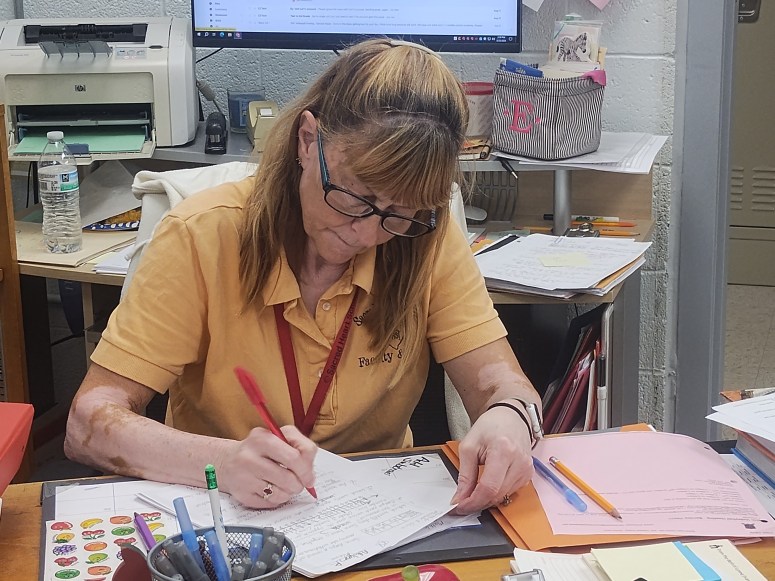
Science teacher Lynne Evanczyk grades papers in her classroom. Evanczyk, a junior high teacher at Sacred Heart in Jeffersonville, is a JHS graduate and has taught at Sacred Heart for over 40 years. Photo by Austin Bainbridge.

Evanczyk attended JHS and graduated in 1977 in a class with around 800 students. She then went on to attend Hanover College for her bachelor’s degree and went on to Indiana University Southeast for her master’s degree. She went on the job hunt and was preparing to take a job in Texas, but her connections from JHS got her local job. 

“I’m very thankful that my connections in the public education system helped me to get a job closer to home,” Evanczyk said.  

Evanczyk is a very hard-working teacher. She works every Sacred Heart event possible. She also usually helps to plan every event. She leads most committees and always finds time to help students, no matter the hour. 

“She puts in a lot more time and work than the other teachers at Sacred Heart; she’s always willing to help,” said seventh grader Adeline Bainbridge.

Evanczyk taught in the public school system for two years and has been teaching private school for 41 years. She likes to think that she combines elements of the style of teaching used in both settings that other teachers cannot.

“I believe in bringing a mixture of the love of learning and discipline into the classroom,” she said.

Evanczyk started out teaching second grade. She then was offered a position as a seventh-grade science teacher. She loved the position and has worked in the Sacred Heart Middle School ever since.

“If I had to say one thing, my favorite part about teaching is seeing the look in a kid’s eye when they realize they mastered a topic.”

Sacred Heart Teacher Lynne Evanczyk

“I fell in love with doing middle school science. I always enjoyed using microscopes and dissecting frogs. That’s stuff you just can’t do with second graders,” she stated.

She also likes to get to know her students and create a positive learning environment. She said that if she knows her students it’s much easier to teach them.  

 Bainbridge said, “When I enter her room I feel welcome and accepted, like I can still get things wrong but not feel embarrassed.”

Evanczyk prides herself on making her lessons interesting while still being easy to learn. She often uses examples and takes extra time if a student needs it.

“She is very energetic and cares if we understand the topic. I never felt like I was on an island with her as my teacher,” said Trinity High School freshman Caleb Johnson.

Evanczyk’s students also enjoy her being their teacher for other reasons. They say that she is a great teacher for preparing them for high school. She likes to assign work at the rate high school teachers would and always likes to make sure her students go to a high school that’s a better fit for them.

“She really helped me prepare for high school like other teachers didn’t. She helped me prepare for a high school workload and style of learning,” said Johnson.

She says JHS greatly impacted her career. Her teachers at JHS are the people that made her want to teach. Without Jeff she couldn’t have been such an impactful teacher.

“My teachers at Jeff really influenced me, especially my science teacher. I felt how they all impacted me and I thought I want to be able to do that. I really am appreciative of all the teachers at Sacred Heart and Jeff that helped me become a better educator,” said Evanczyk.

Evanczyk loves teaching for many reasons, from interacting with kids to having fun events. She said that she has one favorite item about teaching:

“If I had to say one thing, my favorite part about teaching is seeing the look in a kid’s eye when they realize they mastered a topic. That really makes me feel very happy because they are so overjoyed to realize they know what was taught.” 

Benning, JROTC impact lives beyond the classroom

by Shelby Keesee

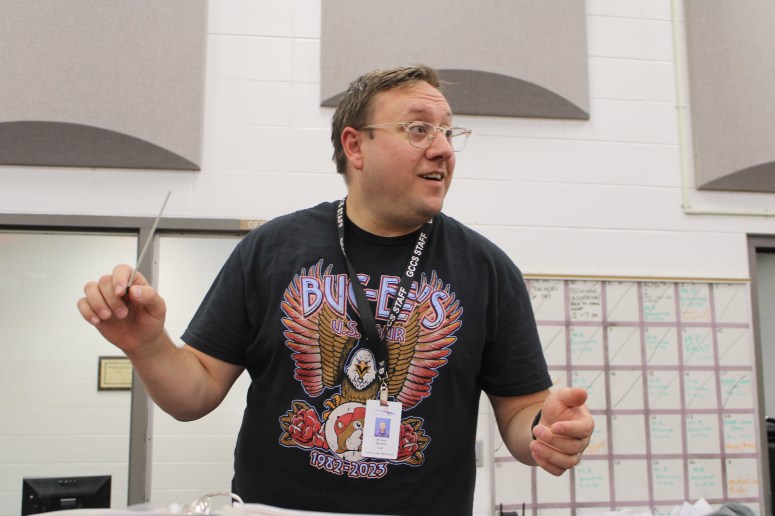
Col. Robert Benning instructs his JROTC cadets during PT practice. Photo by Shelby Keesee.

Colonel Robert Benning walks around the classroom, detailing his freshmen on the captivating history of the earlier days of flight. 

“John Montgomery’s 1911 glider was called The Evergreen…” begins Benning.

On a day at JHS, one may stumble upon Benning and pass by without a second thought. If not, they would most likely assume he’s just a typical bald man wearing military-like outfits.

However, this isn’t the case.

At first glance, no one would comprehend he’s not only spent 11 years at JHS teaching JROTC, served 25 years in the U.S. Air Force active duty, but has also majored in physics.

“They have a lasting impact because in some ways, we end up having friends for life.”

Colonel Robert Benning, JROTC Instructor

“I came into the Air Force and I had a four-year obligation. And so it was kind of, ‘I’ll do four years and get out.’ But it was about that eight or 10-year point where I kind of decided, ‘You know, I really like what I’m doing, I’m being successful, I think I’ll stay in.’ So, it was just always, always, wanting to serve my country,” stated Benning.

Benning’s first teaching opportunity was in the Air Force’s active duty.

“When I was in the Air Force, I got the opportunity in the Air Force on active duty to teach or instruct,” Benning stated. “I was in charge of training.”

Benning undeniably enjoys teaching and working with others.

“But this job, yeah, it’s teaching in the classroom. But to me, it’s so much about mentoring our youth,” said Benning. “And that’s what keeps me coming back each year. It’s being able to work with the high school students.”

Using team building exercises in the classroom, Benning attempts to increase mentorship within his students.

“My favorite thing about Colonel is he’s a mentor, he’s a life coach, he extends outside of ROTC, he helps you with every aspect of life,” stated Cadet Evan Cooper, a senior. “Academics, personally, just anything you ask him, he’ll be there for you.”

Cadets report Benning has improved their leadership skills.

“I’ve learned more leadership strategies through what he’s kind of like, taught and what he’s talked about with me over,” said Cadet Dylan Wibbels, a senior. “He seems like he likes to do right by the world, and he sticks to his moral compass.”

His students also report Benning having an impact on their daily lives, ranging from how his students go about their day, to a different, more positive view on how the world works.

“As a person, he is a big influence on my morality,” Cooper said. 

Not only does Benning have a great influence on his students, but he is often described positively by them. 

“I would describe him as calm, stern, collected and very intelligent,” said Cooper. “I think he’s a model example of what a man should be.”

Because of the mutual impact and likability between Benning and his students, after the students graduate, Benning keeps contact with them.

“What other things that we do is after kids graduate, we try and keep touch. Especially those that go into the military. So anytime they’re in town, we’ll take them out to lunch or dinner, and I try and keep that correspondence with as many of my students as possible,” Benning stated.

Benning’s favorite part of his job is seeing the successes of his students after graduation when an enduring impact has been made on them. He deeply enjoys the connections that are shared between the students and himself.

“They have a lasting impact because in some ways, we end up having friends for life.”

Freshmen adjust to high school life

by Ja’shia Mathews

High school is an adjustment for any student. Every person is trying to discover who they are in a not-so-forgiving climate. It’s very stressful to transition from middle school to high school.

Freshman Isabella Stewart said, “I talked to my big sister who is already in high school. She helped me prepare for high school, and I try to prepare myself mentally.  It isn’t easy making friends. Everybody is very judgy and looks mean. Work has been easy for me for the first couple of weeks.” 

She added, “The food is better than my middle school food. The lunchroom is much more organized, and I like sitting anywhere I want with my friends.” 

Freshman Kayla Taylor, said, “High school is harder than eighth grade because it is tough to learn the work. Jeff High is a huge school, but most of the kids and teachers are nice and help a lot.” 

High school is a struggle for freshmen coming into a large school from middle school, especially when adjusting to the amount of academic work.

For example, freshman Chris Allen said, “There is a lot of work. We get new assignments each day.”

Allen said he relies on his older siblings for help in school. 

“If I don’t know it I ask my older sister and brothers. I have a lot of support at home that helps me throughout the school year.”

Some classes are very easy for Allen and remind him of middle school.

“Coming into high school is tough. People try to pick on you because you’re very small and they think because you’re a freshman you can’t be good at certain things.”

JHS does have programs in place to help incoming freshmen adjust to high school life.

For example, some freshmen expressed gratitude towards their Academy principal, Holly Bernard-Bramlett, for her efforts in facilitating their academic journey. 

According to her, “They are all on teams, and we have meetings to discuss any issues and touch base.”

Bernard-Bramlett assumed the role of Freshman Academy principal in 2020, acknowledging the significant influence of freshmen in high school. She emphasized that just as the freshmen were learning about high school life, she was also acclimating herself to the role.  

High school is a journey of self-discovery, and every adolescent who enters it leaves changed by their experience. That is the true meaning of high school. 

New directors highlight band goals 

by Isaac Steven Raymer

New director Briston Hatchell instructs band students after school. Photo by Esme Estrin.

JHS has two new band directors Briston Hatchell and Sidney McDonald, who are co-teaching everything music related and like jazz, band, and guitar. 

Both band directors have said that they’ve considered themselves friends for a fair amount of years; both having music teaching experience before joining JHS. Hatchell said he has 10 years of teaching band, which includes several years at Floyd Central High School. McDonald has three years of teaching experience at both the middle and high school levels. 

It’s definitely clear they both have a passion for teaching music, and music as a whole. Both teachers have had their lives impacted by music.

Hatchell, early in life, said he wanted to be an architect until he realized there’s a lot of math involved. While he “wasn’t good at math,” he was talented with the trumpet, so in middle school he decided he wanted to teach music.

McDonald did not take the same path as Hatchell in high school, as she really liked chemistry and ended up becoming a chemistry major in college for a year. She decided to transfer schools for a music program since she missed music and decided to do drum core, which led to her transferring to Indiana State as a music major.  

Both teachers described that they love teaching, and they both put in a lot of work to make sure they are helping all their students the most they can. But it does become a very time consuming job.

An average week of teaching for them normally consists of marching band on Tuesdays, Thursdays, Fridays, and most Saturdays after school, with an open band room around three days a week so kids can practice if they would like with either of the musical directors. 

A school day for them normally consists of AP music theory, guitar and then for the last three periods – 4th, 6th, and 7th – they collaborate and teach intermediate band, a big guitar class, and advanced band. 

Even though they are both doing a lot for all of JHS’s music-related activities, there is still much more they want to do with an emphasis on the band program.

Hatchell said, “We want it bigger, we want more kids and, you can put this in print, we have a school of 2,300 kids and our goal over five years is 10% of the school, so that’s 230 kids, so if we get to that then I say we achieved our goal.”

He makes it very clear that they both want to be able to teach the most they possibly can. They also stated that, even though the band is pretty well funded, they do run fundraisers to help JHS music-related classes be the highest quality they can be.  

Those interested in marching band can go to https://jeffersonvillebands.org to find every upcoming event involving JHS music.

Starting off the year with the Student Council

by Sarah Masingo

Student Council President and senior Koy Ramer has big goals he wants to meet. Ramer plans to rebuild. 

“My plans for this year are mostly a rebuild year. Senior Co-President ,Madison Pritchard, and I really want to focus on bringing a lot of things back that were lost to COVID. We still haven’t seen a lot of things like the homecoming dance,” Ramer said.

Ramer wants to bring back special events that he thinks means a lot to the school and himself, Including the homecoming dance, taking place this September 28th. 

“The homecoming and pep rallies, we just want to have a lot more fun events to bring back up. We really want to set a foundation for future Student Councils and presidents to be able to do more,” Ramer said confidently. Ramer wants to get back in the habit of having fun events for everyone. 

Ramer felt very welcomed becoming Student Council president, especially considering he moved into the school from another district.

“It was very welcoming, coming from a school that wasn’t in Greater Clark. I came into Jeff High knowing 10 to 15 max. People only that I knew from my swim team to being able to go from knowing almost no one to being elected president to essentially becoming president of the whole student body. It was really assuring. I’m going to be able to make a change in this school.” 

Ramer would recommend joining the Student Council. 

“Even if people don’t know you personally, as being a part of this council you’re able to make decisions that affect everyone in the school. If there is something you really want to see you have the opportunity to bring that to council and see that get worked on and see that get changed.”

Ramer saw results, and he thinks students will be able to see them if they too join Student Council.

 “I wanted a homecoming dance, and I went to (principal) Mrs. Hall and now it’s going to happen. And you are able to see real results of what you want done in this school.”

The perks of being president to Ramer is that he is allowed to make things happen that he wants done. “I’m able to bring things back that haven’t happened in a while and I’m able to make sure that everybody on this council has a voice.” 

Ramer will take suggestions to Hall or the administration. He added he will take what students say into consideration. 

“As a president I like that I can make things happen and make sure that every event that the Student Council wants to hold is getting to the people that can make it happen.” 

Ramer is looking forward to the events that the Student Council has planned.

“I’m looking forward to homecoming short term since we haven’t seen it in many years and it’s something that students want, but long term i’m really excited to see Madison and I as Co-President able to set these plans that will not just affect our senior year but hopefully this sets a pattern for many Jeff High years. And it’s not just us making the homecoming dance this year and it starts a pattern of homecoming dances every year after this, so that every class can enjoy it.”

Ramer encouraged students to follow Student Council plans on social media, saying:

“For any readers out there, there’s a lot that we’re planning this year that I think is really exciting. People should be aware of making sure you’re listening to announcements, follow our Instagram so you know of any events that we’re planning and just keep an eye out because it may be easy to miss. We are going to be doing a lot this year that I think will be really exciting.” 

Starting off a new year with NHS and its sponsors

by Sarah Masingo

The National Honor Society has big plans for this school year. Co-sponsors Justin Linde and Emmaly Rose are leading the National Honor Society as a team. Unlike last year, Linde and Rose want to put officers together, induct juniors to celebrate and honor seniors of the NHS.

  Linde and Rose want to talk about roles and responsibilities. They also would like to have announced officers in September. In addition, they will be having a meeting with just the seniors. 

Linde wants to be able to let the students run this group. “While running this group of academic leaders, I would like to have students involved in the NHS to take charge, be able to lead the group themselves and make decisions,” he said.

Another activity the NHS would like to have this year is another blood drive since last year was so successful. Students could potentially work the event. 

Linde said he feels “excited and nervous” about the officer election coming up soon.

He would like students with a high academic ranking to be able to feel free to join the NHS. “Whoever is elected as the NHS president should be able to help support students,” Linde said.

 Linde would like other students to join this group to set themselves apart from their peers. “It looks good on a college application and to be a part of this prestigious organization.”

Linde emphasized the community leadership focus of the NHS.  The organization is “very community service focused, but now we have an E.C.O. club. Which shows that we can continue to support other clubs and lend voices but most of all this group sets us apart from others because we are very academically focused,” Linde said.

Linde is looking forward to officers being more involved; he stated he expects “officers being more involved in ownership, projects running smoothly, becoming more creative, new members, new ideas, and becoming better.” 

“National Honor Society isn’t just another club, it’s an organization of scholars. It’s that one group, students want to join to become a leader in their community. Juniors, be on the lookout for invitations, and seniors be ready with new ideas,” stated Linde.

Guide to Surviving Freshman Year 

By: Ifrah Daber 

How sweet was 8th grade? You used to be a big fish in a small pond. You were at the top of the food chain, and now? You have been thrown into the ocean with the sharks. Welcome to Freshman Year! The school, the number of classes, the number of students— everything is vast, and now you are forced to swim. But don’t stress yet, because I, your wise upperclassman, am here to help! With my survival guide for freshman year, I will give you tips and tricks to help you get through it, so let’s get to it! 

First, you must understand the difference between quarter and semester grades. Your quarter grade is the sum of your assessments and assignments. Assessments take up 70% of your grade, while assignments take up the other 30%. So each quarter you will get a final grade, and that affects your semester grade. You have four quarters and two semesters (two quarters per semester). So if you get an A in your first quarter and a C in your second quarter, then you will likely get a B as your semester grade. Simple, right? Well, your grades determine your GPA, and depending on that, they will give you a number between 0 and 4. 0.0 GPA means you have done zero work, getting Fs across the board, and the numbers go up, representing the letter grades. 3.0 GPA means you get mostly B’s, and 4.0 means mostly A’s. I know that all sounds extremely boring, but it’s important to know. 

I could go on for many pages, but who wants to read that? Plus, there is more to school than work. One of the joys of attending a high school like Jeff’s is the number of clubs they offer. From my experience as a young freshman, my biggest problem was just being too scared to join clubs or not knowing where they were. The latter is easier to solve since a lot of clubs promote themselves on the pride slides. These are slides that should be shown to you during impact, but just in case your teachers don’t show them, don’t panic. A lot of clubs also promote themselves during morning announcements. So in the morning after the pledge, you will hear about all the essential information for the day. Also keep in mind how clubs will greatly affect your schedule. High school is the perfect time to branch out and try new things. So don’t miss out on the new opportunities that Jeff High has to offer!

Freshman year can feel overwhelming. It may feel like it will never end, but it’s shorter than you think. Many have survived the torture of freshman year, and so will you. I have put together a list of advice from different groups of people, including graduates, mental health specialists, and upperclassmen. 

The first list of advice is from your upperclassmen; some of them have been kind enough to pass down their logic to you. 

1. Don’t Date Upperclassmen. Just remember the classic rule! If the grades don’t touch, neither should you. 

2. Develop Good Study Habits. You have a decent amount of work to do and tests to complete. So developing a solid study habit now can help you in the future. If you don’t wanna fail, STUDY! STUDY! STUDY! 

3. Don’t Stand In Big Groups. It may seem like no big deal, but once you have experienced the stress of rushing to class only to end up being blocked by a sea of kids moving as fast as morning traffic, you will understand the frustration. You try to go left, you try to go right, but alas, there is no way around them. It’s annoying; If needed try to stay near the sides. don’t be those kids; no one likes traffic. 

4. Stay Caught Up! You get a lot of schoolwork during the school year, so it’s a pain for both you and your teachers to have a lot of missing assignments. So make sure to stay caught up! 

The second list of advice is from a mental health specialist; high school is a hard time for most people mentally. It is hard for a lot of people to deal with the stresses of school, so here is some advice and some resources for you. 

1. Develop a Routine With Your Mental Health In Mind. Just like your study habits, your mental health needs routine; doing certain activities every week or day can help with this. Either exercise, meditate, or do anything that works for you.

2. Don’t Be Afraid To Ask For Help! Whether it’s schoolwork or something more personal, don’t stop yourself from getting help if you need it. I have added some mental health resources at the end of the article in case you ever need someone safe to reach out to. 

The third list of advice is given by previous students, long past their freshman year. These graduates were kind enough to take their years of wisdom and pass it down to you, naive young folk. 

1. Figure Out Your Interest. High school is a great opportunity to explore your interests with a sense of security because you are likely not paying for them. So try new things; don’t be afraid to explore your interests. One of the joys of attending a high school like Jeff’s is the number of clubs they offer. From chess to archery, Jeff is filled with different opportunities to broaden your horizons. 

2. Don’t Go Exploring The Hallways During Passing Periods.You only have five minutes in the hallway. Don’t waste it on unnecessary exploration. You ain’t Dora the Explorer, so just go to class. 

Well that is all I have for you. I wish you the best of luck in your journey of discovery and hope you have a fun and exhilarating freshman year. 

Mental Health Resources: 

Suicide and Crisis Helpline: 1-800-784-2433 

National Eating Disorder Association: 1-800-931-2237 

For LGBTQ Youth: TrevorLifeline at 1-866-488-7386, TrevorText -Text START to 678-678 Substance Abuse and Mental Health Services Administration Treatment Referral Helpline: 1-877-726-4727

Student Jobs 101

By. Juan Carrillo, Lola Mays, Wesley Lanham, Rhianna Ledbetter

Getting your first job is something all parents and guardians dread, but it’s also  something teenagers can’t wait for. Getting a job means you gain more responsibility and freedom, but there are so many questions one might have about picking that one special place to work: How much do they pay? How do I apply? What’s the work like? In this, we will be discussing answers to all of these questions, as well as some tips for that first day on the job! 

Some may say it is bad for teenagers to get a job because it could add stress to the ever changing balance of school and social life. Having to balance school, work, and other activities builds your resume and helps one to develop time management skills. Speaking of resumes, that might be one thing you need for that first job. Most places hiring highschool aged people don’t require a resume, but it might be wise to offer one to show previous credentials. Points that you can add to your resume include the sports you play, hobbies, or extracurriculars. Employers like to see what you have to offer, so having a resume can show them your character and teamwork skills. 

Applying for a job may sound daunting but it’s a lot easier than you would think. A lot of businesses have online applications that you can fill out by looking up the website or by typing certain keywords into your browser. For example, if you wanted to work at a pizza place in Jeffersonville, Indiana you could type, “Pizza place hiring in Jeffersonville, IN”. You can also ask for an application in person, just by asking an employee if their job is hiring; the worst they can say is no.

One location that is perfect for a first job is Chick-fil-A, typically they begin hiring at 16 years old. The Hyphen interviewed a tenth grader who goes to JHS about her experience working there. “I like my job most of the time, customers and co-workers can be exhausting and not worth it, but it can be said the same vice versa.” The pay may vary based on location, experience, and age. That is why we recommend asking your interviewer about wages like how often you will get paid and what your pay will be. A majority of employers pay every two weeks, but some pay once a week or by the shift as well. 

Another local employer is Stone Cold Creamery, an ice cream shop located near Kroger on Tenth Street. They hire aged 16 and up. We interviewed a few students who said the hours can be demanding at times, and would not recommend working there if you are focused on school but that doesn’t take away from the friendly environment. The employee also said “It’s chill and I love basically playing Papa’s Freezeria in real life.”

Other businesses hiring 16-year-olds around Jeffersonville are Kroger, Meijer, and Rural King. These are great options if you are looking for a retail position, and if you like talking to people and enjoy walking around this job might be for you. In most cases, you will be stocking shelves and helping people with their questions. Some days you might be in different departments or working the cash register. Their paying range is around $12-16 depending on the location.

Other things you will need to know while entering the workforce is how income taxes, state and federal, will affect your paychecks. It is also important to know your rights at your job to make sure you are not being taken advantage of by your employer. Depending on your age you can only work a certain amount of hours a week. Make sure to do your proper research about federal and state labor laws concerning minors before you get a job.

Getting a job is something that can bring responsibility to any teenager. It’s part of becoming who you are and shaping your life. It’s always necessary to make sure you’re going through the correct steps of applying for a job. It is also important to have someone who is experienced to check things over on your application like your grammar and spelling and the correct information you want to be known. We hope you take in consideration the considerable amount of jobs in our article and get inspired to try to make some money.

How Do We Deal With Subconscious Trauma?

By: Lacy Blanton

Image: “Mind Vomit” by Saira-Jayne Jones, the Perspective Project

Imagine this: you’re mindfully strolling through life in a cheery manner. All is well until you are met with an unwelcoming memory, a memory from the past that you look back on with regret, cringe, or even resentment. 

The negative memory can be a variety of events. Was it about you saying some hurtful things to someone when you were in the heat of anger? Or was it that bitter time of feeling socially rejected by your fellow classmates at school? No matter the situation, it’s something that seems to follow you like a shadow. Frequently, the image pops into your mind and leaves you emotionally defeated.

This incident is, what I call, subconscious trauma, and from personal experience, it’s definitely not an enjoyable time when having its discouraging episodes. Fortunately, through time, I’ve found a solution in how to cope with these negative thoughts.

When feeling an episode starting to come on – i.e. thinking about a memory and sensing my emotions toward the subject: I seclude myself to a quieter room, sit down and close my eyes, turn on meditation music through my phone, and begin talking to myself.

Firstly, I admit the negative emotions I’m feeling and the trauma I’m having. Then, I focus on navigating myself through the situation by talking about a potential solution to the problem and remind the positives about myself. 

The sessions of mine are usually a tremendous success with moving forward.

Of course, there are other plentiful methods in coping through such a problem, and this is evident through the several students of Jeffersonville High School I had the chance to interview.

The following Q & A is from my interview with a Jeff High Senior:

Q: Do you have any bad memories that haunt you? If so, would you mind sharing?

A: Honestly, when my dog passed away. It really affected me.

Q: I’m sorry for your loss. What was your dog’s name?

A: His name was Shadrach. It’s a biblical name. He was the best dog I’ve ever had.

Q: How does it make you feel when the memory pops up?

A: It makes me upset and reminisce on the good times we had together.

Q: How do you cope with this bad memory?

A: Whenever I’m upset about the memory, I write. It’s very peaceful and relaxing. Whenever you write, it’s like being in your own world.

In my interview with a Jeff High Junior, the student expressed how there was indeed a negative memory that haunts them in life, and how they feel upset and even humiliated when reflecting back on the moment. In their copings, they found journaling and communicating with another person to be the most therapeutic.

 These different techniques of different students show how there is no official “right” way to cope through a personal crisis. Everyone is unique, but we struggle similarly at the same time, and that should be a comforting fact to know of.

Another helpful mechanism that many also look to is seeking mental evaluation through a professional (counselors, therapists, psychologists, etcetera). 

If one’s subconscious trauma appears more severely dire, or struggling with unhealthy coping habits, this solution is the most appropriate for that situation. 

Mental health still carries a plethora of stigma. It isn’t easy for one to reveal their vulnerability to others or even themselves. 

However, today’s climate has become more accepting in acknowledging such problems, and its door is something that will most likely continue to open as time progresses.

Women’s History Month 2023: Celebrating Storytellers 

By Lacy Blanton, Guest Journalist

March is upon us once again. With this, the annual events of this month include the highly-anticipated March Madness, the mournful (or celebratory) ending of winter, and the welcoming of spring.

Another special event arises during this time: Women’s History Month, an annual declared month that highlights the honorable contributions of women from our society. Each year within the United States, a distinctive theme is chosen by “The Women’s History Alliance”. Recognizing the diversity and different roles that women have played throughout history. 

This year’s theme is a very special one. That theme being “Celebrating Women Who Tell Our Stories”. Highlighting those who have dedicated their lives and been active through press, broadcasting, blogs, podcasts, playwrights, scholars, and much more.

I wish to recognize and honor the trailblazing female journalists, from yesterday and today, who have made and continue to create a potent bridge between women and the world of journalism.

Barbara Walters – (1929-2022)

Legendary broadcast journalist and television personality, Barbara Walters has been in the journalism world for remarkably over sixty years.    

After receiving a bachelor’s degree in English from Sarah Lawerence College, Walters would land a position in writing press releases for NBC network’s flagship station “WNTB-TV”, now known as “WNBC”. In 1961, she joined “The Today Show” as a researcher and writer, and later became the program’s ‘Today Girl’. Only handling light stories and discussing the weather. A time Walters herself described, when a woman discussing “hard news” wasn’t an idea that many took seriously. She broke that mold however in 1974 by being the first female co-host of a US news program.

By 1979, Walters had teamed up with Hugh Downs for “ABC”’s program “20/20” as correspondent and later co-host. Where she flourished until her eventual retirement in 2004. Seven years prior, she became the co-creator, co-executive producer, and co-host for daytime talk show “The View”, and later retired from her career as a noteworthy anchor and journalist in 2014.

Throughout the course of Walters’ career: she was most eminent for her interviews involving high-profiled individuals. Such as former US president Jimmy Carter and wife Rosalyn Carter, current Russian president Vladimir Putin, actress icon Lucille Ball, and ‘King of Pop’ Michael Jackson. She was also well-known in asking the most brutal of questions amidst interviews.

Barbara Walters passed away peacefully in her Manhattan home on December 30th, 2022. She was 93 years old. In death, she leaves behind a daughter, close friends, and a legacy of helping pave the way for future female journalists.

Belva Davis – 

Born in 1932, Belvagene “Belva” Melton-Davis is another phenomenal example of shaping the world of storytelling. She was the first ever African-American woman to be a television reporter for the US west coast, and worked as a radio broadcaster and news anchor for multiple stations.

Upon performing a freelance assignment for African-American magazine “Jet”, and receiving a mere $5 with no byline from it: Davis found herself writing pieces for other minority publications such as the “Sun Reporter”. 

Throughout the 1960’s, Davis worked radio stations across radio stations with “KSAN”, “KDIA”, and “KNEW”. She then ultimately landed a spot for “KPIX-TV” in San Francisco, where she was positioned for thirty years. 

Davis made herself recognizable for her coverages involving politics, race, and gender. As well as her calm, collected disposition. She has gone on to win eight “Emmy Award”’s and has been recognized by the “American Women in Radio and Television” and the “National Association of Black Journalists”.

Belva Davis is still alive and well today; having been retired since 2012. She cheerily lives in Petaluma, California with husband Bill Moore. She has two children with ex-husband Frank Davis. Despite her current age and reported diminishing memory, the journalism community still sees the versatile, talented woman who has ‘opened the heavy doors’ for so many. 

Juju Chang – 

Korean-born television journalist, Hyunju “Juju” Chang has created an impressive career for herself with backgrounds in “ABC News” and “Nightline”.

From Stanford University, Chang graduated with a bachelor’s degree in Political Science and Communications. After school, she began working for “ABC” as a desk assistant in 1984, and would later work for “ABC World News Tonight” as a producer and off-air reporter.

By 2009, Chang had made history in becoming the first Korean-American with an essential role in US morning news television through being a part of “Good Morning America”; where she was the news anchor and helped contribute news stories. She would eventually leave to work full-time for the program “Nightline”.

With her work-ethic and dedication, Chang has received numerous awards throughout the course of her career. Some of her achievements include the “Alfred I. DuPont”, multiple “Gracie’s” and “Emmy’s”, and a “Freddie” award.

Chang now lives on the west side of lavish Manhattan with husband Neal Shapiro (whom she has three children with), proudly continuing to serve as anchor for “Nightline”. She is an involved member of the Asian-American community as she is a founding board member of the “Korean American Community Foundation” and member of the “Council on Foreign Relations”.

Akoto Ofori-Atta – 

Proud co-founder and chief audience officer for the Black-led national news organization “Capital B”: Akoto Ofori-Atta is one of a kind in her work.

In her early life, Ofori-Atta earned her bachelor’s degree in Print Journalism from Hampton University, and received a master’s in Communication, and Culture and Technology from Georgetown University.

She would go on to become the associate editor and social media manager for “The Root” and hold the position of senior editor at “Essence Magazine”.

Before leaving to pursue further development of “Capital B”, Ofori-Atta was previously the managing editor for “The Trace”, where she took full accountability for partnerships, special projects, and editorial operations. She had also completed a John S. Knight Journalism Fellowship at Stanford University in 2015, focusing on issues regarding the Black press and diversity.

Today, Akoto Ofori-Atta continues to help “Capital B” flourish. Her “Instagram” account showcases the vibrant life she lives. Through promoting “Capital B”, sharing past heartfelt memories of friends and family, and pictures of her and the love of her life. She and her husband also share a beautiful baby girl together.

Shahrnaz Javid – 

Woman of words, wearer of all hats, vivid photographer, and traveling-dreamer: Shahrnaz Javid is no doubt a soul many people should aspire to be.

Born in Louisville, Kentucky and graduated from Jeffersonville High School in 2011, Javid’s background and story is one that touches many of us.

Upon graduation, Javid attended Columbia College Chicago to major in magazine writing and was under a scholarship when attending. In 2016, she graduated with a bachelor’s degree in Journalism.

Since then she has been involved in a number of enterprises as a writer and/or content creator. Several of her works include being an intern submissions editor for “Toksick Magazine”, a content creator for “The Times”, and currently holding the positions as a creative writer for “Unsaid” and contributing writer for “SVRN”. On top of that, Javid is her own boss as she is self-employed as a freelance writer and photographer.

Residing in Antwerp, Belgium with her husband and their beautiful little daughter, Shahrnaz Javid is very open about her career and life through her “Instagram” page. Upon reading and catching glimpses of her page, one can say it’s like a storybook come to life. Shots of urban European landscapes, eccentricities, lovely colors, and captions with words belonging to a poetry book. 

Shahrnaz Javid, like the rest of these outstanding storytellers, is someone who is beyond influential.

Reading and/or listening to all of their professional work is an absolute must. They are all a mix of talent, truth, and devotion combined. These five journalists did more than merely write. They created a story of their own that many more female storytellers will look up to.
The Absence of Middle School

Written By: Nathaniel Edwards

(Pictured Above: Kaydee Merrifield)

An integral part of childhood development is the knowledge and skills acquired in middle school. In elementary school, you are exposed to a small group of students, separated heavily by the grade you are a part of. However, once you hit middle school, not only are you exposed to students from various elementary schools in your district, but students in all grade levels interact with each other. This melting pot creates an environment that forces students to interact with one another, and create the social skills necessary for the real world. This integral part of development was shattered in 2020. Desks began to spread, masks blocked faces, interaction was minimized. The freshman in 2022, the class of 2026, were stripped of their entire middle school experience. For Kaydee Merrifield, this has created an issue in her freshman experience.

Kaydee Merrifield is part of the class of 2026 and a former River Valley Middle School student. For her, the Covid-19 pandemic has halted her social skills and academic knowledge. Covid-19 started, for Kaydee, during her sixth grade year. Everything went online, and she would not be back in school until July of her seventh grade year. Although, coming back to school would not be any more advantageous to these social skills and academic knowledge than staying at home. At lunch, Kaydee expected to be able to make a big group of friends and socialize with them daily, but it became impossible due to the rule of three to four students per table. Class was not much better either; desks were spread so far apart that it was impossible to turn to a neighboring desk to talk or give simple remarks. “I was really crossing my fingers to make more friends in middle school but I did not make as many as I wanted to because I could never get around people.”

Suddenly, Kaydee was a freshman in high school. “Coming to high school, it’s like somehow I got whiplash. Suddenly there’s a lot of stuff.” Everything she grew to know as normal in middle school was now irrelevant. The normal became the standards expected from Freshman three years ago. Teachers expecting these standards is detrimental to the success of the Freshman class. “My math teacher expects us to know certain things, but I didn’t get a chance to learn them.” It is not just math that has this expectation, it is almost every Freshman class. Kaydee was never a science person, but her Biology Honors instructor expects so much from her class that she is now getting constant C’s. This pressure for reaching an academic level that you did not build to efficiently is suffocating individuals’ mental health.

“I definitely became less social during Covid. I like talking to people; it takes me an hour to leave a party because I keep getting stuck in different conversations. Now, it takes me a lot longer to even introduce myself to people.” It is intimidating to come to a brand new school where you get to interact with a large assortment of people, but given that you could not socialize consistently with your own middle school classmates, Freshman year is that much more difficult.

Kaydee Merrifield has to pick up the pieces she was not taught quickly, but she is doing it successfully. She is making tons of new friends, and she has established a wonderful relationship with a new friend group. Although this year will be difficult, she continues to show that it is possible to make this situation work. All Class of 2026 Freshman are struggling with their academics and socialization, but as the year progresses, we hope all Freshman can work as hard as Kaydee Merrifield is.