Review: Meet Your Maker Arts Festival Review

by Sam Ottinger

One of the prides that Hermitage Farm takes is how they offer a diverse selection of unique crafts from an equally diverse vendor selection. 

And this was certainly the case when I attended the Meet Your Maker Art’s Festival on Sunday, Oct. 27. 

Meet Your Maker was able to supply visitors with a great variety of items. This ranged from jewelry, like those found at the Love is a Seed booth ran by Amanda Mathews; clothing, like those found at Mojo Quilts and More ran by Angelique Shah; paperworks, like those found at Lion Palace ran by Liz Morely Glenn; or paintings, like those found at Makara Thach Sernett ran by a vendor by the same name, just to name a few of the crafts.

Amanda Mathews and her booth, Love is a Seed, standing next to Angelique Shah and her booth, Mojo Quilts and More. Photo by Sam Ottinger.

The wide range of items may seem like it would be an overwhelming experience, but in reality I found it to be one of the more peaceful arts festivals I have been to.

In addition to Hermitage Farm choosing a wide area for all the booths, making it feel open enough to not overwhelm but not empty to where it seemed that there was extra space, the multiple items left room for disinterest.

In many events, hearing of the presence of disinterest can be a very negative thing, but for an art event with a little over 100 vendors, it is essential to prevent feelings of missing out and rushing through. 

There was enough of one type of craft to be affordable to the buyers to get something from each, while also leaving room for other types that were others’ favorites.

One aspect that does need mentioning is the accessibility.

Due to this event taking place on a farm, there were not as many accommodations as a more leveled festival may have.

The parking was located on the top of a large declining hill, yet offered handicap parking nearing the front of the lot. In order to get to the area, guests could then walk down the hill and over another smaller hill. Yet another way guests could get to the main event was on one of the two tractors for a seasonal hayride.

The first vendor area, closest to where guests entered, was unpaved, which could make it harder to navigate with those who rely on non-powered wheelchairs. However, the second vendor area, the one past the top left corner of the first area and near the petting zoo, was in a circle of paved road at the entrance of each booth.

One of the joys that came with this event is that not only did guests have an enjoyable time, but the vendors were given space to be able to enjoy it just as much.

Due to the openness of the physical area, there was room for these business owners to be able to talk more about their story behind the art they produce.

Morley Glenn, the artist behind the Lion Palace booth, commented, “Once you start creating, you never want to stop” in describing what pushes her to continue this artistic business.

Makara Thach Sernett, who managed the Makara Thach Sernett booth, shared the story of her beginnings as an artist.

After growing up in a Thai refugee camp, Sernett focused not on studying any artistic field, but on law. Yet this career path wasn’t based on passion, but on survival.

Sernett’s life always came with worldly troubles that would prevent the transition in careers, like expectations of being the oldest in an immigrant family and the negative perceptions that come with the title of ‘refugee.’

When she met her husband, he asked her a profound question. “Now that you don’t have to fight to survive, what do you really want to do?” Her answer was painting.

“In [that] world I didn’t know what art was, but I felt the joy and whimsy it could bring,” Sernett commented.

After years of being self taught, she came to Meet Your Maker to use her landscapes and story to inspire others. Seeking to connect with others, even if they may not relate to her life.

Makara Thach Sernett stands inside her booth, Makara Thach Sernett, holding one of her pieces labeled “Vibrant Birch.” Photo by Sam Ottinger.

And Mathews, the main vendor of Love is a Seed, found her love for making jewelry when given kits for her birthday and other holidays.

“I found it to be so fun and satisfying to create quick little projects that I could wear,” Mathews said, describing her progression from kits to her own creations. She would share this fun activity with her soon to be husband, Harley Mathews, after graduating high school.

“The key to making something more your own is to follow your creative curiosities, create things that make you feel good, and have fun!” Mathews added, “Don’t be afraid to reinvent pieces you may already have, mix and match, and make it more personal. You can always create special pieces of jewelry out of just about anything!”

Just as the kits were given to her on the holidays, she then decided to gift her finished jewelry to others during these times of year. Even during other times she would still get requests for unique pieces.

Mathews saw the potential, and after working more on increasing her skills through practice and some college courses, she and her husband started to look into the future of getting her art out into the grander world. 

They would go to art markets and visit their friends, finding a match to respark their inspiration, Amanda Mathew’s asking “What if this is something we could do, as our life and our creativity?”

The Mathews started looking into participating in a market like those they visited. And during these looks, many would require more official business info.

“This was intimidating at first, but we were up for the task. We wanted to do this so we dove in head first!” And after talking to other vendors, friends, and family, they felt the support and founded their business, Love is a Seed, in the summer of 2014.

Hermitage Farm’s Meet Your Maker back in summer of 2022 caught Mathews’s eye when looking for more fall events. She saw the fun family fall event and applied. “It has become a place where I meet dear friends who are also amazing artisans and is my favorite event to do every year,” she commented.

Amanda Mathews inside her Love is a Seed booth, located near the entrance of the main vendor area. Photo by Sam Ottinger.

Meet Your Maker did not only allow me to purchase wonderful handmade crafts, but it also allowed me to be able to meet and connect with these business owners, of which I may not have even known about before attending, and learn more about the love of creation that fills many in our community.

Their stories not only connect us, but they also act as a light at the end of the tunnel for those who want to throw their hat in the ring and be one of these vendors, finally being able to turn their passion into an equally enjoyable work career.

Review: Wonders of Gospelfest create a moving, energetic musical event

by Sam Ottinger

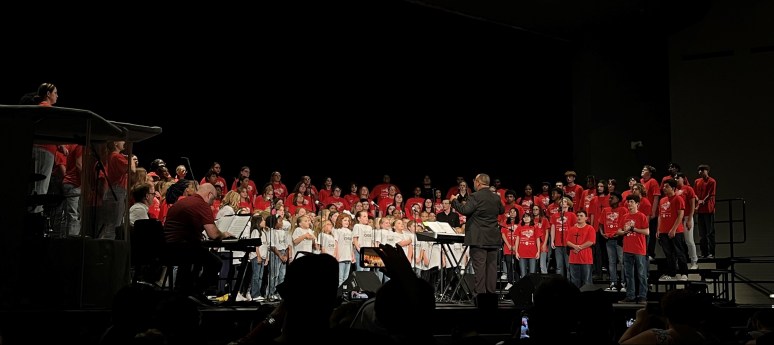
“Welcome to one of the most exciting nights of music anywhere in the Kentucky Indiana area,” choral director Kyle Broady commented last Tuesday night. And, he was absolutely right.

Gospelfest was a fantastic, moving, and very energetic event. The concert style worked perfectly to create an environment of connection among those in the audience. The singing along of audience members would typically be one of irritation, yet somehow they were able to make it feel as though it belongs among the singing voices of the choir.


Choir director Kyle Broady and Dr. Roosevelt Escalante direct all of the choirs at the annual Gospelfest on Tuesday, Sept. 24. Photo by Sam Ottinger.

The performance consisted of eight songs. The very first, sung by the chamber choir of JHS singers, started off slow with a soft piano sound of “I Believe,” yet it soon grew into an energetic piece as the sizzles of a cymbal joined, and the audience was encouraged to clap along. 

Following this piece was a favorite among the crowd, as well as one favorite of my own, known as “He Heard My Cry.” Senior Luna Guyse began with a solo accompanied by similar soft piano notes and then transitioned into a harmony and cymbal climb. The crowd cheered nearly after every other lyric.

The next two songs, “You Should Know” and “My Soul Has Been Anchored in the Lord,” were sung by the gospel ensemble, with solos from Guyse, freshman Vivienne Diehl, sophomore Presley Inzer, junior Nairah Jadusingh and junior Joshua Broady.

A very special quality that I noticed during Gospelfest was not just the opportunity of connecting with our community, but also being able to connect with our own family. During “My Soul Has Been Anchored in the Lord,” Roosevelt Escalante invited a surprised Broady to come up and sing alongside Broady’s son. 

“He [Dr. Roosevelt] wanted to do it so I could sing with my son, which was pretty special,” Broady said when asked how he felt at that moment.

Before the final song, “The Blood Still Works,” Dr. Escalante was able to perform with his daughter.

Both pieces didn’t just have beautifully sung vocals, but also the warmth of family being able to share the joys of singing together. The way Dr. Escalante’s daughter’s performance flowed into the final song felt as though that warmth was reaching out to encapsulate the audience with it, as the song once again allowed the audience to join along in clapping to the melody.

When going back to the song after Broady came up to sing, “Going up a Yonder,” there is another very special quality. This Gospelfest did not just include JHS choir students but also two other choirs, including the Southern Indiana Children’s Choir.

This was a brand new organization, performing for the very first time, consisting of children in second to fifth grade in Clark and Floyd County. They were selected from their elementary schools by their music specialist or teacher and had rehearsal only once a week.

This in itself made it special for how talented these young kids are, but the conductor who helped teach them their skills is none other than Leslie Gabhart, who used to be a choir teacher here at JHS, and she even was the choir teacher for Broady.

The other choir that combined forces for this Gospelfest was Borden Junior- Senior High School. All three choirs joined together to perform the jazzy piece “Bless the Lord.” Each choir was able to be powerful, yet not overwhelm the others.

“Bless the Lord” had to be my favorite piece for the whole concert. Throughout the song everyone just seemed to work well with one another. The live band, the JHS choir, the Borden choir and the Southern Indiana Children’s choir really showed off their talent with this piece.

The following piece, “No One Like You” – sung by the JHS and Borden choirs – returned to a slower, softer start. This song may not have been the most energetic one, but that does not mean it was even close to being boring. As a soloist started the lyrics off, there was a really captivating way that they performed. For after the third line the singers were able to raise their pitch on the word “me” to this enchanting sound.

For something that started more than two decades ago, the emotional energy created in that auditorium was as young and thriving as ever. The love that could be felt in that room, for the people and for the music, was something I haven’t felt after any other school event.

Barbie (2023) Review

By: London Williams

Barbie has been loved for many generations. She’s the plastic doll we’ve all grown to love. She’s fantastic, and so is this film! ‘Barbie’ came out this past Summer on July 21, 2023. Competing alongside “Oppenheimer” as one of the year’s most anticipated movies. This movie has made over 1.34 billion at the Box Office (for the US) just so far! Barbie jumped out of her box and has been crushing it at the box office ever since the release of this film! The feeling after watching ‘Barbie’ is unlike any movie I’ve ever seen. This movie is so charming and nostalgic. It has you thinking about it long after watching. It manages to have a perfect balance of relatable, real-life issues while keeping its innocent, humorous, and lighthearted approach. 

The plot of Barbie is pretty simple; Barbie has an existential crisis and goes to the real world to figure out why her perfect life seems to be falling apart. Ken tags along, and they both go their separate ways in self-discovery. Barbie runs into the mother-daughter duo that has the answers to all her problems, while Ken is convinced that the real world is run by men. (Which of course, makes him go back to Barbieland to make a world full of Mojo Dojo Casa houses and horses.) This movie perfectly handles the topic of equality. After Barbie goes back to Barbieland and sees what Ken has done she is torn and devastated, things didn’t go well in the real world, and now Barbieland is falling apart too. It feels like the “man vs. woman” situation Barbie felt in the real world. The way Barbie feels is clear and relatable for women while being easy to understand and empathize with for someone who couldn’t personally relate. 

I believe that the casting for the movie was perfect. Margot Robbie and Ryan Gosling did a fantastic job capturing their roles. It felt like Barbie and Ken came to life by how their humanization was portrayed. Robbie and Gosling took one-dimensional characters and gave them more depth and life. Margot Robbie and Ryan Gosling are already extremely beloved actors. That’s another reason I think the casting is perfect. Who wouldn’t want to see the latest Margot Robbie or Ryan Gosling film? ‘Barbie’ also features many other well-known actors, including; Will Ferrel (as Mattel CEO), Michael Cera (as Alan), Dua Lipa (as Mermaid Barbie), and John Cena (as Male Mermaid), and that’s just to name a few! The casting for all the Barbies and Kens was epic, to say the least. It felt like every time I blinked there was an actor that I recognized. They even got Nicki Minaj and Ice Spice to create the song “Barbie World”! After that song came out, it was everywhere. I found myself having the song stuck in my head before and after finishing the movie. The release of “Barbie World” was one of the perfect buildups for the premiere of this film. Some would say it was also a “full circle” moment for Nicki Minaj since she frequently associates herself with the character. The song is also great as a standalone track that worked great with the end credits of the film. Who wouldn’t want to see this exceptional movie?  

I found the maturity rating for this movie very interesting. It’s definitely PG-13, but I noticed people being confused that a Barbie movie would be rated PG-13 instead of just PG. When I went to see this movie, there was an abundance of very small children walking in. This made me wonder about its advertising approach. This could just be parents assuming it was PG or just not caring if their 7-year-old sees a PG-13 movie; which definitely isn’t abnormal, but I thought it was worth noting. When I mentioned Barbie to a few adults in my life, they actually made comments about how they were surprised about the rating. After actually watching Barbie, it’s clear why it’s rated how it is; one very subtle sex joke, its mentions of death, and its topics of womens rights and equality. It feels like Barbie was in between PG-13 and PG, and they went with PG-13 to be safe. 

This movie has many beautiful moments. A notable one is when Barbie is sitting on a bench in the park by an older woman. She tells the woman that she is beautiful, as she is crying. Barbie realizes how beautiful people and the world are. Barbie is seen by a lot of people as a vision of the “perfect woman” who lives a “perfect life”. When Barbie sees the real world it makes it clear that it isn’t true. Nothing is perfect and that is what is beautiful. Things aren’t as simple as Barbie had originally thought. Beauty is all around us, and Barbie makes us realize that. Barbie truly is a beautiful experience you don’t want to miss! 

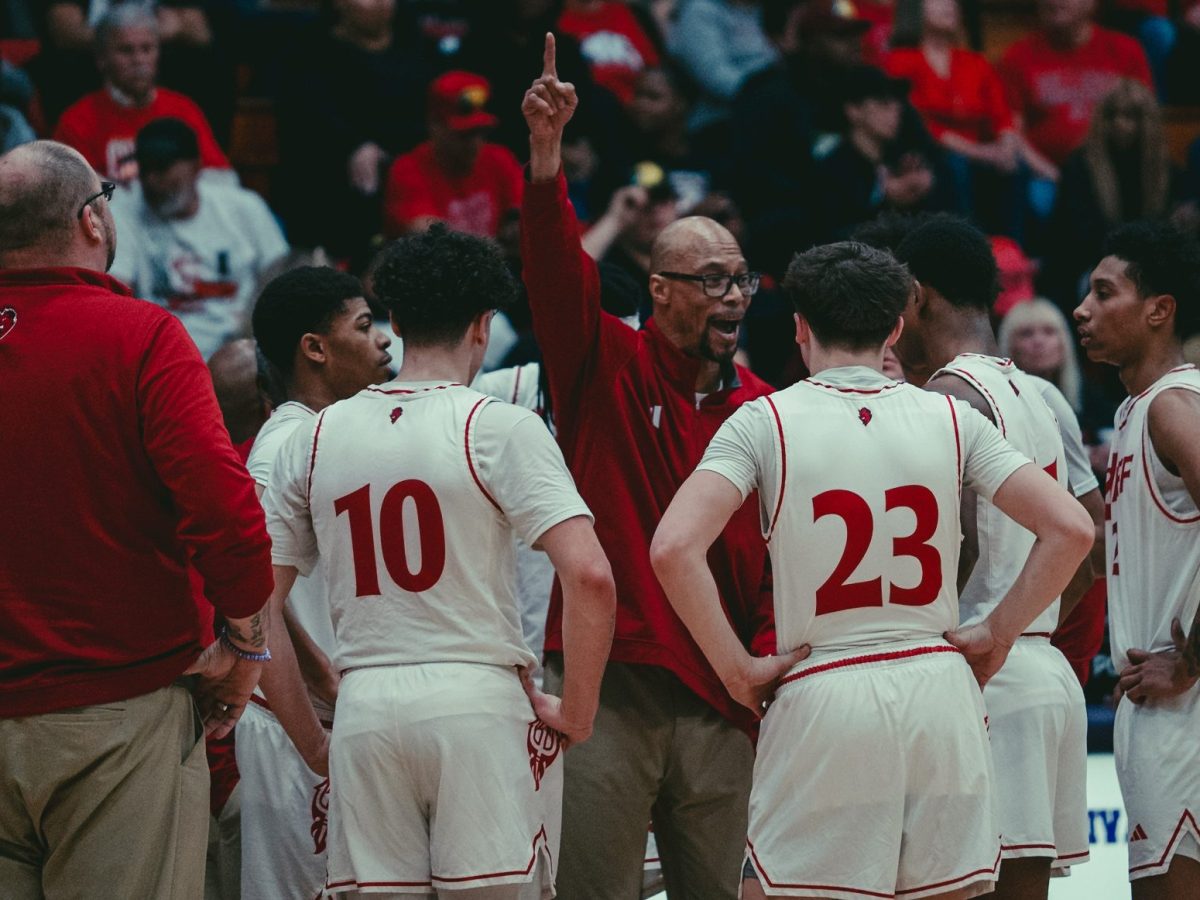
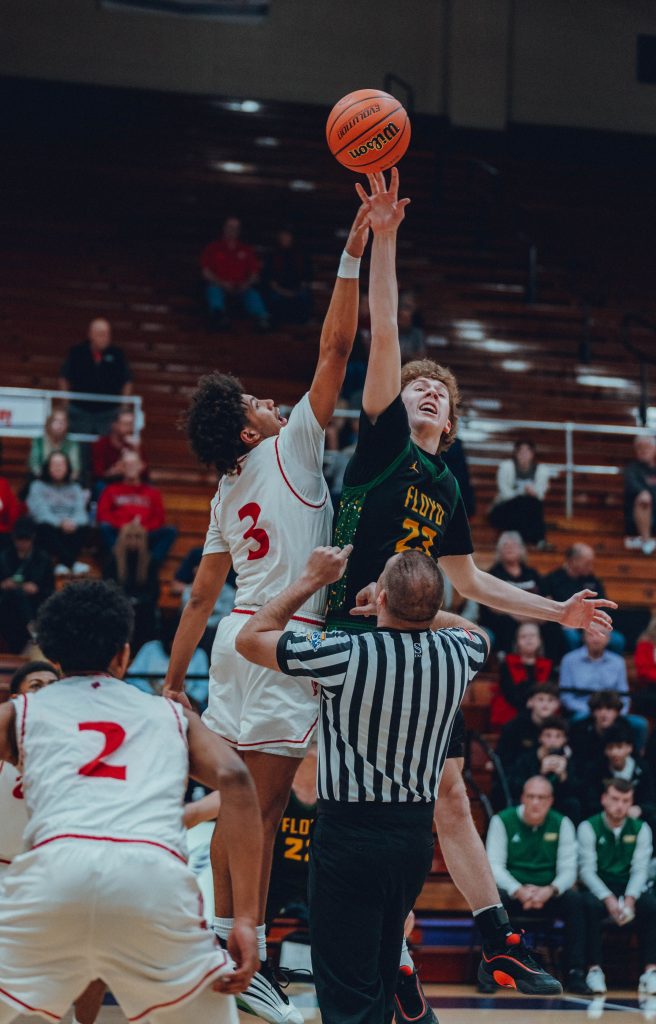
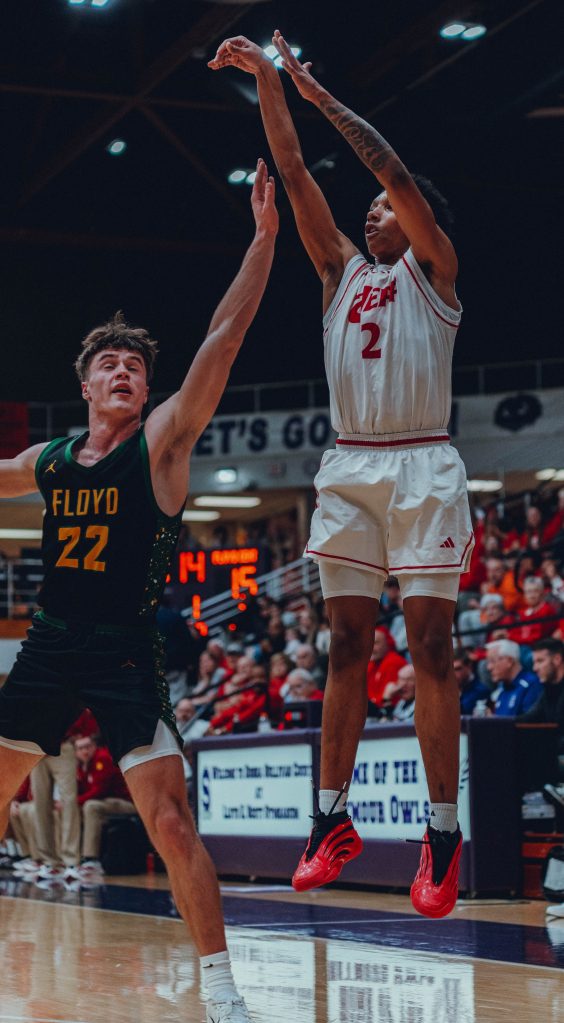
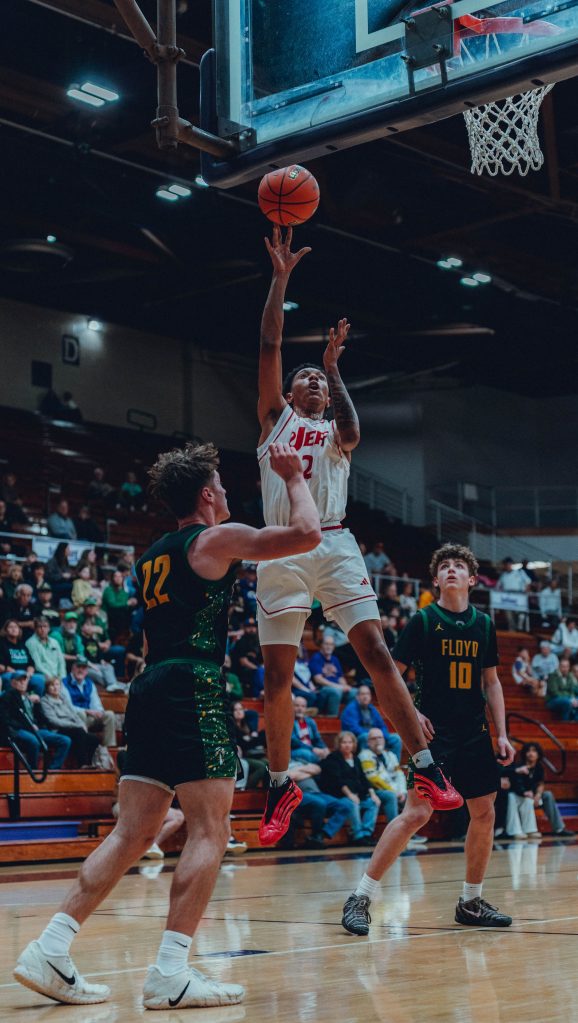
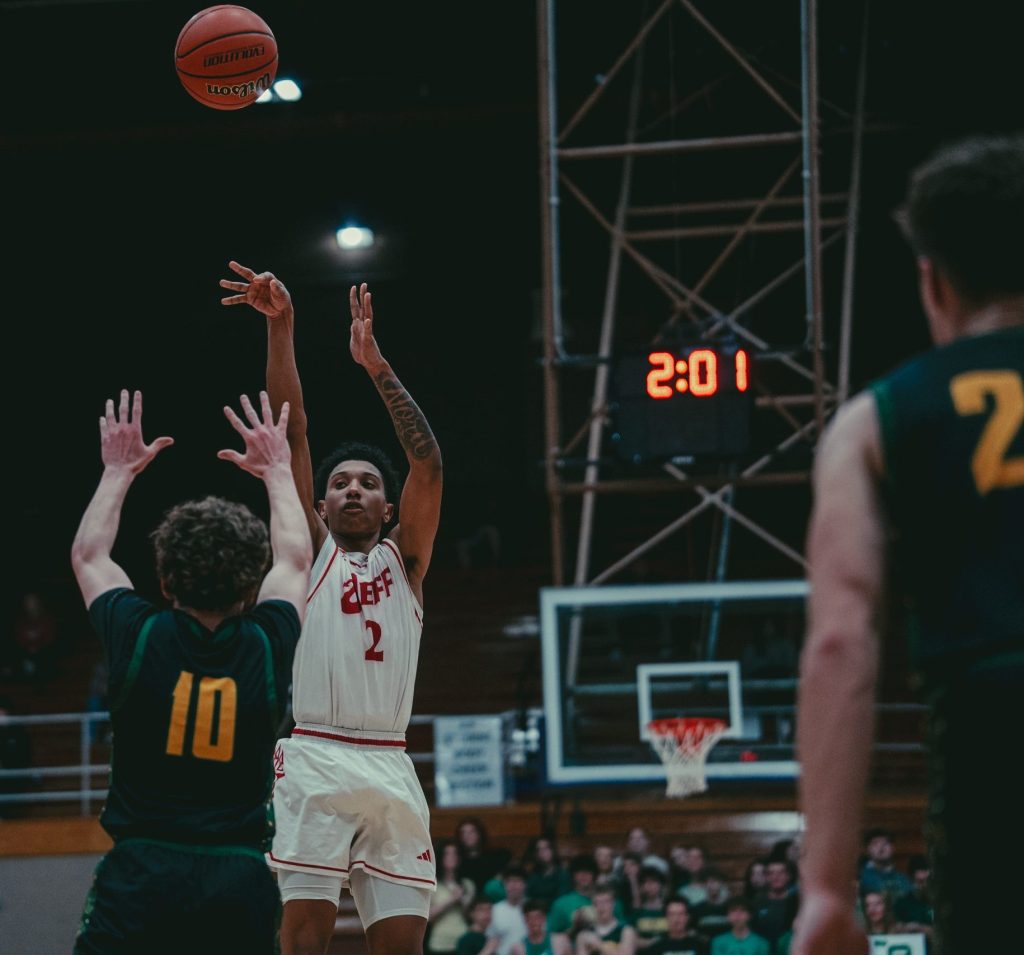
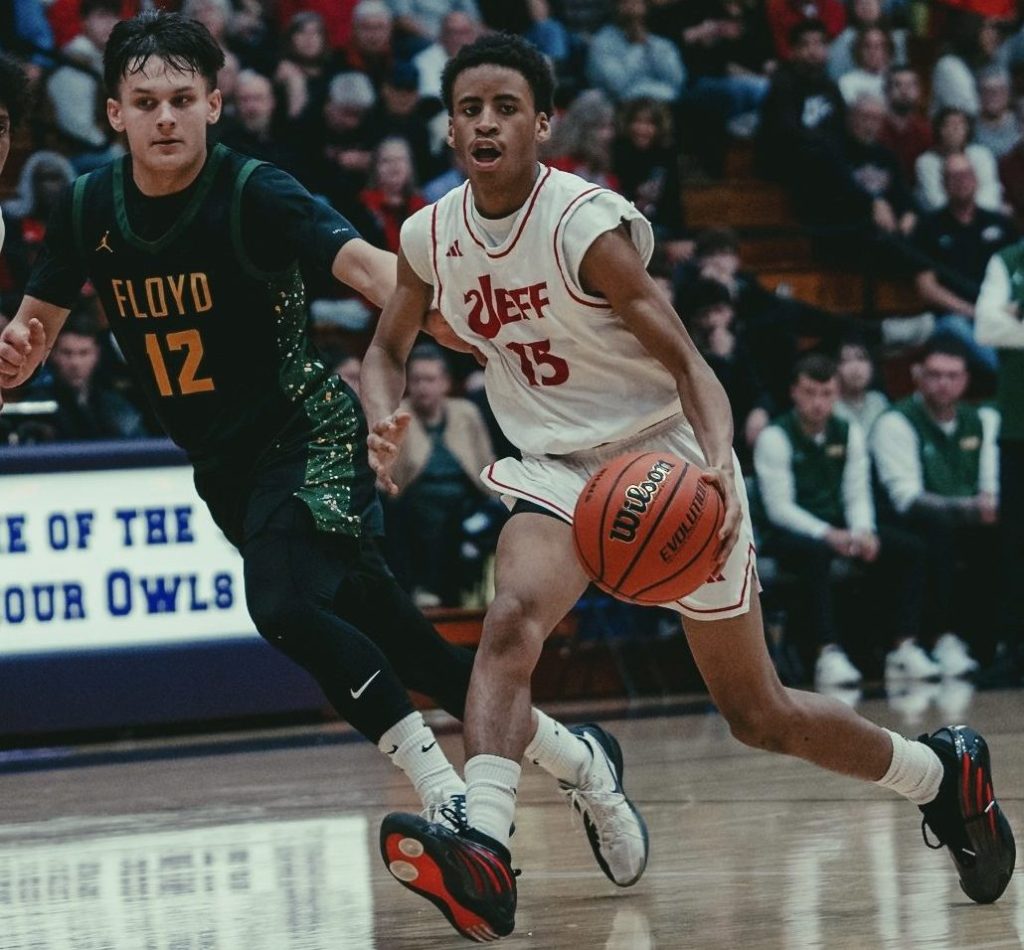
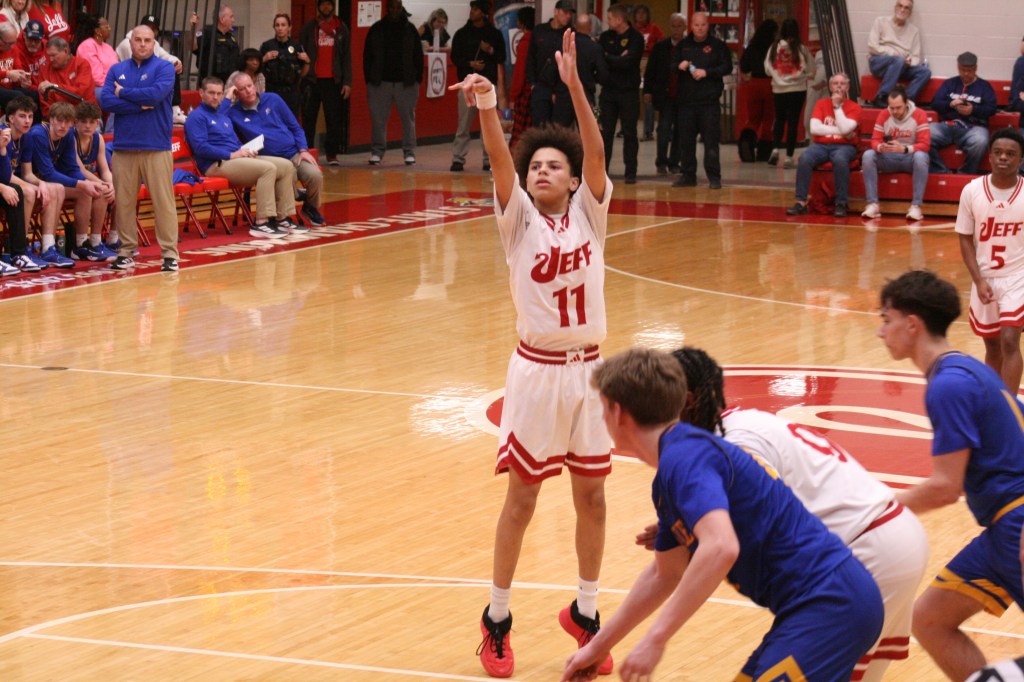
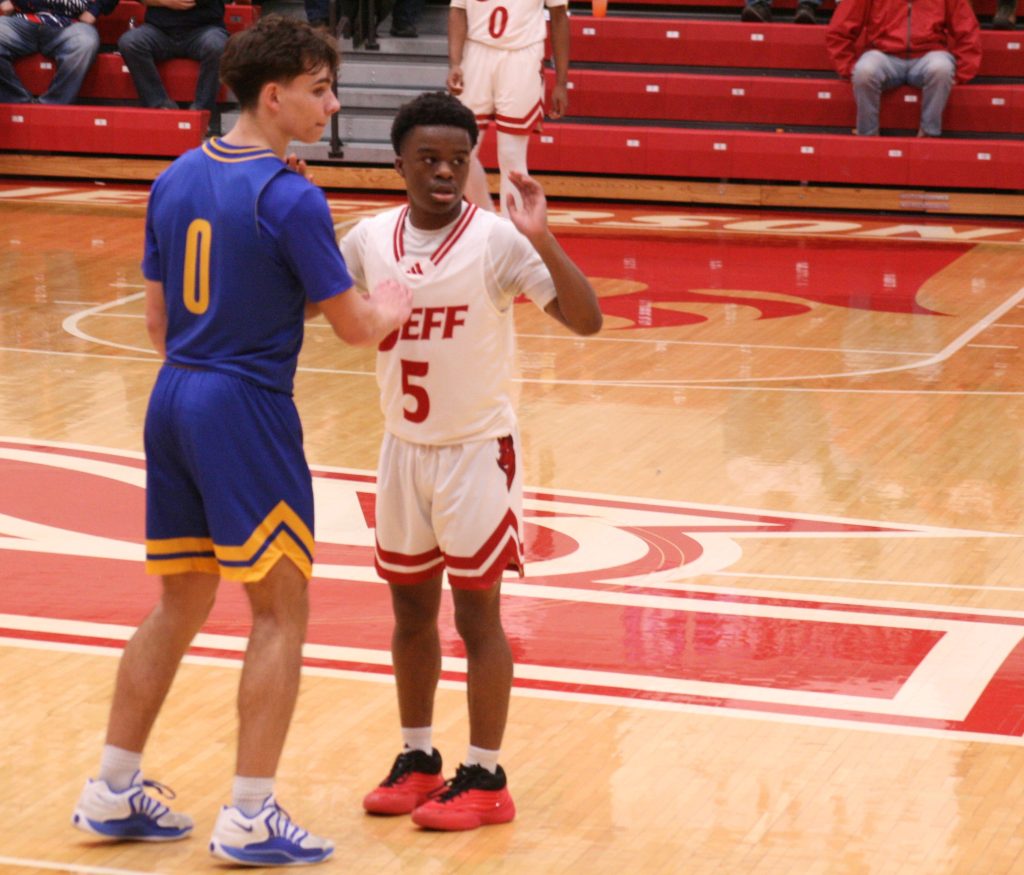
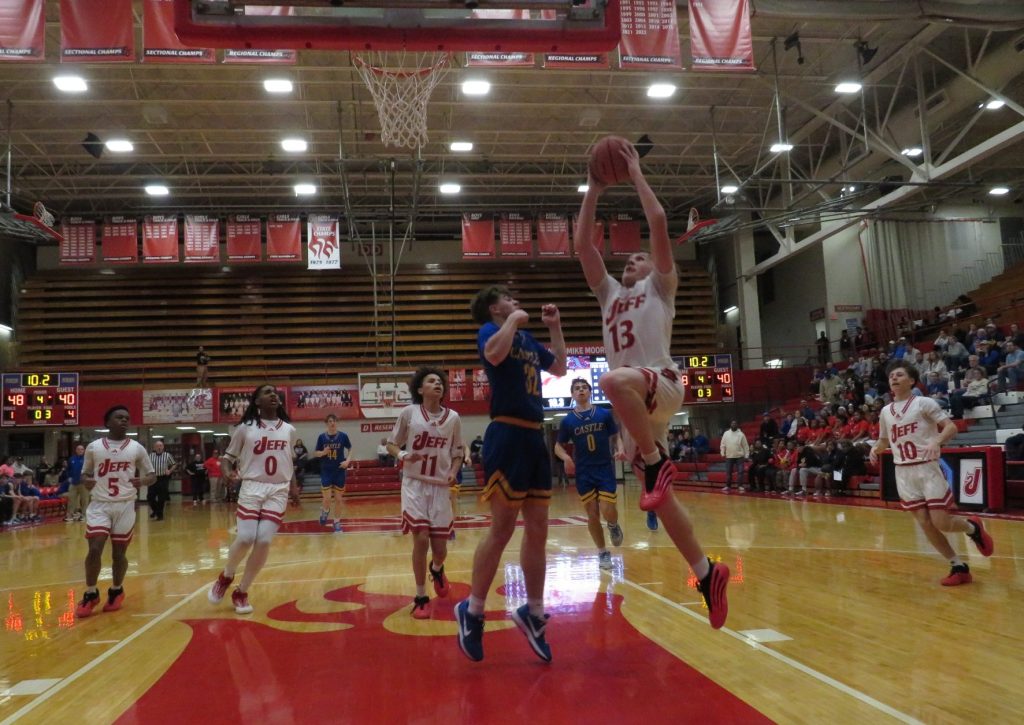
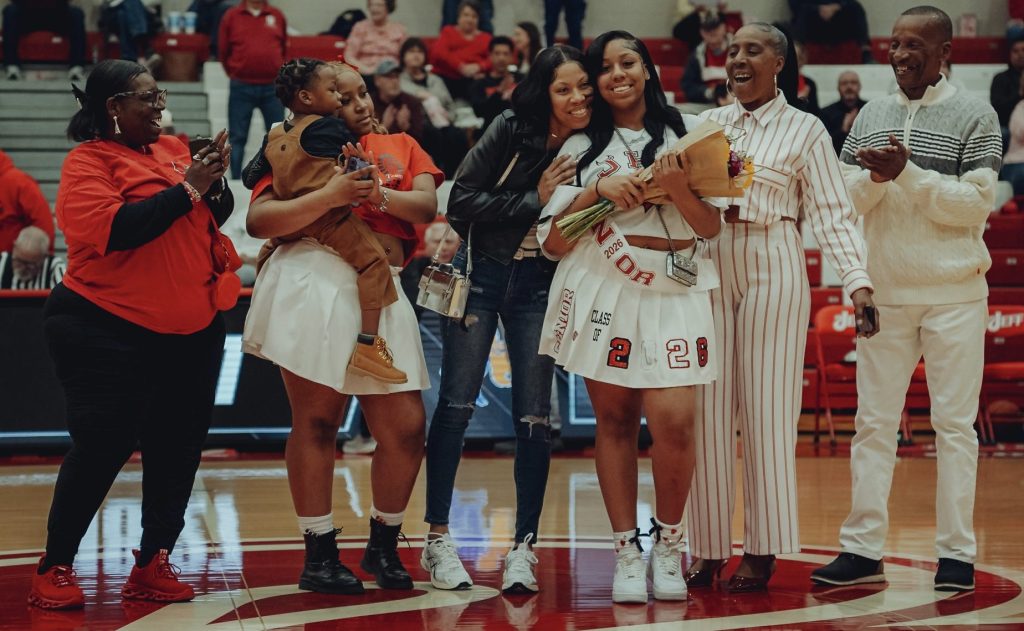
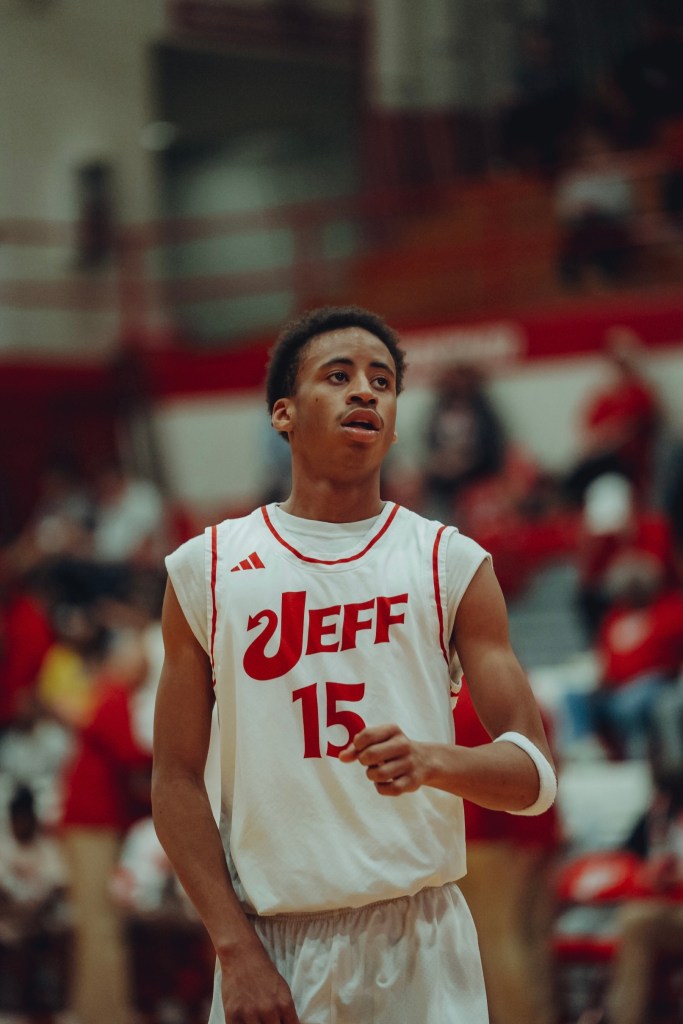
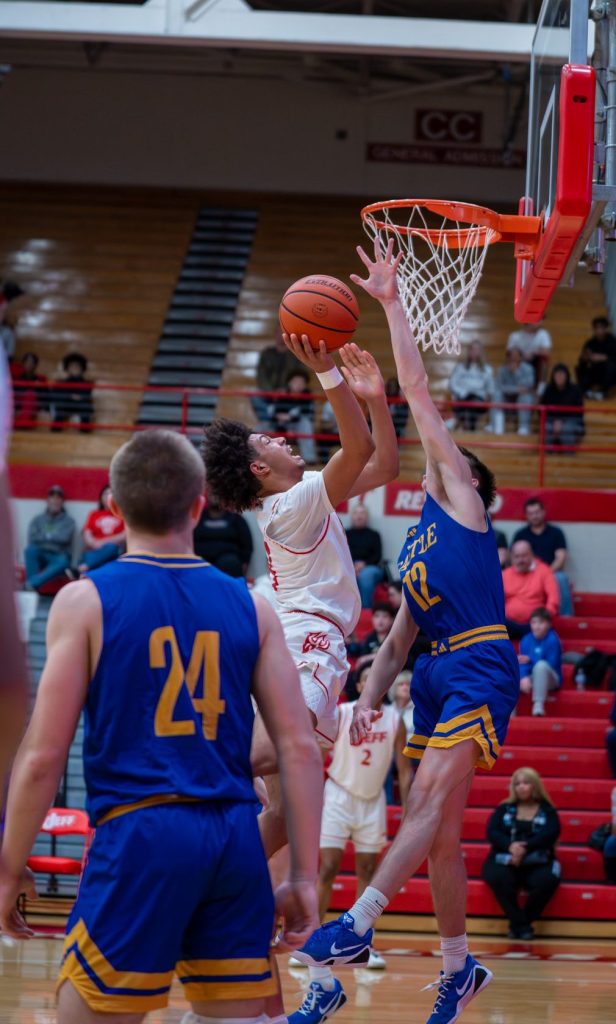
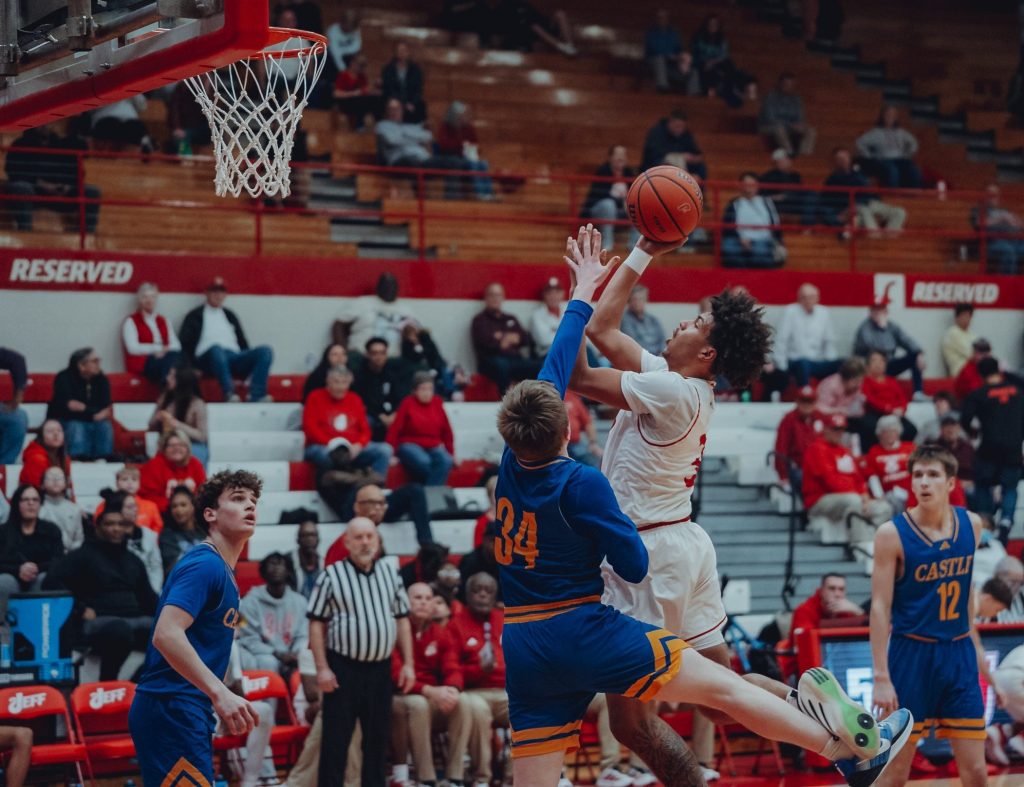
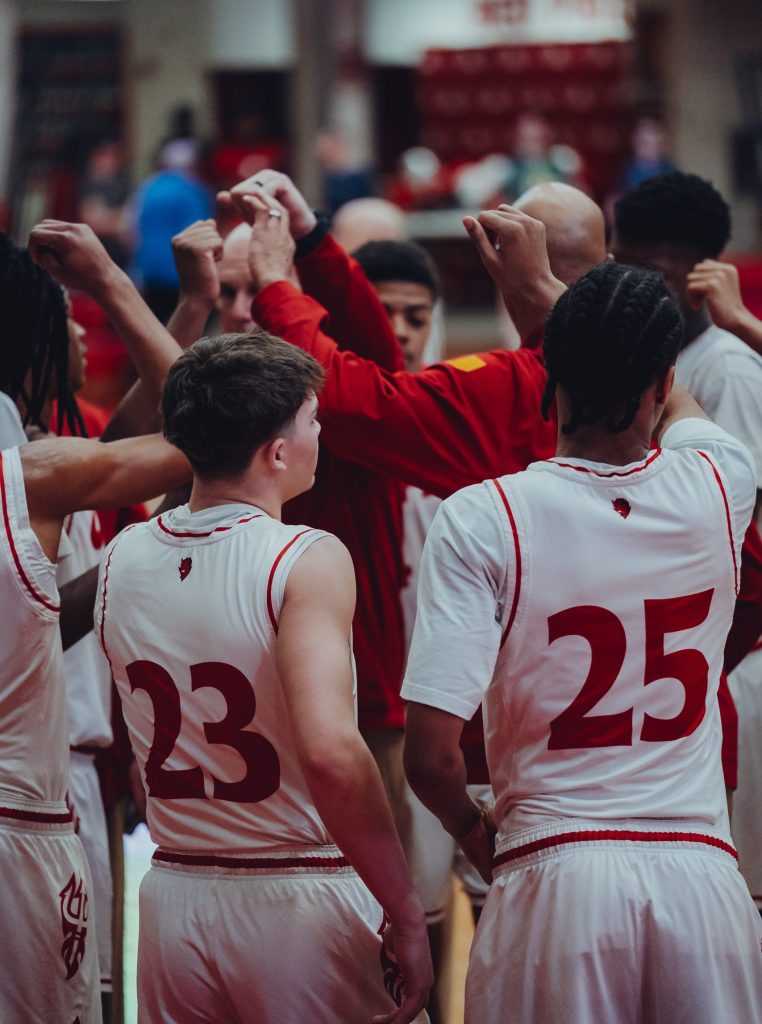
Silver Creek defeats JHS 64-51

State championship rings handed out prior to last night’s game

All photos by Magdalene Conrad, Malachi Conrad, Parket McCloskey, and Isaiah Stewart. Click on photographs in the gallery below.

Niemi wins Sophomore Class JHS Christmas Shirt Fundraiser

Stephanie Niemi poses with the Christmas candy basket she won as part of the Sophomore Class JHS Christmas shirt fundraiser. The Sophomore Class had a drawing for the gift basket for anyone who purchased a shirt, and Niemi’s name was drawn as the winner. The Sophomore Class thanks everyone who participated. Submitted photo.

Red Devils prepare for Silver Creek tonight

by Austin Bainbridge

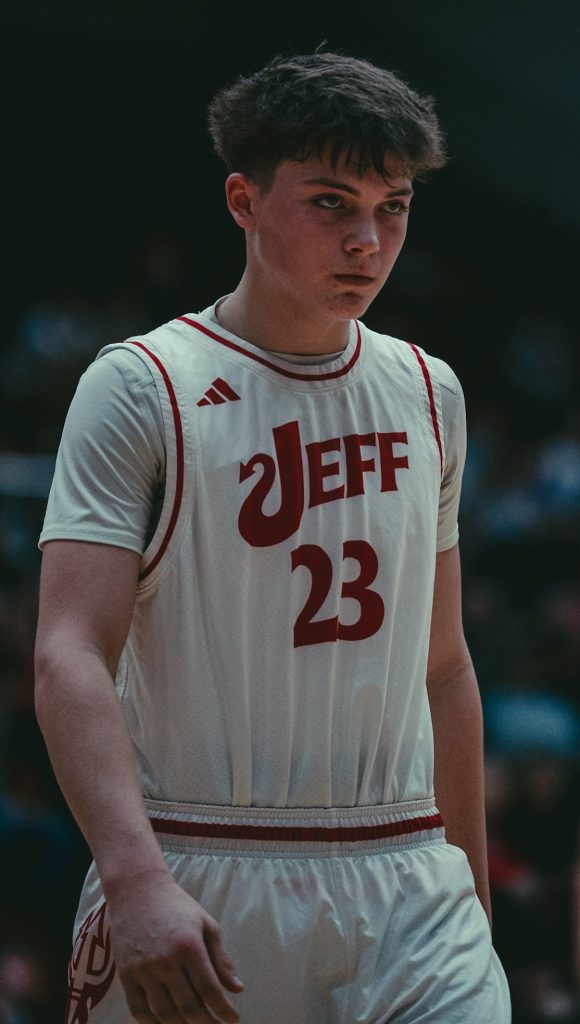
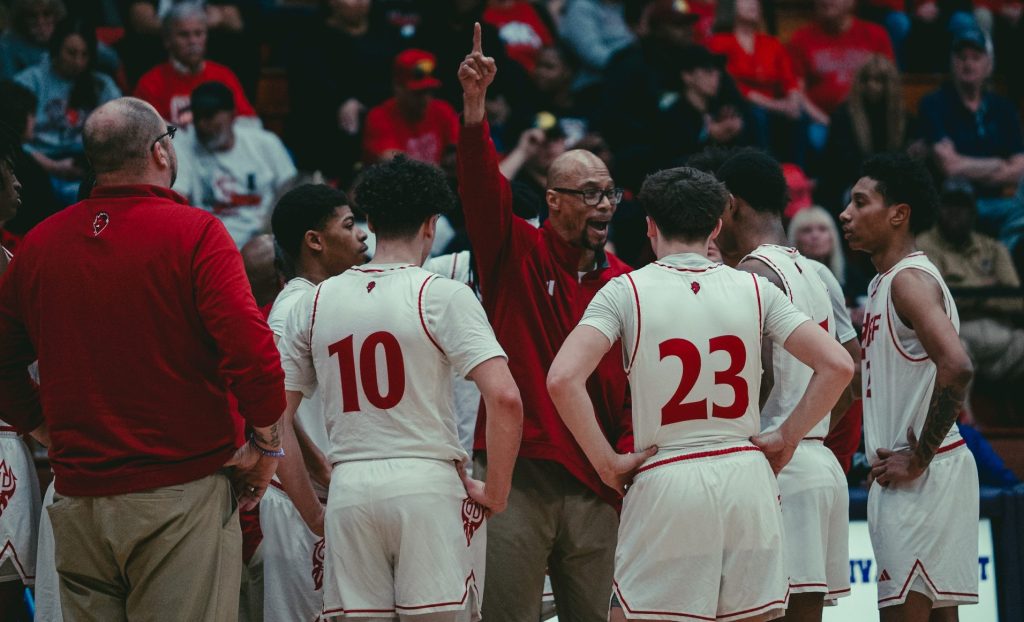
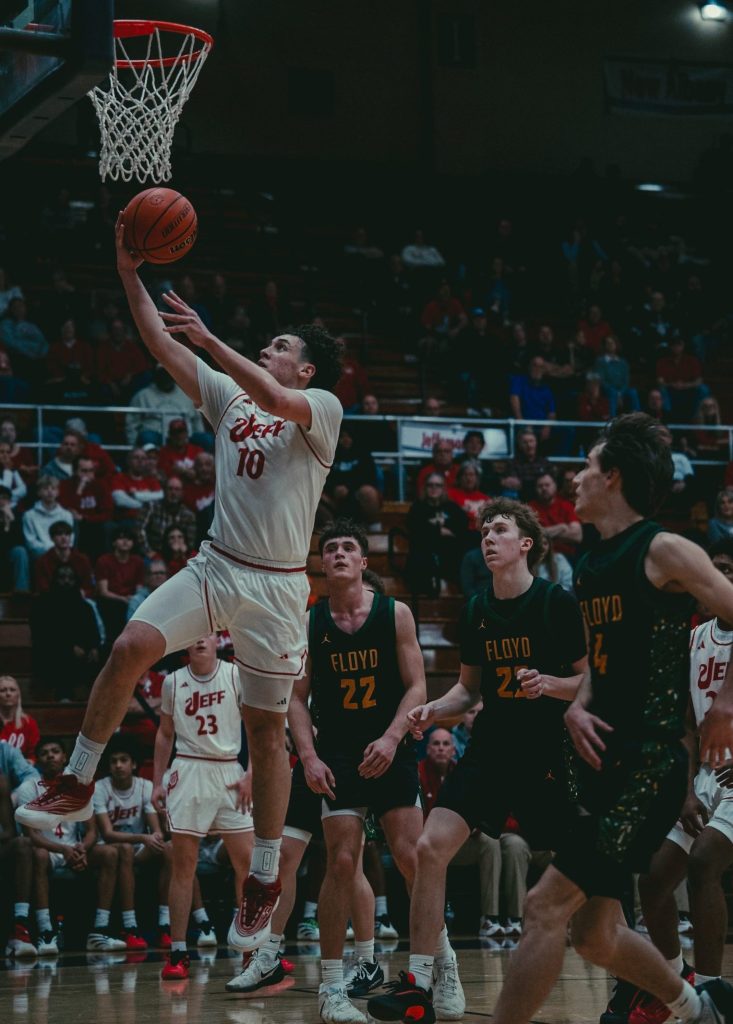
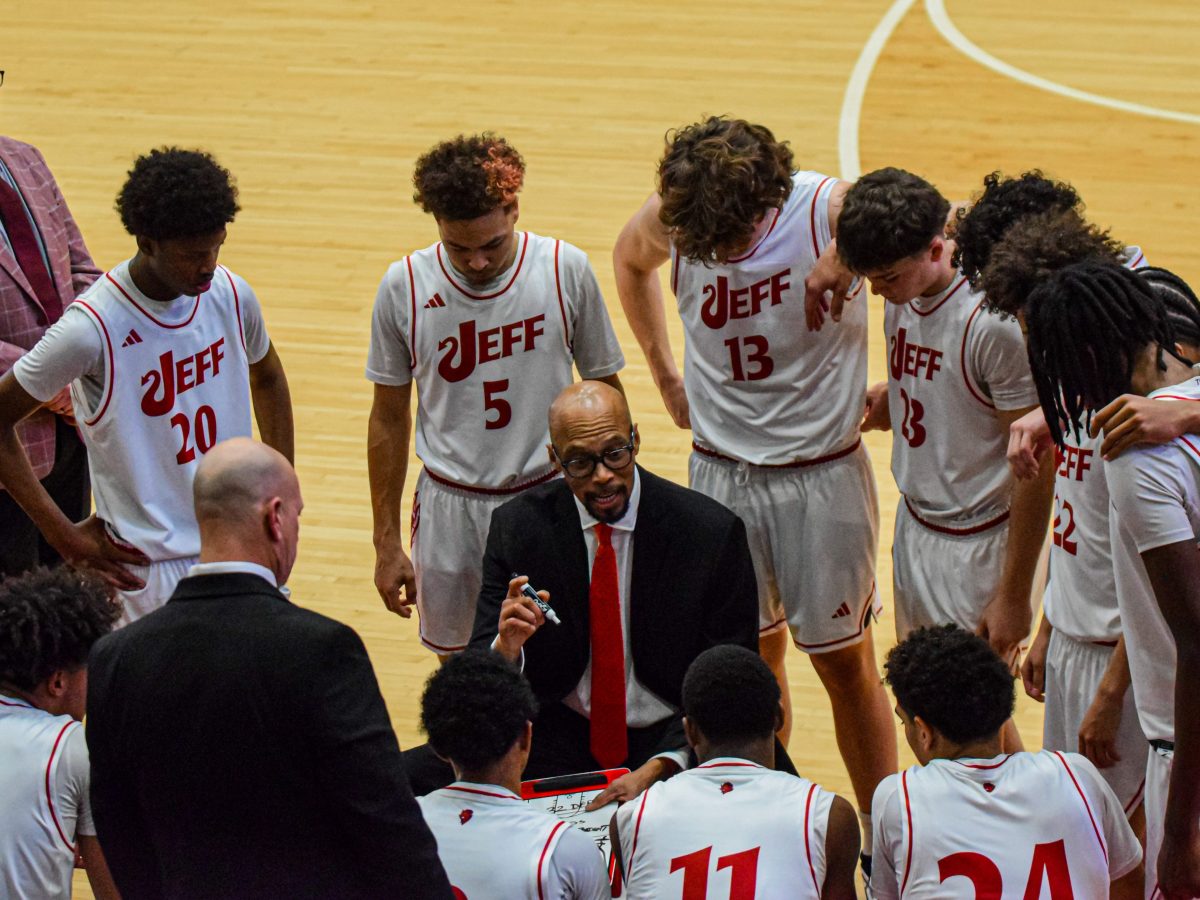
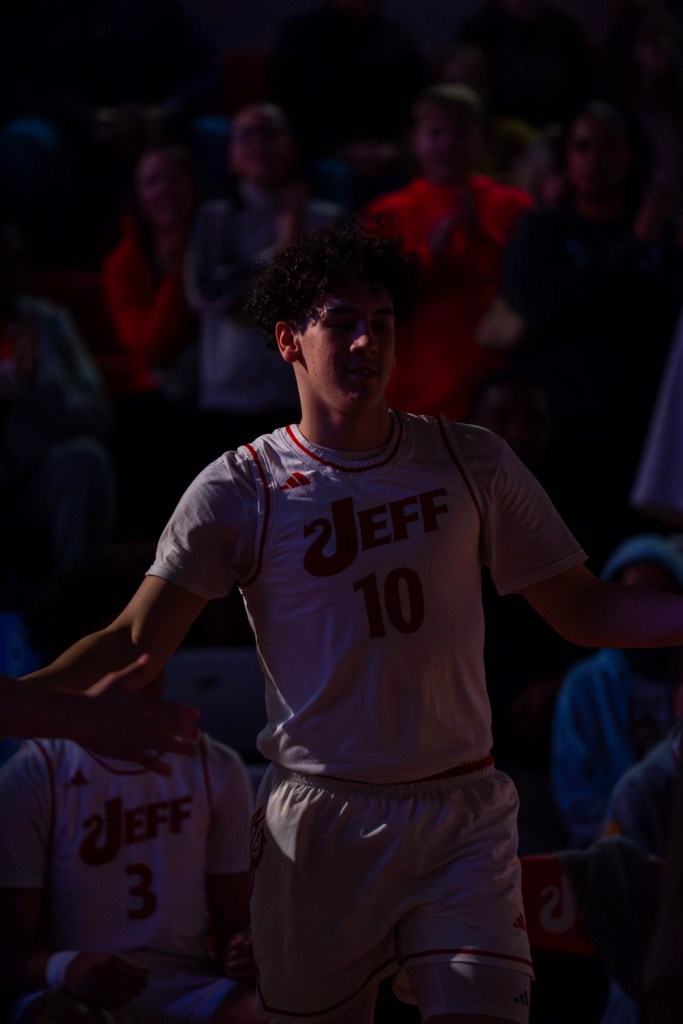
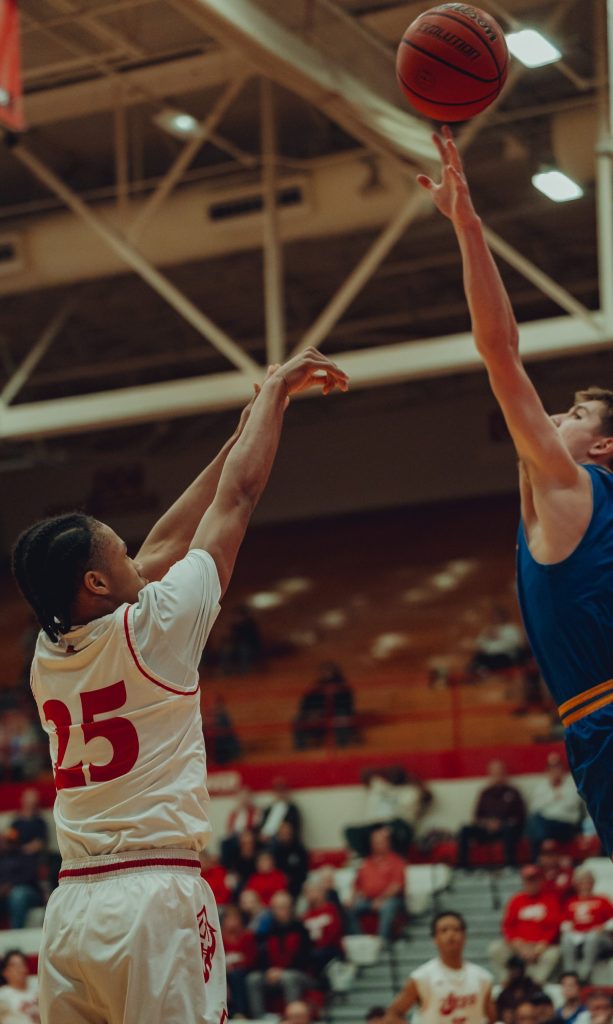
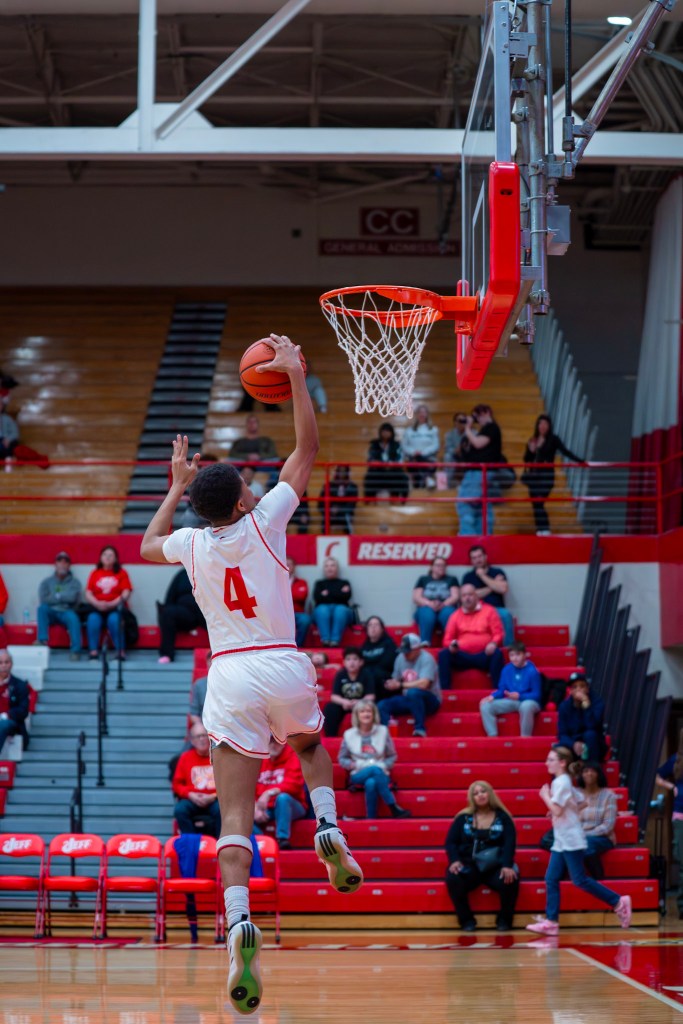
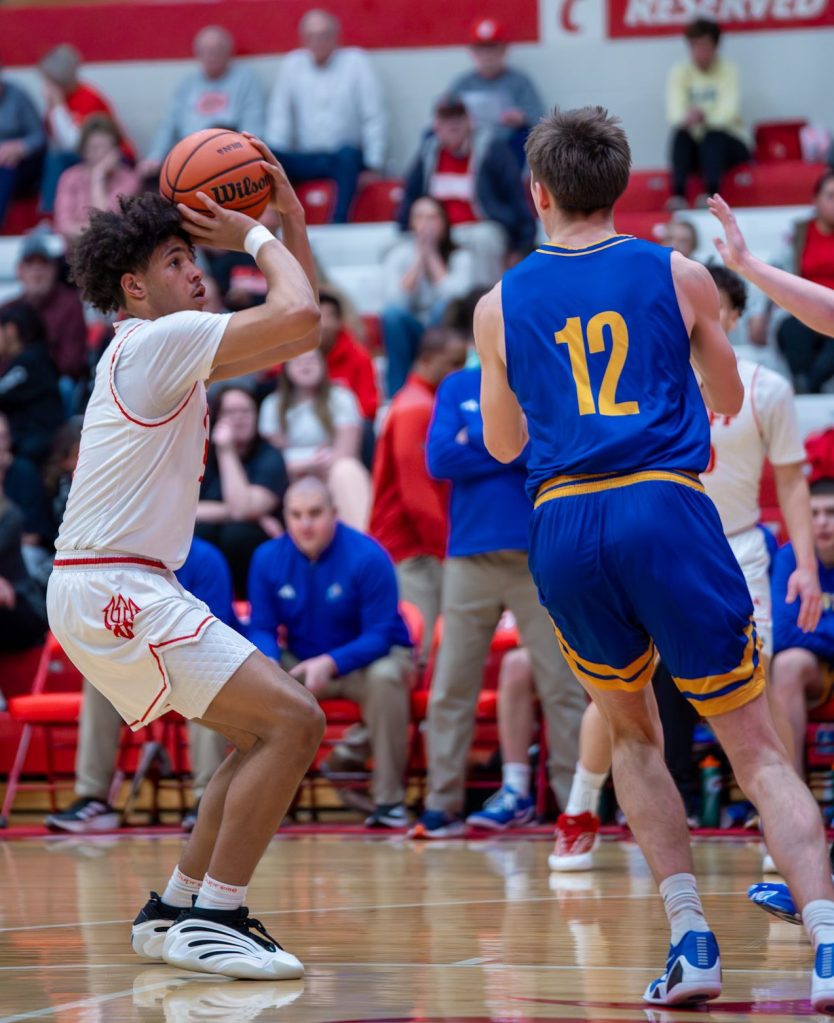
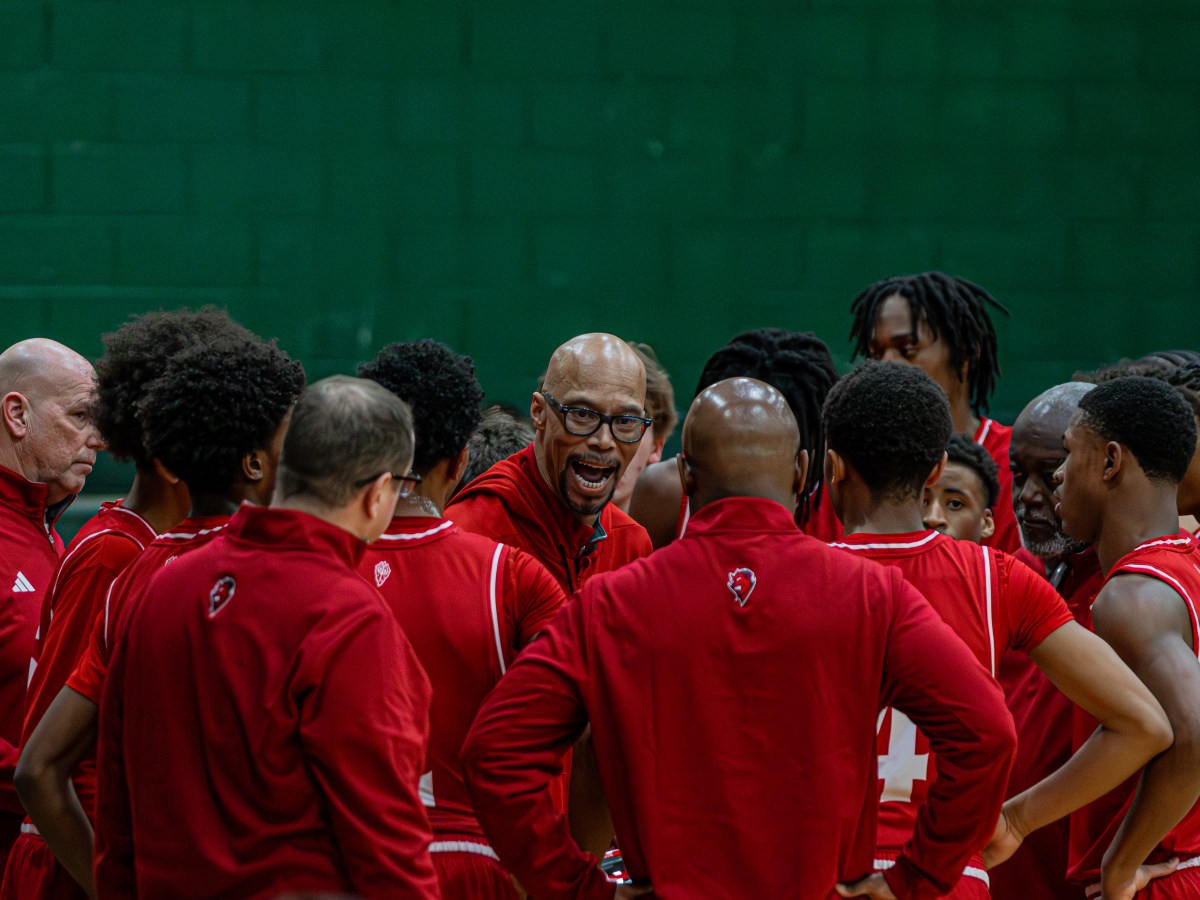
The Jeff boys’ basketball team faces one of the top-ranked schools in Indiana, Silver Creek, for their home opener in a big benchmark game tonight in Johnson Arena.

“This is an important game; even though it’s not a rivalry like Floyd or New Albany there is a very good team and a win would be huge,” said sophomore guard Cornelius Weobong.

Silver Creek is looking like one of the best teams in Indiana and is searching for a statement win against Jeff.

“They’re really good at sharing the basketball. They’ve got six guys that could score 20 on any given night. So they do a really good job of moving the ball,” said head coach Sherron Wilkerson.

Graphic by Magdalene Conrad.

Jeff isn’t looking as potent as last year’s state championship team but still sees this as a competitive game.

“Our biggest keys are — Number one, we’ve got to guard for basketball. Number two, we’ve got to rebound. Number three, we have to take care of it, we cannot turn the ball over,” said Wilkerson.

The fans are also looking forward to a competitive game like this early in the season.

“I’m excited to see our guys play at home. I hope that we can come away with a win against a team as good as Silver Creek — that would be a big momentum boost,” said English teacher David Kummer.

To come away with a victory Jeff is going to have to capitalize on opportunities and not give Silver Creek very many.

“We have a lot of time where you get a good cut, get the ball, and then we miss, we give them free possession again… and then on defense we have got to know where we were at and we’ve got to sprint to our spot. We can’t give them easy points,” said Weobong.

Silver Creek is good as a team, but they also have players who shine above the rest.

“Brandon Hunter — he just recently had a game where he had 13 rebounds at the point guard position. When you have a point guard putting up 13 rebounds, that means that he is worthy of being able to get you a triple double, which probably makes him the most dangerous player on the floor,” said Wilkerson.

The Red Devils are looking to overcome some of early year struggles.

“Our mental toughness and our physical toughness is probably our biggest hurdle right now. And I think that once we’re able to correct those two issues, I think then you will start to see us jell into a unit,” said Wilkerson.

This game has been on Jeffs’ calendar for some time and they’ve been preparing.

“We’ve been preparing for Silver Creek since the buzzer went off at Seymour; we’ve been gameplanning and preparing pretty intensely,” said Weobong.

This young Jeff team could put itself on the map with a Silver Creek win, and they’re ready for tonight’s challenge.

“A win would be huge for us because this particular group as a unit has not been through the fire yet. So it would be nice to be able to go through the fire and come out successful. These guys are ready to be recognized,” said Wilkerson.

In addition to tonight’s battle with the Dragons, Jeff players and coaches will be honored with the presentation of their state championship rings from last season.

Kentucky fans react to new football coach

by Sophia Waldridge

After 13 seasons Mark Stoops brought historic stability to Kentucky and led four 10-win campaigns in 2018 and 2021. He also showed the team eight consecutive bowl games and two top-25 finishes. But after too many losing streaks and a 41-0 loss to Louisville on Dec. 1, Kentucky fired him. Will Stein is the new Kentucky coach.

Many Louisville fans are happy because they want real change and challenge. Senior Kaeleb Hayes, who is a die hard Louisville fan, said that Kentucky “needed to do it” and that the team would be “better off without Stoops and the team will get along so much better with the leadership and the stability of Stein.”

But others do not agree with Hayes and think that Stoops should not have been fired. Sophomore Eli Tate, “I think that we will have better prospects but at the same time he was a good coach and I don’t think that this one game should have caused him to be fired.” 

Sophomore Cali Smith agreed with Tate and is also a Kentucky fan; she said that the team will have to come up with new critical thinking skills and “learn to adapt with a new coach with different teaching styles.”

Freshman Harper Gordon also said that the Wildcats will have to adapt and thinks that it was a good thing because “Stoops has been a bad coach for three years and gave us a horrible season.” She said the new coach Stein is better for the team because he will push them harder.

Kentucky fans aren’t too happy, but most of them are rallying for the new coach and can’t wait to see how he trains the team differently and if they’ll get any better under different and new leadership.

Column: Schools should adjust early start times for teens

by Sanae Ittu

The hardest part of school isn’t the homework — it’s the early time that forces teens to function on almost no sleep. The CDC reports that 7 out of 10 high school students don’t get enough sleep. When teens are tired, we don’t learn well, and early bells make the problem worse.

Studies consistently show that early start time leads to more stress, lower attention, and high chances of students drifting off in class. The American Academy of Pediatrics confirmed that early time causes chronic sleep loss which links to higher stress, irritability, and difficulty paying attention in class.

Sleep deprivation doesn’t just make teens feel tired, but affects our academic performance. Oxford academic researchers using EEG data from high school students found that students in early morning classes had lower attentiveness and performed worse than mid-morning students. Teachers noticed right away that students have unfinished assignments, slower participation, and struggle to stay alert during instruction. Early start times make learning feel harder than it should be.

The main benefit of starting school later is better attendance and grades. The University of Washington Study decided to test out starting school later to see the effects  it has on students. In the same study, after school start times were pushed back, final grades were 4.5 percent higher and first period absences dropped. There are also more benefits like improved mood and fewer car crashes among youth.

Early start times also take a toll on students’ moods. When teens don’t get enough sleep, it shows through low energy, irritability, and difficulty staying positive throughout the day. In early classes, it’s common to see students with their heads down or barely awake, but in later classes those same students are noticeably more alert and engaged. When someone starts the day exhausted, it becomes harder to focus, stay motivated, or complete work until they feel fully awake again.

Some may argue that teens can just go to sleep early, but this would not work because teens can’t just go to bed early; our bodies naturally stay up later at night. 

Dr. Mary Carskadon stated during a PBS Frontline interview, “there is another part of their brain..the biological timing system, or the circadian clock… But when they start the day with the empty bank…they really should be home in bed sleeping, not sleeping in the classroom.”

Column: Listening to music provides healthy benefits

by Brooklynn Stevenson

Music has long been a part of human culture for centuries, serving both as a form of expression and a way to communicate. Music plays a significant role in enhancing our mental, emotional, and even physical well-being. Engaging with music can foster personal growth and improve our overall quality of life.

One of the most notable benefits of music is its impact on mood. According to Right As Rain, listening to music can trigger the release of dopamine in the brain. This is why many people turn to music during times of stress or sadness. Playing a favorite song can uplift spirits and provide a deep sense of comfort. 

Music allows individuals to process their feelings and experiences in a healthy way.

In addition to the emotional benefits it provides, music has been shown to have several advantages as well. According to PMC, engaging with music can enhance memory and boost focus. Learning to play an instrument requires multitasking and commitment, all of which are skills that can bring good academic performance and problem-solving abilities. APA states that students involved in music education often score better in math, science, and English than their nonmusical peers.

A significant part of music is the social aspect. Music often brings people together, bringing connections. Whether through concerts or just listening with friends, the communal experience of music can enhance social bonds. Collaborating in music also encourages teamwork and communication skills, which are essential in personal and professional environments

Music can have therapeutic effects as well. Music therapy is recognized for its effectiveness in treating mental health conditions, such as anxiety, depression, and PTSD. It can help individuals express emotions that may be difficult to express or articulate. Additionally, music is often used in rehab programs to aid in physical recovery. Overall, the benefits of music highlight its importance as a huge aspect of human experience.

Column: Education system should do more to relieve neverending pressure

by Jilliann Denbo

As a kid, I’ve always thought I would be a teacher, or maybe do something with ocean animals. And I always thought I could just change my job whenever and it wouldn’t affect me. I used to have so many goals and different career paths I had wanted. But now all that is just a fantasy.

Kids like me didn’t even know there were many options for careers only because I was never opened up to the idea of ‘different jobs’.

Now that I’m a sophomore, the next two years really impact my career. I’ve always been indecisive on what I want to do or how I want to do things. And knowing I have to make the right choices sometime this year really scares me even though I know exactly what I want to be, I just don’t know where to start.

I never really thought about how much money I’m going to make, or how confusing it would be to pick the right paths for my career. There are always little Google forms about picking classes to help with a career choice , I never know which ones to pick. It always makes me nervous because I don’t have any idea if I chose the right thing or how it will affect me.

Many people like me feel this way too. There is just a never ending pressure about picking our career. Maybe it’s all too soon?

Teachers don’t give us enough opportunities to explore their career, yes we get to move paths only once maybe twice. But what if that isn’t even enough?

Education should focus on more than making us pick a path early, it should equip us with a broad knowledge base, and explore many different possibilities open to us.

Some students mix up degrees and careers, leading them to pick the wrong classes. I feel us students should have a little more of an understanding about exactly what classes to choose for each career. 

Yes, picking a wrong career will not ruin anything. But pressure from friends, family, and society make it feel like it will. Even if we know exactly what they want to be, people can push us to pick classes that have nothing to do with our career. 

Feeling stressed about a career can affect our mind and body, as well as, a lot of students overthinking options before making a decision. 

Teachers can start giving kids more options at a young age by opening our minds to different ideas and pathways.

In all, students shouldn’t have to stress out as badly as they do just because they have zero idea where to start. Education should have more openings into teaching students where to start.

Review: ‘The Wild Robot’ brings beautiful animation to the screen

by Noah Lopez Salazar

From reading the book The Wild Robot when I was younger to finally watching it in theaters it meant a lot. The Wild Robot was turned into a film focused on nature as well as motherly love. It came out Sept. 27 2024 and I was ready to watch with the books giving me high expectations. 

The movie starts off with a futuristic robot named Roz accidentally arriving on an island full of wildlife trying to do its programming and help any person in need trying to complete its task. Roz starts to understand animal language. The animals in the forest have only rude things to say about Roz just because she’s different from them. Roz tries to leave but finds a duck egg by itself. 

She found a task to complete which is to care for the egg with the help of a fox who wanted to help for selfish reasons but turned soft after a while. The main conflict in the story is how to raise a duck as a robot and robots like Roz trying to take her back home from the island.  

This animated film has great quality with having the animators from Puss in Boots The Last Wish. Roz was Lupita Nyong’o who did a great impression of a robotic voice. Pedro Pascal playing the fox called Fink had a great personality in his voice that was way different from him in person. Kit Connor as Bright Bill was pretty good.

The story was heartfelt, which gives you a fuzzy feeling with a whirlwind of emotions with a 97% rating on Rotten Tomatoes with 260 reviews, 8.2/IMDb the most talked about detail was their animation and how beautifully they portrayed the book.

Column: School dress code would enhance focus on academics

by Cylie Ross

School uniforms, such a picky topic. Either people are really against them or love them. Let’s talk about it. 

At JHS we don’t have specific pieces of clothing that we have to wear to school everyday, but we do have a dress code. Some of the policies in the dress code include no inappropriate signs or words on shirts or hats. No mini skirts, or revealing shirts. But I believe uniforms would make everybody’s school life easier.

Teachers wouldn’t have to worry about sending kids home or to the office to change. They also wouldn’t have to worry about watching everybody in the halls to make sure their appearance is appropriate for school. The students wouldn’t have to worry about what they’re gonna wear to school in the morning, which some of the time causes the teenage girls to be late. And it would also be a good idea because students are always worried about what their peers are wearing and that wouldn’t happen if we had school uniforms.

This would also be ideal for busy parents because they would only have to buy three shirts, two pairs of pants and a pair of shoes for their kids because they would only have to buy the uniforms that are assigned by the school. Having uniforms would also increase our focus in class — everyone would be worried about the assignment and not what people are wearing.

School uniforms would also prevent students from falling for trends, or thinking they have to have the newest clothes or they’re not cool enough.

School uniforms should be mandatory for students, as they promote equality, enhance focus on academics, and save parents money.

Column: Slow Start, Not a Lost Season

Why Kentucky basketball isn’t in trouble yet

by Jaxon Sturgeon

Kentucky basketball fans are not known for patience. When you wear blue and white, expectations are always Final Four or bust. So after a slow start to the season, a lot of fans are already worried. But this team isn’t failing– it’s just still building. And with key players like Jayden Quaintance and Jaland Lowe getting back to full health, things could look a lot different by the time conference play really heats up. 

Early in the season, chemistry matters just as much as talent. Kentucky has both, but chemistry takes time. New players have to learn from each other, figure out roles, and build trust on the court. When injuries are added into the mix, that process slows down even more. That’s been part of the problem– the team hasn’t been whole.

The good news is that help is coming. Quaintance brings energy, defense, and presence inside. When he is healthy, he changes the flow of the game down low. Lowe adds speed, scoring, and guard depth that Kentucky badly needs.

Fans want wins immediately. That’s understandable. But basketball seasons aren’t movies– they don’t peak in the first act. What really matters is progress. Kentucky is learning how to finish games, how to handle pressure, and how to stay steady when shots aren’t falling. Those lessons hurt now, but they matter later.

Sometimes a slow start is actually a good thing. It forces a team to grow up fast. Nobody feels comfortable. Nobody assumes anything. When adversity shows up early, teams that stick together usually come out stronger on the other end. This is when leadership is built, and roles become clear.

History shows Kentucky doesn’t need to be perfect in November and December to be dangerous in March. The best teams usually don’t run through the season without problems– they survive them. This group still has time, talent, and reasons to believe.

The season is far from over. Once Quaintance and Lowe are back to 100% and the rotation settles in, Kentucky won’t look like the same team from the first few weeks. This is not the end of the story.

It’s just the awkward beginning.

Column: Using cell phones in school requires a balanced approach

by Mikail Cetiner

Whether we like it or not, phones are everywhere at school. We see them in pockets, peeking from under desks, or being used to text someone who’s just a few seats away. As much as teachers try to control it, smartphones are part of our daily lives now. So, the question is, should they be allowed in school?

Honestly, I think phones can be really useful, like if we need to look up something for a project, want to record notes, or take a picture of the homework on the board. There’s an app for almost anything school related. There’s no question that in today’s world, we use technology for everything from work to communication, so learning how to use it responsibly seems important.

“With the right balance, smartphones could help us learn more and not distract us from learning at all.”

But let’s be real. Phones can also ruin focus faster than anything else. One message, one notification, and suddenly we are scrolling through TikTok for just a minute, that turns into ten. It’s not just distraction, either; phones can cause drama, make cheating easier, or create pressure to look perfect online. School should be a place to learn, and not a place to compare who has the newest iPhone or the most followers.

So, what’s the solution? Completely banning phones doesn’t seem realistic, and letting everyone use them freely definitely doesn’t work. The best option is somewhere in the middle. Use them only when they’re actually needed for schoolwork or let students have them during breaks. And more importantly, teach students how to use technology responsibly instead of just taking it away.

In the end, phones aren’t a bad thing, they’re just tools. How they affect school depends on how we use them. With the right balance, smartphones could help us learn more and not distract us from learning at all.

Solutions:

Make free phone zones.

Bigger consequences if we use your phones in class.

The school can give us phones with no games on so they can use it as a tool.

Column: ‘The stories we read shape us just as much as the events we experience’

by Rain Gresham

In 1637 New English Canaan by Thomas Morton was officially the first book to be banned in the USA. 

It was banned because it was seen as “a too harsh critique of puritan customs.” Of course the ban was just a sign of times. This wouldn’t happen now, would it? 

One of the most recent books to be banned in American public schools was Sold by Patricia McCormick. This book is about a young girl who was sold into prostitution but finds strength within herself to go on. 

Why would a book like this be banned? If not for control? Why would we shade things like this from a 13-year-old girl when someone the exact same age is living the story. César A. Cru once said, “Art should comfort the disturbed and disturb the comfortable.” 

So should we allow just any books in schools? All for the sake of reality? Should adult fiction novels like A Court Of Thorns And Roses  be allowed in school because “No book should be banned.” Where is the line drawn? 

The line is drawn for the sake of intent. A book that shows cruelty and explicitly for the sake of story telling is a lot different than one that shows it for entertainment. 

What is this “intent” ? Sure we can use the concept of the word “meaningful and telling” but what does it mean? I could say that it has intent because it makes me feel happy, right?

No, because the intent is literary intent. It’s about the purpose of the art and how effectively it is dealt with.  

In A Court Of Thorns And Roses there are countless adult topics but they are not handled with care or nuance,  the reader both gains and loses nothing from reading it. Compared to say The Handmaid’s Tale where it also shares adult topics but in a way that these topics have meaning. Meaning other than to just entertain; meaning to teach. 

This small difference in comparison makes a big difference in impact. I can’t tell you much about the last few romance novels I’ve read over the years but I can tell you how the first time I read Anne Frank’s diary in the sixth grade and how it truly made me realise injustice. How it made me want to look for voices that I might not have heard before. 

You can tell children about bad things happening, but unless you show them from their views of those people it’s nothing but a cautionary tale for them. Another reason why they should be thankful for what they have. 

But they shouldn’t just be thankful, they should be aware of what children their same age go through in the world no matter how “uncomfortable” that conversation might be.

The stories we read shape us just as much as the events we experience. In today’s world we are so capable of seeing each other so why limit that?  Why continue ignorance for the sake of comfortability? 

Hate comes from ignorance, so why not open a book? 

Column: Guitar Hero brings both fun and nostalgia

by Kaylin Bowman

“Easy, medium, hard, and expert.”

These are the choices for what mode you want to play in a famous 2000s game called Guitar Hero. Guitar Hero was a very popular game, with its first release of Guitar Hero 1 in 2005. The game itself was originally designed for the PS2 and PS3. Still, it eventually expanded to other consoles, including the Xbox 360, Wii, PS4, Xbox One, Wii U, and even mobile devices and handhelds like the Nintendo DS.

There are at least 25 Guitar Hero games. From Guitar Hero (2005) to Guitar Hero Live (2015), and other games based on Guitar Hero like Rock Band, Clone Hero, and DJ Hero as well! I prefer the original, but it’s always fun to try the other games as well. Now I have Guitar Hero for the Xbox 360. Sure, there are some lag spikes here and there, but other than that, it runs smoothly, and I enjoy the game a lot.

There are different ways to play Guitar Hero, too. You can use the Guitars, Drums, Microphone, and even your console controller. I prefer to use the Guitar controller; it makes the experience more immersive and more enjoyable. Guitar Hero even has a practice mode, as well as a learning mode. Practice mode allows players to practice the songs in the game, while learning mode teaches new players how to hit the notes and strum the bar to time it perfectly. It also teaches you cool techniques you can use when playing the songs to help you understand the game’s concept. 

Not many people play Guitar Hero anymore. When I’ve talked to my parents, teachers, and even other students, which sucks because, sure, it’s an older game that’s outdated, but it can still be fun to play if you actually try it out. 

Should other people play it? Yes, for sure it’s not a violent game, and you battle your opponents with guitar skills instead of guns, chainsaws, knives, etc, and once you beat the game, you’ll have all the songs unlocked so you can practice your skills even more and eventually make your way to expert, which is the highest you can get.

When I’m playing Guitar Hero, I’m fully immersed in the game, from how entertaining it is, and I’ve been playing it for over a year now, and I still love the game. Even though it took me forever, I finally made it to expert, and I’m proud that I made it that far with the game.

“Jump straight to expert. It’ll be difficult at first, but it’ll get easier as you play.”

Those are words that my dad told me when I first started playing, and that’s what I did, and turns out I could do it when I thought that I couldn’t at all, and when I listened to what he told me that day, it all made sense why he said that. When I first tried it, I sucked at it because of how fast the notes were moving, but over time, I learned how to do it, and I got better at it, and that’s how I got to where I am today on Guitar Hero.

Guitar Hero even has a lot of bands in it; some bands even have their own Guitar Hero game dedicated to them. Like Guitar Hero: Aerosmith, Guitar Hero: Metallica, Guitar Hero: Van Halen, and more. Some bands that are in the main games are Nirvana, AC/DC, DragonForce, Foo Fighters, Queen, Slipknot, KISS, and so much more. Another game that a lot of rock songs are on is Guitar Hero: Smash Hits, which has a lot of rock songs that a majority of people know about.


Sadly, over time, Guitar Hero stopped due to market saturation and declining sales, which is sad, but the games that are out, you can still buy and play them. Another reason why they stopped is that Guitar Hero peripherals often did not work with new game versions, requiring further investment, and Activision officially discontinued the series and disbanded its music game division to refocus on other online and interactive entertainment. Even tho RedOctane is the original publisher of Guitar Hero, and over time they closed Guitar Hero for other new rhythm games. But will there be more games in the future?

So what will it be? “Easy, Medium, Hard, or Expert?”

Column: Unseen struggles reveal the challenge of being a responsible student athlete

by Spencer Robinson

From seven hours of school to two hours of practice then finally to homework, athletes go through more than what most people wouldn’t expect. Whether it’s on or off the court, young athletes of any sport silently struggle day to day with the heavy burden of being a “student athlete.”

“Pressure to achieve certain goals that come from the athlete themselves or by coaches and parents can lead to dissatisfaction or feeling as if you need to please everybody,” said Johns Hopkins Medicine.

Also, some student athletes may find it hard to make time for academics while also making sure they stay on top of their grades.

“S.A.I.S.” states “Athletes are driven, focused, goal oriented, and high achieving individuals. Qualities that help them excel at sports and in the classroom are also qualities that drive anxiety, depression, and other mental health concerns.”

In these cases some student athletes may feel hopeless or even alone. Others find ways to cheer themselves up and motivate themselves.

Penn State Pro Wellness says that it’s important to set goals for yourself when you feel down and also distract yourself with other activities to get your mind away from the stress of living a student athlete’s life.

Penn State Pro Wellness

  • Set goals for yourself
  • Participate in other activities outside of sports
  • Have emotional support by friends and family
  • Start your day with a positive attitude 

At such young ages athletes burn out or just overall lose interest in their sport because they may feel like it’s too much for them or they can’t find the time to get everything done.

After uncovering the unseen struggles an athlete goes through on a day to day basis you can start to understand that it takes a strong and motivated person to play sports.

Column: When used correctly, social media can help teens make connections

by Kaylee Borelli

Around 96% of teens aged 13 to 17 are reported to spend time on social media each day. Social media is significant to today’s generation. For example, social media allows teens to connect with their friends, express themselves, and find communities of people with similar interests.

Social media is, for the most part, a good thing. But social media can also be quite harmful and can lead to mental health problems in teens. According to a Pew Research study, roughly 48% of teens say social media has a mostly negative impact on people their age, but only 14% say it harms them.

According to the same study, parents of teens are more likely to be concerned about teens’ mental health than teens themselves. Overall, 55% of parents say they are extremely concerned about the mental health of teens. In contrast, only 35% of teens make the same claim.

Women are also more significantly impacted by social media than men. According to a study by Memorial University of Newfoundland, 88% of women compare themselves to other women online, compared to 65% of men who do the same. This can lead to many problematic things, like self-esteem issues, body dysphoria, and, in extreme cases, can lead to an eating disorder.

Not only does social media harm teens’ body image, but it can also increase the risk of teens having other mental health problems like depression and anxiety.

According to a  Yale Medicine study, American teens aged from 12-15 who use social media for three or more hours a day faced twice the risk of things like anxiety and depression.

Even with all these problems that social media can cause, it isn’t all a bad thing. Actually, social media can also be good in many ways.

According to a National Institute of Health study,  social media can help teens maintain and build connections with their friends and peers. It also helps teens who might have a long-distance friend or relationship keep in touch. The study states that teen girls who spent time with their friends on social media made their friendships closer.

Social media doesn’t just allow teens to connect with others, but it can also give teens a place of belonging.

The same study shows that different groups of people use social media to find other people like them and create and build communities. For example, teens with chronic or rare diseases used social media to find more people like them to connect and combat isolation.

Social media is both a good and a bad thing. Yes, it can cause mental health problems like anxiety and depression, but it can also allow people to find their community and connect with friends. I believe that if teens use social media correctly, they will find it much more helpful than harmful.

Columns: The Devil’s in the Details

Behind-the-scenes look reveals the challenge of performing and competing in marching band

Editor’s Note: Check out pages 12 and 13 of the December, 2025 print Hyphen for a photo essay on the marching band season.

by Cherish Brown

“You’re just walking, it’s not that hard.”

This is what I hear when I try to express that marching band is just as hard as a sport. I wouldn’t be too upset if people told basketball players that “you’re just throwing a ball in a hole,” or told baseball players that “you’re just hitting a ball with a stick.” But no. Instead, they get praised for their hard work, while people overlook ours. So here’s what actually goes into the halftime show that you see at football games.

The first lesson we had to learn was how to march correctly. It might look like walking to some, but it’s a little bit more than that. There’s a specific technique that we have to use going forwards and backwards. To go forwards we had to learn to walk while keeping our legs straight, and also roll stepping. Roll stepping is rolling off your foot into the next step to make it look smooth instead of robotic.

Now for backwards. We have to walk on our tippy toes, while keeping our legs straight, and we can’t look backwards. If we don’t march on our tippy toes when we go fast, we will fall.

Now that we know how to go forwards and backwards, we now have to learn how to go sideways. The weird part about it is, we can’t have our shoulders facing anywhere but forward unless we are told otherwise. So, to march sideways, our bottom half has to face sideways, but our top half is facing forwards. The only people who don’t do that are the drumline, who crabwalk, and the battery, who don’t move.

“So no, we’re not just walking. We’re working hard, competing, and most of all, performing.”

We can’t just have you watch us march, though; that would be too boring. We had to learn how to play the music. To be honest, it’s really hard music. In the first piece we all have to play 16th notes, which is four notes per beat, which means you have to be quick with the notes, even at a slow tempo. And the second piece is at 160 beats per minute, which is double the speed of the second piece. And all that is hard enough while sitting down and looking at it, but when we’re marching, we have to play off of memory.

Now, we have to learn where we’re going, and how the music relates to how we march. The thing is, we aren’t just marching to random places. If you’re high enough in the stands, you can see that we make shapes with where we’re standing. We have to march to specific places, which are called our sets. And we have to learn the entire song while only marching before we can even grab our instruments.

Then we start playing. We have to go by each set (or spot we’re marching to) and learn which part of the music goes where. It takes a long time, especially because there are three different pieces we have to put together. So, we take many days of practice just learning how the music and our sets relate to each other, when we’re supposed to get where, and how big or small of steps that we have to take to make it on time.

Then, we have to make it look cool. We add what we call our choreography. It’s not actually dancing, like the color guard does with their flags. We do different things. Our choreography includes lunges, pliés, and forced arches. And we usually do those while we’re not moving, so we don’t look like we’re just awkwardly standing there. We also do these while we’re playing our music, so it has to match up with what’s happening musically.

Now we take all of this, that we started learning before school even started, and put it together for everyone’s entertainment. But there is something we do that many people don’t get to see.

We perform and represent the Jeffersonville Red Devils at our own competitions. We competitively perform in front of judges, against many bands in our district. This season our hard work led to an appearance at the state finals, where we placed 15th.

Our hard work got us there — work done over many months, and for some of us, years. I hope this season we’ve made everyone proud, especially the seniors, who have helped us all throughout this season.

So no, we’re not just walking. We’re working hard, competing, and most of all, performing.

Marching band performs its show The Devils in the Details. The Red Devils placed 15th in ISSMA state finals competition this season. Photo by Cherish Brown.

Marching band is clearly a sport

by Caitlyn Brock

Marching is a sport.

I’ve done my first season now in drumline, and it was some work. We had to learn how to march, and we stood for hours on end and didn’t get many breaks. During a typical school week, we practice for 8 1/2 hours of just practice alone, not counting all of band camp and competition days, with some Saturday rehearsals We went to scholastic prelims to qualify for finals and ended up getting 6/7 bands and went to scholastic finals, which took place in October.

Marching band is obviously a sport. First off, it requires physical exertion and skill, just like football or soccer. Next, we compete against other marching bands for a score which also can lead to finals, which other sports have, such as basketball.  Finally, it’s done for entertainment, especially because of all the visuals and drill.

Initially, people would think that marching bands are laid back and easy, that all the instruments are not that big and don’t weigh that much, but that is wrong. 

Drums can go from being 16 pounds all the way up to 70 pounds with gravity, which can be super difficult. Sousaphones weigh about 50 pounds, and all of those weights can be difficult depending on the person and size, with also having the marching around for 6-9 minutes (depending on the show length) while hitting all of the visuals and drill spots and playing all of the music by memory. That is a lot of expectations for high school musicians.

“Marching band is obviously a sport. First off, it requires physical exertion and skill, just like football or soccer. Next, we compete against other marching bands for a score which also can lead to finals, which other sports have, such as basketball.  Finally, it’s done for entertainment, especially because of all the visuals and drill.”

Nobody talks about the demand for marching bands. We’re expected to learn music and hit the drill fairly quickly, given the limited time available, as rehearsals are often lengthy. Some days we are expected to start rehearsal as early as 6:30 a.m., going as late as 5 p.m., and marching in the heat is a whole different story.

We compete just like other sports. We have scholastic prelims — which would be called sectionals for other sports — and scholastic finals, which we get to go to. But we compete against other bands at different schools and get a score. Our scoring may be different than other sports, but we still compete.

Others may say that we don’t run around and throw around a ball or even have the same scoring as other sports, and we don’t do it for any entertainment, and that’s where they are wrong.

That comes to my final reason. Doing all of this work for one show is all for entertainment. We make the whole show look good just for the eyes of the judges and the people watching. We play music that people know for their enjoyment, too.

So that brings us back to one question. Is a marching band a sport? Yes, it is. We dedicate a lot time to it, and we march and play music for hours on end and compete for a score.

And we obviously do it for entertainment, because that is what it is all for in the end.

Review: ‘Blue Weekend’ remains a favorite among Wolf Alice fans

by Abigail Hall

Wolf Alice, a familiar name for fans of the indie-rock genre. 

The band is made up of lead vocalist Ellie Rowsell, guitarist Joff Oddie, drummer Joel Amey, and bassist Theo Ellis. They started as an acoustic duo in London around 2010, consisting of Rowsell and Oddie, but Amey and Ellis joined in 2012.

 Since then, they have released four albums; their newest release, titled “The Clearing,” came out in 2025. However, one album of theirs has remained a favorite among their fans: “Blue Weekend.”

Released in 2021, the album explores themes of love, heartbreak, past experiences, and new places, all wrapped up in 11 songs lasting 40 minutes combined. 

It opens with Track 1 named “The Beach.” The song begins with a faint guitar solo and references Shakespeare’s Macbeth, which sets a tone of impending drama and questions like “When will we meet again?” 

The song then gradually fades into a verse voicing Rowsell’s frustration with inconsistent relationships that involve a push-and-pull trope, speaking of her experiences with trying to keep her friendships without ego. “We don’t need to battle, and we both shall win.”

Following right after is Track 2: “Delicious Things.” This song features heavy themes involving the disillusionment of fame and the feeling of being alone in a big city such as Los Angeles, describing Rowsell’s experiences with trying to fit in with the superficial crowd while also wondering where she truly belongs. “I don’t belong here, though it really is quite fun here.”

The band covers the heavy themes with a catchy beat, featuring a lot of building drums and dreamy bass guitar, accompanied by Rowsell’s ethereally wistful vocalizing. 

The track fades out with a hazy, pensive repetition of a lyric describing the underlying theme, filling listeners with a sense of existential dread. “Don’t lose sight.”

One of the most meaningful songs on the record is Track 6, a heartfelt plea for happiness, titled “How Can I Make It Ok?”

The song features lyrics about trying to heal ourselves and the people closest to us, using a memorable rhythm and beat to get the point across. The whole album has an underlying sense of love, whether platonic or romantic, but especially this song. The music slowly builds from an anxious-sounding introduction to an almost desperate, angry ending, which symbolizes the growth of a selfless love. 

With lyrics such as “How can I make it okay? Nothing else is as important as that to me.” and “How do we sell you the world?” the band makes it clear that they are so desperate for a close friend or significant other’s happiness that they would do just about anything, something that can resonate with people all over the world.

The album closes out with “The Beach II,” a sort of sequel to the opening number, which ties the record together in a perfect ending. 

The track opens with a contrasting introduction to its predecessor, a breezy, lighthearted combination of string instruments. Unlike the themes of anxiety in previous songs from the album, “The Beach II” focuses more on closure and acceptance of the life we’re living. Through the lyrics and the softer melodies, it offers a sense of peace and solace in our friendships, rather than trying to keep hold of the stressful, contradicting experiences going on around us.

With the final lyrics being “Happy ever after” and “It’s okay,” the song closes out the album on a lighter, happier note, giving the listener a respite from the heavy heartedness laced in all the tracks.

Wolf Alice, the band as a whole, leaves listeners with a sense of fulfillment after ending the record. Their distinct, memorable style influences their fans greatly, whether they realize it or not.

Don’t lose sight.

,

“Elemental” Is a Mix of Vibrancy and Heart

By Lacy Blanton

“Elemental” (2023) is the newest animated film produced by Disney and Pixar. Although marketed for young viewers, the film has two adult stories to share: one of romance and the other of immigration.

In a world where the four natural elements (Fire, Water, Air, and Earth) are the anthropomorphic inhabitants comes Ember Lumen: A young Fire woman who’s the daughter of “Fireland”-immigrants, living tucked away in Firetown, a district of Element City. Her family and culture mean everything to her – evident through her goal of becoming the next owner of her aging father’s convenience store. Just when she believes her future life is all figured out, Ember meets an unlikely friend (and her very unlikely Prince Charming), Wade Ripple: a young Water man, through certain circumstances. Their relationship may appear to look doomed from the start as the societal belief of Element City is that “elements don’t mix”, but that idea may be challenged as Ember and Wade grow closer as friends, and even a little more than that. 

One of the main highlights that can draw any person into watching the film is its animation. Almost every scene was beautifully colorful; from the backgrounds, locations, and character designs. The greatest comparison of its style is of a watercolor painting – vibrant, fresh, yet so calming. Its shimmering flair never grew too overwhelming for the eyes to see and multiple scenes had something new for viewers to see, such as the Lumen’s bustling convenience shop, the ‘Cyclone Stadium’ and Brook Ripple’s (Wade’s mother) aquatic luxury penthouse.

The character designs were remarkably impressive by how much their movements were reminiscent of their real-life counterparts. The artists and animators truly embraced the concept of the characters being their respective elements in scenes of having them display their own unique abilities, to how they can struggle or benefit from another elemental force. 

Both stories of Ember’s family, and the love story between her and Wade balance with each other. Impressively, they even intertwine at times. The Lumen family’s struggles and resiliency as Fire people residing in Element City is a reflection of what many real-life immigrants in our everyday world experience. It’s something insightful and inspiring to see. 

As an animated movie: was it a rom-com, and was it romantic? Very much so! Wade and Ember had an adorably wholesome relationship thanks to their chemistry, appreciation for each other, and willingness to help lift one another up. Wade intuitively goes out of his way to make Ember happy, and the latter is always attempting to protect him from her parents’ distrust toward Water people. Being of different elements: the couple is a perfect metaphor of an interracial couple – It has its difficulties, but they make it work out of means of true love. 

The film had a way of making the audience feel for the main characters. All you wanted was for Wade and Ember to be happily together without any challenges, and for Ember to have the best of both worlds with her parents, career, and her newly found love.

Peter Sohn, the director, was inspired to create “Elemental” based on his own personal experience of being born to Korean-immigrant parents in 1970’s New York City. To hear such an inspiration that originated from childhood is a highly vulnerable yet special thing. When watching the film, you could feel the love that Sohn had poured into it with scenes or background information on the Lumen’s being native to Fireland. 

Around the time of its release, “Elemental” received generally positive reception, with merely a few mixed reviews from critics; praising the picture for its visuals but pointing out how the storytelling felt underwhelming – a very unusual detriment for a “Pixar” flick. While it doesn’t live up to the sheer masterpieces of “Wall-E”, the “Toy Story” franchise, “Finding Nemo”, or even “Soul”: “Elemental” is still an enjoyable, heartfelt picture that tells a mixed but balanced story of an opposites-attract romance, the importance of family and their sacrifices they make. No matter any accusations of “underwhelming” storytelling from critics: the vibrant animation, endearing lead characters and their bond, and the director’s inspiration outway such criticism.

As a self-declared “Pixar” fan: this wasn’t a definite favorite film from the company’s collection, but nonetheless, a charming picture that one can hold dear to them for a long time, and that can be most likely said the same for Peter Sohn. 


The Repetition of Star Wars

by Sam Broady

Star Wars has been releasing a lot of content lately. You can watch it all on Disney Plus. But will you enjoy it? Do you like repetitive spinoffs that keep you attached to the past? Or do you like refreshing stories with new characters and expansive lore? I believe the writers should focus more on originality than formula. This was the great mistake of the Disney purchase in 2012. They continue to show their desperate merchandise intentions through all these films, series, games, and more. But Star Wars isn’t the only cash-grab franchise; that term applies to Marvel, Pixar, and the rest of Disney as well.

Let’s start with the sequel trilogy. Whether you enjoy it or not, there’s no denying its similarity to the original trilogy and its reliance on fan service. Disney didn’t plan a storyline, their writing was based on the audience’s reactions to each installment. For example, the amount of backlash that “The Last Jedi” received led to a retcon of everything in “The Rise of Skywalker”. Rey is a Palpatine instead of a nobody; Anakin’s lightsaber is fixed; Kylo has his mask back; and Rose is heavily sidelined. Fast forward to season 2 of “The Mandalorian”. The first season is its own story, but the next one is a festival of cameos from well-known franchise characters including Cobb Vanth, Bo Katan, Ahsoka Tano, Luke Skywalker, and R2-D2. Then there’s an animated series entitled “The Bad Batch”, a prime example of one cliche after the other. There are some good episodes, but most of them have no stakes and old characters are thrown into the story on occasion to keep us engaged. Next we have “The Book of Boba Fett” which is literally living in the past. There are cameos everywhere and Tatooine is an overused location that loves smashing familiar sites in your face. Which is one of the problems with the series “Obi-Wan Kenobi”. It’s nothing new; it uses shaky cam too often; and it’s the third time we’ve seen the protagonist care for a child.

There’s a pattern to be noticed here. Disney is relying too much on our familiarity with the franchise in order to get viewers. I think plenty of people would still watch their content if they took a new approach. “The Mandalorian” was the first Star Wars series on Disney Plus and it succeeded because it’s a standalone story with a completely different tone. But people don’t realize that. The final arc of “The Clone Wars” is in the top tier of television. “Andor” is such a bold take on the lore and it doesn’t feel like Star Wars at all. Clearly, Disney isn’t always lazy. “Rogue One” is a great film that tells its own engaging story without the Skywalkers. “Rebels” is a fun series with many meaningful moments such as Ahsoka’s duel with Vader and Kenobi’s confrontation with Maul. The point is that Star Wars needs to be more consistent with its quality. One day, it’s the same old content. The next day, it’s the best we’ve seen in a long time. The reason Star Wars became popular in the first place is because it was something no one has ever seen before. It’s an exploratory adventure with memorable characters and iconic imagery that blew everyone’s minds with the ambition of its filmmaking. Now, they need to continue building off of that.

The other Disney projects have the same issues. The Marvel Cinematic Universe is even more formulaic and I cannot stand how unoriginal the majority of its installments are. They’re typical superhero stories with an overuse of poor CGI. Again, not all of them are like that. It mostly applies to Phase 4 and the amount of content released isn’t helping. They need more time to craft thoughtful and passionate projects. Pixar isn’t necessarily in the same boat, but even their films have a tiring formula at this point. Sure, each installment has its own creative premise and execution. But they all have very similar messages. Whether they’re about life, family, or friendship.

The moral is that people don’t like seeing the same thing over and over. We only pay to do so because we expect something from franchises that we fell in love with. Writers like Dave Filoni, Jon Favreau, and Rian Johnson need to stay in the business because they have bold takes on storytelling in Star Wars. Dave Filoni dove so deep into the lore of the universe; Jon Favreau crafted an original and immersive western story; and Rian Johnson wasn’t afraid to take a trilogy into a new direction. I believe techniques like those are what’s most important.

Speaking Out on “The Poet X”

By Lacy Blanton, Guest Journalist

Image: HarperCollins Publishers, 2023

“Even with the tambourine and festive singing, these days, church seems less party and more prison” is one of many quotes and themes from the ingenious book “The Poet X” that simply took my breath away through amazement. 

“The Poet X” is a 2018 young adult novel written by Harlem-based author and poet Elizabeth Acevedo, published by “HarperTeen”. 

The story follows fifteen-year-old Dominican girl Xiomara Batista living in the vibrant city of Harlem, New York. A land home to thousands of Afro-Latino identities, and its culturally rich street life that her overprotective Mamí shields her from. Xiomara (who also goes by “Xio” or “X”) hides the beautiful talent of her writing in a notebook. In it, she lyrically pours out her thoughts and documents the struggles in her daily life. These struggles include frequent sexual harassment from men, questioning the authenticity of her birth-religion and Mamí making that freedom of choice difficult for her, and her confused feelings after a blossoming crush on a boy at her school. X discovers and is captured by the Black-based culture of slam poetry, which she begins to explore within her notebook. Living in a world where people try to keep her silent, X learns the power of her poetic words and fights for them to be heard. 

A feature that makes this novel compelling is how it is written from an in-verse perspective. Each chapter is reminiscent of a page from a notebook, and almost every chapter is a poem that documents X’s life. Each poem or “entry” has a style that is easy-to-follow. They’re typically short but powerfully clever nonetheless. (A huge plus for those who struggle paying attention when reading.) Other details are that each chapter is dated to a month and a day of the week. All of this helps create an atmosphere that you’re truly immersed into X’s world, that you really are reading the notebook of an impressionable but talented teenager. And with that, rooting for the main character feels essential. The shockingly realistic plot and brutal honesty is also an immense factor to the novel’s merit. The summary given above are just several of the many heavy topics that the story tackles, but all are dealt with in a respectful and believable fashion. The novel is loaded with memorable quotes that’ll make readers’ fingers snap and go “mmm” with their mouths, most likely linked to the straightforwardness. As X and her family are Latinx, there are several chapters or phrases completely written in Spanish. Additionally helping the novel contain a piece of realism and have the readers feel even more immersed in the protagonist’s culture. Above else, the message of speaking out was the true shining star. Acevedo didn’t just write this book, she made this with true love and passionate words. 

I, like many reviewers that have marveled over this book, are touched by this story. X’s passions, struggles, and life holds a mirror to mine. Not only as a person of color, high schooler, and twin, but also as a writer and poet wishing for my work to be heard. 

Since its release, many schools across the US have outright banned the book for its inclusive themes of sexuality in adolescence, and claims of it being ‘anti-religious’ and having ‘alternative beliefs’. What these schools fail to realize is that “The Poet X” was not written for controversy, spectacle, or shock. It is a daring book that tells the real lives and situations of numerous individuals. From a current teenager’s coming-of-age to a grown adult who had similar experiences to X’s growing up. Acevedo’s central message about the power of voice alongside the art that is slam poetry within this story is a message for all to hear. It is absolutely going to save and inspire many.

Stranger Things Season 4 – Review

Project | Stranger Things, Season 4 - Rodeo FX

Written By: Samuel Broady

The popular Netflix original series known as “Stranger Things” fully released its fourth and latest season last July and fans all over the world are still talking about it. Everybody loves a great sci-fi horror story about a group of kids stopping supernatural forces; and, personally, I believe that the show deserves all the views and love it has received. Of course, the newest season isn’t without its flaws, but it did revive the show and there’s a lot of reasons for that.

The main improvement with the fourth season is that the original elements of mystery and horror have returned. It’s safe to say that a mysterious story is all about revealing one piece of information after another, until each piece fits together perfectly to reveal the whole story. On a horror basis, this season really cranks it up. It embraces the Stephen King vibes and it increases the brutality. With the introduction of the villain Vecna, it’s a refreshing take on the genres that made the show magic in the first place.

Another thing that has always driven this show is the characters. Eleven is always interesting; Hopper remains a strong fighter; Steve’s development is amazing; and Eddie is amusing. However, in Season 4, Max has the best arc. She blocks out her friends because of her depression and trauma. But when she’s faced with the risk of death, she uses her happy memories to escape the darkness. What seemed like an apathetic lifestyle turned into an instinctive embracing of friendship and life. As a social commentary, I believe that her struggle is the best aspect in the new season.

There are a lot of other positive aspects in this season. The emotions are all over the place. Building off of our attachment to the characters, there are several heartbreaking scenes.

Additionally, the scope of the story is huge, the production design is off the charts, the filming locations are stunning, the special effects look convincing, the cinematography is showcased in spectacular use of dramatically colored lighting, the action doesn’t fail to entertain, and the performances rock. Sadie Sink (Max) and Millie Bobby Brown (Eleven) especially shine in this season. Finally, the music is awesome. The biggest example is “Running Up That Hill”, a song from the 1980s by Kate Bush, which topped the charts on Spotify this year after its revival on the show.

There are negative aspects, unfortunately. The biggest issue is how overstuffed the episodes are. Too much happening can make one get lost and some subplots are more engaging than others. They should remove characters because some have no need in the show anymore. Also, the amount of plot armor and untied loose ends is somewhat underwhelming.

Needless to say, “Stranger Things” Season 4 improves on a lot of things. It’s not perfect, but it certainly proves the possibility for blockbuster television. All we can do now is wait for Season 5 and hope it’s even better because the future looks bright. According to the Duffer Brothers, we’re headed into a time jump that will only take place in Hawkins with no new characters. And that sure sounds promising.

All in all, Stranger Things Season Four deserves a 9/10.

Puss in Boots: The Last Wish – Review

By: Sam Broady

2022 was a good year for movies. With “Top Gun: Maverick,” “The Batman,”  “Glass Onion: A Knives Out Mystery,” “Bullet Train,” “Everything Everywhere All at Once,” cinema was back. Oddly enough, there was one other film in theaters that nobody asked for, nobody expected it to be good, and nobody hated it. That film is “Puss in Boots: The Last Wish.” Out of all the possibilities for a sequel, “Puss in Boots” turned out to have one and it happened to be amazing. I was blown away in theaters. I have a good memory of it and I look forward to re-watching it because it may be my favorite Dreamworks film. “How to Train Your Dragon” held that title for a long time.

The best thing about this film is by far the animation. In all honesty, it is the best animation I have ever seen. “Spider-Man: Into the Spider-Verse” is well known for its top notch animation, but while its visuals have the highest highlights, I think this film has better visuals overall. The action looks especially good. I love how the frame rate slows down in all the fight scenes. My favorite scene is the fight between Puss in Boots and Death because the color scheme looks amazing. I adore the use of colors and lighting in this film.

Another thing I love about this movie is the characters. I think it’s really important for a film to prioritize its characters if it wants to be memorable; luckily, that’s what happened. I highly enjoy Puss in Boots in this film. I don’t remember anything about the prequel but it doesn’t matter. Antonio Banderas gives the character such energy and he keeps his vibrant personality among the challenges he faces. I like his reunion with Kitty: she gets the job done. Perrito the dog is a funny addition. He brings love and comfort to the story. Goldilocks and the three bears are a delight to see and I didn’t expect them to be so fun. However, my favorite character is the wolf. His name is Death and he is the coolest character in fiction. Every time he’s on screen, he gives me the creeps. 

Surprisingly, the themes are conveyed with more depth than I expected. This film explores the fear of dying, which many can relate to. With Puss in Boots being on one out of nine lives, he is running for his life for the first time. His objective in the story is to make a wish for more lives so he can be the legend everyone knows him as. But, in the end, he realizes one life is enough when he gets to spend it with the people he loves. Or should I say animals. Everyone else cancels their wish as well when they learn to appreciate what they have. Having someone to trust, having a family, having friends; there’s a heartfelt message about sticking with what you have in life and it’s done in a rather subtle manner that complements the characterization of our protagonist.

Extra aspects that I enjoyed are the voice acting, the humor, and the music. I don’t know why Dreamworks went so hard on this film, but I am so glad they did. We need more animated masterpieces like these; films that specialize in the telling of a story and the style of animation rather than serving as a formulaic cash grab that intends to sell merchandise and teach kids nothing. You can feel the passion that went into every frame of this film. I cannot feel anything when watching films produced by Illumination like “Minions”. The difference in quality between Illumination and Dreamworks is unreal. By all means, I think it’s safe to say that “Puss in Boots: The Last Wish” is the best animated film of 2022 and I am very thankful for its release.

Column: Schools should limit homework

by Reese Dobson

Homework in schools is a controversy. Going to school five times a week for seven hours is a lot of work for a student. Should students really be assigned more work to do after these hours? 

According to a Stanford report, 56 percent of students considered homework a primary source of stress, according to the survey data.

After school hours are mainly spent on sports practices, rehearsals, eating dinner with family, and occasionally relaxing. 

Students should have these few hours so they can do as they want, not stress about their extra homework assignments.

Some students have the resources and the technology to complete work from home; however, some students do not, and I think that is way overlooked. 

According to Pew Research Center in 2021, “Some 15% of U.S. households with school-age children do not have a high-speed internet connection at home, according to an analysis of 2015 U.S. Census Bureau data.”

This is unfair to students who cannot control their at home life and creates a large disadvantage to those who may still have limited access 10 years later. 

The University of the People’s article “The Pros and Cons of Homework” states, “While some might have a quiet space and access to the internet, others might struggle with distractions and lack of resources. This disparity can put certain students at a disadvantage, making homework more of a burden than a learning tool.”

For the equality of all students, homework at home should at least be optional if a student does want that extra practice

An average high school student has about seven class periods a day. If each teacher assigns even 20 minutes of homework each night, that adds up to 140 minutes of homework, which is about two-and-a-half hours. 

Students normally work on an assignment during class time. If a student does not finish, they should have the opportunity to complete it at home. However, teachers should not assign another assignment just for home.

If a student doesn’t know how to do the material at home, it’s impossible to complete, which is why I think they should only do it in school, in case they need help. 

An article from Healthline shared, “Research suggests that when students are pushed to handle a workload that’s out of sync with their development level, it can lead to significant stress — for children and their parents.”

Kids and teenagers go through enough stress in their every day lives. Going to school takes a lot out of students, and homework adds to the stress significantly. 

Homework is just unnecessary and stressful. If a student wants extra practice, I think it should be optional, not mandatory.  

Column: Teenagers are too young to have their whole futures figured out 

by Liddia Waterbury

Teenagers shouldn’t be forced into choosing a career before they even know themselves.

Freshmen, especially here at school, are encouraged to select a career academy and are required to be in the college and career program. 

Indiana added readiness seals to the diploma last year, “to better prepare Hoosier students for the future.” Out of the three, one seal is required to be on our diplomas when we graduate. One of these seals is the employment seal.

The employment seal requires students to complete a market-driven credential of value aligned to a specific occupation, three courses in a Career and Technology Education (CTE) pathway, an approved career preparation experience aligned to Indiana’s CSA program, or an approved, locally-created pathway. 

With the employment seal or the plus version, students need 150+ hours of pre-apprenticeship or moderate youth apprenticeship of work-based learning. This can cause a lot of stress, as it requires choosing a pathway and completing all these hours to obtain this seal.  

Chart by Liddia Waterbury.

Teens often feel pressured to choose a career path early due to expectations from parents, society, and schools, which include programs such as college and career readiness initiatives and seals of approval. This pressure can lead to anxiety, burnout, or regret later, especially if our early decisions don’t align with our evolving interests.

Many teenagers don’t feel they have enough information to make such a big decision. According to an OECD report, a large number of students feel unprepared. 47% agree “I worry that I am not prepared for life after… school.” 34% say they don’t feel well-informed about possible career paths. 

Adolescence is a period of “storm and stress,” marked by emotional changes, identity formation, and uncertainty about the future, particularly in school. This is because teens’ self-identity and interests are still developing. Forcing a career decision too early can limit our exploration and lead to a poor long-term fit. 

Long-term stress in adolescence doesn’t just affect well-being now; it can also impact participation while doing work in early adulthood. 

Teenagers might lock into a career choice too early, only to realize later we don’t enjoy it. This can lead to switching majors, careers, wasted time, or regret. As our interests and identities evolve, early commitments can limit our future options. 

College and career programs, as well as readiness seals, play a crucial role in shaping our future in college and the workforce. However, schools should emphasize exploration over commitment. 

As teens, we need time to understand ourselves before making significant decisions about our futures. When we are rushed into choosing a career, we are only pressured and confused. Giving us space to explore helps us choose a path that truly fits who we are.
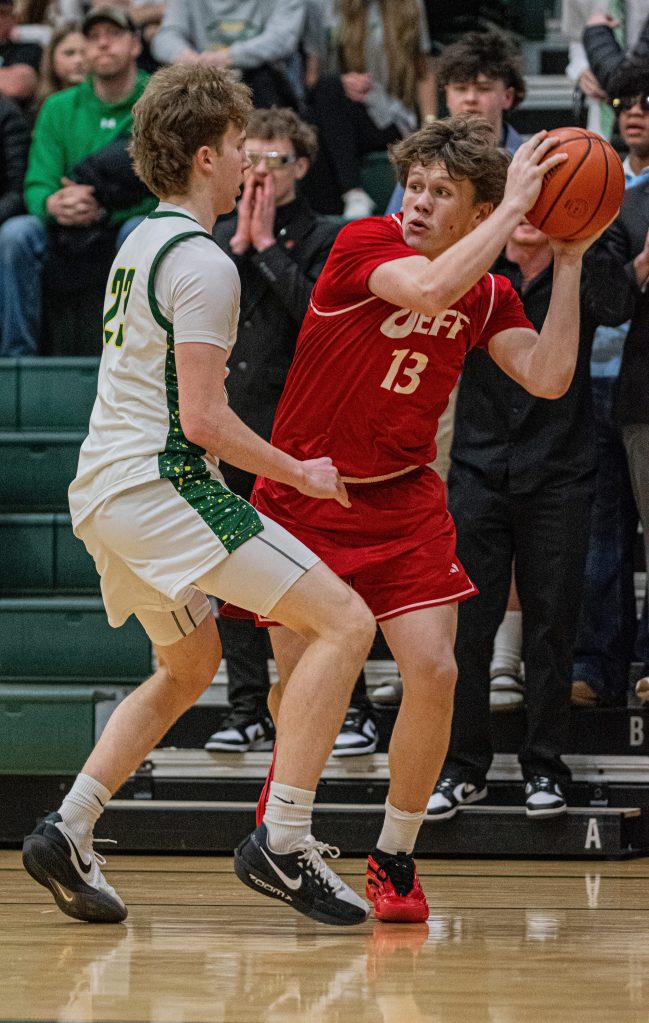
Column: All Eyes on Sudan

Americans must learn about modern humanitarian crisis

by Ameerah Gbadamosi

Sometimes there are problems that exist on the other side of the world that we don’t know about or pay much attention to. For example ,Sudan.

Sudan is facing one of the worst humanitarian crises in modern history due to the ongoing conflict happening between the Sudanese Armed Forces (SAF) and the parliamentary Rapid Support Forces (RSF) plunges the nation deeper into turmoil.

The war, which started in April 2023, has devastated communities, displaced millions and worsened an already dire humanitarian crisis.

Even before the war erupted in 2023, Sudan was already experiencing a severe humanitarian crisis that left 15.8 million people in need of aid. Now over two years of war have drastically worsened the living conditions, displacing over 12 million people and leaving 30.4 million people, more than half of Sudan’s population in need of humanitarian support.

More than two years of the civil war going on in Sudan, the civilians are subject to frequent attacks and human right violation, while the country’s health care system has collapsed as life-threatening famine sets in. The attacks on humanitarian aid workers have made it difficult to deliver life saving  aid to some of the most fragile and vulnerable communities in the world.

The famine spreading around Sudan as violence hinders humanitarian’s ability to deliver food. Meanwhile soaring food prices and collapse of food supply left families starving.

Between December 2024 and May 2025, over 26.4 million are trapped in a health deteriorating food insecurity, over 630,000 people including in the country’s largest camp for displaced people are experiencing extreme famine conditions and a very high risk of death, the severe food shortage also leaves people vulnerable to illness and infection due to lack of essential nutrients.  

Children are among the most vulnerable to famine. An estimated 15 million boys and girls require humanitarian assistance in Sudan, nearly double the 7.8 million at the start of 2023. More than 2.9 million children in Sudan are acutely malnourished, and an additional 729,000 children under five suffer from severe acute malnutrition.
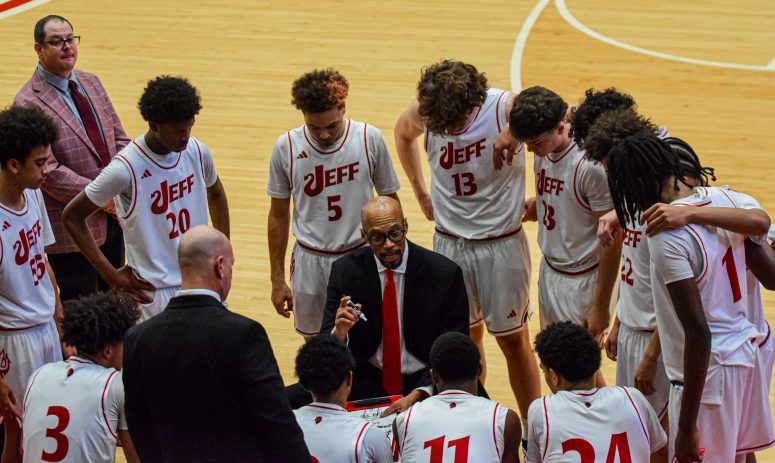

Despite the threats of the famine ongoing in Sudan, both the SAF and RSF are actively restricting aid delivery across Sudan. International organizations like the World Food Programme say they cannot access 90% of the people facing emergency levels of hunger in Sudan.

As if the famine and their suffering isn’t enough, there is an increased risk of sexual violence and an alarming rise of gender based violence against women and girls during times of armed conflict.

In war torn Sudan, rape is likely being used as a weapon of war, and in less than two years, the number of people at risk of gender-based violence has more than tripled. 

An estimate of 12.1 million people or 25 percent of the population are at risk of gender based violence with frontline responders and survivors reporting alarming rates of rape, abuse, coersion, and child marriage, trafficking, while survivors struggle to access support.

In Darfur alarming rates of sexual violence underscore the immense suffering endured in those dire situations, which reveals the exceptional vulnerability of women and girls that live there.

As of April 2025, nearly 13 million people living in Sudan have been forced to flee their homes in search of safety. 8 million have been internally displaced by the conflict in Sudan, 1 million refugees lived in Sudan prior to the current conflict-the second highest refugee population in Africa.   

The war and genocide in Sudan has not been talked about enough, with what they go through each day. People fear for their own lives because they never know when the war will end or what will happen to them. Women and little girls being raped, famine spreading everywhere, People fleeing their homes because of bombings.

What we can do to help the people living in Sudan is donate anything to a charity cause that helps Sudan, make videos or posts about what’s happening so others can know or donate.  

10 facts about Sudan

  • Sudan is located in Northeast Africa sharing its border with seven countries.
  • Sudan is home to more pyramids than Egypt.
  • The capital of Sudan is Khartoum, with an estimated population of 9.3 million in the city.
  • Arabic is the main language of Sudan.
  • The majority of Sudan’s population is Muslim.
  • Sudan hosts over 500 ethnic groups.
  • Sudan was once home to the Kingdom of Kush, an African kingdom.
  • Sudan was the largest country in size until 2011.
  • There are over 100 indigenous languages spoken in Sudan.
  • The Arab population makes up approximately 70% of the country.

‘Leader by example’

Junior Abi Lemon gives her all in four different sports

by Aubrey Cummings

Four different sports each school year seems impossible. How exactly does one do it?

Junior Abi Lemon does just that and has every year since she started high school. She participates in football, soccer, wrestling, and tennis.

Junior Abi Lemon shows determination during a wrestling meet. In addition to her leadership on the wrestling mat. Lemon also plays football, soccer, and tennis. Submitted photo.

“They are all so different but also help each other in their own way,” she explained.

She doesn’t just participate in these sports, though. She leads in them.  She is the person coaches look to for an example.  She is also the person her teammates look to when they need help. 

Wrestling coach Danny Struck described Lemon as a leader on and off the mat.

“She leads by example. She’s involved in so many things. It’s what leaders do — they get involved.  But she doesn’t just participate, she gives them her all.”

Lemon is constantly doing whatever she can to get better in each sport she participates in.

“I am constantly training, whether it’s for one sport or multiple. During soccer I’m also training for football, and when those are over, wrestling begins.  And when in tennis I also train with the track team on occasion,” she said.

Her family plays a big role in why she plays the sports she plays.

“My mom is a really big soccer fan, so getting into it was for her, but I also found a love for it myself,” Lemon explained. “And my family is always playing tennis together.”

Lemon isn’t just an athlete, though — she is also a student, an employee and a friend.  She is constantly having to find a way to balance all of this, which isn’t always easy.

“I am basically always busy, which means doing school work on the way to meets or games or even the period before it’s due,” Lemon said with a laugh.

Throughout the time Lemon has participated in these sports she has made friendships that she never would have had she not been a part of the team.

“Until I joined to football team, I never would’ve never even considered being friends with the guys, but when I joined I met them and now they are some of my closest friends.”

Lemon is a role model for those who want to try something new and for those who are already in the sports they love.  She shows people how to push through challenges and she teaches people what it means to be a leader.

Junior Abi Lemon wrestles her opponent; wrestling is one of four sports Lemon participates in at JHS. Submitted photo.

Column: While teens experience peer pressure, some have developed strategies for managing the problem

by Breslyn Dozal

“Everyone is doing it, nothing bad will happen.”

Seven out of ten teens often feel peer pressured. Peer pressure can vary from drugs, trying different trends (ex: clothing styles) to being pressured into sexual actions. Peer pressure affects teens in different ways, causing them to act out or look different at certain situations.

Peer pressure is when teens feel pushed by friends to do things they might not want to do. It can impact our choices and how they behave. About 90% of teens experience peer pressure. Some teens experience it worse than others. Depending on the situation it can cause serious consequences.

The biggest cause of peer pressure is the desire for social acceptance and belonging. This might be doing pranks for social media or doing what your friends tell you to do to fit in. Most kids experience peer pressure around the age 12, and it continues on from then. Peer pressure affects kids more from the age 13-15. The older we get, the more we understand peer pressure and the more we know how to act in certain circumstances.

There are plenty of ways to avoid peer pressure; knowing which way is best is the challenge. 

I asked teens how to avoid it, and here are some of their answers:

“I would avoid them by telling them that I wouldn’t do it, ‘nah,’ ‘nah,’ I’m good,” said sophomore Marcus Baker.

“I would just walk away,” said freshman Jaxon Maranto.

“I would tell a trusted adult, or decline kindly so the situation doesn’t escalate,” said college sophomore Santana Dozal. 

Peer pressure can take a toll on mental health. Failing classes, not wanting to do social activities, and being distant can be some of the side effects to peer pressure. Most teens feel helpless and don’t know what to do. Some of us think we have no one to talk to, but there are many resources.

Peer pressure will always be an obstacle in our lives. But it can always be avoided. 

“That’s okay, I think I’m gonna sit this one out.”

Column: Why we should still read physical books 

by Chloe Newton

In a non-stop motion world that just keeps speeding up, we can be tempted to let screens take over every aspect of our lives – even our reading. E-books are convenient, and our phones are always in reach; it might seem like the easier option. But there’s a reason physical books are still around and continue to hang on, even when the rest of our world and routine has gone digital. A real book does something a screen can not replace, and pretending they are the same experience is selling reading short. 

Graphic by Chloe Newton.

Firstly, a physical book forces you to be present. When you’re holding a book, you are not constantly checking the time or flipping to another app every time our mind wanders to something new. There’s a kind of focus that only physical media can give you – it requires you to sit and stay for a moment without thinking about all of the other distractions in our lives. That kind of slow attention is getting rare, and it is worth protecting.

There is also something physical about the memory of these moments. People often remember where something happened on the page, whether it be in the middle of the chapter or the top left corner. That spatial awareness helps us absorb and recall information better than reading on a glowing screen. Reading books physically helps our  brain build a map of the story, not just a trail of scrolling or hitting the turn page button.

“Reading is supposed to be more than content consumption. It’s supposed to be an immersive experience. While technology can have a place in our lives, there’s still nothing better than the feeling of opening and closing a book, turning physical pages, and letting the rest of the world take a backseat.”

 Honestly, there is the simple pleasure of the book itself. A book has weight. It ages with the world. It can be loaned, shared, annotated, or thrown in a bag without worrying about a charger or if you will have internet access. A shelf of books tells a story about the kind of person you are in a way a Kindle or tablet never will. When you finish a book and can close it, there’s a sense of accomplishment-something real in our  hands, not just a digital checkmark or finish line. 

Finally, physical books give us a break from the constant digital noise. We spend so much time on screen at school, work, home, and even in communication that reading becomes one of the only chances to unplug. It’s healthy to step away from the fluorescent light and algorithms and just let our mind wander through our thoughts and through a story that isn’t competing for attention.

Reading is supposed to be more than content consumption. It’s supposed to be an immersive experience. While technology can have a place in our lives, there’s still nothing better than the feeling of opening and closing a book, turning physical pages, and letting the rest of the world take a backseat. That is something worth keeping in mind.