Most Recent

Jeff High Theatre Brings “9 to 5” to the Stage This Weekend

The Jeffersonville High School theatre department is putting on a production of Dolly Parton’s “9 to 5”, directed by Jeff High alumni Sarah Holland. Performances are March 12 and 13 at 7 p.m. and on March 14 at 2:30 p.m. All performances will be held in the JHS auditorium.

“9 to 5” explores the experience of women in the workplace, and it includes plenty of quirky characters. Judy (portrayed by Hannah Dickens) is freshly divorced and working in an office for the first time in her life, finding it difficult in a new environment. Doralee (Jasmine Fondrisi) is judged by her colleagues for how she looks and endures hardship over the things she enjoys. And Violet (Joryn Burns) is a strong woman who is trying to move outside of her comfort zone and take control of not only what she needs, but what she wants. “9 to 5” tells the story of 3 women, in very different situations, not only standing up to their sexist and hypocritical boss Mr. Hart (Benjamin Broady) but also a system that is rigged against them. 

The original production of “9 to 5” takes place in the 1970’s, but by adding modern clothing and a more recent set, Holland renews this show by setting it in 2021. Holland points out that this change was to ask how we as a society can be better. “It’s amazing how when I sat down with all the girls in the cast, going around the room, talking about our experiences with sexual harassment. Every single person had their own story to share. That was both disheartening and it was great to speak about it and to have tough conversations. Because with a show like this, I’m not being subtle, I’m very firmly saying ‘this is an issue that we need to work on’ and I’m questioning the audience.” She expresses how lucky she feels to have this cast, and she feels relieved that the students have such great chemistry on stage.

Holland expressed the love she has for this cast. Although it was a challenge to pull it together in such a challenging time, she is pleasantly surprised with the result. “I know tickets are limited, but it’s gonna be streamed. Make sure you see 9 to 5, it’s truly something special.”

Cast and crew members have worked for weeks to prepare for this spring’s musical, “9 to 5”. Photo by Paige Moore.

Story by Emily Proctor

The Pandemic and Mental Health

Let’s be honest: COVID-19 is hard on everyone, but it’s particularly hard on teenagers. It has affected every aspect of our lives. School is different, sports are different, work is different, friendships are different. The list goes on and on. As Pediatrician Rebekah Fenton said in a recent Washington Post column, “The teens of the pandemic are living through a significant and prolonged stress that most adults have never known.”

Under the circumstances, it’s not surprising that teens are struggling with mental health issues. As a result, other aspects of health are suffering. Dr. Fenton says that some of her teen patients “have gained or lost significant weight, in search of comfort or control. Some who had manageable levels of anxiety before the pandemic have worsening symptoms. Isolation precipitates depression or suicidal ideation. More than younger children, adolescents notice and are affected by their parents’ emotions, including financial pressure.”

You should take care of your mental health as much as you take care of your physical health. Mental health illnesses affect the ability to handle daily activities. This means that those who are having a harder time may experience panic attacks, start having a harder time focusing, start sleeping more, start having a hard time completing assignments which make cause in grades plummeting, start having trouble getting out of bed or taking showers and even more obstacles.


Studies around the world are already showing how teenagers’ mental health is suffering during COVID-19, but we wanted to know how it is affecting you, our readers.

The Hyphen sent out a survey to a group of students that have chosen to remain anonymous. When asked how their mental health was before COVID-19, 80% said they were happy or in a good state of mind. Since the pandemic started, 60% of respondents said that their mental health has dropped or they are having a harder time. One student said, ”Corona has affected my mental health by allowing me to have more extra time on my phone, which leads to being on social media, or anything relevant to that, which leads to comparing myself to others way too much. It has also caused me to overthink and worry about things I should not be.”

This is a rough time for all of us. If you are struggling with mental health issues, please reach out. This is not something you should have to go through alone. Below are hotlines if you are not comfortable talking with a
parent or counselor.

By Rachel Lowe

Wrestlers Balance the Risks and Rewards of Competing during COVID

With the COVID-19 pandemic affecting the way we live our lives in many ways, one major thing it has affected is athletes and their sports. Some sports are not as affected as others such as cross country, where they can still run the same trails while being socially distant.

Other sports that are close contact such as wrestling have had to change their routines significantly to keep at their success. Junior Wrestler Dillon Mouser says their entire practice schedule has been altered compared to last year. “Last year, we used to be able to just switch partners. Now we have pods of 4 people , and we can’t drill, lift, or practice with anyone outside of our pods. Typically we practice with only one person in our pod until it’s time to wrestle each other for a live match.”


Mouser says they also had to split up into separate rooms. “Stations 1 and 2 are mat 1 , and 2 are in the same room but divided by a curtain. Station 3 is the weight room. Station 4 is mat 3 , which we moved upstairs. Sixteen people on one mat, and obviously we wear our masks everywhere except for when we are on the mat, and every time we switch stations we sanitize.”

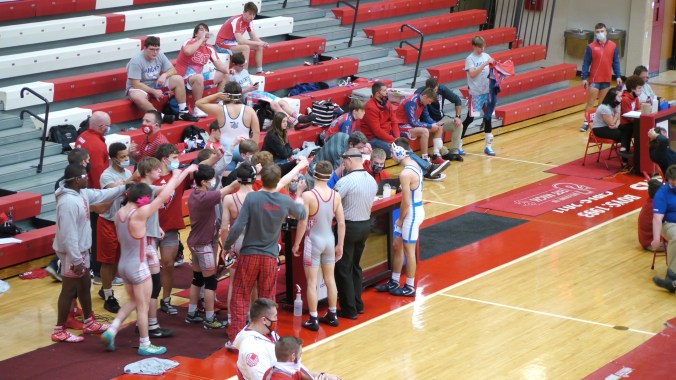
Wrestling team members gather around a teammate to offer support before at match at the December 5 meet. Photo by Paige Moore

Practice routines aren’t just the only thing COVID-19 has affected. Varsity wrestler Evan Clayton decided to switch to online school to lessen his risk of exposure during wrestling season. “Online school makes it harder to get work done because you aren’t in the classroom learning first hand and you lack the motivation you would normally have in class,” Clayton says. “But it wasn’t a hard decision knowing I can maintain my grades and not risk missing out on a big part of the season,” he adds.


Over Christmas break, Clayton got quarantined, and not getting quarantined leading into sectionals was a big part of his decision. “I live fairly far from most of my family, but when I got quarantined over Christmas I was upset because I couldn’t go see my grandma, and that was pretty hard for me.” Clayton intends to stay in online school until he can finish up his season and the school quarter to learn the material easier and prepare for his AP tests.


The decision to participate in a team sport has affected some wrestlers at home also. Some athletes’ relatives have health problems that would put them at risk if they contracted COVID-19.


Even before COVID-19, being an athlete required making tough trade-offs. For athletes this year, the stakes seem more significant and the choices more complicated — but the drive to compete has not gone away

By Cameron Allen

Matt Barker’s goal: a “great experience” for athletes, fans and visitors

Athletics are a big part of student life at Jeff High, which means there has to be an athletics director to keep sports running smoothly. Recently someone new has come to the position, Matt Barker. Having prior experience in the GCCS corporation and plenty of familiarity in the athletic department, Barker is ready for any challenge that comes his way. “I’m enjoying it, it’s a lot of work,” he says, “I’m really just trying to do the right thing.”

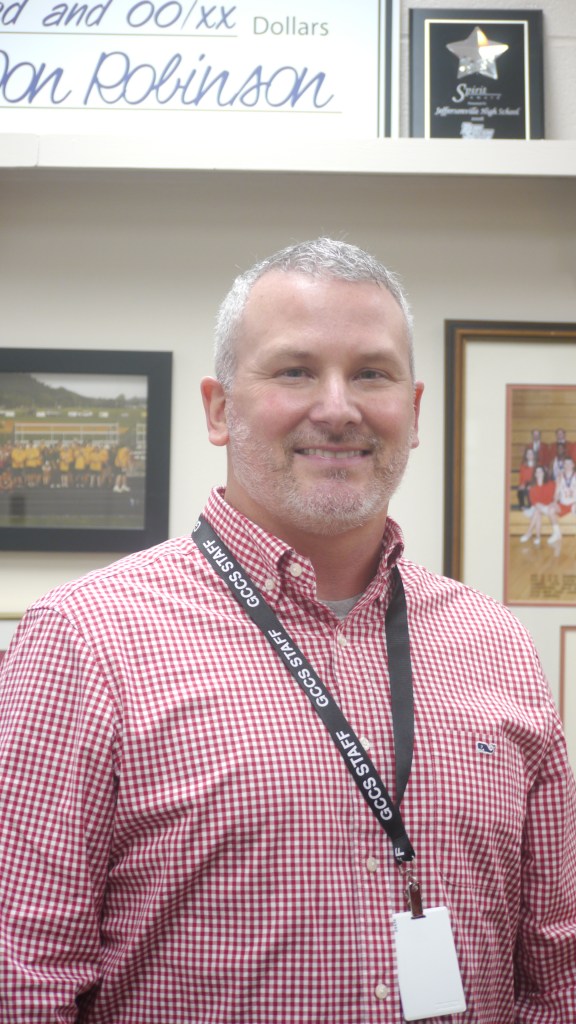
Athletics Director Matt Barker
Hyphen Staff Photo

Barker has had a passion for coaching for most of his life, starting with his first coaching gig for a girls powder puff team as a junior in high school. He ended up coaching and teaching PE at Parkview Middle School, and after that Barker and his family moved to northern Indiana. He pursued his education and now has a bachelors from Valparaiso, a teaching license from Manchester, a masters in secondary education from IU Southeast and a masters in administration from Grand Canyon University. Having no plan to move, Barker was looking into an administrative position at a nearby elementary school when he got a call from an old friend from Parkview, Pam Hall (now Principal at Jeff High). Knowing the love he had
for coaching, she offered him a job as the Athletics Director. “I’ve always respected Pam. She was a really great leader. So I said let’s do an interview and I’ll let you know. I interviewed for it, I honestly, being a coach for 20 years, seeing the hours of work athletics directors put in, figured I didn’t want to do that. But I interviewed and everything was kind of what I wanted to hear, so I accepted the position.”

Jeff High can be a very intimidating place, but Barker feels right
at home. He explains that although things can be quite hectic, the people around him are truly helpful. “I’ve found in the couple months I’ve been in this job, the athletics director world is very open to helping people out.” When he first arrived during late October, Barker was informed that there was a little bit of financial strain in the athletics department. Naturally, he got right to work on this issue and a couple others, such as transportation. Barker makes sure to note that he puts emphasis on communication between coaches and student athletes. With the spring season quickly approaching, there is plenty more work to be done.

Working as an athletics director in the midst of the COVID-19 pandemic is complicated at best. Barker expresses his dejection about the crack down on fans allowed at games. “It sounds weird, you only have 500 people, but it would have been much easier to let 4000 people in.” He elaborates on the importance of proper mask protocol and social distancing.


Current events aren’t all Barker is focusing on, though. He is also making plans for the future. He believes that an important part of bringing up a good athletics program is a comfortable atmosphere and well-kept equipment. “My goal is to make sure that when people come to Jeffersonville — whether you’re an official, an opposing player, opposing coach, a fan — that you come here and you have a great experience.” This summer he wants to clean up the basketball lobby before the next season starts, and in the more distant future he hopes there will be turf on all of Jeff High’s fields and a new weight room. Barker isn’t only concerned with
the aesthetics of our facilities; another concern of his is our hospitality. “When you get an email about how welcoming you were as a school, that’s a great feeling.”


Barker conveys that success isn’t all in the wins and losses. He values sportsmanship and the overall experience for student athletes. He feels the most important part of his new position is getting students ready
for the world outside high school. Looking to give athletes team working and communication skills for future opportunities, he hopes that sports can be a well-needed escape for high schoolers.

By Emily Proctor

Photo Gallery: It’s The Look of The Century

Vintage, Cottagecore, aesthetics galore! All throughout Jeff High, there are plenty of students who have their own unique sense of style. Some of these students agreed to an interview to talk with us about how it all comes together.

Captions by November Shawler and Chloey Trinkle
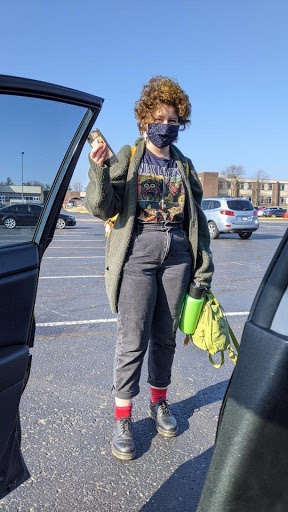
All photos submitted


When someone chooses their sense of style, it may come from a multitude of different sources. It could come from a certain era of fashion in the past, a certain celebrity who wears certain styles of clothing, experimenting with old items of clothing and revamping them into something new, or even just seeing something from a store and developing your own style based on that. Whatever it may be, everyone has their own taste and it comes down to preference. In the end, it’s all about expressing yourself.

Jeffersonville High School Leaders Considering Whether to Stick With Block Schedule Next School Year

At the beginning of this school year, Jeffersonville High School implemented a block schedule as part of the school’s efforts to reduce the spread of COVID-19. According to Principal Pam Hall, “When we went to [block schedule] shortly before school started, the main reason was contact tracing and limiting exposures. The other was to limit movement.”


Now, as Jeff High starts to plan ahead for life after COVID-19, the question arises: stay on a block schedule next school year or go back to “normal”?


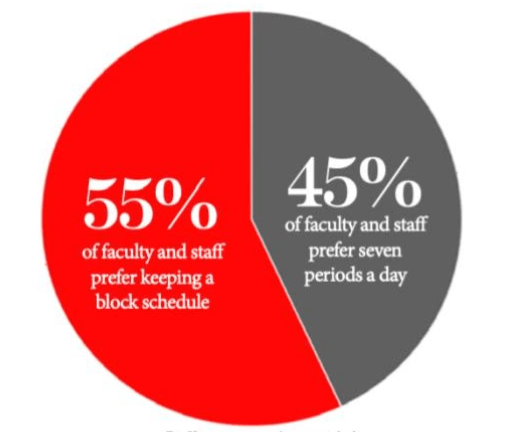
Hall says the process of making that decision is underway, but it could take a while to make sure all perspectives are considered. Step one was sending a survey to faculty and staff. This occurred in early January. Of those who completed the survey, 55 percent said they prefer the block schedule and 45 percent said they prefer seven periods a day.

Staff survey provided by Jeffersonville High School


Next, Jeff High’s administrators met with leaders from] other high schools in the district. Those schools had also conducted surveys about whether to keep the block schedule.


The next step in the process is to meet with the building leadership team at Jeff High (a group of people who
represents different departments and interests) to discuss the pros and cons of each option. The survey data is just one part of the puzzle. They must also consider the potential impact on student scheduling, lunch times, teachers’ planning time and more.


Whether Jeff High stays on block schedule or reverts to seven periods, Hall says the longer classes have been
beneficial during this challenging year, and not just for contact tracing purposes. “We learned we need to slow down and make sure students have the skills to be successful.”

Story By The Hyphen Staff

Jeff High Senior Jasmine Fondrisi Sings Her Way to the Finals

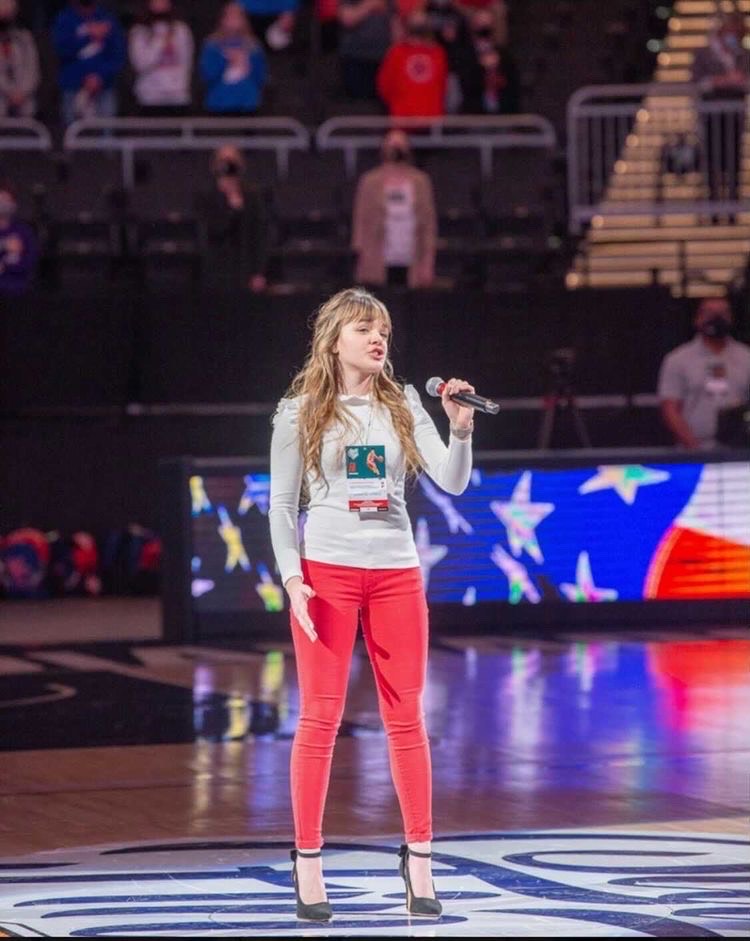
Jasmine Fondrisi performs the national anthem before the 3A Girls Basketball State Finals.
Photo Credit: News and Tribune

Eight years ago, on the advice of her friends, 4th grader Jasmine Fondrisi asked to sing the national anthem before a Utica Elementary School basketball game. The scene on that day in the elementary gymnasium was much different than the scene on Feb. 27, 2021, as Fondrisi stood, center stage, at Bankers Life Fieldhouse in Indianapolis singing the national anthem prior to the Class 3A Girls Basketball State Finals.

“Ever since I was little I loved singing, and I loved performing,” she says. That love was showcased in her participation in cheerleading, theater, and music all throughout middle school. But despite her talent, many at Jeff High didn’t necessarily know Fondrisi for her voice prior to this year. As an active student, she is just about everywhere: the IMPACT slides warning about avoiding dangerous situations, the auditorium preparing to perform, the football sideline cheering on the team or in the studio as a broadcaster for WJHI (Jeff’s radio and TV station).

Yet this year she was given a new opportunity to represent Jeff High, by singing the national anthem before basketball games. Fondrisi says she got the opportunity simply by asking. As she was sitting in the stands watching her sister play, she recalls relaying to her grandma that she wished she could sing the national anthem. “The worst they could say is no,” her grandma remarked. So she asked the athletic office for the opportunity to sing the anthem prior to tip-off. When they said yes, Fondrisi was once again ready to do what she loved. 

After that, it became a routine — and as she continued to perform, the compliments didn’t stop. One of those compliments came from the referees at the boys New Albany game, along with an offer to sing the national anthem at the state finals this year. After they exchanged information, and the IHSAA approved, the stage was set.

This performance was different than the usual at Jeff High. Rather than warming up in her car, she warmed up in the bathroom, and instead of easily maneuvering through a gym she had been to all her life, she admits she got lost in Bankers Life. Fondrisi summed up the experience in one word – “surreal.” She began as she had so many times before, and as she finished with “home of the brave,” her performance was met with cheers and applause.

For Fondrisi, singing the national anthem means a lot, whether in fourth grade or high school. “I feel proud because I get to represent myself, and I get to represent the school,” she says.  

PDF: February 2021

The Hyphen is back with our first print issue since the COVID-19 pandemic began. This issue includes:

  • News and reader voices about the possibility of keeping a block schedule next year
  • An exploration of the term “politically correct” and its role in today’s cancel culture
  • A photo gallery featuring students who have a unique sense of style 
  • Interviews with new boys and girls basketball head coaches
  • A look inside how COVID-19 affected this year’s wrestling season
  • And more

Download PDF

Black Out: Jeff High Staff Wear Black to Protest Proposed Changes to State Education Funding

English teacher Allison Clary was one of several teachers who wore black on February 24 to support the #Blackout4Ed movement

Many Jeff High teachers wore black on Wednesday Feb. 24, in opposition to recent actions by the state legislature and Indiana Governor Eric Holcomb. While Greater Clark staff typically wear red on Wednesdays as part of their “Red for Ed”campaign, the teachers participating in “Black out for Ed” opted for the color change to underscore the gravity of the moment. “The situation is dire,” said Jeff High English teacher Allison Clary.

The primary reason for the protest is Indiana House Bill No. 1001. The bill has drawn considerable opposition from many including the Indiana State Teachers Association and former State Superintendent of Public Instruction Jennifer McCormick. 

Passing on a near party line vote, the bill would increase education spending by 378 million dollars over the next two years. However, more than a third of the increase is targeted toward voucher programs rather than public schools according to WDRB.

Jeff High Principal Pam Hall cited the budget as her reason for wearing black on Wednesday saying, “[the budget] affects every student in our building.” She also had strong words for the legislators who passed the bill saying, “politicians are robbing Jeff High students of the money they are entitled to and deserve.”

Principal Pam Hall wore black on February 24 to support the #Blackout4Ed movement

The bill adds to a laundry list of complaints many teachers’ unions and public education advocates have toward Governor Eric Holcomb and Indiana Republicans. “Holcomb is not really a friend of public education,” said Clary.

Jeff High teacher Kristen Case cited other reasons for wearing black, saying she “hopes the governor will get vaccines pushed out to teachers and keep teachers well paid.”

The bill still has to be passed by the senate and signed by the governor prior to becoming law.

Story by Max Fisher

Photo Gallery: Winter Storms Coat Jeffersonville in Ice and Snow

Photos by Amber Walker, Marni Scholl and Max Fisher

Strike Hard: A Review of Cobra Kai Season 3

It was only a few years back when the YouTube Red series Cobra Kai premiered to an eager base of fans ready to experience an action-comedy drama that brought back fond memories of the blockbuster film, Karate Kid. Despite a great fan following on YouTube Red, Cobra Kai only felt its giant boost when it finally debuted on Netflix in the summer of 2019, reaching the #1 spot on Netflix’s top ten most watched shows, and #1 in Nielsen Ratings nationally (Nielsen ratings measure audience viewership and ratings nationwide).

Cobra Kai builds on the legacy of the Karate Kid movie series, while also exploring the full story of what happened then and what has happened since.The two enemies from the first movie, Johnny Lawrence (William Zabka) and Daniel LaRusso (Ralph Macchio) are now middle-aged men. Still their lives seem to be rooted by the consequences of the original film’s ending, where Daniel kicks Johnny in the head and wins the All-Valley Under 18 Tournament, all thanks to his wise and great mentor, Mr. Miyagi (played by late Pat Morita). 

The show released its third season on January 1, 2021. So without further ado, we’re going to strike first, strike hard, and show no mercy with this review of Cobra Kai’s third season.

– – – – Warning: Potential Spoilers Ahead! – – – –

Season 3, much like the previous seasons, has received a lot of critical and audience acclaim. We start the season revealing the consequences of what happened at the end of Season 2: Johnny Lawrence is broken and giving up on life again, Miguel Diaz is in a coma, Johnny’s son Robby is hiding from the law enforcement, and Kreese is operating Cobra Kai.

The Plot

By far, the plot of the series is brutally compact with a lot of poetic throwbacks to the film trilogy. However, I believe the third season’s plot sells us short. We see a semi-repeat of Season 2 with Miguel helping Johnny impress girls and Johnny growing his relationship with Carmen Diaz, Miguel’s mother. Even the season finale depicts a rematch of the fight that literally happened in season 2. Among many others, an interesting one is the rehashing of the whole love triangle with Robby getting angry at Miguel and Sam “falling in love again.” The season seems to be reiteration of what already has happened, which is a key recurring theme in the series. Hopefully the creators of the franchise take the lessons they bring to the table: to their hearts as well.

The Narrative

The plot isn’t so great, but there is a plus side to that: the season becomes redeemed by the narrative. A narrative is often binding, no matter how expansive. Like Star Wars. The third season follows the Miyagi-Do and Cobra Kai dynamic, but it isn’t the teachers fighting it out this time. It’s the students. Sam LaRusso is willing to take things into her own hands, Hawk won’t stop bullying Demetri. Robby is willing to live by the Cobra Kai creed, you have a lot of the key character arcs of Season 2 culminating to their greatest peak. You can tell the story is being a little lazy, but essentially it just ends up like the Return of the Jedi from the Saga of Star Wars. The story has way fewer risks, but the result is somewhat more appealing: This season brings a renewed focus to the new characters — building their relationships, building their motivations for future seasons.

The Layering: Shading it together

What Cobra Kai’s third season does, is what movies and television series are constantly trying to do right. The layering. Adding motivations to characters, so you know it isn’t some white-headed nose-less wizard just trying to do stuff because evil is something to enjoy (if you didn’t get that reference, please search up “JK Rowling”). There is a composite and uniform slate of ideologies that make Cobra Kai so compelling to watch. This is why I believe the show has broken so many records to achieve ultimate success.

In season 3, we see the story delve into John Kreese’s background. A bullied teenager, with a mother suffering from mental problems on the verge of committing suicide, who then ends up enlisting to go to Vietnam. He fights in the war, loses his best friend to Vietnamese soldiers after failing to learn the “no mercy” lesson taught by his military superior (NOT EVEN REALIZING that his military superior actually withheld information about his girlfriend’s fatal car accident). As this storyline develops, Cobra Kai becomes dark very quickly. Kreese then ends up being forced to fight with his military superior. In this scene, you see the brutality that has formed the man we saw in Karate Kid and learn more about this season.

And here’s the bigger theme of Cobra Kai: everyone, in their own way, makes sense. Kreese failed to learn “strike first, strike hard, no mercy!” And when he did, he lost people he cared about, he suffered mentally and physically, but most of all: the regrets of those failures create the “monstrosity” which exists in the founder of the Karate Dojo: Cobra Kai. But we’re only skimming Kreese here, when we explore Daniel LaRusso, we explore Johnny Lawrence: you realize their fighting isn’t even over ideologies, of whose karate teachings make more sense. It’s about the people they care about: Daniel cares about Robby, he’s learned to accept Miguel-Sam’s relationship. Johnny has begun to care more about Miguel’s mother: he isn’t shy of who he WAS, when he talks to Ali; returns to the Karate spotlight by launching his dojo.

Is Nostalgia Getting too Much?

Let’s face it, the nostalgia on Cobra Kai makes you laugh, cry, scream, and take the show even more seriously. The past is what makes Cobra Kai’s present all the more endearing. It’s the basis of Cobra Kai’s success. The return of the old characters, and settings, and more importantly the dividing attitudes of society on survival in the real world. Cobra Kai, using this very nostalgia, has transformed this show into one about the hard route with a slate of moral values, and the shortcuts without an exact slate of moral values.

But we reach a point eventually in season 3 and ask ourselves: has the nostalgia reached its peak? Season 1 and 2 masterfully depict the continuation and evolution of what once was, while keeping core ideas intact. Season 3, meanwhile, is reminiscent of the post-Lucas Star Wars films. We see Daniel finding out about a whole new karate technique (Luke projecting himself across the galaxy), old villains who are now supposed heroes like Chozen (Boba Fett saving Baby Yoda), and a bit of copy-paste from Season 2 (Force Awakens copying A New Hope).

There’s very little at stake in Season 3, but….

There’s a Very Good Setup
Sam LaRusso, Miguel Diaz, Robby Lawrence, Tory Nichols, Daniel, Johnny, Demetri, Kreese and his gang … everyone has something to look forward to in the next season. Everything is suddenly at stake. The All-Valley Tournament next time isn’t some beef-bashing on love triangles: A dojo will close, a set of values will triumph, characters reach the peak of their arcs. No matter the shortcomings and great moments from Season 3, the fourth season will be worth the watch. 

Written by Yousaf Quereshi

Greater Clark School Board Will Vote on Cost Reduction Plan Tomorrow

Superintendent Mark Laughner says changes are crucial to making GCCS more financially stable

On Tuesday, Jan. 26, 2021, the Greater Clark County School Board will vote on the Cost Reduction Plan proposed by Superintendent Mark Laughner and his cabinet. If passed, the plan will cut the budget by over six million dollars in an effort to move the district away from deficit spending and restore cash balances, two things Laughner believes are crucial to making GCCS a more financially stable district. Laughner believes this plan uses money more efficiently, allowing for what he said is the ultimate goal, “Getting all the resources you can possibly get back into the classroom.”

One of the primary concerns for Laughner was the possibility of the Distressed Unit Appeals Board (DUAB) action. This board, created in 2012 by the Indiana Legislature, is meant to address school boards and other institutions in need of relief. According to Laughner, DUAB first looks to see whether a district has a plan in place to correct its financial state. At that point, they will often take action. That is a process Laughner hopes to avoid with the passage of the Cost Reduction Plan. 

Greater Clark County will cut about 3 million dollars from both the Educational Budget and the Operational Budget. Here is a closer look at the changes in the Cost Reduction Plan:

Education Budget

Bridgepoint Closing (Savings – $800,000 per year)

Under the proposal, Bridgepoint Elementary in Jeffersonville will close, and its students will be sent to either Franklin Square or Riverside Elementary. Bridgepoint staff will be moved to the new schools proportionally, and certain staff will be reassigned to different positions. For Laughner, the decision is an efficiency issue, “It’s not financially efficient to have small elementary schools anymore,” he says. However, he also highlighted the benefits of the larger and newer elementary schools for students, saying, “it’s just a better environment.” 

Corden Porter Site Changes (Savings – $500,000 per year)

The Reduction Plan will also seek to shift the Corden Porter program out of its centralized location in Downtown Jeffersonville to different locations. The high school portion of the program will be moved back into the Jeffersonville High School building, and the middle school program would be moved to Parkview Middle School. For Laughner, the goal for Corden Porter students is “to get them back to their home school” by allowing students to slowly immerse back into the school community, while still maintaining a separate area of the school for the students.

Elementary School Related Arts Staffing Change (Savings – $600,000)

In this plan, most related arts education would be taught by Related Arts Specialists supervised by four Related Arts Coordinators at the district level, who will be tasked with designing a consistent curriculum for the Related Arts Specialists. The plan also retains 1 certified teacher for related arts in each Elementary School. To attain this goal, the district will hire around 19 Related Arts Specialists and reassign 10 Media Clerks as Media/Tech Related Arts Specialists. Laughner believes this change, similar to one proposed last year, will “help us have a strong related arts program at the elementary level.” Laughner made sure to clear up some confusion, asserting that this plan in no way eliminates any related arts programs for elementary students and clarifying that it would not lead to the firing of any teachers.

Paraeducation Position Changes (Savings – $300,000)

The proposed Reduction Plan would reduce the number of paraeducation positions in the district. It would also usher in a hybrid approach in which some para-educators would be full-time while others would be part-time (29 hours). According to Laughner, the district would not take away benefits from any current paraeducators. On his decision, Laughner cited efficiency and the district’s difficulty acquiring paraprofessionals.“For years we’ve had a hard time filling para positions,” he says. He also said the district would be strategic to make sure this cut didn’t affect the classroom. 

Other Reductions within the Education Budget

  • Reducing 5 classified positions (Savings – $174,000)
  • Reducing 5 certified (full-time) positions through attrition  (Savings – $347,000)
  • Reducing early childhood education (ECA) positions (Saving – $140,000)
  • Contract Reductions for Administrators (Savings – $62,000)
  • Readjusting grant spending to offset educational spending (Savings – $30,000)
  • Attrition of other certified positions (Savings – $150,000)

Operational Budget

Custodial Service Outsourcing (Savings – Estimated $800,000, but will depend on provider)

If the Cost Reduction Plan is approved, Greater Clark will advertise for an outsourced provider of all maintenance and custodial services. While Laughner can’t guarantee that all current custodial staff will keep their jobs, he does guarantee that they will be able to apply to the new provider. He believes the outsourced provider will be able to pay workers more and provide a solid benefits plan. Acknowledging that this plan may leave current employees feeling uncertain, he said, “One thing I can assure you is that we are going to treat our employees fairly.”

Two-Tiered Busing for Jeffersonville Schools (Savings – $495,000)

Under the proposed plan, Greater Clark will implement a two-tiered busing system for Jeffersonville Schools. Currently, Jeffersonville operates with a three-tiered bus model (different buses for each age group: high school, middle school, and elementary.) If approved,  Jeffersonville schools will shift to a two-tiered system in which middle and high schoolers will ride the same buses. However, the policy could result in 10-15 minute longer bus drives for students, and bus drivers will now be tasked with dividing middle and high school students on the bus. Like many of the changes, Laughner believes the policy will, “allow us (GCCS) to be more efficient.”

Other Reductions within the Operations budget

  • Guaranteed Energy Savings Contract (Savings – $ 524,000, but will expand over time)
  • Reassign 2 permanent subs as bus drivers, and 1 permanent sub as an administrative office assistant (Savings – $135,000 per year)
  • Eliminate two New Washington Routes (Savings – $91,000 per year)
  • Estimated Reduction in the price of Service Contracts (Savings – $385,000)
  • Reduction of Maintenance positions through attrition ($50,000)
  • Moving bus drivers from collective bargaining agreement (CBA) leave to 2-day emergency leave (Savings – $236,000)
  • Other operational adjustments (Saving – $323,000)

Outlook for the Board Vote

Going into the meeting, Laughner expressed confidence in the board. “I’m fairly confident that they see the issue at hand and that they see that we have to do something,” Laughner said. Laughner also said that if the board doesn’t approve the budget, he would be forced to “go back and look at cutting teaching positions.” For him the choice is simple: “Essentially … we have to do something with our budget. You can’t spend more money than you’re bringing in for very long.”

The GCCS board will vote on the Budget Reduction at their 6 p.m. meeting on Jan. 26, 2020. The public can comment on the plan via a Google Form and watch the meeting at https://livestream.com/gccschools

*All price saving values are based on GCCS estimates

Story by Max Fisher