After warming up, the girls’ soccer players are split into teams to play a game of keep away. They practice their passes during a heated game. Head coach Julie Deuser advises the girls as they play.
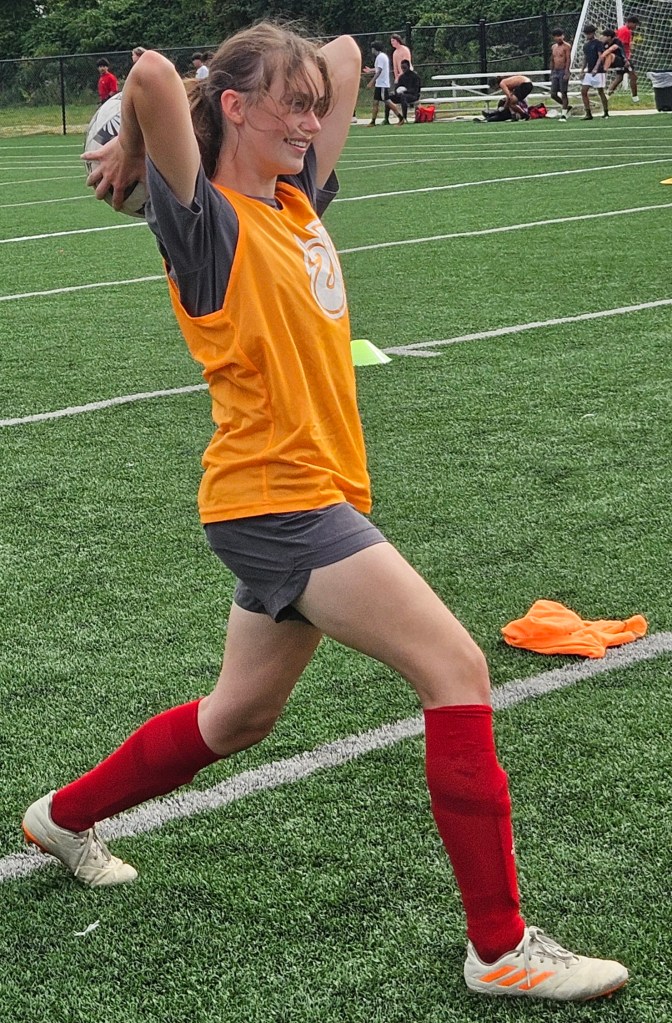
Senior Jovie Golko practices her throw-ins with the rest of the team. Photo by Sarah Jacobs.
“I think the soccer department is really going in the right direction,” said senior Jovie Golko as she reflected on her years playing soccer at JHS. She cited the new coach as a key factor as to why she is feeling optimistic about the current season.
Deuser has a history with coaching soccer, having coached and played during her college years.
“I want to have a winning season and build the team back up,” Deuser said. She believes the team has a strong core group who are familiar with one another.
Sophomore Zoe Johnson cited the team’s positive attitude as a key strength. “I think our defense is our strongest point,” said defensive player Golko.
Strong as the team may be, it’s not perfect. “We really need more girls to come out and play,” Deuser said.
Golko and Johnson believe the team’s ability to get control of the ball is its greatest weakness. If they can’t take control of the ball, it becomes harder to get scoring opportunities.
Training drills help improve these skills, though. The team trains in a variety of ways during the off season. The entire team does conditioning, but individual players have more variety in their routine. Johnson and Golko play indoor soccer separate from the school. Junior Aubrey Cummings does wrestling.
Johnson, Golko, and Cummings said their goal for the team this season is to win sectionals. With a unified goal in mind, the team, joined by their new coach, is working hard this season to achieve that win.
Freshman former JV football player Jaxx Long trots onto the field feeling confident after his pregame rituals and a week of practice ready to help his team win the game.
“I always put the team first. I love it when we win because not just me but the whole team wins,” said Long.
Practice is four days a week and three hours long every day. Head football coach Joe Washington likes to see it go well because he puts a lot of effort into every practice and places a lot of importance on it.
“I’d say about 80% of winning games is practice because if we have a lot of talent but don’t know how to execute it we will probably fail,” said Washington.
Players also take practice very seriously, as they know of its importance. The practices throughout the week greatly impact games.
“I put in 100% effort into every play during practice because it helps me during games,” said sophomore JV player Landon Dauby.
Practice has many different activities. After all, athletes can do a lot in three hours. JV may not have the number one priority, but they get to do activities that varsity does not.
“We like to use a scout team with JV to get our varsity guys used to the other teams’ plays. Since they’re going against varsity players it can sharpen their skills. We also like to let them run our plays at the end of practice,” said Washington.
JV is often treated as a different part of the team entirely; it doesn’t usually get influenced by how the other teams play. They do get the benefit of playing against the same players they will play with on varsity in the future.
“The coaching staff doesn’t use JV as an example of how varsity will play and vice versa. We like to run more true read option plays with Little Cam. We also want to throw the ball more since our JV receivers are pretty good,” said Washington
Practice plays a large role in preparing for the week, but pregame rituals and traditions are also important. Without them, players may not be able to perform to the best of their abilities.
“Before the game, I listen to music to stay focused on what I need to do. I think it greatly helps me play to the best of my ability,” said Long.
Some people think JV has little if any purpose, but to the players it means a lot. They have a large portion of their lives centered around it and it makes them feel ready for life.
“Playing football makes me feel good; my body feels better overall, and I feel that I’m ready to do almost anything,” said Dauby.
People often don’t realize that a great amount of work goes into JV games. From Monday practice to kickoff on Saturday, players put their whole body and mind into it. They do not play football for the glitz and glamor, but for the love of the game.
“I play football because I feel better during and afterward. I love the camaraderie and brotherhood I get from the team, and I really enjoy just playing football to the best of my ability,” said Long.
“Welcome to one of the most exciting nights of music anywhere in the Kentucky Indiana area,” choral director Kyle Broady commented last Tuesday night. And, he was absolutely right.
Gospelfest was a fantastic, moving, and very energetic event. The concert style worked perfectly to create an environment of connection among those in the audience. The singing along of audience members would typically be one of irritation, yet somehow they were able to make it feel as though it belongs among the singing voices of the choir.
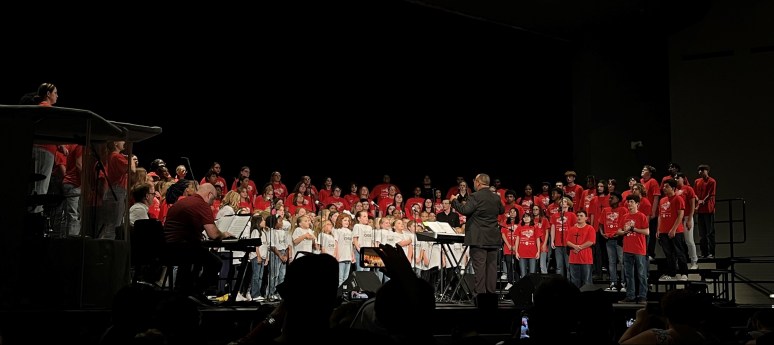
Choir director Kyle Broady and Dr. Roosevelt Escalante direct all of the choirs at the annual Gospelfest on Tuesday, Sept. 24. Photo by Sam Ottinger.
The performance consisted of eight songs. The very first, sung by the chamber choir of JHS singers, started off slow with a soft piano sound of “I Believe,” yet it soon grew into an energetic piece as the sizzles of a cymbal joined, and the audience was encouraged to clap along.
Following this piece was a favorite among the crowd, as well as one favorite of my own, known as “He Heard My Cry.” Senior Luna Guyse began with a solo accompanied by similar soft piano notes and then transitioned into a harmony and cymbal climb. The crowd cheered nearly after every other lyric.
The next two songs, “You Should Know” and “My Soul Has Been Anchored in the Lord,” were sung by the gospel ensemble, with solos from Guyse, freshman Vivienne Diehl, sophomore Presley Inzer, junior Nairah Jadusingh and junior Joshua Broady.
A very special quality that I noticed during Gospelfest was not just the opportunity of connecting with our community, but also being able to connect with our own family. During “My Soul Has Been Anchored in the Lord,” Roosevelt Escalante invited a surprised Broady to come up and sing alongside Broady’s son.
“He [Dr. Roosevelt] wanted to do it so I could sing with my son, which was pretty special,” Broady said when asked how he felt at that moment.
Before the final song, “The Blood Still Works,” Dr. Escalante was able to perform with his daughter.
Both pieces didn’t just have beautifully sung vocals, but also the warmth of family being able to share the joys of singing together. The way Dr. Escalante’s daughter’s performance flowed into the final song felt as though that warmth was reaching out to encapsulate the audience with it, as the song once again allowed the audience to join along in clapping to the melody.
When going back to the song after Broady came up to sing, “Going up a Yonder,” there is another very special quality. This Gospelfest did not just include JHS choir students but also two other choirs, including the Southern Indiana Children’s Choir.
This was a brand new organization, performing for the very first time, consisting of children in second to fifth grade in Clark and Floyd County. They were selected from their elementary schools by their music specialist or teacher and had rehearsal only once a week.
This in itself made it special for how talented these young kids are, but the conductor who helped teach them their skills is none other than Leslie Gabhart, who used to be a choir teacher here at JHS, and she even was the choir teacher for Broady.
The other choir that combined forces for this Gospelfest was Borden Junior- Senior High School. All three choirs joined together to perform the jazzy piece “Bless the Lord.” Each choir was able to be powerful, yet not overwhelm the others.
“Bless the Lord” had to be my favorite piece for the whole concert. Throughout the song everyone just seemed to work well with one another. The live band, the JHS choir, the Borden choir and the Southern Indiana Children’s choir really showed off their talent with this piece.
The following piece, “No One Like You” – sung by the JHS and Borden choirs – returned to a slower, softer start. This song may not have been the most energetic one, but that does not mean it was even close to being boring. As a soloist started the lyrics off, there was a really captivating way that they performed. For after the third line the singers were able to raise their pitch on the word “me” to this enchanting sound.
For something that started more than two decades ago, the emotional energy created in that auditorium was as young and thriving as ever. The love that could be felt in that room, for the people and for the music, was something I haven’t felt after any other school event.
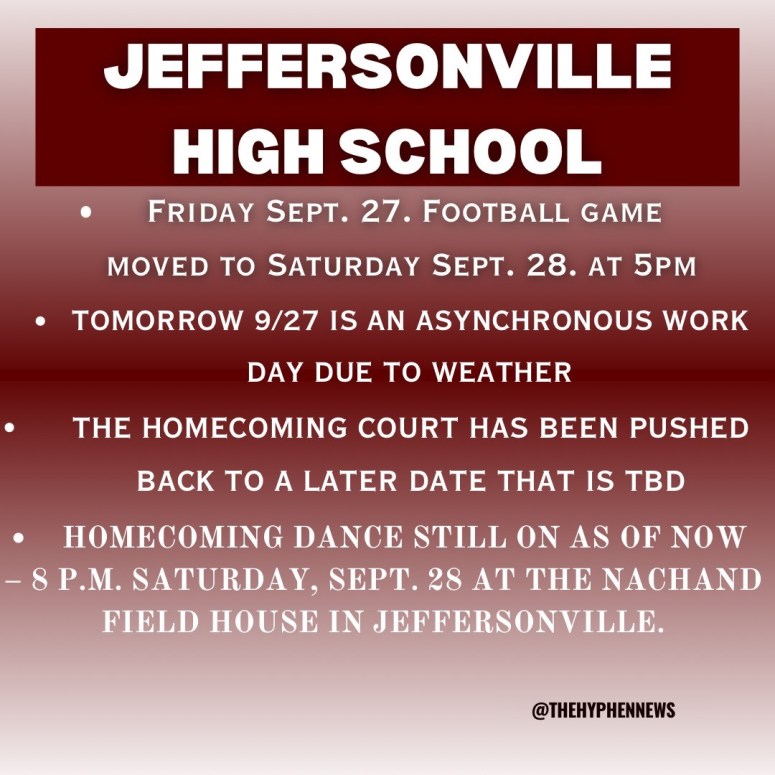
The tradition of a Homecoming dance has been missing at Jeff High for over 20 years. The absence of such a dance has no specific reason, but some theorize budget issues or lack of interest. However, neither of these concerns has held JHS back, as for the first time in over 20 years the Red Devils will finally be having a Homecoming dance at 8 p.m. Saturday night at the Nachand Fieldhouse in Jeffersonville.
“The point is to bring all the students together.”
Senior and Student Council President Koy Ramer
Student Council presidents, seniors Madison Pritchard and Koy Ramer, started the idea to bring back this custom. They knew that past presidents had hoped to have a Homecoming dance, but the idea was always rejected due to issues with budgeting or lack of a defined idea. So when Ramer and Pritchard wanted to plan a dance for Homecoming, they knew they needed a good plan for principal Pam Hall. They worked with the Student Council and sponsors Natalie Woods and Chloe Merkle to create a dance that the school body could enjoy.
“We were in completely new territory,” Pritchard stated.
Given the lack of examples to examine, there was no direction to go in when planning the dance. So Pritchard and Ramer surveyed the student body.
There were many different ideas and opinions, some students wanted an upperclassmen-only Homecoming, while others wanted the venue to be outside or for different entertainment. The pair struggled with finding a way to appease everyone. They attempted to find fair compromises for all students, but some decisions were made, not due to what the students needed, but because of what they could afford.
Most of the money for the dance came out of Student Council funds. A priority was to keep the dance relatively inexpensive. This led to some trade-offs being made. For example, the dance was hoped to be outside originally, but the idea proved to be too expensive.
The Homecoming dance ended up being one of the least expensive dances when compared to other yearly events. The dance only cost over 1,000 dollars, around 500 being for the venue and entertainment and only about 100 for the decorations.
“We wanted to utilize the student body,” Woods stated. A large part of why the dance was able to keep the budget low was due to the fact that the student body was utilized for various parts.
The culinary classes provide the catering via cake pops and pretzel rods. The marketing class helped make the tickets and flyers, as well as providing the ability to use the old Jeff gym as the venue. The Nachand Fieldhouse was both a cheaper venue and a symbolic statement, given its connection to Jeff.
The Nachand Fieldhouse is one of the city’s most historic buildings. Standing on 601 E Court Ave, Jeffersonville, the old court was used as the JHS gym and held the basketball games until 1971.
Due to renovations in 2017, there is one rule given it is a basketball court: all heels or black soled shoes can not be worn on the court. Students can wear them to the dance if they wish, but they cannot walk on the court with them on.
Despite this, it was the perfect place to hold a dance that was meant to symbolize community and school pride.
“The point is to bring all the students together,” Ramer stated.
The concept of unity was a large part of the decision to have a homecoming dance. From the theme of “Light the Night on Fire” being a direct reference to Jeff High’s mascot of the devil, along with allowing all grades to attend, and no outside guests, the center of Homecoming was the students, and they were the strong incentive for planning the dance.
“Students’ excitement and making this happen for the students was our motivation,” Merkle stated; they wanted to provide something new for the students to look forward to.
But despite their best efforts, at the end of the day the continuing of the Homecoming dance is up to student participation.
The hope for participation is 200 students, to help show that the Homecoming dance has enough interest for the dance to continue for years to come as well as to make up for the funds that the Student Council put into the dance.
“You get what you put into it,” Pritchard said, and the sentiment was shared by all who planned the event. The need for student support is at the core of helping the dance be successful and improving it for future students.
The preparation of the dance was a long and hard process, but was achieved by the helpful individuals who planned it for the students. They all hope that students have a fun time, enjoy themselves, and hopefully future students will experience the same joy.
Retired Clark County police officer Chuck Adams fondly remembers his days working in law enforcement and now spends his days hanging out with grandkids, fishing, and talking with long-time friends.
Adams added that he had wanted to become a police officer since he was a boy. ”As a young man I liked the fact that they helped people and got people through rough times,” he stated.
“I just feel like I helped a lot of people in my career, and I can’t just think of one individual great accomplishment that stands out,” Adams continued to say about his career in law enforcement.
His daughter, Shannon Anderson, backed up this claim by stating, “I would just say he is honest, fair, motivated by doing the right thing and not the popular thing, but most importantly he treated everybody as a human being and not like a criminal, or not like the bad guys.”
Before joining the Clark County Police Department, Adams’s first jobs included pumping gas at the age of 14 at a truck stop, and working at McDonalds, Jeffboat, and Ford Motor Company. His service to the public had already begun at an early age.
Adams stated, “I have lived in Clark County my whole life, long time Clark County resident.”
Best known for his sense of humor, he is always ready to tell a joke or a tall tale to brighten someone’s day.
Anderson recalled two tall tales he told: ”How he wound the old Colgate clock and he hung the railroad lights by hand.”
Adams’ ex- wife, Faye Briley, described how she met him in 1983 on a blind date and has known him for 41 years.
Briley described how he is outgoing, friendly, kind of loud, and just a good person.
“I started dating him because I just thought he was the man I always wanted; he was the whole package. He was dependable, hard working, kind, and the fact that he was nice looking didn’t hurt,” Briley explained.
Briley and Anderson have both said very inspiring and nice things about their experience around Adams.
Briley said, “He has turned out to be a good ex-husband, a good dad, a good friend, and someone I can count on up until this day.”
Anderson described her father to be a very good person and stated, “Overall,I would just say that he is quite the unique individual, and if you have time on your hands it would be worthwhile to have a conversation with him if you have 2-3 hours of spare time.”
Adams retired from CCPD in 2013. He stated, “I was 58 years old and maxed out on my pension. I had enough years to retire and financially able to retire.”
Life is different now for Adams. He said, “It’s a lot different from when I was working — no set times or schedules like when I was working, unless I want to be there.”
His life advice for happiness is simple.
”Well, I think if you try to live your life and be a good person, work hard, good things will happen to you, and your life will be fulfilled.”
Having been chosen as an exchange student, people put high expectations on my adaptability, on my desires to open myself to people and be presentable to my fellow American neighborhood and people of other ethnicities.
It would be a lie to say that this adventure isn’t scary to me, to be all alone in a big English world, a world that isn’t mine nor made to be mine, but from the first time I took the flight to come here I should have known everything wouldn’t be easy.
After more than 24 hours of traveling with a connection to Belgium, in which I couldn’t rest because of the tumultuous plane that kept moving around (answer the call of Gotham was the best part of the trip, as having to binge three DC movies was so much fun). However, eating during the flight was a terrible idea — my stomach ache was my biggest misery of that adventure. But the real difficulty was to say bye to my family and friends.
This exchange isn’t about the school at any point, but if there was something I wasn’t ready for, it’s how American high schools really are.
American high school isn’t like in the movies, but it makes it even more authentic, even more realistic, even more loveable, and I cherish every minute I pass between JHS walls.
Exchange Student Sarah Baloucoune
Are American schools better than schooling in Senegal? Coming from a foreign country, the first thing that had me rolling on the floor was the reality of the American high schools, which are immensely different from how they are in the movies.
All over the world, an image is spread of the “perfect school” where everything is good and sweet with music, dances, and love stories. But in fact, it is much more complicated and different than that – and a lot more stressful, too. This makes it closer to my school in Senegal and the whole Senegalese education system than to the fantasy they want us to believe.
Senegal is a country within Africa that was marked by the colonization of the French empire. As a result, the school organization of that West African nation is inspired by the ancient French school system and modified to accommodate the Senegalese government’s desires, even if some of the lessons we are taught are more than unnecessary.
The differences between the American curriculum and overall coordination and the Senegalese school structure are multiple. One of them is that in America (or maybe just in the United States) the students have to walk through the hallways to get to their next classes. This was very weird and confusing at first because of this school’s immensity and the numerous rooms, making finding my way impossible without help or previous knowledge.
In contrast, in my home country, students are placed in the classroom with people based on their grade, and the teachers move each class period instead of the students. Teachers bring their material and teach their subject, sometimes with bags or nothing. It wouldn’t be a lie to say that the students prefer this format and take great pleasure in staying alone in the classroom when the educator is late or off duty.
Another academic divergence between the two schools is the usage of Chromebooks, which is revolutionary to a student used to writing on paper and can be seen as a blessing as much as a curse to everyone else. The positive side is that it minimizes the number of books and notebooks, and it makes rapport between the teachers and the students easier and the usage of the internet for research more practical than using books. This is pretty much better than the written notebooks, except that the computer needs to be charged to be useful.
To be honest, the usage of Chromebooks gives me “toxic boyfriend” vibes: I want to have it, it’s fancy, fast and looks so professional; however, when using it, I am much slower than with a pen. I need help to learn everything about it because there is nothing to make you understand it and without advice, you don’t learn anything. It’s just a mess to have to learn how to use a computer when people are teaching their subjects.
All those highlights of the not-so-important differences are here to show the actual gap between those two systems, being the whole organization of the schools. The biggest and most internationally known of them are the graduation system and the classes’ curriculum, those two being deeper problems covered by the Senegalese government and school accomplices.
In Senegal, to successfully graduate high school, you must pass an exam named Baccalaureate, just like in the French school system. The funny part is that to get into high school, you also have to do an exam called BFEM (brevet de fin d’étude moyenne); this time passing it or not doesn’t have a big impact on the high school experience but totally changes the university experience.
This exam was my nightmare because even before I started the ninth grade, people started putting pressure on me about it. Being constantly reminded of this left a bitter taste on my tongue, and the real preparation begins when there are 100 days left before the three days of suffering in the exam centers. It is more fierce and stressful than all of the middle school years. I succeeded in that exam, but I won’t forget how badly people put stress in my heart for an exam I was confident about for the whole school year.
The coordination of those national exams is pretty long but relatively simple since in most of the schools you don’t get to choose all your classes. As an example, in high school, you have to make one of the biggest choices of your life that will change your whole school experience, being the choice of the series. Students either choose the series S (in which you get to work more on the sciences and study the reality of the matters), or the series L (mostly turned to literature and philosophy or the study of human civilizations). Once students choose their series, most of the classes are already chosen for them.
I was placed in the scientific side but switched at the beginning of the 10th grade (first year of high school in Senegal); this was the best idea I had in a while. I may not be as good in mathematics as I would have been in series S, but my grades thank me greatly for that choice, and my mind and heart were still at ease by the end of the year. That change made me lose some school classes, but, hey, I did great that year, so that’s fine anyway (that’s also a reason why I am struggling in precalculus even if I had straight A’s my whole grade).
With all those realities, most Senegalese students fantasize about the so-called “main character high school” with all its dramas and romance, but even more because it got the reputation to be easier than in some other countries, not to say most of them. After all this intellectual talk, let me end this comparison with a little emotional note – there are a lot of more differences that I didn’t tell you about like the usage of the phones, which is forbidden in my school; the American cafeteria and its catalog of food that gives the students the choice of what to eat for lunch, which is totally different in most of my home country schools; and the freshmen who are still in middle school in the Senegalese organization.
I really am enjoying school in America, but I miss my home country school. I miss my friends and family even more, but I love this experience.
American high school isn’t like in the movies, but it makes it even more authentic, even more realistic, even more loveable, and I cherish every minute I pass between JHS walls. I will never forget the people I met here (big up to my sweet Senegalese friends all over the states and my incredible host family here).
Every year as the fall months come around, an annual and very special performance comes along with it.
This event is Gospelfest, performed in the JHS Auditorium this Tuesday, Sept. 24 at 7 p.m., with tickets ranging from 5-10 dollars.
“It’s a full on gospel experience, right here in Jeff.”
Choir Director Kyle Broady
The very first production occurred 20 years ago, roughly back in the 2000’s. Contrary to what may be believed, the first Gospelfest was put on at New Albany. JHS was able to join in on this blossoming tradition due to both former choir directors being longtime friends.
Gospelfest is an all choir concert, which is entirely composed of African American gospel music, picked and conducted by a special guest who specializes in Black Gospel and jazz, Dr. Roosevelt Escalante.
“It’s a full on gospel experience, right here in Jeff,” choir director Kyle Broady stated.
And an experience it shall be. The choir consists of 150+ students. In addition to the JHS choir, Borden High School will be performing with the Southern Indiana Children’s Choir. A live band will accompany the singers, while the sound system will be used in full in order to project the combining music towards the audience while in a full concert layout.
“This group, in particular, is going to make it pretty special,” added senior Luna Guyse, currently in her seventh year in a choir.
Gospelfest may be a once-a-year performance, but it has touched many hearts.
The choir director at Borden is a JHS alumnus, joining the Gospelfest last year due to how much she enjoyed it in her high school years. Yet she is not the only one with a connection to past Gospelfests, for the choir director of the Southern Indiana Children’s Choir had previously retired from being JHS’s choir director.
Many can’t wait for the performance, including current choir students.
“We have a really good set coming up. We have a mix of good people returning, and a lot of good people coming in, it’s just great,” said senior Ella Motluck, currently in her seventh year in choir.
The excitement isn’t just felt in one student, for the others are just as enthused.
“I’m really excited! Dr. Escalante picked out some really good songs this year,” said senior Sylvana Sandoval Camacho, who currently is in her sixth year of a choir.
There are many challenges that can come with events like this. “I’m not even sure I remembered everything,” Broady joked when showing off a checklist of preparations. And there are the challenges of keeping everyone on the same page when there is not constant contact.
Yet through that all, the choir pushes through it together, motivated by the knowledge of community that their performances bloom. For one of the most enjoyable parts of being in choir is, as Guyse put it, “Doing something you love, with people who love it just as much as you.”
As a new school year begins, new rules and legislation kick in with it. The beginning of the 2024-25 year school marks the becoming of a phoneless JHS school day.
On July 1, 2024, the official “No Phone Law” was put into effect, affecting JHS and all other Indiana public schools.
The official law “Requires each school corporation and charter school to:
(1) adopt and implement a wireless communication device policy that governs student use of a wireless communication device; and
(2) publish the policy on the school corporation’s or charter school’s website. “
According to Harvard University, “the presence of electronic devices in the classroom is not, in and of itself, the problem. Rather, it’s the way we incorporate electronic devices into situations in which we are already inclined to pay attention to too many things.”
Research from thePew Research Center shows that about seven in ten (72%) teachers say that high school students being distracted by phones in the classroom is a significant problem. So now with the policy in place, JHS hopes to reverse any potential poor effects devices in school could have caused.
Although the legislation may seem redundant or unnecessary to many students, some teachers, including English teacher Allison Clary, implemented their own “no phone rule” prior to the state-wide ban.
“At the end of the year two years ago I was ready to quit. I was ready to throw in the towel…I’m going to be honest, I couldn’t stand to look at those kids anymore at the end of the year, but what I realized, it wasn’t really the kids; it was the phones,” Clary said.
But when Clary started implementing her own rule and seeing results, she contacted principal Pam Hall to ask if she could share her findings with the school staff.
Clary addressed the whole faculty and told them “just how important it was” and “how it had saved everything for me, and that if we are all on board with this it’s going to work a lot better.”
She said that even her students have seen the benefits of limited phone usage.
“I had so many students say… that even though they didn’t like it at first, it was something that they grew to love, that they appreciated that if all their teachers had done it, they’d have straight A’s across the board because they were so much more engaged.”
Hall said that she thinks that the policy will help improve classroom settings as all teachers use the same strategy.
“The feedback that we’ve got from teachers is that students aren’t really pushing back,” Hall stated when asked how teachers and students have responded. “They come into the classroom and they know the routine and the procedures. There’s attendance, they put their phones up and they get started with the lesson. I think it’s really been a pleasant surprise for our teachers.”
The law is straightforward on what the state of Indiana wants to be done for its education, but it gives freedom of how each school may put it into practice.
Hall and leaders of other schools in the area communicated and received their opinions on what they were planning to do in their schools to adhere to the new law.
As stated by Hall, GCCS leaders tried to find “common pieces” as they implemented the new law, but “each school is able to implement what works best for them.” There is “not one consistent message.”
But already, our school is finding that the absence of phones has made visible improvement compared to previous years with staff receiving adequate feedback from teachers and students on how this has and will benefit the classroom and learning across the board.
“I mean, I’m very proud of our students here because you know, we’ve had very few cell phone disciplines where we’ve had to send kids to ISS on there and I’m just very thankful for them being a partner with us,” said Hall.
Late September brings college-related activities that should interest seniors and college-bound students, including next week’s College Go Week.
Health academy Counselor Amy Colangelo stated, “College Go Week is a week to get students excited and in the know of college.”
It’s a time where colleges may waive fees on applications and have scholarships available.
Colangelo said, “It’s an important introduction to college. And it’s an easy way to apply to multiple colleges at once.”
JHS will offer the following opportunities for college-bound students and their families:
Thursday, Sept. 19: JHS offers College Info Night in the JHS Commons from 6-8 p.m.
According to the Counseling Department, the College Info Night will include 25-minute breakout sessions on:
Scholarships
Transcript Requests / Parchment – how to request transcripts be sent to colleges and to receive a copy
Applying for College – Common App and more
Ivy Tech Jeff Promise Scholarship
INvestEd – Financial Aid & FAFSA 10 1
Friday, Sept. 20: A FSA ID creation event in the JHS Media Center from 11 a.m.-1 p.m.
Seniors and parents can sign up for 30-minute time slots to create their FSA ID. This is the first step in filing the FAFSA, which is required for seniors to fill out.
College Go Week — Sept. 23-27:
Seniors will have the opportunity to work with Admissions professionals from IVY Tech and/or University of Evansville on Tuesday, Sept. 24 during lunch and IMPACT.
Sacred Heart Middle School teacher Lynne Evanczyk’s day is never truly over as she helps a student with homework after school hours while also planning school-wide events and creating lesson plans for the next day.
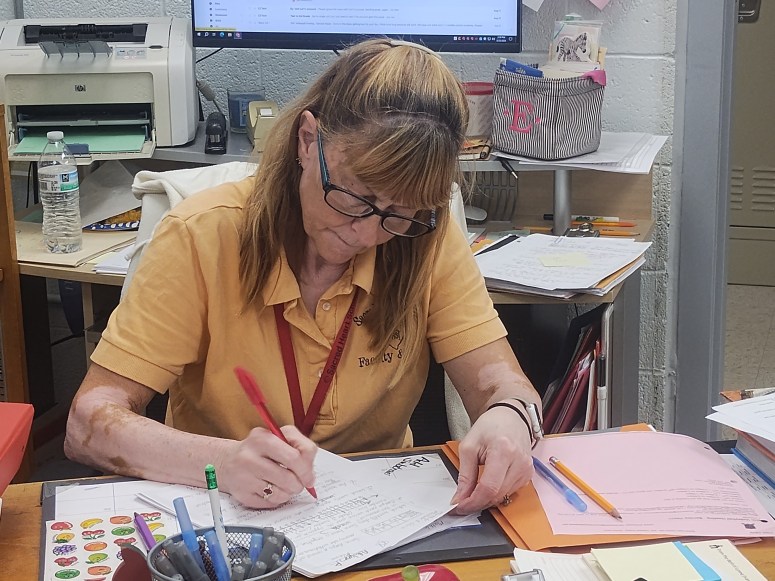
Science teacher Lynne Evanczyk grades papers in her classroom. Evanczyk, a junior high teacher at Sacred Heart in Jeffersonville, is a JHS graduate and has taught at Sacred Heart for over 40 years. Photo by Austin Bainbridge.
Evanczyk attended JHS and graduated in 1977 in a class with around 800 students. She then went on to attend Hanover College for her bachelor’s degree and went on to Indiana University Southeast for her master’s degree. She went on the job hunt and was preparing to take a job in Texas, but her connections from JHS got her local job.
“I’m very thankful that my connections in the public education system helped me to get a job closer to home,” Evanczyk said.
Evanczyk is a very hard-working teacher. She works every Sacred Heart event possible. She also usually helps to plan every event. She leads most committees and always finds time to help students, no matter the hour.
“She puts in a lot more time and work than the other teachers at Sacred Heart; she’s always willing to help,” said seventh grader Adeline Bainbridge.
Evanczyk taught in the public school system for two years and has been teaching private school for 41 years. She likes to think that she combines elements of the style of teaching used in both settings that other teachers cannot.
“I believe in bringing a mixture of the love of learning and discipline into the classroom,” she said.
Evanczyk started out teaching second grade. She then was offered a position as a seventh-grade science teacher. She loved the position and has worked in the Sacred Heart Middle School ever since.
“If I had to say one thing, my favorite part about teaching is seeing the look in a kid’s eye when they realize they mastered a topic.”
Sacred Heart Teacher Lynne Evanczyk
“I fell in love with doing middle school science. I always enjoyed using microscopes and dissecting frogs. That’s stuff you just can’t do with second graders,” she stated.
She also likes to get to know her students and create a positive learning environment. She said that if she knows her students it’s much easier to teach them.
Bainbridge said, “When I enter her room I feel welcome and accepted, like I can still get things wrong but not feel embarrassed.”
Evanczyk prides herself on making her lessons interesting while still being easy to learn. She often uses examples and takes extra time if a student needs it.
“She is very energetic and cares if we understand the topic. I never felt like I was on an island with her as my teacher,” said Trinity High School freshman Caleb Johnson.
Evanczyk’s students also enjoy her being their teacher for other reasons. They say that she is a great teacher for preparing them for high school. She likes to assign work at the rate high school teachers would and always likes to make sure her students go to a high school that’s a better fit for them.
“She really helped me prepare for high school like other teachers didn’t. She helped me prepare for a high school workload and style of learning,” said Johnson.
She says JHS greatly impacted her career. Her teachers at JHS are the people that made her want to teach. Without Jeff she couldn’t have been such an impactful teacher.
“My teachers at Jeff really influenced me, especially my science teacher. I felt how they all impacted me and I thought I want to be able to do that. I really am appreciative of all the teachers at Sacred Heart and Jeff that helped me become a better educator,” said Evanczyk.
Evanczyk loves teaching for many reasons, from interacting with kids to having fun events. She said that she has one favorite item about teaching:
“If I had to say one thing, my favorite part about teaching is seeing the look in a kid’s eye when they realize they mastered a topic. That really makes me feel very happy because they are so overjoyed to realize they know what was taught.”



 thehyphennews.com