The Hyphen Staff will publish a 16-page special state championship issue next week. Printed copies will be available at JHS — more details soon — and the pdf will be posted here on the Hyphen website.
The special issue tells the story of the championship season through the photographs of Hyphen photographers Madison Pritchard and Magdalene Conrad, and through the reporting of Hyphen basketball reporter Austin Bainbridge.
More information coming soon, so watch this space. In the meantime, enjoy this brief preview of the cover, featuring a photo by senior Madison Pritchard and design work by JHS media arts students.
Cover — special championship issue of The Hyphen student newspaper. Photo by Madison Pritchard. Cover design by JHS multimedia students.
JHS is home to 2,130 students. Within those 2,130 students is a diverse community, each with different perspectives of a regular day at JHS.
Sophomore David Perez explains that his school day is “rather boring, but it gets me out of my house.” During lunch, he “pops into Radio and Broadcasting” to do any project he has.
“Radio and Broadcasting is, in fact, one of the most engaging classes because it’s hands-on, and it puts you out there. If you’re a talent, it gives you airtime. If you’re behind the scenes, it puts you to work on the technical side of most of our events,” Perez said confidently.
JHS is like a community itself. Social interactions are at an all-time high and are never dull.
“JHS’s hallways depend on the day. Most of the time, they’re chill, sometimes crowded, but chill. I meet up with friends quite frequently throughout the day, whether it’s before a period or after a period,” freshman Izzy Wemes explained.
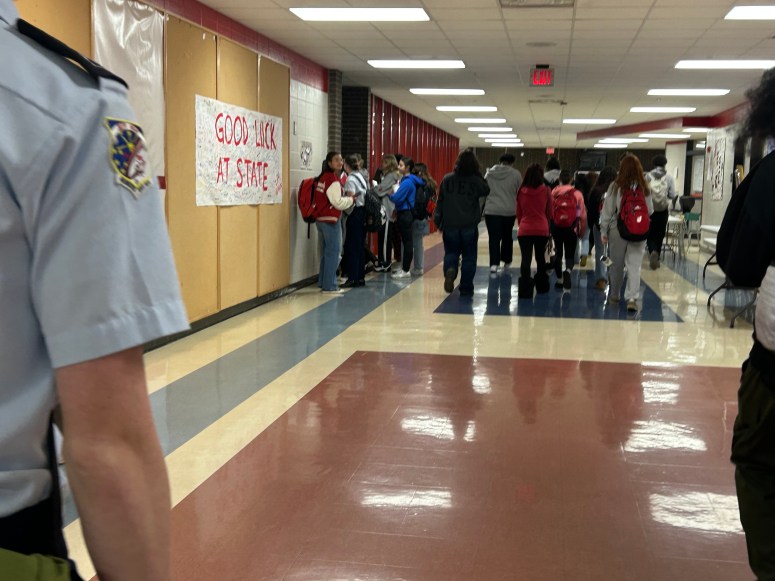
Students move towards their destinations for dismissal. Photo by Ayianna Maddox.
“The halls are crowded. It sucks because people sort of just stand there or group together, or walk right where I’m going to walk. It’s pretty hard because they walk slowly, and there’s no opening,” said sophomore Cary Anderson Rospigliosi.
Engagement levels in classes can fluctuate throughout the day.
According to a study made by Gellis in 2011, as cited on the National Library of Medicine, “As school engagement declines during adolescence, sleep quality and duration decrease.”
With a decline in engagement at school, followed by sleep deprivation, academic skills could be next.
In fact, according to junior Siri Murphy, “It can definitely fluctuate a lot. I think some teachers tend to talk at students more than they teach, per se, but I do think that a lot of times, if the subject materials at least have something interesting, then it can really make a difference.”
In middle school teachers will tell students that high school will be a lot harder and feel longer because of how much work is assigned; and they are not wrong. JHS students are starting to feel the pressure and are realizing how hard school really gets towards the end of the year.
Freshman Mahalia Smith said the work is getting so hard that she is far behind. “Teachers assign so much work all at once with such a short amount of time to do it before the due date, and it causes students to panic and give up with getting work done; it’s too much.”
However, English teacher Eric Watson disagreed, saying, “Having many assignments all at once allows the students to practice essential skills like time management, multitasking, and prioritization; students should test their limits. It’s good for the mind.”
With personal experience I can agree with both sides of this argument, but I myself am stressed with the workload that the teachers have put on students the last couple of weeks left in school. I feel teachers should have meetings where they agree to do a week-long project in each class until the very last week of school; not all at once.
Another freshman, Calob Somoro, agreed with Watson. “All the assignments the teachers have assigned are easy. Most of them are just slideshow projects that take no longer than a day to complete.”
English co-teacher Michelle Houchin is one of the teachers that sees the situation from a student’s point of view, but since she is also a teacher like Watson, she thinks that a student should never give up on getting assignments done.
“I understand that students receive numerous projects and homework assignments daily. Knowing this and the fact that many students have after-school obligations, I do not assign big projects or any homework, and I communicate with my classes,” said Houchin.
In my honest opinion, I do not think that teachers assign too much work, but I do think that they make the work a little too hard sometimes and they expect students to get it done in less than a week.
I struggle with keeping up with work a lot of the time, so I can truly relate to these students and their concerns, but I also try my hardest and know that students should trust their teachers and remember that they’re not here to hurt us, but just to make us better and help us learn more for when we’re older.
Health Academy Services teacher Charles Patton demonstrates a dissection lab to his students on April 9 during his Human Body System’s class. Photo by Viviana Chavez Gonzalez.
by Viviana Chavez Gonzalez
“If you’d like to head to the lab area, we can get started,” begins health academy teacher Charles Patton.
After being in the health services industry for many years, a job opportunity came up for Patton — teaching high school students different health classes. This was a big change for Patton, having no personal experience teaching students before.
“I never really saw myself becoming a teacher, but I have many role models growing up, making me believe that I could do things above what I felt I could,” he said. “In college I had professors that also helped me see that there’s a lot of different ways to think about things than just what you read and interpret and take them to the next step further and do some other research and see what other people say about a certain subject.”
While it may not have been planned, Patton illuminates his newfound care for the education profession and his classes.
“I’m not a huge believer in divine intervention, or things happening for a particular reason, but I think this particular job did happen for a particular reason. It put me where I was supposed to be.”
Even though becoming a teacher wasn’t exactly what Patton envisioned, students have grown fond of their new health teacher, boasting over the comfortability of the classroom environment.
“One of my favorite memories was the week before break and he had bought us all popcorn and he made us laugh the entire class,” said sophomore Laela Rudicel. “We just got to tell stories, talk, watch movies and do whatever. We got to draw on the walls with paint markers. Everytime I see those drawings it’s a cute reminder of how much fun and comfortable the environment is. I just feel like every day in that class is my favorite.”
Another classmate, junior Amaree Smith, also described the classroom atmosphere as a close knit relationship between the students and Patton. She illustrated the family-like relationship they have grown over the year, shining a light on how important he has become in the students’ day-to-day lives.
As time continues more students have grown to love his class and enjoy learning with him, much like Smith and Rudicel.
Sophomore Kaniyah Woodley demonstrated how she feels in her third- period class with Patton, describing how inclusion and attention from teachers is important for students.
“He’s a great teacher. I’m not afraid to ask Mr. Patton questions in his class because he’s very kind and doesn’t make you feel uncomfortable or bothersome I guess. Like when we’re doing a lab or something similar, you can ask him and he’ll demonstrate it for you. He’s very good at making you feel comfortable and it’s not like you’re being left behind.”
Continuing the notion, sophomore Camden White detailed the importance of student-teacher relationships, stating, “I feel like compared to other teachers, Mr. Patton just understands on a deeper level, and he understands that the connections are really important. He wants to be involved and really help us understand our subjects. There’s some teachers who don’t really explain much and who aren’t very into it. They don’t understand us and what we need or how we need to learn.”
Moments like these with a welcoming environment and engaging activities can be critical for students and their learning pathways. All students are different and they may require unique conditions in order to be successful in the classroom. This may come as a difficulty for some teachers, especially with the new generation and their views.
Despite this, Patton enjoys the challenge. He described how interesting it is to see how sometimes the most unexpected events lead to something even greater.
“To be able to impact a whole classroom of students that are locked in and interested in what you’re saying. It’s a different feeling than I’d ever really experienced. And I think it’s those moments that keep me centered in and knowing that this is the right choice for me.”
With a new look on life and new experiences, it’s exciting to see how as people we can grow. A huge part of students’ lives is meeting new people and making connections, and for the students of Patton this is a key part of building a healthy learning environment.
Sophomore Arianna Adams shared her personal experience as well, illustrating the guidance she is able to receive from Patton.
“I really like his teaching style because I feel like I could ask any questions and he explains it to me in a way I can really get it. Usually if I have a problem teachers kind of want me to figure it out by myself but he understands and helps me figure it out instead of just sending me out lost.”
It’s Patton’s teaching style that helps him connect with his students.
“The best part of teaching is when you all lock in, you get to actually see what you’re trying to teach, take hold and make sense. That really is it, when I can stand up here and see what I’m saying, connect with you guys, that’s the best part of teaching.”
Students believe Patton’s personality is what makes their connections with him so powerful.
“He’s himself which I feel like being himself and being funny and natural is what helps us connect with him so well. It helps us have an understanding of each other. We get to have a lot of fun doing nice sections in different labs, and those are always a good time working together, laughing, and joking around,” continued White.
Being a teacher is difficult, but isn’t it worth the hard work when it’s for the students? To be able to see lessons come to life and inspire those around you.
Rudicel illuminated the relationship between Patton and his students.
“He truly cares for us as we are his own children. He all makes us happy. I like how understanding and kind he is. Most teachers could care less about what’s going on or what’s happening to make you feel bad or upset but Mr. Patton cares. Today I was super tired and drained and he came up to me and I ended up laughing. He just makes the day better, I believe he is a true teacher.”
From the rhythm of a heartbeat to the melodies of a symphony, music is fed into the very souls of human existence. Music impacts our language, culture, emotions, shaping memories and influencing our behavior in ways we often don’t realize.
But how exactly does this seemingly art have such a profound influence on us?
“Music is my life. I listen to music everywhere I go no matter how I feel. I never thought about how the lyrics can affect me as a student. I tend to listen to rap and the words aren’t the best, but they are very catchy,” said sophomore Josiah Whisenat.
These catchy beats and rhythms in music can overpower lyrics.
“As a person who loves music and even got into playing an instrument myself, it does have an influence on my everyday life. I’m constantly listening to music, whether it be while working during class, in the car on my way home, or just while practicing playing the guitar. Music is all around the world and one of the most popular forms of entertainment and escape. Music has always been my favorite hobby to do,” said junior Ubaldo Pille Jaremillo.
Music is a part of people’s lives and has a hold on them.
“As a teen, I usually listen to worship. Not many people, let alone teenagers, listen to worship, but it gives me peace. The words are always so powerful and meaningful. It makes me better as a whole,” said freshman Chelsie Jean.
Listening to music with meaningful lyrics can impact people as a whole, especially since music taps into people’s memories.
“Music is a memory reminder for me. There have always been songs that remind me of special times of life. My family loves to listen to music everyday in our house. Music transports me back to specific times and places in my life. It rekindles memories and emotions that might otherwise be lost,” said junior Ashly West.
Music has always been art in some way; it just depends on how the artist makes it.
“I listen to Rap and RnB on a daily basis. I don’t really listen to the lyrics, but the way it sounds is what I like about it. Now that I think about it, when I sing my music it’s not so good,” said freshman Marcus Baker.
Paying attention to the lyrics in the music we listen to could change our perspectives. So, the next time you listen to your favorite song, take a moment to appreciate the profound impact it’s having on your mind, body, and soul.
Music is more than just entertainment; it’s the soundtrack of our lives, shaping who we are and how we experience the world.
Every artist has demons that they fight. Billie Eilish is no exception. Her music captures her raw emotion as she is feeling it. Her songs “bad guy,” “Happier Than Ever” and “Bury a Friend” are all examples of such songs.
Billie Eilish has been an inspiration all my life. Ever since I was little, her song ”bad guy” played in the background. My mom found it and became obsessed with it. Some lyrics that stood out to me the most are “I’m the bad guy, Duh” and “I got bad thoughts, I got bad vibes.” These stick out to me because I grew up with mental illnesses in the family, so I could relate to the lyrics specifically.
Musically, Eilish blurs the lines between pop, alternative, and electronic, often favoring whispery vocals over minimalist, sometimes eerie productions. Her debut album “When We All Fall Asleep, Where Do We Go?” (2019) was a cultural reset in the music industry. Eilish was fearless when it came to singing about topics of mental health, fame, and identity. Songs like “bad guy” and “Bury A Friend” showcased her versatility, while tracks like “i love you” highlighted her emotional depth.
What sets Eilish apart is her authenticity. She doesn’t chase trends—she sets them. From her distinct fashion sense to her refusal to conform to traditional pop aesthetics, she brings a punk emotion to mainstream music. Her 2021 follow-up album Happier Than Ever showcased her growth, trading some of the earlier darkness for reflective ballads and a more mature sound, while still maintaining that signature Eilish vitality.
Billie Eilish is the voice of the anxious, the sensitive, the misunderstood. She’s reshaping what it means to be a pop star in the 21st century—providing that quiet can be as powerful as loud, and being true to yourself is the boldest move of all.
Studio Albums
Popular Songs
When We All Fall Asleep, Where Do We Go
xanny, all the good girls go to hell, bad guy, you should see me in a crown
Once again the fascistic phenomenon that is the Trump administration has made headlines with its incompetence. On March 24, Jeffery Goldberg — former IDF prison guard and editor-in-chief of The Atlantic — reported that he had been added to a Signal group chat containing members of the Trump Administration.
The group chat discussed the bombing of the Yemeni supposed terrorist organization “The Ansar Allah,” also known as “The Houthis.” Goldberg assumed it was nothing but a prank until the bombs actually started falling.
The Atlantic article and other large media corporations responded to this situation by attacking the incompetence of the administration. Yes, it is incredibly ignorant management, but the texts themselves should be subject to scrutiny.
The media has not responded to the plain-as-day texts that speak of a situation that involved bombing a suspected terrorist’s girlfriend’s entire complex, only the boyish behavior exhibited in their words. None of these media organizations have responded to the casual bombing of civilians. Therefore, none of the media should be trusted.
It should go without saying that the situation in the Middle East is extremely nuanced and should only be approached with an understanding of each of these group’s actions, goals and effects they have on and within the region.
So, who are these groups?
The American and Israeli governments, and Hamas and Ansar Allah, who have all exploited the Yemeni and Palestinian people, through ruthless violence and extremist ideology.
The media remains very removed from the Ansar Allah, referring to them by the name of their now dead ideological figurehead, Hussein al-Houthi. We must ask ourselves: Why does the media so simply write off one group as the terrorists? Why do corporate media conglomerates swing radically to the right, but swing only moderately to the left? What changed in our culture to incite this?
Of course these questions are all indicative of wider systemic issues, but the skepticism should still hold when dealing with how we identify groups of people. Why do the masses accept that the Ansar Allah are simply radical terrorists, while our government and its allies are not.
But how could I say this? Well, let’s define some terms.
The United Nations classifies terrorism as “criminal acts, including against civilians, committed with the intent to cause death or serious bodily injury, or taking of hostages, with the purpose to provoke a state of terror.”
Merriam-Webster defines “radical” as something relating to the root or origin, fundamental, extreme, or favoring extreme change, often used in political or social contexts.
The Ansar Allah is an insurgent group in Yemen. The attacks they have perpetrated on cargo ships in the Red Sea — often referred to as simply “The Red Sea Crisis” — are from their point of view to stand in solidarity with Palestine and the genocide in Gaza. However, the U.S. government frames them as terrorists.
The claim from the U.S. government, in Donald Trump’s own words, is that the Ansar Allahs “piracy, violence, and terrorism” had cost “billions” and put lives at risk, that it is Iran who is funding them. Iran denies this, claiming purely ideological support. Notice how the first concern was the money.
In the text messages within the White House group chat, these infantile men casually gloat and exchange emojis, while talking about the bombing of a suspected terrorist’s girlfriend’s apartment. How could you say this isn’t inflicting terror? So many lives were devastated and taken in an attack on someone who was suspected a radical terrorist and judged as such.
My point isn’t to moralize the Ansar Allah, but to compare what they are being labeled as to the U.S. government. And, yes, I am talking to you, the average U.S. citizen. I do not acknowledge the oppressive actions and propaganda of our government as indicative of my true beliefs of Truth, Liberty and Peace.
These ideals are not utopian or naive. They are the future, a future we can all start building to.
Creating a book is a tall task, from coming up with an original idea, making a draft, editing through the draft, making a cover, and then the actual publishing process. Despite how long the process can take, an estimated 2.2 million books are published yearly.
Joining these 2.2 million books is The Band, a book being published by English teacher and club Creative Writing Club adviser David Kummer.
Kummer has been writing since he was a kid – he recounted writing his own stories as young as the age of 9. He would fill notebooks with his own stories, showing them to his father, with youthful drive.
It shouldn’t be shocking then that Kummer started publishing as young as 15 with his first novel She. Kummer has continued to self-publish a number of original stories. Inspired by authors like Mark Edwards, Kummer’s books “leans towards horror, mystery, thriller, and young adult fiction.” This leads to his books often being filled with twists and turns and morally in-depth characters.
The specific inspiration for The Band was Kummer’s visit to West Virginia where he went and saw a musical festival, which is a direct connection to the plot, as the main characters in the book are a traveling cover band.
Another large part of inspiration for the book is Kummer’s wife, who drew illustrations for the book, as well as helping him throughout the writing process.
However, unlike Kummer’s fun summer trip to West Virginia, the book goes in a more tragic direction. following a main character who feels in the shadows, falling in love with a bandmate, while dealing with a possible murderous end. For those who are lovers of thrillers, this book is handcrafted for them.
When Kummer isn’t working diligently on his books, he works as an English teacher and as the Creative Writing Club adviser, a club meant to help students self-publish and grow confidence in their writing and put it out there. Many young people aspire to become authors, producing stories for the world to read and enjoy but are shackled by fear to put their work out there actively.
“The best way to grow confidence is to start by showing your work to friends, family, or even teachers,” he said.
He also advised starting with something small and writing shorter stories before doing a larger project. Kummer talked about how experimentation with short stories is a great way to try to figure out your “core writer voice.
“Throw stuff at the wall and see what sticks,” he stated.
Kummer stated that a large part of writing is for writers to throw themselves into it and find their wings as they go. He said writers can’t be scared of being good or bad; they simply have to try if they wish to improve.
“Don’t be afraid of the first draft,” Kummer stated. He said that most first drafts are rough – they won’t be the best, but something is better than nothing.
To conclude, Kummer’s book is available for preorder on his website, davidkummer.com, and on Amazon. For those who want to read it, the first two chapters are also free on his website.
English teacher David Kummer presents his newest book, The Band. Photo by Ifrah Daber.
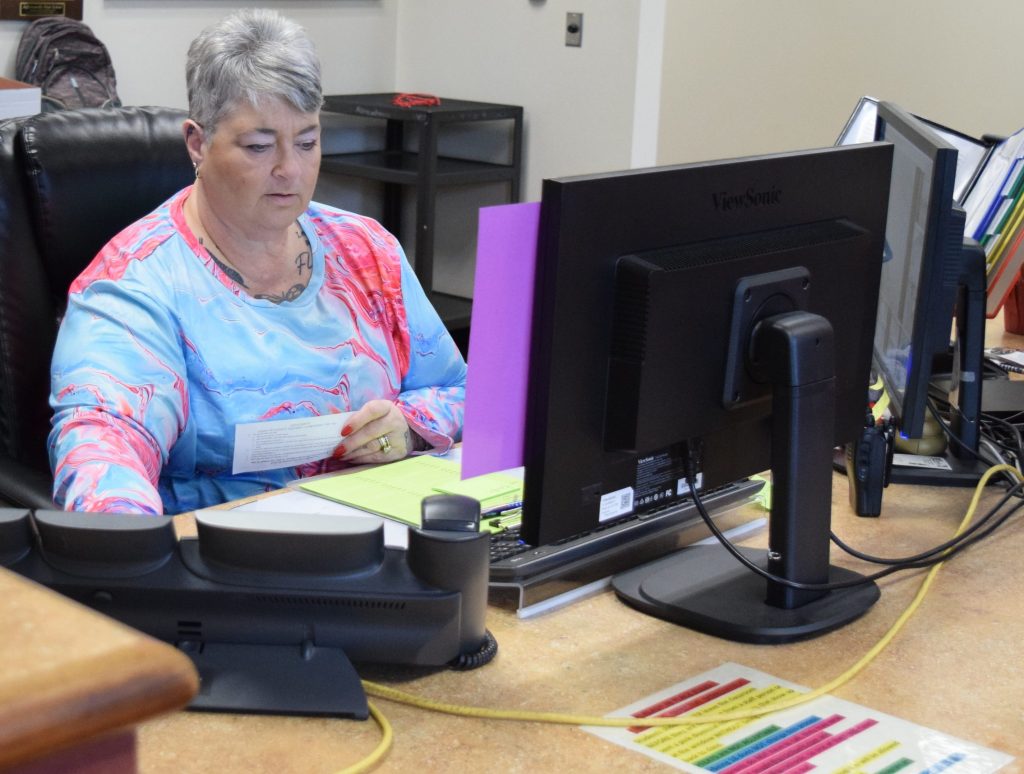
Administrative assistant Torin Clapp, selected at the Support Staff Member of the Year. Clapp said her nomination “kind of blew me away. I was caught off guard and really appreciate that they appreciate me. It feels good to be appreciated since I feel like I do a lot here for everyone and am kind of like a sort of mom for everyone here, so it was an extreme honor to be the Staff Member of the Year.” Photo by Isaac Raymer.Spanish teacher Megan Cortes was recently named the JHS Staff Teacher of the Year. Cortes said, “I feel really honored, and I don’t just feel honored by my students, but honored by my peers, and by administration since it sees me as a leader and role model for other teachers, and I’m really proud of all the work that I’ve done. Photo by Isaac Raymer.
As eighth graders stand on the brink of high school, they are filled with a mix of excitement and apprehension. Eleanor Roosevelt once said, ”The future belongs to those who believe in the beauty of their dreams.”
These young students transitioning from middle to high school is not just a change in environment; it marks a pivotal moment in their academic and personal growth.
Parkview eighth grader Ryder Humphreys said, “In high school, I plan on getting better grades along with better mental health to better myself,”
With new challenges ahead, such as navigating larger campuses, meeting diverse peers, and taking on more rigorous coursework, these students are poised to embrace a world full of opportunities.
“My biggest fear about going to high school is not knowing my way around then being late to my classes,” said Humphreys.
Parkview eighth grader Lia Logsdon said, “I have heard that I will have classes with students in other grades; I think that will be a big change for me.”
Parkview eighth grader Easton Spaulding said, that he is afraid of there being too much work and taking too much time away from other activities.
The journey may be daunting, but it also offers a chance to discover new interests and develop skills that will shape their futures.
Parkview eighth grade counselor Michele Page said, “It will be a chance for students to learn about new career options by gaining a further understanding through more class electives and opportunities they do not have at the middle school level.”
As they prepare to step into this next chapter, it’s essential for them to hold onto their dreams and aspirations, remembering that every challenge is an opportunity for growth.
Rock Creek eighth grader Graceanne Liechty said, “I have wanted to be a hair stylist since I was a little kid, so I plan to go through with that. I want to go to prosser for cosmetology then get out of school to go through with my dream.”
The transition to high school is a significant milestone for eighth graders. It’s a time to reflect their achievements while looking forward to the adventures that await. With determination and a belief in themselves, these students can navigate the complexities of high school and emerge stronger, ready to make their mark on the world.