by Sanae Ittu
High school is a place of education for teenagers. A place filled with opportunities. A place that provides time for self-discovery. And a place to become more marketable for college. However, there are mixed opinions if high school is slowly losing its purpose or not.
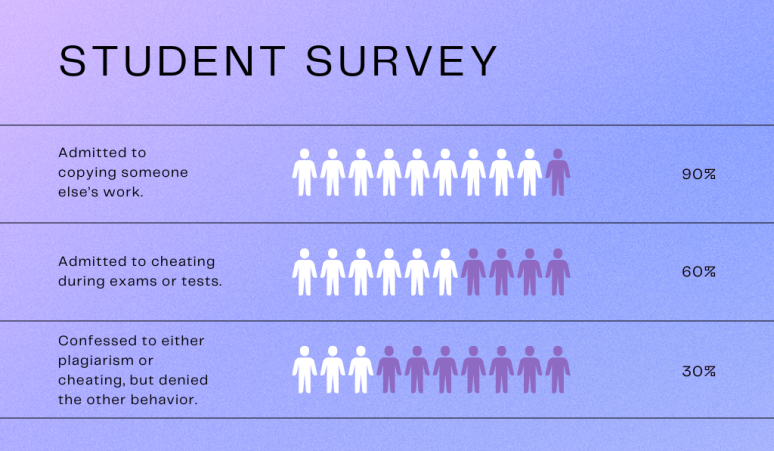
Students are focused more on passing classes than actually taking the time to learn. It’s absurd how normalized it is for students to cheat to escape failure instead of using failure as a chance to grow. The real question is “Why do students feel the need to cheat?”
According to story in edutopia, students feel the need to cheat because either they don’t find any value in certain assignments, they have the fear of losing social status, or just finding comfort with being rebellious.
So how can we fix this problem?
We are living in a society that tells us that how we perform in school can determine our whole future. But aren’t we forgetting that there are successful people living among us that didn’t do well in school academically?
Like Richard Branson, who dropped out of school at the age of 16 but is now a billionaire entrepreneur. Or one of the most famous scientists in human history, Albert Einstein. He dropped out of school at the age of 15 and trained himself for the following year.
We would assume that this can be an easy fix. Like increasing strict punishments and surveillance, focus more on grades and testing, and assigning group works. These so-called solutions may sound promising but it will not work in the long run.
Harsh punishments and intense surveillance can make students feel mistrust, leading to secretive cheating.
Harvard University’s website explains,“Students assigned to high-suspension schools are more likely to be arrested and incarcerated later, and less likely to attend a four-year college.”
Focusing more on grades and testing can limit sutdent’s creativity and critical thinking and increase stress and anxiety, leading to more cheating.
According to Queens University, “When students are mainly motivated by getting good grades, they tend to focus on memorizing information instead of deeply understanding new concepts…”
Assigning group work does not address why students cheat or lack passion, students can use it to rely on others to do all the work.
High school senior Yun F. Zheng shared on the Education Week website, “Assigning only individual work outside the classroom removes the risk of group members being overly reliant on others.”
To avoid any of these consequences, administrators should focus more on restorative practice, formative assessment and mastery learning, and structured collaborative learning with individual accountability.
According to PowerSchool, formative assessment and mastery learning have benefits, including defined learning goals, increased rigor, and improved academic achievement.
So take this as a suggestion that education should focus more on genuine learning rather than just passing tests or chasing grades. Success can come in many forms. Creativity, emotional intelligence, and practical skills that matter just much as a test score.
 thehyphennews.com