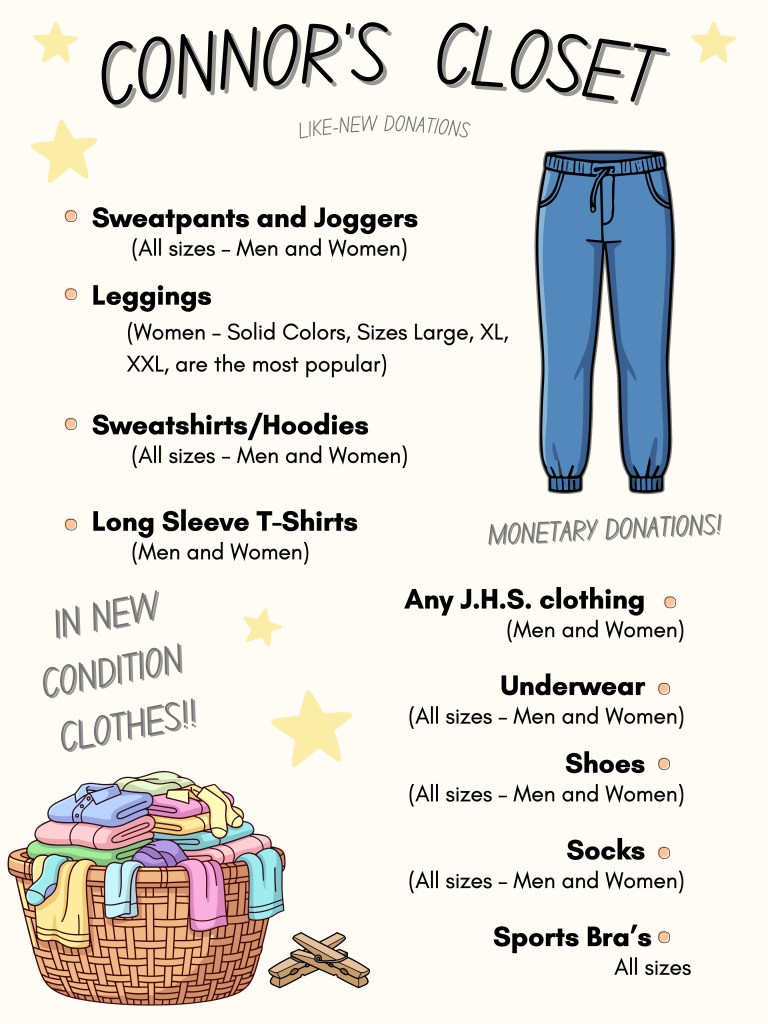
The food pantry and Connor’s Closet at Jeffersonville High School prioritizes the needs of students and families. As winter break comes to an end, items and clothing are in high demand to help students.
Those interested in donating supplies for the Food Pantry may turn them in to room A225 or in A204. For more information, contact Michelle Houchin.
Michelle Houchin: mhouchin@gccschools.com
Graphic by Daysha Gray.
If someone outside the school is interested in donating items for Connor’s Closet, contact Stephanie Soper or Jennifer Mitchell for further information. Students who are interested in donating, may bring their donations to room C125.
In the United States, a government shutdown occurs when Congress cannot reach a deal to pass a funding bill before the deadline. After the deadline, the government shuts down, and some federal employees are laid off, while others work without pay.
This may not seem detrimental to students and families, but the 2025 Government Shutdown, the longest ever at 43 days, put a hold on many necessities.
The Trump Administration planned for mass firings, despite the illegality in doing so, mainly for governmental positions; the firings were planned to be permanent even after the shutdown ends. Over 900,000 federal employees were laid off, and another 2 million worked for 43 days without pay. The Trump Administration stated their goal was to downsize the government and cut costs, but what isn’t taken into consideration is that many families lost their only income.
The government also funds food programs, such as SNAP (Supplemental Nutrition Assistance Program), commonly known as food stamps. These programs are protected by contingency plans, but those become strained in later stages of a government shutdown, and even afterwards. Benefits do not come back immediately.
On Oct. 24, Brooke Rollins, The U.S Secretary of Agriculture, claimed in a memo circulated through the Department of Agriculture, that the contingency funds for SNAP are for natural disasters and not for government shutdowns. This put over 42 million Americans at risk of losing their benefits during the shutdown.
National school lunch and breakfast programs will suffer a similar fate, as they are on contingency plans as well. This will affect anyone who needs government assistance for food, and will leave many families hungry through any shutdown.
“A shutdown is more than just a disagreement on funding. It’s an emergency that needs proper attention and action taken.”
In addition to SNAP losing funding, the Special Supplemental Nutrition Program for Women, Infants, and Children will also be in trouble, even with the attempts from the Trump Administration to keep it afloat. This will put over 7 million pregnant women and new mothers in danger of not being able to feed their infants and buy necessities for their families.
The longer a shutdown lasts, the more programs that the nation relies on will fall. The Trump administration did the bare minimum to keep funds for necessary programs, and flat out refused to work with Democrats to fix this issue. They also didn’t tap into contingency funds to help keep food aid for millions of families.
A shutdown is more than just a disagreement on funding. It’s an emergency that needs proper attention and action taken. Some people live off the programs that were and still are currently at stake, and as President, Trump needed to address the issue before it’s too late.
The Trump Administration came to an agreement to pay active military personnel, but still did not find a way to feed people who cannot eat. The priorities of the Trump Administration do not align with the problems that we as people are facing.
I personally have family members who work in government who are struggling financially because they had to work without pay. Making people work normal hours and maintain the same level of integrity even while receiving nothing in return is disrespectful.
Even after the government shutdown has ended, the aftermath still lingers. SNAP funding is slowly making a return, but not in a timely fashion. Funding is still going to suffer long-term and families will still experience issues at the end of the year.
Republicans claimed that the shutdown is due to democrats wanting to protest against republicans instead of making a compromise with them. This is simply just false. Now that an agreement has been reached to end the shutdown, it’s very clear that the democrats were being as cooperative as possible without hurting the needs of families.
Republicans planned on cutting funding for certain programs, including health care. They say the subsidies for the Affordable Care Act should not be tied to the immediate funding bill, and should be discussed later. However, Democrats were not being uncooperative as a power play. This was a move to try and save millions of families and give them the life they deserve.
As the school year continues, new laws regarding Indiana classrooms have become an important topic among teachers and students. Some laws have been favored by the community, while others have sparked debates on if the law should be enforced.
New policies regarding student behavior, cell phone bans and improved absence tracking are being put into place for the new year. Specific laws address rising teacher pay and closer parental involvement in truancy cases.
Senate Enrolled Act 482 aims to better understand chronic absenteeism by improving the data reported to the Indiana Department of Education.
State lawmakers passed a two-year budget, which adds a 2% increase to school budgets for every year. They also expanded vouchers to private schools for 2026 so parents no longer have to pay for textbooks.
Student absences have always been a worry with parents and school administrators. This year, schools will be required to provide a list of chronically absent students.
Sophomore Leandra Willis thinks the new laws regarding absences are too strict, and students’ personal lives need to be taken into consideration.
“I think the new laws are bogus. What if something happens and you can’t get excused because the school decided to make a law saying no absences can be excused, like a funeral,” she said.
New phone laws have sparked some controversy with students. The new law suggests that students cannot have their phones during instruction time, with the exception of medical reasons or emergencies.
Willis believes this new law could break a connection from students to parents in case of an emergency.
“If something bad happens or we need to know how to get home if they can’t pick us up, we wouldn’t know since we can’t have our phones,” she said.
Sophomore Perry Coats agreed with Willis and thinks the new policies against students are too strict, and should have more leeway to be independent.
“I think the new policies are inhumane and not right. We should have freedom; we’re almost adults,” He said.
Principles of Human Services teacher Kyle Keplinger said that the laws help students in school and also make it easier on teachers to get students to listen.
“The rules help teachers keep students focused and on track; these laws really benefit everyone in the long run by letting teachers save energy and helping students stay focused on doing their work and having good grades,” he said.
He says that he agrees with all the laws, but that some of them are a little too harsh.
“The tardy and absence laws are a little too harsh; they should make certain things excused because students could potentially need to be called out of school for something and not be excused. That could lead to truancy and students don’t need that if they’re out for important reasons.”
English 9 teacher Eric Watson agreed with Keplinger, saying, “The absence laws seem to be working. I think that absenteeism is a problem and these laws are doing a good thing by putting pressure on parents to get their kids to school and by putting pressure on the kids to show up more.”
He said that the cell phone law helps students “lock in” and get good grades
“Teachers should have the latitude to snatch a kids phone without having the repercussions for doing so,” he said.
Principal Pamala Hall said that the laws and cuts in schools throughout Indiana may affect students negatively, but could also help some in positive ways.
“These laws and cuts affect class size and staff cuts, and even affects what we can feed you at lunch.”
She added that the cell phone laws limiting phone usage in classrooms are appropriate for schools because they keeps students focused, but that Indiana schools could be stricter with attendance laws.
“The schools can’t do the attendance alone because they make them at state levels and then there’s nothing to hold them in place, and I don’t find it fair that someone can miss 40 days of school and only log into Google Classroom and have the same grade as someone who never misses a day.”
Many students and staff agree with each other on certain policies, but also disagree on others. They agree that the absence laws should be more lenient, but disagree with other policies, including phones.
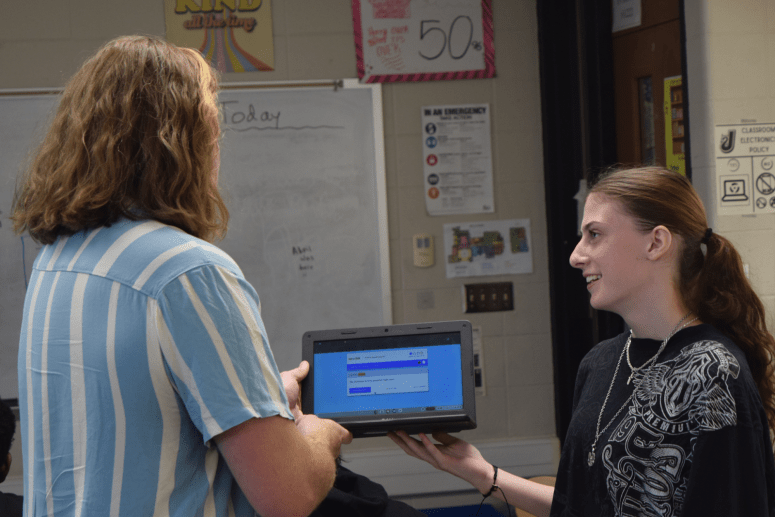
English 9 teacher David Kummer teaches freshman Harper Gordon with her assignment on August 6. The class is working on what he calls a No Red Ink assignment. Photo by Malachi Conrad.
As summer comes to an end, a new start has begun for many freshmen and staff. It’s that time of the year when you meet new people and begin new friendships.
Beginning at a new school can be unfamiliar, but with the help of friendships, it will make life calmer.
A foundation of support has guided freshman Alexis Guadalupe. “At first, I felt lost. I didn’t know where I was going. I had friends to help me, and I figured my way out. It’s interesting seeing old faces and new faces from different middle schools. Being all together feels good.”
The new environmental changes might be sudden, but Guadalupe stays on track with his schedule.
“Nothing really changes. I always wake up at the same time every single day. It isn’t really a change for me, but when leaving school, that is a change for me. It is a little crowded every time I try to leave school, but it’s okay, I still get on the bus on time,” he said.
Guadalupe plans to take courses that will help with next school year.
“I’m taking regular classes right now. But I’m going to try and take an honors class next year in English.” He recalls moments from River Valley Middle School and shares how teachers showed great support by teaching to their best abilities and being open to talk about anything when needed.
Freshman Elliott Taylor is intimidated by the size of the school in comparison to his previous years.
“I was most scared of how big the school is. My fourth and fifth periods are far away from each other, and I usually end up tardy,” he said.
Taylor isn’t stressed about the new year, and is starting off his high school years with good grades.
“I’m feeling pretty good about my classes. I have all A’s as of now, and the work isn’t too hard so far.”
In comparison to his previous school years, his freshman year is flowing much better. “I went to River Valley Middle School last year. The teachers this year and the classes are a lot better.”
Taylor has a certain class and teacher who has stood out to him so far. In comparison to previous years, “My favorite class this year is Algebra honors with Mr. (Scott) Lowe. He’s really nice to us, and he’s a great teacher.”
Starting high school can be a lot for a student, but Taylor already has a set plan for what he wants to do with his school career.
“In sophomore year, I would like to stay in honors classes and go into welding.”
College and careers teacher Angela Krueger loves being a freshman teacher so she can set her students on a path for success.
“I like being a freshman teacher because it’s a new school, a new environment, and I can help them set up their academies and pathways, and it makes me feel like I make a difference.”
Krueger went through years of school just so she could make sure she gives her students a good education.
“I went to IUS with a bachelor’s in psychology, and then I got my master’s in education at University of Cumberland. It took six years in total.”
Krueger has a few tips that may help incoming freshmen do better in school.
“You should take your classes seriously, and especially this college and careers class. It is probably your most important class, and can help you carve your entire high school career.”
Even with personal struggles, Krueger still has a goal to build a bond with her new students. “I’m about to go on maternity leave, but I hope I can still build a relationship with my students just as I did last year.”
Freshman Maddie Tetley agreed with Guadalupe and shared her experience bringing herself into a new environment,
“I was intimidated about the size of the school, so I was nervous that I was going to get lost, but now that it’s been a few days, the school doesn’t seem as big and I’m making my way around easily,” she said.
Tetley looks forward to participating in clubs and teams in hopes of academic improvement and experience.
“I’ll be on the golf team, hopefully the swim team, and as for classes, hopefully I’m in all or most of the honors, or the AP classes next year.”
School counselor Andrea Schedler encourages students to get involved in a new community of people and activities to find new aspirations.
I think that is key to high school, being involved in things and finding a passion you might want to pursue in the future.”
Freshman Counselor Andrea Schedler
“I would definitely encourage them to branch out and get to know more new people and participate in new opportunities that they haven’t had before. I think that is key to high school, being involved in things and finding a passion you might want to pursue in the future,” Schedler said.
Schedler has focused the past three years as a freshman counselor as well as relying on years of experience to mentor her students.
“This is my third year at Jeff High as a freshman counselor, but I’ve been an educator for 18 years.”
She attended the University of Kentucky as an undergraduate, earned her elementary education degree, and minor in psychology. She also attended Eastern Kentucky for her master’s and ranked one for school counseling.
Freshman Kaylee Borelli said, “I wasn’t stressed, I just didn’t want to get lost when I got here.”
Her favorite class is also math teacher Cory Densford, and she sees herself taking AP honors classes like dual credit chemistry, Honors English, and Honors Algebra, as well as doing volleyball and being on the yearbook staff in the future.
Freshman algebra teacher Patricia Midkiff shows support to her students by demonstrating adaptive teaching techniques.
“I have people in pairs so that they have additional people to work with. I also model in front of the classroom quite a bit. I do extensive examples and we slowly build in what we’re doing in class,” she said.
Midkiff shows additional support throughout the course of the year by reviewing topics with students.
“I will work as hard as you do. What I mean by that is, I always try to motivate people, but if you are working in my class and you’re still struggling, I will work with you as much as we need to, to get you through,” she said.
Midkiff shares advice to encourage incoming freshmen in their journeys. “You succeed in your responsibility. If you want to be successful in high school, you need to take initiative.”
Every year, the incoming freshmen class gets dropped into the deep end at JHS. Most of them, for a while, don’t have any good advice that they can find because it’s not something people ask.
Freshman Harper Gordon was “absolutely terrified” for high school. She sat back and sighed, then continued talking about her years in middle school and how she came from a public Montessori school, and she “had no idea how her first time in a traditional public school was going to look like.”
She is now happy to be here, making new friends and sees herself taking regular classes and in the Hyphen in her following years here at JHS.
English 9 teacher Eric Watson said he couldn’t wait for the school year to start so he can teach all his new lessons.
“Every year, teachers want to change up their lesson plan so they grow as a teacher and learn new things themselves.” He says his new freshman classes are all amazing, and they are fast-paced learners.
English 9 teacher David Kummer helps freshman Dakota Jeat with her assignment on August 6 during his fourth period class. Kummer is demonstrating his ability to teach students efficiently. Photo by Malachi Conrad.
English 9 teacher David Kummer had a lot of tips for freshmen.
“One thing I tell my students the most is to try and find a class that they look forward to,” he said. “I think a lot of freshmen coming in this year are outgoing; the ones that are very outgoing are talkative, but also are able to buckle down and do their work.”
Kummer also had one more piece of advice for incoming freshmen:
“It gets a lot easier trying to find new friends as the year goes on. Maybe say ‘hi’ to the people you sit next to. Even if it’s nerve-wrecking, it helps out and makes things easier.”


 thehyphennews.com