High caffeine energy drinks linked to negative health effects

by Jackson Anderson

While energy drinks have been popular among students, side effects have been a concern for teachers, nurses, and parents. 

The popularity of high caffeine and sugar drinks worries many parents and teachers, including nursing assistant Donna Poole, who described the side effects she sees working in the JHS health office.

“All of these things can be side effects — high blood pressure, mental health. You can have anxiety, irritability, restlessness — all of those things can be affected by too much caffeine,” she said. 

Poole said these side effects can be activated by consuming energy drinks on a daily basis. This excessive amounts build up a negative dependency in human systems.

“If you drink them on a daily basis, you are building up a dependency. So then if you don’t have them, like I said, you’re going to get side effects — headaches, not feel good. You’re going to be lethargic,” she said. 

Abusing the consumption of these drinks can highly affect children’s growth, restricting bone acquisition and causing hormonal imbalances due to the high caffeine and sugar levels that energy drinks carry. 

“It’s better if you can just not get to that situation, where you are dependent. Everyone has to make their own decisions about that; we just need to be educated on what it’s doing to us,” said Poole.

The American Academy of Pediatrics warns these drinks can be harmful and addictive, increasing the risk of excess weight gain, cavities, heart disease, diabetes and fatty liver disease. 

These energy drink companies just market their products as fun drinks with bright colors with trendy styles and formats, designed specifically to attract teenagers, according to The Guardian. Poole described these advertising techniques as a negative way to hook teenagers. 
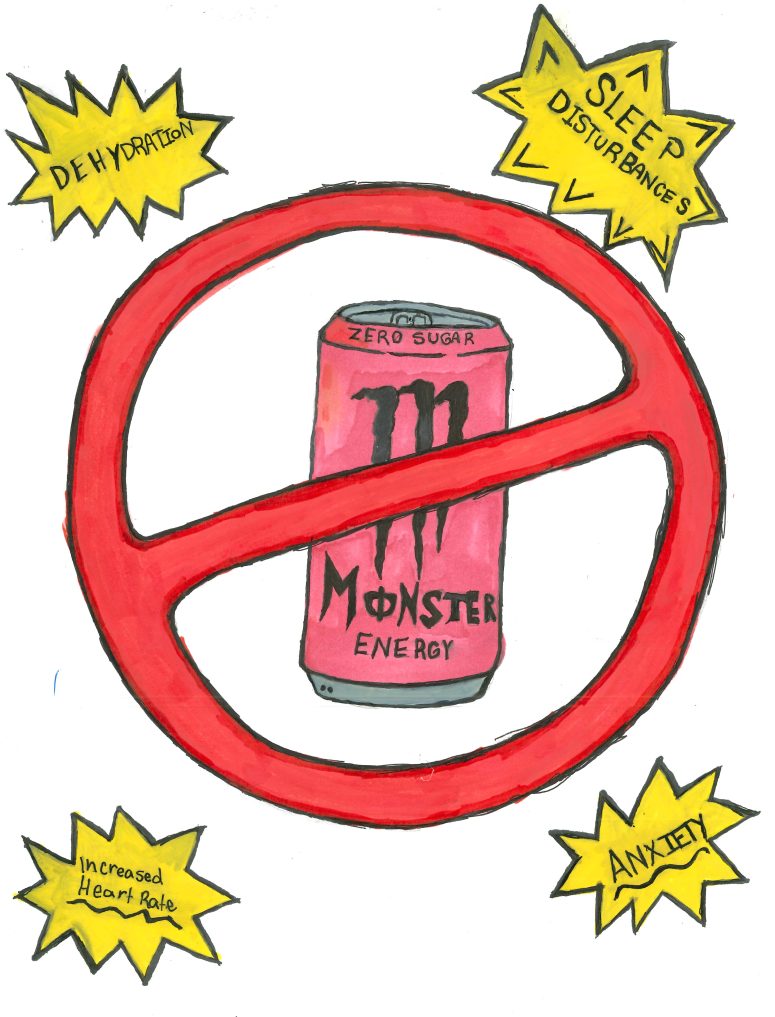
Art by Mackenzie Stubblefield.

“They package them to target kids; they make them look good. They make you want them, so I mean it’s just that we need some healthier alternatives.”

Sophomore Makenzi Middleton said she drinks energy drinks, listing a variety of flavors, and described how the brand Alani listens to their consumers.

“One reason why I really like that brand is because they listen to people’s ideas a lot, like people will talk about ideas they like, and then you might see it coming out. Like the cotton candy energy drinks were limited, and people wanted them back, so they brought them back, as well as two other flavors,” she said. 

The company Alani creates new flavors based on consumer recommendations. However, Poole finds even these tactics to be a problem — “tricking teens” to buy their product that is advertised to be positive and give a “quick boost of energy,” but still doing damage. 

“I just hate to see the damage that’s being done by energy drinks. Personally, I don’t think kids should be allowed to buy them, but they’re going to get them anyway. I mean that’s how kids are, we always find a way, doesn’t matter if you’re supposed to or not,” she said.

Poole explained that educators and health officials still make it known that energy drinks carry dangers and the effects that they can cause, especially to young audiences.

“You live and learn. I do know everybody here is concerned and knows the dangers, the teachers and the staff know the dangers for kids,” she said. 

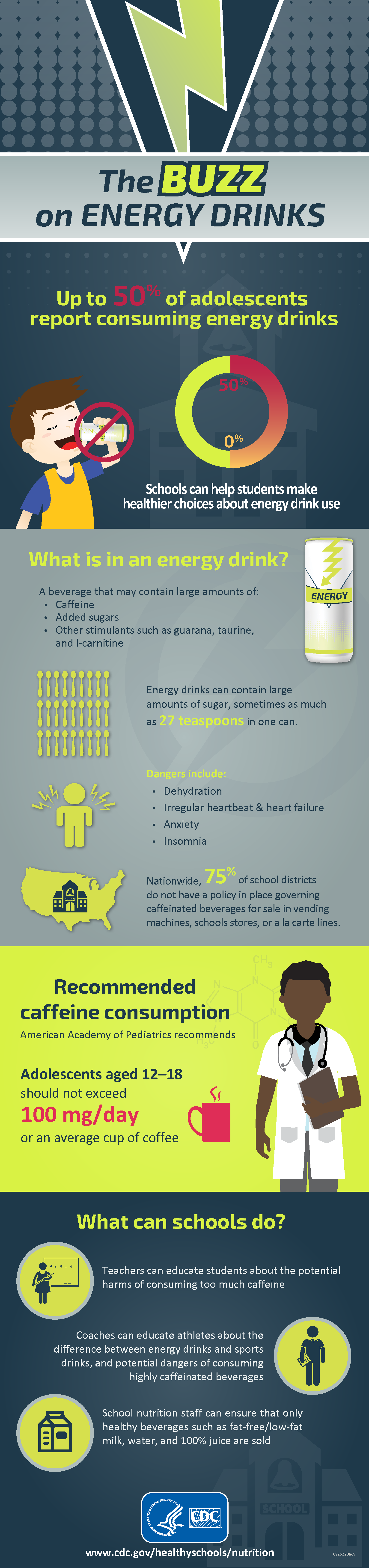
There is no federal legal age requirement for teens to purchase energy drinks in the United States. While no national law exists, both the American Academy of Pediatrics and the Center for Disease Control and Prevention (CDCP) recommend that adolescents from ages 12-18 limit their caffeine consumption to 100 milligrams per day. 

These drinks hold a dangerous level of caffeine, all the way up to 200-plus milligrams. For comparison, the average cup of coffee is 80-120 milligrams. That’s about less than half the usual energy drink 

It is highly recommended for consumers to drink one a day maximum, considering the average intake of caffeine in a day should be around 100 milligrams, which is far less than many cans hold. 

AP biology teacher Melissa Brewer supported limiting caffeine, saying, “You’re not supposed to have that much caffeine maybe in a whole day, but I see kids drinking two or three of those a day.”

Coffee may be better slightly statistically than an energy drink, but Brewer said teens must be wise with the amount and consistency they drink to avoid addiction. 

Poole agreed. “I like my coffee a lot, but your brains are still developing, so it affects you all more. A lot of these kids, they drink so much of it, they really feel the effects of it, so I mean everybody has to use their own everything in moderation.” 

For senior Natalie Hollins energy drinks are something she can control on a daily basis.

“I consume energy drinks because they give me a boost through days that I’m tired or having a bad day, but I don’t drink them as often as I used to, so l’d say maybe twice a week.”
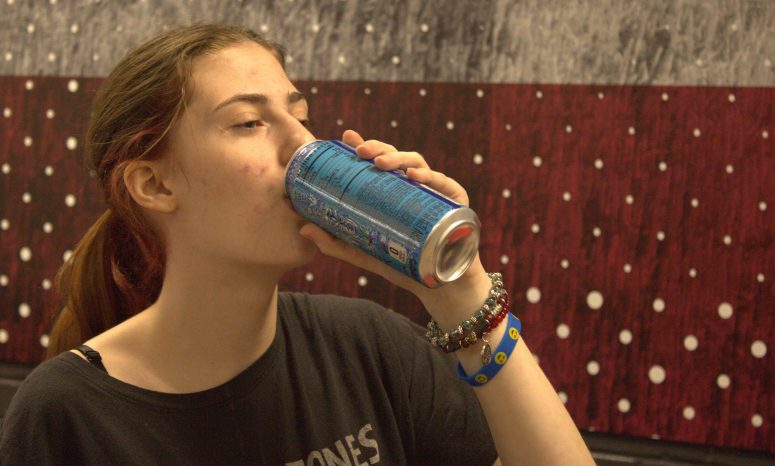
Freshman Dakota Jent drinks an Ultra Blue Hawaiian Monster energy drink, which is a zero-sugar, low-calorie energy drink containing 150 milligrams of caffeine. Photo by Mackenzie Stubblefield.

While some teens control their energy drink intake, others avoid the drinks altogether.

Sophomore Ethan Jenkins said, “I don’t consume energy drinks because it can ruin your sleep schedule, it’s unhealthy and for some even unsafe for your heart and blood sugar levels. I wouldn’t try one — it seems too dangerous and not worth it at all.” 

Sophomore Dana Romero Regalado said she has noticed these side effects, too.

“At times, I have experienced side effects such as feeling jittery, an increased heart rate, and difficulty falling asleep if consumed later in the day.”

At the end of the day, research links energy drinks and caffeine to negative health effects, which is why JHS does not sell them at lunch and stocks vending machines with lower calorie drinks that are all zero sugar.
Red Devils face Bedford North Lawrence at homecoming game tonight

by Austin Bainbridge

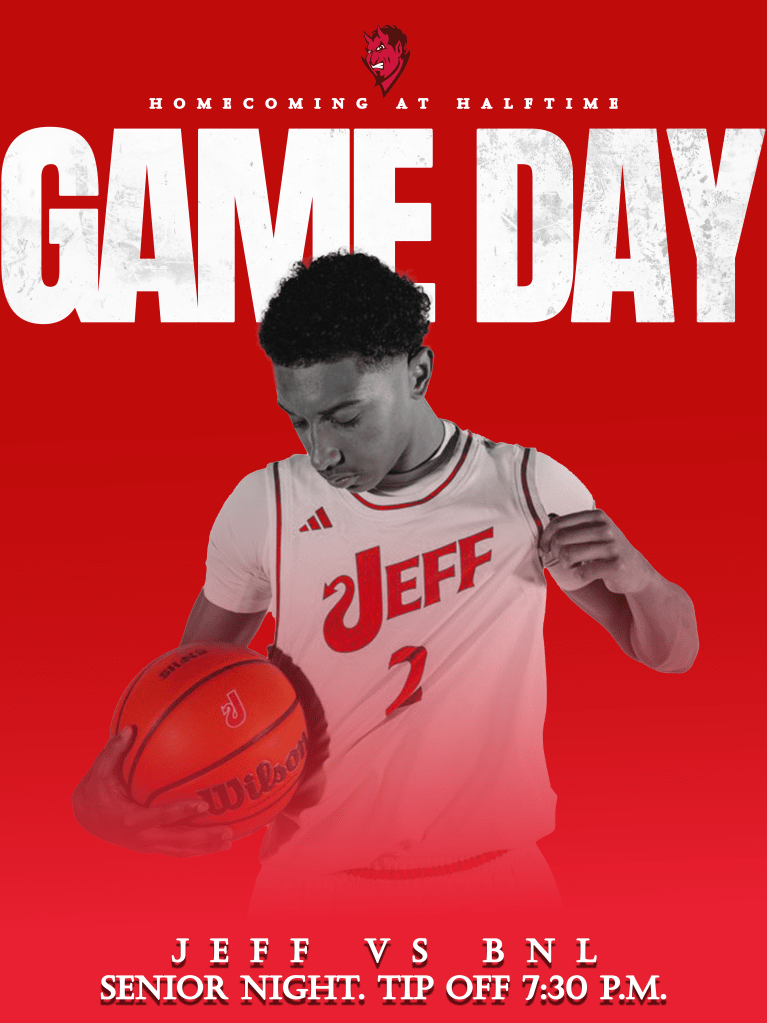
Jeff is looking to get back into the win column at tonight’s Homecoming game after a three-game slide as the Red Devils make their final push to sectionals.

Jeff faces Southern Indiana rival Bedford North Lawrence at 7:30 p.m. tonight in Johnson Arena.

“I think that this upcoming game is just a must win.  We’ve been having a hard season and a hard time connecting as a team. So hopeful we can breeze through this game and prepare ourselves for sectionals,” said sophomore center Mason Longest.

The players are always looking for a good crowd to get them ready to play.

“I think there’s going to be a lot of important people at that game, and it’s just going to give us the fire to win and we’re just going to play hard,” said sophomore center Demauri Crosby.

But having the belief in their skills has gotten the team as far as they are.

“I see a lot of confidence in the team, and that doesn’t come from nowhere; it comes from success, and I think a win against BNL would definitely help with that confidence,” said head coach Sherron Wilkerson.

BNL is struggling in the height department, topping out at 6 ‘3, and Jeff is waiting to exploit that.

“I think we’ll be able to get a lot of post touches, and we should be able to easily get a lot of rebounds,” said Crosby.

The first stat everyone looks at is the team’s record, but the players say it hasn’t been that simple with many of the teams they’ve played.  

“Don’t look at the (opponent’s)record. I mean, it’s an Indianapolis team, so they’re obviously going pay hard.  So, we just need to come home and play harder. We played a Warren Central team with a bad record and lost, so don’t regard that,” said Crosby.

Graphic by Magdalene Conrad.

This is Senior Night and homecoming, where a king and queen will be crowned, and with that the coaches don’t just see a celebration, but a lesson.

“I hope it affects the seniors in a way that we’re running out of games. We’re running out of opportunities to get the stuff that needs to be addressed addressed, so there needs to be a sense of urgency,” said Wilkerson.

Moving forward after BNL tonight, Jeff will end this season playing four straight games against .500 teams, and they’re looking to make final adjustments before the playoffs.

“Those teams obviously aren’t powerhouses, but we can’t count them out. I think they will be a great chance to get everything in tune for when it matters most in sectionals,” said Longest.

Column: Human services providers are people, too

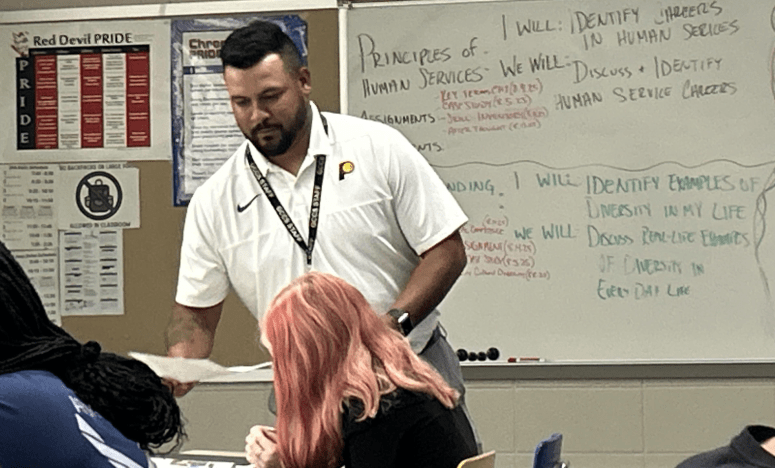
Principles of Human Services teacher Kyle Keplinger hands out assignments to his seventh-hour students. Photo by Ayianna Maddox.

by Ayianna Maddox

When someone says that they work in Human Services, the automatic thought is Child Protective Services (CPS) or counseling. But, CPS and counseling are only fractions of Human Services. What other fractions make up the whole pie?

“It’s not just counseling mental health; there are a lot of different avenues people can go down. We need each of those services, from cosmetology to police officers and firefighters. It’s all the necessities for day-to-day life,” Human Services teacher Kyle Keplinger stated. 

In a way, people in the human services business sacrifice their lives every day. Firefighters fight fires, police officers fight crime, and assist in cases that involve abuse. 

Psychologists and therapists put their needs aside to help guide their clients into a better lifestyle. These titles have quite a lot in common, but the most important fact is that they all selflessly put their lives on pause to aid other people.

According to the U.S. Bureau of Labor Statistics, “firefighters sleep, eat, and perform other duties during shifts that often last 24 hours.” 

For psychologists, “Psychologists can expect to work 35-40 hours a week, usually Monday-Friday, 9 a.m.-5 p.m. However, they can do more or fewer hours depending on their role,” CPD Online College reports. 

As children, we view these people as invincible or immortal. But we have to remember that they are just like us, human. Humans are mortal, emotional, and forces to be reckoned with, but our idols have families and friends too. Putting their lives on the line, knowing they could alter their fate differently each day, to protect others, is an act done out of selflessness and valor.

“It can be emotionally taxing, but it can be a very rewarding career. The reward far outweighs any of the negatives,” Keplinger said contentedly.

Human Services poses as an opportunity to create lasting bonds and carry them throughout life. As life progresses, there will be multiple job interviews, multiple opportunities, but with different backgrounds. Who knows, your future employer could be a life you’ve changed in the past.

A.J. Moye joins JHS as new athletic director

New JHS athletic director A.J. Moye with junior Xavier Santiago Cortes and junior Alan Solorzano Lopez, both soccer players. Photo by Parker McCloskey.

by Izzy Wemes and Austin Bainbridge

A.J. Moye, a well-known and loved IU basketball player remembered for his block of Duke’s Carlos Boozer in the 2002 NCAA Sweet 16, has joined JHS as the new athletic director.

While Moye is known for his skills in basketball, that wasn’t the only sport he played. 

“I played almost every sport growing up,” said Moye, who sees how important it is to relate to Red Devil student athletes and coaches as part of his new job.

His colleagues have taken notice.

“I think his ability to relate to each student athlete — that’s the first thing,” said boys’ basketball coach Sherron Wilkerson. “The second thing is his experiences put him in a position where he can basically mentor any student athlete no matter the sport, and that’s priceless in this day and age.”

Moye appreciates all sports, even those that may be under-appreciated by others. He wants everyone to feel valued, especially the coaches and players.

“I try and get to every team’s practices once or twice a week. Just Saturday I went to the girls’ golf, first tournament, and saw them play, and the coaches were just like, ‘ You won’t believe how supportive this is’,” said Moye. 

In particular, Moye said he realizes the impact of supporting the boys’ and girls’ teams, saying he’s adamant about supporting all equally.

“You know, I have three daughters and one son, so I understand some of the frustrations,” he said.

I’m just really watching and supporting all the coaches, but more importantly, trying to be a good shepherd for the kids, and being someone who the kids look up to.”

Athletic Director A.J. Moye

Moye said in his new role he wants to give Red Devil athletes a reason to work hard, showing them that he cares.

“I’m just really watching and supporting all the coaches, but more importantly, trying to be a good shepherd for the kids, and being someone who the kids look up to.”

Moye is taking what he has learned from his time working and coaching as an assistant coach at Valparaiso University and from his time working with NBA players like Kobe Bryant, Kyrie Irving, and DeMar Derozan to lead a way for JHS coaches to better athletes, including those who hope to play in college or professionally.

 “Pro ball is going to influence how he does things. Because ultimately, for a lot of these kids, that’s their goal. So if they want to get there, we have to put these kids in a position to be successful. So with him knowing what it is to get to that pro level and the steps that he’s seen at high schools and colleges along the way, he can implement that structure,” said head football coach Joe Washington. 

Moye’s colleagues say he has a contagious personality that everyone can feel and relate to.

“I feel like how I am as a person, it rubs off on everyone I meet, including the kids,” Moye said. 

Moye has plans of grandeur for this athletic department. He knows what he can bring to it and what he wants from it. The main goal that he wants is to see every sport succeed. His coaches believe in his vision.

Washington said Moye has brought a “family atmosphere” to JHS athletics.

“He has a good vision for what he wants the overall athletic department to look like in athletic programs. And he’s backing a lot of us, to give us what we need to be successful as programs,” said Washington. “He’s letting me know some of the steps that I didn’t know about being a head coach and paperwork and making sure that  I’m staying within the guidelines of IHSAA — just helping me out. He understands how it is to be a successful head coach.”

In particular, Moye is trying to be present, to be a part of the community. Coaches have taken notice of this and appreciate him taking the time to be present.

“I only know of one of the previous ADs, but, yeah, he’s just out in public. He comes to a lot of the practices,” said Washington. “During practice, he’ll walk up and he’s asking questions, even both of confidence,  just saying I like what you’re doing. Just being visible. So that’s a real big positive for him.”

“An athletic director is probably the most important position in our department” said Wilkerson. “Athletic directors touch everybody in an organization and I think you need a dynamic person to be successful as an athletic director.”

Moye said he loves his job for many reasons, but one shines brighter than the rest.

 “I love being the AD because there’s a lot of unexpected occurrences and changes,”  he said.

Moye has mentioned that he has big plans for Jeff sports, the athletic department, and making Jeff embraceable.

“There are a lot of plans that I have. I want the fans, parents, and students to embrace Jeff, but in order to have that happen our sports department has to be embraceable.” 

New JHS athletic director A.J. Moye poses with his daughter,Bella Moye. Photo by Parker McCloskey.