Column: When used correctly, social media can help teens make connections

by Kaylee Borelli

Around 96% of teens aged 13 to 17 are reported to spend time on social media each day. Social media is significant to today’s generation. For example, social media allows teens to connect with their friends, express themselves, and find communities of people with similar interests.

Social media is, for the most part, a good thing. But social media can also be quite harmful and can lead to mental health problems in teens. According to a Pew Research study, roughly 48% of teens say social media has a mostly negative impact on people their age, but only 14% say it harms them.

According to the same study, parents of teens are more likely to be concerned about teens’ mental health than teens themselves. Overall, 55% of parents say they are extremely concerned about the mental health of teens. In contrast, only 35% of teens make the same claim.

Women are also more significantly impacted by social media than men. According to a study by Memorial University of Newfoundland, 88% of women compare themselves to other women online, compared to 65% of men who do the same. This can lead to many problematic things, like self-esteem issues, body dysphoria, and, in extreme cases, can lead to an eating disorder.

Not only does social media harm teens’ body image, but it can also increase the risk of teens having other mental health problems like depression and anxiety.

According to a  Yale Medicine study, American teens aged from 12-15 who use social media for three or more hours a day faced twice the risk of things like anxiety and depression.

Even with all these problems that social media can cause, it isn’t all a bad thing. Actually, social media can also be good in many ways.

According to a National Institute of Health study,  social media can help teens maintain and build connections with their friends and peers. It also helps teens who might have a long-distance friend or relationship keep in touch. The study states that teen girls who spent time with their friends on social media made their friendships closer.

Social media doesn’t just allow teens to connect with others, but it can also give teens a place of belonging.

The same study shows that different groups of people use social media to find other people like them and create and build communities. For example, teens with chronic or rare diseases used social media to find more people like them to connect and combat isolation.

Social media is both a good and a bad thing. Yes, it can cause mental health problems like anxiety and depression, but it can also allow people to find their community and connect with friends. I believe that if teens use social media correctly, they will find it much more helpful than harmful.
Column: High school athletes use social media to build on their success

by Spencer Robinson

The impact social media has on up-and-coming athletes 

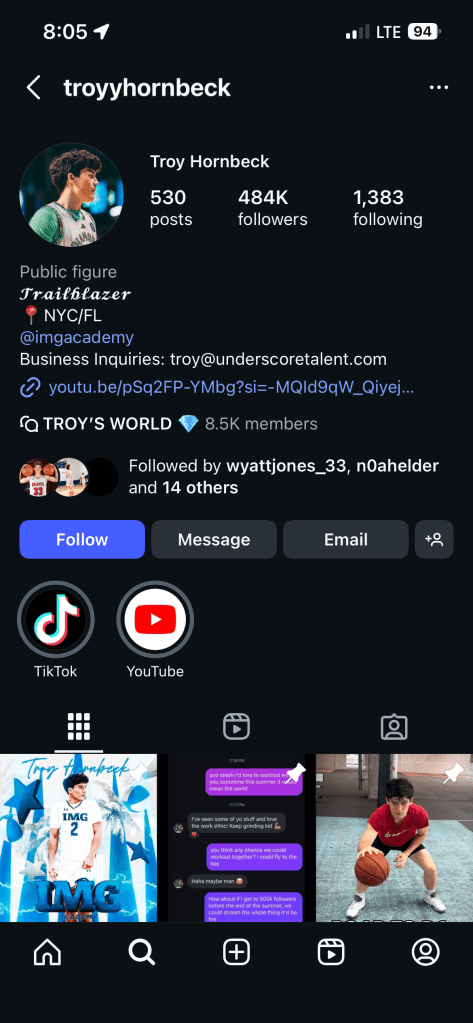
From being an unknown hooper to now having a combined 600,000 followers across TikTok and Instagram sounds ridiculous. That’s exactly what undersized class of 2026 guard Troy Hornbeck did in the span of a few months.

In his videos Hornbeck has a series called “Road to D1.” Here, Hornbeck posts the day in the life of someone trying to make it to the Division One level. Being at the height of 6 ‘2 Hornbeck everyday makes sure he puts himself out there for college coaches all over the world to see.

Hornbeck is a great example of why social media can change athletes’ lives for the better.

Another basketball league that’s generating major buzz all over social media is the new league located in Atlanta, Georgia called “Overtime Elite.”  Overtimes’ whole goal is to boost an athlete’s rep and get them in front of the eyes of the biggest and best coaches in the world.

Overtime has accumulated 1.3 million followers on Instagram alone. Their media has set their high school athletes up for major success on the court and financially with the minimum salary being $100,000 a year. NBA players Amen and his twin brother Ausar Thompson have roots with Overtime. This is an example of how putting yourself out there can help you play at the highest level like the Thompson twins.

Also, the use of social media for young athletes teaches them core professional values.

True sport

  • Social media with athletes boost a player’s name, image, and likeness.
  • Athletes can keep up with the professional athletes in their respective sport and learn from the people at the highest level.
  • More opportunities for coaches to easily access your highlights and learn more about you. 

So, the next time you see Hornbeck’s “Road to D1” vlog or you look on Instagram and see Overtime hosting the best high school athletes in the country, know that these athletes are setting themselves up for a bigger and brighter future.

Social media impacts fashion in teens

by Brennan Zoeller and Jilliann Denbo

Men’s Fashion

Many fashion styles have changed over the years, some good, some bad. Teens’ fashion, specifically boys, however, changes the most, usually from social media impacting the way they dress. Seeing the way many people style and express themselves impacts how a lot of people dress, in many different ways.

When seeing other people on social media make outfits in different ways, it changes how students want to dress.

Class of 2025 graduate Shawn Boyd stated, “By seeing other types of clothes and styles, it gives me a broader imagination on the different types of styles I can mix and match.”

Many teens don’t necessarily get their outfits directly from social media, but they get inspiration from it.

“I get a lot of inspiration from different fashion influencers and wouldn’t know a lot of brands without advertisement on social media platforms,” sophomore Isaiah Valenzuela said about how much social media impacts his style.

Social media lets students express themselves in ways that they’ve wanted to do but couldn’t because of the pressure of it not looking good. Now with social media, they can express themselves in ways they want.

Boyd said,”Social media really allowed the things I wear to be more acceptable and accessible,” while Valenzuela said,”I wouldn’t really think to put some things on without seeing it on social media first.”

Sophomore Ryder Lott also stated, “The things I wear are meant to express myself.”

The way that students dress isn’t entirely changed, but it’s inspired and blossomed out because of what they see on social media.

“The way I dress really comes from how I feel within. I’ve gotten to a point where I just use social media to see the different types of clothing that are available, rather than following the latest trend,” Boyd said

Women’s Fashion

Most girls sit in front of their closets and wonder what they are wearing for the day, while others scroll on their phones trying to pick out outfits. Social media helps most girls pick out their outfits; it also can influence them to change their styles all the time. But others don’t use social media at all to pick their outfits.

“I don’t feel pressure to change what I wear. But the way I keep up with fashion trends is normally when I think a style is cute I’ll look up inspiration. But I normally don’t rush to change my style every couple of months,” said sophomore Cheyanne Bogan

Despite some girls not using social media for their outfits, others typically rely heavily on social media for those reasons.

“Social media definitely affects what I wear because I constantly see new styles and outfits when getting on Tik Tok or Instagram. It makes me feel like I need to buy new items and wear what that person is wearing to feel confident and to feel like I look good,” said sophomore Miaa Caporale

Most girls also like to have many different outfits and styles, but a lot of the time they need help figuring out which ones to choose from.

“Influencers definitely affect what I wear. If I like what they are wearing, I buy outfits off of that. I normally use different influencers to choose from multiple different styles,” said sophomore Malloree Fletcher

While a lot of girls think it is a positive influence, changing styles when trends change is hard to keep up with, along with most girls thinking they have to change styles when others do.

“I do feel pressure to wear what I do because I don’t want to be left out or not fit in a trend. With Tik Tok and many other social platforms, there’s so many new trends that it’s hard to keep up with. These trends make me feel like I need to adjust my style to fit in,” said Caporale. 

While it’s tempting to jump on every little trend, always know that a style is about a person’s personality and lifestyle. And not always about the latest trends and looks.

How Does Social Media Affect Your Mental Health?

You live in a pretend world. Viewing fake people in fake places with all of their fake possessions. Sure you have followers, sure you have “friends,” but are you really happy? Most people think Yeah, I’m Happy, but social media can affect your mental health more than you think.

According to a Pew Research Center study, 92 percent of teens claim to go online at least once a day, and 24 percent say they are online almost nonstop. The statistics are from 2015 and I can only assume these numbers have increased in the past three years. So, here’s my question: how much does this affect your pursuit of happiness?

Worrying about the amount of “friends” you have or the amount of likes you get can impact you more than you think. Not only does social media have emotional consequences, but it can influence what you eat, how much you eat and how often you choose to go to the gym. These things can cause physical problems, not just emotional problems. If you’re under eating and over-exercising (yes, that is a real thing) just to impress your followers, it can generate physical health issues.

Cyberbullying is another big problem that comes with social media. Not being the “perfect weight,” not wearing the “right clothes,” and/or not having all the right materialistic things are only a few situations that could result in cyberbullying. People can be mean. I’m just going to put that out there. Some will criticize you for things that may not even be true, but that’s just the way the world works. I’m not saying that cyberbullying is okay; that’s not at all what I’m implying. What I am trying to say is that you can’t expect for things to be perfect. And, if you are getting bullied, in person or not, you should definitely talk to a trusted adult. Whether that be a teacher, counselor or parent, they can most likely help you.

Growing up without social media hasn’t been super easy, which seemingly contradicts the purpose of this entire article; however, that actually helps my case. I don’t connect with people in the same ways as everyone else does. I tend to feel left out when I don’t see “that picture” or “that tweet” or don’t get “that invitation.” Just as having social media can cause negative feelings, not having social media can degrade your self-esteem too. This shows how much these apps have changed people throughout the last decade. If I can feel uncomfortable just because I am forced to have physical conversations, that tells you that some changes really need to be made.

What can you do to alter the way social media influences you? First I would suggest a cleanse. Although I said that not having social can be negative, I still think that you should try to go a couple days or maybe even a week or two without using any of your social media. It may end up becoming something that you make permanent. If you can’t stomach dropping Snapchat, however, you need to remember that whatever you post it will be out there forever. You don’t need to change who you are to fit in. If you are posting things that are even the slightest bit inappropriate just because everyone else is doing it, that can really come back to haunt you. Everything you put on the internet can be saved by anyone who sees it, even if it gets deleted.


Written by Kristen Jacobs