by Jilliann Denbo
As a kid, I’ve always loved turtles, the way they swam, their shells, and just how they looked in general.
But, there is one main reason I love them so much.
When I was little, I would go over to my mom’s aunt’s house. She had a ton of little knick knacks, and little turtles that were made out of seashells were one of them. I always loved going to her house and looking at them, I was always careful to not break anything no matter what.
The turtles were always my favorite, though, because I thought it was cool how people made an animal out of tiny shells from the beach.
I was only around four and most people may not think I remember, but I will always remember seeing those turtles. Even though my mom’s aunt is not with us anymore, that will always be one of my favorite memories from when I was little.
But these sea creatures are far more important than a childhood memory.
From the tiniest plankton to the biggest whale, ocean animals struggle to live a lot more than we think they do. The reason? Ocean pollution.
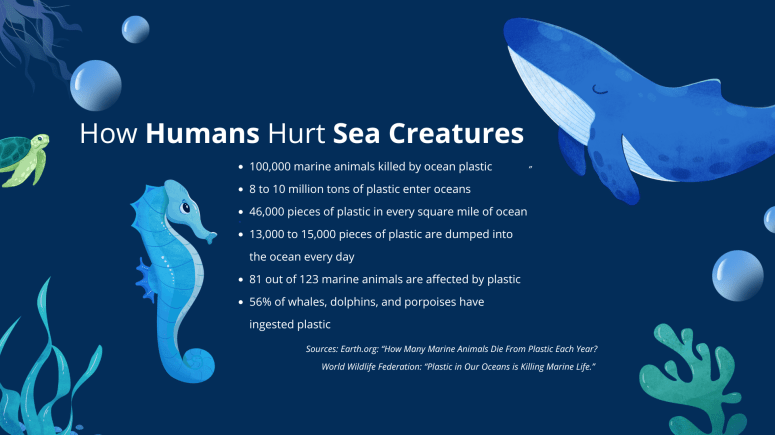
We may not understand the effects of ocean pollution but we are running out of time to help these ocean creatures. We have to put a stop to unwanted pollution.
The biggest sources of ocean pollution are nonpoint sources like septic tanks, cars, trucks, and boats. Eighty percent of ocean pollution comes from the land.
Over 100 million marine animals’ lives get lost every single year because of the devastating living spaces of these creatures.
These factors are endangering our health as well. Around 3 billion people are being affected negatively by ocean pollution. There are many ways we can put a stop to all of this.
We can start to change ocean pollution by recycling properly, avoid products containing microbeads, and participate in a beach or river cleanup.
All these actions can help us change our home and our health. But most importantly, the animals’ health.
Ocean animals suffer because we don’t think enough about our actions and we don’t think that it actually affects the oceans.
Unlike most ocean animals, turtles and whales get affected by ocean pollution a little more than the rest of the animals.
Because of pollution sea turtles ingest too much plastic, causing them to be unable to dive properly to get the food they need. Over 260 loggerhead sea turtles are suffering because of plastic pollution in the ocean.
Whales often mistake plastic for prey, this leads to their stomach being stopped up, which then leads to a slow and painful starvation.
Plastic pollution is the leading threat to ocean health. 4 to 12 metric tons of plastic enters our oceans every year. This travels to every ocean, and even rivers.
Once the vibrant ocean, full of life and wonder, now covered in plastic with suffering animals, and what feels like cold waters. The ocean now looks like a graveyard. We have to stop this pollution.
 thehyphennews.com