by Noah Keserovic
| Birthday: May 6, 1999 Hometown: Corydon, Indiana Favorite sport: Softball Favorite food: Pasta Favorite movie: “Iron Man“ Favorite music genre: Pop music Hobbies: Reading, arts and crafts Time spent teaching: Two years. |
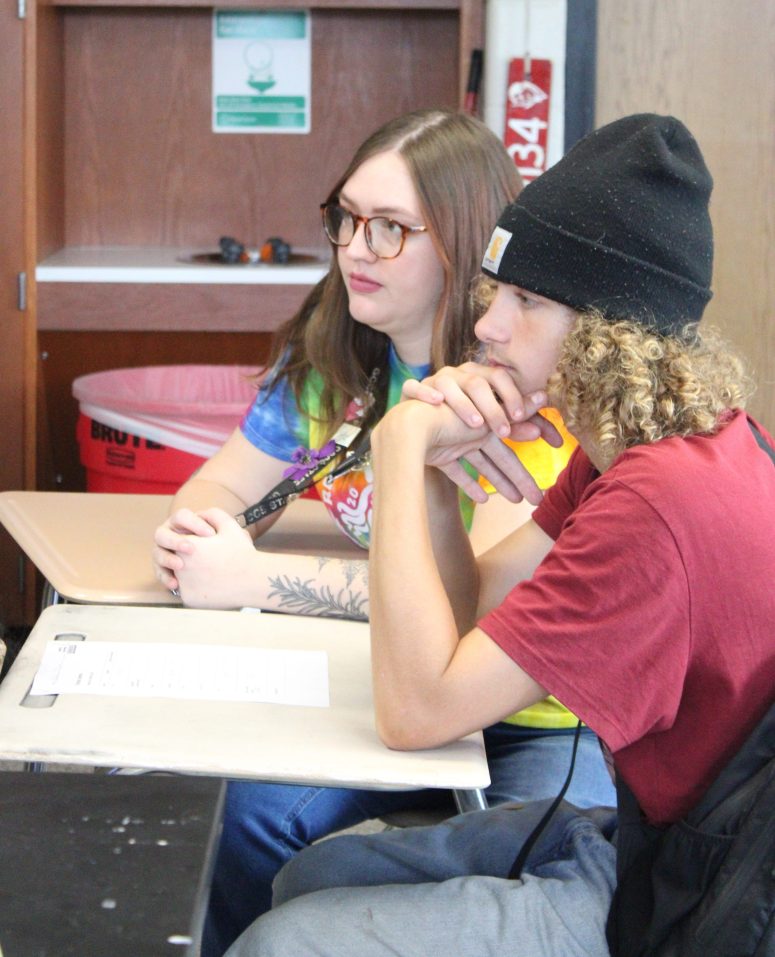
Biology and PLTW Human Body Systems teacher Karson Cecil sits at her desk, checking emails and grading assignments as the students in her seventh period Human Body Systems class work, constructing an origami diagram of a bone. A Louisville Police badge sits on her desk in a case.

One may walk past Cecil’s classroom without a second thought, just thinking that she is any ordinary science teacher; however, that isn’t the case here.
At a first glance, no one would know that she once worked as a crime scene technician for the Louisville Police.
“My experience as a crime scene technician was fantastic; it was a fulfilling job and it was always something new each day. I left that position due to the schedule being too chaotic,” Cecil said.
However, one may wonder why she would take up such a job, with so much danger and unpredictability.
“I just applied and showed up. But the biggest influence is ‘Criminal Minds’, the show,” Cecil stated.
After quitting her job as a crime scene technician she took her career in a completely different direction.
“I chose science because my degree is in science, and it’s my favorite subject,” she answered.
Despite the troubles and annoyances of being a teacher, she has still decided to stick with this career as a science teacher.
“I like getting to help students find something that’s interesting to them and discover that science can be pretty fun.”
Cecil had to take various different classes in high school and then college in order to be able to pursue her career in teaching, biology, and human anatomy.
“In high school I took Advanced Science classes and then in college I took a lot of biology and chemistry classes. I also took an education class, not with interest in teaching, just to fill a space, but then I went to grad school and took anatomy classes,” Cecil said.
Cecil is still a new teacher, at least compared to others, having chosen to teach at JHS for a simple reason.
“Yeah, because it’s close to my home and they were looking to hire a science teacher,” Cecil stated.
Her students have had many positive impacts on her life.
“My students impact my life by brightening my day and they always keep me learning too, they teach me new things which are important. They teach me slang, and I’ve learned some TikTok dances,” she said.
However, Cecil has also had impacts on the lives of her students as well.
“I say she’s taught me a lot and helped me learn a lot of information I need to know for my career,” said sophomore Haylee Schwarz, a student in Cecil’s PLTW Human Body Systems class.
Cecil has also been an inspiration for her students.
“She inspires me to be a better person because of the way she teaches,” stated sophomore Layla Dizdar, another PLTW Human Body Systems student.
Cecil thinks that science is a very important subject, especially in today’s world.
“Science explains the world and how it’s always changing. It is also important that people are able to keep up with new information,” she stated.
Some may find biology and human anatomy to be boring, so one may wonder how Cecil keeps her class fun and interesting.
“I try to incorporate different styles of learning and different games,” she said.
But, do her methods really work at all?
“I find it fun because I like learning the stuff but I find it interesting because of the people,” said Schwarz.
Cecil also has a way to motivate her students to work efficiently.
“Knowing we can have fun after our work is done is a big motivator for everyone,” said Dizdar.
Many people seem to have a positive opinion of Cecil as well.
“I think she’s a very funny and kind individual,” stated Dizdar.
Despite Cecil having a rather chaotic history, and teaching such an important and complicated subject, she has one, very simple goal in her life.
“My biggest goal in life is to have a small hobby farm with miniature cows.”