Column: ‘The stories we read shape us just as much as the events we experience’

by Rain Gresham

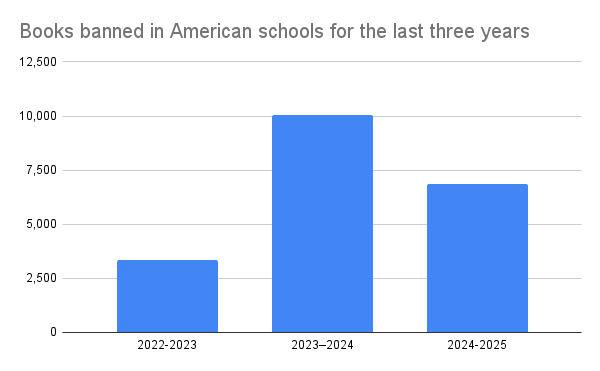
In 1637 New English Canaan by Thomas Morton was officially the first book to be banned in the USA. 

It was banned because it was seen as “a too harsh critique of puritan customs.” Of course the ban was just a sign of times. This wouldn’t happen now, would it? 

One of the most recent books to be banned in American public schools was Sold by Patricia McCormick. This book is about a young girl who was sold into prostitution but finds strength within herself to go on. 

Why would a book like this be banned? If not for control? Why would we shade things like this from a 13-year-old girl when someone the exact same age is living the story. César A. Cru once said, “Art should comfort the disturbed and disturb the comfortable.” 

So should we allow just any books in schools? All for the sake of reality? Should adult fiction novels like A Court Of Thorns And Roses  be allowed in school because “No book should be banned.” Where is the line drawn? 

The line is drawn for the sake of intent. A book that shows cruelty and explicitly for the sake of story telling is a lot different than one that shows it for entertainment. 

What is this “intent” ? Sure we can use the concept of the word “meaningful and telling” but what does it mean? I could say that it has intent because it makes me feel happy, right?

No, because the intent is literary intent. It’s about the purpose of the art and how effectively it is dealt with.  

In A Court Of Thorns And Roses there are countless adult topics but they are not handled with care or nuance,  the reader both gains and loses nothing from reading it. Compared to say The Handmaid’s Tale where it also shares adult topics but in a way that these topics have meaning. Meaning other than to just entertain; meaning to teach. 

This small difference in comparison makes a big difference in impact. I can’t tell you much about the last few romance novels I’ve read over the years but I can tell you how the first time I read Anne Frank’s diary in the sixth grade and how it truly made me realise injustice. How it made me want to look for voices that I might not have heard before. 

You can tell children about bad things happening, but unless you show them from their views of those people it’s nothing but a cautionary tale for them. Another reason why they should be thankful for what they have. 

But they shouldn’t just be thankful, they should be aware of what children their same age go through in the world no matter how “uncomfortable” that conversation might be.

The stories we read shape us just as much as the events we experience. In today’s world we are so capable of seeing each other so why limit that?  Why continue ignorance for the sake of comfortability? 

Hate comes from ignorance, so why not open a book? 

Column: Public transportation can improve the beauty of our communities

by Rain Gresham

In this day and age, all we focus on is ourselves. But if you just took the time to stop and look around, you would see the beauty of people. The beauty of community. 

An estimated 28 million people use public transportation. That’s roughly 8% of the U.S. population and despite this, mass transit is in danger of losing its footing. 

During the pandemic, when people stopped using federal transportation and other infrastructure of economic importance the government put the Coronavirus Aid, Relief, and Economic Security Act (or CARES Act) into place in March of 2020. 

Graphic by Rain Gresham.

This act was a 2.2 trillion economic stimulus, and 25 billion of that was allocated to the protection of public transportation; it was followed by the Coronavirus Response and Relief Supplemental Appropriations Act later in the same year with 14 billion more dollars.

Then in March of the following year the “American Rescue Plan Act of 2021” was put into effect via a giant 30.5 billion dollar relief fund to the same cause.

Though over the four years since this, that 69.5 billion has been exhausted. It wouldn’t necessarily be a problem except for the fact that they never truly recovered from the pandemic rider-ship wise. Without the funding it is truly impossible for public transit to continue running effectively and fruitfully.   

I’m sure you’re wondering “Why should I care?” I mean we go everywhere with our parents, we have our own cars. What does public transportation have to do with us?

Everything, because public transportation isn’t just about buses or trains; it’s about the people.

The dad going home to his kids, the nurse on her way back from a long shift, the student just trying to get home early enough to eat dinner with her family. Without these little things, these quiet connections that bring us together, what are we? If not held together by the glue of these everyday moments, we are a shell of a community.  

We need to fight for this because who else will. So what can you do? 

You can give it your attention. Take the bus instead of calling an uber or door dash. Every ride counts even if it’s just once in a while. It may seem silly and useless because what can one person do? But that’s how change starts with one person taking initiative. 

Showing that you care, care enough to help the drivers keep their jobs, enough to help systems stay funded, and enough to show the people in power that this isn’t a lost cause 

Sure, we can’t vote. We’re not adults? But we are not children either, we can use our voices as little as it might seem. It makes a difference. 

Bring the problem to the forefront of people’s minds. If you can’t make them care, at least make them think.

Tea Club provides a stress-free, relaxed atmosphere to socialize

by Rain Gresham

Everyday life is filled with stress, whether that be school, work, or responsibilities. A place to be yourself is desirable, a place like say, Tea Club.  

Tea Club was founded in 2019 by dedicated student September Kaugchak when people were in most need of a relaxing social club — a place where people could come together, talk, and relax over their shared love of tea without the stress of the real world. 

Stepping inside students could feel the difference, the stress of bustling hallways during school hours melting away as they stepped into the surreal welcomeness of Tea Club. 

Tea Club members gather during their after-school meeting in the Media Center. Photo by Rain Gresham.

“Everybody talks to each other,” said German teacher and sponsor Lisa Stumler. She makes sure that everyone stays safe and has fun. 

From the Blackberry citrus to Darjeeling, Tea Club is full of all kinds of tea fitted for all types of different students to come together and enjoy the simplicity. 

“I realized being a part of something that can help students develop their social skills is one of the key elements to them being successful adults,” stated French teacher and sponsor Dana Schenk.

Everybody has their own ways of falling into the things they love, whether that be a friend, a student, or even just stumbling upon it. 

“Ms Schenk, the French teacher, she mentioned she was asked to be the teacher sponsor and she thought it’d be great if we could be teacher sponsors together, and I thought it’d be a great idea as well,” said Stumler.

“I fell into it because one of my students (current president and senior Toby Wilder) asked me if I can sponsor it and I assisted to some of those last year,” Schenk shared. 

“I saw them on eighth grade night;  they had tea bags and rainbow flags together. I thought it was cute and welcoming,” reminisced Wilder, the current co-president of Tea Club. She takes care of the fundings. 

“I joined the club because my friends invited me and I thought it was cool,” stated senior Marianna Bush, the other co-president. She plans events.

Tea Club is a social club and a successful one at that, as they rake in about 40-50 people at the beginning of each quarter.  “First weeks of the quarter always have a lot more,” emphasized Wilder

First time Tea Club goer Lilly Wright thought that it was “pretty chill. I liked the snacks and tea.”

Visitors walking into the Media Center after school on an average Friday would be met with the sight of Wilder and Bush setting up the tea and snacks. 

Making way to one of the tables, you could interact with any of the people in the club. 

Once everyone has gathered and they have finished setting up the tables, Bush and Wilder come around telling people they could now go up to grab  tea and snacks.

The selection of tea for members in the Media Center after school. Photo by Rain Gresham.

The selection of tea bags to choose from varies drastically, from sweet to savory to earthy. 

Wilder and Bush make sure of that. The two cherish the club and think of it as home, away from home a place where they can relax from the stress of the week. 

The club has been a big part of their life for the past four years and even after they graduate from high school, it will hold a place in their hearts. 

 “I want it to continue, as it was found as a safe space for people,” said Wilder.