by Jilliann Denbo
Around this time last year, I was diagnosed with POTS. I thought it would just be another thing I could ignore pretty easily, even after the recurring hospital visits. But it’s taken over my life for the worse.

The day my parents truly knew something was wrong was on Halloween of last year. I was up cleaning, doing normal activities. I was just taking the trash out when I suddenly passed out on the stairs; thankfully, my dad was there to see it all happen.
After that night, I started having problems with breathing, and my heart rate would never slow down. I was physically exhausted all the time. During this, no one had an answer for me.
The first couple of times we went to the hospital, they ran blood tests and said I was fine, and that they had no answer. I knew that wasn’t right. And my mom knew that as well, so she kept pushing for answers.
After many hospital and doctor visits, I finally got in with the cardiologist, and I eventually got put on a heart monitor. That’s when I knew we were finally going to get some answers.
After I was diagnosed with POTS, I had absolutely no idea what it was. And I was terrified. I didn’t understand anything that was going on in my body.
To this day, only a year later, a lot of people don’t really know what POTS is or what it does to our bodies. They always assume that if they aren’t educated about it, then it can’t be that bad.
“Postural orthostatic tachycardia syndrome (POTS) is a condition that causes a number of symptoms when you transition from lying down to standing up, such as a fast heart rate, dizziness, and fatigue. While there’s no cure, several treatments and lifestyle changes can help manage the symptoms of POTS,” stated Cleveland Clinic.
Before any of this happened, I loved school; I was always focused, and work came to me easily. Now brain fog is one of my worst symptoms. I am never able to truly sit down and focus on any topic. I also tend to forget most things very quickly.
It’s also hard for me to be active anymore; I get lightheaded super easily, and when this happens, everything moves in slow motion.
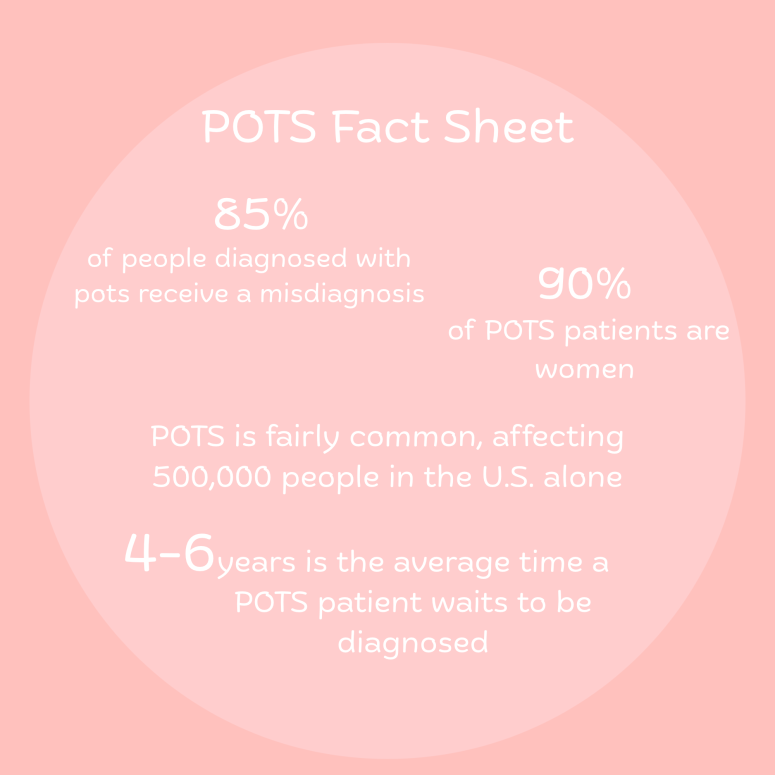
“POTS is fairly common, affecting 500,000 people in the U.S. alone. Most people with POTS are females aging from 15-50 years old,” stated Cleveland Clinic.
Sadly, I got unlucky and got diagnosed right at the age of 15. And it’s not going to get any better from here.
While there are ways to manage it, like getting a good amount of electrolytes, medication, and a bunch of salt, the episodes that come along with it are hard to predict and get ahead of.
Even though this has affected my life awfully, I’m so excited to have friends and family to be on my side no matter what happens. I would never wish this upon anyone else. And I’m glad I am able to take each day one at a time, with my people with me every step of the way.