Educators adjust to new Indiana cell phone ban

by Parker Vibbert and Kaylee Borelli

July 30, 2026 ushered in a new school year at JHS. Along with hundreds of new students, there is a new policy here and in all Indiana high schools: no cell phones.

The Indiana State Senate passed Senate Bill 78 in February, instituting a statewide bell-to-bell cell phone ban in every public and charter school in the state.

Before SB 78, the Indiana Legislature passed Senate Enrolled Act 185 in 2024, which banned cell phone use during instructional time during the 2025-26 School year, but set clear exceptions for education, emergency, health care needs, and disability-related accommodations. However, it did not address how schools were to enforce the bans, nor did it address lunchtime or passing periods.

Under SB 78, cell phones are banned bell-to-bell, with minimal exceptions for health reasons. At JHS, teachers and staff confiscate student phones and turn them into the front office in yellow envelopes; students and eventually parents must pick confiscated phones up at the end of the school day or after school.

Teachers and staff place confiscated cell phones in yellow envelopes for student or parent pick-up at the end of the school day. The change in cell phone policy is a result of legislation passed in Indiana and signed into law by Governor Mike Braun. Photo by Ashton Walcott.

German Teacher Lisa Stumler said the ban is necessary and beneficial.

“I’ve noticed people looking each other in the eye more now, and in the hallway, they’re paying attention to where they’re going, and they’re not all looking down,” Stumler said.

“It’s easier in class to not be paranoid, ‘Are they just on TikTok?’ I don’t have to think about that at all,” she added.

Previously, the policy regarding phones at JHS was largely at each teacher’s discretion, with most simply forbidding phones during instruction, but allowing them after. 

Stumler allowed students to use their phones during non-instructional time, or as a substitute for a Chromebook. Unfortunately, Stumler said they would often become distracted.

“They’d just want to scroll.”

English teacher Justin Linde is “not during instruction” policy worked for a short time, he said, but it ultimately fizzled when students stopped putting their phones in calculator pouches.

“After a couple of weeks, it became ‘I don’t have a phone,’ and I couldn’t accuse someone of not having a phone. It got to the point where everybody was on their phones. Regardless of it being an honors class or a regular class or AP,” Linde said.

The new legislation has significantly impacted media classes, designed to train future journalists to properly use technology.

Radio and broadcasting teacher Fred Cowgill said the statewide ban has heavily affected WJHI’s operations.

“The entire business of broadcast and communications and information, every major news organization is using smartphones. Our entire workflow from the moment we took over two years ago was using our students’ personal cellphones,” Cowgill said.

Cowgill said WJHI was unprepared for the outright ban.

“When we got wind of it this summer that the state was going to implement this bell-to-bell ban of phones in schools, we were told we’d get a ‘hall pass’ to still use them, but around July 1, we were told ‘No’.”

Cowgill’s words were echoed by principal Pam Hall, who said she was unaware the ban would be outright.

“When they were still talking about putting it into law, they talked about giving schools the autonomy to come up with their own plan on how to do it, whether that would be to allow phones in curricular classes. When the law was enacted, they took that away,” Hall explained.

Cowgill, Hall, Linde, Stumler, and freshman counselor Andrea Schedler all agreed the ban was necessary, but differed on the scope of exceptions.

Stumler, Schedler, and Linde said students should be allowed to have phones during lunch.

“If they can handle it, I think lunch should be a time when they can have it. It gives you downtime,” Schedler said.
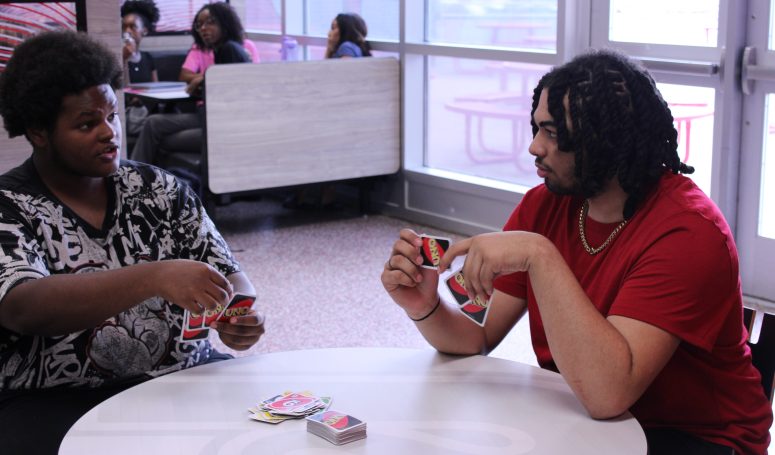
Seniors Joshua Hassan and Ke’moni Mitchell play Uno during B lunch. Students are not permitted to use their cell phones during the school day as a result of new state legislation, including at lunch time. Photo by Ashton Walcott.

Linde agreed. “I think the bill went from one extreme to the other. I don’t understand how you could regulate them in the hallway, or at lunch, and I think students should have access to their phones at those parts of the day.”
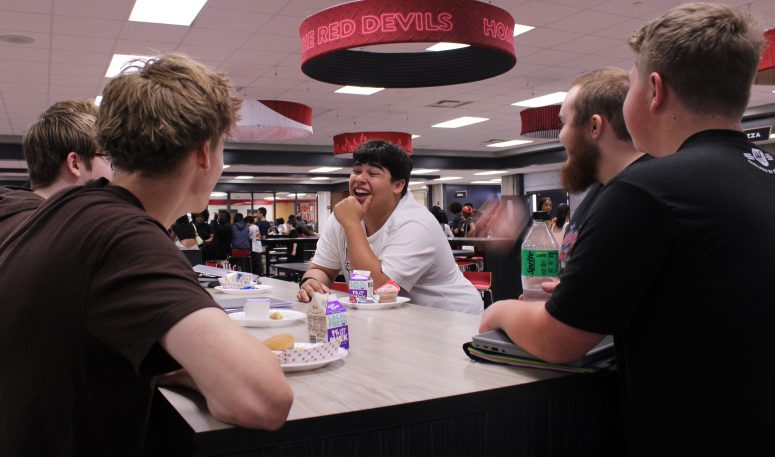
Juniors Evan Floyd, Kenneth Norton, Harrison Cortez, Landon Russell and Gabriel Cecil socialize during B lunch. Public school students may no longer use their cell phones at any time during the school day, including at lunch time. Photo by Ashton Walcott.

Cowgill said student journalism should have been exempt from the ban for curricular reasons.

“The State of Indiana barring smartphone use from its high school communication classes sends the wrong message. We were using them as tools, not as an entertainment device. What better way to teach the correct use of personal smartphones than by giving us the opportunity to do that?”

Hall added that the ban puts an unnecessary burden on emergencies and worried parents.

“I’m one of those parents; my advice to kids is to put it in your purse or in your pocket, turned off or silent at all times, in case something happens, and you have to get out. But don’t have it out. I think it’s important that students, in case of an emergency, have a way to communicate.”

Anchor Club kicks off its upcoming season

Anchor club members Ariana De La Cruz Guerrero, Eliani Schulz, and Alison Hernandez-Estrada showing leadership through their contribution of “Ringing of the Bells” on Dec 12, 2024. Anchor Club leaders are currently planning projects for the new school year. Photo by Areli Hernandez Romero.

by Areli Hernandez Romero

Anchor Club is a dedicated and supportive organization that allows the young women of JHS who are sophomores, juniors, and seniors to express their ideas and themselves while also engaging in community service. This year, with the help of sponsors and the supporting team, Anchor Club is excited to announce its upcoming season. 

Club sponsor Michell Densford said at the beginning of each season, each member is welcomed by an “initiation,” which acts as the formal induction to Anchor Club that each member must attend.  

“We always do an initiation. This is where you come and get a certificate, flower, and light a candle,” she said.

Members who participate for two years, including their senior year, are eligible to receive a chord that represents their dedication to the community.

Francesca Hernandez, who is also a club sponsor, refers to the “executive board” as members who are an influential foundation of Anchor club. 

“Before we go over anything, the executive board goes over projects we want to do and are doing. They’re the head of the projects and make sure the girls are acting right,” said Hernandez. 

Club president and Senior Cassidy Tomlin finds leadership a priority to help support members and ensure that their ideas are heard.

“So, I really try to make sure that I see all sides from all of the levels of the executive board, making sure all their opinions are being considered and making sure that they have a well-respected leader,” she said. 

Her previous experiences in clubs encouraged her to join Anchor Club to seek new experiences.

“I’ve been in Anchor Club since sophomore year, and I joined because. I wanted to give back to my community. I’m a Girl Scout; I’ve been a Girl Scout since kindergarten, so I wanted to find another outlet,” said Tomlin.

I think Anchor Club is a really good way to give back to your community by serving people in Jeff, the school, also a lot of people all around the community.”

Anchor Club President Cassidy Tomlin

Junior Executive Board member Maddie Chandler nods as she mentions her experience as a member. 

“I’ve been part of Anchor Club since my sophomore year. I find all the different projects we get to do for the community interesting.”

Chandler shared the impact Anchor Club has established, as well as sharing one of her favorite projects from her previous year. 

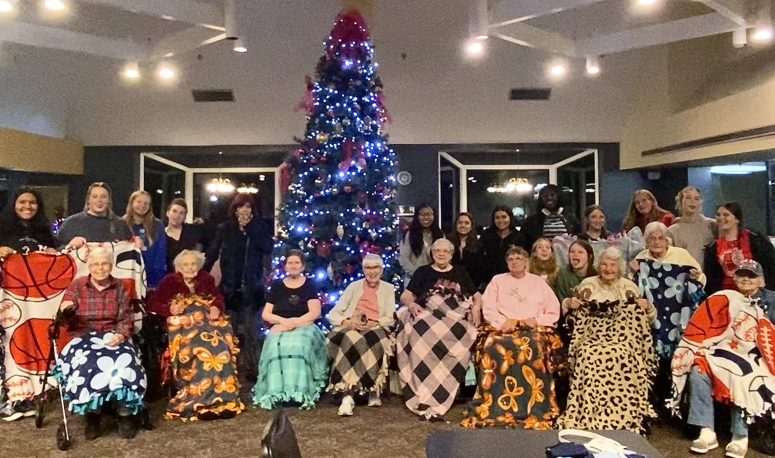
“It’s fun being part of this club. It feels like you have a lot of girls that are your friends, and you get to do new things you wouldn’t normally do. We went to Midwest Village, a nursing home. We made tide blankets for the residents. It was fun doing that.” 

Sophomore Executive Board Member Haliun Otgonbayar is in her first year as a member. She anticipates contributing to the community with her friend, sophomore Samantha Dues. 

“As an Anchor Club executive board member, I’m looking forward to being more involved in the community and helping people. I joined Anchor Club because not only is it a great community, but I’m hoping to plan new events and fundraisers and anything related.”

Dues, who is also in her first year as an executive board member, also anticipates organizing plans in contribution to Anchor Club along with people she cares about. 

“To go off that, I’m also excited to plan events for the community, while doing it with the people I love.  I joined because I wanted to help support, to make the environment even better,” she said.

Densford is satisfied with the efforts of each member and their contributions to make the club great. She proudly mentions the support of the girls and how they are representing themselves in JHS. 

“I like the sisterhood, the girls coming together as a group, supporting each other, holding each other accountable, and holding themselves to a higher standard than what the school does; it’s wonderful. They represent our school well and represent themselves as wonderful young women.”

She recalled her own experience as a past “Anchor” and the influence that stood out to her. 

 “I was an Anchor too when I was in high school. We have some projects that have literally stood the test of time for over 20 years. We have ‘ringing of the bells’, Salvation Army, Steamboat nights — we all have a fun time,” said Densford. 

Hernandez proudly mentions Anchor Club being a very supportive space, giving the impression of a sisterhood sorority to many, while also encouraging them to become remarkable leaders. 

“It’s a wonderful community with great ideas. In a way, they’re future leaders. It’s a very responsible club, and all the girls are doing great things, just being great people. We are making very good future leaders.” She added, “Everybody has their own creative freedom with Anchor Club.”

Anchor club members participated in the “Blanket Making” project while sharing a unique experience with residents of Westminster Village on Dec 13, 2024. Photo by Areli Hernandez Romero.

Tomlin described the Anchor Club community as an organization worth joining for those who want to serve their community. 

I think Anchor Club is a really good way to give back to your community by serving people in Jeff, the school, also a lot of people all around the community. I think it’s a really good idea to join if you want to give back and be a part of a sisterhood, and just experience some fun new things.”

Anchor Club has stood out with its unique sense of sisterhood and teamwork, leaving fellow sponsors and members with great memories they will cherish in the future.  

“If they want to be a part of a really supportive club, then this is a club for them. We do anything we can for the students of JHS and for the community, and I think that’s what makes it beautiful, a fun place to be. If you know a successful woman, they were probably an anchor,” said Densford.

Additional reporting by Parker Vibbert.