Indiana school voucher program expanded

Any eligible child can now receive voucher, regardless of family financial status

by Parker Vibbert

The Indiana Choice Scholarship, commonly known as a school voucher, was created in 2011 in an effort led by former Governor Mitch Daniels, R-IN, with the goal of providing lower and middle-class Hoosiers the opportunity to attend Private Schools.

Daniels advocated for the program and signed it into law to help Hoosier students.

“My intention was to give low-income citizens the same range of choices for their children’s education as their wealthier neighbors have,” Daniels stated in an email interview.

Daniels was also critical of the mandate that students must attend specific schools.

“We don’t tell them where they must buy their groceries or where they have to get their haircut, but in this most crucial of life decisions we had been telling them that their kids will attend a specific school, even if they found that school unsafe or of poor quality,” he stated.

With that goal in mind, the vouchers opened the door for students in poor or failing schools to attend private, often religious, schools whose tuition they otherwise could not afford.

It quickly grew into the largest school voucher program in the United States, with 76,000 Hoosier students using school vouchers in the 2024-25 school year.

Daniels served as president of Purdue University from 2013 to 2022, and has again served as interim president since July. No stranger to helping students and their families financially, he froze the tuition at the university for 11 straight school years during his prior tenure, and it has continued into the 2026-27 school year, reaching the university’s 14th consecutive year of frozen tuition.

Daniels says this is a priority because he has seen the financial burden Hoosiers face in their daily lives.

“I arrived at Purdue after 10 years of daily personal contact with the people of Indiana, and I was highly conscious of the pressure high college costs were imposing on our low- and middle-income families. I thought it was especially important for our public universities to prioritize affordability, and Purdue, the state’s land-grant school, most of all. In business and government, I had found again and again that large bureaucracies will always charge more if they can get away with it.”

Despite the annual tuition freezes, Daniels said Purdue never wound up with a deficit, which was enough for the practice to continue.

“When we broke the annual increase pattern, and found that we could still break even, I was able to persuade our board to do it a second time, then a third, and the success became self-reinforcing,” Daniels said.

Now, Governor Mike Braun, R-IN, and the Republican supermajorities in both houses of the Indiana General Assembly have removed the $220,000 yearly income cap for a family of four on the voucher program, allowing any eligible child to receive a voucher, regardless of financial status.

State Representative Wendy Dant Chesser, D-Jeffersonville, criticized the move, pointing to data showing the average yearly income of a school voucher recipient is around $102,840, nearly 50% higher than the average annual Hoosier income of roughly $70,000.

“In the 2024-25 school year, more voucher dollars went to families earning over $100,000 than to families earning less,” Dant Chesser said.

Dant Chesser also criticized the method in which the income cap was removed, being included in the state budget.

“The income cap change was included in the 2025 state budget bill instead of being passed as standalone legislation. I voted for the state budget because of what it did for our community, including funding for skilled trade education.  If removal of the income cap had been its own bill, I would have voted against it.”

Critics argue the state is now giving money to families who don’t need it so their children can attend an elite private school at little to no cost to them.

Daniels rebukes that argument.

“The duty of the state is to provide for children’s education, not to dictate where, or what form that education should take.  Regardless of their income, parents are simply directing tax dollars they have paid to the schools they believe [are] best-suited to their children.”

Freshmen and their teachers highlight their school year plans

by Sophia Waldridge, Tyler Conley, Parker Vibbert, Areli Hernandez, Malachi Conrad

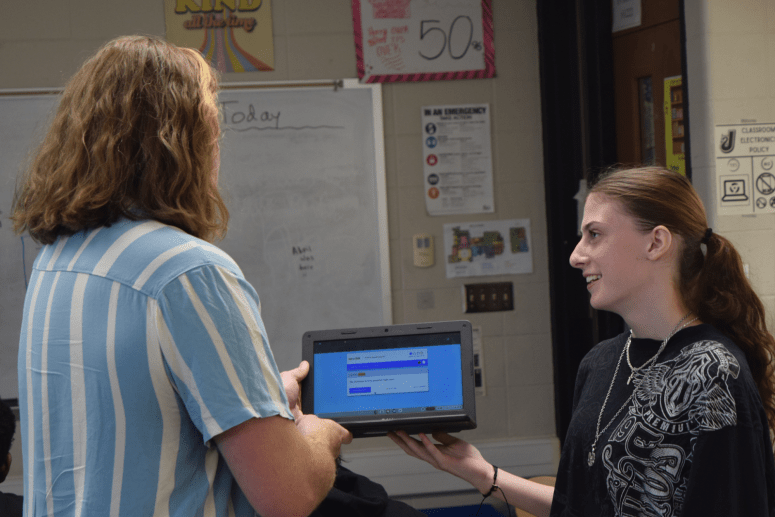
English 9 teacher David Kummer teaches freshman Harper Gordon with her assignment on August 6. The class is working on what he calls a No Red Ink assignment. Photo by Malachi Conrad.

As summer comes to an end, a new start has begun for many freshmen and staff. It’s that time of the year when you meet new people and begin new friendships.

Beginning at a new school can be unfamiliar, but with the help of friendships, it will make life calmer.

A foundation of support has guided freshman Alexis Guadalupe. “At first, I felt lost. I didn’t know where I was going. I had friends to help me, and I figured my way out. It’s interesting seeing old faces and new faces from different middle schools. Being all together feels good.”

The new environmental changes might be sudden, but Guadalupe stays on track with his schedule.

“Nothing really changes. I always wake up at the same time every single day. It isn’t really a change for me, but when leaving school, that is a change for me. It is a little crowded every time I try to leave school, but it’s okay, I still get on the bus on time,” he said.

Guadalupe plans to take courses that will help with next school year.

“I’m taking regular classes right now. But I’m going to try and take an honors class next year in English.” He recalls moments from River Valley Middle School and shares how teachers showed great support by teaching to their best abilities and being open to talk about anything when needed.

Freshman Elliott Taylor is intimidated by the size of the school in comparison to his previous years.

“I was most scared of how big the school is. My fourth and fifth periods are far away from each other, and I usually end up tardy,” he said.

Taylor isn’t stressed about the new year, and is starting off his high school years with good grades.

“I’m feeling pretty good about my classes. I have all A’s as of now, and the work isn’t too hard so far.”

In comparison to his previous school years, his freshman year is flowing much better. “I went to River Valley Middle School last year. The teachers this year and the classes are a lot better.”

Taylor has a certain class and teacher who has stood out to him so far. In comparison to previous years, “My favorite class this year is Algebra honors with Mr. (Scott) Lowe. He’s really nice to us, and he’s a great teacher.”

Starting high school can be a lot for a student, but Taylor already has a set plan for what he wants to do with his school career.

“In sophomore year, I would like to stay in honors classes and go into welding.”

College and careers teacher Angela Krueger loves being a freshman teacher so she can set her students on a path for success.

“I like being a freshman teacher because it’s a new school, a new environment, and I can help them set up their academies and pathways, and it makes me feel like I make a difference.”

Krueger went through years of school just so she could make sure she gives her students a good education.

“I went to IUS with a bachelor’s in psychology, and then I got my master’s in education at University of Cumberland. It took six years in total.”

Krueger has a few tips that may help incoming freshmen do better in school.

“You should take your classes seriously, and especially this college and careers class. It is probably your most important class, and can help you carve your entire high school career.”

Even with personal struggles, Krueger still has a goal to build a bond with her new students. “I’m about to go on maternity leave, but I hope I can still build a relationship with my students just as I did last year.”

Freshman Maddie Tetley agreed with Guadalupe and shared her experience bringing herself into a new environment,

“I was intimidated about the size of the school, so I was nervous that I was going to get lost, but now that it’s been a few days, the school doesn’t seem as big and I’m making my way around easily,” she said.

Tetley looks forward to participating in clubs and teams in hopes of academic improvement and experience.

“I’ll be on the golf team, hopefully the swim team, and as for classes, hopefully I’m in all or most of the honors, or the AP classes next year.”

School counselor Andrea Schedler encourages students to get involved in a new community of people and activities to find new aspirations.

I think that is key to high school, being involved in things and finding a passion you might want to pursue in the future.”

Freshman Counselor Andrea Schedler

“I would definitely encourage them to branch out and get to know more new people and participate in new opportunities that they haven’t had before. I think that is key to high school, being involved in things and finding a passion you might want to pursue in the future,” Schedler said.

Schedler has focused the past three years as a freshman counselor as well as relying on years of experience to mentor her students.

“This is my third year at Jeff High as a freshman counselor, but I’ve been an educator for 18 years.”

She attended the University of Kentucky as an undergraduate, earned her elementary education degree, and minor in psychology. She also attended Eastern Kentucky for her master’s and ranked one for school counseling.

Freshman Kaylee Borelli said, “I wasn’t stressed, I just didn’t want to get lost when I got here.” 

Her favorite class is also math teacher Cory Densford, and she sees herself taking AP honors classes like dual credit chemistry, Honors English, and Honors Algebra, as well as doing volleyball and being on the yearbook staff in the future.

Freshman algebra teacher Patricia Midkiff shows support to her students by demonstrating adaptive teaching techniques.

“I have people in pairs so that they have additional people to work with. I also model in front of the classroom quite a bit. I do extensive examples and we slowly build in what we’re doing in class,” she said.

Midkiff shows additional support throughout the course of the year by reviewing topics with students.

“I will work as hard as you do. What I mean by that is, I always try to motivate people, but if you are working in my class and you’re still struggling, I will work with you as much as we need to, to get you through,” she said.

Midkiff shares advice to encourage incoming freshmen in their journeys. “You succeed in your responsibility. If you want to be successful in high school, you need to take initiative.”

Every year, the incoming freshmen class gets dropped into the deep end at JHS. Most of them, for a while, don’t have any good advice that they can find because it’s not something people ask.

Freshman Harper Gordon was “absolutely terrified” for high school. She sat back and sighed, then continued talking about her years in middle school and how she came from a public Montessori school, and she “had no idea how her first time in a traditional public school was going to look like.”

She is now happy to be here, making new friends and sees herself taking regular classes and in the Hyphen in her following years here at JHS.

English 9 teacher Eric Watson said he couldn’t wait for the school year to start so he can teach all his new lessons.

“Every year, teachers want to change up their lesson plan so they grow as a teacher and learn new things themselves.” He says his new freshman classes are all amazing, and they are fast-paced learners.

English 9 teacher David Kummer helps freshman Dakota Jeat with her assignment on August 6 during his fourth period class. Kummer is demonstrating his ability to teach students efficiently. Photo by Malachi Conrad.

English 9 teacher David Kummer had a lot of tips for freshmen.

 “One thing I tell my students the most is to try and find a class that they look forward to,” he said. “I think a lot of freshmen coming in this year are outgoing; the ones that are very outgoing are talkative, but also are able to buckle down and do their work.”

Kummer also had one more piece of advice for incoming freshmen:

“It gets a lot easier trying to find new friends as the year goes on. Maybe say ‘hi’ to the people you sit next to. Even if it’s nerve-wrecking, it helps out and makes things easier.”