Editor’s Note: Proceed carefully, Stranger Things fans, as the following feature story contains spoilers.
by Shelby Keesee
On Dec. 31, 2025, at 8 p.m. EST, the highly anticipated Stranger Things series finale, written and directed by the Duffer Brothers, aired on Netflix, and later was accessible for viewers to see in select theaters.
The series ran for almost 10 years (2016-2025) and gained numerous fans through its 1980s nostalgia, references, unique plot, and most importantly, its characters.
Prior to the finale, two volumes containing episodes of the fifth season arrived on Netflix, with Volume 1 (episodes 1-4) releasing on Nov. 26, and Volume 2 (episodes 5-7) releasing on Dec. 25.
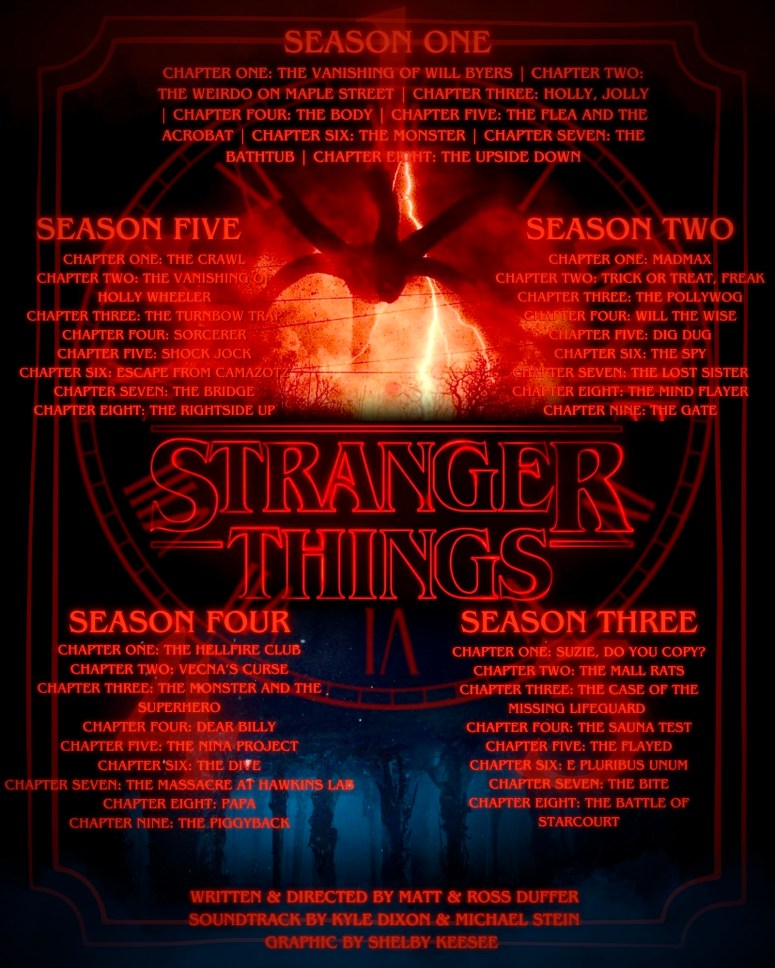
The Crawl
The first episode, entitled “The Crawl,” is set in 1987 in the fictional town of Hawkins, Indiana. The episode begins with a flashback to Will’s vanishing in the Upside Down, which was the first event that led viewers into Stranger Things’ complex and emotional story.
“My first thought was, ‘Oh my God – they were babies. They were such little babies,’ and now they’re like, grown men and stuff,” stated Student Council sponsor Natalie Woods. “I don’t know if it did it justice – if I’ve never watched seasons one, two, three or four, and I just watched the flashback, I don’t think I would’ve been able to get the gist of what happened. So I feel like if they really wanted to do that fairly, it should’ve been an episode all on its own.”
The episode then reveals that Hawkins is under military occupation due to an “earthquake,” which leads the main cast into frequent “crawls” to look for Vecna, one of the main villains, in the Upside Down.
The Vanishing of Holly Wheeler
The second episode, entitled “The Vanishing of Holly Wheeler,” contains the season’s main storyline – Holly’s vanishing, orchestrated by “Mr. Whatsit,” who is later revealed to be an alter ego of Henry Creel/Vecna.
“They focused on Holly a lot. She was definitely the main character of this season, and if they were planning on making a Stranger Things follow-up, she’s the start of the next generation of kids.” said English teacher Eric Watson.
“I loved episode 2, probably my favorite of the whole season,” stated English teacher Allison Clary.
The Turnbow Trap and Sorcerer
“The Turnbow Trap” contains Derek Turnbow’s addition into the plot, and the fourth episode, “Sorcerer,” leads viewers into a turning point – Will’s realization of his sorcerer-like powers.
“But, my next one was number four, ‘Sorcerer,’ because, of course, that was so shocking — none of us knew Will had those powers,” said Clary.
Volume 2
The second volume, containing “Shock Jock,” “Escape from Camazotz,” and “The Bridge,” gave us key events prior to the final adventure. The episodes, containing Nancy and Jonathan’s near-death experience, Max’s escape, and Will’s vulnerable moment, received mixed feelings from viewers. Critics expressed that the Duffers’ writing in the volume either lacked professionalism, was rushed, or lacked character depth.
“The part with Max was kind of confusing to me. She’s in a coma, but she’s still alive and functioning with other people who are stuck in the Upside Down,” stated history teacher Kent Porter.
“I know on the internet, a lot of people were really upset that Will had his whole coming-out scene and everything,” English teacher Holden Henderson said. “I mean, I think it’s great to give people representation – that is a very emotionally taxing moment, and so it makes sense that he would feel that way, but I do think for the story itself, I feel like they (Duffers) spent too much time on it.”
“The Rightside Up” is Stranger Things’ final episode, and it mainly focused on the group teaming up to successfully defeat Vecna.
“The thing about the final episode is the build-up for this season – all of these Demodogs and Demogorgons and all these monsters having to do with all this stuff, but when they actually go into the Upside Down, it’s not there,” said Henderson. “A couple of episodes before, when the Demodogs were fighting all the soldiers outside of the gate, like, that was a huge fight with lots of monsters and stuff – you’d think Vecna would’ve probably tried to defend himself a little bit.”
But the finale’s emotional ending has sparked a contentious question among fans; was Eleven’s sacrifice an illusion – or did she actually die?
In the debate, some believe that she didn’t perish, with an example being Woods.
“I don’t think she did. She’s too strong to have died just like that. Out of all things that poor child has gone through, that’s it? She’s gonna be whisked away with the wind?” Woods stated.
Some others believe she truly died, including Porter.
“I think she did. The way they just kind of left it there with her being in the Upside Down with everything breaking apart, I think it got her.” Porter said.
However, others have a more neutral stance, like Watson.
“I think the way they did the ending was the coward’s way out. They gave everyone a happy ending, they had a dramatic moment where like, it was a pyrrhic victory; they won, but they had lost something very valuable,” stated Watson. “And I feel like leaving the hope that Eleven is still alive undercuts that in a way that was disappointing. I would’ve been happier if they would’ve picked one.”
One of the Greatest?
Despite the common criticism over season 5, the season and the series still appeal to fans as one of the greatest they’ve seen yet.
“I loved the whole series, and I overall loved season 5,” Clary said. “I know some people were disappointed with the very last episode, number 8, but I was not disappointed at all. It was a great way to wrap up everything and everybody – all the characters kind of climaxed, and I understand why Eleven had to go.”
“Season 5 I thought was very enjoyable, as far as a watching experience, I enjoyed watching it,” stated Henderson. “But, part of that was taking a step back from a cinema graphic, or a movie critic style approach, and more of just like, ‘Hey, I really like this series, I want to enjoy it.’ There were definitely some flaws, there were definitely some weaknesses, but overall, it was enjoyable.”
The Characters
Even though a percentage of the audience has not viewed season 5 yet, the characters in Stranger Things are unforgettable and complex.
“Favorite character? Either Steve – the babysitter guy, or Dustin,” stated math teacher Cory Densford, who has yet to watch the final season. “Those are definitely my favorites. I really liked Steve’s character arc. I always have a soft spot for those kind of villain characters.”
“I liked Hopper a whole lot. I’m a pretty sarcastic dude, and he delivered the most sarcasm, I think. And also, he’s just surrounded by teenagers and exhausted all the time, and that’s relatable to me,” Watson said.
“Everyone wants to say Will, because his character led up to that culminating point where he mind slayed Vecna, but I feel like it’s going to be Lucas for me,” said Woods. “He had such a role of keeping the group together. He didn’t have these main character storylines, but he was always the one that was there – if something went good, if something went bad, he really had the answers to everything.”
Because of these characters’ relatability, viewers tend to feel more of an emotional response while watching Stranger Things.
“I think maybe part of that is because it’s taken place over nearly 10 years,” stated Clary. “I’ve literally watched since the first year, so a lot of people who have strong feelings, sometimes it’s because they’ve been watching for so long.”
“I think some of it has to do with the writing style and the characters. You usually feel very realistic towards them, so when we see characters we can kind of imagine as ourselves or our friends or our loved ones, we can see similarities, and since they are more realistic, we see them going through these things, so it seems more emotionally real to us as well,” said Henderson.
“Having characters that have flaws are important in media,” Densford stated. “Nobody’s perfect, and if they’re perfect, it’s hard to relate.”
The exceptional, emotional story and character depth has led fans to share the series with their friends and family.
“I’ve heard about it because my wife’s a big fan of it,” stated English teacher David Kummer, who has not yet watched the show. “She started watching it a couple of years ago and binge watched it.”
“Honestly, my son – he was the one who recommended it, and the minute we watched it, it stuck.” Woods said.
Overall, Stranger Things has made its impact on numerous fans, and its popularity will continue to rise over the years.
The series’ versatility in multiple areas, such as its writing, unique plot, and in-depth characters makes it a historical show for viewers. Regardless of season five’s criticism, it still remains a favorite for many.
“It seems like there’s always a show every 10 years or so that becomes bigger than some of its parts,” stated Watson.
 thehyphennews.com