AI Data Centers have withering effects on environment

by Louis Stifler

As the glittering sun rose over the rainbow wilderness below, a loud, deafening roar emanated out from a gray boxy building almost the size of multiple city blocks. Inside this building huge server racks were being turned on and heated up. The heated server racks needed to be cooled by water being drawn from the surrounding environments, devastating them and taking resources vital to organisms and the ecosystems.

Over the past couple of years there have been massive achievements in the A.I. industries. With that almost new models come out every single day and there is a huge need for them to be trained. That training that is needed requires a gargantuan amount of water to keep the server racks cooled during that process leading to many different negative effects on the ecosystem around it.

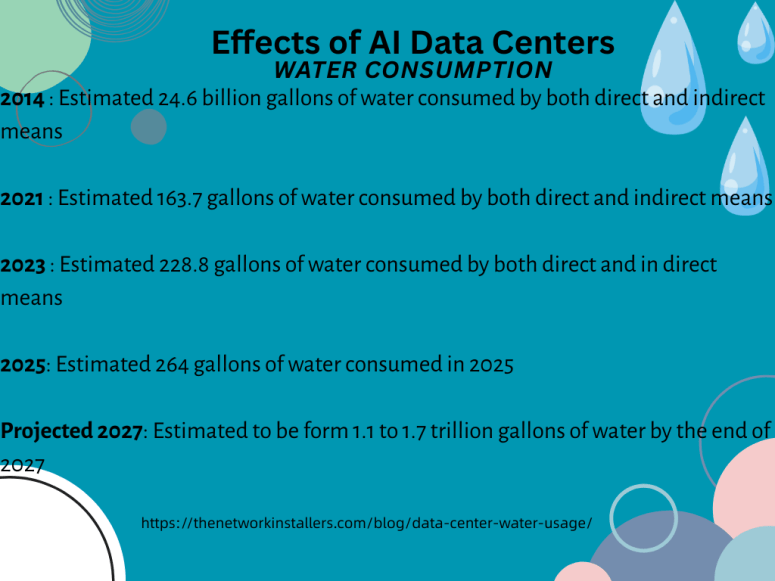
The Nature Forward organization says “Enterprise data centers’ consume, on average, 300,000 to 500,000 gallons of water per day.” and as well stating “For context, five million gallons per day is equivalent to the water use of a town of 10,000 to 50,000 residents.”

These centers are on the smaller scale for data centers. They can scale much larger as the Hyperion Data Center in Louisiana can consume water equal to 100, 000 households of the average family per day. All of these numbers depend on the season of the year however as the temperature of the air outside as the summer months can make water consumption possibly multiply it by three times.

The water, however, is not destroyed. It evaporates and goes through the process of the water cycle where it eventually turns into rain, but since the clouds that carry the water travel with the wind, all of that water is taken to a whole different region. That water also has a new problem with it.
Graphic by Louis Stifler.

The nonprofit Environmental Health Sciences states, “This wastewater, also called blowdown, may contain salts and minerals, corrosion/scaling inhibitors, biocides, heavy metals from piping systems, refrigerants, and PFAS chemicals.”

There are many other harmful side effects that data centers produce along with consuming water and polluting. Including air pollution, noise pollution, water pollution, and many others continue to damage the environments that they are based in.

“The team found that emissions from data centers’ generators increased substantially in the region between 2015 and 2023: Carbon monoxide emissions increased by 196%, nitrous oxide emissions rose by 111%, and dangerous particulate matter emissions jumped by 139%.” These numbers are from VCU’s report on A.I. data centers in eastern Virginia. They have also found that “Currently, those data center emissions in Northern Virginia make up 3% of carbon monoxide, 11% of nitrous oxide and 3% of particulate matter.”

In addition to this consuming water, producing a huge amount of pollution into the atmosphere, they have a huge drain on the electricity of the region that they are in.

An Article from the MIT Technology Review shows that data centers can spend up to five 5 gigawatts per data center alone which is the electricity bill of New Hampshire alone. This would increase the electricity bill of the region that the data centers are in for people who might not be able to afford that would suffer. MIT Technology Review also states that from 2017 to 2023 the electricity that A.I. data centers has nearly doubled and now takes 4.4% of the electricity spent in the U.S.

Huge companies such as OPEN AI, Microsoft, Google, NVIDIA, and many others are investing hundreds of billions of dollars into the A.I. industry. These companies are feeding colossal building that dry the resources of the local regions that they are in and destroy the ecosystems around them with all kinds of pollution. People should know how data centers affect them and their homes.

Behind the Scenes

Drew Davis uses soccer to teach life lessons

by Louis Stifler

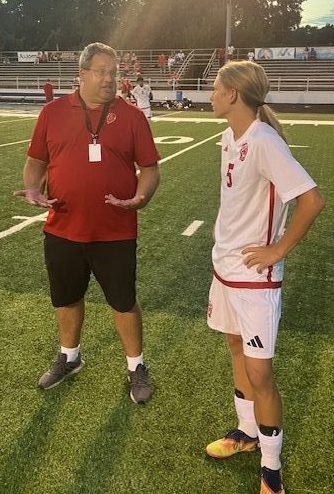
Junior varsity soccer coach Drew Davis crouches down on to the ground to discuss the product of the half with his team. He describes how their Evansville Reitz opponents play and the weakness his players may leverage for their success and what they might improve on in the next half.

“He tells me what to do and we just win games and that’s what it’s all about,” said freshman Ryan McKinley, a JV soccer starter.

Not only does he help them on the field but he teaches them other lessons, especially off the field. 

“It’s teaching them to work with others and learning that you won’t win everything, but if you stay the course with the right game plan you will be successful in life,” recounted Davis. “It teaches discipline and responsibility in that you sacrifice stuff for others.”

Coach Davis has been in the soccer program for 13 years. He has also coached at several other schools and played during his high school years.

“I would say when I started to get to high school and would watch games with friends it was more than anything I could really imagine,” remarked Davis.

Out of all the years, though, Coach Davis said that this year is different for the soccer program. 

“I think that this team from top to bottom is the best team since I have been here. It’s a marriage of skill and belief,” stated Davis. 

Junior varsity soccer coach Drew Davis instructs freshman Ryan McKinley during the Providence game. Photo by Louis Stifler.

This team seems to have something different to it that both the coaches and the players see.

“It is a lot more accepting and a lot more people have come out,” said sophomore JV player Ryland Prichard.

The atmosphere of the teams signifies that there is a different fire this year. Over the years it was building up. The coaches can feel it, and so can the players. 

“My goal would one day to be fighting for a state title. You do that by not just winning games, but getting good grades, being a leader,on and off the field, and just being a role model,” stated Davis. 

This soccer program has improved under all of those who support it. 

Davis said the JHS soccer success has been special, especially in “the years when JV had an undefeated season — which I never thought I’d do — and the varsity season last year as we went as far as I did as a player.” 

Coach Davis has brought this program back up higher than ever and he plans to bring it even higher as a teacher, a leader, but especially as a coach. 

“I love coaching because I enjoy giving back to others and watching them enjoy the experience I got out of the sport and being a part of a building project, watching it grow and get.”

Freshman Camron Bell chases his soccer dreams

by Javian DeLa Luz Garcia

Freshman Camron Bell listens intently as head coach Drew Davis instructs the players on what to do during practice.

“I look forward to scoring a lot of goals and making it to sectionals and regionals,” said Bell. He is a part of the junior varsity JHS soccer team. He hopes to be a regular starter in junior varsity, and eventually be a part of the varsity soccer squad.

“I’m proud of how far I made it in soccer, because the level I am at is extremely difficult and hard,” said Bell. 

He is a normal kid. He goes to school and he hangs out with his friends; however; one of his main aspects in life is playing soccer. His main passion in life is playing soccer.

“I strive to go pro because it is my dream. It is my passion, I love this sport and I want to go pro in it,” said Bell.

Though he strives to go pro now, he has always had a passion for soccer from an early age.

“When I was three years old, my mom wanted me to try out a sport, so I chose soccer.”

After choosing soccer Bell has fallen in love with the sport of soccer ever since. His coach, Davis, is the one who trains Bell and the JV team.

“I think that he is not someone who tiptoes into challenges. He throws himself into challenges. He puts 110% effort in all factors of the game,” said coach Davis.

Freshman Camron Bell. Photo by Mason McGuire.

Freshman Cayden Stolte, Bell’s teammate, agreed with Davis, describing him as a good goalscorer for the team. 

Although his life mostly consists of sports he also gives effort into school. Bell has to be on top of his school work to be able to play in this soccer team. The school has requirements to be able to play in a school team.

“Nothing below a D and if you have a D you have to have no missing assignments,” said Bell.

Having to deal with both his school and athlete life, Bell finds himself sometimes being overwhelmed by the pressure.

“Balancing them both is hard… because you have to get good grades and study and sometimes they interfere. I study at home, get good grades, and go out and play on the field,” said Bell.

It’s this philosophy that drives Bell towards success in the sport of soccer.

“Never give up, chase your dreams no matter the setbacks. And that life will get hard, just never stop trying.”