by Kaylee Borelli
ICE, the U.S. Immigration and Customs Enforcement, enforces immigration laws and conducts investigations into undocumented immigration and arrests and deports undocumented immigrants. Their mission is to protect America through criminal investigations and enforcing immigration laws to preserve national security and public safety, but recently, this doesn’t seem like the case.
In January, ICE agents shot and killed two American citizens in Minneapolis, Minnesota. One of them was a 37-year-old mother of three, Renee Nicole Good. She was shot when ICE ordered her out of her car and briefly reversed before moving forward. The second victim was 37-year-old intensive care nurse Alex Pretti on Jan. 24. He was shot while he was both protecting a woman who was pushed to the ground by an agent, during a protest, and filming law enforcement. The Department of Homeland Security claimed that he was in possession of a weapon and “violently resisted.” But video analysis and witnesses say otherwise, ICE agents removed his pistol from his holster while he was pinned to the ground, before shooting him in the back. These two people weren’t shot in self-defense; they were murdered.
ICE hasn’t just been responsible for murdering two American citizens, but they have also detained and deported people with legal documents and no criminal record, even though they claim they are targeting criminals.
According to Brookings, since Donald Trump took office in January 2025, more than 540,000 people have been deported. Along with this, one-third of people who have been arrested by ICE have no criminal record. If they really cared about targeting criminals, they would actually target criminals and not allegedly bust out car windows just to justify arrests. On top of this, a total of 32 people have died while in ICE custody in 2025. This isn’t about making America a “safer place.” This is racism and a complete abuse of power by Trump.
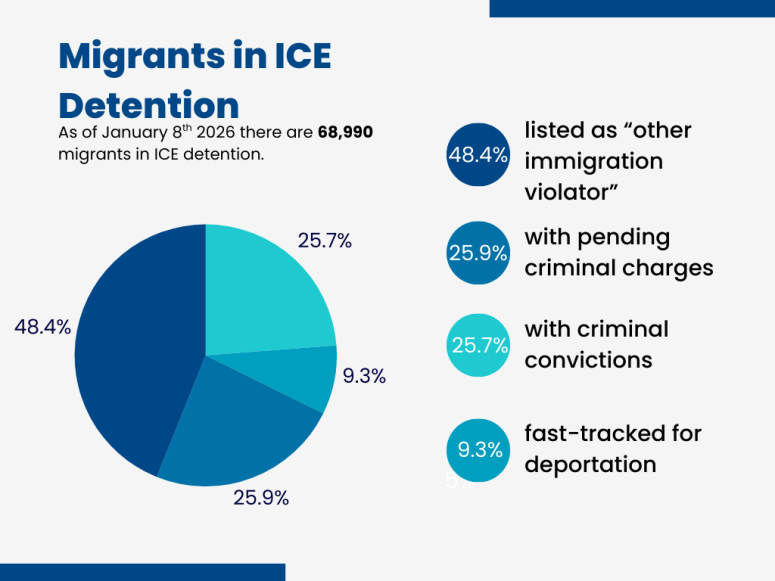
Along with the over 540,000 that have been deported, according to WLRN, as of December 2025, 74% of around 70,000 immigrants in Immigration and Customs Enforcement detention have zero criminal convictions. And yet Trump is still saying he is only targeting criminals when ¾ of the people in detention centers aren’t even criminals.
On Jan. 20, according to CNN, 5-year-old Liam Conejo Ramos was detained along with his father in Minnesota while arriving home from his preschool. They were then flown more than 1,300 miles to a family detention facility in Texas. Liam and his family are originally from Ecuador, and in December 2024, they presented themselves to border officers and applied for asylum, but still, the DHS labels them as “illegal aliens.” Also, according to CNN, the Trump Administration has repeatedly said that they are targeting people who are “violent criminals” and the “worst of the worst.” So why are they arresting a 5-year-old boy and a father who were in the process of becoming American citizens? Luckily, on Jan. 30, Liam and his father were released and returned home to Minnesota, but they shouldn’t have ever been detained in the first place.
ICE isn’t just detaining people for no reason, but they are also violating the amendments of the United States.
The Fourth Amendment states that the right of the people to be secure in their persons, houses, papers, and effects, against unreasonable searches and seizures, shall not be violated, and no warrants shall issue, but upon probable cause, supported by oath or affirmation, and particularly describing the place to be searched, and the persons or things to be seized. This means that people are protected from unreasonable searches and seizures by the government. According to the National Immigration Justice Center, ICE officers will knock on people’s doors and claim they have a warrant to enter and search your house. These “warrants,” though, are not signed by judges; they are forms signed by ICE officers, so they do not allow agents to enter your home without consent. But still, agents are entering homes illegally and detaining people even if they have legal documents or are in the process of obtaining legal documents.
Not only is ICE violating the rights of people to detain them, but once they are detained, the facilities they send them to are disgusting and deadly.
The ICE detention centers are now notorious for both violating the rights of immigrants and for the harsh conditions. According to the ACLU, Fernando Vieira Reyes, who was held in one of these detention centers, faced many problems while there. He tried to get proper treatment for his prostate cancer, which he discovered he had while in the center. He had requested to see a urologist but was constantly ignored, and when he reported pain, they just prescribed him some Vitamin C and Tylenol. The conditions in the facility were also horrible. They were held in small concrete cells that were the size of a parking space, along with being without adequate food, water, and clothing for hours on end.
Even though it is repeatedly said that ICE only targets undocumented immigrants with criminal convictions, pending criminal charges, or those who are deemed as threats to public safety and national security, it has been very clear that this is not how it is. From arresting a 5-year-old who had done nothing wrong to the 74% of immigrants who have no criminal record, it is very clear that this is racism and an assessment of power.
Hopefully, soon this will change, because innocent immigrants and people who have done nothing wrong shouldn’t be getting arrested, being put in centers that neglect their basic needs, and even being murdered in the so-called “Land of the Free.”

 thehyphennews.com