Column: Slow Start, Not a Lost Season

Why Kentucky basketball isn’t in trouble yet

by Jaxon Sturgeon

Kentucky basketball fans are not known for patience. When you wear blue and white, expectations are always Final Four or bust. So after a slow start to the season, a lot of fans are already worried. But this team isn’t failing– it’s just still building. And with key players like Jayden Quaintance and Jaland Lowe getting back to full health, things could look a lot different by the time conference play really heats up. 

Early in the season, chemistry matters just as much as talent. Kentucky has both, but chemistry takes time. New players have to learn from each other, figure out roles, and build trust on the court. When injuries are added into the mix, that process slows down even more. That’s been part of the problem– the team hasn’t been whole.

The good news is that help is coming. Quaintance brings energy, defense, and presence inside. When he is healthy, he changes the flow of the game down low. Lowe adds speed, scoring, and guard depth that Kentucky badly needs.

Fans want wins immediately. That’s understandable. But basketball seasons aren’t movies– they don’t peak in the first act. What really matters is progress. Kentucky is learning how to finish games, how to handle pressure, and how to stay steady when shots aren’t falling. Those lessons hurt now, but they matter later.

Sometimes a slow start is actually a good thing. It forces a team to grow up fast. Nobody feels comfortable. Nobody assumes anything. When adversity shows up early, teams that stick together usually come out stronger on the other end. This is when leadership is built, and roles become clear.

History shows Kentucky doesn’t need to be perfect in November and December to be dangerous in March. The best teams usually don’t run through the season without problems– they survive them. This group still has time, talent, and reasons to believe.

The season is far from over. Once Quaintance and Lowe are back to 100% and the rotation settles in, Kentucky won’t look like the same team from the first few weeks. This is not the end of the story.

It’s just the awkward beginning.
Column: Transfer portal has turned college sports into free agency

by Jaxon Sturgeon

College sports used to be about development, watching players grow through the program, build chemistry with teammates, and represent their school with pride. Now, with the rise of the transfer portal and Name, Image, and Likeness (NIL) deals, that’s starting to change. What once felt like a unique part of college athletics is starting to look a lot more like professional free agency.

The transfer portal was originally meant to give athletes more freedom. Before it existed, players who wanted to transfer often had to sit out a year or go through a messy process. The new system made it easier and fairer for athletes to move if they weren’t happy. But when NIL money entered the picture, things took a sharp turn. Now, the best players aren’t transferring for playing time; instead, they’re transferring for the biggest paycheck. 

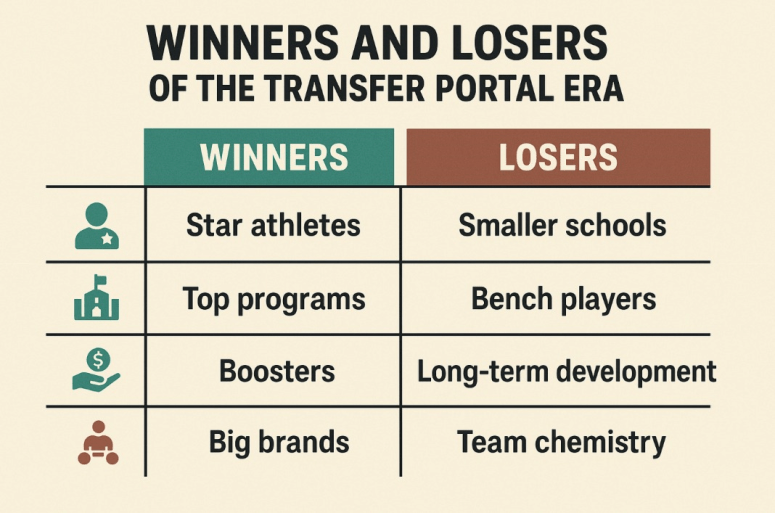
Graphic by Jaxon Sturgeon.

Top programs can now essentially “buy” players by offering them huge NIL deals. Big schools with massive fan bases and booster support have the money to make these offers. Small programs, on the other hand, can’t compete financially. A player might spend two years developing at a smaller school, then leave for a powerhouse program that can offer more exposure and a better NIL deal. It’s frustrating for coaches who invest time into developing talent, only to lose that talent once the player becomes valuable.

Because of this, college recruiting has started to feel more like pro free agency. Coaches aren’t just trying to recruit high school players anymore; they’re constantly re-recruiting their own athletes, hoping they won’t jump ship. Players, too, are learning to treat college as a business, weighing offers and sponsorships like professional athletes. While that might sound fair on the surface, after all, they deserve to profit from their talent, it also strips away some of what made college sports special: loyalty, team growth, and long term development. 

In the end, the combination of the transfer portal and NIL has made college sports more about money than development. While it’s great that athletes finally have more control over their careers, it’s hard not to feel like the spirit of college athletics is being lost along the way.

If things keep heading in this direction, it’s going to start feeling less like college sports and more like the pros.

Better broadcasters, but also better people, is the goal of WJHI media adviser Fred Cowgill

by Jaxon Sturgeon

When Fred Cowgill walked into Jeffersonville High School, his first impression was simple: “A place that was very … what’s the expression? Best kept secret in America.”

Cowgill, who spent nearly five decades in TV and radio, including more than 30 years at WLKY, now leads the WJHI broadcasting program. But for him, the goal has never just been about producing future broadcasters.

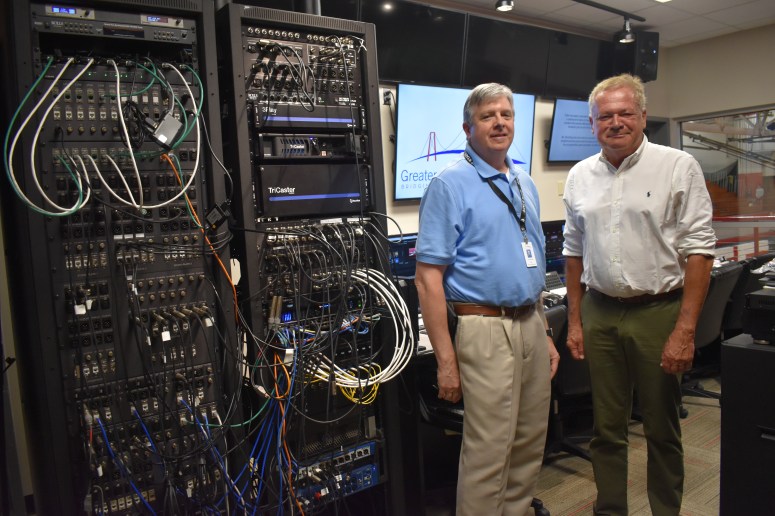
The JHS broadcasting team Dave Callan and Fred Cowgill in the WJHI studio soon after they were hired last school year. Cowgill brings nearly five decades of broadcast experience to the job. Photo by Bruno Diaz Cerro.

“We’d love it to be in broadcasting, but we believe what we’re trying to accomplish and teach goes well beyond that,” Cowgill explained. “Better people. Better people to function in society, better prepared for whatever they decide to do with their lives.”

Cowgill always reminds students that the studio isn’t just about lights, cameras, and editing software. It’s about building real world skills, responsibility, problem-solving, and collaboration that last far beyond high school. “We tell them we’re TV dads, and they’re stuck with us for life now,” he said with a laugh.

To him, what makes WJHI stand out is the family atmosphere they’ve built. “We tell them this is a safe place. If they’ve got a problem, come,” Cowgill said. “We’d like to make this a better program, a better school, a better community, and it takes time.”

Cowgill said he’s always looked at his time at WJHI through a “five-year window.” He knows he won’t be teaching forever, but in that time, his mission is to build something lasting, an operation that runs smoothly long after he’s gone.

“The goal has always been five years, because I’m not a kid,” Cowgill said with a laugh. “But in that time, we can make this a turnkey operation where we hand off to the next people, and they have a framework for what we’re trying to accomplish.”

That plan, he feels, is already beginning to take shape. Year one, he admits, was “flying blind.” But now, in year two, the vision is sharper. With the help of teacher Dave Callan, the program is really finding its rhythm.

“We’re establishing year one, we were flying blind,” Cowgill said. “But year two, we’re laying a foundation. The culture’s better.”

Students say they’ve noticed that shift, too. Robert Tucker, a sophomore in the program, said Cowgill has a way of pushing them without ever making the work feel overwhelming. “He’s tough in the best way.” 

Tucker said. “When you know his background in broadcasting, you want to kind of rise to his level. It makes you work harder, but it also makes you care more.”

For him, though, it’s not the big projects that matter most. It’s the little things he sees in the classroom. “I see kids  do something cool that I didn’t expect, didn’t see coming. Makes my month,” he said.

Kaden Westbay, another student in the program, said that encouragement sticks with him. “The smallest compliment from him feels like a huge deal,” Westbay said. “Because when he says you did something right or good, you know it’s legit coming from a guy who’s been doing this for what 50 years?”

What ultimately sets the program apart, Cowgill believes, is its connection to the real world. 

“My 50th anniversary in broadcasting is Sept. 1. Forty-eight and a half of those, give or take, were in TV and radio. We know what works. We know what’s going on in the business. We know what to teach,” he said. 

Cowgill’s mission is clear: build broadcasters, yes, but more importantly, build better people.