New Pace

Cross country team adjusts to recent coaching change

by Isaiah Gatton and Elijah Lahrman

The foundation of the cross country team was established as a strong program, but the team has had to adjust to recent coaching changes.

The team is now under the guidance of Coach Carlis Phillips, who has a background in sprinting and hurdles, bringing a new perspective to the program and enhancing it with the experience he has accumulated throughout the six years he has worked at Jeff High.

“I’ve been coaching for some time. I have been at Jeff for the last six years, working as the sprint coach for 4-5 years. I have a sprint background, hurdle background; I’m up for the challenge to try and build our little distance and cross country team to be as competitive as our sprinters,” he said.
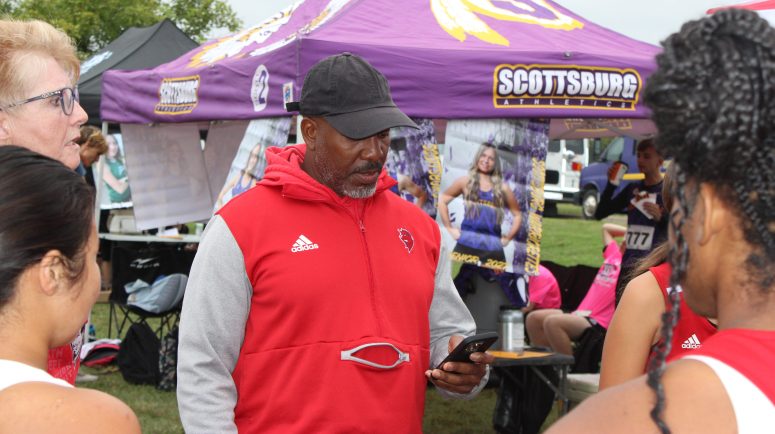
Cross country coach Carlis Phillips gathers the team at the Silver Creek Invitational on Sept. 22 to discuss times that they need to hit to get into the running mindset. “If you see someone, pass them,” said Coach Phillips. Photo by Isaiah Gatton.

His goal for the rest of the season is to get the cross country team in a competitive mindset, having the hunger to push past limits and barriers.

Phillips has also introduced new expectations for the team, including recommending runners purchase watches to track their mileage and implementing mile warm-ups and cool-downs. He views the season as an educational journey as he continues to guide the team.

“It is an educational thing, what a high performing cross country team looks like,” he said. “Just recently I recommended that they should invest in a running watch. Tracking is a big part of running. There are some foundation pieces that I’m implementing as well. Giving them information and knowledge about what a successful cross country runner looks like. I’m going to coach everyone in here like a champion. I do want them to be challenged, feel the tug and pull of what a successful runner looks like.”

With the change in coaching has come a change in training. Compared to previous seasons, runners have noticed more intervals, sprinting, and strength-focused workouts.

“We do a lot more intervals instead of just long-distance runs,” sophomore varsity runner Micah Nef said. “A lot of it is just focusing on speed work instead of distance.”

For some runners, the new training has been challenging but has provided an opportunity to develop different skills. Senior varsity runner Nathan Scovanner said he likes the balance between speed and endurance.

“I like that part, because we do need to build up some speed,” Scovanner said. “If we mix in both speed and endurance, we’ll become better runners overall, because we’ll have that speed and still be able to keep our speed going through our races.”

Junior Marcus Baker has also started to enjoy the new sprint-focused workouts. Having previously run sprints in middle school, Baker said the new practices have brought back something he enjoyed.

“I feel like every day when we’re on that track, he pushes us,” Baker said. “It feels good running sprints.”

However, not every runner has found the transition easy. Some athletes said they preferred aspects of former Coach Sam Mull’s approach, particularly his emphasis on endurance and the mental side of running. They are adjusting, though.

“I think it’s weird having a different coach, but it’s good to learn different things from multiple people,” Nef said.

Nef said her times felt faster when the team focused more on endurance training, although she acknowledged the new training has been more challenging.

Senior runner Lizeth Gonzalez said she sees value in both coaching styles.

“I like both of them,” Gonzalez said. “Whenever you do compete in a 5k, you do need the strength to push yourself. But at the same time, when you do long mileage, the three miles start becoming easier in a way.”

For Gonzalez, one of the biggest differences between Mull and Phillips is how they approach athletes mentally.

“Coach Mull taught us in more of a mental type of way, but also physical, and Coach Phillips is more of a physical type of coach,” Gonzalez said.

She said she would like to see the strengths of both coaches combined.

“I would enjoy having, of course, Coach Mull back, and have both of them as coaches,” Gonzalez said. “I know both of them could allow us to become better athletes because they both can focus on our weaknesses and strengths.”

The coaching change has also affected some of the traditions and activities that helped bring the team together. Nef said Mull was known for organizing additional activities that were not necessarily required but helped create connections among teammates.

“He was really good at getting things done and doing extra things that weren’t necessary,” Nef said, referring to activities such as a 24-hour relay that has been recently canceled.

Despite the changes, Nef said the team has remained close, with the team captain helping maintain that connection.

“We still have a good team captain, so we’re still close,” Nef said.

Other runners are looking toward what Phillips’s experience could bring to the program. Phillips’ background in track has given him experience working with athletes who specialize in speed, something that some runners believe could help the cross-country team develop.

“I do think so,” Scovanner said when asked if Phillips’s reputation would help the program. “I think it will bring some more people to the team, possibly. He also does have some experience, but cross country is a new thing to him, I’m sure that’s not going to affect him.”

Gonzalez also believes Phillips’s experience could bring more recognition to the program.

“I believe we are going to get more support,” Gonzalez said. “I feel like Coach Phillips has a good history with training athletes, sending them to state, and being able to train them. And I believe it will allow us to get a little bit more recognition as a team.”

For Scovanner, the transition has been a process. As a senior running cross-country for his second year, he said he initially had concerns about what the coaching change would mean for the team.

“At first, I was a little skeptical,” Scovanner said. “I didn’t know how everything was going to play out. I had a lot of doubts in my mind.”

As the season has progressed, however, Scovanner said he has become more comfortable with Phillips’s approach.

“I had faith, and so far, everything’s turned out really well,” Scovanner said. “I really like everything that’s been going on.”

While athletes have different opinions about the new direction, the team is continuing to adjust as the season progresses. Phillips’s emphasis on speed, strength, and competitiveness has created a different training environment, while runners continue to carry lessons from previous seasons.
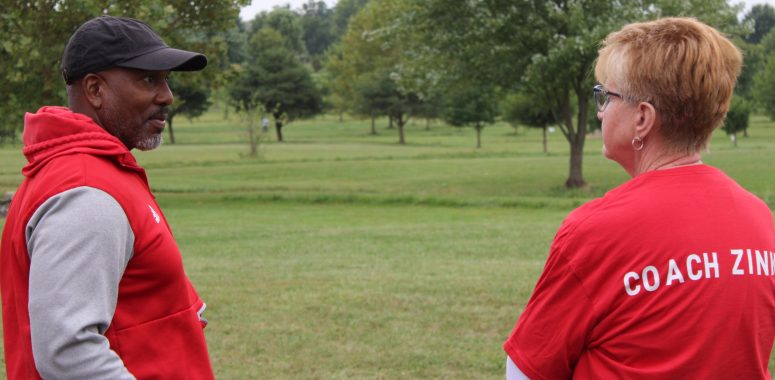
Cross country head coach Carlis Phillips and coach Kim Zink team up during the Silver Creek Invitational on Sept. 22. “We’re here to be competitive, start off strong and finish stronger,” said Phillips. Photo by Elijah Lahrman.

Cross country program seeks support as athletes continue to excel

Editor’s Note: This story was completed before recent coaching changes with the cross country team.

by Isaiah Gatton and Elijah Lahrman

As the cross country season continues, the growing team hopes for increased support and recognition.

Former head coach Sam Mull spent 21 years involved with the program, first as an assistant before eventually becoming head coach. As a former JHS runner himself, Mull experienced the challenges of the sport firsthand.

“So when I was here, I did every sport possible, but I was mainly a runner. I did football, did basketball, wrestled, swam, cross-country, and track, but I was a track runner, mainly,” said Mull.

Mull said cross country presents a unique mental challenge because runners are constantly competing against some of the best athletes in the state and the daunting fact that it’s running.

“This is probably the toughest mental sport that you’ll ever participate in,” he said.

He explained that unlike team sports, athletes advance as individuals, and ultimately how well they do depends on them. 

“If you’re a 100-meter runner, you’re not competing against 475 other teams in the state; you’re competing against a 1000 other kids in the state. And you’ve got to advance against those thousand each week and get knocked out and knocked out until you make it to the final, final level. It’s a very, very difficult sport to advance in,” said Mull.

While the sport itself presents challenges, Mull said the Jeffersonville cross country program faces another problem: a lack of recognition and funding compared with other sports.

“We don’t get recognized as much as other team sports, such as basketball and football. Results are often overlooked or discredited. And when it comes to funding for equipment, it’s often overlooked. And I’ve had to go outside the school on many occasions to get basic equipment that schools should provide for both sports,” said Mull.

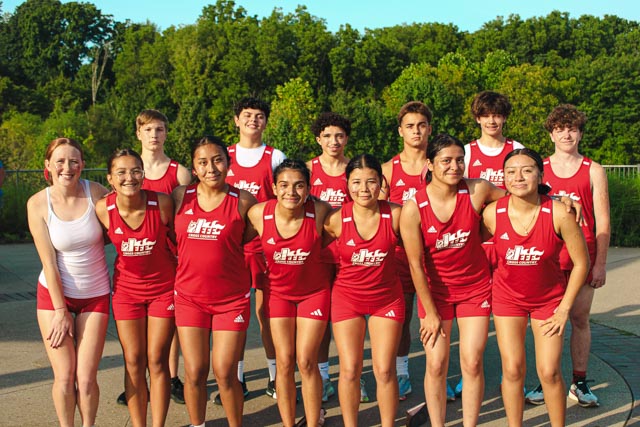
Members of the 2026-27 cross-country team pose for a photo before their first meet on August 15. Photo by Aby Lawson.

The lack of support is something athletes have noticed as well. Senior cross country runner Lizette Gonzalez said the team needs more support from the school and community in order to grow.

“The team needs more girls, more support from school, parents, friends, and others so we can thrive as a team. ‘Cause right now, our backbone is basically Mull. He’s the one that’s been getting us everything, either funding or fundraisers, or just paying out of pocket,” said Gonzalez.

Mull also had problems getting funding for his other sport, track and field, saying that the condition of the equipment isn’t up to the standard needed due to having the same hurdles for 30 years, and how the track itself is not up to the condition of other schools, suggesting that it may need to be updated to 8 to 10 lanes.

Athletic director AJ Moye said the JHS athletic programs often have to generate their own funding rather than relying on a large yearly athletic budget.

“We have to generate a lot of our own revenue. We have to generate a lot of our own funds to help out our students and help our student-athletes get better facilities, get better things,” he said.

Moye said the athletic department works to form partnerships with businesses and promote student-athletes both on and off the field.

“We show them our student-athletes; we show them not only what they do in terms of their athletic fields, but man, we show them in the classroom,” said Moye. “It’s not like every year I’m getting $250,000. So I have to go out and form partnerships, go out, market our student-athletes.”

Despite these challenges, Mull said there are positive signs for the cross country team this year. The girls’ team has grown, with Mull saying the program has more athletes this year than in any of his previous four seasons. The boys’ team, however, remains at around eight runners, a number that has stayed relatively consistent over the past few years.

“We have a lot of girls. Most girls I’ve had in the four years I’ve had the team. Boys, looks like we’re sitting at eight, which we’ve stayed at for the past couple of years, and I would like to see that grow, but we just continue to truck along with what we’ve got, keep encouraging people to come out,” said Mull.

For students who might want to try running, Mull encourages them not to discount themselves.

“It’s one of those things that you got to come out, and you just got to prove yourself day in and day out, and a lot of people find that maybe it’s not for them, but there’s another handful of those kids that also find out that it is very rewarding and they find out being much better than they thought they were,” he said.

With more students joining the team and greater support from the school and community, the cross country program has an opportunity to continue growing both on and off the course.

Junior Marcus Baker runs in the cross country team’s first meet of the season on August 15. Photo by Aby Lawson.

Junior Marcus Baker has been part of the cross-country team for three years and has contributed a lot of his efforts to the team, motivating everyone, showing up to practice, and overall being a figurehead. 

“I think cross country is a mental sport for everybody. I think it is good for people to go out and run. Get out all your personal stuff at home,” said Baker. “For me, running helps with my mental stuff, getting all my stress out.”

Baker looks past the fact that cross country can be a difficult and physical sport. Instead, he sees it as a way to decompress and hang out with friends. For him and many other runners, cross country is more than just a sport; it is also a way to improve their mental well-being and build relationships with their teammates. 

Funding is important for the continued growth of the cross country program, providing better equipment, uniforms, and transportation for the team.

“It would be cool to get some new uniforms,” said Baker. 

With more financial support from the school and community, the team could have more opportunities to improve, compete, and attract new runners. As the cross country team continues to grow each year, support from the community could play an important role in helping the program reach its full potential.

“The will to win means nothing without the will to prepare,” stated Mull.