by Tyler Conley and Parker Vibbert
In December 2024, the Indiana State Board of Education adopted new high school diploma standards, which will take effect beginning with the Class of 2029. These new standards will affect all current and future Indiana freshmen.
With the Indiana High School diploma remaining significantly unchanged for several years, the Indiana Department of Education aims to provide students with more work-based learning opportunities and increased chances to achieve their goals.
Engineering Academy counselor Whitney Roberts said the new standards are in response to employers’ increased need for employees who are ready to enter the workforce upon graduation.
“They are trying to get away from a college-focused curriculum, and instead are trying to keep up with employers that need a more ready workforce,” she said.
According to Roberts, the new standards feature a base diploma and three core principles.
“The new diploma splits, it’s three E’s: Employment, if you want to go to work after high school; Enrollment, if you want to enroll into a college, and Enlistment, if you want to go into the military,” she said.
“They are trying to get away from a college-focused curriculum, and instead are trying to keep up with employers that need a more ready workforce.”
Engineering Academy Counselor Whitney Roberts
Greater Clark County Schools wants to ensure that students meet their work-based learning goals while still enjoying extracurricular activities.
“Greater Clark County has purchased an online system to allow students who have lots of after-school commitments to still meet work-based learning goals for high school students,” she said. This should help students meet some work-based requirements through their extracurriculars.
Freshman Academy counselor Andrea Schedler explained that the biggest change from the previous diploma is that the number of credits needed for graduation has increased.
“The biggest thing is now it’s 42 credits instead of 40,” she said.
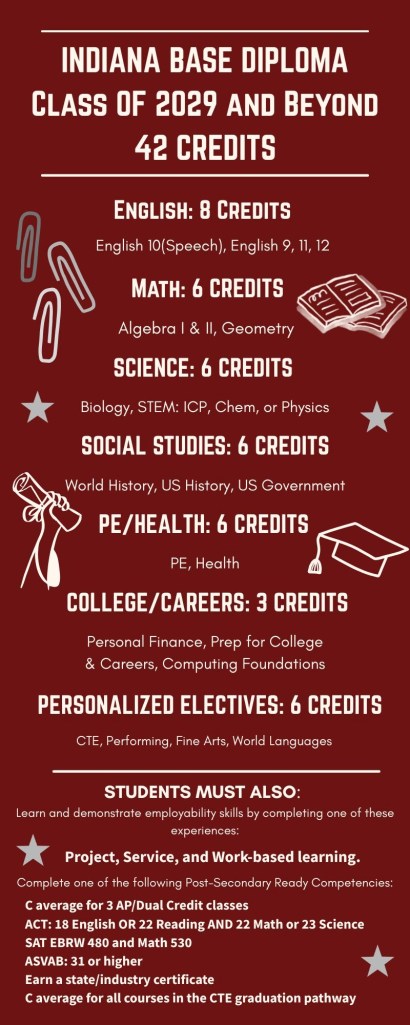
Indiana Diploma Standards have been well known as the “Core 40” for 15 years, since it took effect in 2011, owing to the now-outdated 40-credit graduation requirement. Before this, the diploma standards had not seen any changes in a decade.
Among these new standards, some classes have now been labeled as graduation requirements.
“For English 10, they are going to either take Speech or an advanced English class. Another big change is the College and Careers Credit, which, along with Computing Foundations and Personal Finance, has become a required graduation class,” Schedler said.
Prior to the new standards, College and Careers was not a graduation requirement, nor did Computing Foundations exist until this school year. Preceding Computing Foundations as the semester 2 successor to College and Careers, was Personal Finance, which has now become a required senior class.
Unlike the “Core 40” diploma, the new standards feature more honors academic options.
“In the old diploma, there was only the base diploma, academic honors, and technical honors. Now there are more options, like the honors seal and the honors plus seal,” Schedler said.
Each diploma (Enrollment, Employment, and Enlistment) have their own specific requirements to obtain the honors and honors-plus seals to ensure success in each field.
Schedler said that there are advantages and disadvantages to these changes, and they could put a lot of stress on students’ shoulders
“I think there’s good and bad. The good thing is that we give students more options, but the requirements for the honors plus seal for employment can be very difficult. It requires 650 work hours,” she said.
Public Service Academy Principal Chelsea Jordan elaborated on the difficulties of building direct relationships between students and their work.
“We’re going to have to work with teachers to find ways to build more career-driven, hands-on experiences in the classroom,” she said.
Principals and teachers alike are taking any step necessary to stay informed on the new changes to better help the students meet their goals.
“We’ve already spoken with our teachers about it and kind of brainstormed different ideas within the academies of how to make adjustments,” Jordan said.
Jordan, however, is more skeptical about the changes and how they actually benefit the majority of students.
“I think it’s a little extreme. You have kids in sports, or other extracurricular activities, and it can be hard for them to meet their diploma requirements,” she said.
College and Careers teacher Michael Moody believes giving kids more options other than enrolling in college is a benefit.
“College isn’t for everybody. One of my friends actually went into the military, and they paid in full for her college after serving for nine years,” he said.
Moody helped create the college and careers program at Jeff High and described it as a gateway into figuring out what teens would like to do during their high school careers.
“We have basic jobs that we’re supposed to do mainly to help you have an idea of where your skills and aptitudes match in the pathways,” he said.
With college not being for everyone, the new diploma also helps students realize easier paths to success in their future fields.
“Why should you go to a four-year college and spend tens of thousands of dollars to get a job when you can go and get training and you get started getting paid right out of school?” he said.
Ultimately, teachers, counselors, and the State Board of Education all agree that the changes to this diploma were made to encourage and support students to achieve their goals, whether that be Employment, Enrollment, or Enlistment.
 thehyphennews.com