by Areli Hernandez
Allison Clary is an English language arts teacher, whose strong character and passion for teaching has reflected through not only her ELA courses, but also through her Holocaust class where she conveys the importance of history to students.
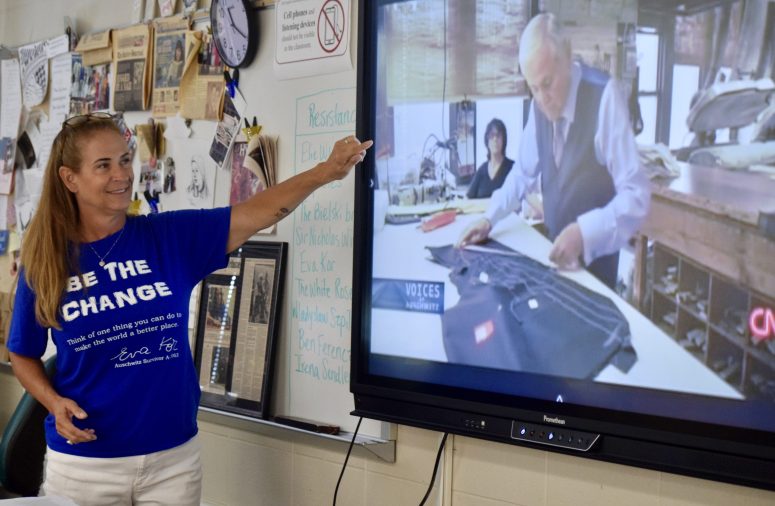
Clary acknowledges her former students, whose interests and curiosity led to the innovation of the Holocaust class, which was later introduced to JHS in 2007.
“The book Night; I taught that in my English classes; it’s about the Holocaust. It was so moving that my kids asked me if I could teach more around 2004. That’s how the ball got rolling. I give my kids the credit—years and years ago.”
Elie Wiesel’s book Night left a significant impact with its powerful message, creating personal connections among students, including Clary.
“That book specifically is about a teenager who ends up in Auschwitz. The main character was 15 years old. So, I think it was easy for them to relate to that and to think, ‘What if this were me?’ It’s a life-changing book for me — the horrors that they went through and how they survived.
“I felt like my kids could also identify with it.”
Clary relies on years of experience that have allowed her to teach all high school levels, along with teaching more than one course at JHS.
“This is my 34th year and I’ve taught all types of English arts. 9 through 12. Currently teaching 11th. Then, I have all of my elective courses; mythology and Holocaust.”
“History repeats itself; kids need to know what to look for. Kids need to know about the past because they are the future.”
English teacher Allison Clary
Senior Richard Morocho shared his previous experience in Clary’s ELA classroom, which later encouraged him to join her Holocaust class.
“I’ve been in this class since the start of the year. I joined it mostly because I like having her as a teacher last year. Also, because Holocaust is an interesting subject. She had a lot of experience with people whose relatives were in the Holocaust and survivors,” he said.
He highly mentioned Clary’s way of teaching and the reassurance she has given to her students to express themselves freely.
“Her opinions are really expressive whenever it comes down to bad things that people do now and how it’s influenced by the Holocaust. When it comes to freedom of speech, she is really vocal about that and we’re allowed to say what we want about that, too.”
Morocho added, “She gives us more freedom of the things that we can say and put our opinions on.”
He explained that this class has allowed him to learn history from a different perspective and encouraged students to join.
“All I can say is that they’re kind of missing out because it’s a really interesting and fun class to take. It’s not a book class, it’s an experience kind of thing. It’s really interesting stuff.”
Junior Andrew Hampton agreed with Morocho, explaining the significance of being a part of the Holocaust class, while also highlighting the engaging setting of the class itself.
“It’s a really relevant topic that we should be learning about. Her class is also engaging; it is the opposite of a boring class. There’s never been a moment when I’m not paying attention in that class. It’s too engaging not to.”
Hampton described Clary’s positive attitude and the bright influence she has made in her classroom daily.
“She is very happy to be here and that is very helpful. She makes you happy to be here as well. Her energy radiates, making it more engaging.”
Clary recalled moments where she witnessed students from different courses, personally connecting with her lessons and assignments.
“I see that all the time; I’m not going to lie. I do see it in Holocaust often, but I also see it in English. I think kids have connected with some of the stuff we’ve already done in class,” she said.
Hampton has found Clary’s lessons significant to both ELA and Holocaust class.
“For English class I enjoy the topics that she teaches. I enjoy reading the stories. Right now we are learning about Frederick, who was someone I didn’t really know about. For Holocaust class we are watching a movie right now and that movie is fire. It’s called ‘Resistance’. It’s a really good movie, honestly,” said Hampton.
Junior Lizeth Gonzalez is content with Clary’s contribution to help students succeed in her ELA class.
“I feel like she brings out specific people. People who we wouldn’t really mention in class. She tells a story and explains it to us in a way where we are experiencing it ourselves.”
Clary’s lessons have opened an interesting approach towards her ELA students. Gonzalez is satisfied with learning a new standpoint in history.
“I enjoy her lectures because it opens a perspective more whenever we talk about black history. Normally, in history class we talk about it but you don’t get into the depth of the history.”
Hampton emphasized the importance of learning history to avoid repeating mistakes from the past.
“So that we don’t repeat things. Most of our history is not good. I think that is the most important reason. So, that way we don’t keep repeating things over and over, and we become better.”
Clary agreed with Hampton, emphasizing the importance of students studying history to prepare them for the future.
“History repeats itself; kids need to know what to look for. Kids need to know about the past because they are the future.”
Clary’s impactful influence has stood out to many students at JHS, which is rewarding to her.
“There are many days that I feel like I shouldn’t be getting paid to do something that makes me feel so happy. I could’ve retired already and I don’t because I genuinely love doing this.”
She added, “I’m not sure if I know who I am, without being the teacher part of ‘Mrs.Clary’.”

 thehyphennews.com