by Jaxon Sturgeon
When Fred Cowgill walked into Jeffersonville High School, his first impression was simple: “A place that was very … what’s the expression? Best kept secret in America.”
Cowgill, who spent nearly five decades in TV and radio, including more than 30 years at WLKY, now leads the WJHI broadcasting program. But for him, the goal has never just been about producing future broadcasters.
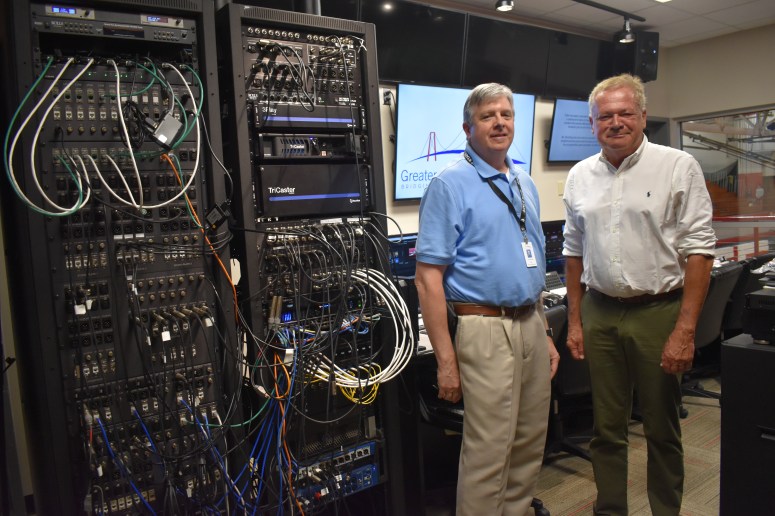
“We’d love it to be in broadcasting, but we believe what we’re trying to accomplish and teach goes well beyond that,” Cowgill explained. “Better people. Better people to function in society, better prepared for whatever they decide to do with their lives.”
Cowgill always reminds students that the studio isn’t just about lights, cameras, and editing software. It’s about building real world skills, responsibility, problem-solving, and collaboration that last far beyond high school. “We tell them we’re TV dads, and they’re stuck with us for life now,” he said with a laugh.
To him, what makes WJHI stand out is the family atmosphere they’ve built. “We tell them this is a safe place. If they’ve got a problem, come,” Cowgill said. “We’d like to make this a better program, a better school, a better community, and it takes time.”
Cowgill said he’s always looked at his time at WJHI through a “five-year window.” He knows he won’t be teaching forever, but in that time, his mission is to build something lasting, an operation that runs smoothly long after he’s gone.
“The goal has always been five years, because I’m not a kid,” Cowgill said with a laugh. “But in that time, we can make this a turnkey operation where we hand off to the next people, and they have a framework for what we’re trying to accomplish.”
That plan, he feels, is already beginning to take shape. Year one, he admits, was “flying blind.” But now, in year two, the vision is sharper. With the help of teacher Dave Callan, the program is really finding its rhythm.
“We’re establishing year one, we were flying blind,” Cowgill said. “But year two, we’re laying a foundation. The culture’s better.”
Students say they’ve noticed that shift, too. Robert Tucker, a sophomore in the program, said Cowgill has a way of pushing them without ever making the work feel overwhelming. “He’s tough in the best way.”
Tucker said. “When you know his background in broadcasting, you want to kind of rise to his level. It makes you work harder, but it also makes you care more.”
For him, though, it’s not the big projects that matter most. It’s the little things he sees in the classroom. “I see kids do something cool that I didn’t expect, didn’t see coming. Makes my month,” he said.
Kaden Westbay, another student in the program, said that encouragement sticks with him. “The smallest compliment from him feels like a huge deal,” Westbay said. “Because when he says you did something right or good, you know it’s legit coming from a guy who’s been doing this for what 50 years?”
What ultimately sets the program apart, Cowgill believes, is its connection to the real world.
“My 50th anniversary in broadcasting is Sept. 1. Forty-eight and a half of those, give or take, were in TV and radio. We know what works. We know what’s going on in the business. We know what to teach,” he said.
Cowgill’s mission is clear: build broadcasters, yes, but more importantly, build better people.
 thehyphennews.com