English teacher Justin Linde wants his students to be critical thinkers

by Kori Washington

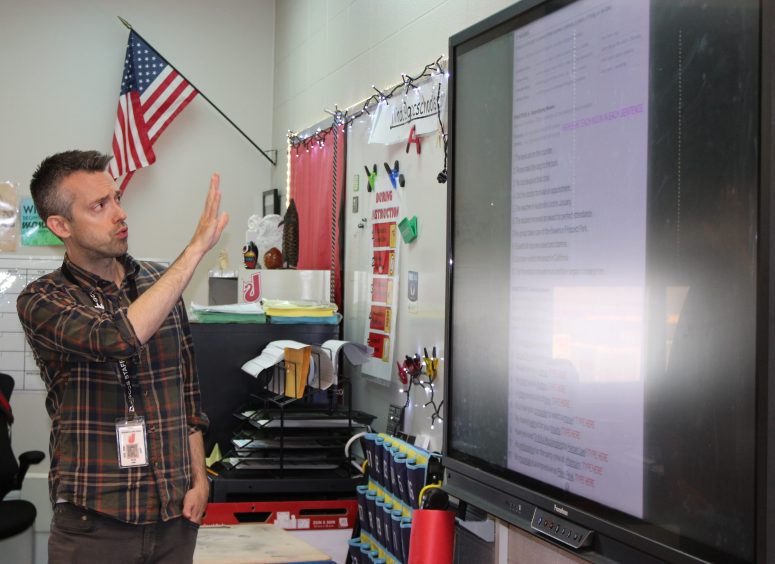
English teacher Justin Linde teaches his fourth-hour sophomore honors class the importance of nouns and grammar. Linde shared his opinion on visuals in the classroom, stating, “I always try to make sure there’s a video, that there’s some sort of visual element to my lesson whether it’s a video or whether we are looking at an image or work of art,” Photo by Aby Lawson.

For some teachers, teaching is something that they have wanted to do their whole lives. For others, it may take a little longer to figure out what they’re really passionate about. That’s the exact situation English teacher Justin Linde found himself in.

From a young age, Linde had always known that he loved English and literature, but once he got to college, that’s when he knew those were not the only subjects that he actually cared about. 

“I started realizing that I wanted to study more than just literature. I wanted to study more than just that subject. I did more than just literature. I wanted to study all the aspects. I wanted to know about the history, the historical context. I wanted to know about the cultural and artistic background of literature. And I realized that all of my interests aligned with philosophy,” said Linde.

Although Linde knew he loved philosophy and English, he questioned himself about pursuing his interests as a career path. So he continued taking classes at the University of Louisville, but he had limited time.

“I got a scholarship to attend the University of Louisville, so I went to U of L and declared myself an English major. That was my original major. For the first year or two, I was just taking my general ed classes, but I also took English classes,” stated Linde.

Linde recalls his love for philosophy started when he first began reading books about the subject early in his education.

“So probably in middle school, I started encountering philosophers, but it wasn’t probably until high school that I started reading philosophers and philosophy on my own,” he said.

But the one philosopher who stuck out the most was a German philosopher named Nietzsche, and Linde became interested in him because he felt he could relate to him. 

Although Linde had finally found his passion, his journey to pursue it wasn’t easy. 

“I was at U of L for five years, and I didn’t finish my degree. And I said, you know what, I’ve spent all the scholarship money, and now I have to pay for things on my own. So I was like, I can’t afford this. I’m going to take a year off, figure things out,” he stated.

During Linde’s year off, he moved to Indiana because his job offered him more pay. While moving, Linde decided that it was time to go back to school, so he transferred all his college credits to IUS, where he majored in philosophy.

“So I transferred my college credits to IUS and took all those missing classes that I needed, and I finally graduated with my bachelor’s degree in philosophy in 2013,” he said. 

Linde spent years thinking about what his next moves should be after graduating.

“After many plans fell through, I kept working at Meijer, and then finally, one day it dawned on me. Why did I never decide to teach high school? Because sometimes I dreaded going to school, but I loved the teachers,” said Linde.

Linde started taking an online program to get his license to teach, which took him two years, and later went back to get his master’s degree. Although Linde had finally gotten his dream job, his journey still wasn’t over.

“When I started teaching, the challenge was that I hadn’t been teaching, so I didn’t have the experience, and that was challenging because I felt they knew I just started, so they took advantage of that,” said Linde.

Although Linde saw the challenges of starting teaching later than other teachers, others saw it as an advantage because of his different perspective on things.

“Unlike many other teachers, Mr. Linde is fairly flexible about his daily curriculum; he is willing to adjust the assignments or lessons planned to better tailor the class to meet his students’ needs,” said senior Tristan Cooley. 

“Something that makes him stand out is how he goes through each assignment step by step and is very patient and understanding with his students,” said sophomore Jonayazia Dickerson. 

Starting his teaching career later in life gave Linde a different perspective on how he teaches his students.

“I like to introduce some of the other philosophers to my students. I think that makes me different because I want to teach kids how to think like philosophers and I want them to focus on philosophical big ideas,” he said. 

Before making his way into teaching high school students, Linde gained experience that helped him understand how to work with students and their different emotions and  personalities.

“In customer service, you often have to deal with angry customers. and I think you have to learn how to deal with conflict and conflict resolution, and that transfers to the classroom. Because when students are struggling or having personal problems that spill out into the classroom. And as a teacher, you have to learn how to manage that,” stated Linde.

While his past job taught him how to handle conflict and work with different personalities, becoming a teacher came with other challenges. Linde also found support from teachers who helped him along the way.

English teacher Allison Clary complimented Linde’s challenging coursework, adding, “He’s quickly learned how to assign that right work for certain students, and he’s so brilliant that now he’s teaching AP and honors and I know that he just really works on it to keep difficult while also being manageable.”

“Ms .Clary really became a mentor for me,” said Linde. “She helped me out a lot. I went to her and I asked her questions and she really supported me and helped me.”

With Clary’s support, Linde had someone to guide him in the right direction as a new teacher.

Clary’s advice helped Linde realize that not all students learn the same way, so he’s been adapting his lessons to meet all students’ needs.

“Students learn differently. So I try to incorporate all types of learning. Some are visual. Some need to write. Some need to speak out loud. So I would say what makes me different,” he said. 

For Linde, making learning more accessible is only part of what he wants to accomplish. His main goal is to teach students how to become better thinkers.

After years of searching for a career that felt right, Linde finally found his passion, and now he hopes to leave his students with the reminder to always ask questions and think like a philosopher.

“We’re here because I want students to become critical thinkers. And that’s the goal,” said Linde.
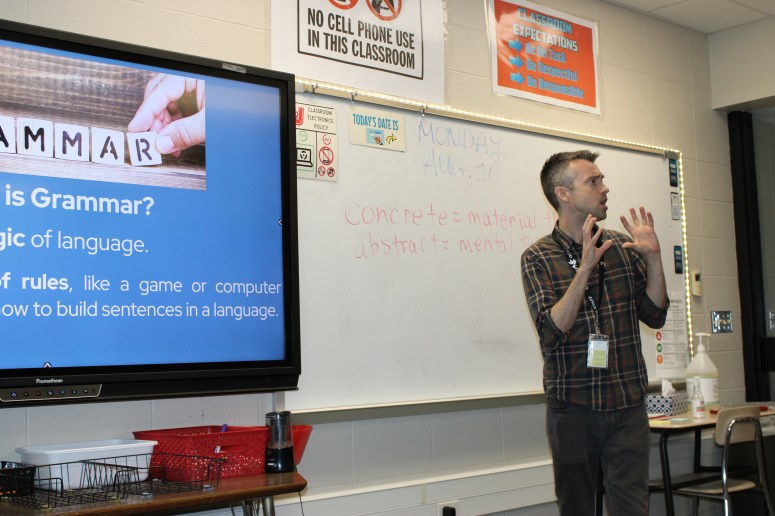
English teacher Justin Linde teaches his fourth-hour sophomore honors class the importance of nouns and grammar. Photo by Aby Lawson.

Kentucky fans react to new football coach

by Sophia Waldridge

After 13 seasons Mark Stoops brought historic stability to Kentucky and led four 10-win campaigns in 2018 and 2021. He also showed the team eight consecutive bowl games and two top-25 finishes. But after too many losing streaks and a 41-0 loss to Louisville on Dec. 1, Kentucky fired him. Will Stein is the new Kentucky coach.

Many Louisville fans are happy because they want real change and challenge. Senior Kaeleb Hayes, who is a die hard Louisville fan, said that Kentucky “needed to do it” and that the team would be “better off without Stoops and the team will get along so much better with the leadership and the stability of Stein.”

But others do not agree with Hayes and think that Stoops should not have been fired. Sophomore Eli Tate, “I think that we will have better prospects but at the same time he was a good coach and I don’t think that this one game should have caused him to be fired.” 

Sophomore Cali Smith agreed with Tate and is also a Kentucky fan; she said that the team will have to come up with new critical thinking skills and “learn to adapt with a new coach with different teaching styles.”

Freshman Harper Gordon also said that the Wildcats will have to adapt and thinks that it was a good thing because “Stoops has been a bad coach for three years and gave us a horrible season.” She said the new coach Stein is better for the team because he will push them harder.

Kentucky fans aren’t too happy, but most of them are rallying for the new coach and can’t wait to see how he trains the team differently and if they’ll get any better under different and new leadership.

Students prepare for Thanksgiving traditions

by Sophia Waldridge

When Thanksgiving starts rolling around every student gets excited; it’s the time to eat, go on a week long break from school, and see family.

Many families have traditions for this time of year, and it’s different for many families across Indiana.

 Senior Kaeleb Hayes said that he and his family go to some type of sports game before he goes on fall break as a tradition, and that they don’t decorate but that he helps his mom cook and they prepare a big meal.

“For Thanksgiving we watch the NFL games and my mom makes a lot of food for my brother and sister to come in from out of town.” 

He said that they also prepare a meal for their chickens as a tradition and he is excited for the extra days off school and to see his siblings.

Junior Billy Wibbels is similar to Hayes and for Thanksgiving he hangs out with his family and friends. 

“We don’t really decorate, we just make a huge dinner and all hang out. My grandpa comes to town from Florida and we all just reminisce.”

But some have very different traditions and don’t do anything for Thanksgiving, like sophomore Gracie Harder. She said she just spends Thanksgiving break cleaning her room and doing a self care reset, and spends most of the break alone until later into Thanksgiving day and she goes to her grandma’s.

“For break I always spend it all alone until I go to my grandma’s late on Thanksgiving day and we eat a big dinner, and we decorate the Christmas tree; everyone who comes brings a dish and I like to bake sweets and bring them, but other than that my family doesn’t do anything special.”

Freshman Harper Gordon said that her and her family just treat it like another day — they watch Christmas movies together and make a meal together but other than that they have no traditions and the plans change every year.

“My family sometimes makes a little turkey and we turn on Christmas movies but there are some years that we just don’t do anything, a few of my family members come over but only three or four.”

So many families eat together, spend time together, but not all decorate or have traditions. There are some that don’t do anything and just spend the day alone, or just eat a regular dinner like every other day.

Freshmen plan now for their futures

by Hailey Craynon

In 10 years from now, everyone will be off doing their own thing. What are you going to do? What makes you want to do this? How committed are you?  Where do you see yourself?

Freshman Kyra Gibson said, “I want to be a criminal investigator. I want to be a criminal investigator because I want to understand why criminals do the things they do, and I’m planning to achieve this by staying focused in school and graduating from a good college.”

Gibson has been passionate about being a criminal investigator since she was in sixth grade, as she found it exciting and interesting.

“I have always watched documentaries with my mom and tried to solve them, and it got me into criminal investigations.”

Some students are interested in nursing.

Freshman Makhia Hall said, “In 10 years, I see myself figuring out what college I want to go to so that I can study for a nursing degree, and I’ve always been good with kids and just people in general. I’m going to achieve this by getting good grades, making sure my GPA is high, and paying attention more in classes.”

Some think nursing is maybe too hard and they give up on a dream, but Hall said to “focus on the impact you will have on patients’ lives and never give up.”  

And while some freshmen do not know exactly what they’d like to do in the future yet, they still plan to make the most of high school.

Freshman Serenity Dees said, “In 10 years, I would probably be either in or graduating college, hopefully with a job of some sort and living with a friend or on my own. To achieve that, I’ll need to keep my grades up and graduate from high school in the pathway I plan to pursue.”

Some people are uncertain what they want to do with their lives when they’re older, and that’s okay. They still plan to have a fun and sustainable life.

Freshman Tryston Looney said, “I see myself in 10 years in a nice house, and I’m planning to be a police officer because I have always wanted to be one. I plan to achieve this by saving up money and working hard. I want to do this so I can live a happy and decent life in the future.” 

Some may have a dream and think it’s too hard, or that they will never make it, but “fight strong and never give up on your dreams,” said Looney. 

No matter how challenging their dreams are, most freshmen plan to never give up on their dreams.

Faculty, students share their modern day heroes

by Gabriella Kraft

Everybody has a modern-day hero. Whether it be a family member, a famous artist, or a poet; they have one. For Spanish teacher Suzanne Padron, her modern-day hero is her daughter. 

“My daughter is the hardest-working person I know. She works harder every day to grow her career, of which she has two, and never fails to stand up for what’s right,” said Padron.

She first realized her daughter was her hero in 2020, during the Black Lives Matter protests, because despite her not being in great physical condition, she kept going back to continue protesting.

“She continued to protest every day, even after she broke her foot, even after being hit with tear gas, even after being shot at with rubber bullets; she went back the next day to continue protesting,” Padron said.

Sophomore Kahlani Hunts modern-day hero, was very present in most of her childhood movies, Lin-Manuel Miranda.

“He is in a lot of my childhood movies, and his songs just bring me a lot of nostalgic memories. I first discovered him when I was nine years old in Moana, that’s when I first realized he was my hero,” said Hunt.

“His songs bring feelings of joy because his songs remind me of happy childhood memories, and sadness because the lyrics in his songs are so heartfelt they bring me to tears,” said Hunt.

Biomedical teacher Charles ‘Brian’ Patton’s modern-day hero is a bit more personal — it’s his father.

“He is my hero because he is everything I would want to be as a man, father, teacher, and person. He’s been my hero for as long as I can remember,” said Patton

For sophomore Rachel Ledbetter, her modern-day hero is the very famous author Kristin Hannah.

“She’s my hero because her books touch on important topics people should be more informed about. I was first introduced to her when I read her book ‘The Great Alone’ last year. I also read her book ‘“’The Nightingale’, which brought me to tears,” said Ledbetter

Chemistry teacher James Huffman’s modern-day hero is the ex-football player Dan Marino, whom he grew up watching.

“He is my hero because I loved the Miami Dolphins growing up, and I always wanted to be a quarterback even though I was a running back. I remember first watching him when I was 5 or 6 ‘til the time I turned 18,” said Huffman. 

 Sophomore Alia Griffith’s modern-day hero is a little closer to home, as it is her mother.

“She teaches me to be the person I aspire to be in the future. She’s who I looked up to my whole life. And that hasn’t changed as I’ve gotten older,” said Griffith.

For English teacher David Kummer, his modern-day hero is Greta Thunberg.

“For her to speak out about what she cares about, and not just environmental stuff, but also the genocide in Palestine, even when she put herself in danger, made me admire her,” said Kummer.

He first heard about her when he was in college and she was in high school because it was at that point that she started getting popular for how outspoken she was.

“I heard about her through social media, specifically about her environmentalism, and I thought it was cool that a high schooler was so outspoken about that,” said Kummer.

Everybody’s modern-day hero is different. They all carry various emotions, different people, and different goals. Our hero reflects on who we are as a person.

Waves of Music

Music in the classroom can enhance student learning

by Dana Romero Regalado

Music is often viewed as a controversial topic; some question whether it should be included in the classroom or prohibited. Many see music as a distraction or unethical to have at a school, when it’s supposed to be a learning experience and environment for many students. 

“I think it helps them, again, to improve their pronunciation. It widens their knowledge of vocabulary,”  stated educator Megan Cortez.

Additionally, incorporating music into the classroom can further strengthen these skills. Music provides students with exposure to authentic language use, offering rhythm, tone, and repetition that aid in mastering correct pronunciation. It also introduces new vocabulary in meaningful and memorable contexts, allowing students to expand their language skills in an engaging way.

By integrating music into lessons, teachers can create a more dynamic learning environment that motivates students and supports long-term retention, according to Cortez.

“Yes, I do believe that music helps me strive to learn because it reduces stress as I listen to mostly calm songs, and it helps my brain process information more easily instead of shutting down under pressure,” stated sophomore Zihan Lin.

Music also serves as a powerful aid in reducing stress and enhancing students’ ability to process information. By creating a soothing and supportive atmosphere, music helps alleviate the pressure often associated with academic settings, allowing students to approach learning with a clearer and calmer mind. This lowered stress not only improves focus but also strengthens memory retention. Moreover, the rhythm and structure of music stimulate cognitive functions, enabling students to organize and internalize new information more effectively.

“Music has the potential to help students succeed in school, build self-confidence, and create leaders and well-rounded young people,” according to the Save the Music Foundation, a charity program that supports students by providing schools with instruments, training, and resources.

Music not only enriches academic performance but also strengthens essential life skills. When students engage with music, whether through playing an instrument, singing, or analyzing lyrics, they learn discipline, patience, and teamwork. These skills translate beyond the classroom, preparing them for real-world challenges and opportunities.

By fostering creativity and emotional expression, music also provides a healthy outlet for stress, allowing students to balance their mental and emotional well-being with their academic responsibilities.

“Yes, I believe music helps me strive to learn more because some songs just hit, and they make you study more, rather than just not listening to anything because I usually don’t like studying, but with music, it makes me want to study more,” said freshman Diego Hernandez.

Music can also serve as a powerful tool to enhance concentration and productivity while studying. The rhythm and melodies of certain songs can create a stimulating environment that keeps the mind engaged and reduces boredom. Instead of viewing studying as a tedious task, music transforms it into a more enjoyable experience, allowing students to remain focused for longer periods of time. This positive effect on motivation can ultimately improve both learning efficiency and academic performance.

“Music helps me express myself because it shows what kind of person I am without directly telling the other person. And it could also express my feelings. For example, if I’m listening to happy music or upbeat music, then you could assume I’m happy, and if I’m listening to sad music, then I could be sad. Music helps me in a lot of ways. I personally enjoy music. I can’t go a day without listening to music. Music soothes me, it helps me relax, and puts me in a good mood. Listening to your favorite music helps you calm down/relax, and the good thing now is that you can listen to music anywhere with a portable device,” said senior Luis Reb.

In addition to reflecting emotions, music also serves as a universal language that connects people across different backgrounds. It can communicate feelings and ideas that words sometimes cannot, creating a deeper understanding between individuals.

Whether through shared playlists, concerts, or simply enjoying the same song, music builds bonds and brings people together. This ability to both express individuality and foster connection makes music an important part of daily life and personal growth.

Musical interests connect teens, keep them in tune with emotions

by Noah Lopez Salazar

“It just makes me feel like I’m not alone or lets me know that people out there are also going through things in their lives.” 

This is what sophomore Jayliana Burris thinks about music and what many other students consider about when listening to music. They agree that music gets them in tune with feelings and emotions.

“Music means a lot to me and without music I don’t think I could get through some days,” said sophomore Chimamanda Chidi-Okorie. “Music definitely changes my emotions, mostly in a positive way and it helps with my anger and distress, which has made me more of a calm person.”

Some students relate to specific artists, which makes them feel understood.

“Central Cee is British, so I like how he’s different from other artists, and both Sza and Frank make very relatable music that I can feel to,” said Burris. 

Music means a lot to listeners, especially because of the artists that write lyrics in meaningful ways which help teens relate to the music they’re listening to. 

“I listen to Ariana Grande, Sabrina and Laufey as well; the reason why is because it gives me a warm, comforting feeling when I listen to them,” Chidi-Okorie stated.  

“Music takes me away from real life some times,” added senior Jezel Garcia.  

Garcia agreed with Chidi-Okorie that music brings people together with artists they share in common, or as an icebreaker to help get closer with other people. 

“I let people pick what songs they want to listen to while driving so I get to know them more,” said Garcia.  

Even freshmen rely on music to cheer them up. 

“It gives me somewhere to connect my feelings to so that I know I’m not the only one who has felt what I am feeling currently,” said freshmen Sanina Robinson. “Lyrics hit close to home and bring me memories.”

Robinson said lyrics and style of songs help connect people with similar musical interests.

“I listen to lots of popular and common artists; I feel like lots of people listen to my music,”  added Robinson. “Music cancels out what I feel normally and it is kind of like a background thing to keep me grounded.”

No matter the age or grade, music will always affect and impact teenagers. 

As Burris said, “Music is a kind of way of expressing yourself and it’s something that means a lot  to some people, but it’s something that everyone can do or make.”