by Liddia Waterbury
Not all comets follow the rules.
3I/ATLAS is an interstellar comet from another solar system, discovered in July 2025, and is the third ever found in ours.
Normally, comets only form a visible coma when sunlight melts their ices and compounds, but 3I/ATLAS developed one far from the sun, leading some to speculate it might be an alien spacecraft. Even though it isn’t, and there is evidence to prove it.
3I/ATLAS has a normal gravitational motion, meaning its orbital path is simple. There are no signs of an artificial thrust or course changes.
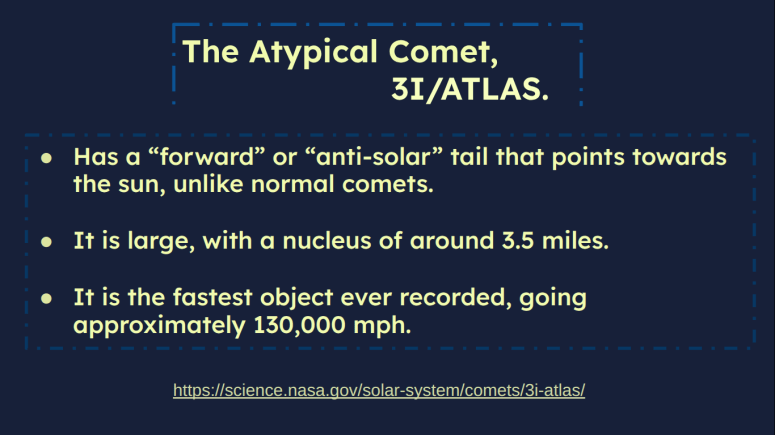
As well as a normal gravitational motion, it also shows normal cometary activity, as the formation of a coma and tail is a natural reaction to the sun’s heat. It is not something you’d expect from a solid, artificial object.
Studying 3I/ATLAS’s abnormal qualities can inspire teenagers and young adults who enjoy space science. It can also help us uncover new evidence about other solar systems and the wider universe.
When I was little, maybe around three or four, I went to my stepmom’s aunt’s house for a party. I can’t remember what kind of party or how long I was there for, but I remember how big the house was.
In the living room, there was a ladder that led to a loft with a window. My step-siblings and I climbed up the ladder and found a telescope. One of my older cousins was looking out of it and helped us see out of it, too. I remember looking out the telescope and seeing the stars and the moon. I was astonished by the beauty of space.
When I heard about this unusual comet, I immediately thought of this memory and how much space interests me.
This comet can also bring new interests to us teenagers.
Since the comet came from another solar system, it shows that our solar system isn’t isolated. Learning more about 3I/ATLAS could inspire us, young people, to study astronomy and space science.
Not all comets follow the rules, and 3I/ALTAS is one of them. Its unusual coma and path show how surprising space can be. Discoveries like this can inspire teens to look deeper into space.
 thehyphennews.com