Me being a daddy’s girl, I never thought in a million years that my first heartbreak would be my father. With everything I’ve been through, this one hurt me the most
It was during a normal scorching hot Sunday. My cousins and I were upstairs playing in the playroom, and I suddenly heard a loud knock at the door; my stomach dropped. We all ran downstairs and to see who it was – it was the police. All the family, including my dad, were downstairs having family time playing cards and eating. My nana opened the door, and they asked for my father. At this moment I knew that he was going to leave, but I didn’t know why. At this time I was too young to know.
Everything hit the fan when the police said, “I’m sorry ma’am, your son has to come with us.” I cried in confusion, not understanding what was going on. I asked my aunt if he was coming back, and she said yes. Years later I felt lied to, because he didn’t come back when I expected him to. I fell into depression at the ages of 7-14. I never thought that him being incarcerated would affect me that much.
It hurt me the most because I knew I couldn’t be with him physically and him missing most of my childhood left me hurt. Falling into depression affected my relationship with my mother. We were bumping heads, and nothing just seemed to work out. All the arguing, fighting, and commotion – it was too much for me to handle. My heart was broken, and I knew that only my father and God could pick up the pieces. While my father is still locked up, he and I still remained close and he slowly picked up my pieces.
My dad helped me grow into the person I am today. He helped me get through all my problems, and he never judges me. He’s always open ears.
What I learned from this particular situation is that even though times can get hard or something traumatic happens in your life, you still continue to push, fight, and be strong. Don’t let anything affect you or change you into a person that’s going to destroy you. You do have a purpose in life. You are here for a reason, and God’s creation is no mistake, so cherish your life and what you have while you can. Know that your story is your testimony.
You could ask me the simplest question, and it might take me a few minutes to answer. And I always think of the worst that could happen. Sometimes I jinx myself because it does end up happening. That’s why I stick to activities that are within my comfort zone — so I don’t have to stress myself out. Still, sometimes I think that my anxiety is what holds me back from gaining new life experiences.
But that’s not even the worst part about it. My anxiety has also caused me insomnia, which has played a big part in my life, especially when I was younger. I remember my fourth-grade year. My grandmother had passed away, and that really took a toll on me because she was my best friend. So that summer was the first time I started having sleeping problems, and that was also the year I had my first depression episode.
I can remember it like it was yesterday – the long nights, the feeling of nothingness, and the worst part of it all was that I lost interest in activities that I used to enjoy. For example, I didn’t go outside anymore to play with my sisters or friends, and I just stayed in bed all day, even though I couldn’t sleep. I had no motivation to do anything else. However, after a few months of feeling that way, I finally got the help I needed, and I went to talk to someone.
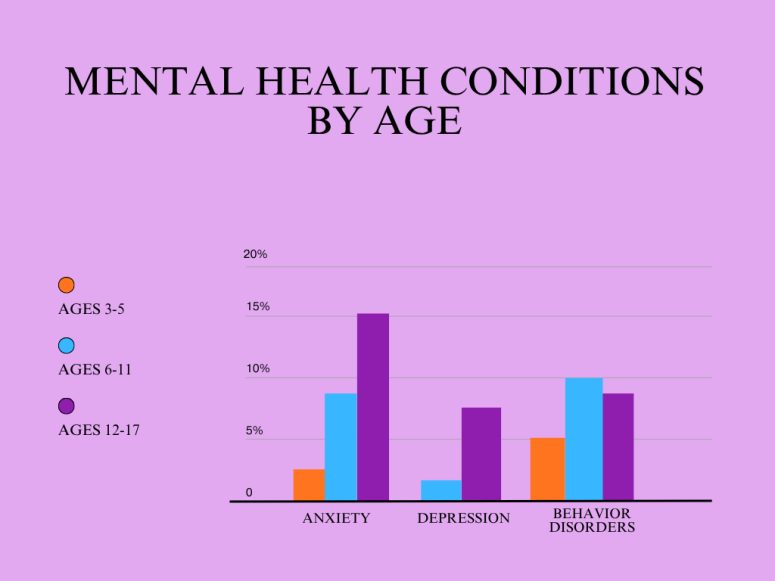
But the crazy thing is, to this day, some people believe that teens shouldn´t have anxiety because they think that teens don’t have enough life experience to be unhappy or stressed. But according to the World Health Organization, “One in six people is aged 10–19 years. Adolescence is a unique and formative time. Physical, emotional, and social changes, including exposure to poverty, abuse, or violence, can make adolescents vulnerable to mental health problems.”
This proves that out of all people, we teens have the most to worry about. We have to worry about our looks, grades, and social life while also planning for our futures.
But if we don’t worry about these issues, then we’d be irresponsible and unlikable, which causes us more stress because everyone wants to be liked, and if someone tells you they don’t, they’re lying because every person wants to feel loved or cared for by someone.
In the end, my experiences with anxiety have taught me that it’s okay to feel overwhelmed and that it’s a common struggle for many, especially during our teen years. While I often overthink and worry about the worst outcome, I’ve been working on trying to see the better side of life.
It’s important to remember that everyone faces our own battles, and that reaching out for support is okay. By doing this, I’m starting to try new experiences, one step at a time.
In today’s society, the growing amount of hate directed at Christians is a troubling issue. Many people, especially younger individuals, experience discrimination and unfriendliness based on their faith.
This bitterness often stems from misunderstandings and stereotypes that paint Christians in a negative light. Whether it’s derogatory remarks in schools, exclusion from social circles, or targeted harassment on social media, the impact of this hate is profound and damaging. It not only affects the mental well-being of those targeted but also contributes to a culture of division that undermines our collective humanity.
Furthermore, the picture of Christianity in mainstream media often extends negative narratives that fuel the hate. Exaggerating stories that focus on radical behaviors overshadow the values of compassion, love, and acceptance that are central to the Christian faith. As a result, many young Christians feel excluded and isolated, battling a struggle to claim their identity in a society that sometimes seems unaccepting.
“Let’s commit to supporting one another, embracing our differences, and creating a culture where kindness overrules hate. Only then can we hope to bring a future where everyone feels safe and valued, regardless of their beliefs.”
It’s essential for all of us—regardless of our personal beliefs—to challenge these narratives and promote a more balanced understanding of what it means to be a Christian today.
To counter this growing hate, we must build an environment of open dialogue and mutual respect. Schools, communities, and even online platforms should encourage discussions that promote understanding and empathy. By standing together against intolerance, whether it’s directed at Christians or any other group, we can build a society that values diversity and encourages acceptance.
Let’s commit to supporting one another, embracing our differences, and creating a culture where kindness overrules hate. Only then can we hope to bring a future where everyone feels safe and valued, regardless of their beliefs.
We are actively destroying our planet and we need to stop.
As someone who wants to go into marine biology, climate change with animals is a very important topic to me and should be to you, too. Thinking about it now it doesn´t seem to matter but this is the plant we are inheriting. Over 100 million ocean animals die in a year. On average that’s 227,777 per day.
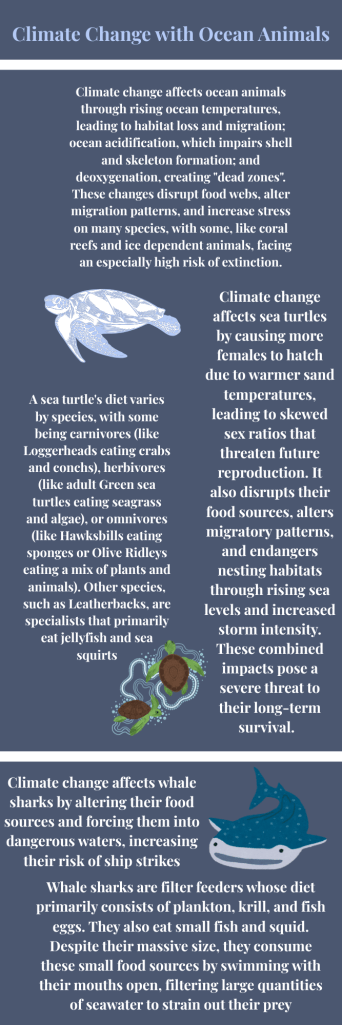
Graphic by Harper Gordon.
How does climate change affect ocean animals? Specifically whales and turtles?
Climate change affects ocean animals through rising ocean temperatures, leading to habitat loss and migration; ocean acidification, which impairs shell and skeleton formation; and deoxygenation, creating “dead zones.” These changes disrupt food webs, alter migration patterns, and increase stress on many species, with some, like coral reefs and ice dependent animals, facing an especially high risk of extinction.
Whale Sharks
Climate change affects whale sharks by altering their food sources and forcing them into dangerous waters, increasing their risk of ship strikes.
Whale sharks are filter feeders whose diet primarily consists of plankton, krill, and fish eggs. They also eat small fish and squid. Despite their massive size, they consume these small food sources by swimming with their mouths open, filtering large quantities of seawater to strain out their prey.
Sea Turtles
Climate change affects sea turtles by causing more females to hatch due to warmer sand temperatures, leading to skewed sex ratios that threaten future reproduction. It also disrupts their food sources, alters migratory patterns, and endangers nesting habitats through rising sea levels and increased storm intensity. These combined impacts pose a severe threat to their long-term survival.
A sea turtle’s diet varies by species, with some being carnivores (like Loggerheads eating crabs and conchs), herbivores (like adult Green sea turtles eating seagrass and algae), or omnivores (like Hawksbills eating sponges or Olive Ridleys eating a mix of plants and animals). Other species, such as Leatherbacks, are specialists that primarily eat jellyfish and sea squirts.
As a person going into marine biology this is a big issue to me. We live our normal everyday lives acting like our earth isn’t crumbling and it is not acceptable. As an adult I plan to attend UCLA. So I can be the change I wish to see.
We can and should all work together and be the change.
The impact social media has on up-and-coming athletes
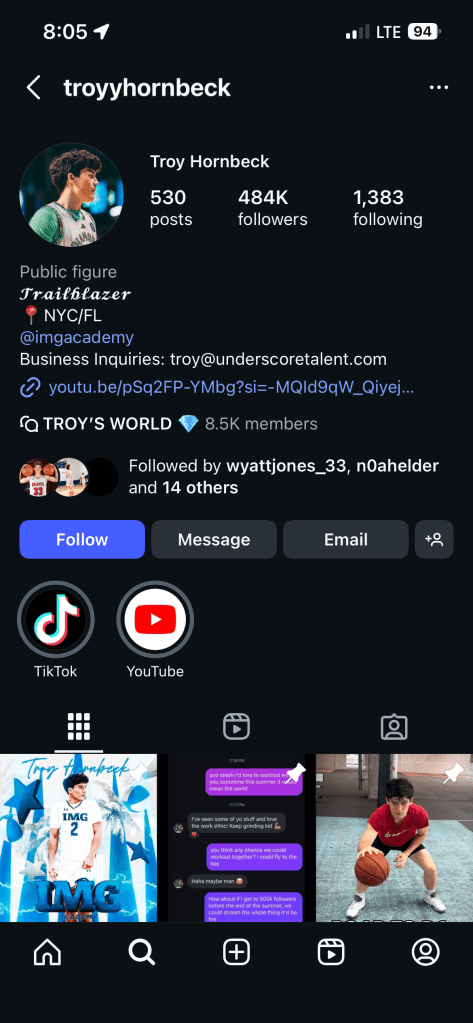
From being an unknown hooper to now having a combined 600,000 followers across TikTok and Instagram sounds ridiculous. That’s exactly what undersized class of 2026 guard Troy Hornbeck did in the span of a few months.
In his videos Hornbeck has a series called “Road to D1.” Here, Hornbeck posts the day in the life of someone trying to make it to the Division One level. Being at the height of 6 ‘2 Hornbeck everyday makes sure he puts himself out there for college coaches all over the world to see.
Hornbeck is a great example of why social media can change athletes’ lives for the better.
Another basketball league that’s generating major buzz all over social media is the new league located in Atlanta, Georgia called “Overtime Elite.” Overtimes’ whole goal is to boost an athlete’s rep and get them in front of the eyes of the biggest and best coaches in the world.
Overtime has accumulated 1.3 million followers on Instagram alone. Their media has set their high school athletes up for major success on the court and financially with the minimum salary being $100,000 a year. NBA players Amen and his twin brother Ausar Thompson have roots with Overtime. This is an example of how putting yourself out there can help you play at the highest level like the Thompson twins.
Also, the use of social media for young athletes teaches them core professional values.
True sport
Social media with athletes boost a player’s name, image, and likeness.
Athletes can keep up with the professional athletes in their respective sport and learn from the people at the highest level.
More opportunities for coaches to easily access your highlights and learn more about you.
So, the next time you see Hornbeck’s “Road to D1” vlog or you look on Instagram and see Overtime hosting the best high school athletes in the country, know that these athletes are setting themselves up for a bigger and brighter future.
There’s a problem. Well, at least for me there is. Maybe people will agree with me. There are so many problems in today’s world that many don’t even realize that this is a problem. We don’t even realize what is actually going on behind closed doors.
Oh, here we go. Not again. One after another. Problem after problem. Am I the problem? What did I do wrong? Always asking myself what is wrong with me. Why am I not loved? House after house. Family after family.
Why can’t I have a family?
I know I’m not perfect, but I don’t deserve this. Holding on to hope that I will make it out. Call after call. Picture after picture. Hoping one day someone will help me. Why won’t my case worker help me? I called. I have proof. Pictures, videos and even recordings. Still nothing. I’m still stuck.
Being a foster kid is not for the weak. In today’s world the foster care system is so corrupt. Children and teens today are put in situations that no one should be put in. Some people are just not meant to be case workers. Or foster parents.
One of the biggest issues is the lack of oversight and accountability. When case workers are overburdened or just simply not doing their jobs properly, it can lead to children and teens being placed in unsafe or neglectful homes. The system needs to be doing more checks and balances to ensure that children and teens are being protected and that foster parents are providing accurate care.
Additional checks and balances will help children and teens that are in danger. Not everyone has or had a bad home. Or maybe even a bad case worker, but I did. I wasn’t allowed to eat when I wanted. Shower when I wanted. I had to ask for toilet paper. I wasn’t allowed to have a roll. I wasn’t allowed to shut my door. Not even to change. I had to use the bathroom to change. These were just some of the major rules I had.
Many people don’t realize how foster care can really be. They don’t talk about all the little issues inside the home until you’re in the home. They also don’t mention how foster siblings can be, either — from stealing our belongings to giving them away. Sleeping in your bed. Using your personal belongings as theirs. To physical fighting, to late night arguments, it seriously never ends.
This is why I think the foster care system is corrupt because of the experience I had. Calling for help and being ignored. There are so many children and teens that struggle from the same experience I had. It’s not fair. It’s not fair that children and teens are getting abused mentally and physically because the foster care system has failed to provide them a safe and loving home.
Children and teens have resources like school or a trusted adult. There are many resources to reach out to. It’s important to speak up, even when it’s hard. Being in the foster system doesn’t mean your voice isn’t heard. You just have to find the right resources to help. Living through a difficult experience doesn’t mean you have to have a sad story.
I’m not a sad story. I went through something traumatic, but holding on to the past wouldn’t help me move forward. I have good grades now. I have a job. A future, even after going through that traumatic experience.
My favorite quote is, “Never be a prisoner of your past; it was a life lesson not a life sentence.” I carry that around with me everywhere. I sit and think about the lessons I learned instead of holding on to what happened in the past.
It can get better. Reach out to those around you. Check up on them. You never know what someone could be experiencing.
If I have one operating philosophy about life, it is this — life goes by so quickly. Without realizing it, you just look up in the time already past you.
“Life moves pretty fast; if you don’t stop and look around once in a while, you could miss it.”
– Ferris Bueller
We always have to be so serious about everything, never having fun or acting wild for the hopes of making other people happy, mostly our parents. It makes me think about everything I did in the beginning of freshman year, always home, never out. Stressing about school work or grades. That wasn’t living, just merely existing.
Until one day I did.
I remember it like it was yesterday. It was the beginning of my junior year.
“Before we let these worries drown us, let’s just look around for a while.”
My friends wanted to go to the Jeff versus Floyd Central football game — theme Frat. We all made a plan to dress fratty. Jean shorts, long sleeve button up, strip tie, drawn-on mustaches. A little basic, yes, but still, it was the greatest time I ever had. We took pictures, laughed, joked around and got “sendy” like frat boys do.
We didn’t stay at the game after Floyd had scored 12-0 — we knew we were going to lose. So we went to Sundae Paradise ice cream across the street. We stayed there for a while, then left to go to Vissing Park. When we arrived at the park, the feeling of the night felt different. A good kind of different — electric even.
As we walked around in the woods area near Vissing Park with our flashlights, we laughed so hard we couldn’t breathe because it was so dark. It was better to laugh it off then worry so much on the matter.
We all got tired of walking and running, so we went to sit at the park. My friend Zoe and I sat on swings, seeing who could swing the farthest. Eventually, we stopped and started to feel sick as we slowed down and swayed back in further on the swings.
I looked around and saw all my friends talking and laughing. Then it hit me that this is what I’m going to remember most from high school. Not all the tests or the drama. These are the people that make life worth living and make my “high school experience” feel like a dream. These are the people I hope I get to grow into adulthood with.
When we look back on these memories as adults and future college graduates, we’re not going to remember what score we got on the SATs or the grade-point average we had.
We’re going to remember these key moments in our lives that really shape who we become as a person. We only live once. We will only be this young once in this era of time.
Before the worries about college and jobs, or the fear of choosing the wrong college major, or possibly getting a job we may hate…
Or becoming like our parents, jumping from job to job and living from paycheck to paycheck…
Or working ourselves to death just to make a decent living…
Before we let these worries drown us, let’s just look around for a while.
The topic of gun laws is very sensitive. Some people believe that you should have the right to have a gun because of the Second Amendment, while others believe that there should be more restrictive laws because of gun violence and school shootings. I think that people should be allowed to have firearms, but they shouldn’t be handed to people who have the wrong intentions.
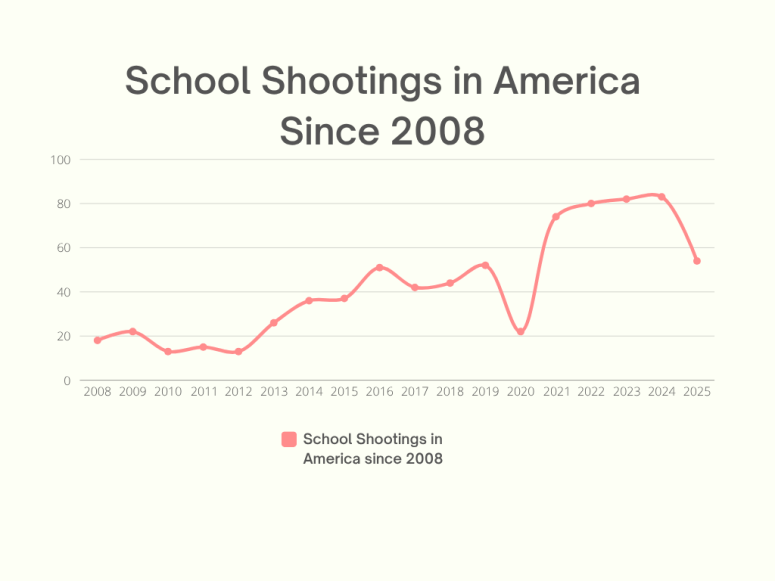
According to CNN, as of September 23, 2025, there have been 53 school shootings in 2025. 27 of these shootings occurred on college campuses, and the other 26 were on K-12 school grounds.
The number of school shootings so far this year hasn’t been as high as in previous years, but this number is still too high. According to a CNN chart, the number of school shootings has mostly risen since 2008; last year had the highest number of school shootings, with 83 of them. But even before 2008, there were problems with school shootings.
For example, Columbine is one of the most notorious school shootings. It occurred on April 20, 1999, and led to 13 deaths, many injuries, and physical and emotional trauma to the survivors. As a result of this devastation, there was a national reassessment of school safety and a significant change in school security and policies.
While these changes seem like a good solution at the moment, these security measures aren’t working. I believe that, in addition to the security measures, there should be more action on gun laws and more research into how these tragedies can be prevented.
Many gun laws have been proposed in the past, but these laws haven’t been passed, and if they are passed, they could cut down on school shootings. In other countries, the gun laws are much stricter, and there isn’t widespread availability and accessibility to firearms. In Canada, France, Germany, Japan, Italy, and the United Kingdom together, there have only been five school shootings since 2009. In contrast, there have been 288 school shootings in America since 2009. This data alone should be enough for there to be a crackdown on gun laws, and still, it seems as if people don’t care enough to take action.
Another important part of preventing school shootings is preventing adolescents from having access to firearms.
According to the Virginia Department of Criminal Justice Service, the average age of adolescent school shooters is 16 years old. Since these kids aren’t legally able to purchase a gun, they have to turn to stealing it from their parents. Most of the time, these guns are loaded and easily accessible, rather than being locked away. This poses extreme danger. Guns should be required to be locked up and in a safe place where a kid cannot access them. Studies have also shown that when children and teens live in a home with firearms, there is an increased risk of firearm injuries to them.
Since so many teens have had access to firearms, there have been huge problems along with it, like firearms being the number one cause of death in children and teens.
According to Harvard Medical School, since 2020, firearms have been the number one cause of death among children and teens. Along with those deaths, many children and teens also suffer from injuries as a result of firearms. These deaths and injuries cause mental health problems in both the families and the children. These mental health problems seriously affect the people suffering from them and can last a lifetime.
With all these dangers and risks, many students are nervous coming to school with the possibility of getting shot. It’s also not just students worried about a school shooting happening at their school; their parents also share the same concern.
In a Pew Research study, 57% of teens say that they are worried about the possibility of a shooting happening, with one-in-four of these students saying they are extremely worried about it happening. For parents, 63% said that they were somewhat worried about a shooting happening at their children’s school.
If action isn’t taken on gun laws, there will continue to be school shootings. It’s not just school shootings that are the problem, but also mass shootings in general are a major problem. Without any control over gun laws, students are afraid to go to school, and some people might be scared to leave their houses. These shootings have taken a toll on mental health, and if people really cared, something would have already been changed. I think it’s about time for important people to actually care about this problem, so that something can change, hopefully for the better.
3I/ATLAS is an interstellar comet from another solar system, discovered in July 2025, and is the third ever found in ours.
Normally, comets only form a visible coma when sunlight melts their ices and compounds, but 3I/ATLAS developed one far from the sun, leading some to speculate it might be an alien spacecraft. Even though it isn’t, and there is evidence to prove it.
3I/ATLAS has a normal gravitational motion, meaning its orbital path is simple. There are no signs of an artificial thrust or course changes.
Graphic by Liddia Waterbury.
As well as a normal gravitational motion, it also shows normal cometary activity, as the formation of a coma and tail is a natural reaction to the sun’s heat. It is not something you’d expect from a solid, artificial object.
Studying 3I/ATLAS’s abnormal qualities can inspire teenagers and young adults who enjoy space science. It can also help us uncover new evidence about other solar systems and the wider universe.
When I was little, maybe around three or four, I went to my stepmom’s aunt’s house for a party. I can’t remember what kind of party or how long I was there for, but I remember how big the house was.
In the living room, there was a ladder that led to a loft with a window. My step-siblings and I climbed up the ladder and found a telescope. One of my older cousins was looking out of it and helped us see out of it, too. I remember looking out the telescope and seeing the stars and the moon. I was astonished by the beauty of space.
When I heard about this unusual comet, I immediately thought of this memory and how much space interests me.
This comet can also bring new interests to us teenagers.
Since the comet came from another solar system, it shows that our solar system isn’t isolated. Learning more about 3I/ATLAS could inspire us, young people, to study astronomy and space science.
Not all comets follow the rules, and 3I/ALTAS is one of them. Its unusual coma and path show how surprising space can be. Discoveries like this can inspire teens to look deeper into space.
As a girl that has participated in wrestling her entire life I have been asked that same question more times than I can count. I’ve never really known how to answer it, though, I understand what they are asking logically but at the same time who is to say what is and isn’t for a certain gender.
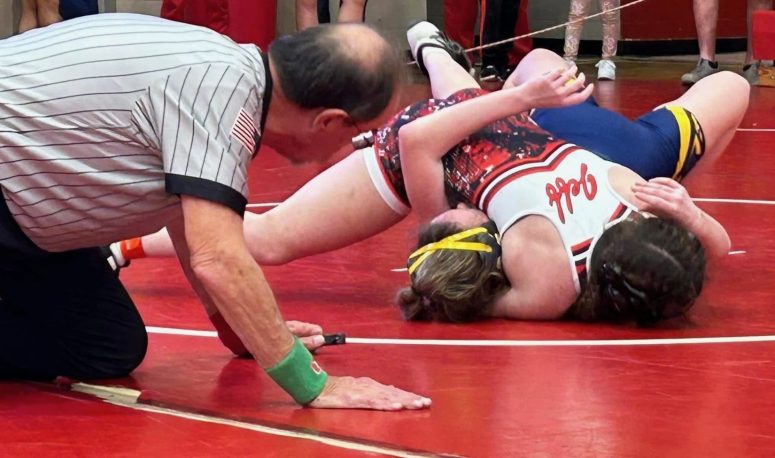
Junior Scarlett McRae competes at Doss High School in the 2022-23 girls’ wrestling season. Submitted photo.
Just because the most participants are male doesn’t mean female participants should be seen as any less deserving of being there than their male counterparts. I have always been looked down upon not even just by the male participants but also the adults that are there.
Sure there are disadvantages of being a girl in traditionally boys’ sports because boys are considered stronger. But there are advantages that go along with that. Guys tend to underestimate girls because they think they are weaker but when out on the mat at a meet anything is possible.
Senior soccer player and wrestler Abril Andres explained, “Even at practice the new guys who haven’t really seen girls in the sport automatically write us off and think we can’t do what they do. It’s frustrating because we work as hard as they do and they still act like we will never be able to beat them until we prove them wrong.”
I talk about wrestling because this is the world I am most familiar with, but this isn’t the only world like this and it’s definitely not just sports where things like this go on. Even in the classroom in areas where they are more male dominated the girls are overlooked.
“In both of my engineering classes I am 1 of 4 women in a class of 24 and 1 of 2 in a class of 12. On an engineering field trip I went on, I was the only girl there. Can you see the trend? Sometimes it’s harder to be in a male- dominated career path,but I believe it helps me push to become better and stronger to make myself stand out more than just being a woman in a male dominated academy,“ said engineering pathway senior Kaydee Merrifield.
Experiences like what Merrifield and Andres talked about are seen everywhere in the world, not just in sports and school. But for teen girls those are two of the biggest places in their lives. These are also the areas that help set their futures.
Junior Abi Lemon wrestles during last year’s Jeff Classic. Submitted photo.
This mindset in the world created a wall that most girls aren’t brave enough to jump in order to experience and prove themselves on the other side. This causes rifts like what is happening in the engineering world — women step back instead of stepping up because they know how they are going to be treated.
We as women have to continue fighting for our place in this world. We have to keep showing that we can do extraordinary things and prove to those who doubt us. If we put our minds to it we can do anything, so keep pushing forward and trying new experiences even if they aren’t typically for girls.
A well-balanced lifestyle is hard enough as just a regular student. The added stress of being an athlete brings so much more pressure.
When I first started two sports, I was on two teams for cheerleading, with practice every day except Fridays and Saturdays. And with basketball, I had practice scheduled right before it on Mondays, Wednesdays, and Saturday mornings.
I felt like I was drowning trying to balance school work, sports, friends, and life. It felt impossible until I quit basketball. I felt like I was finally able to breathe. It didn’t make a major difference, but it was big enough that I could feel alive again.
Without basketball, I was able to actually hang out with my friends outside of school, get my homework done at night, and I wasn’t stressing over little things.
“A well-balanced life revolves around having a schedule while also giving ourselves time to breathe. If it’s all work and no play, the sport starts feeling like a job that’s holding us back from our full potential.”
A well-balanced life revolves around having a schedule while also giving ourselves time to breathe. If it’s all work and no play, the sport starts feeling like a job that’s holding us back from our full potential.
A better way to manage our time as a student-athlete involves prioritizing what is most important, learning to say “no,” setting realistic goals, and using downtime wisely.
It’s easy for athletes to over-commit, to push ourselves until we can’t push anymore, simply, because we feel obligated to be the best at everything — not because we are cocky, but because we want to push ourselves to be the best we can be. Most don’t feel that it’s possible if we aren’t pushing until we cannot anymore.
Sooner or later, our mental health declines. We aren’t the best at our sport, our grades fall, and we feel like we are alone. We feel that if we aren’t excelling in at least one or all aspects of our lives, we are failing.
Most people don’t even notice an athlete who’s spiraling out of control until we are completely pulled away and have distanced ourselves. We feel as if we are too far from saving.
Parents play an important role in a student-athlete’s life as well. Kids can only give as much as we get. When teens get a pushy parent who only yells and does not provide much support otherwise, they eventually just give up.
Athletes need all the support we can get, or we break under the pressure.
College sports used to be about development, watching players grow through the program, build chemistry with teammates, and represent their school with pride. Now, with the rise of the transfer portal and Name, Image, and Likeness (NIL) deals, that’s starting to change. What once felt like a unique part of college athletics is starting to look a lot more like professional free agency.
The transfer portal was originally meant to give athletes more freedom. Before it existed, players who wanted to transfer often had to sit out a year or go through a messy process. The new system made it easier and fairer for athletes to move if they weren’t happy. But when NIL money entered the picture, things took a sharp turn. Now, the best players aren’t transferring for playing time; instead, they’re transferring for the biggest paycheck.
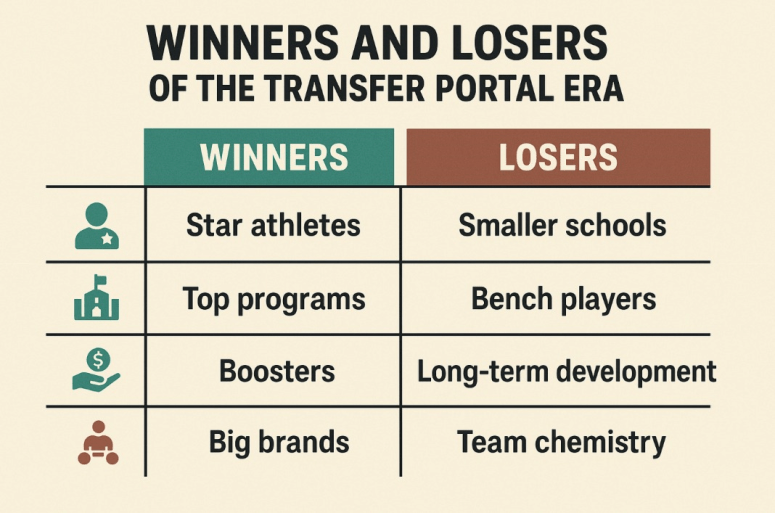
Graphic by Jaxon Sturgeon.
Top programs can now essentially “buy” players by offering them huge NIL deals. Big schools with massive fan bases and booster support have the money to make these offers. Small programs, on the other hand, can’t compete financially. A player might spend two years developing at a smaller school, then leave for a powerhouse program that can offer more exposure and a better NIL deal. It’s frustrating for coaches who invest time into developing talent, only to lose that talent once the player becomes valuable.
Because of this, college recruiting has started to feel more like pro free agency. Coaches aren’t just trying to recruit high school players anymore; they’re constantly re-recruiting their own athletes, hoping they won’t jump ship. Players, too, are learning to treat college as a business, weighing offers and sponsorships like professional athletes. While that might sound fair on the surface, after all, they deserve to profit from their talent, it also strips away some of what made college sports special: loyalty, team growth, and long term development.
In the end, the combination of the transfer portal and NIL has made college sports more about money than development. While it’s great that athletes finally have more control over their careers, it’s hard not to feel like the spirit of college athletics is being lost along the way.
If things keep heading in this direction, it’s going to start feeling less like college sports and more like the pros.


 thehyphennews.com