Column: Why we should still read physical books 

by Chloe Newton

In a non-stop motion world that just keeps speeding up, we can be tempted to let screens take over every aspect of our lives – even our reading. E-books are convenient, and our phones are always in reach; it might seem like the easier option. But there’s a reason physical books are still around and continue to hang on, even when the rest of our world and routine has gone digital. A real book does something a screen can not replace, and pretending they are the same experience is selling reading short. 

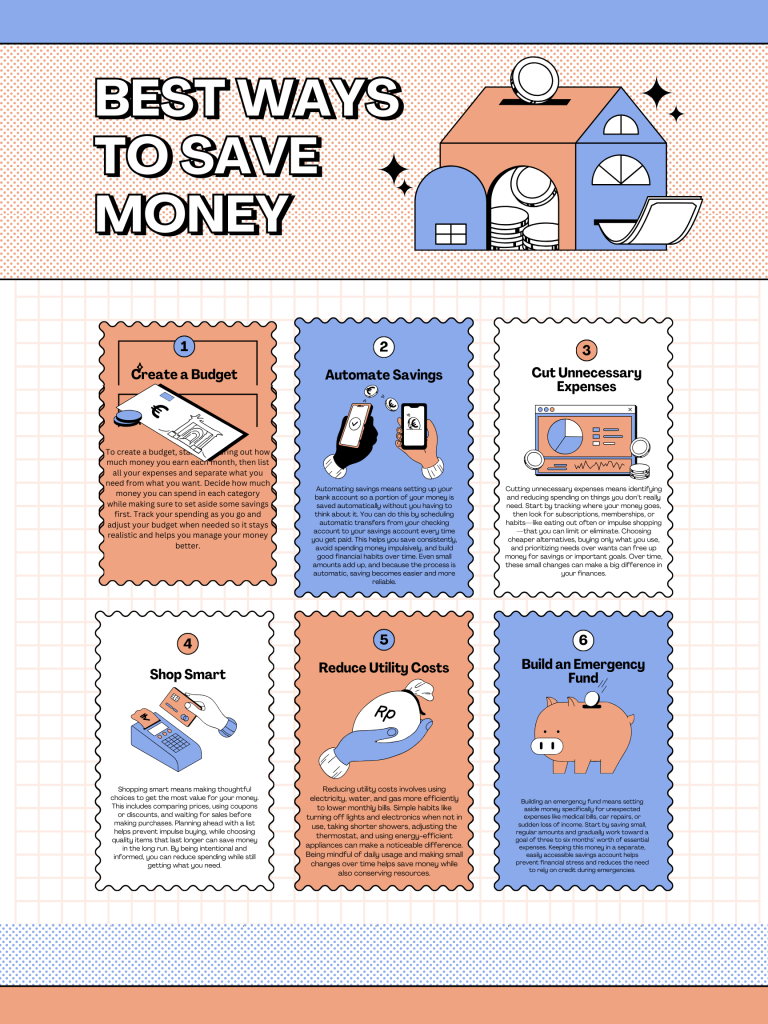
Graphic by Chloe Newton.

Firstly, a physical book forces you to be present. When you’re holding a book, you are not constantly checking the time or flipping to another app every time our mind wanders to something new. There’s a kind of focus that only physical media can give you – it requires you to sit and stay for a moment without thinking about all of the other distractions in our lives. That kind of slow attention is getting rare, and it is worth protecting.

There is also something physical about the memory of these moments. People often remember where something happened on the page, whether it be in the middle of the chapter or the top left corner. That spatial awareness helps us absorb and recall information better than reading on a glowing screen. Reading books physically helps our  brain build a map of the story, not just a trail of scrolling or hitting the turn page button.

“Reading is supposed to be more than content consumption. It’s supposed to be an immersive experience. While technology can have a place in our lives, there’s still nothing better than the feeling of opening and closing a book, turning physical pages, and letting the rest of the world take a backseat.”

 Honestly, there is the simple pleasure of the book itself. A book has weight. It ages with the world. It can be loaned, shared, annotated, or thrown in a bag without worrying about a charger or if you will have internet access. A shelf of books tells a story about the kind of person you are in a way a Kindle or tablet never will. When you finish a book and can close it, there’s a sense of accomplishment-something real in our  hands, not just a digital checkmark or finish line. 

Finally, physical books give us a break from the constant digital noise. We spend so much time on screen at school, work, home, and even in communication that reading becomes one of the only chances to unplug. It’s healthy to step away from the fluorescent light and algorithms and just let our mind wander through our thoughts and through a story that isn’t competing for attention.

Reading is supposed to be more than content consumption. It’s supposed to be an immersive experience. While technology can have a place in our lives, there’s still nothing better than the feeling of opening and closing a book, turning physical pages, and letting the rest of the world take a backseat. That is something worth keeping in mind.

Review: Atmospheric pop meets honest storytelling in MUNA’s debut

by Chloe Newton 

MUNA’s debut album About U, released in 2017, is a neon-lit diary of heartbreak, self-discovery, and resilience. It doesn’t feel like just discovering an album; it feels like a moment in time, like standing on a city rooftop at midnight, overwhelmed by possibilities.

MUNA is an American indie-pop trio formed at the University of Southern California. The members Katie Gavin, Naomi McPherson, and Josette Maskin combine shimmering synth-pop production with deeply emotional lyrics, often exploring LGBTQ+ identity, trauma, and empowerment. Their music exists in a bittersweet space between crying on the floor and dancing through the pain.

The opening track, “So Special,” immediately sets the emotional tone with a questioning vulnerability — “Now I know I’m not so special,” a line that conveys a sense of genuineness and rawness, leaving listeners feeling seen. 

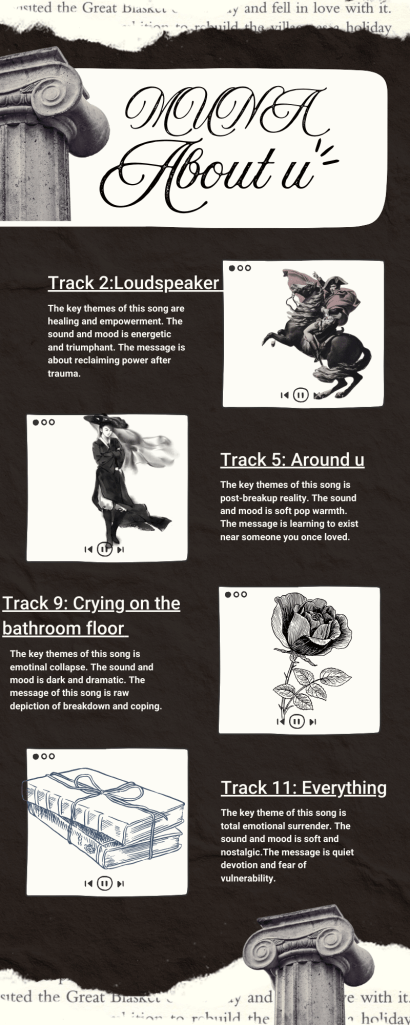
Graphic by Chloe Newton.

“I Know a Place” rises like an anthem for belonging: the powerful and hopeful chorus “I know a place we can go/Where everyone’s gonna lay down their weapons” sounds like an offering of safety and strength. In early 2018, MUNA released some acoustic versions of their songs, including “I Know a Place.” The shift was not just musical – it was political and emotional. The United States was coming out of the second month of Donald Trump’s first term in office, a time when fears around LGBTQ+ rights, immigration, and civil liberties were heightened. 

Many queer people and allies felt a renewed urgency to protect one another and speak out. In this acoustic version, it carries a sharp accusatory tone: “Even if our skin or our gods look different/I believe all human life is significant/I throw my arms open wide in resistance/He’s not my leader even if he’s my president.” The adjustment is powerful, and instead of focusing on harm already done, the new line turns toward collective resistance and resilience. This version also stripped away the glittery pop polish of the original. What remained was raw voice, raw emotion, and raw community, almost like a rally cry whispered directly into the listener’s ear. Releasing this version when they did made the song feel like a response to the moment one of MUNA’s first moments, where they leaned into visibility, encouraging their listeners to stay loud. 

Meanwhile, “Winterbreak” is icy, aching, and melodic; it captures the sting of someone who lingers in memory like cold air through a cracked window. The repeated confession “This is the love that we won’t get right”  feels painfully honest to listeners.

The standout emotional knockout comes in “If U Love Me Now”, where the lyrics depict a painful struggle with depression and suicidal thoughts, when MUNA is questioning if they are “deserving” of love and expressing a desire for their partner to leave, as heard in the line “If you love me now/ You should just let me leave.” This gives the song intimacy and a heavy feeling, but ultimately a very hopeful and important message on the exploration of mental health within a relationship.

This album to me felt like peeling back the layers of some heavy emotions- the songs explore uncovering pieces of identity, vulnerability, and power. They move between quiet introspective thoughts to glittering liberation, a duality that makes the listening experience personal and immersive. 

Some production elements blur together mid-album, creating moments where tracks sound sonically similar. However, the emotional clarity and lyrical depth keep the record grounded. 

Available on streaming platforms; physical CD copies generally retail around $10-$15 USD depending on the store and edition. 

This album discusses trauma, heartbreak, queer identity, and emotional vulnerability. The suggested sensitivity rating is PG-13 for emotional intensity and mature themes.

About U stands out with sincerity-an electrified love letter to survival, vulnerability, and chosen identity. A debut that does merely introduce MUNA, but invites listeners into a shimmering, earnest world of healing.

Column: College pressure crisis creates ‘success’ with a price tag

by Chloe Newton

Every year, we get told that college is the key to success. Teachers, parents, and counselors repeat the message like a mantra: “Work hard, get good grades, get into the best college you can.” But few talk about the price of that advice, not just the tens of thousands of dollars many families can’t afford, but also the toll it takes on students’ mental health and sense of purpose.

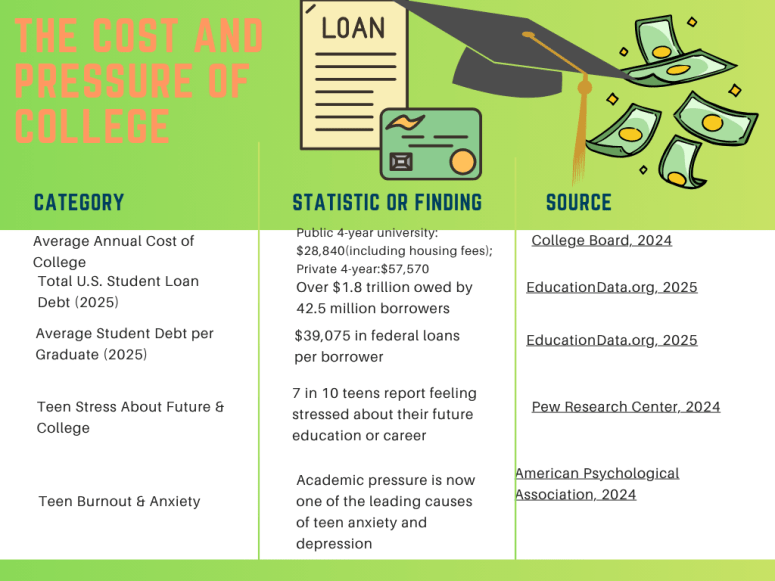
Today, the path to higher education has become an issue that teens can’t afford to ignore. College costs have climbed faster than inflation for decades. According to the College Board’s 2024 Trends in College Pricing Report, the average annual cost (including tuition, housing, and fees) is about $28,840 for public universities and $57,570 for private colleges. That means a single four-year degree can easily exceed $100,000. Meanwhile, the total U.S. student loan debt has reached $1.8 trillion.

The result is a generation that feels trapped in anxiety. We are told that college is essential to success, yet the financial reality makes it nearly impossible to pursue it without incurring debt. This system pressures us to make life-altering decisions before graduating from high school, often without a clear understanding of the financial implications of debt. 

Even worse, the cultural obsession with “the perfect college” has turned education into a competition rather than an opportunity for growth. A 2024 Pew Research Center survey found that seven in ten teenagers feel stressed about their future education or career plans. The American Psychological Association reports that constant academic pressure is now one of the leading sources of teen anxiety and burnout. When students feel their worth depends on getting into a top school, learning becomes secondary to surviving the system. 

Graphic by Chloe Newton.

This issue goes beyond money- it’s about values. Society has built a narrative that college is the only path to success, when, in reality, the Bureau of Labor Statistics reports that many skilled trade jobs, such as those in electrician and technician roles, or healthcare assistant positions, are growing faster than the national average and often require less than a four-year college degree. If this trend continues, we risk creating a future where only the wealthy can afford education without hardship. That’s not opportunity – that’s inequality. It’s time to rethink how we define success for teens and how schools prepare us for life after graduation.

To move forward, we need action on several levels. Schools should provide transparent financial education, showing the real college costs, interest rates, and repayment timelines before students apply. Counselors should present multiple paths —trade programs, community college, or apprenticeships—without treating them as “less than.” Lawmakers must invest in making public education more affordable, expanding Pell Grants, and capping interest rates on student loans. Students can speak out by writing, organizing awareness campaigns, or advocating for school boards to include financial literacy in their graduation requirements. 

Redefining success doesn’t mean giving up ambition but making it sustainable. The dream of college shouldn’t come with a lifetime of debt or exhaustion before adulthood even begins.

Education is supposed to open doors, not lock students into decades of repayment and pressure. Until we fix the system, the actual cost of college won’t be just financial- it will be the mental and emotional price our generation pays for chasing an idea of success that no longer fits our world.

Eco Club inspires activism one small act at a time 

Club members hope their work makes a difference at JHS and in the community

by Chloe Newton

Before the recycling bins are rolled down the hallway, or a single piece of trash is picked up, the  Eco Club is already planning its next activity to help keep JHS a cleaner place. 

Every Monday after school, the members gather in a classroom that smells faintly of dry-erase markers and recycling ideas. The meeting begins with updates on who is recycling this week, which community event requires volunteers, and whether the tree planting partnership with the local tree board is ready to commence. 

What most people don’t see is the planning. Students check their schedules, sort donated containers, and brainstorm new projects. Sponsor and Spanish teacher  Jenna Felix moves between groups, answering questions and encouraging the nervous freshmen who are still finding their voices.

“Leadership is about reminders and organization,” Felix stated as a student leader snapped a photo of the new recycling chart for the club’s group chat.

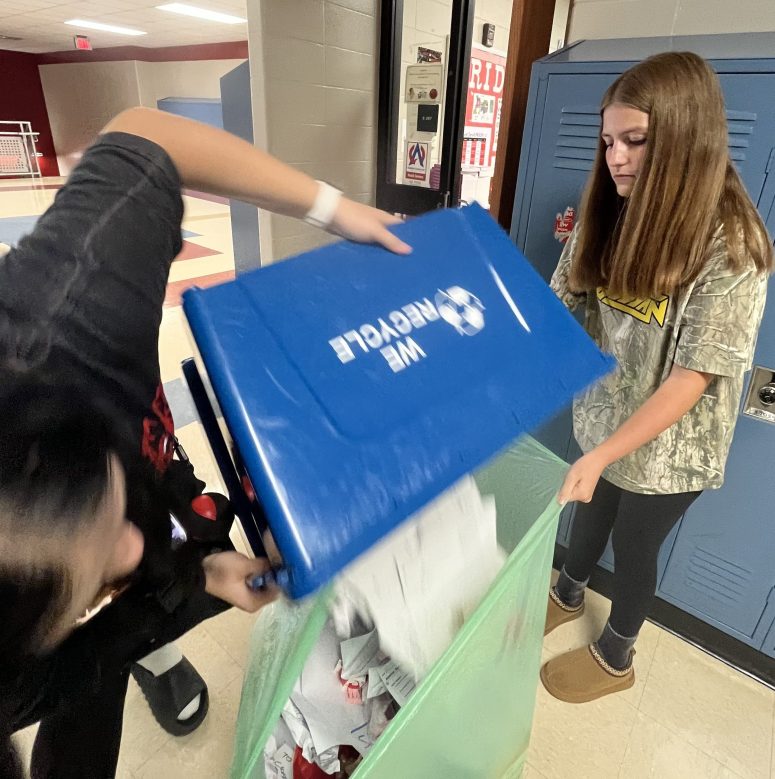
On Mondays, students might spot a few members quietly collecting bottles and paper from classrooms. They joke and laugh while hauling bags, but they’re also very careful, ensuring that all recyclables are sorted and clean.  

Sophomore Rachel Ledbetter said, “It’s simple, but it feels good to know we’re making a difference and helping our school stay cleaner.”

Sophomore Monserratt Gonzalez added that “Eco Club is a place where I can go after school to feel better about myself because no matter the grades, I know I am making the world a stronger place.” 

Sometimes opportunities drop in unexpectedly. For instance, recently a local river sweep needed volunteers, or a new idea for upcycling plastic into benches popped up mid-meeting. The club thrives on these moments, turning small sparks into action. 

Sophomore Vivianna Hill shared that this is one of the things that made her want to be a part of the Eco Club.

“I joined because I wanted to help the environment, but I’ve learned so much more about how even small changes can inspire our whole community.”

Their biggest challenge? Convincing the wider school to reduce single-use plastics and see recycling as a last resort instead of a first. 

By the end of the week, the bins are emptied, plans are made, and the hallways look just a little better. Most students never notice the effort that the Eco Club puts into keeping JHS clean. The behind-the-scenes work is not about the attention, though; it is about creating a cleaner, more sustainable school and inspiring others to care for the planet, one small act at a time. 

CLub members develop their sense of purpose through small, sustainable acts

by Miaa Caporale and Kenshawn Schilling

When most people hear about an eco club, they picture recycling bins and posters about how to save the planet. But there’s so much more going on behind the scenes. The Eco Club is characterized by team work, sharing ideas, and taking steps to improve the school’s environment. 

“It gives me a sense of purpose by joining the Eco Club and helping our community,” sophomore Ellyana Chattin stated.

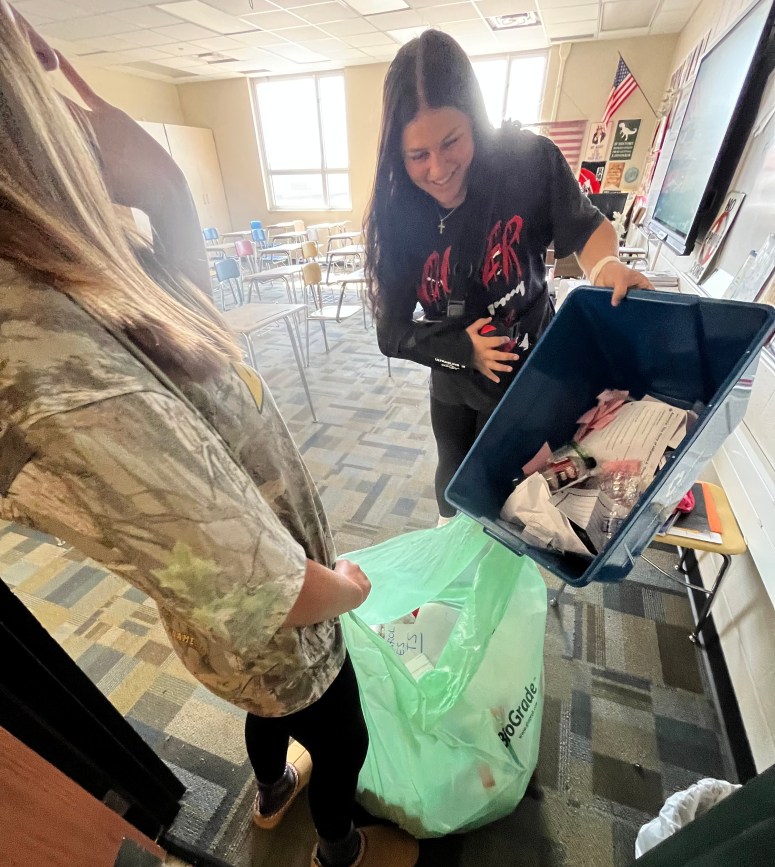
Sophomores Ellyana Chattin and Kenzie Myers pick up recycling from classrooms for the Eco Club. Photo by Miaa Caporale.

From clean-up days to starting new recycling projects, members stay busy making a difference on school grounds. 

 “I joined the Eco Club because I wanted to learn more about the environment and help out the community in every way I can,” said sophomore Jordyn Jaggers.

Her motivation reflects the club’s spirit; students come together not just to learn, but also to take action that makes a difference.

“The club encourages students to recycle not just at school, but also at home,” said sophomore Zoey Breeden.

This shows how Eco Club’s influence reaches further than the hallways of JHS, reminding students that even small actions can make a big difference in the world. 

“We are all passionate about the same cause, and it feels good knowing that all of us just want to make a difference,” said sophomore Graciela Sanchez. 

Her words reflect the sense of community the Eco Club has built for students, bringing students together who share the same passion.   

“Small actions matter. Just because we are a high school club doesn’t mean we aren’t making a difference. If everyone does one eco-friendly thing every day, together we can make a huge difference,”  Chattin said.

Sophomores Ellyana Chattin and Kenzie Myers pick up recycling from classrooms for the Eco Club. Photo by Miaa Caporale.

That belief is what pushes the Eco Club’s mission, reminding students that small steps added together can create a real change at JHS.

“Being in the Eco Club makes me more mindful about my choices, like recycling and saving energy by turning off a light when it’s not being used,” Breeden said.

This mindfulness is what the Eco Club wants to inspire students to do. Even a simple change like flipping a light switch can help save energy. By encouraging these small habits, the club hopes more students will become aware of their impact and choose to live more eco-friendly at home and at school. 

“My message to my classmates would be to become friendly; you don’t have to change your whole life. Small changes really matter, and if every student works together, the difference could be a huge impact on our community,” said Chattin.

French teacher Dana Schenk brings the world and a sense of curiosity to her students

by Chloe Newton

The morning sun and smoke fill the classroom windows as French teacher and fifth-generation architect Dana Schenk shifts between her desks; her voice carries through the room. 

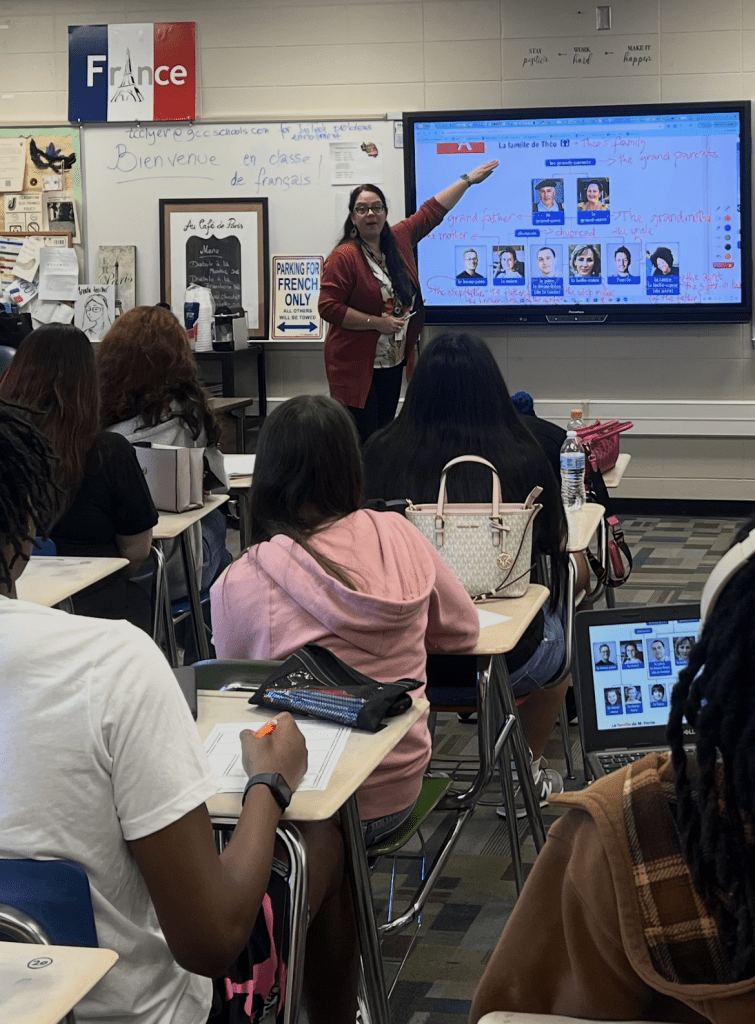
French teacher Dana Schenk teaches a lesson on family members during third-hour French II class. Photo by Chloe Newton.

Her voice is full of the life lived between three countries. France has given her a love for language, Romania is where she grew up learning her first language and how to read and write, and America is where she has chosen to take her knowledge and share it with her students at Jeffersonville High School. 

She pauses mid-sentence to smile at her students’ careful pronunciation, her eyes lighting up and reflecting the same caring atmosphere that once welcomed her into new cultures.

Schenk has never let anything stand in the way of her dreams. Born in Romania, she moved to France and eventually to the United States, each travel and experience guided by her  “spirit of adventure.”

“Living in different countries teaches you a lot about yourself; you become the person who can survive in any environment,” she said.

The countries and cultures shaped her teaching style. When Schenk discusses the history of these countries, she is not just talking; she is drawing from her adventures and experiences, helping students connect beyond the classroom and curriculum. 

“Be curious about life and you’re going to get very far. No task or pathway is impossible as long as you’re curious.”

French Teacher Dana Schenk

In her class, learning goes beyond just pencil and paper. She allows students to apply French terms to real-world situations and history. Students complete projects such as building an apartment floor plan or creating personalized crests. 

“We try to put together as many skills as we can while we’re learning French, that’s how I make it fun and engaging.”

Her goal is not just to teach a language but to encourage students to “be citizens of the world, open their minds, and take more than just the language from my class.”

Students see that engagement firsthand. French II student Shane Adkins described her as a teacher who keeps lessons very interactive and interesting. 

“She talks about her culture a lot, and it feels like a first-hand experience.”

He points out why this class is different from other language classes he has taken because of her unique teaching style and lively feeling she brings to the class. 

“She’s just very expressive with her reactions and words. There’s no other way to put it,” he said.

This feeling and expressiveness have also had a lasting impact on colleagues. German teacher Lisa Stumler described feeling nervous when the previous French teacher left and Schenk came in. 

“I was worried – would the new French teacher even like me? But, instantly, I thought, ‘She’s wonderful’.”

The two took a trip together to Europe over the summer. The trip lasted two weeks, during which Stumler and Schenk helped each other while seeing all the fascinating places from their cultures. 

“She’s influenced me to pause more, to ask questions, to not jump to conclusions.”

Schenk’s philosophy and mindset carry the same courage and clarity she encourages in her students.

“Be curious about life and you’re going to get very far. No task or pathway is impossible as long as you’re curious. I don’t regret anything, I love my choices.”

The impact of this mindset carries beyond the classroom. Schenk recalled a student who once volunteered in Africa and had to rely on French to communicate.

“I felt so proud… he realized the importance of knowing a foreign language, and it just made my eyes light up. ”

In the classroom or abroad, Schenk’s students and peers describe her in the same way: expressive, passionate, and unforgettable. As one student described her, she was likened to a croissant, very layered and one of a kind.