Educators adjust to new Indiana cell phone ban

by Parker Vibbert and Kaylee Borelli

July 30, 2026 ushered in a new school year at JHS. Along with hundreds of new students, there is a new policy here and in all Indiana high schools: no cell phones.

The Indiana State Senate passed Senate Bill 78 in February, instituting a statewide bell-to-bell cell phone ban in every public and charter school in the state.

Before SB 78, the Indiana Legislature passed Senate Enrolled Act 185 in 2024, which banned cell phone use during instructional time during the 2025-26 School year, but set clear exceptions for education, emergency, health care needs, and disability-related accommodations. However, it did not address how schools were to enforce the bans, nor did it address lunchtime or passing periods.

Under SB 78, cell phones are banned bell-to-bell, with minimal exceptions for health reasons. At JHS, teachers and staff confiscate student phones and turn them into the front office in yellow envelopes; students and eventually parents must pick confiscated phones up at the end of the school day or after school.

Teachers and staff place confiscated cell phones in yellow envelopes for student or parent pick-up at the end of the school day. The change in cell phone policy is a result of legislation passed in Indiana and signed into law by Governor Mike Braun. Photo by Ashton Walcott.

German Teacher Lisa Stumler said the ban is necessary and beneficial.

“I’ve noticed people looking each other in the eye more now, and in the hallway, they’re paying attention to where they’re going, and they’re not all looking down,” Stumler said.

“It’s easier in class to not be paranoid, ‘Are they just on TikTok?’ I don’t have to think about that at all,” she added.

Previously, the policy regarding phones at JHS was largely at each teacher’s discretion, with most simply forbidding phones during instruction, but allowing them after. 

Stumler allowed students to use their phones during non-instructional time, or as a substitute for a Chromebook. Unfortunately, Stumler said they would often become distracted.

“They’d just want to scroll.”

English teacher Justin Linde is “not during instruction” policy worked for a short time, he said, but it ultimately fizzled when students stopped putting their phones in calculator pouches.

“After a couple of weeks, it became ‘I don’t have a phone,’ and I couldn’t accuse someone of not having a phone. It got to the point where everybody was on their phones. Regardless of it being an honors class or a regular class or AP,” Linde said.

The new legislation has significantly impacted media classes, designed to train future journalists to properly use technology.

Radio and broadcasting teacher Fred Cowgill said the statewide ban has heavily affected WJHI’s operations.

“The entire business of broadcast and communications and information, every major news organization is using smartphones. Our entire workflow from the moment we took over two years ago was using our students’ personal cellphones,” Cowgill said.

Cowgill said WJHI was unprepared for the outright ban.

“When we got wind of it this summer that the state was going to implement this bell-to-bell ban of phones in schools, we were told we’d get a ‘hall pass’ to still use them, but around July 1, we were told ‘No’.”

Cowgill’s words were echoed by principal Pam Hall, who said she was unaware the ban would be outright.

“When they were still talking about putting it into law, they talked about giving schools the autonomy to come up with their own plan on how to do it, whether that would be to allow phones in curricular classes. When the law was enacted, they took that away,” Hall explained.

Cowgill, Hall, Linde, Stumler, and freshman counselor Andrea Schedler all agreed the ban was necessary, but differed on the scope of exceptions.

Stumler, Schedler, and Linde said students should be allowed to have phones during lunch.

“If they can handle it, I think lunch should be a time when they can have it. It gives you downtime,” Schedler said.
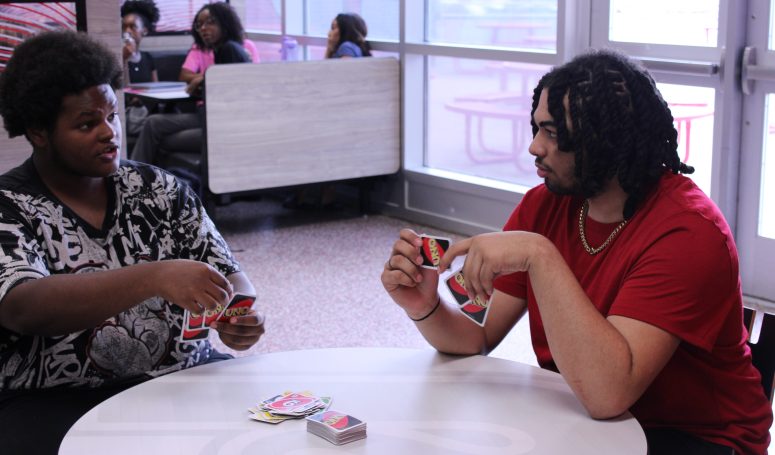
Seniors Joshua Hassan and Ke’moni Mitchell play Uno during B lunch. Students are not permitted to use their cell phones during the school day as a result of new state legislation, including at lunch time. Photo by Ashton Walcott.

Linde agreed. “I think the bill went from one extreme to the other. I don’t understand how you could regulate them in the hallway, or at lunch, and I think students should have access to their phones at those parts of the day.”

Juniors Evan Floyd, Kenneth Norton, Harrison Cortez, Landon Russell and Gabriel Cecil socialize during B lunch. Public school students may no longer use their cell phones at any time during the school day, including at lunch time. Photo by Ashton Walcott.

Cowgill said student journalism should have been exempt from the ban for curricular reasons.

“The State of Indiana barring smartphone use from its high school communication classes sends the wrong message. We were using them as tools, not as an entertainment device. What better way to teach the correct use of personal smartphones than by giving us the opportunity to do that?”

Hall added that the ban puts an unnecessary burden on emergencies and worried parents.

“I’m one of those parents; my advice to kids is to put it in your purse or in your pocket, turned off or silent at all times, in case something happens, and you have to get out. But don’t have it out. I think it’s important that students, in case of an emergency, have a way to communicate.”
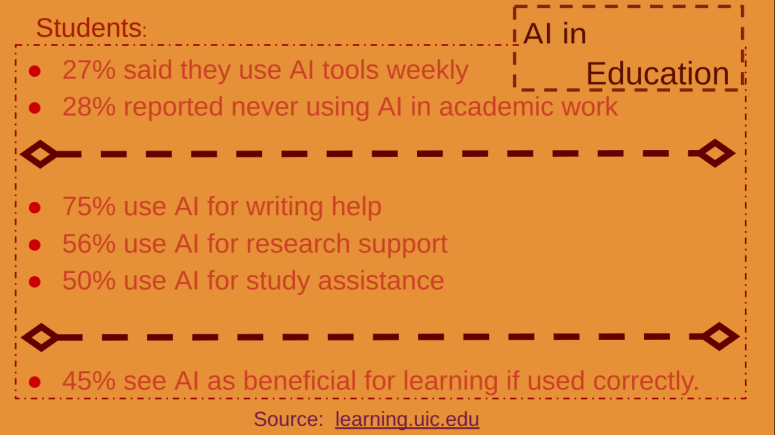
Faculty, students believe AI, cell phone technology should support rather than distract from learning

by Liddia Waterbury

In today’s classrooms, phones and AI are powerful tools that can support learning. They can also be major distractions that pull students’ attention away. 

Phones and AI in classrooms are changing how students learn and how teachers teach. Some people believe that they help with research and organization, while others worry they cause distractions. Teachers and students show different views on how these tools impact learning.

“Teachers are afraid of students getting lazy and say, ‘AI type me out a three-page paper,’ and they wouldn’t have actually done anything. Like, in college, if you have to turn in major research papers, professors can scan them into something to see if they’ve been copyrighted or already written. If it was already written somewhere else, you’d get kicked out of school for plagiarism or the use of AI,” said college and careers teacher John Moody.

Some teachers focus on the serious consequences of using AI improperly, while others are more concerned about how AI affects learning. Many teachers believe students rely on AI too much and are worried about how it changes the way students work, such as writing essays.  

“The issues I see are that students tend to either try to get AI to write essays all for them, where they’re doing nothing and learning nothing. Or, they’ll write it, and then they’ll have AI just completely rewrite it for them to make it better. They don’t learn how to improve their writing themselves,” said English teacher Holden Henderson.

Graphic by Liddia Waterbury.

Even though teachers are concerned about students depending too much on AI, they believe that technology can still be useful. When used as a tool, it can help students understand and learn properly. 

“For reading, if you don’t know what a word means or there’s something that doesn’t make sense, you can quickly look it up so you have more context to the story. For writing, I would use my phone for the same thing, like if I’m unsure how to spell a word, I’ll hop on my phone and try to look up an answer really quickly,” said Henderson.  

In addition to phones being used as a tool, AI can be utilized in the same manner.

“In math, I would use AI as a fact checker. If you don’t have the answers to something, you would try to answer the mathematical problem yourself and then put it on AI to see if you got the answer right. And for English, I would use it as a guide to add to the information that I would already have,” said Moody.

Although teachers see AI as a helpful tool, other teachers worry that it can hurt students’ problem-solving skills.  

“I know kids ask why we learn this, but I think math can teach how to solve problems, and once you get older, life gets hard, and learning how to struggle through problems and learning how to solve problems comes from math. AI changes that because they just want to get to the problem fast; they don’t want to struggle or challenge themselves,” said math teacher Alyssa Jones. 

Technology affects students in more ways than just how they solve problems. It can also make it harder for students to stay focused and pay attention in class. 

“Phones definitely affect focus for a lot of kids. Five minutes into class, they check out, and they just want to start scrolling immediately. Sometimes in life we’ve got to do boring things, but it’s really important to focus in class because if you don’t, you can become super behind, and then you’re not going to want to catch up,” said Jones.  

Teachers say how phones hurt students’ focus in class. This problem is also noticed by other students. They see how phones easily distract them and their classmates from learning. 

“My classmates like using phones in class. They sometimes get distracted because all they want to do is scroll on TikTok, listen to music, or just be on social media in general. They’re distracted because they prioritize their phones before school,” said freshman Kaden Eurton.

While some students see phones as a major distraction in class, others think they can help focus when used correctly. 

“My phone can sometimes be distracting if I really have to focus on work, but when I use my AirPods to listen to music, it helps me focus better. I just sometimes use AI, like science, because I can use it as a base. Only if I really need help formatting my notes,” said freshman Aby Lawson.   

While some students see AI as a helpful tool, teachers are more cautious and focused on its limits and downsides. 

“AI is kind of the way of the future. The good things about it are that it will help you with some information. However, the downside is that it doesn’t always have a clear reasoning. It will only spit out the direct question without researching,” said Moody. 

AI and phones are the future. They can help students during class, even though they might be distracting at times. Teachers believe that, if used in the right way, they can be a very beneficial tool, even when they don’t fully support these tools. 

“I try to avoid AI for the most part, but I do try to suggest good ways to use it, like when we are doing a project, you could use AI to come up with topics to brainstorm, but it shouldn’t be used to generate actual content,” said Henderson. “Phones are so distracting because we are so used to checking them every time we get a notification. Using them for research, like looking up a word, checking if your grammar is correct on an essay, listening to music for focus, are really the only ways phones benefit students.”  

Column: Using cell phones in school requires a balanced approach

by Mikail Cetiner

Whether we like it or not, phones are everywhere at school. We see them in pockets, peeking from under desks, or being used to text someone who’s just a few seats away. As much as teachers try to control it, smartphones are part of our daily lives now. So, the question is, should they be allowed in school?

Honestly, I think phones can be really useful, like if we need to look up something for a project, want to record notes, or take a picture of the homework on the board. There’s an app for almost anything school related. There’s no question that in today’s world, we use technology for everything from work to communication, so learning how to use it responsibly seems important.

“With the right balance, smartphones could help us learn more and not distract us from learning at all.”

But let’s be real. Phones can also ruin focus faster than anything else. One message, one notification, and suddenly we are scrolling through TikTok for just a minute, that turns into ten. It’s not just distraction, either; phones can cause drama, make cheating easier, or create pressure to look perfect online. School should be a place to learn, and not a place to compare who has the newest iPhone or the most followers.

So, what’s the solution? Completely banning phones doesn’t seem realistic, and letting everyone use them freely definitely doesn’t work. The best option is somewhere in the middle. Use them only when they’re actually needed for schoolwork or let students have them during breaks. And more importantly, teach students how to use technology responsibly instead of just taking it away.

In the end, phones aren’t a bad thing, they’re just tools. How they affect school depends on how we use them. With the right balance, smartphones could help us learn more and not distract us from learning at all.

Solutions:

Make free phone zones.

Bigger consequences if we use your phones in class.

The school can give us phones with no games on so they can use it as a tool.

New Indiana laws impact schools, students

by Sophia Waldridge and Tyler Conley

As the school year continues, new laws regarding Indiana classrooms have become an important topic among teachers and students. Some laws have been favored by the community, while others have sparked debates on if the law should be enforced. 

New policies regarding student behavior, cell phone bans and improved absence tracking are being put into place for the new year. Specific laws address rising teacher pay and closer parental involvement in truancy cases.

 Senate Enrolled Act 482 aims to better understand chronic absenteeism by improving the data reported to the Indiana Department of Education.

State lawmakers passed a two-year budget, which adds a 2% increase to school budgets for every year. They also expanded vouchers to private schools for 2026 so parents no longer have to pay for textbooks.

Student absences have always been a worry with parents and school administrators. This year, schools will be required to provide a list of chronically absent students.

Sophomore Leandra Willis thinks the new laws regarding absences are too strict, and students’ personal lives need to be taken into consideration.

“I think the new laws are bogus. What if something happens and you can’t get excused because the school decided to make a law saying no absences can be excused, like a funeral,” she said. 

New phone laws have sparked some controversy with students. The new law suggests that students cannot have their phones during instruction time, with the exception of medical reasons or emergencies. 

Willis believes this new law could break a connection from students to parents in case of an emergency.

  “If something bad happens or we need to know how to get home if they can’t pick us up, we wouldn’t know since we can’t have our phones,” she said. 

Sophomore Perry Coats agreed with Willis and thinks the new policies against students are too strict, and should have more leeway to be independent.

“I think the new policies are inhumane and not right. We should have freedom; we’re almost adults,” He said. 

Principles of Human Services teacher Kyle Keplinger said that the laws help students in school and also make it easier on teachers to get students to listen. 

“The rules help teachers keep students focused and on track; these laws really benefit everyone in the long run by letting teachers save energy and helping students stay focused on doing their work and having good grades,” he said. 

He says that he agrees with all the laws, but that some of them are a little too harsh.

  “The tardy and absence laws are a little too harsh; they should make certain things excused because students could potentially need to be called out of school for something and not be excused. That could lead to truancy and students don’t need that if they’re out for important reasons.”

English 9 teacher Eric Watson agreed with Keplinger, saying, “The absence laws seem to be working. I think that absenteeism is a problem and these laws are doing a good thing by putting pressure on parents to get their kids to school and by putting pressure on the kids to show up more.”

He said that the cell phone law helps students “lock in” and get good grades

“Teachers should have the latitude to snatch a kids phone without having the repercussions for doing so,” he said. 

Principal Pamala Hall said that the laws and cuts in schools throughout Indiana may affect students negatively, but could also help some in positive ways.

 “These laws and cuts affect class size and staff cuts, and even affects what we can feed you at lunch.”

She added that the cell phone laws limiting phone usage in classrooms are appropriate for schools because they keeps students focused, but that Indiana schools could be stricter with attendance laws.

“The schools can’t do the attendance alone because they make them at state levels and then there’s nothing to hold them in place, and I don’t find it fair that someone can miss 40 days of school and only log into Google Classroom and have the same grade as someone who never misses a day.”

Many students and staff agree with each other on certain policies, but also disagree on others. They agree that the absence laws should be more lenient, but disagree with other policies,  including phones.