by Liddia Waterbury
In today’s classrooms, phones and AI are powerful tools that can support learning. They can also be major distractions that pull students’ attention away.
Phones and AI in classrooms are changing how students learn and how teachers teach. Some people believe that they help with research and organization, while others worry they cause distractions. Teachers and students show different views on how these tools impact learning.
“Teachers are afraid of students getting lazy and say, ‘AI type me out a three-page paper,’ and they wouldn’t have actually done anything. Like, in college, if you have to turn in major research papers, professors can scan them into something to see if they’ve been copyrighted or already written. If it was already written somewhere else, you’d get kicked out of school for plagiarism or the use of AI,” said college and careers teacher John Moody.
Some teachers focus on the serious consequences of using AI improperly, while others are more concerned about how AI affects learning. Many teachers believe students rely on AI too much and are worried about how it changes the way students work, such as writing essays.
“The issues I see are that students tend to either try to get AI to write essays all for them, where they’re doing nothing and learning nothing. Or, they’ll write it, and then they’ll have AI just completely rewrite it for them to make it better. They don’t learn how to improve their writing themselves,” said English teacher Holden Henderson.
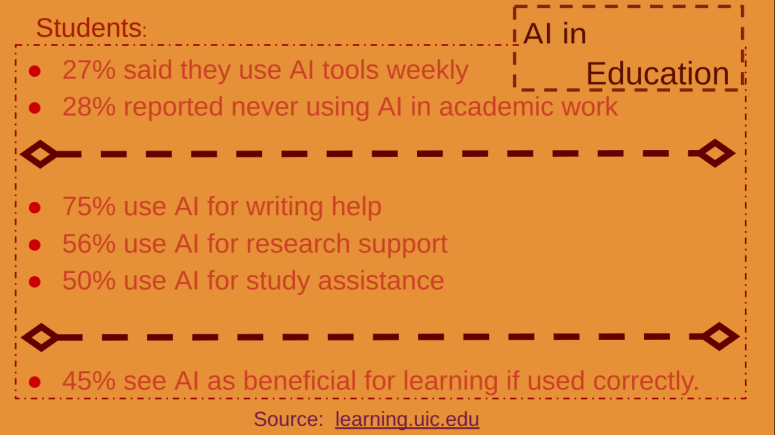
Even though teachers are concerned about students depending too much on AI, they believe that technology can still be useful. When used as a tool, it can help students understand and learn properly.
“For reading, if you don’t know what a word means or there’s something that doesn’t make sense, you can quickly look it up so you have more context to the story. For writing, I would use my phone for the same thing, like if I’m unsure how to spell a word, I’ll hop on my phone and try to look up an answer really quickly,” said Henderson.
In addition to phones being used as a tool, AI can be utilized in the same manner.
“In math, I would use AI as a fact checker. If you don’t have the answers to something, you would try to answer the mathematical problem yourself and then put it on AI to see if you got the answer right. And for English, I would use it as a guide to add to the information that I would already have,” said Moody.
Although teachers see AI as a helpful tool, other teachers worry that it can hurt students’ problem-solving skills.
“I know kids ask why we learn this, but I think math can teach how to solve problems, and once you get older, life gets hard, and learning how to struggle through problems and learning how to solve problems comes from math. AI changes that because they just want to get to the problem fast; they don’t want to struggle or challenge themselves,” said math teacher Alyssa Jones.
Technology affects students in more ways than just how they solve problems. It can also make it harder for students to stay focused and pay attention in class.
“Phones definitely affect focus for a lot of kids. Five minutes into class, they check out, and they just want to start scrolling immediately. Sometimes in life we’ve got to do boring things, but it’s really important to focus in class because if you don’t, you can become super behind, and then you’re not going to want to catch up,” said Jones.
Teachers say how phones hurt students’ focus in class. This problem is also noticed by other students. They see how phones easily distract them and their classmates from learning.
“My classmates like using phones in class. They sometimes get distracted because all they want to do is scroll on TikTok, listen to music, or just be on social media in general. They’re distracted because they prioritize their phones before school,” said freshman Kaden Eurton.
While some students see phones as a major distraction in class, others think they can help focus when used correctly.
“My phone can sometimes be distracting if I really have to focus on work, but when I use my AirPods to listen to music, it helps me focus better. I just sometimes use AI, like science, because I can use it as a base. Only if I really need help formatting my notes,” said freshman Aby Lawson.
While some students see AI as a helpful tool, teachers are more cautious and focused on its limits and downsides.
“AI is kind of the way of the future. The good things about it are that it will help you with some information. However, the downside is that it doesn’t always have a clear reasoning. It will only spit out the direct question without researching,” said Moody.
AI and phones are the future. They can help students during class, even though they might be distracting at times. Teachers believe that, if used in the right way, they can be a very beneficial tool, even when they don’t fully support these tools.
“I try to avoid AI for the most part, but I do try to suggest good ways to use it, like when we are doing a project, you could use AI to come up with topics to brainstorm, but it shouldn’t be used to generate actual content,” said Henderson. “Phones are so distracting because we are so used to checking them every time we get a notification. Using them for research, like looking up a word, checking if your grammar is correct on an essay, listening to music for focus, are really the only ways phones benefit students.”
 thehyphennews.com