Cyrano de Bergerac will take to the Jeff High stage this weekend to try to romance Roxane.
Show dates include:
Friday, March 27 — 7 p.m.
Saturday, March 28 — 7 p.m.
Sunday, March 29 — 2 p.m.
Friday, April 3 — 7 p.m.
Saturday, April 4 — 7 p.m.
On-stage performers include Blessing James, Finn Matzek, Jayden Trevell, Jackson Fried, Sarah Proctor, Jalen Nifong, Tristan Cooley, Lucas Dimmit, Wyatt Clements, Sophie Ellis, Jude Polete, Roberto Castro, and Natalie Creagh.
Behind-the-scenes crew members include McKayla Hannan, Parker Grubbs, Kira Timberlake, Elianna McCurdy, Shiann Spalding, Nataly Barragan, Lindsay Austin, Ada Morrill, Hailey Littrell, Bella Roman, Chloe Kallbreier, Zoe Schwieman, Kenzie Stone, and Sage Mace.
Sophomore actress Natalie Creagh said, “We take a more modern take on the original story of ‘Cyrano de Bergerac’.”
The advice Creagh has for those who want to take theater is to keep believing in themselves even though it’s a lot of hard work.
Theatre arts teacher Derrick Ledbetter said, “The story behind Cyrano de Bergerac is, in a war-ridden France, there is a love story that takes place that is very complicated.”
Ledbetter said he’s most excited to see the students act out the script, since it’s his most complicated one yet.
Tickets are free for staff — and general admission tickets are $10, according to Ledbetter.
Ceramics provides a hands-on approach to creativity for students looking to expand their artistic abilities and outputs. In ceramics, artists learn how to craft pottery and make various shapes using clay, employing methods such as wheel-throwing and hand-building. This is followed by the processes of drying, firing, and glazing, resulting in completed functional or artistic works.
Senior Evan Shelton makes a spoon holder out of clay for his third-hour ceramic class. Photo by Audrey Ball
3D and Art Teacher Jennifer Beckman said, “Ceramics is beneficial. It teaches students skills and can teach them to make money.”
Student artists appreciate the creative process in the ceramics classroom.
Junior Arianna Adams said, “Ceramics helps me learn that practice makes progress and that patience is key. For anyone new to ceramics, I would tell them to have patience and to make sure to listen very carefully to understand directions.
“Working with clay allows me to be very creative and express my creative side. My advice for someone taking a ceramics class would be to be patient. Give yourself grace and be proud of all the progress you make.”
Senior Natalie Hollins said the classroom atmosphere adds to the creative process.
“Ms. Beckman has been an amazing teacher and I’ve loved her class since I had it my freshman year,” said Hollins. “Making things in art is something that I’ve really grown to love. I’ve always loved art and drawing and making things.”
According to Beckman, when making pottery, there are numerous uses for creations, including selling and making household products, as well as decorative pieces such as vases, wall art, and candle holders.
Clay crafting provides therapeutic advantages, encourages creative expression, and can serve as a financially beneficial hobby or enterprise when students engage with communities and acquire new skills, such as handbuilding and wheel throwing, and seek inspiration on platforms like Pinterest.
“Selling pottery projects in this class could be easily done. Considering we use professional clay, it is safe for dishes and microwaving them. A best seller could be a butter dish. They’re great and easy to sell for tons of money,” said Beckman.
Working with clay for the first time can be challenging, particularly when using a pottery wheel. That’s why taking a 3D Art class is beneficial. Creating a simple pottery piece requires a lot of effort and skill.
Beckman also explained, “We start with easier projects and progressively increase the difficulty. When assigning a project to my students, we must plan and sketch before diving straight into the clay. Ceramics can be difficult, but it does create more confidence.”
Adams agreed. “Being involved with ceramics makes me confident in various ways, because when I finish a project, I feel really good about it in the end.”
“I would say ceramics helps my confidence because it really makes me appreciate all of my hard work,” said Somerville. “It makes me proud of my artwork.”
Aside from all of the fun and beneficial activities that pottery making entails, there are indeed serious rules that must be followed in the process.
Beckman said guidelines help ensure that the art form remains safe, enjoyable, and productive for everyone involved. Whether a seasoned potter or a novice just beginning to explore the craft, understanding these rules is crucial. They establish a foundation for good practices in techniques, equipment usage, and safety measures.
Hollins added, “We get pretty messy when working with softer, wet clay. We do different things, whether that’s on the pottery wheel or by hand.”
In the end, it comes down to being careful within the artistic space.
“Remember to be careful with all utensils,” said Beckman. “Some can be dangerous, including knives and wires. Please take notes and sketch out creations to fully understand what you are going to create.”
From voices to instruments to improv, the JHS arts has much to offer those who are musically inclined. While the performances highlight the many talents of the students here, the process of joining each class begins much before the performances do.
To begin a musical journey into choir, music education and choral teacher Kyle Broady said students should talk with a counselor about joining. The requirements are simple for joining chorus class.
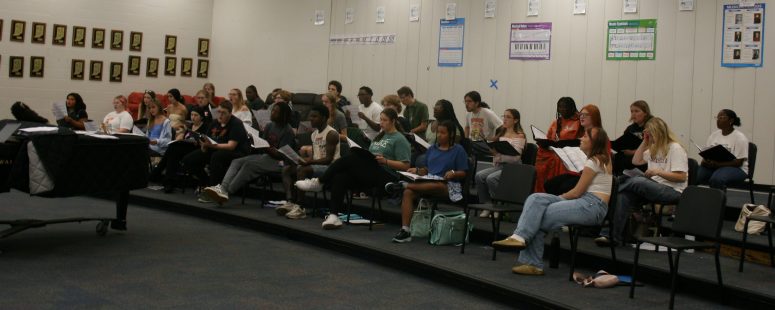
The choir practices for Gospelfest on August 11. Gospelfest will be performed next Thursday, Sept. 18. Photos by Aurora Grisham.
“For regular chorus, no skills are needed, although a past (with music) is helpful. Upper chorus, you have to qualify,” said Broady.
Students are required to be engaged during class. There are also times that students are required to stay after school to practice. However, with the chamber choir, the expectations are a bit higher because they are more experienced.
On Thursday, Sept. 18 Broady said the annual Gospelfest will be performed in the JHS auditorium. Additionally, On Dec. 9 and 11, there will be a Winter Fantasy performance with solo and ensemble musicians. In choir, students will be required to wear uniforms for performances, which consist of formal, black attire.
Continuing the journey into theater, theater arts teacher Derrick Ledbetter said to get into his class that students must audition. Ledbetter said the biggest skill to have in the theater experience is an open mind.
Ledbetter encourages students to rehearse and prepare for the JHS theatrical performances. In late October, theater students will perform “Once Upon a Mattress” and later in the year, they will perform “Cyrano de Bergerac.”
Finally, ending this journey going into band, music education and band teacher Sidney McDonald said most students participate in band during middle school and sign up when they choose classes for high school.
Band director Sidney McDonald shows her fourth-period band class how to keep tempo. Photo by Kaleb Baker.
“We’ve started a beginning band as well, for those who have never done band before,” said McDonald.
The teachers also offer extra help so that they can guide students.
“We have an open band room, which is after school on Wednesdays, so students can come work on any music they are struggling with,” she said.



 thehyphennews.com