JROTC uniforms reflect discipline, pride of cadets

by Raven Baker

The JHS Junior Reserve Officers’ Training Corps (JROTC) program has its own sense of community and discipline. 

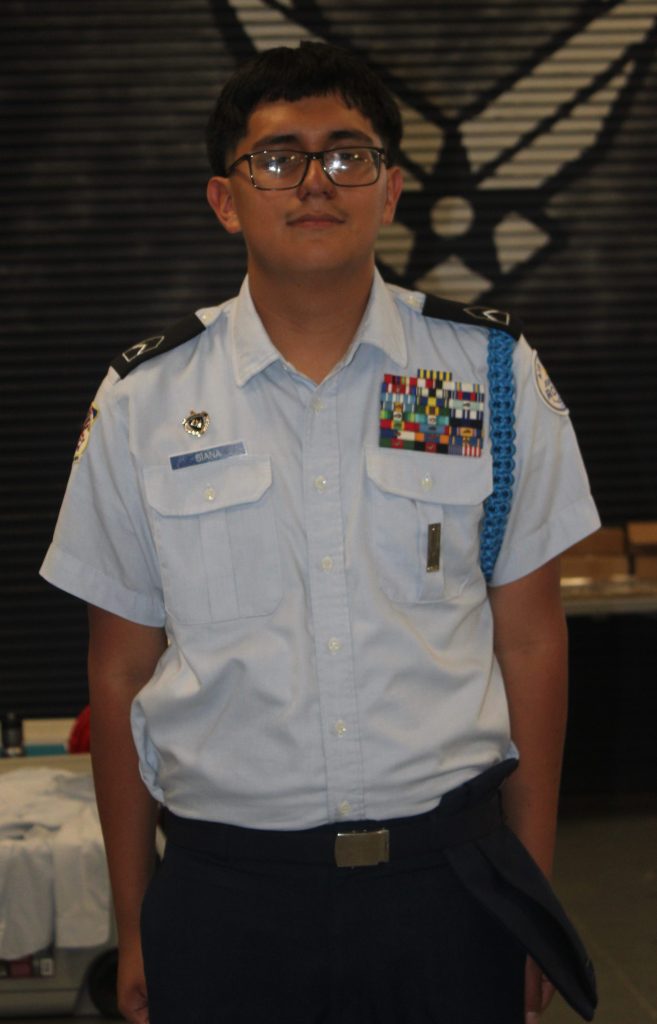
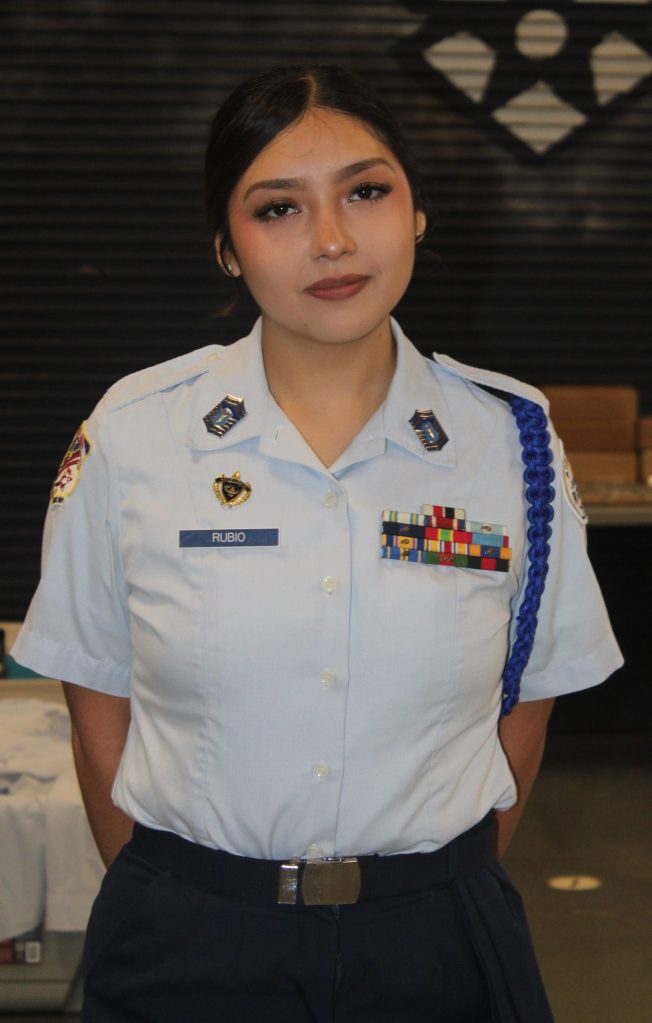
Students train and test on military-related activities to help with starting a future in the military. Cadets also proudly wear their uniforms every Wednesday for a grade – they begin with the blues and can earn their ABU uniforms.

Cadets learn valuable life skills, teamwork, and leadership, which prepare them for both future military service and civilian life.

Junior Angel Siana, Cadet Second Lieutenant; Junior Wendy Rubio, Senior Master Sergeant; Col. Robert Benning; Junior Jocelyn Zarate, Junior Cadet Major; Junior Kameron Hayden, Cadet Second Lieutenant. Photo by Ashton Walcott.

Col. Robert Benning said uniforms are important to the tradition of the program.

“The purpose of school-issued uniforms for Junior Air Force cadets is to instill customs and courtesies, ensuring they learn to properly and proudly adhere to military standards,” said Benning. “The uniforms serve as a tool for education, preparing students for potential military careers by getting them familiar with regulations and expectations.”

Benning described several different uniform types.

“Students learn different uniform types like the OCP, which replicate active-duty wear. They also have their ABUs, which you earn with hard work put into the class.”

In addition, Benning said uniforms are tied to the grading system, “where older students grade younger ones on their uniform based on standards, which shows the importance of precision and regulation. The uniform is a key component in developing discipline and a sense of belonging within the JROTC program.”

Junior Angel Siana, Cadet Second Lieutenant

“I feel okay about the uniforms now that I’m more comfortable, though I was a bit self-conscious at first. It’s important for uniforms to be correct to set a good example for others. The uniform check is a bit lenient, but it’s preparing me for discipline.”

Junior Kameron Hayden, Cadet Second Lieutenant

“I find the uniforms comfortable, and they help me feel ready. It’s important to wear them correctly to show respect and be a good example. The uniform check is pretty simple, and it’s preparing me to be organized and disciplined.”

Junior Wendy Rubio, Senior Master Sergeant

“The uniforms aren’t bad, and I’m getting used to them; they help me with responsibility. It’s important to have them correct to show respect for the uniform and follow the rules. The uniform check requires a decent effort, and it’s preparing me for military experience and neatness.”

Junior Jocelyn Zarate, Junior Cadet Major

“The uniforms are not too bad, and I feel a bit competitive about them. Having them correct is important for assignment grades and helps me weekly. It prepares me for the future in the Air Force, and I’m part of JROTC for community service and field trips.”

Benning said the JROTC program is a class to build up discipline and physically prepare students to be ready for the military, or help them start their future. The uniforms serve the purpose of giving encouragement to students on learning discipline and how to be neater, which are positive traits to obtain. 

Benning wants his students to wear their uniform with pride, but also properly. The uniforms also serve as an educational tool. Students enjoy their uniforms knowing they’re the example for the underclassmen. They show respect to the purpose while also being comfortable.

All photos by Ashton Walcott.

Educators adjust to new Indiana cell phone ban

by Parker Vibbert and Kaylee Borelli

July 30, 2026 ushered in a new school year at JHS. Along with hundreds of new students, there is a new policy here and in all Indiana high schools: no cell phones.

The Indiana State Senate passed Senate Bill 78 in February, instituting a statewide bell-to-bell cell phone ban in every public and charter school in the state.

Before SB 78, the Indiana Legislature passed Senate Enrolled Act 185 in 2024, which banned cell phone use during instructional time during the 2025-26 School year, but set clear exceptions for education, emergency, health care needs, and disability-related accommodations. However, it did not address how schools were to enforce the bans, nor did it address lunchtime or passing periods.

Under SB 78, cell phones are banned bell-to-bell, with minimal exceptions for health reasons. At JHS, teachers and staff confiscate student phones and turn them into the front office in yellow envelopes; students and eventually parents must pick confiscated phones up at the end of the school day or after school.

Teachers and staff place confiscated cell phones in yellow envelopes for student or parent pick-up at the end of the school day. The change in cell phone policy is a result of legislation passed in Indiana and signed into law by Governor Mike Braun. Photo by Ashton Walcott.

German Teacher Lisa Stumler said the ban is necessary and beneficial.

“I’ve noticed people looking each other in the eye more now, and in the hallway, they’re paying attention to where they’re going, and they’re not all looking down,” Stumler said.

“It’s easier in class to not be paranoid, ‘Are they just on TikTok?’ I don’t have to think about that at all,” she added.

Previously, the policy regarding phones at JHS was largely at each teacher’s discretion, with most simply forbidding phones during instruction, but allowing them after. 

Stumler allowed students to use their phones during non-instructional time, or as a substitute for a Chromebook. Unfortunately, Stumler said they would often become distracted.

“They’d just want to scroll.”

English teacher Justin Linde is “not during instruction” policy worked for a short time, he said, but it ultimately fizzled when students stopped putting their phones in calculator pouches.

“After a couple of weeks, it became ‘I don’t have a phone,’ and I couldn’t accuse someone of not having a phone. It got to the point where everybody was on their phones. Regardless of it being an honors class or a regular class or AP,” Linde said.

The new legislation has significantly impacted media classes, designed to train future journalists to properly use technology.

Radio and broadcasting teacher Fred Cowgill said the statewide ban has heavily affected WJHI’s operations.

“The entire business of broadcast and communications and information, every major news organization is using smartphones. Our entire workflow from the moment we took over two years ago was using our students’ personal cellphones,” Cowgill said.

Cowgill said WJHI was unprepared for the outright ban.

“When we got wind of it this summer that the state was going to implement this bell-to-bell ban of phones in schools, we were told we’d get a ‘hall pass’ to still use them, but around July 1, we were told ‘No’.”

Cowgill’s words were echoed by principal Pam Hall, who said she was unaware the ban would be outright.

“When they were still talking about putting it into law, they talked about giving schools the autonomy to come up with their own plan on how to do it, whether that would be to allow phones in curricular classes. When the law was enacted, they took that away,” Hall explained.

Cowgill, Hall, Linde, Stumler, and freshman counselor Andrea Schedler all agreed the ban was necessary, but differed on the scope of exceptions.

Stumler, Schedler, and Linde said students should be allowed to have phones during lunch.

“If they can handle it, I think lunch should be a time when they can have it. It gives you downtime,” Schedler said.

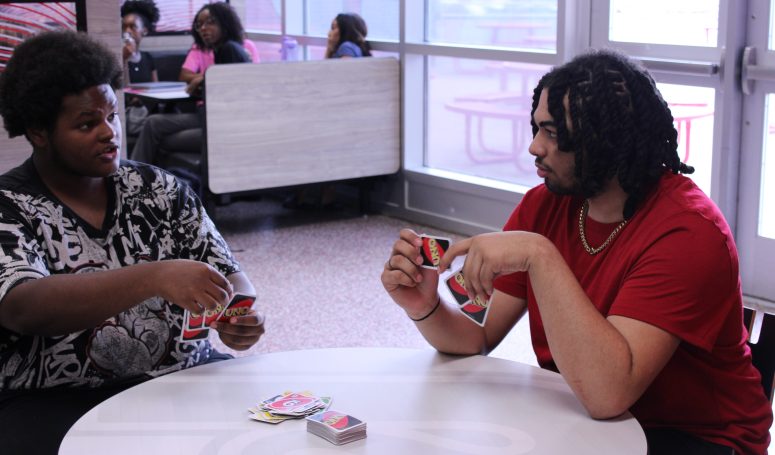
Seniors Joshua Hassan and Ke’moni Mitchell play Uno during B lunch. Students are not permitted to use their cell phones during the school day as a result of new state legislation, including at lunch time. Photo by Ashton Walcott.

Linde agreed. “I think the bill went from one extreme to the other. I don’t understand how you could regulate them in the hallway, or at lunch, and I think students should have access to their phones at those parts of the day.”

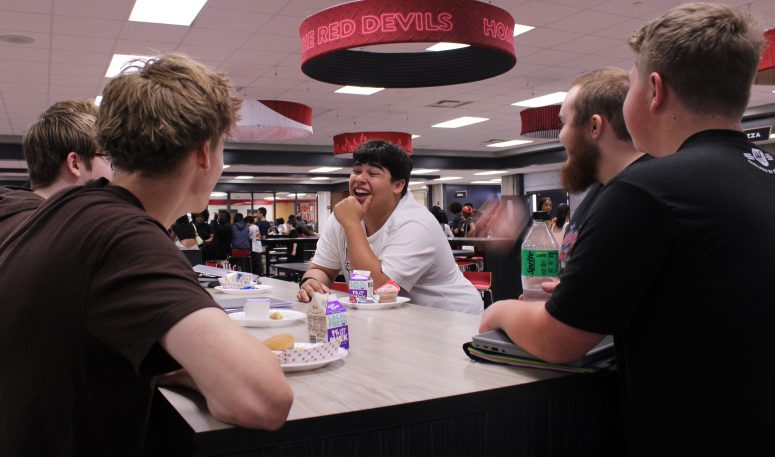
Juniors Evan Floyd, Kenneth Norton, Harrison Cortez, Landon Russell and Gabriel Cecil socialize during B lunch. Public school students may no longer use their cell phones at any time during the school day, including at lunch time. Photo by Ashton Walcott.

Cowgill said student journalism should have been exempt from the ban for curricular reasons.

“The State of Indiana barring smartphone use from its high school communication classes sends the wrong message. We were using them as tools, not as an entertainment device. What better way to teach the correct use of personal smartphones than by giving us the opportunity to do that?”

Hall added that the ban puts an unnecessary burden on emergencies and worried parents.

“I’m one of those parents; my advice to kids is to put it in your purse or in your pocket, turned off or silent at all times, in case something happens, and you have to get out. But don’t have it out. I think it’s important that students, in case of an emergency, have a way to communicate.”

Theatre Department previews two shows focused on teen experiences

by Natalie Creagh and Aurora Grisham

For years, the JHS Theatre Department has presented two shows per year.  Each show is usually an opposing genre, but this season, they are similar. They’re both set in a high school setting around students and their experiences.  

This season’s shows are Mean Girls, the Musical, a musical where a girl moves from Africa and attends a public high school and befriends the popular girls. Throughout the show, the main character, Cady, goes from an awkward new kid to hanging out with the most popular and powerful girls in school. 

Our Play is about a group of high school kids from different backgrounds putting on Thornton Wilder’s Our Town, a new show, published in 2025 by Jessica Moss.

Theatre director Derrick Ledbetter. Photo by Ashton Walcott.

“I think that they are the right fit for our students,” said theatre director Derrick Ledbetter. “I think it’s shows they can relate to.” 

Ledbetter said he chose these two shows with similar themes for a reason – the appeal they have for young audiences.

“I think it goes back to how the shows are in closer experiences to our students,” he stated.

Beyond the theme-related performances, Ledbetter said he has some more ambitions for this season, saying, “I hope we have a lot of people come out. I hope we get a lot of new experiences for people.”

Ledbetter also said these audiences will appreciate the performances of these two shows, stating, “I think it has to do with choosing authenticity over popularity.”

Theatre students are already preparing for the performances this season.

Junior Kahlani Hunt said she definitely has a favorite show this season.

“I’m most excited for Mean Girls. I’m hoping to do tech this year.”

Sophomore Lucas Dimmitt agreed, saying,  “I’m hoping to get a bigger role. I’m most excited for Mean Girls.”

Senior Jalen Nifong said, “I want to accomplish something I’m proud of. I’m intrigued to see Our Play because it’s a lesser known show.” 

The message for the Theatre Department is for teens to be their authentic selves and not to conform to social norms. Ledbetter said he selected these plays not only for entertainment, but also to send an important message to the audience.

Seniors Jalen Nifong and Wyatt Clements act during Derrick Ledbetter’s fourth-period black box theatre class. Photo by Ashton Walcott.