Review: ‘Blue Weekend’ remains a favorite among Wolf Alice fans

by Abigail Hall

Wolf Alice, a familiar name for fans of the indie-rock genre. 

The band is made up of lead vocalist Ellie Rowsell, guitarist Joff Oddie, drummer Joel Amey, and bassist Theo Ellis. They started as an acoustic duo in London around 2010, consisting of Rowsell and Oddie, but Amey and Ellis joined in 2012.

 Since then, they have released four albums; their newest release, titled “The Clearing,” came out in 2025. However, one album of theirs has remained a favorite among their fans: “Blue Weekend.”

Released in 2021, the album explores themes of love, heartbreak, past experiences, and new places, all wrapped up in 11 songs lasting 40 minutes combined. 

It opens with Track 1 named “The Beach.” The song begins with a faint guitar solo and references Shakespeare’s Macbeth, which sets a tone of impending drama and questions like “When will we meet again?” 

The song then gradually fades into a verse voicing Rowsell’s frustration with inconsistent relationships that involve a push-and-pull trope, speaking of her experiences with trying to keep her friendships without ego. “We don’t need to battle, and we both shall win.”

Following right after is Track 2: “Delicious Things.” This song features heavy themes involving the disillusionment of fame and the feeling of being alone in a big city such as Los Angeles, describing Rowsell’s experiences with trying to fit in with the superficial crowd while also wondering where she truly belongs. “I don’t belong here, though it really is quite fun here.”

The band covers the heavy themes with a catchy beat, featuring a lot of building drums and dreamy bass guitar, accompanied by Rowsell’s ethereally wistful vocalizing. 

The track fades out with a hazy, pensive repetition of a lyric describing the underlying theme, filling listeners with a sense of existential dread. “Don’t lose sight.”

One of the most meaningful songs on the record is Track 6, a heartfelt plea for happiness, titled “How Can I Make It Ok?”

The song features lyrics about trying to heal ourselves and the people closest to us, using a memorable rhythm and beat to get the point across. The whole album has an underlying sense of love, whether platonic or romantic, but especially this song. The music slowly builds from an anxious-sounding introduction to an almost desperate, angry ending, which symbolizes the growth of a selfless love. 

With lyrics such as “How can I make it okay? Nothing else is as important as that to me.” and “How do we sell you the world?” the band makes it clear that they are so desperate for a close friend or significant other’s happiness that they would do just about anything, something that can resonate with people all over the world.

The album closes out with “The Beach II,” a sort of sequel to the opening number, which ties the record together in a perfect ending. 

The track opens with a contrasting introduction to its predecessor, a breezy, lighthearted combination of string instruments. Unlike the themes of anxiety in previous songs from the album, “The Beach II” focuses more on closure and acceptance of the life we’re living. Through the lyrics and the softer melodies, it offers a sense of peace and solace in our friendships, rather than trying to keep hold of the stressful, contradicting experiences going on around us.

With the final lyrics being “Happy ever after” and “It’s okay,” the song closes out the album on a lighter, happier note, giving the listener a respite from the heavy heartedness laced in all the tracks.

Wolf Alice, the band as a whole, leaves listeners with a sense of fulfillment after ending the record. Their distinct, memorable style influences their fans greatly, whether they realize it or not.

Don’t lose sight.

Review: Phoebe Bridgers ‘Stranger In the Alps’ debut blends important themes with wistful sound

by Abigail Hall

“I went with you up to the place you grew up in.”

Phoebe Bridgers opens her debut album, Stranger In The Alps, with this lyric from “Smoke Signals.” The album, released Sept. 22, 2017, explores themes such as nostalgia and childhood relationships, combining them with a wistful and melancholic sound.

Bridgers herself was born on August 17, 1994, in Pasadena, California. She wrote her first song at the age of 11, and she was in multiple bands, including Sloppy Jane, throughout her years in high school. Prior to releasing Stranger In The Alps, affectionately known to fans by the acronym SITA, Bridgers released an EP titled The Killer EP, featuring songs like “Georgia” and “Steamroller.”

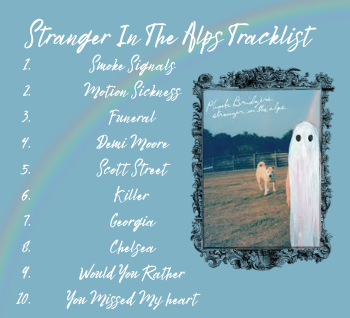
Graphic by Abigail Hall.

Bridgers and her fanbase, known commonly as “Pharbs,” excitedly listened to Stranger In The Alps on its release day eight years ago.

It opens with a song called “Smoke Signals.” The song starts with an instrumental opening, a mixture of bass and violin. Bridgers writes about meeting someone, a partner or significant other, and learning of their past, as well as finding out they have struggled through some of the same things, which made it seem like they were looking for each other subconsciously. 

In the last verse of the track, she includes the lyric, “I buried a hatchet; it’s coming up lavender.” This symbolizes a past resentment for her situation that has grown into calm and a sense of peace, presumably with the help of the aforementioned partner. “Smoke Signals” fades out with an instrumental closing, focused on bass and bells.

An immediate bass guitar strum introduces the next song, “Motion Sickness.” Her theme of past resentment and nostalgia continues with the first lyric: “I hate you for what you did, and I miss you like a little kid.” Bridgers mentions having “emotional motion sickness” and sings about her experiences with an older person, implying her experience with being groomed. 

Bridgers uses vague lyrics that could relate to many people, yet they still hold personal meaning to her. For example, one of the most iconic lyrics in the song: “You were in a band when I was born.” Reading between the lines, listeners can infer that the person she was involved with was old enough, likely an adult, to have a band while Bridgers was a baby. The words hold weight, drawing in many listeners who share similar experiences. The entire song builds up to the bridge, where her tone takes on something more angry when she sings, You said when you met me you were bored. The chords on the guitar gradually fade out into something more wistful.

A seemingly string ensemble transitions into the next song, “Funeral.” A heavier theme belongs to this song, as Bridgers sings about her guilt: “Wishing I was someone else, feeling sorry for myself, when I remember someone’s kid is dead.” Again, she draws in listeners with her relatable emotions, allowing people to feel less alone when they tune in. Though it seems to be about a funeral, this track is more about Bridgers and her awareness of being self-absorbed in depression, making it hard to think much about how others are feeling. She ends the song with a heavy lyric, summing up the whole song and implementing the feeling of guilt and dread all in one. “And it’s 4 a.m. again; And I’m doing nothing again.”

Skipping ahead to arguably the most notable song on the album and perhaps in Bridgers’ entire discography, “Scott Street.”

“Scott Street” begins with a soft guitar solo that completely encapsulates the feeling of nostalgia, which is the aching theme throughout the lyrics. Bridgers puts the feeling of going back to your childhood home in words, her powerful words making your heart sink with memories. A well-renowned lyric, one of the most well-known on the record, is “Do you feel ashamed when you hear my name?” Paired with the heartbreaking guitar, bicycle bells from her childhood, and train whistles in the background, Bridgers has your chest aching. Before you have time to recover, whether from her lyricism or from the memories she’d dug up, she hits you with one of the most heart-wrenching and nostalgia-ridden lyrics ever written: “Anyway, don’t be a stranger.”

While Bridgers has since released another solo album, Punisher, and multiple solo projects with bands like boygenius, Stranger In The Alps remains in the heart of many fans. Her lyricism, experiences, haunting instrumentals, and her somber voice invoke a sense of longing and sentiment in her listeners. Regardless of whether you consider yourself a “pharb” or not, this album will stick sweetly with you.

“Don’t be a stranger.”

David Callan brings professional experience into WJHI broadcast program

by Abigail Hall

Broadcasting teacher David Callan waves his hands animatedly as he explains the basics of editing.

“Drag and drop your video onto the timeline.”

While he appears normal or a generic teacher to a passerby, he has quite a history. Very few people know that he was a producer and executive director at WDRB before he came to Jeffersonville. 

“I did audio, graphics, technical directing, directing, and eventually became the boss. So I did every job you can do in production,” he recalled.

David Callan assists WJHI student journalists with projects in the broadcast production lab. Photo by Abigail Hall.

However, he started out as a courier. 

“I started off as the station runner. So back then, they had people who went to different TV stations, radio stations,” Callan said. “I went to the movie houses to get what they called movie trailers.”

He tells his students about his time in the production world very fondly, but everyone around him is grateful he made the switch to high school teaching.

Senior broadcasting student Alyssa Jendrick said that Callan has positively impacted her school experience in many ways.

“I’d describe him as a great guide to help others,” she began. “After understanding what you need, it’s nice to help others and even inspire them if they’re willing to dream big and open their minds.” 

Other students often speak highly of Callan, stating how great a teacher and mentor he is. However, it’s not just students; his colleagues also admire him.

Colleague and fellow broadcasting teacher Fred Cowgill said, “He is a great broadcaster, enormously talented, but he’s a better man. He spews integrity, he works hard, he has incredible standards and none higher than for himself.” 

Callan and Cowgill work hard together to make the class a fun and educational place for students to be. In the future, they hope to improve the quality of the program in many ways.

“I’m hoping I’ll have some time and I can get into Adobe certification,” Callan stated. “I’m going to put myself through it, so I understand what you need to do as a student.”

Besides editing, broadcasting students work on many other things. They are involved with producing livestreams of sports games that go on here at the high school. 

“We’re trying to elevate the production level of the game,” he added. “I don’t expect you guys to be at the level that I had when I was working at DRB early on. These people, these were professionals who knew how to do the jobs. But what we want to do is we want to get in a learning step.”

Regardless of what he decides to teach, students know that they will enjoy it, just as much as they enjoy his mentorship and presence. He continues to help others in their learning and life experiences, always putting them first.

“Our goal, Mr. Cowgill’s and I, and our goal is to make you better people, to get you more informed as a citizen.”