Annual Halloween field trip provides plenty of scary thrills, props, and characters
by Ricky Cummins
If you are looking for an extreme haunted experience, the Haunted Hotel in Louisville pulls no punches.
The moment that hotel visitors arrive it is clear that you are in for a roller coaster ride of fright and fear. The actors have no beliefs in personal space or boundaries and they can and WILL touch, grab, throw, and pull you around as you move through the hotel. I got pinned up against a wall, pushed down, and pulled by the hair. This haunted house is not for the faint of heart.
From narrow corridors to open rooms, the Haunted Hotel has everything that you would look for in a haunted house. If it’s not the flashing lights, fog and chainsaws or the makeup, props and atmosphere, there will be something that would at least startle you.
“Zizzle,” an actor who interacts with the crowd, looks on as JHS students and teachers prepare to “check into” the Haunted Hotel in Louisville on Sunday night, Oct. 26. Photo by Ricky Cummins.
The wait is the worst and best part. The long lines and loud surroundings can be a little much for younger or older people, or just people who are impatient. But my favorite part of the waiting line was Zizzle, an actor who engages and has fun with the people in line. He is well known for his “sparky” performance and his iconic yellow smiley mask.
When it comes to accommodation they could do a little bit better, but overall is still pretty good. If you don’t want to get thrown around or pushed, they will give you a glowstick to show to the actors or to wear so you don’t get the full ride of what’s to come. The actors will still touch you, though.
My overall verdict would be a 4.5/5 star review. The only reason I don’t give it a 5 is because they send in people too quickly. Multiple times my group had to stop and wait for the group in front of us to get ahead so we could go. Other than that, I had a great time. I would highly recommend it.
I grew up on a farm surrounded by wide-open fields, dirt roads, and the sound of animals waking me up in the morning. Life felt simple there. I had my mom, my dad, my brother, and my dad’s side of the family all around me.
Most days were spent running the gator through the grass, feeding animals, or climbing trees. I remember the smell of hay in the barn, the rumble of tractors, and the way the sky glowed orange when the sun set behind the fields. At night, the stars looked close enough to touch, and the only sounds were crickets singing and the distant call of an owl.
That farm wasn’t just where I lived, it was my world. That farm felt like home, and I thought it always would be.
But one day, everything changed. My grandmother came and picked me up from the bus stop of my long rocky road from the farm and told me I was moving away from the farm. At first, I didn’t understand what it meant. Packing up my room felt strange, I was putting pieces of my childhood into boxes, not realizing I wouldn’t see that place again. I held onto little things like my favorite toy tractor, a picture of me with my dad by the barn and placed them carefully into boxes. It felt like I was putting pieces of my childhood away.
When the moving day finally came, I climbed into the car and pressed my face to the window. As we drove away, I watched the fields, the barn, and the trees getting smaller and smaller until they were gone. The farther we went, the smaller everything looked, until it was completely gone. I felt like a part of me was left behind.
Moving to the city was like stepping into another world. The first thing I noticed was the noise. Instead of birds and cows, I heard cars honking, people shouting, and sirens in the distance. The air didn’t smell fresh anymore, it smelled like pavement after rain, exhaust from cars, and food from restaurants we passed. The houses seemed squished together, side by side, with tiny yards that felt nothing like the acres of space I used to have. Even at night, the city wasn’t quiet. Lights from street lamps and buildings replaced the stars, and I missed looking up at the sky and seeing nothing but constellations.
Adjusting to life in the city was hard. I had grown up with so much space to run, but here I had to stay on sidewalks or in crowded parks. People dressed differently, talked differently, and even moved faster. I felt out of place, like a farm kid dropped into a world I didn’t belong to. My mom tried to make the new house feel like home, but I could feel the change in her too. My parents had split custody, and suddenly, my life felt divided.
For a while, I still saw my dad, but then one day, I didn’t anymore. At first, I thought it was temporary, that maybe he was just busy and would come around again. I kept waiting for the phone to ring or for him to show up. But weeks turned into months, and months turned into years, and he never did. Losing the farm was hard, but losing him was harder. It was confusing, painful, and something I didn’t know how to explain. I carried questions that never really had answers.
As time went on, I had to learn how to adjust. I had to learn the “city way” of living, walking down busy sidewalks, getting used to neighbors being so close, and not hearing crickets at night. I learned how to cross busy streets, how to sleep even when the city never seemed quiet, and how to find little comforts in a place that felt so different from what I knew. It wasn’t easy, but slowly, I figured out how to fit in. Over time, the sidewalks didn’t feel so strange, and I started making memories in the city too. The farm kid inside me still missed the country, but I learned to find pieces of comfort in my new life. But even as I adjusted, a part of me still missed the smell of fresh cut grass, the silence of the country, and the closeness of family on the farm.
Looking back, moving away from the farm was more than just changing houses. It was the moment everything shifted, my family, my home, and even the way I saw the world. It was painful, but it also taught me something important: how to adapt and be stronger, even when life feels unfair or doesn’t go the way you expect.
The city may never feel exactly like the farm, but it became part of who I am, and so did the lessons I learned along the way.
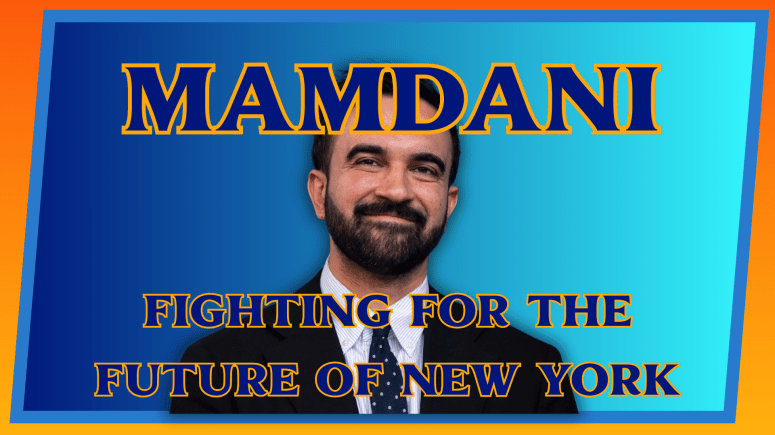
In June, New York State Assemblyman Zohran Mamdani won the Democratic Primary for this fall’s NYC mayoral election. Mamdani’s win was attributed to a late-stage surge in popularity among young and liberal voters who felt disenfranchised by the establishment Democratic candidate, former New York Governor Andrew Cuomo.
Mamdani, a self-described socialist, has attracted controversy for his political views and his Muslim faith. “Old Guard Democrats” – the more moderate, older, and establishment members of the party – have generally stayed silent on or criticized Mamdani.
Mamdani is widely regarded as the favorite and a shoo-in come November. Embattled incumbent Eric Adams mounted an independent re-election campaign after forgoing the Democratic Primary, which would have ensured his defeat; however, Adams dropped out of the election on September 28th. Mamdani is facing former primary opponent Cuomo and the Republican nominee, Curtis Sliwa.
In my opinion, Mamdani will win, and I think he’ll do good things for the city, but I don’t believe his socialist approach to running the largest city in the United States is the best one. I do think New York would be better served by a more traditional, moderate-liberal candidate, not a socialist akin to Senator Bernie Sanders or Congresswoman Alexandria Ocasio-Cortez.
Most of Mamdani’s campaign is based around lowering the cost of living in the city; his approaches include freezing rent in the city; fare free busses; the new department of community safety; no cost childcare; city-owned grocery stores; triple the city’s production of permanently affordable, union-built, rent-stabilized homes; cracking down on bad landlords; and higher taxes on corporations and the richest New Yorkers to pay for his programs.
These are good programs, no doubt, that I mostly agree with. Freezing rent in the city is probably one of his best ideas. A majority of New Yorkers are tenants, and more than two million of them live in rent-stabilized apartments. Adams has taken every opportunity to squeeze tenants, with his hand-picked appointees to the Rent Guidelines Board jacking up rents on stabilized apartments by 9% (and counting ) – the most since a Republican Mayoral Administration.
Mamdani plans to immediately freeze the rent for all stabilized tenants and use “every available resource” to build the housing New Yorkers need and reduce the rent. However, I do believe his promise of city-owned grocery stores, while a good idea for easing financial burden, is unrealistic and too idealistic.
Cuomo’s plans to improve affordability include increasing the supply of affordable housing, expanding access to affordable healthcare, guaranteeing universal 3-K, increasing childcare options, making transportation more affordable by expanding discounted access to buses, and significantly increasing the percentage of New Yorkers who enroll in the subsidized Fair Fares programs for which they are eligible. provide targeted tax relief to lower-income and middle-class voters, including homeowners, worker protections, and via tax-cutting measures.
Forgotten and certain to lose, the Republican Nominee for Mayor, Curtis Sliwa, the founder of the Guardian Angels, was previously the 2021 Republican Nominee, losing to Adams. Sliwa plans to utilize vacant New York City Housing Authority apartments, pointing to thousands of vacant apartments within the NYCHA system as an untapped resource for addressing the city’s housing needs.
A better candidate, such as the current and former Congressman for New York’s 3rd Congressional District, Tom Suozzi, a pragmatic moderate, did not run in the Mayoral Primary. Suozzi has criticized Mamdani and Ocasio-Cortez. Suozzi has said that “every” Democratic socialist should leave the Democratic Party and form their own party. He expressed his wish that Mamdani lose the general election since it would “be bad for the Democratic Party” if he won. Suozzi has also voiced his wish for the Democratic Party to work with the Trump Administration.
Cuomo is too embattled and unpopular, resigning in disgrace from the governor’s office in 2021 after 14 accusations of sexual harassment, and the controversial matter of his understating the toll of COVID-19-related deaths in state nursing homes by as much as 50 percent while governor. For this, he is currently being investigated by the United States Department of Justice.
While Cuomo is certainly the most qualified candidate for Mayor, Mamdani is the most popular and the most likely victor. New York City’s politics, leaders, and politicians have attracted considerable criticism in the last four years, during former President Joe Biden’s term and the previous years of Mayor Adams’ term. Adams has proven a corrupt, self-serving, lying criminal idiot without a backbone and is arguably the worst mayor in New York City history.
On Sept. 3, it was revealed that the Trump Administration had reportedly talked to the Adams Campaign about offering the mayor a position in the Department of Housing and Urban Development, or as the Ambassador to Saudi Arabia, if Adams agreed to drop out, so Cuomo stands a better chance of defeating Mamdani in the election. Adams, however, denied this and refused to drop out of the election on Sept. 6. However, with his ever-flip-flopping nature as evident as ever, Adams finally dropped out on Sunday, Sept. 28.
The 2025 New York City mayoral election is simultaneously the most controversial and potentially corrupt election of the year, and the most clear-cut in terms of who will ultimately emerge victorious. Zohran Kwame Mamdani, a 33-year-old socialist, a Ugandan-born Muslim immigrant, will become the 111th Mayor of New York City on Jan. 1, 2026.
And for this, New York City will receive what I believe will be effective, boots on the ground, support for the 8 million that inhabit the five boroughs. Mamdani may not be the most ideal or perfect candidate, but with the choices we have, in light of the past, Mamdani is the best choice for Mayor of New York City
In our country, we’ve come to know the news as a cycle of proliferating madness. It can make the most minuscule events seem like the end of the world, and the most dangerous of people seem like strong leaders. Lately, there’s one man that media across the board seem to be going after. Fox News, The New York Times, and The Atlantic, just to name a few, have taken aim at state assemblyman and mayoral candidate Zohran Mamdani.
The Democratic Socialist seemingly emerged from nowhere with a strong base of support and the rhetoric to stand against the other Democratic nominees in the New York City mayoral primaries. This is where he first started making waves for those outside of the city. Mamdani stood on stage and grilled Andrew Cuomo on a plethora of issues that plagued the former governor’s reign.
Cuomo’s stint in office was fraught with controversy. From sexual harassment allegations to hospital overcrowding during COVID to misappropriation of city funds for his own personal use, it’s a surprise he even had the courage to run again. In the Democratic primaries, Mamdani was the hardest on Cuomo, calling him out for many of the issues that arise with the idea of another term. It’s this type of aggressive rhetoric that we must show to politicians who have failed us. We can’t settle for corruption to fight corruption.
One of the biggest issues that arose in the primary debate was that of Israel. In the most viral moment of the debate, the candidates were asked where they would go on their first trip outside of the city. Mamdani was the only person to insist he’d remain in New York, while almost every other candidate answered Israel, as well as Canada and the Caribbean.
This may be one of the most pivotal moments in American history regarding our relationship to Israel and the ongoing genocide, especially after Mamdani has come out on top in the primaries. He has been one of the key voices addressing the ethnic cleansing with its true moniker of a genocide. At the same time, he has maintained a good relationship with the Jewish population of New York, even being backed by “Jewish New Yorkers for Peace.”
In a country in which the consensus among politicians is that the conflict is “complicated,” a voice that assesses the situation for what it is might be the change we need. Beyond just this issue, Mamdani is gaining support for his rent control, public transport, and city-owned grocery store policies.
Do not get it twisted. These are Socialist policies, but they are not scary policies. The media and many establishment politicians have critiqued them for being good on paper but not realistic. Of course, we can’t say for sure that this will all come to fruition, but the plan that Mamdani lays out is quite strong.
Taxing millionaires and big corporations is a working-class dream. As we’ve seen across the country, even in Republican areas, people are tired of the 1% hoarding their wealth that they will never be able to entirely spend. This isn’t a baseless claim, either. Senator Bernie Sanders — who paved the way for this generation’s Democratic Socialist s— has been making waves across the country in his “fight against oligarchy” tour.
On the YouTube channel “More Perfect Union”, Sanders was followed around West Virginia as he interacted with the mostly Republican population. The reaction was astounding; the same problems that Mamdani is trying to address in New York are found all over the U.S. Billionaire tax breaks, health care, and child care, all in the heart of Trump country.
Simply raising the taxes on corporations to the same level as that in New Jersey, and putting a 2% tax on every dollar beyond that of a million would be fund many of the policies that Mamdani advocates. The argument here is that it would push corporations out of the city.
In Cornell University Professor Cristobal Young’s book “The Myth of Millionaire Tax Flight: How Place Still Matters for the Rich,” this myth is largely debunked, finding that just .3% of millionaires who do end up moving (which is an astounding 2.4%) do not find themselves in a lower-taxed state.
These types of policies aren’t unpopular; they’re just demonized by the most elite of businessmen and politicians. The clearest sign of the policies not being unpopular is the fact that Mamdani did indeed win the Democratic primaries. Establishment Democrats are scrambling to cope with this. Cuomo and former mayor Eric Adams are both now running as independents against the nominee with a pathetic imitation of Mamdani’s campaign.
They cannot seem to catch on like Mamdani is, and why is this? People do not trust Cuomo or Adams. With Cuomo’s previously mentioned controversy and Adams’ history of bribery allegations, these are not politicians who are known to be trusted. Adversaries of Mamdani say that these two candidates are “more experienced,” but the question is, what are they more experienced with?
Cuomo is shown to not be able to understand the word “no” not just from his sexual harassment scandals, but from his inability to back down when he loses an election. He fumbled the COVID-19 pandemic, understating the amount of nursing home deaths by a whopping 50%, and then using state funds to write a book about how great he handled the situation.
Adams, on the other hand, has been shown to be an incompetent and untrustworthy candidate. In 2024 the mayor found himself indicted on five corruption charges, which would be later dismissed by Trump’s Justice Department. This corruption ended in the resignation of multiple federal prosecutors who had taken on the case.
The Republican nominee, Curtis Sliwa, has little chance of making any real headway in this race — albeit more than Adams. Probably the most absurd out of the candidates, he wears a red beret and insists that putting feral cats in rat infested areas is the solution to the pest problem. Of course, there’s more to him but those two peculiarities sum up the substance of his campaign.
Due to there being four main candidates, the vote may be more split then we’ve ever seen in the city, but frequent polls show Mamdani dominating the field. It seems he represents everything we’ve lost in this country and much we’ve dreamed of.
A government that provides. Not a copy-paste centrist who provides marginal benefits to the working class, while giving the rich more tax cuts. Not a faux-populist who takes advantage of the working class to jumpstart an authoritarian regime. Zohran Mamdani isn’t just the future of New York, he’s the future of America.
While the old guard dies off, remaining more loyal to AIPAC than American people, Mamdani pushes the left forward. He provides a framework for which the new left can emerge. With Governor Hochul’s support it’s clear that Democratic Socialism is going to be a consistent voice in politics. The only question now is if it can get nationwide working class voter support.
Editor’s Note: For an alternate take on this year’s election, check out Parker Vibbert’s column tomorrow.
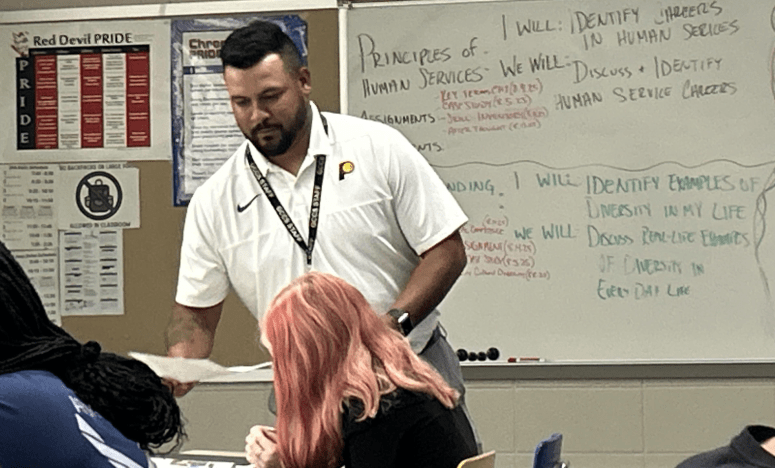
Principles of Human Services teacher Kyle Keplinger hands out assignments to his seventh-hour students. Photo by Ayianna Maddox.
by Ayianna Maddox
When someone says that they work in Human Services, the automatic thought is Child Protective Services (CPS) or counseling. But, CPS and counseling are only fractions of Human Services. What other fractions make up the whole pie?
“It’s not just counseling mental health; there are a lot of different avenues people can go down. We need each of those services, from cosmetology to police officers and firefighters. It’s all the necessities for day-to-day life,” Human Services teacher Kyle Keplinger stated.
In a way, people in the human services business sacrifice their lives every day. Firefighters fight fires, police officers fight crime, and assist in cases that involve abuse.
Psychologists and therapists put their needs aside to help guide their clients into a better lifestyle. These titles have quite a lot in common, but the most important fact is that they all selflessly put their lives on pause to aid other people.
According to the U.S. Bureau of Labor Statistics, “firefighters sleep, eat, and perform other duties during shifts that often last 24 hours.”
For psychologists, “Psychologists can expect to work 35-40 hours a week, usually Monday-Friday, 9 a.m.-5 p.m. However, they can do more or fewer hours depending on their role,” CPD Online College reports.
As children, we view these people as invincible or immortal. But we have to remember that they are just like us, human. Humans are mortal, emotional, and forces to be reckoned with, but our idols have families and friends too. Putting their lives on the line, knowing they could alter their fate differently each day, to protect others, is an act done out of selflessness and valor.
“It can be emotionally taxing, but it can be a very rewarding career. The reward far outweighs any of the negatives,” Keplinger said contentedly.
Human Services poses as an opportunity to create lasting bonds and carry them throughout life. As life progresses, there will be multiple job interviews, multiple opportunities, but with different backgrounds. Who knows, your future employer could be a life you’ve changed in the past.
Daniel Eks’ recent investment of $702 million as the founder of Prima Matra in the German AI military combat-defense company, Helsing, has sparked considerable controversy among several artists, starting discussions on what our art is funding and the moralities of using platforms that fund programs such as war technology. Many artists have responded with a boycott, and it has made people reconsider their methods of streaming music.
San Francisco band Deerhoof was the first to leave the platform over this; they first announced their departure on June 30, 2025. Deerhoof stated that they didn’t want their music contributing to “AI Battle tech” and that, “We don’t want our music killing people.”
Deerhoof isn’t the only band that responded to the boycott; Xiu Xiu announced on their Instagram page just after Deerhoof: “We are currently working to take all of our music off the garbage hole violent armageddon portal Spotify.” They followed by encouraging fans to cancel their Spotify subscriptions.
King Gizzard & Lizard Wizard followed suit, and so have other smaller artists. Godspeed You! Black Emperor just recently announced their departure from all streaming services this August 17. This problem certainly has the potential to spread to other streaming services.
It seems that many bands have been looking for excuses to leave the platform, claiming the pay isn’t worth it and that the main benefit to Spotify is its “discoverability.” Some artists believe this takes away from the experience as it’s overly accessible, and on the go isn’t the way music was intended to be appreciated. Spotify isn’t a friend of the music industry. It impacts traditional music sales and is by no means a sustainable income on its own. On average, artists make 0.004 cents per stream. That’s 1 cent for every 25 listens.
Jamie Stewart, the frontperson of Xiu Xiu, put it bluntly: “There’s no amount of money that would make us want to participate in a company that is trying to murder people.”
Spotify is the only in favor of this, artists are gaining no benefit. Listeners want their favorite artists getting paid. For example, freshman Sophie Ellis said, “The money should be going to the artists, and the people that actually run Spotify,” and freshman Rowaan Stephens agreed.
This isn’t new news. Daniel Eks’ interests in Helsing go all the way back to 2021. In February of 2021, he vowed to invest over 1 billion through venture capital firm Prima Matra. At this time he made his initial investment and joined the company’s board. Since he has become the founder of Helsing, he claims that his donations are important for Europe’s technological defense, and that his firm’s decision is “right for Europe” and that he is unconcerned with the backlash, emphasizing the importance of AI development and its use on the battlefield.
The majority of bands are against their art funding war in any way, and so are many of listeners. After asking students, it is clear where the moralities stand on AI and Daniel Eks funding.
“It’s scummy,” said junior Kaylee Austin after hearing about the controversy. “AI takes away from art, it helps people be lazy.”
Spotify is the world’s most popular music streaming service. AI being such a big part of it is bound to start discussion. Daniel Ek’s interest in AI goes beyond Helsing; AI is all over Spotify. It’s in our daylists and our DJ, it’s in the weird four-minute video that was at the end of our yearly recap. It’s the mind behind all of our recommendations. Data is being directly put into this AI algorithm; listeners are the product. It seems to be a good idea to switch platforms, and many people do use other platforms.
After asking several students what their alternatives were, it is still clear Spotify is in the lead. But Apple Music, Pandora, Soundcloud, YouTube music are still relevant.
Senior Ciara Lee is a listener of Spotity, but after hearing the news she said she “might not continue.”
Many people online recommend alternatives, but they aren’t exactly perfect either. Many musicians feel putting their music on these platforms is a necessary evil. However, there are many ways to directly support artists. Bandcamp is a great alternative, as artists get to keep 82-85% of their sales. Buying tickets and seeing shows, and making visits to local music shops is also a perfect way to support the minds behind the music.
In Philip K. Dick’s 1956 novelette “Minority Report” a group of psychics is used by the police department to predict future crimes.
In J.R.R. In Tolkien’s classic “Lord of The Rings” the palantir stone is the magical crystal ball which allows the user to spy on others from distances.
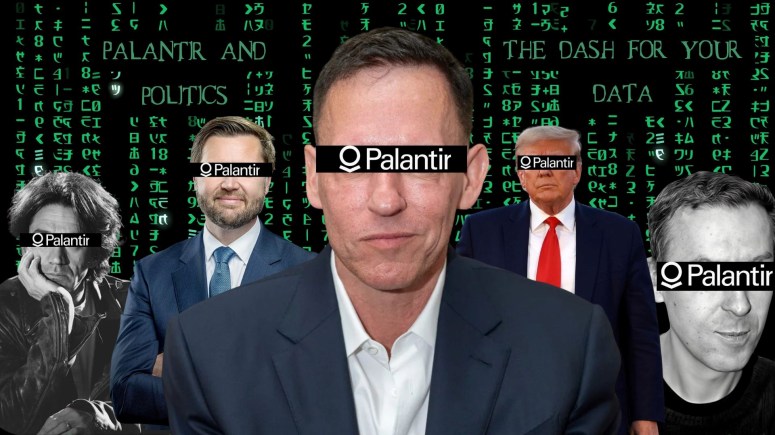
In our world Peter Thiel is the billionaire trying to bring these concepts from fiction to reality and it is anything but utopian.
Thiel founded the company “Palantir,” whose namesake is an on-the-nose reference to the fictional item. The function of the company is simple: Provide AI-powered software platforms to help organizations manage data sets.
But these organizations aren’t the local computer store, and these data sets aren’t just any type of information. They are providing the systems that governments use to predict citizen crimes. They are the authors of an ai used to automate drone strikes. The United States, Israel, the United Kingdom, France, Germany, India, Canada, and Spain all have government contracts with this company.
The entire shadow of our internet presence is to be collected and used against us. You may call it a surveillance conspiracy; they will call it marketing; and this is the problem with unchecked corporations. The U.S. government on our half has surrendered the information of Americans to Palantir and in exchange for what? We must ask ourselves , exactly who is this benefiting?
To understand who this benefits we must understand Peter Thiel, the Infamous billionaire who’s claimed “Freedom and Democracy are not compatible” and who has a passing interest in blood transfusions for eternal life.
In a now viral interview with the CEO, he was asked the simple question: “Should humanity endure?” His answer to this was a vomit of stuttering and a plethora of pseudo-intellectual “Well, what do you mean by that” statements.
Should we trust someone who can’t answer this question simply? Especially with the entire nation’s information?
Current Vice President JD Vance thinks so. Vance had worked in Thiel’s venture capital firm and had 15 million dollars of his Senate campaign funded by Thiel. So whose interests does Vance really have at heart? Well, if we take the so-called “Philosopher behind JD Vance” Curtis Yarvin’s word for it, his interests lie in monarchy.
Yarvin and the as well infamous British Philosopher Nick Land spearheaded “The Dark Enlightenment” movement. An ideology built out of an accelerationist view of the future. That democracy is dead and we must have a CEO monarch take hold of society. This belief also posits that humanity in fact will not endure and AI will create a singularity that we will not be able to come back from.
This may seem like something right out of another Philip K Dick novel but this is our current reality. We must not forgo our democracy to authoritarian lunatics. Palantir’s use of AI under these circumstances is even more alarming. While Thiel might not admit AI is bringing about the end of humanity, OpenAI (ChatGPT) CEO Sam Altman is, openly stating: “AI will probably most likely lead to the end of the world, but in the meantime, there’ll be great companies.”
Prioritizing company and corporation over the survival of humanity is the goal of these people. They are not populists. They’re no longer neoliberals. These are radical monarchists who are ushering in an era of dying democracy. This is the New Right.
But we must remember AI is not sentient, omnipresent, nor metaphysical. It lies in data centers. Data centers which could be torn down and replaced with almost anything better. With Microsoft recently investing 1 billion into datacenters in Indiana, the chance to counter is closer than ever. It isn’t over once they’ve built them as long as we have the strength to fight, to protest, and to speak. These democratic ideals are what they intend on taking from us and no one person living in this country should stand for it any longer.
A sort of dark nihilism has gripped the youth of this country. You know them, the “that’s just the system” or the “nothing ever happens” crowd. But we have to keep in mind that this is not the end and there is no end for humanity in sight as long as we keep our democratic spirit. No longer must we relegate the decisions of infrastructure, labor rights, and civil liberties to the will of a few profit driven maniacs.
This isn’t to say we need to drive our force behind the Democrat Party; truthfully, it’s quite obvious that the Democrat Party has failed us. These are people just as disconnected from who they’re supposed to be representing. Hundreds of miles away from their home states, sitting in Washington, with the same corporations who bought the other side, buying them.
But hope is not lost. With grass roots and anti-establishment Democrats gaining traction in cities like New York and Minneapolis, the term Democratic-Socialist is something progressives are starting to warm up to. With Zohran Mamdani’s looming victory over Andrew Cuomo and Omar Fateh’s endorsement by the DFL against Jacob Frey, it’s clear there is a shift within the party’s values.
Going forward as a country we need to understand just who we’re supporting and who’s financially supporting them. We must become the free country we so often boast of being — free of tyrannical surveillance and corporate lobbyists. We cannot let them tear down our homes for their data centers. We cannot have our peace destroyed for their profit. We must stand and shout louder for every voice they silence. There is a future for us, but we are the ones who have to build it.
Mental health is an extremely intricate topic because there are so many different components to it, yet all of them are equally as important as the other. Mental health issues are really common in youth, ranging anywhere from 10 years old to 20 years old, and more; however, these are the most common. An age range that mental health is an extremely big issue for is the mid teens, like 13-17 years old.
With teenagers, mental health has only become a bigger issue throughout the past few years, stemming especially from 2020 in the COVID-19 pandemic. Mental health is greatly associated with the overuse of social media with teenagers and being stuck in the house in 2020, significantly affecting people’s mental health in a negative manner because one of the main things we all resorted to for entertainment was social media.
Social media can negatively affect anyone because it has come such a long way, and in some cases, that isn’t a good thing. For example, cyberbullying.
Cyberbullying is the use of electronic communication to bully an individual, or multiple individuals. Social media is one of the main ways people communicate in today’s society, and specific platforms and apps are rapidly becoming more and more popular, like the application TikTok. TikTok was essentially a dancing and lip-syncing app and it was meant for ages 13 and up, but several children would get ahold of the app and somehow make their own account and enter a false birth date.
As the popularity of this app continued to rise, the original meaning for the app changed. It went from being a dancing and singing app to an app where graphic news stories would be uploaded or negative posts would appear. These posts were so unlike the other fun posts, that they blew up and went viral, creating more people to want to create that same content. In addition, since almost the entire world has access to this app and the age restriction is able to be bypassed, there are subjects being revealed to young minds that shouldn’t be revealed to them and all kinds of people use this app and many other apps for cyberbullying.
There are accounts on TikTok whose main goal in posting is to degrade certain individuals and then on top of that, people in the comments that are also belittling these people and agreeing with the creator of the account. When someone is being insulted by thousands of people, that is going to take a toll on their mental health without a doubt. Some people will even get bullied by their own friends and peers, which can be worse because these are people you see everyday and have to be around.
A specific story that I always tend to bring up when speaking about mental health is about a girl named Aubreigh Wyatt. Aubreigh Wyatt was a 13-year-old girl that committed suicide due to bullying. Her mother, Heather Wyatt, has used a TikTok platform used to bring awareness to mental health and prevent bullying, whether it’s cyberbullying or in-person. Her mother using her platform for a positive impact on people is what we should be doing with our social media.
If you or anyone you know struggles with mental health or suicidal inclinations, the national suicide prevention hotline is 988.
Editor’s Note: Journalism I students who have published on the Hyphen website this school year were given the opportunity to write and publish a final message to readers on a topic and with a style of their choice.
by Juliette Acuna Garcia
I’ve been told I’m “too sensitive” more times than I can count. People laugh off comments about race, act like they don’t matter, or tell me “it was just a joke.” But the truth is that those comments do stick. They stay with you. I know, because one has stayed with me since I was seven years old.
I was only in second grade when I realized that the color of my skin made people see me differently.
It was recess. I was wearing a bright yellow shirt, my melanin skin beaming in the sun. I was ready to play whatever, with whoever. When this little blonde haired girl appeared in front of me, I was filled with excitement. As I was young, I had no shame. I asked her if she wanted to play with me.
“No…I’m scared of your skin color.”
I froze. I didn’t even know what to say. I didn’t cry or run away. I just stood there, confused and embarrassed, wondering what about me was so scary. When I walked away, I pretended not to care. But I did. That one comment stuck to me like glue.
I wasn’t being bullied out loud, but something in that sentence felt deep, ugly, and wrong.
I didn’t understand at the time, but now I know that was a form of micro racism — those small, everyday comments or actions that show bias without being as obvious as a racial slur. People think racism only looks like shouting or violence, but it can look like a classmate flinching when you sit too close. It can sound like “You’re pretty for a brown girl.” It can feel like being left out of certain things, being trapped in your own mind.
What happened to me that day on the playground wasn’t just one moment — it was the start of a pattern I would notice again and again growing up. That memory made me more aware, made me listen harder to what people really mean when they speak. I started realizing how normal it is for people to make those kinds of comments without thinking twice.
It’s in the jokes, when someone makes a comment about how “surprisingly well” you speak English, even though you were born here. Or when someone says, “I don’t see color,” as if pretending racism doesn’t exist is the same as stopping it.
Micro racism is so normalized that people don’t even realize they’re doing it. It hides behind jokes, “preferences,” and stereotypes. And when you call it out, you often get told you’re “overreacting.” It’s frustrating. It’s tiring.
That day on the playground might seem small to some people. But to me, it was the beginning of realizing that the world sometimes sees me differently, and not in a good way … just because of my skin. And I think that’s why it matters so much to talk about it. Because if we stay quiet, these moments will keep being brushed off as “just a joke.”
I’m not angry at that girl anymore. She was young and probably repeating some things she heard at home. But I do wish someone had taught her better. Because we all deserve to feel safe, welcome, and equal. I know I will never really feel that way, but I’m not that little girl on the playground anymore. I’m stronger, and I’m louder. It made me want to speak out, because no one should feel “scary” just for existing in their skin.
I’ve learned to be proud of my skin, my roots, and who I am. Being ashamed of what I look like will never happen again. I will always remember that little girl at recess, and how one sentence made me question who I was. That’s why I am writing this. Maybe if we start calling out these moments, we can stop them from becoming someone else’s memory, too.
Editor’s Note: Journalism I students who have published on the Hyphen website this school year were given the opportunity to write and publish a final message to readers on a topic and with a style of their choice.
by Ayianna Maddox
To be naive once again.
The world out here is cruel.
To not see crystal clear, but to see a cartoon.
To see the world bright and colorful again, instead of bland and dull.
How I miss hearing the ice cream truck’s tune.
Now I wake to a snooze alarm.
To not have a care in the world.
To yearn for the newest toy, not an extra 5 minutes.
The years passed by, believing they’d last forever.
The memories slip away, but small fragments of nostalgia remain.
Excavated memories and treasures.
Innocence to reality.
The world has never looked the same.
Looking back is realizing that every day that naive child is still present.
That naive child lives in my heart, where she’s always been since the start.
AI has had an ever increasing prevalence since OpenAI’s introduction of DALL-E in January of 2021, and ChatGPT in November of 2022. It has been a popular addition to company websites, search engines, and social media platforms.
The presence of artificial intelligence is nothing new, for Tik Toks “For You” page is able to be what it is due to the use of AI to personalize recommendations for each user. This is similar to X, formally known as Twitter, that also uses this same type of algorithm-based timeline, starting all the way back in 2016.
Yet the current use of generative AI, now not just relying on analyzing existing data, but instead using this data to “create” text or images, is more invasive than it has ever been.
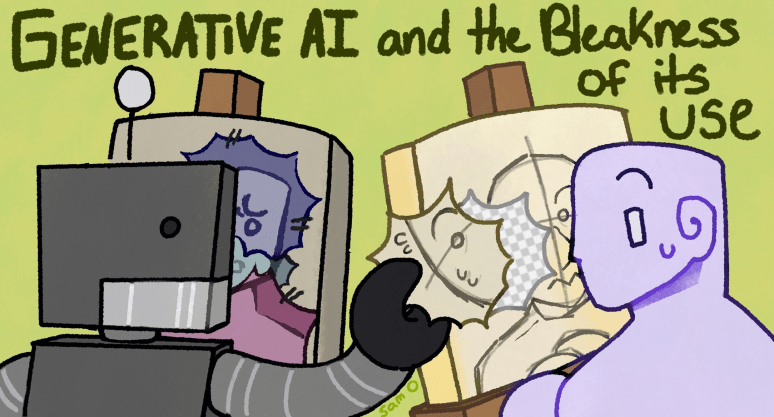
Art by Sam Ottinger.
It’s hard to go onto any major platform without running into generative AI being implemented within it. Search engines like Google have Gemini, website creators like Squarespace have Squarespace AI, and social media companies like Meta have Meta AI.
Many of these inclusions come with a lesser known contract to those that use it. For some companies, this use of AI features gives them permission to use the users data to train their AI models.
Even those that don’t use these tools, or specifically opt out of this use, can still have their work used against their will.
This has been a major problem for many creatives, especially with the presence of popular generative AI websites like DALL-E 2, Midjourney, Craiyon, and recently ChatGPT. Each using datasets, often scrapping images and artworks from artists and photographers all over the internet, in order to produce images that try to replicate their human creation.
Generative AI isn’t just used by a subset of individuals; it’s also found its home through different social media trends.
Some have participated in generating turnarounds from an image, also known as the microwave trend, while others have used it to turn themselves into dolls, mimicking the style and packaging of Barbies or classic action figures. Yet most recently there has been a trend of turning images into the style of Studio Ghibli, using ChatGPT.
This latest trend has caused the most controversy. Hayao Miyazaki, a co-founder of the aforementioned studio, has been outspoken of his dislike of AI since all the way back in 2016. In a documentary called “Never-Ending Man: Hayao Miyazaki,” he comments on an AI-generated demo shown to him, stating that AI’s use is “an insult to life itself.”
This dislike of the technology producing these images has caused many Ghibli fans to be concerned about the disrespect of using AI to copy the hand drawn and intricate style of the real Studio Ghibli – only producing a cheap soulless copy.
The hate on generative AI isn’t only for the stealing from others’ works; it’s also the way its presence has been used to put down the creatives that made it. Many who swear by AI-generated images boast about the quick generating speeds and how it puts out near “perfect” products in that shorter time frame, ignoring the true meaning of creating something through your own living hands.
Without genuine human creation in the world, there would be no data for these AI models to rely on, showing the hypocrisy of this belief that generative AI will somehow ever replace the value in handmade media.
In the past few months, anyone who is paying attention to the news has seen how the conversation surrounding undocumented immigrants has been stealing headlines. Sadly, these discussions have been another example of loud misinformed hate-filled rhetoric from people who attempt to paint a group of individuals as the main problem with America.
Immigration, even when done through the legal process, has always been a hot-button issue. Still, with mass deportations and debate as to whether undocumented immigrants should be afforded the same rights as “real” Americans, the quiet part that racist people have been screaming about for years is finally out in the open:
“You aren’t a person unless you look and act like me.”
People might call me dramatic, but this has been how America has set up its immigration policy for decades now. The Immigration Act of 1924 was an immigration plan that set quotas and heavily restricted immigration from Asia and certain European areas. Why was this? A fear of change, and a fear of those who are different steers this mentality of sweeping racist ideology.
And this hasn’t changed, it’s simply been repackaged. An immigration policy in 2017 that is commonly referred to as the “Muslim ban” made it so that countries that were majority could not travel to America. But it has been repurposed again in the current Trump Administration with a colored tier list for which countries can and cannot travel to America.
Those who have seen the list will note just how strict the travel ban is – and that the majority are from Muslim countries. These restrictions that feed the mentality of danger that those from these countries are inherently more harmful than others are insulting.
Many claim other reasons for why they think undocumented immigrants, or just high immigration in general, is harmful to America. Immigrant restrictionists claim that undocumented immigrants are a drain on the economy, but this is simply an unfounded belief.
So those who claim that immigrants are a detriment to the U.S. economy simply do not actually understand the immense benefits that immigrants bring by boosting the economy and doing their part for society just like anyone else.
The other main argument against undocumented immigrants is that they are criminals and are coming here illegally. That statement in itself is incorrect.
Entering the country without proper documentation is not a crime. It is a civil violation, so immigrants are not “illegal.” Some may call that semantics, but if you are stopped for speeding, you would probably care to know that it’s not a criminal charge.
This second idea that all or most undocumented immigrants are criminals is a fear-mongering tactic that people are falling for and have been for centuries.
The American Immigration Council used data from the FBI and the U.S. Census Bureau and did not find any correlation between higher levels of immigration and an increase in crime levels. In addition, the National Institute of Justice presented a study that argued that undocumented immigrants are less likely to commit crimes when compared to native-born citizens, or citizens born in America.
So where did the idea that immigrants were violent or dangerous come from? Well, there are multiple factors, but in the end, it all boils down to two things: racism and the logical fallacy of hasty generalizations.
Society sees one person of color or undocumented committing a crime and they believe that somehow is a representation of all undocumented immigrants. However, this is partly the fault of the media and the way that immigrants and people of color are portrayed. Often when a person of color commits a crime, the first thing in the headlines is their race. Crimes are a reflection of the person, and yet people expect their whole race and demographic to pay the price for it.
The last ethical fallacy is the “breaking into my house” analogy, that those who enter America without the proper documentation are unwelcomed guests in their home, and that if they were to “break in” to another person’s country or home that they would have to leave.
Here’s why neither of these examples works. First, if you were to destroy someone’s home, and then they came to you asking for housing from the destruction you caused, I believe you would have a moral obligation to house them. That’s a more accurate description of the situation that America is in. America has taken resources from other countries for years and yet now acts shocked when these countries’ citizens are suffering and wish to leave.
The other issue with the comparison of “if I was just going to another country” is the same reason there is a difference between the man who steals to buy a new phone and the man who steals to feed his family and survive. If someone goes to another country just to have a fun vacation and overstays their visa or commits a horrible crime and they get deported, I’ll cry no tears. The problem is distinguishing who is here with good intentions and who is not. ICE and the whole Trump administration have shown time and time again that they aren’t taking the proper steps to give each immigrant the due process he or she deserves to hear each case out.
But why does this matter? Well, as I said at the beginning, if you have been paying attention to the news there is a clear rise of immigrant hate in America. This is happening for all the reasons I have stated, and it’s why people are cheering when people are being thrown in cages. It’s why people who have every legal right to be in America are treated like criminals, and it’s why people argue if undocumented immigrants deserve basic fundamental American rights – because all the issues I’ve described circle back to the dehumanization of immigrants.
For some invisible reason, many believe documented and undocumented immigrants do not deserve due process, a right that is guaranteed under the Constitution. Too many believe that young immigrant children do not deserve lawyers to defend themselves, and that they are guilty until proven innocent.
The direction that America is going to take is scary for anyone who chooses to care. Undocumented immigrants are not criminals – they are afforded all the same rights that any other person would receive. They are human, and that should be enough to make us feel horrible for what is happening. The fact they are human should be enough.





 thehyphennews.com