As a kid, I’ve always thought I would be a teacher, or maybe do something with ocean animals. And I always thought I could just change my job whenever and it wouldn’t affect me. I used to have so many goals and different career paths I had wanted. But now all that is just a fantasy.
Kids like me didn’t even know there were many options for careers only because I was never opened up to the idea of ‘different jobs’.
Now that I’m a sophomore, the next two years really impact my career. I’ve always been indecisive on what I want to do or how I want to do things. And knowing I have to make the right choices sometime this year really scares me even though I know exactly what I want to be, I just don’t know where to start.
I never really thought about how much money I’m going to make, or how confusing it would be to pick the right paths for my career. There are always little Google forms about picking classes to help with a career choice , I never know which ones to pick. It always makes me nervous because I don’t have any idea if I chose the right thing or how it will affect me.
Many people like me feel this way too. There is just a never ending pressure about picking our career. Maybe it’s all too soon?
Teachers don’t give us enough opportunities to explore their career, yes we get to move paths only once maybe twice. But what if that isn’t even enough?
Education should focus on more than making us pick a path early, it should equip us with a broad knowledge base, and explore many different possibilities open to us.
Some students mix up degrees and careers, leading them to pick the wrong classes. I feel us students should have a little more of an understanding about exactly what classes to choose for each career.
Yes, picking a wrong career will not ruin anything. But pressure from friends, family, and society make it feel like it will. Even if we know exactly what they want to be, people can push us to pick classes that have nothing to do with our career.
Feeling stressed about a career can affect our mind and body, as well as, a lot of students overthinking options before making a decision.
Teachers can start giving kids more options at a young age by opening our minds to different ideas and pathways.
In all, students shouldn’t have to stress out as badly as they do just because they have zero idea where to start. Education should have more openings into teaching students where to start.
From reading the book The Wild Robot when I was younger to finally watching it in theaters it meant a lot. The Wild Robot was turned into a film focused on nature as well as motherly love. It came out Sept. 27 2024 and I was ready to watch with the books giving me high expectations.
The movie starts off with a futuristic robot named Roz accidentally arriving on an island full of wildlife trying to do its programming and help any person in need trying to complete its task. Roz starts to understand animal language. The animals in the forest have only rude things to say about Roz just because she’s different from them. Roz tries to leave but finds a duck egg by itself.
She found a task to complete which is to care for the egg with the help of a fox who wanted to help for selfish reasons but turned soft after a while. The main conflict in the story is how to raise a duck as a robot and robots like Roz trying to take her back home from the island.
This animated film has great quality with having the animators from Puss in Boots The Last Wish. Roz was Lupita Nyong’o who did a great impression of a robotic voice. Pedro Pascal playing the fox called Fink had a great personality in his voice that was way different from him in person. Kit Connor as Bright Bill was pretty good.
The story was heartfelt, which gives you a fuzzy feeling with a whirlwind of emotions with a 97% rating on Rotten Tomatoes with 260 reviews, 8.2/IMDb the most talked about detail was their animation and how beautifully they portrayed the book.
Whether we like it or not, phones are everywhere at school. We see them in pockets, peeking from under desks, or being used to text someone who’s just a few seats away. As much as teachers try to control it, smartphones are part of our daily lives now. So, the question is, should they be allowed in school?
Honestly, I think phones can be really useful, like if we need to look up something for a project, want to record notes, or take a picture of the homework on the board. There’s an app for almost anything school related. There’s no question that in today’s world, we use technology for everything from work to communication, so learning how to use it responsibly seems important.
“With the right balance, smartphones could help us learn more and not distract us from learning at all.”
But let’s be real. Phones can also ruin focus faster than anything else. One message, one notification, and suddenly we are scrolling through TikTok for just a minute, that turns into ten. It’s not just distraction, either; phones can cause drama, make cheating easier, or create pressure to look perfect online. School should be a place to learn, and not a place to compare who has the newest iPhone or the most followers.
So, what’s the solution? Completely banning phones doesn’t seem realistic, and letting everyone use them freely definitely doesn’t work. The best option is somewhere in the middle. Use them only when they’re actually needed for schoolwork or let students have them during breaks. And more importantly, teach students how to use technology responsibly instead of just taking it away.
In the end, phones aren’t a bad thing, they’re just tools. How they affect school depends on how we use them. With the right balance, smartphones could help us learn more and not distract us from learning at all.
Solutions:
Make free phone zones.
Bigger consequences if we use your phones in class.
The school can give us phones with no games on so they can use it as a tool.
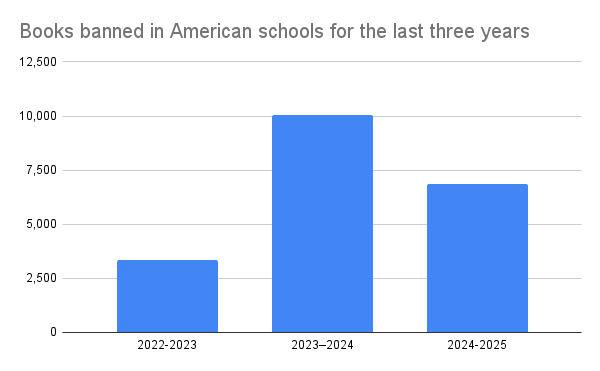
In 1637 New English Canaan by Thomas Morton was officially the first book to be banned in the USA.
It was banned because it was seen as “a too harsh critique of puritan customs.” Of course the ban was just a sign of times. This wouldn’t happen now, would it?
One of the most recent books to be banned in American public schools was Sold by Patricia McCormick. This book is about a young girl who was sold into prostitution but finds strength within herself to go on.
Why would a book like this be banned? If not for control? Why would we shade things like this from a 13-year-old girl when someone the exact same age is living the story. César A. Cru once said, “Art should comfort the disturbed and disturb the comfortable.”
So should we allow just any books in schools? All for the sake of reality? Should adult fiction novels like A Court Of Thorns And Roses be allowed in school because “No book should be banned.” Where is the line drawn?
The line is drawn for the sake of intent. A book that shows cruelty and explicitly for the sake of story telling is a lot different than one that shows it for entertainment.
What is this “intent” ? Sure we can use the concept of the word “meaningful and telling” but what does it mean? I could say that it has intent because it makes me feel happy, right?
No, because the intent is literary intent. It’s about the purpose of the art and how effectively it is dealt with.
In A Court Of Thorns And Roses there are countless adult topics but they are not handled with care or nuance, the reader both gains and loses nothing from reading it. Compared to say The Handmaid’s Tale where it also shares adult topics but in a way that these topics have meaning. Meaning other than to just entertain; meaning to teach.
This small difference in comparison makes a big difference in impact. I can’t tell you much about the last few romance novels I’ve read over the years but I can tell you how the first time I read Anne Frank’s diary in the sixth grade and how it truly made me realise injustice. How it made me want to look for voices that I might not have heard before.
You can tell children about bad things happening, but unless you show them from their views of those people it’s nothing but a cautionary tale for them. Another reason why they should be thankful for what they have.
But they shouldn’t just be thankful, they should be aware of what children their same age go through in the world no matter how “uncomfortable” that conversation might be.
The stories we read shape us just as much as the events we experience. In today’s world we are so capable of seeing each other so why limit that? Why continue ignorance for the sake of comfortability?
Hate comes from ignorance, so why not open a book?
These are the choices for what mode you want to play in a famous 2000s game called Guitar Hero. Guitar Hero was a very popular game, with its first release of Guitar Hero 1 in 2005. The game itself was originally designed for the PS2 and PS3. Still, it eventually expanded to other consoles, including the Xbox 360, Wii, PS4, Xbox One, Wii U, and even mobile devices and handhelds like the Nintendo DS.
There are at least 25 Guitar Hero games. From Guitar Hero (2005) to Guitar Hero Live (2015), and other games based on Guitar Hero like Rock Band, Clone Hero, and DJ Hero as well! I prefer the original, but it’s always fun to try the other games as well. Now I have Guitar Hero for the Xbox 360. Sure, there are some lag spikes here and there, but other than that, it runs smoothly, and I enjoy the game a lot.
There are different ways to play Guitar Hero, too. You can use the Guitars, Drums, Microphone, and even your console controller. I prefer to use the Guitar controller; it makes the experience more immersive and more enjoyable. Guitar Hero even has a practice mode, as well as a learning mode. Practice mode allows players to practice the songs in the game, while learning mode teaches new players how to hit the notes and strum the bar to time it perfectly. It also teaches you cool techniques you can use when playing the songs to help you understand the game’s concept.
Not many people play Guitar Hero anymore. When I’ve talked to my parents, teachers, and even other students, which sucks because, sure, it’s an older game that’s outdated, but it can still be fun to play if you actually try it out.
Should other people play it? Yes, for sure it’s not a violent game, and you battle your opponents with guitar skills instead of guns, chainsaws, knives, etc, and once you beat the game, you’ll have all the songs unlocked so you can practice your skills even more and eventually make your way to expert, which is the highest you can get.
When I’m playing Guitar Hero, I’m fully immersed in the game, from how entertaining it is, and I’ve been playing it for over a year now, and I still love the game. Even though it took me forever, I finally made it to expert, and I’m proud that I made it that far with the game.
“Jump straight to expert. It’ll be difficult at first, but it’ll get easier as you play.”
Those are words that my dad told me when I first started playing, and that’s what I did, and turns out I could do it when I thought that I couldn’t at all, and when I listened to what he told me that day, it all made sense why he said that. When I first tried it, I sucked at it because of how fast the notes were moving, but over time, I learned how to do it, and I got better at it, and that’s how I got to where I am today on Guitar Hero.
Guitar Hero even has a lot of bands in it; some bands even have their own Guitar Hero game dedicated to them. Like Guitar Hero: Aerosmith, Guitar Hero: Metallica, Guitar Hero: Van Halen, and more. Some bands that are in the main games are Nirvana, AC/DC, DragonForce, Foo Fighters, Queen, Slipknot, KISS, and so much more. Another game that a lot of rock songs are on is Guitar Hero: Smash Hits, which has a lot of rock songs that a majority of people know about.
Sadly, over time, Guitar Hero stopped due to market saturation and declining sales, which is sad, but the games that are out, you can still buy and play them. Another reason why they stopped is that Guitar Hero peripherals often did not work with new game versions, requiring further investment, and Activision officially discontinued the series and disbanded its music game division to refocus on other online and interactive entertainment. Even tho RedOctane is the original publisher of Guitar Hero, and over time they closed Guitar Hero for other new rhythm games. But will there be more games in the future?
So what will it be? “Easy, Medium, Hard, or Expert?”
Around 96% of teens aged 13 to 17 are reported to spend time on social media each day. Social media is significant to today’s generation. For example, social media allows teens to connect with their friends, express themselves, and find communities of people with similar interests.
Social media is, for the most part, a good thing. But social media can also be quite harmful and can lead to mental health problems in teens. According to a Pew Research study, roughly 48% of teens say social media has a mostly negative impact on people their age, but only 14% say it harms them.
According to the same study, parents of teens are more likely to be concerned about teens’ mental health than teens themselves. Overall, 55% of parents say they are extremely concerned about the mental health of teens. In contrast, only 35% of teens make the same claim.
Women are also more significantly impacted by social media than men. According to a study by Memorial University of Newfoundland, 88% of women compare themselves to other women online, compared to 65% of men who do the same. This can lead to many problematic things, like self-esteem issues, body dysphoria, and, in extreme cases, can lead to an eating disorder.
Not only does social media harm teens’ body image, but it can also increase the risk of teens having other mental health problems like depression and anxiety.
According to a Yale Medicine study, American teens aged from 12-15 who use social media for three or more hours a day faced twice the risk of things like anxiety and depression.
Even with all these problems that social media can cause, it isn’t all a bad thing. Actually, social media can also be good in many ways.
According to a National Institute of Health study, social media can help teens maintain and build connections with their friends and peers. It also helps teens who might have a long-distance friend or relationship keep in touch. The study states that teen girls who spent time with their friends on social media made their friendships closer.
Social media doesn’t just allow teens to connect with others, but it can also give teens a place of belonging.
The same study shows that different groups of people use social media to find other people like them and create and build communities. For example, teens with chronic or rare diseases used social media to find more people like them to connect and combat isolation.
Social media is both a good and a bad thing. Yes, it can cause mental health problems like anxiety and depression, but it can also allow people to find their community and connect with friends. I believe that if teens use social media correctly, they will find it much more helpful than harmful.
Behind-the-scenes look reveals the challenge of performing and competing in marching band
Editor’s Note: Check out pages 12 and 13 of the December, 2025 print Hyphen for a photo essay on the marching band season.
by Cherish Brown
“You’re just walking, it’s not that hard.”
This is what I hear when I try to express that marching band is just as hard as a sport. I wouldn’t be too upset if people told basketball players that “you’re just throwing a ball in a hole,” or told baseball players that “you’re just hitting a ball with a stick.” But no. Instead, they get praised for their hard work, while people overlook ours. So here’s what actually goes into the halftime show that you see at football games.
The first lesson we had to learn was how to march correctly. It might look like walking to some, but it’s a little bit more than that. There’s a specific technique that we have to use going forwards and backwards. To go forwards we had to learn to walk while keeping our legs straight, and also roll stepping. Roll stepping is rolling off your foot into the next step to make it look smooth instead of robotic.
Now for backwards. We have to walk on our tippy toes, while keeping our legs straight, and we can’t look backwards. If we don’t march on our tippy toes when we go fast, we will fall.
Now that we know how to go forwards and backwards, we now have to learn how to go sideways. The weird part about it is, we can’t have our shoulders facing anywhere but forward unless we are told otherwise. So, to march sideways, our bottom half has to face sideways, but our top half is facing forwards. The only people who don’t do that are the drumline, who crabwalk, and the battery, who don’t move.
“So no, we’re not just walking. We’re working hard, competing, and most of all, performing.”
We can’t just have you watch us march, though; that would be too boring. We had to learn how to play the music. To be honest, it’s really hard music. In the first piece we all have to play 16th notes, which is four notes per beat, which means you have to be quick with the notes, even at a slow tempo. And the second piece is at 160 beats per minute, which is double the speed of the second piece. And all that is hard enough while sitting down and looking at it, but when we’re marching, we have to play off of memory.
Now, we have to learn where we’re going, and how the music relates to how we march. The thing is, we aren’t just marching to random places. If you’re high enough in the stands, you can see that we make shapes with where we’re standing. We have to march to specific places, which are called our sets. And we have to learn the entire song while only marching before we can even grab our instruments.
Then we start playing. We have to go by each set (or spot we’re marching to) and learn which part of the music goes where. It takes a long time, especially because there are three different pieces we have to put together. So, we take many days of practice just learning how the music and our sets relate to each other, when we’re supposed to get where, and how big or small of steps that we have to take to make it on time.
Then, we have to make it look cool. We add what we call our choreography. It’s not actually dancing, like the color guard does with their flags. We do different things. Our choreography includes lunges, pliés, and forced arches. And we usually do those while we’re not moving, so we don’t look like we’re just awkwardly standing there. We also do these while we’re playing our music, so it has to match up with what’s happening musically.
Now we take all of this, that we started learning before school even started, and put it together for everyone’s entertainment. But there is something we do that many people don’t get to see.
We perform and represent the Jeffersonville Red Devils at our own competitions. We competitively perform in front of judges, against many bands in our district. This season our hard work led to an appearance at the state finals, where we placed 15th.
Our hard work got us there — work done over many months, and for some of us, years. I hope this season we’ve made everyone proud, especially the seniors, who have helped us all throughout this season.
So no, we’re not just walking. We’re working hard, competing, and most of all, performing.
Marching band performs its show The Devils in the Details. The Red Devils placed 15th in ISSMA state finals competition this season. Photo by Cherish Brown.
Marching band is clearly a sport
by Caitlyn Brock
Marching is a sport.
I’ve done my first season now in drumline, and it was some work. We had to learn how to march, and we stood for hours on end and didn’t get many breaks. During a typical school week, we practice for 8 1/2 hours of just practice alone, not counting all of band camp and competition days, with some Saturday rehearsals We went to scholastic prelims to qualify for finals and ended up getting 6/7 bands and went to scholastic finals, which took place in October.
Marching band is obviously a sport. First off, it requires physical exertion and skill, just like football or soccer. Next, we compete against other marching bands for a score which also can lead to finals, which other sports have, such as basketball. Finally, it’s done for entertainment, especially because of all the visuals and drill.
Initially, people would think that marching bands are laid back and easy, that all the instruments are not that big and don’t weigh that much, but that is wrong.
Drums can go from being 16 pounds all the way up to 70 pounds with gravity, which can be super difficult. Sousaphones weigh about 50 pounds, and all of those weights can be difficult depending on the person and size, with also having the marching around for 6-9 minutes (depending on the show length) while hitting all of the visuals and drill spots and playing all of the music by memory. That is a lot of expectations for high school musicians.
“Marching band is obviously a sport. First off, it requires physical exertion and skill, just like football or soccer. Next, we compete against other marching bands for a score which also can lead to finals, which other sports have, such as basketball. Finally, it’s done for entertainment, especially because of all the visuals and drill.”
Nobody talks about the demand for marching bands. We’re expected to learn music and hit the drill fairly quickly, given the limited time available, as rehearsals are often lengthy. Some days we are expected to start rehearsal as early as 6:30 a.m., going as late as 5 p.m., and marching in the heat is a whole different story.
We compete just like other sports. We have scholastic prelims — which would be called sectionals for other sports — and scholastic finals, which we get to go to. But we compete against other bands at different schools and get a score. Our scoring may be different than other sports, but we still compete.
Others may say that we don’t run around and throw around a ball or even have the same scoring as other sports, and we don’t do it for any entertainment, and that’s where they are wrong.
That comes to my final reason. Doing all of this work for one show is all for entertainment. We make the whole show look good just for the eyes of the judges and the people watching. We play music that people know for their enjoyment, too.
So that brings us back to one question. Is a marching band a sport? Yes, it is. We dedicate a lot time to it, and we march and play music for hours on end and compete for a score.
And we obviously do it for entertainment, because that is what it is all for in the end.
Wolf Alice, a familiar name for fans of the indie-rock genre.
The band is made up of lead vocalist Ellie Rowsell, guitarist Joff Oddie, drummer Joel Amey, and bassist Theo Ellis. They started as an acoustic duo in London around 2010, consisting of Rowsell and Oddie, but Amey and Ellis joined in 2012.
Since then, they have released four albums; their newest release, titled “The Clearing,” came out in 2025. However, one album of theirs has remained a favorite among their fans: “Blue Weekend.”
Released in 2021, the album explores themes of love, heartbreak, past experiences, and new places, all wrapped up in 11 songs lasting 40 minutes combined.
It opens with Track 1 named “The Beach.” The song begins with a faint guitar solo and references Shakespeare’s Macbeth, which sets a tone of impending drama and questions like “When will we meet again?”
The song then gradually fades into a verse voicing Rowsell’s frustration with inconsistent relationships that involve a push-and-pull trope, speaking of her experiences with trying to keep her friendships without ego. “We don’t need to battle, and we both shall win.”
Following right after is Track 2: “Delicious Things.” This song features heavy themes involving the disillusionment of fame and the feeling of being alone in a big city such as Los Angeles, describing Rowsell’s experiences with trying to fit in with the superficial crowd while also wondering where she truly belongs. “I don’t belong here, though it really is quite fun here.”
The band covers the heavy themes with a catchy beat, featuring a lot of building drums and dreamy bass guitar, accompanied by Rowsell’s ethereally wistful vocalizing.
The track fades out with a hazy, pensive repetition of a lyric describing the underlying theme, filling listeners with a sense of existential dread. “Don’t lose sight.”
One of the most meaningful songs on the record is Track 6, a heartfelt plea for happiness, titled “How Can I Make It Ok?”
The song features lyrics about trying to heal ourselves and the people closest to us, using a memorable rhythm and beat to get the point across. The whole album has an underlying sense of love, whether platonic or romantic, but especially this song. The music slowly builds from an anxious-sounding introduction to an almost desperate, angry ending, which symbolizes the growth of a selfless love.
With lyrics such as “How can I make it okay? Nothing else is as important as that to me.” and “How do we sell you the world?” the band makes it clear that they are so desperate for a close friend or significant other’s happiness that they would do just about anything, something that can resonate with people all over the world.
The album closes out with “The Beach II,” a sort of sequel to the opening number, which ties the record together in a perfect ending.
The track opens with a contrasting introduction to its predecessor, a breezy, lighthearted combination of string instruments. Unlike the themes of anxiety in previous songs from the album, “The Beach II” focuses more on closure and acceptance of the life we’re living. Through the lyrics and the softer melodies, it offers a sense of peace and solace in our friendships, rather than trying to keep hold of the stressful, contradicting experiences going on around us.
With the final lyrics being “Happy ever after” and “It’s okay,” the song closes out the album on a lighter, happier note, giving the listener a respite from the heavy heartedness laced in all the tracks.
Wolf Alice, the band as a whole, leaves listeners with a sense of fulfillment after ending the record. Their distinct, memorable style influences their fans greatly, whether they realize it or not.
Teenagers shouldn’t be forced into choosing a career before they even know themselves.
Freshmen, especially here at school, are encouraged to select a career academy and are required to be in the college and career program.
Indiana added readiness seals to the diploma last year, “to better prepare Hoosier students for the future.” Out of the three, one seal is required to be on our diplomas when we graduate. One of these seals is the employment seal.
The employment seal requires students to complete a market-driven credential of value aligned to a specific occupation, three courses in a Career and Technology Education (CTE) pathway, an approved career preparation experience aligned to Indiana’s CSA program, or an approved, locally-created pathway.
With the employment seal or the plus version, students need 150+ hours of pre-apprenticeship or moderate youth apprenticeship of work-based learning. This can cause a lot of stress, as it requires choosing a pathway and completing all these hours to obtain this seal.
Chart by Liddia Waterbury.
Teens often feel pressured to choose a career path early due to expectations from parents, society, and schools, which include programs such as college and career readiness initiatives and seals of approval. This pressure can lead to anxiety, burnout, or regret later, especially if our early decisions don’t align with our evolving interests.
Many teenagers don’t feel they have enough information to make such a big decision. According to an OECD report, a large number of students feel unprepared. 47% agree “I worry that I am not prepared for life after… school.” 34% say they don’t feel well-informed about possible career paths.
Adolescence is a period of “storm and stress,” marked by emotional changes, identity formation, and uncertainty about the future, particularly in school. This is because teens’ self-identity and interests are still developing. Forcing a career decision too early can limit our exploration and lead to a poor long-term fit.
Long-term stress in adolescence doesn’t just affect well-being now; it can also impact participation while doing work in early adulthood.
Teenagers might lock into a career choice too early, only to realize later we don’t enjoy it. This can lead to switching majors, careers, wasted time, or regret. As our interests and identities evolve, early commitments can limit our future options.
College and career programs, as well as readiness seals, play a crucial role in shaping our future in college and the workforce. However, schools should emphasize exploration over commitment.
As teens, we need time to understand ourselves before making significant decisions about our futures. When we are rushed into choosing a career, we are only pressured and confused. Giving us space to explore helps us choose a path that truly fits who we are.
Americans must learn about modern humanitarian crisis
by Ameerah Gbadamosi
Sometimes there are problems that exist on the other side of the world that we don’t know about or pay much attention to. For example ,Sudan.
Sudan is facing one of the worst humanitarian crises in modern history due to the ongoing conflict happening between the Sudanese Armed Forces (SAF) and the parliamentary Rapid Support Forces (RSF) plunges the nation deeper into turmoil.
The war, which started in April 2023, has devastated communities, displaced millions and worsened an already dire humanitarian crisis.
Even before the war erupted in 2023, Sudan was already experiencing a severe humanitarian crisis that left 15.8 million people in need of aid. Now over two years of war have drastically worsened the living conditions, displacing over 12 million people and leaving 30.4 million people, more than half of Sudan’s population in need of humanitarian support.
More than two years of the civil war going on in Sudan, the civilians are subject to frequent attacks and human right violation, while the country’s health care system has collapsed as life-threatening famine sets in. The attacks on humanitarian aid workers have made it difficult to deliver life saving aid to some of the most fragile and vulnerable communities in the world.
The famine spreading around Sudan as violence hinders humanitarian’s ability to deliver food. Meanwhile soaring food prices and collapse of food supply left families starving.
Between December 2024 and May 2025, over 26.4 million are trapped in a health deteriorating food insecurity, over 630,000 people including in the country’s largest camp for displaced people are experiencing extreme famine conditions and a very high risk of death, the severe food shortage also leaves people vulnerable to illness and infection due to lack of essential nutrients.
Children are among the most vulnerable to famine. An estimated 15 million boys and girls require humanitarian assistance in Sudan, nearly double the 7.8 million at the start of 2023. More than 2.9 million children in Sudan are acutely malnourished, and an additional 729,000 children under five suffer from severe acute malnutrition.
Despite the threats of the famine ongoing in Sudan, both the SAF and RSF are actively restricting aid delivery across Sudan. International organizations like the World Food Programme say they cannot access 90% of the people facing emergency levels of hunger in Sudan.
As if the famine and their suffering isn’t enough, there is an increased risk of sexual violence and an alarming rise of gender based violence against women and girls during times of armed conflict.
In war torn Sudan, rape is likely being used as a weapon of war, and in less than two years, the number of people at risk of gender-based violence has more than tripled.
An estimate of 12.1 million people or 25 percent of the population are at risk of gender based violence with frontline responders and survivors reporting alarming rates of rape, abuse, coersion, and child marriage, trafficking, while survivors struggle to access support.
In Darfur alarming rates of sexual violence underscore the immense suffering endured in those dire situations, which reveals the exceptional vulnerability of women and girls that live there.
As of April 2025, nearly 13 million people living in Sudan have been forced to flee their homes in search of safety. 8 million have been internally displaced by the conflict in Sudan, 1 million refugees lived in Sudan prior to the current conflict-the second highest refugee population in Africa.
The war and genocide in Sudan has not been talked about enough, with what they go through each day. People fear for their own lives because they never know when the war will end or what will happen to them. Women and little girls being raped, famine spreading everywhere, People fleeing their homes because of bombings.
What we can do to help the people living in Sudan is donate anything to a charity cause that helps Sudan, make videos or posts about what’s happening so others can know or donate.
10 facts about Sudan
Sudan is located in Northeast Africa sharing its border with seven countries.
Sudan is home to more pyramids than Egypt.
The capital of Sudan is Khartoum, with an estimated population of 9.3 million in the city.
Arabic is the main language of Sudan.
The majority of Sudan’s population is Muslim.
Sudan hosts over 500 ethnic groups.
Sudan was once home to the Kingdom of Kush, an African kingdom.
Sudan was the largest country in size until 2011.
There are over 100 indigenous languages spoken in Sudan.
The Arab population makes up approximately 70% of the country.
In a non-stop motion world that just keeps speeding up, we can be tempted to let screens take over every aspect of our lives – even our reading. E-books are convenient, and our phones are always in reach; it might seem like the easier option. But there’s a reason physical books are still around and continue to hang on, even when the rest of our world and routine has gone digital. A real book does something a screen can not replace, and pretending they are the same experience is selling reading short.
Graphic by Chloe Newton.
Firstly, a physical book forces you to be present. When you’re holding a book, you are not constantly checking the time or flipping to another app every time our mind wanders to something new. There’s a kind of focus that only physical media can give you – it requires you to sit and stay for a moment without thinking about all of the other distractions in our lives. That kind of slow attention is getting rare, and it is worth protecting.
There is also something physical about the memory of these moments. People often remember where something happened on the page, whether it be in the middle of the chapter or the top left corner. That spatial awareness helps us absorb and recall information better than reading on a glowing screen. Reading books physically helps our brain build a map of the story, not just a trail of scrolling or hitting the turn page button.
“Reading is supposed to be more than content consumption. It’s supposed to be an immersive experience. While technology can have a place in our lives, there’s still nothing better than the feeling of opening and closing a book, turning physical pages, and letting the rest of the world take a backseat.”
Honestly, there is the simple pleasure of the book itself. A book has weight. It ages with the world. It can be loaned, shared, annotated, or thrown in a bag without worrying about a charger or if you will have internet access. A shelf of books tells a story about the kind of person you are in a way a Kindle or tablet never will. When you finish a book and can close it, there’s a sense of accomplishment-something real in our hands, not just a digital checkmark or finish line.
Finally, physical books give us a break from the constant digital noise. We spend so much time on screen at school, work, home, and even in communication that reading becomes one of the only chances to unplug. It’s healthy to step away from the fluorescent light and algorithms and just let our mind wander through our thoughts and through a story that isn’t competing for attention.
Reading is supposed to be more than content consumption. It’s supposed to be an immersive experience. While technology can have a place in our lives, there’s still nothing better than the feeling of opening and closing a book, turning physical pages, and letting the rest of the world take a backseat. That is something worth keeping in mind.
“The Greatest Showman” is a musical about P.T. Barnum, a man who wants to build a life bigger than what he was born into. He creates a circus that gives people who feel left out, a place where they finally belong. The story focuses on following our dreams, even when others think we can’t. It also shows how success can be exciting, but it can create new problems, too.
The main character, Barnum, has a huge imagination and is always chasing something bigger. One character I really respect and admire is Barnum’s wife, Charity. She stands by her husband from the very beginning when he has nothing. She gives up her comfortable life to be right by him and support his dream. She believes in his dream from the very beginning, and that loyalty makes her stand out to me.
The cast of this movie really stands out, especially the people who bring performances to life. Out of all actors, Hugh Jackman as Barnum stood out the most to me. He brings so much emotion into his character that it’s easy to believe his character wants to make a difference. He also handles the singing and dancing so effortlessly.
Zendaya and Zac Efron also add to the movie, especially the chemistry in the scenes they share as Anne Wheeler and Phillip Carlyle, but Jackman definitely carries the whole story.
The music is a huge part of why this movie stands out. Every song has emotion behind it and helps tell the story. “Rewrite The Stars” is my personal favorite because the lyrics and harmony goes together, and every part of the song feels smooth. The soundtrack adds excitement and heart to every scene. The circus itself looks colorful and full of energy, making us wish we could see that in real life.
Even though some people say musicals can feel cheesy, I think the songs in this movie make the message even stronger. And while I didn’t like one specific choice a character makes, it reminds us that nobody is perfect, even the people that seem like they have everything. That honestly makes the movie more real.
What I like most is how everyone in the circus sticks together and lifts each other up when the world tries to bring them down. It shows how family can be people who accept us and support us no matter what. The message of confidence and belonging hits hard.
I would definitely recommend “The Greatest Showman” because it has powerful music, stunning visuals, and a story that makes us think about chasing our dreams. It leaves us feeling emotional and inspired. It reminds us to never forget where we come from and to keep going after our dreams. The message stays with us after the movie ends.
Movie Review Chart
Title: The Greatest Showman
Starring: Hugh Jackman, Zac Efron, Zendaya, Michelle Williams