Graphic by Kaedyn Bowers.

Graphic by Kaedyn Bowers.
by Areli Hernandez Romero
Each year hard-working students taking the Heritage Spanish class hope to receive one of two seals on their diploma and Multilingual recognition their senior year.
World language teacher Megan Cortes prepares her students to take the ‘AAPPL’ test in their junior year of high school to be able to achieve that goal.
The Two Seals
Cortes described the two types of seals Greater Clark County offers to students and what they stand for.
“Greater Clark offers two different seals that you can get. One seal is from the state of Indiana called ‘Indiana Comp,’ which is ‘Certificate Of Multilingual Proficiency’. You can take that in a lot of different languages, not just Spanish. We also offer the ‘Global Seal of Biliteracy,’ which can grow across state and national borders and is also like our state one, but just with different levels.”
Cortes explained the different levels of the ‘Global Seal of Biliteracy’ and how they are broken down, as well as, the ‘Indiana Comp’ seal.
“It depends on what your scores are; so the ‘Global Seal Of Biliteracy’ has three different levels. In high school, you can only earn two levels, so they have functional fluency and working fluency.”
“Functional fluency is what I call the level one seal that you can get — it’s kind of like the lowest one, but still shows that you have a certain level of biliteracy, which means that you can read, write, and understand whatever language you are testing. Then, there is a higher one on the ‘Global Seal of Biliteracy’ called ‘Working Fluency,’ which means you’re in a level where you are competent in all four of those levels.”
Students who take the test can also end up getting both seals on their diplomas.
“The ‘Global Seal’ is broken down and ‘Indiana Comp’ is kind of in the middle for their test scores. So, if you get ‘Indiana Comp,’ you are already going to get ‘Functional Fluency’ on the ‘Global Seal.’ Then, the same thing if you get ‘Working Fluency’ on the ‘Global Seal’ — you’re going to get ‘Indiana Comp.’ Some people will end up with two seals,” said Cortes.
Cortes said the test ‘AAPPL’ may be taken by juniors to get one of two seals on their diploma.
“We offer the ‘AAPPL’ test at our school — it has a whole lot of different languages that we have offered in, and that test is acceptable for ‘Indiana Comp’ and it’s also acceptable for the ‘Global Seal of Biliteracy.’ The test scores will determine what level of the seal you can get and seal you are eligible for. The main difference between those levels of seals that you can get is, what scores you have on the test.”
Eligibility
Cortes said any student is eligible to take the ‘AAPPL’ test.
“However, it’s geared for people who are advanced in a language. You can take a regular foreign language test and still take it. We have several different languages,” she said.
Cortes recommended foreign language students take the test.
“If you are a student who’s never studied a second language, I wouldn’t recommend taking it until you’re at least in the third level. Just because it’s probably too advanced for someone in just like the first or second level, but, yeah, I encourage people to take it if they’re in any kind of foreign language class,” she said.
Senior Alejandra Arredondo Resendiz took the ‘AAPPL’ test her prior year and found it to be a challenge.
“I did take the ‘AAPPL’ test. I passed three of the sections; the only section I didn’t do as well was writing. I’d say I’m not struggling anymore. I think I got the concept down; I just think I wasn’t prepared last year for the test.”
Junior Fernando Leon Garcia looks forward to taking the ‘AAPPL’ test.
“I’m nervous but I’m looking forward to it, to see where my level of Spanish is at and where I could improve on,” he said.
Challenges and Successes
Arredondo said taking both regular Spanish and Heritage classes, along with personal experience, helped her.
“It’s been two years I’ve been in Heritage and took two prior years of regular Spanish I and II. I think it’s been pretty easy. I was born and raised in Mexico, so I got the language down. I don’t have a language barrier anymore for either English or Spanish, but it’s definitely helped.”
Leon spoke about his current struggle in class and the subjects he has improved on in Cortes’s class.
“This is my third year in Ms.Cortes’s class. The only struggle I have is writing, word accents, and grammar. Sometimes I don’t know how to pronounce the words, so I just try to listen and try to pronounce them correctly. My reading has gotten better and my writing has been the same. I still have to work on that,” said Leon.
“I love teaching about culture and history. I think it is really important for our students who are Heritage learners to know more about their heritage, background, and culture.”
World Language Teacher Megan Cortes
Sophomore Ariana De La Cruz Guerrero said speaking two languages has helped her.
“This is my second year in Ms.Cortes’s class. Speaking two languages has helped me because it was easier to come into that class knowing some knowledge about Spanish and it being easier to read and write.”
Cortes said students can retake sections that were missed in their junior year. However, there are certain criteria to do so.
“You don’t have to be in a foreign language class— anyone in this school is allowed to take the test if they signed up to take it. The state has certain criteria, but the way they administer the test in individual districts can be decided.”
“We have decided here that juniors can take the test. If they’re a foreign language student or Heritage student and if they don’t pass one of the four parts — they can still take time to learn in your class and retake those your senior year. Now say, a student took the test their junior year and they’re not in a foreign language class at all — If they don’t pass all four sections, they either have to enroll in a foreign language class, or they’re responsible for paying to retake the test.”
Benefits for the Future
Cortes said taking the test has advantages for students.
“Some colleges will accept it for credit. You can use it to help get a job. There are a lot of jobs that will hire you if you’re bilingual, and some of them may require a test. If you show them that you already have a certificate, then that’s already saying that you are Biliterate. It says you can listen, understand, read, write, and speak at a certain level. So it proves that you are at a certain level. I think that’s really good for a student advancing to college or looking for a job in the community and to be able to use their language skills,” she said.
In the future, Arredondo said she would be able to offer help to others in her career. She explained the different opportunities the Bilingual seals may offer.
“Well, since I’m going into real estate I would be able to help out a lot more in the Hispanic community and be able to get back to the people. It can be a pretty valuable asset in my future resume, showcasing my language proficiency to employers. It can also give me an edge in job applications. Especially, for positions requiring bilingual skills. Additionally, it could even open up opportunities for international work or travel.”
Guerrero explained how the bilingual seal would help with her future career and credited her mom for encouraging her.
“I would use the bilingual stamp in my future career to get paid more because like mom always tells me ‘Tu hablando espanol y ingles vales por dos y te pueden pagar mas,’ meaning since I speak Spanish and English I’m worth a lot because I speak two languages. Also, since I want to be a sports agent I would be able to help the players get represented and speak their minds. I want to work in women’s soccer to help represent women because I feel like it would be nice to help women’s soccer be heard more and make it grow,” said Guerrero.
Being able to speak and understand two languages is important to Leon and his future career.
“How I would use the stamp is by using it in my future career, which is being an architect. I would use it because let’s say I become one of the best architects; by being able to speak two different languages. I could get more clients and be known for being able to do so,” said Leon.
The Classes
Guerrero mentioned the challenges of being in Heritage class.
“Something challenging about her class is writing, especially spelling words because in Spanish they are spelled the way they sound. That confused me sometimes because it’s different in English,” she said.


To prepare her students, Cortes used different exercises with her students before taking the ‘AAPPL’ test
“All of the activities we do in class, whether it be grammar exercises, working on accents, speaking, reading, and writing, will help prepare for the test. But we also work on specific practices. The AAPPL test site has samples of what the test will be like. We do practice sessions before the test so students know what to expect,” she said.
Arredondo spoke about how being in a foreign language class has improved her understanding.
“I think it helps me understand the struggles that different people face regardless if it’s because of a language or not. I understand people more certainly now,” she said.
Leon agreed with Arredondo that being in a foreign language class has improved his understanding and learning.
“My Spanish is much better. When I was a kid it was hard to speak. I would have difficulties having conversations with adults and would stutter a lot. Now my grammar is getting better,” he said.
Arredondo described the current day-by-day structure of Cortes’s class.
“We start off by doing a simple ‘Diario,’ which is like a bellringer for any other class. Then, we get to the basics of the class which are grammar, vocab, spelling, mostly about what we are learning. Right now, we are learning how to go back through the text and be able to pick out certain details and specific information. It helps me find more important details in a text rather than just reading and scanning through it,” said Arredondo.
Accomplishment and Pride
Apart from the rewards students get from the test, Cortes proudly talked about the pride and accomplishment it brings to many students.
“I think apart from the job and college and benefits that you can get. I think it’s a great sense of pride for the students it’s something you have accomplished. It’s something you may have felt anxious about throughout their life. It gives you a sense of achievement. I think that is something their families can be proud of too. I think that is important for the kids to have.”
Guerrero talked about the accomplishment of passing the test and what it meant to her.
“I would feel proud of myself and I feel like it would be a big accomplishment. My family would definitely be proud of me because it would make them feel good because I’m representing my roots and my parent’s country,” she said.
Leon described how passing the test would bring accomplishment to him and his family
“I would feel amazing because if I’m one of the few students who ace the test perfectly. I wouldn’t have to redo any sections next year. My family would be very proud of me for such an accomplishment,” he said.
Arredondo credits Cortes and spoke about the encouragement and pride if she passed the test.
”I think I’d be pretty proud of myself and pretty grateful for Ms.Cortes’s contribution to my success as well. My parents would feel pretty proud and pretty happy. I’d also feel encouraged to continue trying to help out the Hispanic community by furthering my education.”
Cortes expressed the importance of being a teacher and being able to teach her students.
“I love teaching about culture and history. I think it is really important for our students who are Heritage learners to know more about their heritage, background, and culture. Specifically, because a lot of them grew up in the U.S. For me being able to help them learn more about their heritage is really important to me.”
Graphic by Kaedyn Bowers.

All photos by Liliana Castellanos.







Graphic by Ifrah Daber.
Graphic by Lola Mays.
by Ifrah Daber
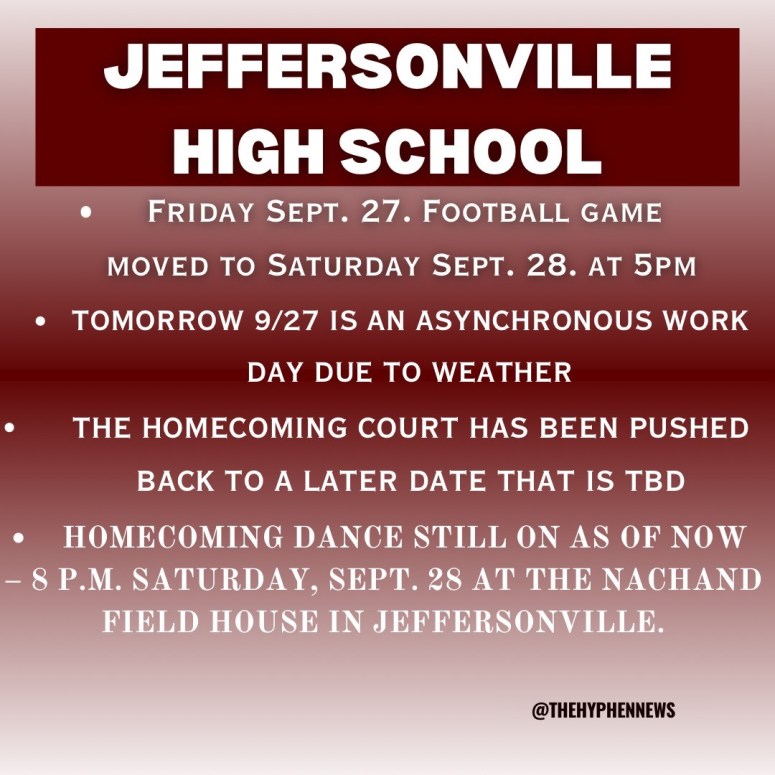
The tradition of a Homecoming dance has been missing at Jeff High for over 20 years. The absence of such a dance has no specific reason, but some theorize budget issues or lack of interest. However, neither of these concerns has held JHS back, as for the first time in over 20 years the Red Devils will finally be having a Homecoming dance at 8 p.m. Saturday night at the Nachand Fieldhouse in Jeffersonville.
“The point is to bring all the students together.”
Senior and Student Council President Koy Ramer
Student Council presidents, seniors Madison Pritchard and Koy Ramer, started the idea to bring back this custom. They knew that past presidents had hoped to have a Homecoming dance, but the idea was always rejected due to issues with budgeting or lack of a defined idea. So when Ramer and Pritchard wanted to plan a dance for Homecoming, they knew they needed a good plan for principal Pam Hall. They worked with the Student Council and sponsors Natalie Woods and Chloe Merkle to create a dance that the school body could enjoy.
“We were in completely new territory,” Pritchard stated.
Given the lack of examples to examine, there was no direction to go in when planning the dance. So Pritchard and Ramer surveyed the student body.
There were many different ideas and opinions, some students wanted an upperclassmen-only Homecoming, while others wanted the venue to be outside or for different entertainment. The pair struggled with finding a way to appease everyone. They attempted to find fair compromises for all students, but some decisions were made, not due to what the students needed, but because of what they could afford.
Most of the money for the dance came out of Student Council funds. A priority was to keep the dance relatively inexpensive. This led to some trade-offs being made. For example, the dance was hoped to be outside originally, but the idea proved to be too expensive.
The Homecoming dance ended up being one of the least expensive dances when compared to other yearly events. The dance only cost over 1,000 dollars, around 500 being for the venue and entertainment and only about 100 for the decorations.
“We wanted to utilize the student body,” Woods stated. A large part of why the dance was able to keep the budget low was due to the fact that the student body was utilized for various parts.
The culinary classes provide the catering via cake pops and pretzel rods. The marketing class helped make the tickets and flyers, as well as providing the ability to use the old Jeff gym as the venue. The Nachand Fieldhouse was both a cheaper venue and a symbolic statement, given its connection to Jeff.
The Nachand Fieldhouse is one of the city’s most historic buildings. Standing on 601 E Court Ave, Jeffersonville, the old court was used as the JHS gym and held the basketball games until 1971.
Due to renovations in 2017, there is one rule given it is a basketball court: all heels or black soled shoes can not be worn on the court. Students can wear them to the dance if they wish, but they cannot walk on the court with them on.
Despite this, it was the perfect place to hold a dance that was meant to symbolize community and school pride.
“The point is to bring all the students together,” Ramer stated.
The concept of unity was a large part of the decision to have a homecoming dance. From the theme of “Light the Night on Fire” being a direct reference to Jeff High’s mascot of the devil, along with allowing all grades to attend, and no outside guests, the center of Homecoming was the students, and they were the strong incentive for planning the dance.
“Students’ excitement and making this happen for the students was our motivation,” Merkle stated; they wanted to provide something new for the students to look forward to.
But despite their best efforts, at the end of the day the continuing of the Homecoming dance is up to student participation.
The hope for participation is 200 students, to help show that the Homecoming dance has enough interest for the dance to continue for years to come as well as to make up for the funds that the Student Council put into the dance.
“You get what you put into it,” Pritchard said, and the sentiment was shared by all who planned the event. The need for student support is at the core of helping the dance be successful and improving it for future students.
The preparation of the dance was a long and hard process, but was achieved by the helpful individuals who planned it for the students. They all hope that students have a fun time, enjoy themselves, and hopefully future students will experience the same joy.
by Jackson Anderson
Retired Clark County police officer Chuck Adams fondly remembers his days working in law enforcement and now spends his days hanging out with grandkids, fishing, and talking with long-time friends.
Adams added that he had wanted to become a police officer since he was a boy. ”As a young man I liked the fact that they helped people and got people through rough times,” he stated.
“I just feel like I helped a lot of people in my career, and I can’t just think of one individual great accomplishment that stands out,” Adams continued to say about his career in law enforcement.
His daughter, Shannon Anderson, backed up this claim by stating, “I would just say he is honest, fair, motivated by doing the right thing and not the popular thing, but most importantly he treated everybody as a human being and not like a criminal, or not like the bad guys.”
Before joining the Clark County Police Department, Adams’s first jobs included pumping gas at the age of 14 at a truck stop, and working at McDonalds, Jeffboat, and Ford Motor Company. His service to the public had already begun at an early age.
Adams stated, “I have lived in Clark County my whole life, long time Clark County resident.”
Best known for his sense of humor, he is always ready to tell a joke or a tall tale to brighten someone’s day.
Anderson recalled two tall tales he told: ”How he wound the old Colgate clock and he hung the railroad lights by hand.”
Adams’ ex- wife, Faye Briley, described how she met him in 1983 on a blind date and has known him for 41 years.
Briley described how he is outgoing, friendly, kind of loud, and just a good person.
“I started dating him because I just thought he was the man I always wanted; he was the whole package. He was dependable, hard working, kind, and the fact that he was nice looking didn’t hurt,” Briley explained.
Briley and Anderson have both said very inspiring and nice things about their experience around Adams.
Briley said, “He has turned out to be a good ex-husband, a good dad, a good friend, and someone I can count on up until this day.”
Anderson described her father to be a very good person and stated, “Overall,I would just say that he is quite the unique individual, and if you have time on your hands it would be worthwhile to have a conversation with him if you have 2-3 hours of spare time.”
Adams retired from CCPD in 2013. He stated, “I was 58 years old and maxed out on my pension. I had enough years to retire and financially able to retire.”
Life is different now for Adams. He said, “It’s a lot different from when I was working — no set times or schedules like when I was working, unless I want to be there.”
His life advice for happiness is simple.
”Well, I think if you try to live your life and be a good person, work hard, good things will happen to you, and your life will be fulfilled.”
by Sam Ottinger
Every year as the fall months come around, an annual and very special performance comes along with it.
This event is Gospelfest, performed in the JHS Auditorium this Tuesday, Sept. 24 at 7 p.m., with tickets ranging from 5-10 dollars.
“It’s a full on gospel experience, right here in Jeff.”
Choir Director Kyle Broady
The very first production occurred 20 years ago, roughly back in the 2000’s. Contrary to what may be believed, the first Gospelfest was put on at New Albany. JHS was able to join in on this blossoming tradition due to both former choir directors being longtime friends.
Gospelfest is an all choir concert, which is entirely composed of African American gospel music, picked and conducted by a special guest who specializes in Black Gospel and jazz, Dr. Roosevelt Escalante.
“It’s a full on gospel experience, right here in Jeff,” choir director Kyle Broady stated.
And an experience it shall be. The choir consists of 150+ students. In addition to the JHS choir, Borden High School will be performing with the Southern Indiana Children’s Choir. A live band will accompany the singers, while the sound system will be used in full in order to project the combining music towards the audience while in a full concert layout.
“This group, in particular, is going to make it pretty special,” added senior Luna Guyse, currently in her seventh year in a choir.
Gospelfest may be a once-a-year performance, but it has touched many hearts.
The choir director at Borden is a JHS alumnus, joining the Gospelfest last year due to how much she enjoyed it in her high school years. Yet she is not the only one with a connection to past Gospelfests, for the choir director of the Southern Indiana Children’s Choir had previously retired from being JHS’s choir director.
Many can’t wait for the performance, including current choir students.
“We have a really good set coming up. We have a mix of good people returning, and a lot of good people coming in, it’s just great,” said senior Ella Motluck, currently in her seventh year in choir.
The excitement isn’t just felt in one student, for the others are just as enthused.
“I’m really excited! Dr. Escalante picked out some really good songs this year,” said senior Sylvana Sandoval Camacho, who currently is in her sixth year of a choir.
There are many challenges that can come with events like this. “I’m not even sure I remembered everything,” Broady joked when showing off a checklist of preparations. And there are the challenges of keeping everyone on the same page when there is not constant contact.
Yet through that all, the choir pushes through it together, motivated by the knowledge of community that their performances bloom. For one of the most enjoyable parts of being in choir is, as Guyse put it, “Doing something you love, with people who love it just as much as you.”