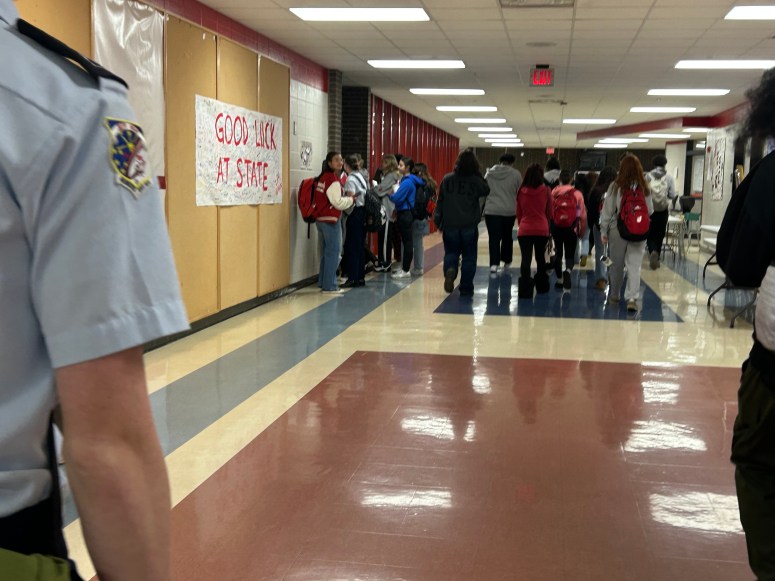
When politics starts touching social life, it doesn’t always turn out well.
From his Jan. 20 Inauguration to the writing of this article, Donald Trump has signed 75 executive orders, primarily focusing on government reform, immigration, border security, and more.
His actions were questionable, like firing and un-firing nuclear workers, but in this article, let me present to you one of the lesser known but still present realities of people being put at risk due to the cutting of funds.
In a society built on money, we will always find a group in need of support. In a world built on international relations, we will always find a country that is overlooked, such as the less rich and popular developing countries like mine, Senegal, but also more famous ones like Argentina.
The funds given by the government were financing non-profit organizations like Child Protective Services, as well as scholarships and grants.
Cultural grant students are students chosen by the host country to share their cultures and impact their local communities in order to create bonds and make friends and families around the world.
However, exchange students are in great dread.
The funding cuts have affected the lives of thousands of students in high schools and colleges. The system of grants for students depends on government funds.
“Cultural grant students are students chosen by the host country to share their cultures and impact their local communities in order to create bonds and make friends and families around the world.”
They create bridges between countries and communities, opening people’s minds to diversity and helping people know and discover the unity of each culture and take the best of each to make life better.
What if these bridges didn’t exist?
The world would be doomed. In a world like ours, making peace with everyone is the only way to survive.
What if a country with a lot of resources decided to collaborate with a country that has a lot of knowledge? Two spirits making one strong body is the best way to improve and make life easier.
The development of the world would have been pretty much slower if the relations between countries weren’t as good as they are now. As an example, people around the world have access to plastic, which was created in Belgium, or petroleum, which is from Saudi Arabia.
Without these diplomatic exchanges between them all, there would be no long and cheap conservation of products with plastic containers, no fuel for the cars and machines with petroleum, nor a lot of small objects we all have in our lives like scissors, gardening tools and sewing equipment.
But with the new policies, nothing is sure. The kids who were supposed to be connections between two lands and create a friendly bond between the two countries might never come.
As a result, the home country and host country might not work together again and, even worse, stop acknowledging the existence of one another.
Until today, the future of the grant student programs is unknown, and this may be the last time we will see grant students in the U.S.
The Jeff Alumni Association was a strong tradition at JHS. Starting in 1994, they were able to raise over $67,000 in scholarships for students that attended and graduated from Jeff.
The organization was disbanded in 2016, but now, after eight long years, with the help of many, including but not limited to special education coordinator Rebecca Shafer and retired teacher Nancy Molnar, the Jeff Alumni Association has come back with blooming plans for the future.
The alumni association has many purposes, from funding scholarships to supporting the school and connecting graduating classes. Its goal is to bring connection to the school and community.
“Our mission is to provide scholarships for graduating seniors, create alumni events that foster connection, and support JHS in meaningful ways. We take great pride in ensuring that the legacy of our alma mater lives on for generations to come,” said Molnar, the coordinator.
There has been a lot of work going on behind the scenes; multiple alumni have come together in a united goal, and for the last two years, they have worked diligently and have made many plans for the future.
“It’s been a long time coming,” said Shafer, the president of the organization.
Special education coordinator Rebecca Shafer, president of the Jeff Alumni Association, shares information about the group’s plans. Shafer is also a JHS alum. Photo by Brian Juarez.
Jeff Alumni now has a website created by Nick Stewart and is taking 10-dollar commissions from members that go to scholarships for students likely in the year of 2026.
Another plan that we will possibly see in the future is the “Hall of Flames,” a celebration to honor outstanding alumni, again to show a sense of community and memorialize those who have made a standing difference for the school and community.
This mission is important for many, but specifically for Molner and Shafer due to their long-running connection to Jeff High. Both were students and teachers here at Jeff.
“Simply put, the love for JHS. It’s in my blood! As a proud graduate, lifelong supporter, and former teacher of 37 years, I have always believed in the power of our alumni community. JHS has shaped so many of us, and now it’s our turn to give back,” said Molnar.
Shafer shared similar emotions over wanting to give back to the school she attended and works at.
“It’s important to give back,” she said. The organization is a nonprofit, meaning that every dollar that they receive is used to benefit the school and students.
Shafer also stated that with how new the organization is and its dependence on funding from donations, its current goal is to get more people involved and aware of their efforts — they’re “just trying to get the word out.”
Alumni interested in joining can go to the website at jeffalumni.com or reach out to Molnar or Shafer.
Molnar best summarized the organization’s goals when she stated, “Our goal is simple: bring Red Devils together, from every generation, so we can keep this incredible school strong. We welcome any alum who wants to join us in making a difference. Once a Red Devil, always a Red Devil!”
Two JHS swimmers will swim in international waters in April.
Senior Margad Pagva and junior Jaga Pagva have been invited to participate in Mongolia’s 18 and Under Junior National Championship Swim Meet from April 9-12.
This swim meet could possibly allow for one or both of the brothers to compete for Mongolia internationally down the road.
Both sat down to answer some questions about the upcoming international experience.
What are you most excited about when swimming in Mongolia?
Margad: “I’m excited about being able to compete with other Mongolian swimmers and to make new friends.”
Jaga: “I’m excited about swimming in a pool on the other side of the world where I can meet new people and make new friends.”
How excited are you to go to your parents home country for the first time?
Margad: “It’s going to be great because my parents have told me many amazing things about Mongolia, so to be able to experience it myself will be great.”
Jaga: “I’m very excited because we have never traveled abroad across the globe before, so it will gives us a new perspective over the sport of swimming and the competition like in Mongolia.”
What events are you swimming and what are your goals?
Margad: “I’m swimming a multitude events from freestyle, butterfly, backstroke and IM. I want to place high and swim well.”
Jaga: “I’m swimming multiple events such as freestyle, IM, and breastroke; my goal is to place high and swim well.”
Have you ever swim short course meters in a meet before?
Margad: “This will be my first short course meters meet.”
Jaga: “Nope, it will be my first SCM meet .”
What are some words of wisdom for people who want to swim at a national level?
Margad: “Train hard and don’t give up.”
Jaga: “Never give up and chase your dreams.”
Senior Margad Pagva and junior Jaga Pagva have been invited to participate in Mongolia’s 18 and Under Junior National Championship Swim Meet from April 9-12. Photo by Sophia Goforth.
For most high school students this can be around 11 p.m., and while many set a bedtime for themselves on school nights, what about the days they know they don’t have school in the morning? It is widely known how drastic our sleep schedules may change during interruptions like seasonal breaks.
According to the National Institutes of Health, there have been studies done that prove that a good night’s sleep enhances learning and problem-solving skills. It also improves focus, decision-making, and creativity. Additionally, research indicates that sleep deficiency alters activity in certain areas of the brain.
It’s commonly known that a certain amount of sleep is required for humans to fully function with the utmost ability, but just how much should students and teachers be getting?
According to sophomores Arianna Adams and Kaniyah Woodley, the general difference in students’ sleep habits over break is very minimal, they believe students actually get more sleep. They conclude that with the extra hours of free time, many students and teachers alike choose to spend it by sleeping, whether that be by naps or during the night.
It’s recommended that the average teenager from the ages of 14 to 17 years should receive around 8 to 10 hours of sleep. A similar guideline is placed for adults ranging from 18 up to 64.
While these guidelines are put in place for better health, there are times when life becomes difficult with external factors. Matters like school, sports, extracurricular activities, and jobs all affect the times people go to sleep and when we wake up.
Graphic by Viana Gonzalez Chavez.
“It’s kind of hard to improve my schedule with sports like track and soccer, it’s everywhere and it changes randomly at times,” said sophomore Laela Rudicel.
And while most of the time students are busy with their own lives, they tend to forget about teachers and their personal lives as well.
Health teacher Charles Patton detailed his own routine during breaks. “I am not as consistent as I would want to be, it heavily depends on Charlie, my 16 month old. When she’s ready to go down that’s when I go down, and so we try for it to be at a certain time, but that’s rarely the case.”
Many factors go into what times everyone goes to bed; thankfully however, during seasonal breaks students and teachers alike are graced with more time in their days.
Thanks to this break from school, many students take the extra time to sleep in a couple more hours each day.
“If I didn’t have a job, best believe I would be home everyday sleeping by 8 o’ clock,” stated junior Amaree Smith.
Junior Francisco Martinez, agreed, stating, “During spring break I think I get more sleep because I wake up early since I already usually do, but then I’ll take a nap in between the day, something I can’t do normally.”
And while this seems to be the case for most students, not everyone agreed.
Rudicel described her own drastic changes during school breaks, saying, “I definitely stay up really late at night, because it’s just easier that way and I sleep in a lot during breaks. During normal weekdays I get at least six to seven hours of sleep and I’m in bed by 10:30, but on the weekends I’m in bed by 4 a.m. and I wake up at 9:30 … basically around five hours of sleep.”
Although this may seem a bit extreme, many students go through similar phases in which they sleep during the day and stay up through the night.
Smith also recalls a time when her schedule was once just as bizarre, “Like two days before school started in the summer I was staying up till 10 o’clock in the morning and going to sleep then waking up at 5 p.m. It’s hard; it is very hard to revert or fix your schedule. The thing is, you try to stay up the whole day to restart, but you never make it through the whole day, so it’s really difficult.”
As she mentioned, fixing the sleep schedule can be very difficult and takes lots of time.
“They (students) will go to sleep later, but they’ll wake up later too so it probably equals out in the end but I think it depends, their sleep patterns get worse. Then when you try to revert that sleep schedule, it doesn’t go back, like you have to have at least a week and a half to revert your sleep schedule back to normal,” continued Patton.
So then, if it is so difficult to fix your schedule, why do people practice these habits?
Many studies show that bad sleep hygiene comes from stress, depression, poor eating habits, or sleep apnea. While resetting their sleep schedule may take a bit, many students would agree that committing to a good night’s rest each day is for the best.
The National Heart, Lung, and Blood Institute described good sleeping habits as regulating the scheduled hours of sleep, being consistent with habits, and even setting aside extra time before bed to quiet down and relax.
So what will you do this upcoming spring break? Will you stay up late or will you catch more Zs during the week off?
Red Devils defeat Bedford North Lawrence, New Albany and face Evansville Harrison at Saturday’s Regional
All photos by Magdalene Conrad.
Click on the images in the gallery below.
Senior Tre Singleton goes up for 2 of his 9 points against Bedford North Lawrence in the sectional semi-final game last Friday. Photo by Magdalene Conrad. Senior Michael Cooper dribbles to maintain the lead during the sectional semi-final game. Cooper scored 23 points against Bedford North Lawrence. Photo by Magdalene Conrad. Freshman Mason Longest helps sophomore Jacob Wilkerson up after a foul during the JHS-Bedford North Lawrence game last Friday in Seymour. Photo by Magdalene Conrad.Junior guard Terrence Nord walks out to start the sectional semi-final game. Nord scored 3 points and had 2 assists and 2 steals against the Bedford North Lawrence Stars. Photo by Magdalene Conrad.Junior guard Elijah Cheeks walks out to start the sectional semi-final. Cheeks scored 5 points and had 2 assists and 1 steal. Photo by Magdalene ConradThe Jeffersonville student section eagerly cheers on the Red Devils with the theme “Y2K” during the sectional semi-final game against Bedford North Lawrence last Friday. Photo by Magdalene Conrad.After receiving a pass, senior forward PJ Douglas looks to create the next play during the sectional semi-final game last Friday. Douglas scored 12 points. Photo by Magdalene Conrad.Coach Sherron Wilkerson guides the Red Devils to 68-38 win against Bedford North Lawrence in last Friday’s sectional semi-final game. The Red Devils advanced to the sectional championship game to face archrival New Albany last Saturday. Photo by Magdalene Conrad. Senior guard Shawn Boyd claps to motivate his team in warmups in the sectional final game last Saturday. Boyd committed to play basketball at Hanover College earlier last week. Photo by Magdalene Conrad.Senior Tre Singleton dribbles up the court to set up a play against the New Albany Bulldogs. Singleton scored 28 points and had 9 rebounds, 6 assists, and 1 steal in the sectional championship game. Photo by Magdalene Conrad.The Jeffersonville student section cheers on the team with the theme “Standing On Business” as the Red Devils face New Albany. Photo by Magdalene Conrad. Junior cheerleader Kyndal McCartin shows her support for the team and for senior Violet Fondrisi by wearing a purple bow. Cheerleaders wore the bow throughout the weekend to support their teammate, who underwent surgery recently. Photo by Magdalene Conrad.The Red Devil bench cheers on the team for the sectional championship win against New Albany last Saturday in Seymour. The Red Devils won 62-47. Photo by Magdalene Conrad.Coach Sherron Wilkerson coaches his the team to the win. during the second half of the sectional championship game last Saturday. Photo by Magdalene Conrad.Seniors Shawn Boyd and Raijon Laird cheer on the team against New Albany last Saturday. Photo by Magdalene Conrad.Senior Michael Cooper shoots his buzzer-beater shot at the end of the third quarter.Red Devils fans celebrate after senior Michael Cooper’s buzzer-beater 3-point shot at the end of the third quarter against New Albany. Photo by Magdalene Conrad.The Red Devils take a moment to discuss the game. Photo by Magdalene Conrad.Senior Michael Cooper races up the court to score 2 of his 7 points against New Albany. Photo by Magdalene Conrad.Senior guard Michael Cooper goes up for a layup during the sectional championship game. JHS defeated New Albany 62-47 on Saturday. Photo by Magdalene Conrad.Senior Tre Singleton waits to shoot free throws. Singleton had 28 points against the Bulldogs. Photo by Magdalene Conrad.Seniors Michael Cooper and PJ Douglas celebrate with fans after defeating the New Albany Bulldogs 62-47 to win the sectional championship on Saturday. Photo by Magdalene Conrad.Senior Raijon Laird cuts down the net after the Red Devils won their second consecutive sectional championship. Photo by Magdalene Conrad.Senior Michael Cooper cuts down the net during the celebration after the sectional win last Saturday. Photo by Magdalene Conrad. Senior Shawn Boyd cuts part of the net after Saturday’s 62-47 sectional title win against New Albany. Photo by Magdalene Conrad.Celebrating a Red Devil victory and a second consecutive sectional championship, principal Pam Hall cuts a piece of the net after the win against New Albany Saturday. Photo by Magdalene Conrad.Principal Pam Hall congratulates coach Sherron Wilkerson on the Red Devils’ 62-47 sectional championship win. Jeff High defeated New Albany for a second time this season to claim the title and improved to 20-5. They face Evansville Harrison (17-7) at the regional this Saturday at 7 p.m. Photo by Magdalene Conrad.
There is an oligarchical, absurd, and distinctly American phenomenon that has been plaguing this country. U.S. Fascism is the biggest danger to societal freedoms and signifies the fraudulence of “The American Dream.” We must recognize this. This is the road our leaders have walked us down, but by letting go of their guidance we can forge a path to far more individual freedoms and real liberty.
The U.S. Empire was built on the back of exploitation. The moment the pilgrims began their slaughter of the Native Americans, the spirit of U.S. Fascism was born. The pilgrims needed a class to oppress to contribute to the British Imperial machine.
120 years after that, slaves were brought in from Africa for the first time. 160 years after that the U.S. invaded Mexico. 15 years after that the country was so split on slavery that they warred over it. Hundreds of thousands of people lost their lives because the rich didn’t want to give up their free laborers. The rich couldn’t stop themselves from engaging in the cruelest of human behavior in exchange for the gain of capital.
The one institution that separated the power of capital from the power of politics was democracy. That separation has become smaller and smaller with every passing year, and now we’ve found ourselves fully submerged in a Fascist Oligarchy. A country that once revolted against the powers of imperialism now stands as the biggest imperial force on the face of the planet. Our ruler is a venture capitalist who conned himself into the presidential role, then was bought out by Elon Musk.
Over $250,000,000 was donated to the Trump campaign. To the average person, that money would completely change the course of their and their families’ lives. To Elon this was just .07% of his wealth. How could you be the single most powerful man in America and still be for the people. The answer? Elon is not. Trump is not.
Feux-Populist rhetoric has elevated the status of Elon Musk and Donald Trump among Republicans to working class heroes. They have an iron grip on the government and culture and are inching us closer to World War III. This is a scary thought, yes, but it’s time to consider the fact that this may really be the road we’ve gone down.
In fact, during the creation of this column there have been two major events that have dipped us further into fascism — Trump’s trapping of Zelenskyy and his aggression against Greenland. Inviting Zelenskyy to be disrespected at the White House was anything but a subtle tell of whose side he’s on. Nor is his praise of Russian Oligarchs as “Very nice people.”
This poses the NATO question. What does Europe do if America leaves NATO? Europe has been very vocal in support of Ukraine. If America secedes from NATO then nothing stands in its way. Trump has been very open in his imperialist rhetoric. His talk of taking Greenland “One way or another “ should strike fear into the hearts of our politicians, but as long as the heavy wealth of the lobbyists lines their pockets, no one will take a stand.
We can’t rely on politicians; we have to rely on the community. We need to take America back from the ground up. Put aside our grievances with each other and fight fascism. Politics has become far too much of a popularity competition. It’s time to retake it as the people’s voice.
Become involved in your community. Write articles for it. Get involved in homeless shelters, even run for office — anything to have some real populist control in this country.
The rapid escalation of Trump’s presidency into a fascist oligarchy has happened at such an incredible rate that we have got to put away social differences to fight this or we will all pay. Except the ones who have the money.
Elon Musk, standing as the current richest person in the world. His wealth amounts to over 300 billion dollars, according to the Bloomberg Billionaires Index as of February 2025. He found his success in companies like Tesla, SpaceX, xAI, and Xcorp, along with the social media app, formerly known as Twitter.
Due to this success, his strong shift into politics and especially his outspoken support for President Donald Trump in this most recent election was sudden, especially given his moderate views in the past. He tweeted in 2018. “To be clear, I am not conservative.” He stated that he was independent and voted for Democratic candidates for many years. So when he opened his wallet to give over 250 million dollars to Trump and his allies campaigning last year, it was directly opposed to his past words and opinions.
These new opinions and support, also came with a new position in government, a brand new department, focused on making the governments spending more efficient. Appropriately, they named it The Department of Government Efficiency, DOGE for short.
Given Musk’s new position in the Department of Government Efficiency, some Americans have seen this as exactly what the government needs to handle the high costs of living and lower their taxes. However, others see this as completely unethical and a blatant disregard for middle-class Americans in favor of the 1%.
To understand both sides, one has to understand exactly what both sides believe and how Musk’s actions are perceived, along with what exactly he has been doing since his appointment as a special government employee.
A special government employee is a role in Congress that allows branches of government to bring in employees temporarily for specific roles. They are usually used as consults and can only work for no more than 130 days in a year.
So what power does that give Musk? Mostly, he is the same as any government employee. He can be given information, including sensitive information, if it is relevant to his job. So he was fully in his right as a special government employee to have access to the Treasury Department payment system, since he’s employed to try to find out how to make the government, specifically the economic side, more efficient.
Some lawyers are concerned about this role for Musk, especially given the possibility of him breaking the rules and laws of his position. Specifically, critics worry about the Hatch Act, a federal law that was created in 1939 that prohibits any department employees, including special government employees, from engaging in partisan political activity while performing their duties or on federal property.
On Feb 11, Musk went to the Oval Office wearing a “Make America Great Again” hat, which might have been a violation of the Hatch Act. However, the Office of Special Counsel, which would be the one to enforce the law, has not made an official announcement on Musk’s choice of hat wear.
However, the Government Executive, a news site, has quoted Laura Nagel, an employment lawyer who represents federal employees, to say that she views the use of “political paraphernalia” as a violation of the Hatch Act. So there is a debate on the topic, but nothing official has come of it so far.
But Musk’s wardrobe aside, most of his supporters care more about what he has promised and not what he chooses to wear. Musk has taken the responsibility and his focus on cutting waste, using the Department of Efficiency as his way to do so. At the first Trump Cabinet meeting, Musk spoke of how the American debt is unsustainable and that America will go broke without some sort of drastic change.
“That’s the reason I’m here,” Musk stated in regard to the national debt. He said he was confident that he could find 1 trillion in savings. He claimed that his efforts were motivated by saving money for the taxpayers.
This position is one that many hear and naturally support, especially given the rising cost of living for average Americans. A poll done by J.L. Partners in late February found that around 60% of Americans viewed their tax dollars as wasted by the government, and 67% supported DOGE’s purpose to save their tax money. In addition, a Harvard Caps/ Harris poll found that over 70 percent of Americans support the U.S. Government Agency focused on the efficiency initiatives, and along with 60 percent believe that DOGE is helping cut major government spending.
However, 58% of voters in Harvard Caps/Harris say that DOGE should not have access to sensitive information on Americans that benefit from government programs, such as names or social security numbers.
DOGE has claimed to make large progress in this; they posted receipts on their website “doge.gov” having a total of 65 billion dollars in savings, but there are discrepancies in the actual amount that has been saved, including mislabeling amounts, claiming they saved 8 billion in ICE contracts when it was 8 million, as well as reportedly listing the same 650 million savings from a contract with USAID multiple times as new savings. Along with other inherent errors, many were called out by media organizations like CBS and Politico.
Musk has prided himself for being transparent, which is the original reason he created the website. He acknowledged these errors at the Oval Office: “Some of the things I say will be incorrect and that should be corrected.”
Despite these inconsistencies, he still praises his organization and himself. He spoke at the Conservative Political Action Committee, wielding a gifted chainsaw, claiming it was a metaphor for how he would “take a chainsaw to bureaucracy.”
So, what exactly have DOGE and Musk accomplished?
Starting early, Musk started using tactics that are similar to when he took over Twitter, now “X”. He immediately tried to downsize, to get rid of any employees and programs that were deemed to be a waste, it being “obvious,” he’s quoted as saying. He sent out emails demanding that employees of multiple departments list the tasks they completed, as well in some instances revealing names and titles of people that he wants to cut, making them public targets for the people. Musk and Trump have also tried to freeze Congress-approved funds, an illegal act.
But what likely is the most controversial is that it’s clear that those who support DOGE want fast change and are willing to deal with the “temporary hardships” that Musk stated would come for ordinary citizens. A perfect example of the “ends justify the means” is that even if there are some mistakes, to many, it is seen as a necessary investment.
Though there are still many against Musk and DOGE, many of their reasons are through the lens of political ethics and the possible red tape that DOGE has crossed in pursuit of it’s goal.
New Mexico representative Melanie Stansbury spoke out directly about how she condemned the actions of DOGE. She said in her opening statements at a Subcommittee meeting, “Donald Trump and Elon Musk are recklessly and illegally dismantling the federal agencies, shuttering federal agencies, firing federal workers, withholding funds vital to safety and well-being of our communities.”
Other Representatives, such as California representative Robert Garcia, said, “We should not stand by as the richest man on the planet gives himself and his companies huge tax cuts while the American people get absolutely nothing.”
Many of these ethical concerns are made worse given how much Musk’s companies have received in funding from the government, along with how closely his companies work with the government. Elon Musk has reportedly received at least 38 billion in federal contracts, loans, subsidies, and tax credits, according to data from the Washington Post, including a reported 456 million dollar loan from the Department of Energy. Throughout the years, the amount of money he’s received has grown.
The White House Press Secretary, Karoline Leavitt, when asked about the possible conflicts of interest, simply said that Musk would determine for himself if there are potential conflicts with his business. With very few checks and balances, many are anxious that Musk could run rampant with no one to stop him.
This has led to many states suing Musk and President Trump on the basis that the authority he had over DOGE was unconstitutional.
Arizona Attorney General Kris Mayes even referred to DOGE as “the whims of a single unelected billionaire.” Mayes argued that the Appointments Clause of the Constitution was violated when Trump created DOGE since the agency was created without congressional approval and gave Musk too much power as a special government employee.
“He has transformed a minor position that was formerly responsible for managing government websites into a designated agent of chaos without limitation and in violation of separation of powers.”
Currently, 14 states have sued Trump and Musk over what they believe is an abuse of power. The large concern for them is clear: the idea of such a wealthy man in government is unethical, and he is given too many privileges.
There is also controversy of the programs he’s already cut, from slashing over 80 independent research contracts at the Institute of Education Science, firing FEMA (Federal Emergency Management Agency) workers, the explanation being that the organization was allegedly spending money on housing migrants in hotels. DOGE also fired workers at the National Institute of Health that focused on dementia research.
The USAID organization, that is focused on providing humanitarian resources around the world, was targeted by DOGE, Musk claiming it to be a criminal organization, and that funds are used for deadly programs. Though many of USAID’s programs that are frozen greatly impacts millions around the world. This including but not limited to, clinics in Africa for HIV patients, and the “Safe Mobility Offices” in many South America countries, a plave were migrants could apply to be legal citizens.
Though DOGE’s said goal is to get rid of waste and corruption, many who oppose Musk would argue that these programs are anything but waste, that they are vital to those who depend on aid from the United States.
Which side you stand on depends on how you view Musk, how you view his position, and if you believe that he can make ethical decisions given his position. It’s clear that the people need a change, that there is frustration in the cost of living, but is DOGE the answer to that? Or is this hatchet style of cutting funding going to do more harm in the long run for the people? We the people will just have to wait and see.
AI, or artificial intelligence, is not a new concept. Since the 1950’s we have been exploring and attempting to understand the depth of artificial intelligence.
Although it has been around for some time, in recent years AI has become more involved in our day-to-day lives than ever. So many people will tell you so many things about it, some in favor while others not.
The term “artificial intelligence” was first coined by professor Darth McCarthy at Dartmouth College (a private Ivy League research university) in Hanover, New Hampshire. During his time there he held a conference in order to discuss his findings from a summer workshop he sponsored to “refine and develop ideas about “thinking machines.”
Since then we have done nothing but continue what he started, to explore in depth the power and limits of AI. Overtime we have incorporated it more and more into our daily lives. Artificial Intelligence has become so common in fact, a survey done by Pew Research found that around 55% of Americans in 2024 claim to regularly use AI.
Most common people who use it tend to be students too, especially with the normalization of AI in things like social media, but now more than ever in schoolwork with a surge of copying. Students have been caught copying straight from AI generated answers on websites like ChatGPT and OpenAI.
Graphic by Viviana Gonzalez Chavez.
Many teachers and students alike have different views on just how much AI is being used nowadays, some supporting it and others degrading it.
When asked about the recent increase of AI usage in schoolwork, health teacher Charles Patton said, “I’m okay with it, as long as they are not regurgitating it straight off of AI. I very much believe that when I hand out a worksheet I want them to think outside the box. In research and in any field, you’re going to have to be able to write, and if that helps then I’m okay with it.”
And although some teachers like Patton have begun to accept it and look for ways to help students utilize it properly, other peers have different views.
“I think people rely on it too much;, you need to use your own creativity for inspiration. It’s dwindling down the creativity of our generation,” stated sophomore Ariana Adams.
But how can you know for sure where we should draw the line? But would it be fair to keep something that allows for this much freedom?
Sophomore Laela Rudicel explained, “I think it helps a little bit if you want to get the answers right then and there but like I said, if you really want to do something with that information then you should learn it on your own instead of using AI.”
Of course, using it properly should be of utmost importance in the classroom, but what’s to stop students from copying? Many modern videos and photographs are AI generated, fake, and made up for different purposes, creating a question as to what to trust.
Despite these questions, some believe AI has benefits.
“I also think it can be helpful to check your work, make sure that work is proper, sounds good, makes sense so then you have better essays to submit. Also, like if you don’t even know what you’re doing it can be used to teach you and help you out and explain in other ways that your teachers may not,” said sophomore Camden White.
Everyone is different and everyone is able to make their own opinions, some arguing that AI will only continue to grow and that we should simply learn to conduct ourselves appropriately with its help. Meanwhile, other staff and students think we should outright ban the use of AI on schoolwork altogether, claiming it will only worsen learning.
Will we ever know, is the question. For many years we have thought of our future with hyper realistic AI robots taking over the world, wiping us of existence. And yet we also see them as the most helpful and adaptive tools mankind has ever created.
So, what do you think? Will AI really be the beginning of our demise, or will it allow for us to grow as a society? Will we ever see a time where students and teachers alike agree on the learning capabilities and drawbacks of artificial intelligence?
Teachers debate AI use in the classroom
Graphic by Presley Scott.
by Presley Scott
Artificial intelligence can be a controversial topic that has many different perspectives. Some people believe that help from robots may spark greatness, while others believe that it’ll spark the downfall of critical thinking. Each year, the capabilities of AI advance, and it leaves people questioning if this should be celebrated, or more controlled.
AI is a computer that is programmed to think how humans think, act, feel, and much more. The idea of creating it was conceived by American Computer Scientist John McCarthy in 1955. Since then, AI has advanced rapidly.
There are now two different systems of AI and four different types of AI. The three systems are called Artificial Narrow Intelligence, Artificial General Intelligence, and Artificial Superintelligence.
Artificial Narrow Intelligence (ANI)
ANI is the weakest type of artificial intelligence. Its capabilities are very limited, meaning that it can only handle one task at a time and isn’t as advanced as the other AIs. This particular type of AI could be ChatGPT, Siri, Alexa, and much more.
Artificial General Intelligence (AGI)
AGI is the AI that is supposed to be on the same thinking level as humans. It can also behave like humans. This particular version of AI was hard to find examples of because it is still actively being worked on, but its products will have human-like capabilities.
Artificial Superintelligence (ASI)
ASI is the highest tier of AI. The idea of this version is to be smarter than humans and to have a consciousness. This would be in the areas where humans cannot see full aspects all the time, like in medicine and engineering. This hasn’t yet been developed, though, due to it naturally being complex.
The type of AI that is being found in students’ work now would be ANI. Apps like “ChatGPT” and “Grammarly” can be either helpful or harmful to students. There’s the perspective of it being an assistant to students for helping them with their work, but there’s another perspective of it potentially assaulting the student’s future work effort.
Teacher Opinion
To get a closer look into this potential uplift or downfall in academics caused by AI, teachers have to closely analyze the smallest changes in their students, as well as their work. These small details can determine what AI’s effect is on the upcoming generations.
“Personally I haven’t noticed any changes in my life because Google Translate has always been a thing, so to me I guess Google Translate is the “A.I.” I’ve dealt with teaching a language, but personally as a teacher, AI can help you make plans such as making slides, so I think that is really cool,” said German teacher Lisa Stumler.
“I think it could be good, it could help students if we’re just talking about the school room. It can help you summarize some things better or get your ideas organized better,” she said.
Whether it’s in or out of the classroom, AI still exists and plays a big part in society now. Stumler goes into detail about how even though we have this great tool, society should still have a dependency.
“For society, that’s what’s scary. We don’t want people who just don’t know how to do anything and they’re just stuck to their phones or computers and they don’t know how to have a conversation or an opinion. So if it’s giving you ideas or if it’s giving you advice, sure I’m all for that. If it’s doing something for you, then I’m not for that,” said Stumler.
Backing up Stumler’s thoughts, freshman math teacher Patricia Midkiff agreed that AI can be used as a tool, but also should be handled correctly.
“If you use it as a way to check your work and to make sure that you’re hitting points and go back reread, that’s different than having it do everything for you because just like everything else, it’ll only do what you put into it,” said Midkiff.
“Honestly in math, we’re just starting to see people use it. If you use it, it can be a great aid regardless of the class. I think it has a lot of potential, but I don’t think it’s what they’re marketing it to be yet. They have a lot of work to do before they can be trusted to do what it’s being advertised as,” said Midkiff.
“I think it’s more teaching people how to use it to advance your work to make it more polished, to use it more like a tool.”
AI can be a helpful assistant, but it can also be harmful to a student’s academic effort and growth. Freshman English teacher David Kummer goes into detail about this and gives further depth to why doing more work can be better than doing less.
“People are going to be finding ways to take shortcuts on work, which isn’t the worst thing, but like I said there’s stuff you have you be able to do by yourself. You can’t always see, like the reason why you’re being asked to do something sometimes is for you to get used to doing things you don’t want to do (academically),” said Kummer.
“As far as my classroom goes, I think I’ve just had to be a lot more watchful for students using it on writing assignments,” he said.
Another observation made by Kummer was how fast AI seemed to enter our lives, and on our personal accounts, devices, and much more so quickly.
“I was really surprised how quickly it took hold like it went from what I felt like in one month, it went from not something that people were talking about to now there’s like an AI plug on my Google Docs that I can’t get rid of. There’s AI on my Facebook and I can’t get rid of it. Anytime I search anything, Google’s first result that pops up is their own AI search of what I just searched, stuff like that. It’s annoying how you can’t opt out of it,” said Kummer.
This kind of introduction to AI could cause it to be resented. Sure, the idea of AI being an assistant to students is nice, but only for the people who want that assistance. The people who don’t are just left to sit with something completely unwanted, which taints their point of view on the robot and makes them feel uncomfortable. Forcing the idea of AI through Google Doc plug-ins or Facebook is very damaging.
“I think that it’s just important to see that it’s important that people are educated about AI and that we see how it can seem like a shortcut, but that shortcuts aren’t always the best, not always good,” said Kummer.
My Personal Opinion
Looking at all the insights, I do think AI could have a great impact on future generations, but that depends on how it is distributed. AI should be a choice, not a necessity. Looking back to what Midkiff and Stumler said, AI could be a great assistant for students when they need help gathering thoughts or creating ideas. On the flip side of what Kummer said, it does seem to be everywhere now, even if you choose it to be or not. The topic of AI is very controversial and does bring up a lot of questions as to what our future will look like, but I believe that if we put limitations on what it can do or be, AI can be a great thing as long as we don’t let it invade our lives.
At the end of the day, AI is going to be in our future. It is all just a matter of how we prepare for that future, and what we walk into it with. A crucial skill for that future is being able to form thoughts of our own, with or without AI. AI will have a memorable impact on the world, but it is up to the world if we let that impact spark creativity, or spark the downfall of critical thinking.
Adele has been a positive influence on me for my entire life. Ever since I was little, her music was all over the place. My mom would play Adele’s music when she was cleaning, cooking, sewing, pretty much anytime that there was a chore to do. Of course, there was other music, too. Adele stuck out the most.
Adele is an inspiration to people all around the world. She encourages individuality, finding our voices, and staying true to ourselves. She has been a trailblazer in promoting body positivity and self acceptance.
Adele is a 36-year-old English singer-songwriter who is known for her soulful vocals and sentimental songs. She has one son, Angelo, whomich she and her ex-husband share joint custody over. They even live across the street from each other in LA to do “what is best for Angelo.”
I appreciate her music so much and\ there are some songs that just put me in a trance-like state. They make me forget about things even if it’s for three and a half minutes. So many of her songs are playful and catchy and enlightening. And some are slower and have a deeper meaning.
Some songs that stick out to me the most are “Rolling In The Deep,” “Hello,” and “Oh My God.”
“Rolling In The Deep” sticks out to me for the reason that she sings about the displeasure and heartbreak of a past relationship. Adele sings about her anger and feelings of betrayal in the lyrics: “There’s a fire starting in my heart, reaching a fever pitch and it’s bringing me out the dark.” She creates a feeling of realization when she sees him “crystal clear,” as she doesn’t see him how she did previously. I believe that “the dark” she refers to is the disillusionment of the relationship.
Adele’s “Hello” broke the record of most views in 24 hours. At 27.7 million views, she even surpassed Taylor Sswift’s “Bad Blood” at only 20.1 million views.
“Hello” speaks about regret and guilt. Adele admits her wrongdoings when she sings, “I must have called a thousand times, To tell you I’m sorry for everything that I’ve done.” She speaks up to honesty and boldness.
Adele sings about feeling dismissed or ignored when she sings, “To tell you I’m sorry for breaking your heart, But it don’t matter, it clearly doesn’t tear you apart anymore.”
When I first heard “Oh My God,” I imagined Adele in a room full of mirrors, walking around and searching for an escape from herself. The lyrics “I’m a fool, but they all think I’m blind, I’d rather be a fool than leave myself behind-,” reveal an internal struggle of whether or not her choices are selfish or if it’s okay to put herself first. She has the same effect when she sings, “I am a grown woman and I do what I want to do.” It’s another unfolding of her journey, a part where uncertainty pervades everything.
Adele has had a great impact on me and countless others. Her soul and jazz music captivates many audiences all around the world.
Albums
Popular Songs
19
“Day Dreamer,” “Chasing Pavements,” Make You Feel My Love”
1988
“Chasing 1988: The Intro,” “First Love (Remot remix),” “Melt My Heart To Stone (kickdrums remix)”
21
“Rolling In The Deep,” “Rumor Has It,” “Turning Tables”
Update: March 8 at 9 p.m.: JHS defeats New Albany 62-47 to win the 2025 sectional championship. Check back for more sectional coverage next week.
Update: March 7 at 9:20 p.m.: It will be a Red Devil-Bulldog rematch for the sectional championship tomorrow at 7:30 p.m. in Seymour as Jeff will face New Albany.
Update: March 7 at 8:30 p.m.: JHS defeats Bedford North Lawrence 68-38 to advance to sectional championship; will face New Albany-Floyd Central winner tomorrow at 7:30 p.m.
by Austin Bainbridge
During the busy playoff season I was able to sit down for an interview with head boys’ basketball coach Sherron Wilkerson.
During the conversation we talked about his confidence after Tuesday’s 82-49 win against the Scottsburg Warriors in the first round of sectional and what the team needs to do in order to maintain playoff success tonight against Bedford North Lawrence (9-12).
Do you think the blowout win against Scottsburg will affect your confidence throughout the rest of the playoffs?
“Yes I do. I don’t think it was necessarily the score that gave us confidence; the way that we played gave us confidence. We hit the goals we set out to accomplish.”
Do any players have their own personal goals?
“We set goals for them of one steal, one layup, one offensive rebound, and a putback.”
Does beating Bedford North Lawrence earlier in the season give you confidence going into the game on Friday, knowing that you have beaten them before?
“No, I think that it has to be just the opposite. Here’s why. Typically, when you beat a team in the regular season there is a tendency to go in overly confident. You have a tendency to overlook them. We are going to get Bedford’s best shot because last time we played them they thought they found some things that they could do better against us. So we have to go in with our most intensity yet so we can beat them.”
Has the team’s winning streak affected the way the players have played, such as playing more confidently?
“I think it makes them more confident in the things we are trying to do. I think it helps them to buy into our system more.”
With you not knowing who your opponent will be because the playoff games are so close together, how do you gameplan?
“Typically, what we do is in our practice plan (is) we’ll incorporate the main tendencies of the potential opponents we could play. So no matter who we play we are at least familiar with the two or three things they do the best.”
Do you treat every playoff game the same, no matter the opponent, whether it’s Scottsburg or the best team in the state?
“We treat it the same. We treat every team like they’re the best in the state. Virginia was a one seed and got upset by a sixteenth seed (in the NCAA tournament), so anything can happen. We see every team as dangerous and we try to play our best no matter what.”
If you win Friday you might have the chance to play New Albany. Do you see that as an opportunity to knock them out of the playoffs since they are a big rival.
“We don’t look at it as that. We look at it as an opportunity to hang another banner, no matter who the opponent is.”
What is the most important thing the team has to do to win these next few games?
“I think they have to stay locked in mentally. I think that is the hardest part, because you’ve been through an entire season. Coach has been pushing you. Coach has been constantly giving you messages that you have to carry out. Coach has been yelling and screaming at you to pay attention to details. It gets repetitive. This is the hardest part of the season, but also the most fun.”
Did anything stick out to you in the win against Scottsburg?
“The players’ mature approach. I think you could have a talented team, you could have a really good team, but if the team isn’t focused on what they need to accomplish, then they are in a really bad spot.”
What do you want to see from the team against Bedford North Lawrence tonight?
“We definitely have to guard the basketball. We have to make sure our shot selection is really good.”
JHS (18-5) plays Bedford North Lawrence (9-12) in the next round of sectional tonight at 6 p.m. in Seymour, followed by the New Albany-Floyd Central game. The winners will face off for the sectional championship tomorrow night.
Check back for sectional updates throughout the weekend.
Red Devils defeat Scottsburg 82-49 Tuesday in sectional play
For photo coverage of Tuesday’s JHS win over Scottsburg, click on the photos in the gallery below.
All photographs by Magdalene Conrad.
The Red Devils gather prior to facing Scottsburg Tuesday night in the opening round of the Seymour sectional. Photo by Magdalene Conrad.Senior Tre Singleton faces off with Scottsburg sophomore Jarin Luttrell in the opening tip. Singleton had 18 points and 3 assists in Tuesday’s sectional game. Photo by Magdalene Conrad.Senior PJ Douglas during the JHS-Scottsburg sectional game. Douglas scored 14 points against the Warriors Tuesday night. Photo by Magdalene Conrad.The JHS cheerleaders lead the student section during the JHS-Scottsburg sectional game. Photo by Magdalene Conrad.Seniors Shawn Boyd and Gilly Polk wait to enter the JHS-Scottsburg game at Seymour. Photo by Magdalene Conrad.Senior Michael Cooper scores two of his 24 points against Scottsburg. Photo by Magdalene Conrad.Senior Michael Cooper shoots over the Scottsburg defense in Tuesday’s sectional game. The Red Devils defeated the Warriors 82-49. Photo by Magdalene Conrad.Junior Elijah Cheeks during a free throw during the game. Cheeks had 2 points and 2 assists against Scottsburg. Photo by Magdalene Conrad.Senior Tre Singleton scores two of his 18 points against Scottsburg. Photo by Magdalene Conrad. Senior Gilly Polk brings the ball upcourt during the 82-49 sectional win against Scottsburg Tuesday night. Polk scored 6 points during the game. Photo by Magdalene Conrad.Sophomore Jacob Wilkerson during Tuesday’s sectional game against Scottsburg. wilkerson scored 3 points. Photo by Magdalene Conrad.Coach Sherron Wilkerson on the sidelines during Tuesday’s sectional game. The Red Devils (18-5) defeated the Scottsburg Warriors 82-49 and will face Bedford North Lawrence (9-12) in sectional play tonight at 6 p.m. Photo by Magdalene Conrad.
JHS Theatre brings nightmares to the stage in the next two weekends.
The Nightmare Story is the tale of a boy who ventures into the unknown to find a cure for his mother’s rare disease before it’s too late.
The one-hour performance features inspiration from Eastern European folklore and old world cautionary fables, as the audience is guided by storytellers under lamplight.
Boy sets off across the countryside seeking a cure for his mother while encountering frightening nightmares in a musical that includes action and folk-style adventure.
The Nightmare Story features live instrumentation through ukulele and percussion, along with a variety of puppetry, foley work, and theatrical sequences.
Please be advised that this production contains loud noises and flashing lights.
The show runs this weekend and next: March 7, 8, 14 , and 15 at 7 p.m.; and March 9 at 2 p.m.
On Tuesday, Feb. 25, 2025, JHS choir participated in the annual Ohio Valley Choral Festival, featuring Southern Indiana choirs from five different high schools.
To view photos, click on the gallery button below.
Choir director Kyle Broady speaks to the audience of the Ohio Valley Choral Festival on Tuesday, Feb. 25. This year the festival was held at JHS. Photo by Elliot Swincher.Ohio Valley Choral Festival director Dan Anderson, also the choral director at Center Grove High School, directs all choirs that were a part of the festival, which included JHS choir. Photo by Elliot Swincher. The JHS choir performs with other participating choirs at the Ohio Valley Choral Festival on Tuesday, Feb. 25. JHS was among five choirs that performed at the festival, which also included choirs from Charlestown, Silver Creek, Madison, and Lawrenceburg. Photo by Elliot Swincher.