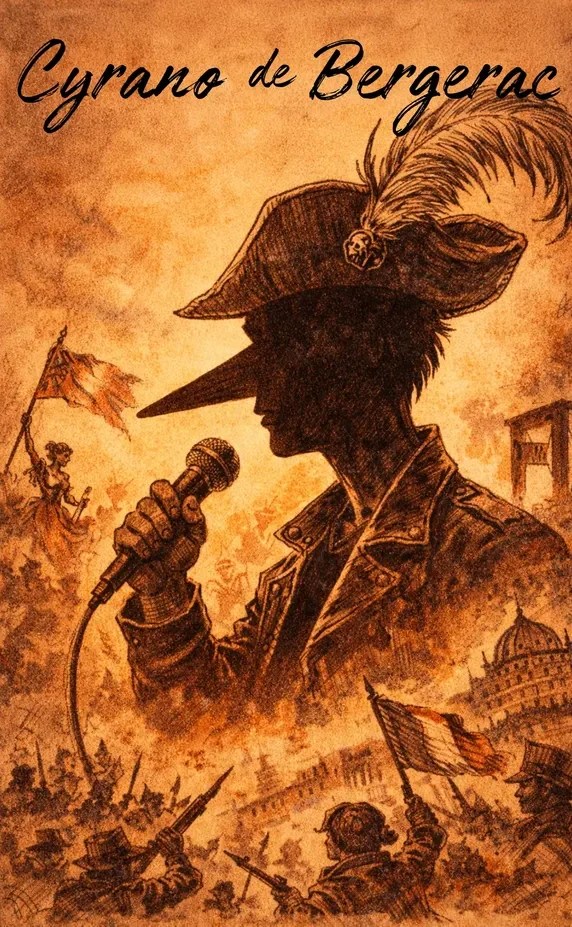
Cyrano de Bergerac will take to the Jeff High stage this weekend to try to romance Roxane.
Show dates include:
Friday, March 27 — 7 p.m.
Saturday, March 28 — 7 p.m.
Sunday, March 29 — 2 p.m.
Friday, April 3 — 7 p.m.
Saturday, April 4 — 7 p.m.
On-stage performers include Blessing James, Finn Matzek, Jayden Trevell, Jackson Fried, Sarah Proctor, Jalen Nifong, Tristan Cooley, Lucas Dimmit, Wyatt Clements, Sophie Ellis, Jude Polete, Roberto Castro, and Natalie Creagh.
Behind-the-scenes crew members include McKayla Hannan, Parker Grubbs, Kira Timberlake, Elianna McCurdy, Shiann Spalding, Nataly Barragan, Lindsay Austin, Ada Morrill, Hailey Littrell, Bella Roman, Chloe Kallbreier, Zoe Schwieman, Kenzie Stone, and Sage Mace.
Sophomore actress Natalie Creagh said, “We take a more modern take on the original story of ‘Cyrano de Bergerac’.”
The advice Creagh has for those who want to take theater is to keep believing in themselves even though it’s a lot of hard work.
Theatre arts teacher Derrick Ledbetter said, “The story behind Cyrano de Bergerac is, in a war-ridden France, there is a love story that takes place that is very complicated.”
Ledbetter said he’s most excited to see the students act out the script, since it’s his most complicated one yet.
Tickets are free for staff — and general admission tickets are $10, according to Ledbetter.
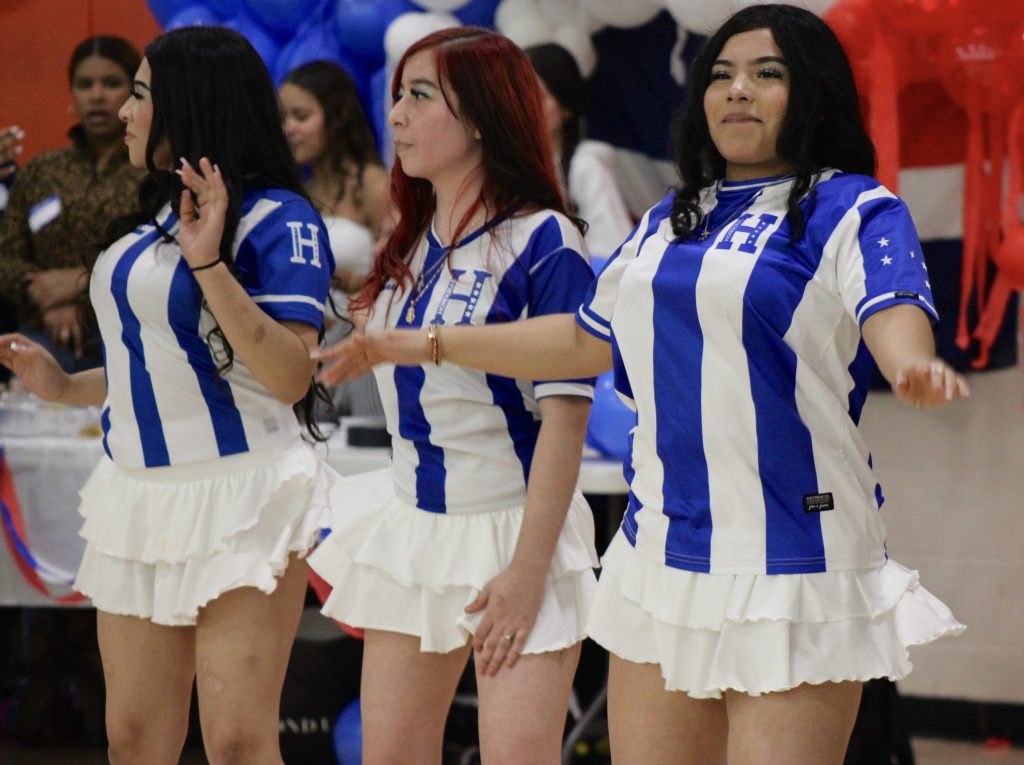
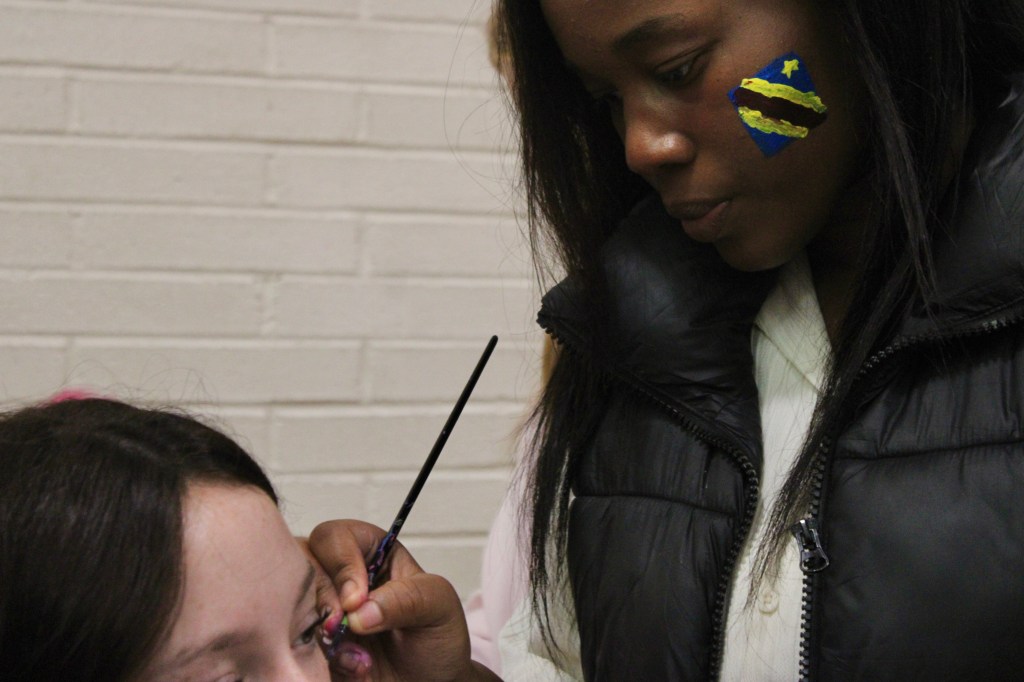
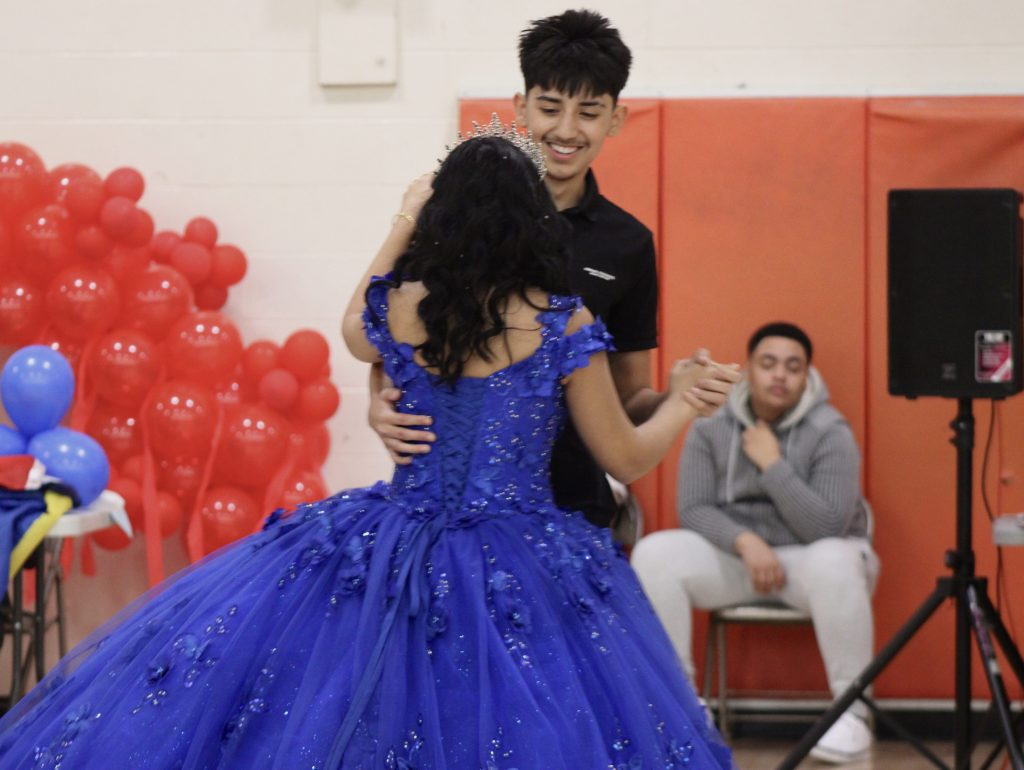
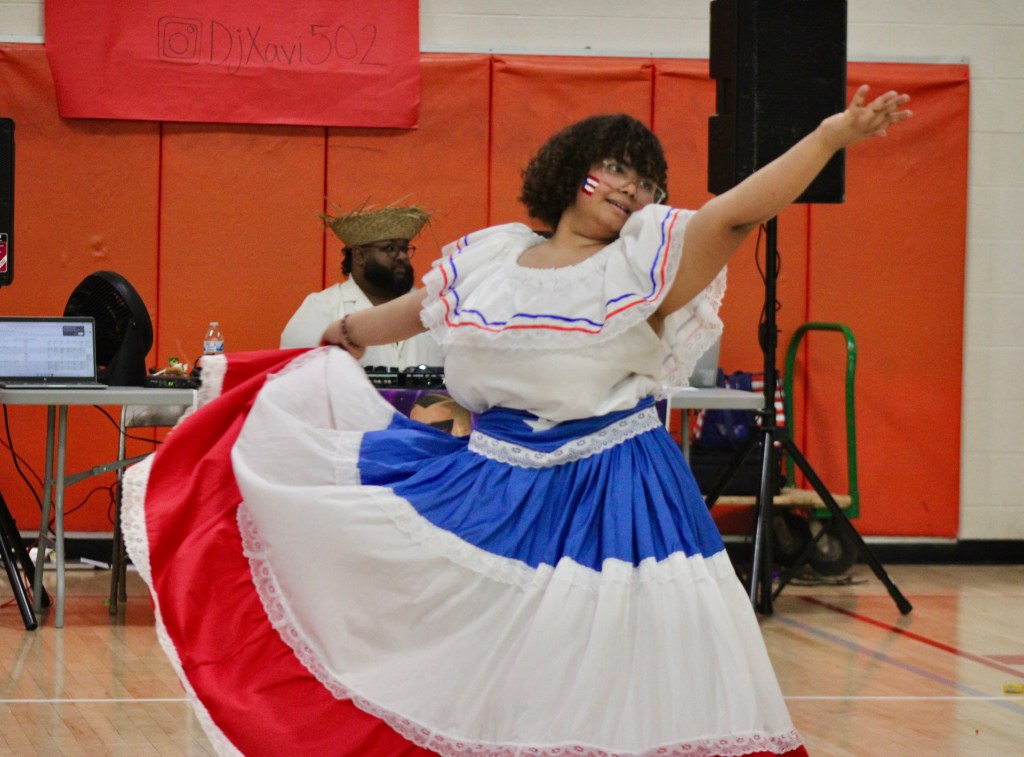
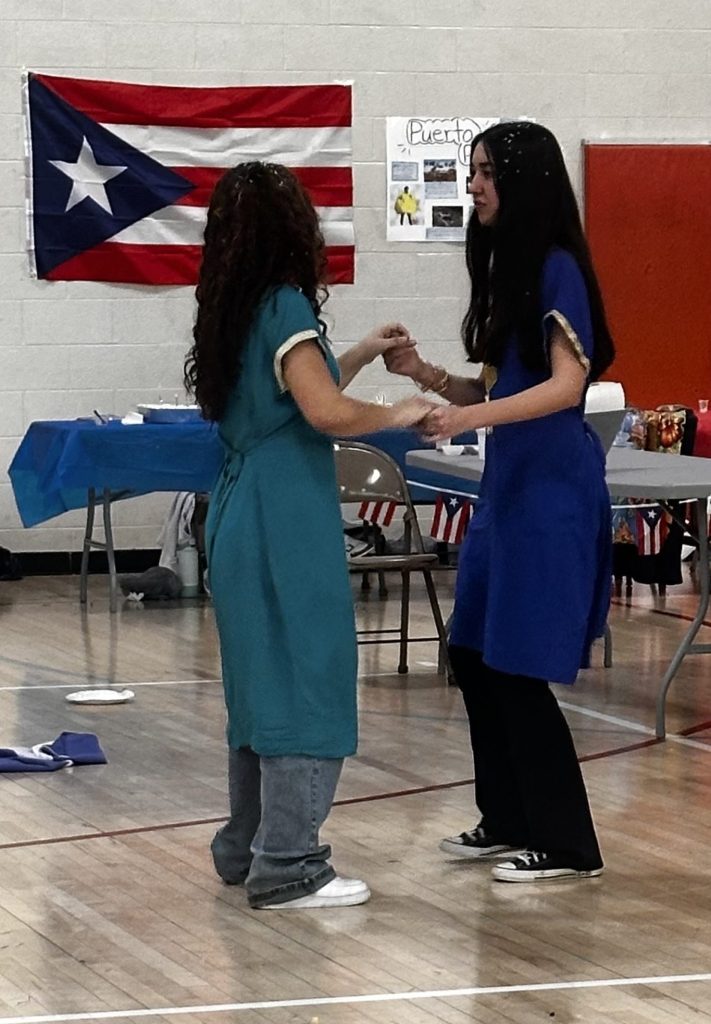
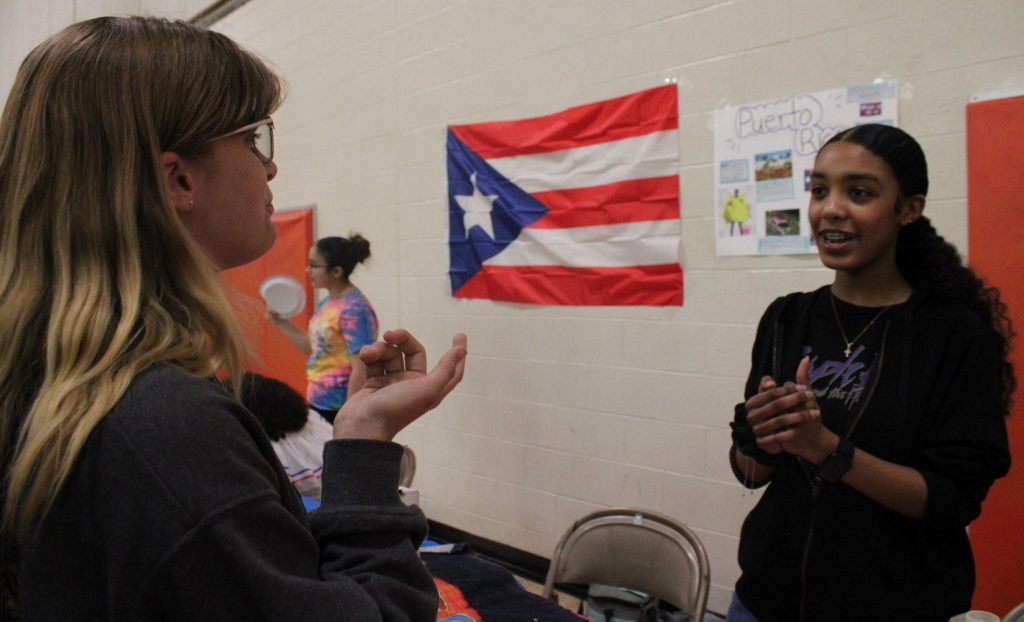
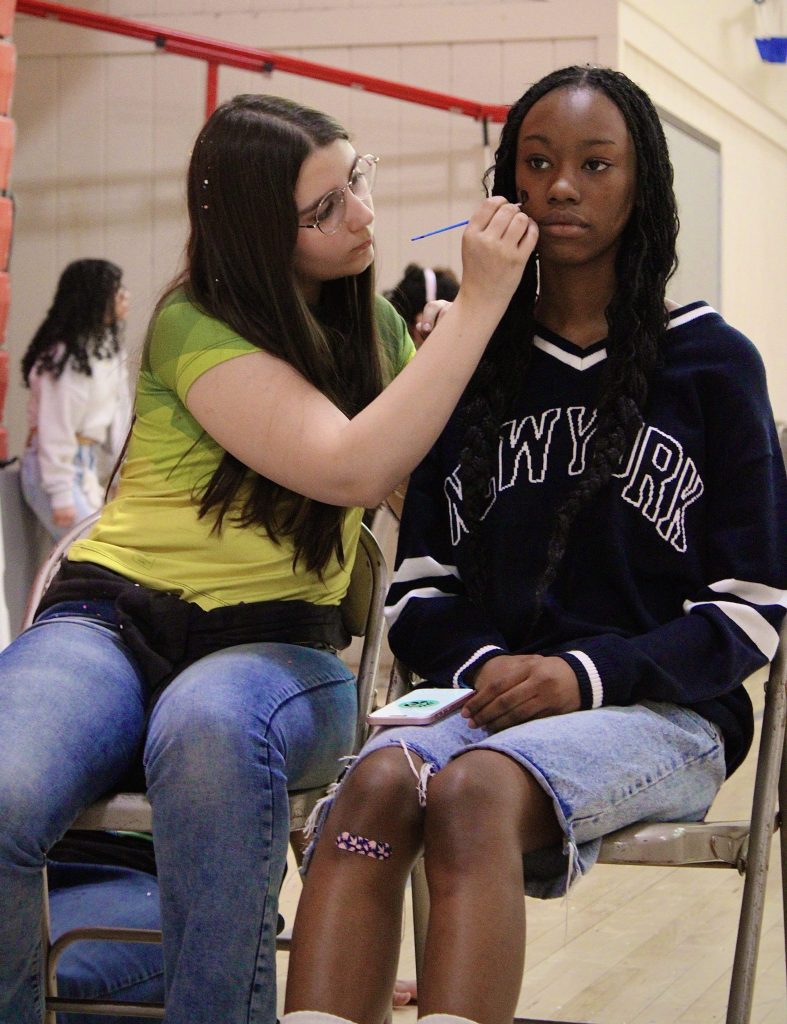
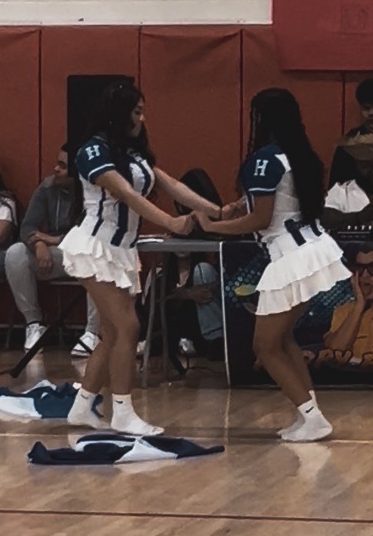
JHS students participated in the annual Multicultural Showcase on Thursday, March 12, sharing their cultures through presentations, dance, food, and dress with their fellow students and staff in the auxiliary gym.
Click on each photo in the gallery below.
A proud group of dancers performs a traditional Honduran dance. Photo by Areli Hernandez.Freshman Ivana Molina hands out food to other high school students during the Multicultural Showcase. Photo by Brycen Vanmeter. Freshman Gio Celis Gamas pours a cup of agua fresca during the Multicultural Showcase in the auxiliary gym on March 12. “It was made by the Aztecs with blended fruits and waters, and flowers to hydrate during travels,“ he said. Photo by Donna Muncy.Sophomore Eliada Tshimbalanga, who represents Congo, proudly faced painted guests with bright colors and designs on March 12. Photo by Areli Hernandez.Freshman Selena Escalante proudly points towards her Brazilian poster to showcase interesting facts on March 12. Students shared research, experiences, food, and traditional dress and dances during the annual event as classes throughout the school visited different booths. Photo by Areli Hernandez.Senior Stacey Nena smiles while performing a traditional Polynesian dance on March 12 at the Multicultural Showcase in the auxiliary gym. Photo by Areli Hernandez.Senior Susan Ochoa displays her bright royal blue dress while dancing to a traditional Mexican quince dance with junior Ian Chavez on March 12 at the Multicultural Showcase. Photo by Areli Hernandez.Junior Maleshka DeJesus glances to the left while performing a traditional Puerto Rican dance on March 12. Photo by Areli Hernandez.Juniors Laila Zaabani and Olivia Zanartu dance at the annual multicultural showcase on March 12. Zanartu stated, “Dancing brings people of all cultures together.” Photo by Kaylee Austin.
Freshman Desi Elliot explains the Puerto Rican culture to the interested students like freshman Lia Logsdon at the multicultural showcase during third hour on March 12. Photo by Kayleen Alvarado.Sophomore Marcela Carreiro paints a vibrant flower on freshman Kerington Caldwell as part of Brazil’s cultural showcase event. Photo by Lia Logsdon.Freshman Valeria Ramirez talks to students about the Mexican culture. “It’s really cool seeing everyone showing off their culture all in one place.” Photo by Logan Vidt.Sophomore Marcela Carreiro facepaints sophomore Jayline Cox Lee at the Multicultural Activity Fair during 7th hour. Photo by Shelby Keesee.Freshmen Yorleny Padilla and San Florencia Padilla dance on March 12 as part of the Multicultural Showcase. Photo by Eva Harbeson.
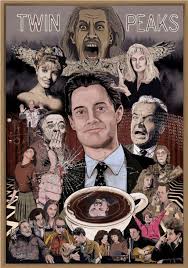
Twin Peaks (directed by David Lynch) – an eerie, surreal show about Agent Dale Cooper working to solve the murder of Laura Palmer, a high school girl in the logging town of Twin Peaks.
The show is considered groundbreaking and it is still world renowned for its impact on the television industry. It brought a cinematic and supernatural program to TVs in the 1990s. Twin Peaks combines themes of supernatural activity, police and crime, and horror to create its iconic status.
It continuously asks the question of “Who killed Laura Palmer?” while incorporating the town’s stories. The show is known for diving deep into the world of traumatic evil in the form of Laura’s tragedy. It starts out as a straightforward, typical murder mystery, but it quickly transitions into something deeper psychologically.
Twin Peaks moves slower than other shows being aired, but its pace allows the town to settle into the viewer, making it seem more suspenseful and dreamlike.
Laura Palmer and her story has stuck with many watchers of the show, integrating herself into the fanbase like no other. Her youth and experiences reflect that of her viewers, making her an important character to millions of people. Her complexity adds many layers, including her loveability because of her trauma and the way she handles it. She is not painted to be a saint like many victims in horror shows.
She is not the first loveable character that David Lynch has brought to life, though. Lynch is known for his directing style, mixing themes of surrealism and horror with a unique charm. He has directed many other iconic films and television shows, including Mulholland Drive, Blue Velvet, and Eraserhead.
While all of his work is widely regarded as memorable and fascinating, Twin Peaks seems to have latched itself into his fans’ lives, as well as other directors and film-makers.
The series has influenced many other famous shows, including the likes of X-Files, Stranger Things, and Lost. The show proved that fans would follow complex characters and dark storylines, allowing these other shows to follow suit.
Lynch introduced genre blending through Twin Peaks, mixing a sense of comedy with the small town’s uniqueness with the horror of Laura’s mystery.
Twin Peaks sparked some controversy with its mixture of comedy and heavy themes, like drug abuse, assault, and murder, without romanticizing the trauma. However, this creates an air of surrealism that drags people in.
Lynch has a specific style of cinematography that many people link with Twin Peaks, as well. Featuring wide shots, darker colors, muted lighting, and unconventional camera angles to make his episodes feel more like a hand-crafted masterpiece than anything.
Twin Peaks has wormed its way into many people’s hearts, as well as the film industry. Television and films will never be the same, whether they’re inspired subconsciously or not.
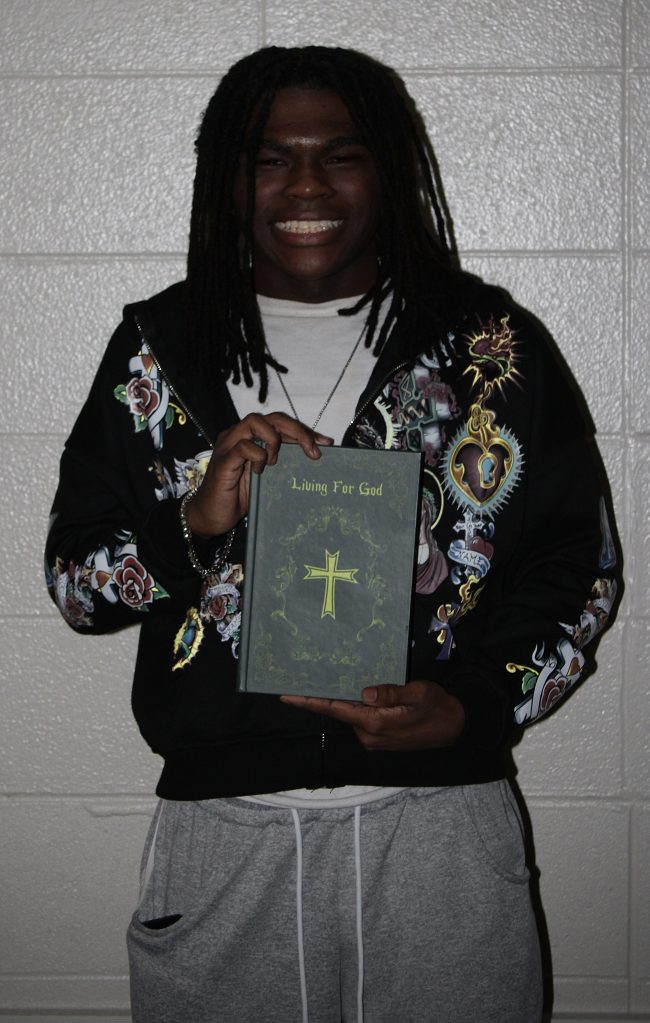
Recently, a book titled Living for God was published by JHS student author Jeremy Baker, a junior. The book’s inspiration came from Baker’s own reflection and experiences and discusses daily faith and intentional living.
Junior author Jeremy Baker displays his most recently-published book, Living for God. Photo by Shelby Keesee.
Baker has published two books, A Heart for God and Living for God on Amazon. Both books provide guidance and acceptance through God. A Heart for God, Baker’s first book, originates from a time where Baker realized he wanted God to be part of his life. This experience later developed into the book’s cover and overall concept.
“I have experience in journaling a lot, especially about situations, struggles, lessons and conversations I had with God,” said Baker. “What started it all was I had an image in mind of a torch with a blazing flame; then I thought about a heart – my own heart, and it made me think about having a burning desire for God in your heart.”
A Heart for God rewarded Baker with personal growth, reflection, and an idea for Living for God, Baker’s recent book.
“From there, I started growing more and more, and there was a time when I was reflecting on what I’ve been doing and how much I changed, and how much I was wanting to live for God, which became the idea for my second book, Living for God,” he said.
Baker summarized both of his works, offering insight for anyone interested in his books”
A Heart for God
“A Heart for God is a guide for anyone who feels lost, feels emptiness in their heart, or is spiritually distant and wants something that’s real. This book guides the readers through recognizing the emptiness they have, to understanding purpose, overcoming struggles like temptations and distractions and builds a strong spiritual foundation.”
Living for God
“Living For Godis a book that is like, shifting from that desire of the heart for God, to daily action and applying it once you have that heart for Him. The first book focuses on developing the heart; Living for God focuses on living it out.”
The two books contain progression, starting from transformation to applying faith and belief our daily lives.
Junior Jeremy Baker’s two self-published books, A Heart for God and Living for God. Photo by Shelby Keesee.
Baker said his favorite book was A Heart for God because it was the first book he published, and due to its topics of desire and faith.
Describing his first book as the start for everything, Baker said, “Before you can truly live intentionally or live for God, there has to be a genuine desire in your heart, [and] without that desire, it doesn’t last. It’s also my favorite because it represents the beginning of my journey, which without it I probably would’ve never made the second book, Living For God.”
An experience on the school bus opened a door for Baker to explore his own faith and eventually begin his writing journey.
“What inspired me to write my books started on the bus when school was over. I saw this one girl who was speaking about God and strong foundations; it deeply impacted me a lot and I felt so much peace in the area. It sparked a strong desire in me to pursue God intentionally.”
Baker said this strong desire led him to follow God, which allowed him to write about his experiences and gain another desire: impacting his readers.
“The impact I want to make with my books is helping (young/adults) people feel very purposeful and hopeful, and reminding them that they were placed here intentionally by God,” stated Baker. “I want the readers to recognize that God is present in every moment of their lives, whether they’re happy, angry, or going through something difficult. I want people to think more deeply about their actions, their motives, and the direction of their lives.”
Faith and purpose are both crucial to Baker because he believes in individuality and that each person has his or her own talents and purposes in life.
“This is important to me because I’ve seen how people, especially around my age, get distracted,” he said. “A lot of people live by only the moment without asking, ‘What can I do now that will matter in the future?’ I feel called to speak to my generation about faith in a way that encourages discipline and intentional living. I don’t want people to waste the gifts and the potential that God has given them.”
Both works are recommended by Baker if readers need faith, purpose and direction.
“I would recommend these books to anyone, young and older. Or if anyone feels maybe unsure about their direction in life, or feel distracted. I also want readers to know that faith is about being willing to seek, grow, and live intentionally.”
Canva’s beginner-like tools enabled Baker to design his book covers. Baker has experience in graphic design and recommends Adobe Illustrator for advanced designs.
Baker discovered the Amazon Kindle Direct Publishing platform, which guided him to publishing his books online.
“I researched the Amazon Kindle Direct Publishing (KDP) and watched tutorials on YouTube to understand each step on how I can get my book on Amazon,” said Baker. “I learned about formatting, trim sizes, and cover dimensions. At one point I was hiring someone through Fiverr to fix some errors with my book, but after looking into Amazon’s Cover Creator tool, I was able to fix the errors myself, which is how I was able to publish my second book.”
Not only is Baker a growing author, but he is working in the fashion industry.
“In addition to writing, I’m also at the moment working on a future clothing brand business, working in the fashion industry, which is a long term thing I am committed to doing.”
Additionally, he is committed to publishing a third book, which remains untitled for now, as he is in the “researching stages of working on a third book, taking time to study, reflect and gather everything I need before I fully jump into it.”
Baker said he wishes to reach readers from every religion and inform them about their worth.
“Even for those who may not believe, I do hope my books at least encourage them to recognize that their life has purpose, and that they were placed here for a reason.”
All photos by Magdalene Conrad and Abygail Lawson. Click on each photo below to view the gallery.
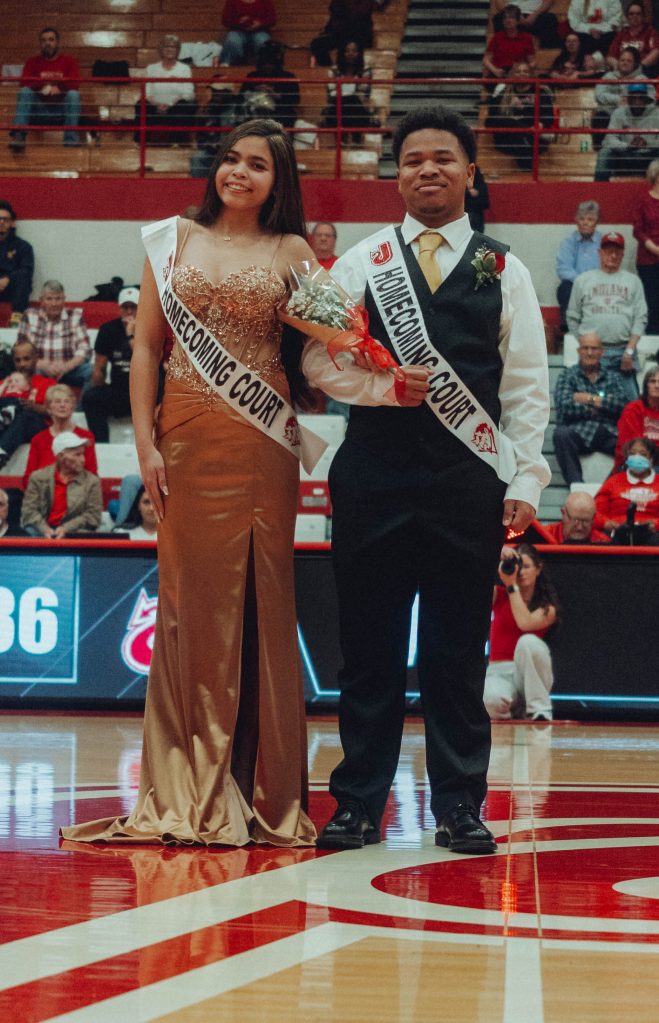
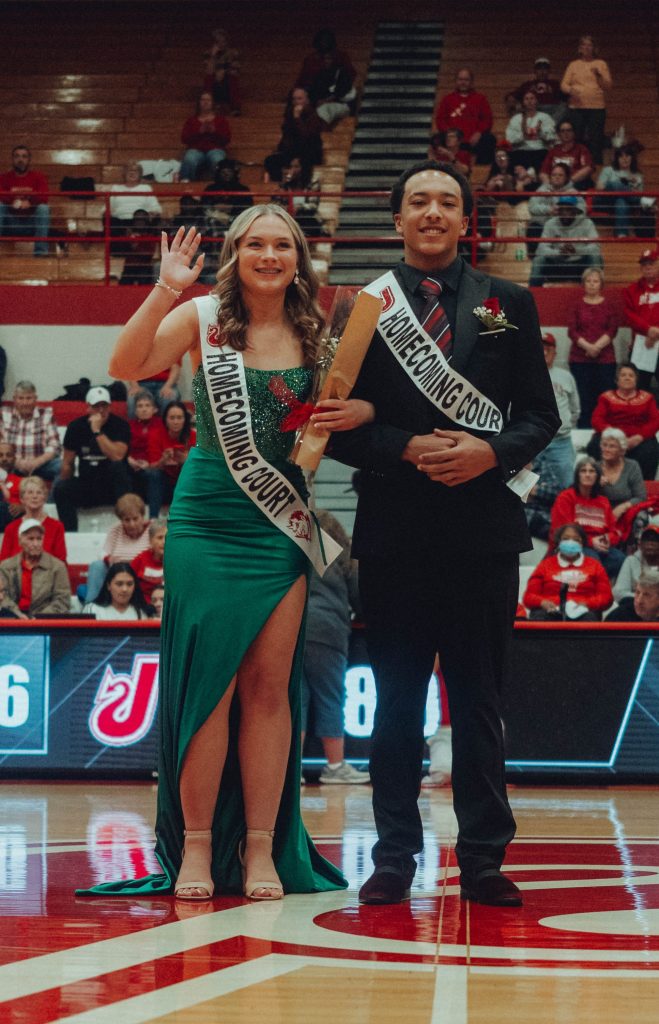
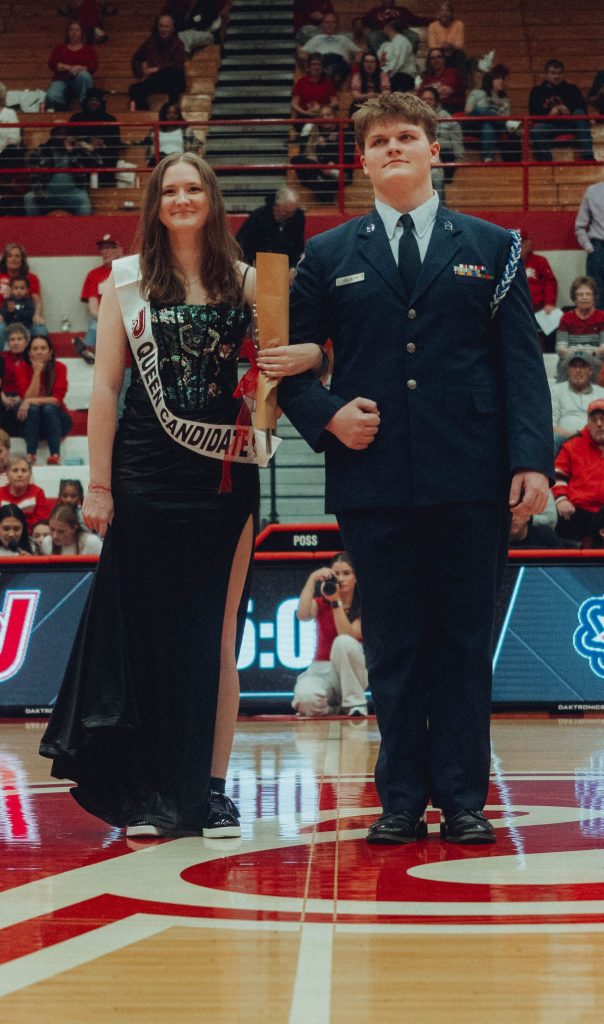
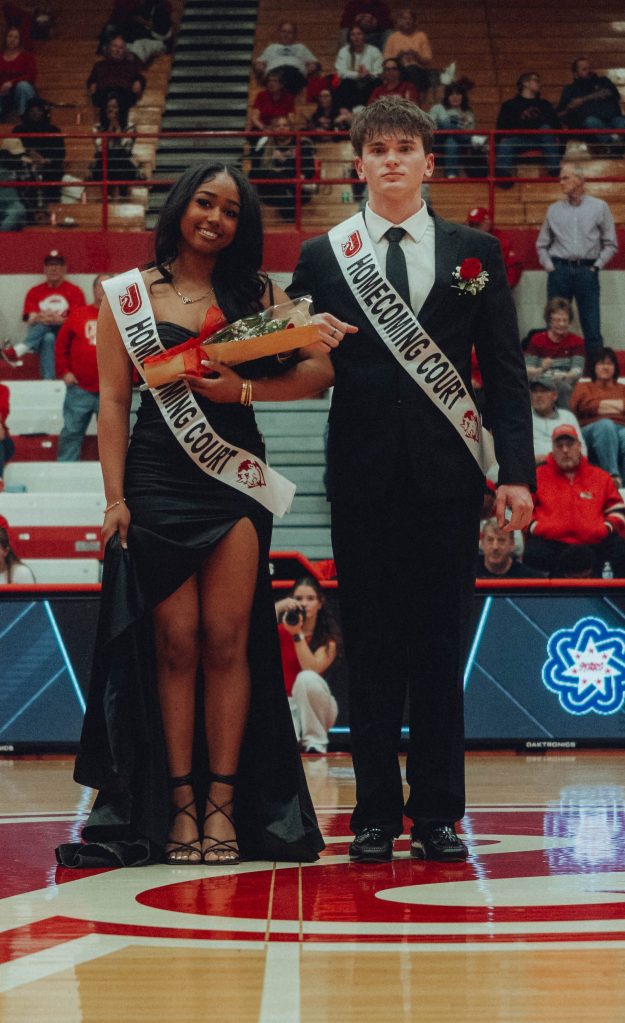
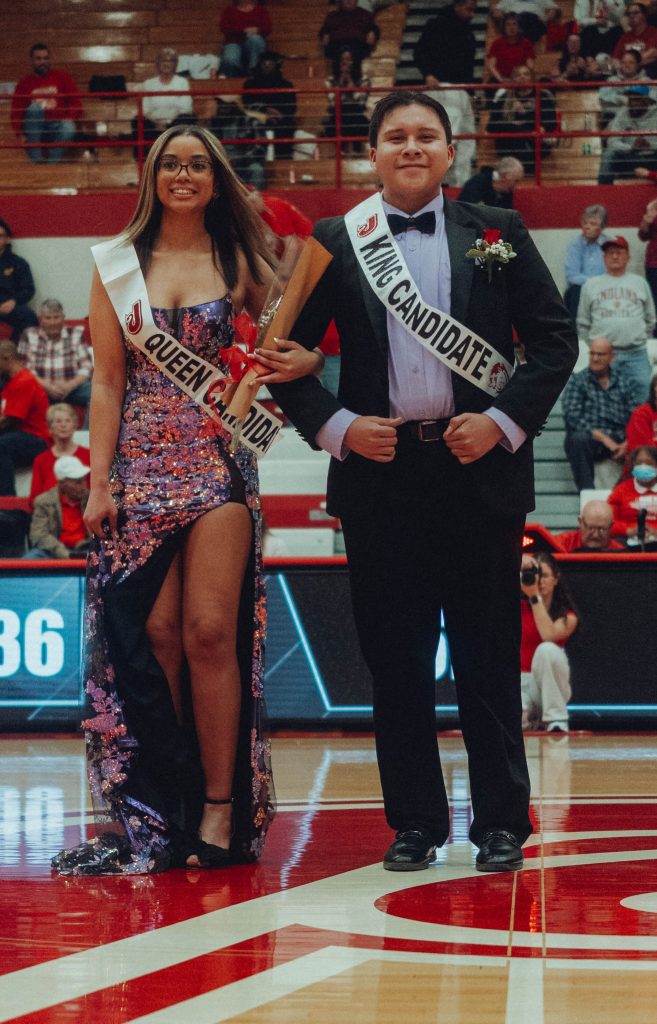
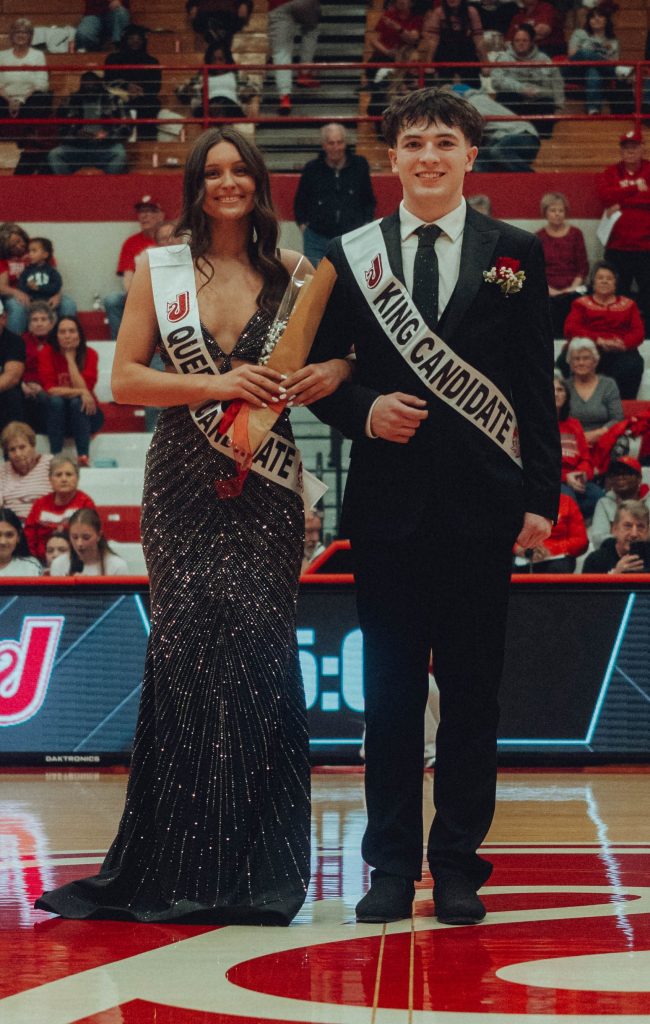
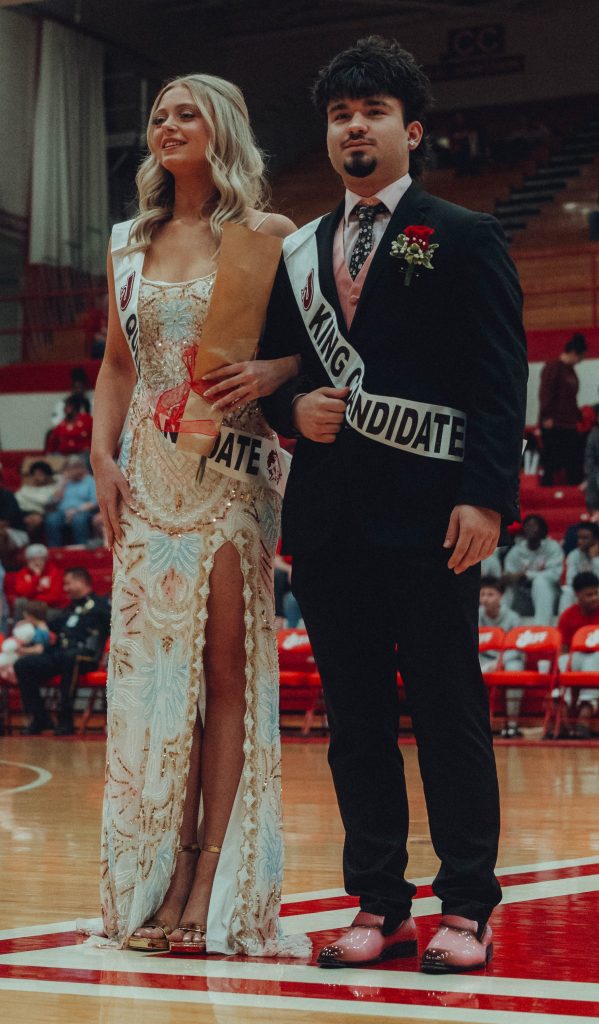
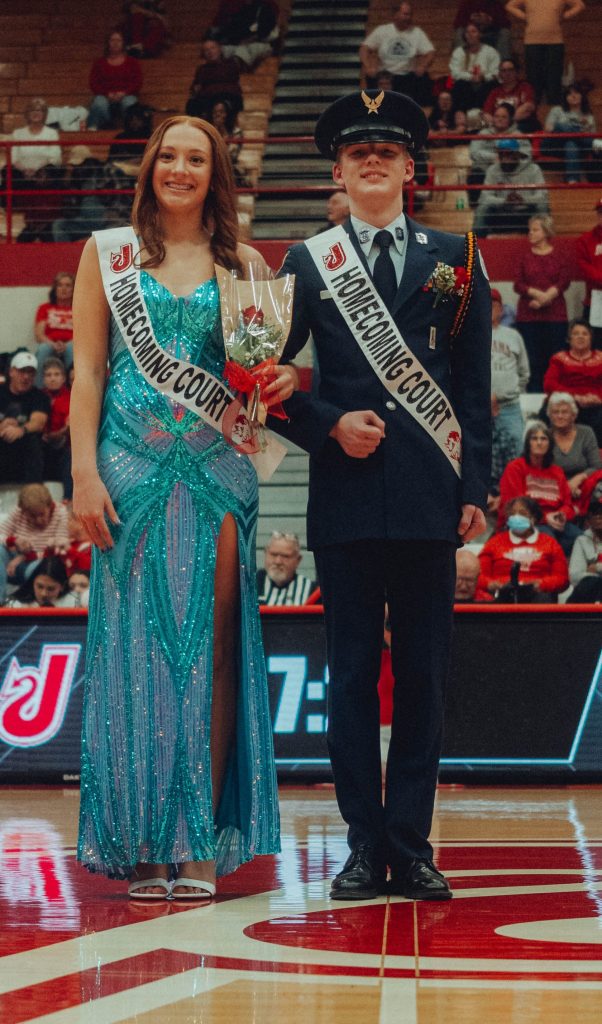
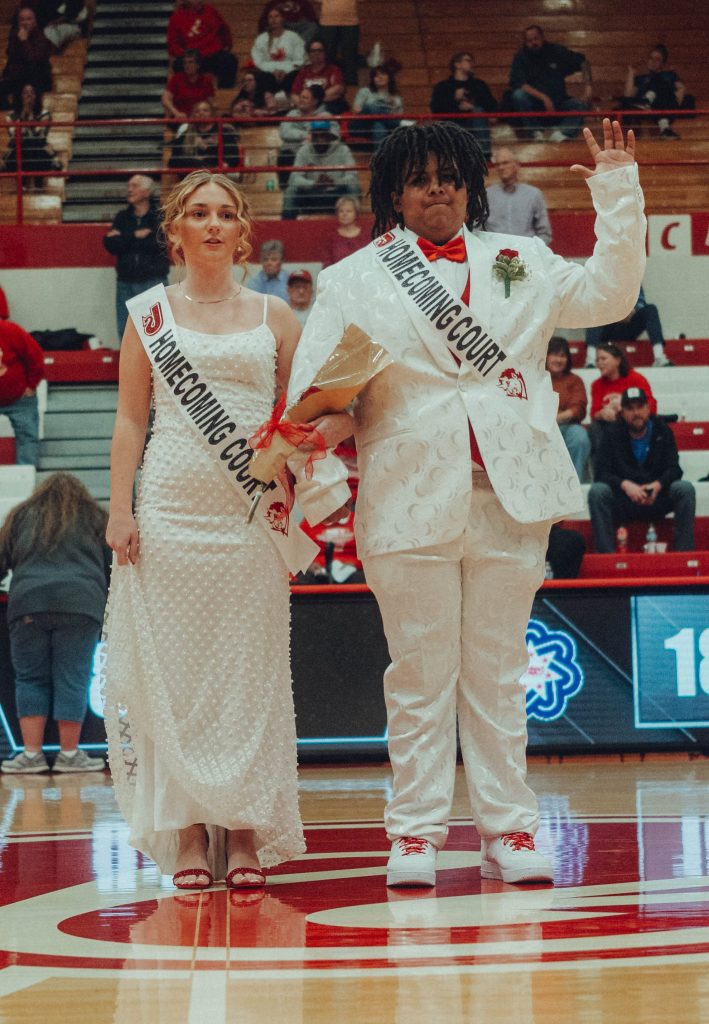
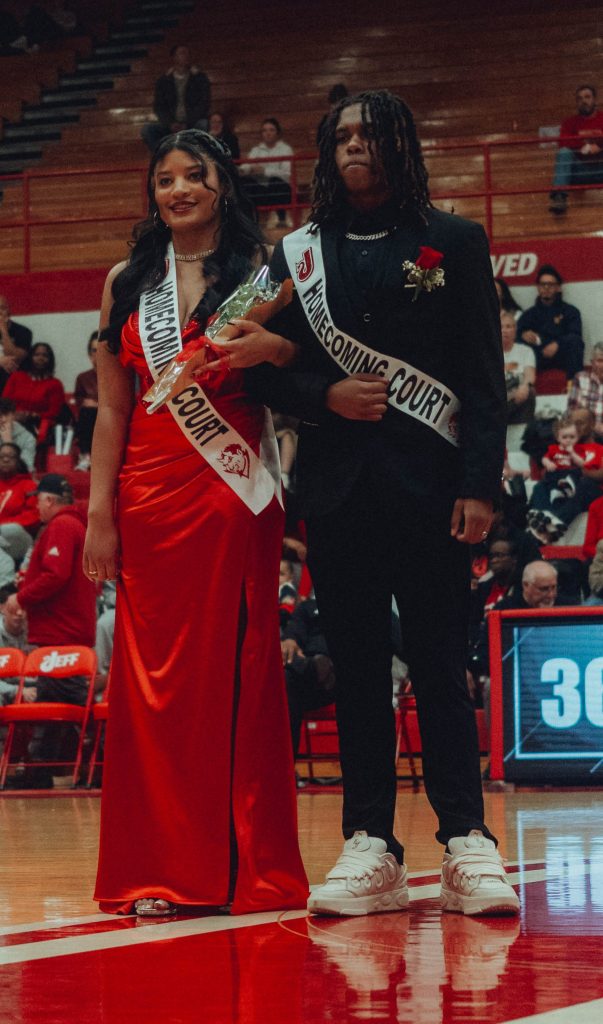
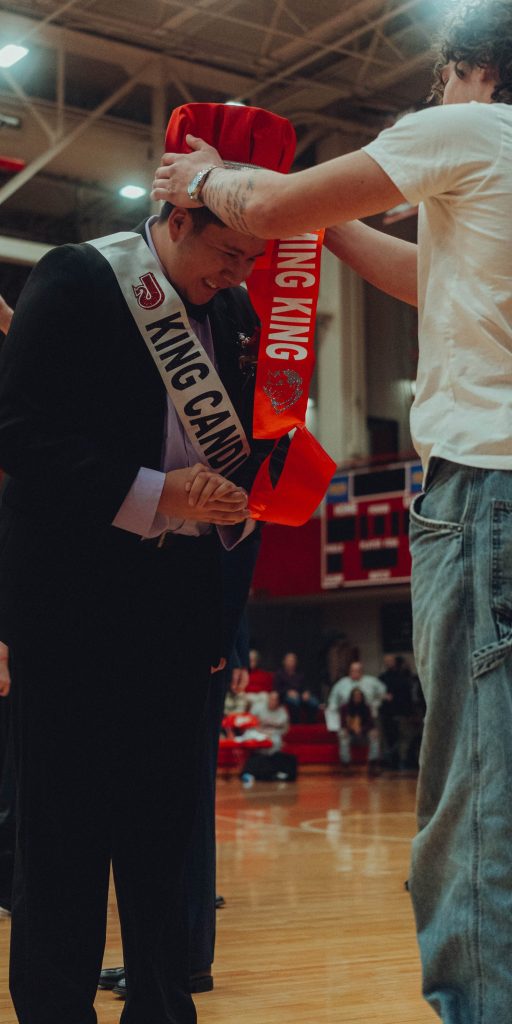
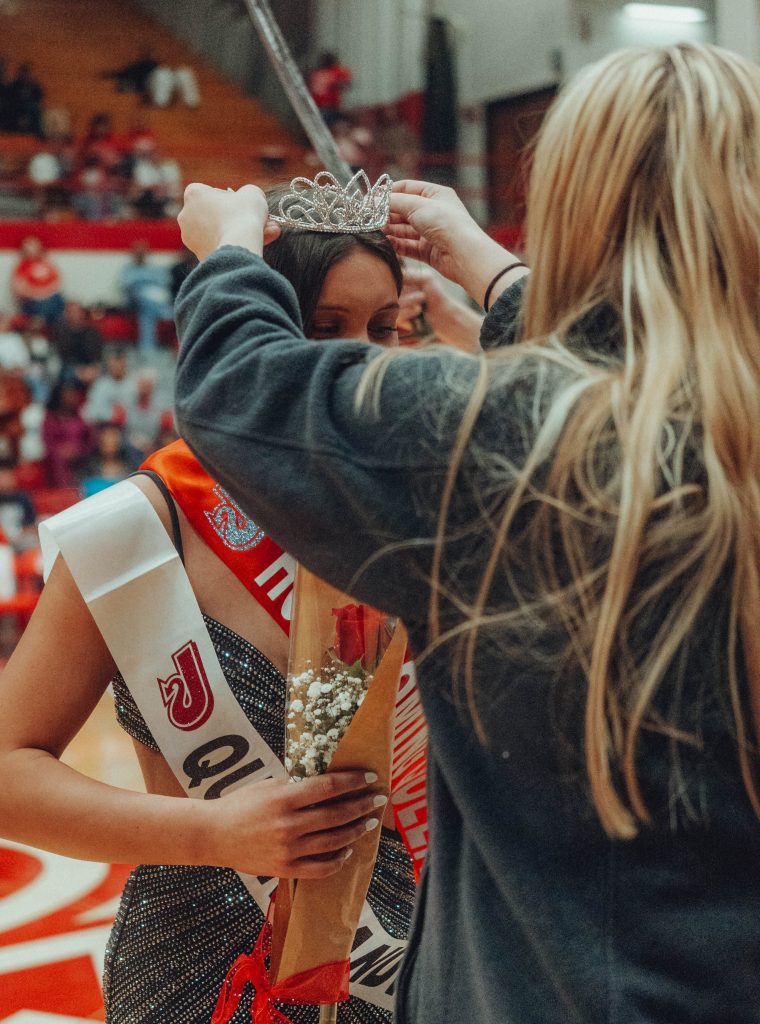
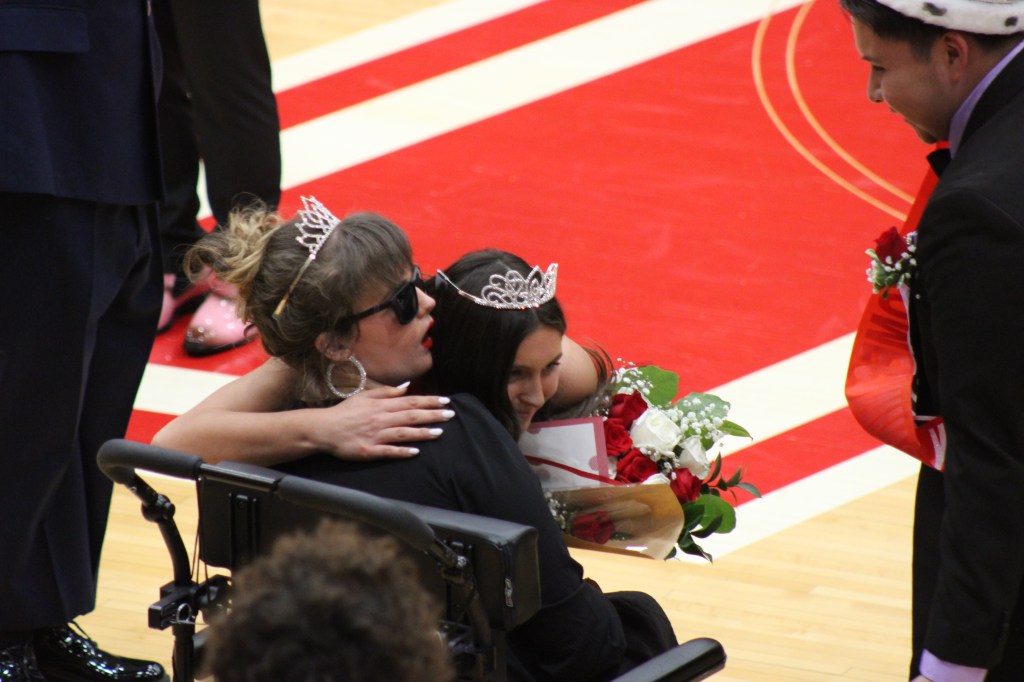
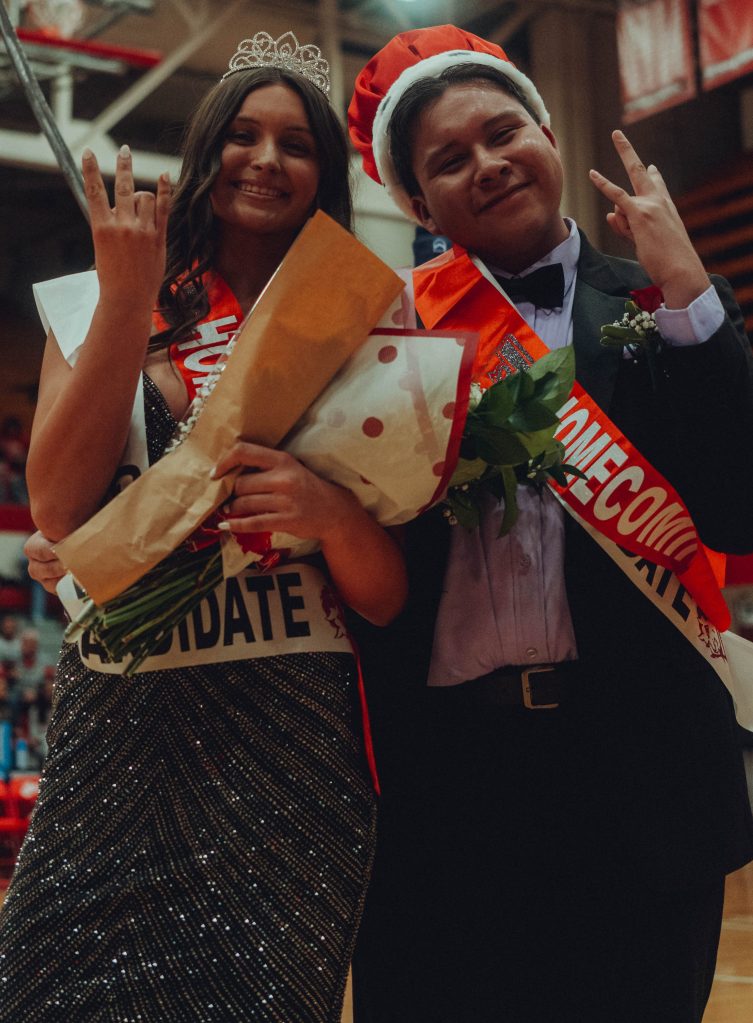
Senior queen candidates Kaydee Merrifield, Kendall Curry, Riley Dobson, and Kyndal McCartin pose for a picture. Photo by Magdalene Conrad.Sophomore homecoming court representatives Malik Fulton and Mya Corbin. Photo by Magdalene Conrad.Freshman homecoming court representatives Quincy Greene and Kylie Lantrip. Photo by Magdalene Conrad.Senior queen candidate Kaydee Merrifield and sophomore Dennis Van Duyn. Photo by Magdalene Conrad.Junior homecoming court representatives Parker McCloskey and Alayah Brown. Photo by Magdalene Conrad.Senior king candidate Ubaldo Pille Jaramillo and senior queen candidate Kendall Curry. Photo by Magdalene Conrad.Senior king candidate Jacob Lantrip and senior queen candidate Riley Dobson. Photo by Magdalene Conrad.Senior king candidate Victor Tenev and senior queen candidate Kyndal McCartin Photo by Magdalene Conrad.Sophomore homecoming court representatives Kai Helton and Lorelei Darling. Photo by Magdalene Conrad.Freshman homecoming court representatives Reno Jones-Turner and Allison Sharp. Photo by Magdalene Conrad.Junior homecoming court representatives Ke’Mari Smith & Kynnadee Harris. Photo by Magdalene Conrad. Senior Ubaldo Pille Jaramillo is crowned by previous homecoming king, Luke Church. Photo by Magdalene Conrad.Senior Riley Dobson crowned winter homecoming queen. Photo by Magdalene Conrad.Senior Riley Dobson celebrates with last winter’s homecoming queen, Violet Fondrisi, during Friday night’s ceremony. Photo by Abygail LawsonSeniors Riley Dobson and Ubaldo Pille Jaramillo pose for a photo after being crowned homecoming king and queen. Photo by Magdalene Conrad.
Editor’s Note: Proceed carefully, Stranger Things fans, as the following feature story contains spoilers.
by Shelby Keesee
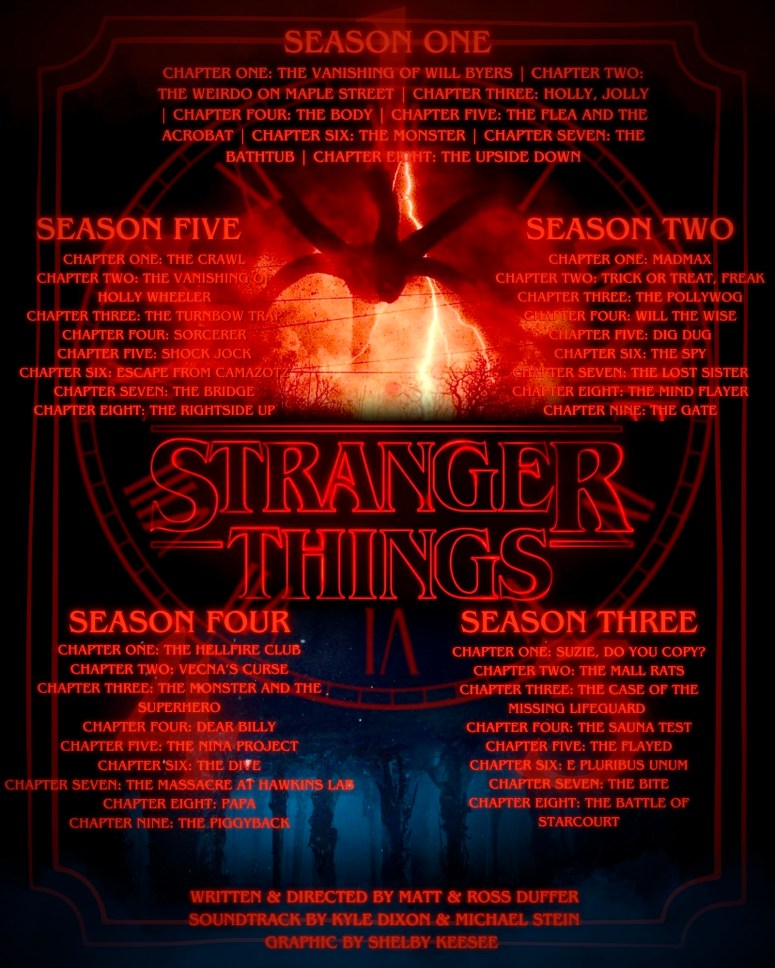
On Dec. 31, 2025, at 8 p.m. EST, the highly anticipated Stranger Things series finale, written and directed by the Duffer Brothers, aired on Netflix, and later was accessible for viewers to see in select theaters.
The series ran for almost 10 years (2016-2025) and gained numerous fans through its 1980s nostalgia, references, unique plot, and most importantly, its characters.
Prior to the finale, two volumes containing episodes of the fifth season arrived on Netflix, with Volume 1 (episodes 1-4) releasing on Nov. 26, and Volume 2 (episodes 5-7) releasing on Dec. 25.
The Crawl
The first episode, entitled “The Crawl,” is set in 1987 in the fictional town of Hawkins, Indiana. The episode begins with a flashback to Will’s vanishing in the Upside Down, which was the first event that led viewers into Stranger Things’ complex and emotional story.
“My first thought was, ‘Oh my God – they were babies. They were such little babies,’ and now they’re like, grown men and stuff,” stated Student Council sponsor Natalie Woods. “I don’t know if it did it justice – if I’ve never watched seasons one, two, three or four, and I just watched the flashback, I don’t think I would’ve been able to get the gist of what happened. So I feel like if they really wanted to do that fairly, it should’ve been an episode all on its own.”
The episode then reveals that Hawkins is under military occupation due to an “earthquake,” which leads the main cast into frequent “crawls” to look for Vecna, one of the main villains, in the Upside Down.
The Vanishing of Holly Wheeler
The second episode, entitled “The Vanishing of Holly Wheeler,” contains the season’s main storyline – Holly’s vanishing, orchestrated by “Mr. Whatsit,” who is later revealed to be an alter ego of Henry Creel/Vecna.
“They focused on Holly a lot. She was definitely the main character of this season, and if they were planning on making a Stranger Things follow-up, she’s the start of the next generation of kids.” said English teacher Eric Watson.
“I loved episode 2, probably my favorite of the whole season,” stated English teacher Allison Clary.
The Turnbow Trap and Sorcerer
“The Turnbow Trap” contains Derek Turnbow’s addition into the plot, and the fourth episode, “Sorcerer,” leads viewers into a turning point – Will’s realization of his sorcerer-like powers.
“But, my next one was number four, ‘Sorcerer,’ because, of course, that was so shocking — none of us knew Will had those powers,” said Clary.
Volume 2
The second volume, containing “Shock Jock,” “Escape from Camazotz,” and “The Bridge,” gave us key events prior to the final adventure. The episodes, containing Nancy and Jonathan’s near-death experience, Max’s escape, and Will’s vulnerable moment, received mixed feelings from viewers. Critics expressed that the Duffers’ writing in the volume either lacked professionalism, was rushed, or lacked character depth.
“The part with Max was kind of confusing to me. She’s in a coma, but she’s still alive and functioning with other people who are stuck in the Upside Down,” stated history teacher Kent Porter.
“I know on the internet, a lot of people were really upset that Will had his whole coming-out scene and everything,” English teacher Holden Henderson said. “I mean, I think it’s great to give people representation – that is a very emotionally taxing moment, and so it makes sense that he would feel that way, but I do think for the story itself, I feel like they (Duffers) spent too much time on it.”
“The Rightside Up” is Stranger Things’ final episode, and it mainly focused on the group teaming up to successfully defeat Vecna.
“The thing about the final episode is the build-up for this season – all of these Demodogs and Demogorgons and all these monsters having to do with all this stuff, but when they actually go into the Upside Down, it’s not there,” said Henderson. “A couple of episodes before, when the Demodogs were fighting all the soldiers outside of the gate, like, that was a huge fight with lots of monsters and stuff – you’d think Vecna would’ve probably tried to defend himself a little bit.”
But the finale’s emotional ending has sparked a contentious question among fans; was Eleven’s sacrifice an illusion – or did she actually die?
In the debate, some believe that she didn’t perish, with an example being Woods.
“I don’t think she did. She’s too strong to have died just like that. Out of all things that poor child has gone through, that’s it? She’s gonna be whisked away with the wind?” Woods stated.
Some others believe she truly died, including Porter.
“I think she did. The way they just kind of left it there with her being in the Upside Down with everything breaking apart, I think it got her.” Porter said.
However, others have a more neutral stance, like Watson.
“I think the way they did the ending was the coward’s way out. They gave everyone a happy ending, they had a dramatic moment where like, it was a pyrrhic victory; they won, but they had lost something very valuable,” stated Watson. “And I feel like leaving the hope that Eleven is still alive undercuts that in a way that was disappointing. I would’ve been happier if they would’ve picked one.”
One of the Greatest?
Despite the common criticism over season 5, the season and the series still appeal to fans as one of the greatest they’ve seen yet.
“I loved the whole series, and I overall loved season 5,” Clary said. “I know some people were disappointed with the very last episode, number 8, but I was not disappointed at all. It was a great way to wrap up everything and everybody – all the characters kind of climaxed, and I understand why Eleven had to go.”
“Season 5 I thought was very enjoyable, as far as a watching experience, I enjoyed watching it,” stated Henderson. “But, part of that was taking a step back from a cinema graphic, or a movie critic style approach, and more of just like, ‘Hey, I really like this series, I want to enjoy it.’ There were definitely some flaws, there were definitely some weaknesses, but overall, it was enjoyable.”
The Characters
Even though a percentage of the audience has not viewed season 5 yet, the characters in Stranger Things are unforgettable and complex.
“Favorite character? Either Steve – the babysitter guy, or Dustin,” stated math teacher Cory Densford, who has yet to watch the final season. “Those are definitely my favorites. I really liked Steve’s character arc. I always have a soft spot for those kind of villain characters.”
“I liked Hopper a whole lot. I’m a pretty sarcastic dude, and he delivered the most sarcasm, I think. And also, he’s just surrounded by teenagers and exhausted all the time, and that’s relatable to me,” Watson said.
“Everyone wants to say Will, because his character led up to that culminating point where he mind slayed Vecna, but I feel like it’s going to be Lucas for me,” said Woods. “He had such a role of keeping the group together. He didn’t have these main character storylines, but he was always the one that was there – if something went good, if something went bad, he really had the answers to everything.”
Because of these characters’ relatability, viewers tend to feel more of an emotional response while watching Stranger Things.
“I think maybe part of that is because it’s taken place over nearly 10 years,” stated Clary. “I’ve literally watched since the first year, so a lot of people who have strong feelings, sometimes it’s because they’ve been watching for so long.”
“I think some of it has to do with the writing style and the characters. You usually feel very realistic towards them, so when we see characters we can kind of imagine as ourselves or our friends or our loved ones, we can see similarities, and since they are more realistic, we see them going through these things, so it seems more emotionally real to us as well,” said Henderson.
“Having characters that have flaws are important in media,” Densford stated. “Nobody’s perfect, and if they’re perfect, it’s hard to relate.”
The exceptional, emotional story and character depth has led fans to share the series with their friends and family.
“I’ve heard about it because my wife’s a big fan of it,” stated English teacher David Kummer, who has not yet watched the show. “She started watching it a couple of years ago and binge watched it.”
“Honestly, my son – he was the one who recommended it, and the minute we watched it, it stuck.” Woods said.
Overall, Stranger Things has made its impact on numerous fans, and its popularity will continue to rise over the years.
The series’ versatility in multiple areas, such as its writing, unique plot, and in-depth characters makes it a historical show for viewers. Regardless of season five’s criticism, it still remains a favorite for many.
“It seems like there’s always a show every 10 years or so that becomes bigger than some of its parts,” stated Watson.
From reading the book The Wild Robot when I was younger to finally watching it in theaters it meant a lot. The Wild Robot was turned into a film focused on nature as well as motherly love. It came out Sept. 27 2024 and I was ready to watch with the books giving me high expectations.
The movie starts off with a futuristic robot named Roz accidentally arriving on an island full of wildlife trying to do its programming and help any person in need trying to complete its task. Roz starts to understand animal language. The animals in the forest have only rude things to say about Roz just because she’s different from them. Roz tries to leave but finds a duck egg by itself.
She found a task to complete which is to care for the egg with the help of a fox who wanted to help for selfish reasons but turned soft after a while. The main conflict in the story is how to raise a duck as a robot and robots like Roz trying to take her back home from the island.
This animated film has great quality with having the animators from Puss in Boots The Last Wish. Roz was Lupita Nyong’o who did a great impression of a robotic voice. Pedro Pascal playing the fox called Fink had a great personality in his voice that was way different from him in person. Kit Connor as Bright Bill was pretty good.
The story was heartfelt, which gives you a fuzzy feeling with a whirlwind of emotions with a 97% rating on Rotten Tomatoes with 260 reviews, 8.2/IMDb the most talked about detail was their animation and how beautifully they portrayed the book.
These are the choices for what mode you want to play in a famous 2000s game called Guitar Hero. Guitar Hero was a very popular game, with its first release of Guitar Hero 1 in 2005. The game itself was originally designed for the PS2 and PS3. Still, it eventually expanded to other consoles, including the Xbox 360, Wii, PS4, Xbox One, Wii U, and even mobile devices and handhelds like the Nintendo DS.
There are at least 25 Guitar Hero games. From Guitar Hero (2005) to Guitar Hero Live (2015), and other games based on Guitar Hero like Rock Band, Clone Hero, and DJ Hero as well! I prefer the original, but it’s always fun to try the other games as well. Now I have Guitar Hero for the Xbox 360. Sure, there are some lag spikes here and there, but other than that, it runs smoothly, and I enjoy the game a lot.
There are different ways to play Guitar Hero, too. You can use the Guitars, Drums, Microphone, and even your console controller. I prefer to use the Guitar controller; it makes the experience more immersive and more enjoyable. Guitar Hero even has a practice mode, as well as a learning mode. Practice mode allows players to practice the songs in the game, while learning mode teaches new players how to hit the notes and strum the bar to time it perfectly. It also teaches you cool techniques you can use when playing the songs to help you understand the game’s concept.
Not many people play Guitar Hero anymore. When I’ve talked to my parents, teachers, and even other students, which sucks because, sure, it’s an older game that’s outdated, but it can still be fun to play if you actually try it out.
Should other people play it? Yes, for sure it’s not a violent game, and you battle your opponents with guitar skills instead of guns, chainsaws, knives, etc, and once you beat the game, you’ll have all the songs unlocked so you can practice your skills even more and eventually make your way to expert, which is the highest you can get.
When I’m playing Guitar Hero, I’m fully immersed in the game, from how entertaining it is, and I’ve been playing it for over a year now, and I still love the game. Even though it took me forever, I finally made it to expert, and I’m proud that I made it that far with the game.
“Jump straight to expert. It’ll be difficult at first, but it’ll get easier as you play.”
Those are words that my dad told me when I first started playing, and that’s what I did, and turns out I could do it when I thought that I couldn’t at all, and when I listened to what he told me that day, it all made sense why he said that. When I first tried it, I sucked at it because of how fast the notes were moving, but over time, I learned how to do it, and I got better at it, and that’s how I got to where I am today on Guitar Hero.
Guitar Hero even has a lot of bands in it; some bands even have their own Guitar Hero game dedicated to them. Like Guitar Hero: Aerosmith, Guitar Hero: Metallica, Guitar Hero: Van Halen, and more. Some bands that are in the main games are Nirvana, AC/DC, DragonForce, Foo Fighters, Queen, Slipknot, KISS, and so much more. Another game that a lot of rock songs are on is Guitar Hero: Smash Hits, which has a lot of rock songs that a majority of people know about.
Sadly, over time, Guitar Hero stopped due to market saturation and declining sales, which is sad, but the games that are out, you can still buy and play them. Another reason why they stopped is that Guitar Hero peripherals often did not work with new game versions, requiring further investment, and Activision officially discontinued the series and disbanded its music game division to refocus on other online and interactive entertainment. Even tho RedOctane is the original publisher of Guitar Hero, and over time they closed Guitar Hero for other new rhythm games. But will there be more games in the future?
So what will it be? “Easy, Medium, Hard, or Expert?”
Behind-the-scenes look reveals the challenge of performing and competing in marching band
Editor’s Note: Check out pages 12 and 13 of the December, 2025 print Hyphen for a photo essay on the marching band season.
by Cherish Brown
“You’re just walking, it’s not that hard.”
This is what I hear when I try to express that marching band is just as hard as a sport. I wouldn’t be too upset if people told basketball players that “you’re just throwing a ball in a hole,” or told baseball players that “you’re just hitting a ball with a stick.” But no. Instead, they get praised for their hard work, while people overlook ours. So here’s what actually goes into the halftime show that you see at football games.
The first lesson we had to learn was how to march correctly. It might look like walking to some, but it’s a little bit more than that. There’s a specific technique that we have to use going forwards and backwards. To go forwards we had to learn to walk while keeping our legs straight, and also roll stepping. Roll stepping is rolling off your foot into the next step to make it look smooth instead of robotic.
Now for backwards. We have to walk on our tippy toes, while keeping our legs straight, and we can’t look backwards. If we don’t march on our tippy toes when we go fast, we will fall.
Now that we know how to go forwards and backwards, we now have to learn how to go sideways. The weird part about it is, we can’t have our shoulders facing anywhere but forward unless we are told otherwise. So, to march sideways, our bottom half has to face sideways, but our top half is facing forwards. The only people who don’t do that are the drumline, who crabwalk, and the battery, who don’t move.
“So no, we’re not just walking. We’re working hard, competing, and most of all, performing.”
We can’t just have you watch us march, though; that would be too boring. We had to learn how to play the music. To be honest, it’s really hard music. In the first piece we all have to play 16th notes, which is four notes per beat, which means you have to be quick with the notes, even at a slow tempo. And the second piece is at 160 beats per minute, which is double the speed of the second piece. And all that is hard enough while sitting down and looking at it, but when we’re marching, we have to play off of memory.
Now, we have to learn where we’re going, and how the music relates to how we march. The thing is, we aren’t just marching to random places. If you’re high enough in the stands, you can see that we make shapes with where we’re standing. We have to march to specific places, which are called our sets. And we have to learn the entire song while only marching before we can even grab our instruments.
Then we start playing. We have to go by each set (or spot we’re marching to) and learn which part of the music goes where. It takes a long time, especially because there are three different pieces we have to put together. So, we take many days of practice just learning how the music and our sets relate to each other, when we’re supposed to get where, and how big or small of steps that we have to take to make it on time.
Then, we have to make it look cool. We add what we call our choreography. It’s not actually dancing, like the color guard does with their flags. We do different things. Our choreography includes lunges, pliés, and forced arches. And we usually do those while we’re not moving, so we don’t look like we’re just awkwardly standing there. We also do these while we’re playing our music, so it has to match up with what’s happening musically.
Now we take all of this, that we started learning before school even started, and put it together for everyone’s entertainment. But there is something we do that many people don’t get to see.
We perform and represent the Jeffersonville Red Devils at our own competitions. We competitively perform in front of judges, against many bands in our district. This season our hard work led to an appearance at the state finals, where we placed 15th.
Our hard work got us there — work done over many months, and for some of us, years. I hope this season we’ve made everyone proud, especially the seniors, who have helped us all throughout this season.
So no, we’re not just walking. We’re working hard, competing, and most of all, performing.
Marching band performs its show The Devils in the Details. The Red Devils placed 15th in ISSMA state finals competition this season. Photo by Cherish Brown.
Marching band is clearly a sport
by Caitlyn Brock
Marching is a sport.
I’ve done my first season now in drumline, and it was some work. We had to learn how to march, and we stood for hours on end and didn’t get many breaks. During a typical school week, we practice for 8 1/2 hours of just practice alone, not counting all of band camp and competition days, with some Saturday rehearsals We went to scholastic prelims to qualify for finals and ended up getting 6/7 bands and went to scholastic finals, which took place in October.
Marching band is obviously a sport. First off, it requires physical exertion and skill, just like football or soccer. Next, we compete against other marching bands for a score which also can lead to finals, which other sports have, such as basketball. Finally, it’s done for entertainment, especially because of all the visuals and drill.
Initially, people would think that marching bands are laid back and easy, that all the instruments are not that big and don’t weigh that much, but that is wrong.
Drums can go from being 16 pounds all the way up to 70 pounds with gravity, which can be super difficult. Sousaphones weigh about 50 pounds, and all of those weights can be difficult depending on the person and size, with also having the marching around for 6-9 minutes (depending on the show length) while hitting all of the visuals and drill spots and playing all of the music by memory. That is a lot of expectations for high school musicians.
“Marching band is obviously a sport. First off, it requires physical exertion and skill, just like football or soccer. Next, we compete against other marching bands for a score which also can lead to finals, which other sports have, such as basketball. Finally, it’s done for entertainment, especially because of all the visuals and drill.”
Nobody talks about the demand for marching bands. We’re expected to learn music and hit the drill fairly quickly, given the limited time available, as rehearsals are often lengthy. Some days we are expected to start rehearsal as early as 6:30 a.m., going as late as 5 p.m., and marching in the heat is a whole different story.
We compete just like other sports. We have scholastic prelims — which would be called sectionals for other sports — and scholastic finals, which we get to go to. But we compete against other bands at different schools and get a score. Our scoring may be different than other sports, but we still compete.
Others may say that we don’t run around and throw around a ball or even have the same scoring as other sports, and we don’t do it for any entertainment, and that’s where they are wrong.
That comes to my final reason. Doing all of this work for one show is all for entertainment. We make the whole show look good just for the eyes of the judges and the people watching. We play music that people know for their enjoyment, too.
So that brings us back to one question. Is a marching band a sport? Yes, it is. We dedicate a lot time to it, and we march and play music for hours on end and compete for a score.
And we obviously do it for entertainment, because that is what it is all for in the end.
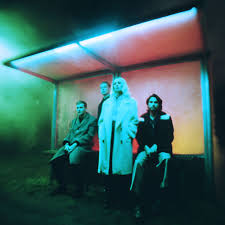
Wolf Alice, a familiar name for fans of the indie-rock genre.
The band is made up of lead vocalist Ellie Rowsell, guitarist Joff Oddie, drummer Joel Amey, and bassist Theo Ellis. They started as an acoustic duo in London around 2010, consisting of Rowsell and Oddie, but Amey and Ellis joined in 2012.
Since then, they have released four albums; their newest release, titled “The Clearing,” came out in 2025. However, one album of theirs has remained a favorite among their fans: “Blue Weekend.”
Released in 2021, the album explores themes of love, heartbreak, past experiences, and new places, all wrapped up in 11 songs lasting 40 minutes combined.
It opens with Track 1 named “The Beach.” The song begins with a faint guitar solo and references Shakespeare’s Macbeth, which sets a tone of impending drama and questions like “When will we meet again?”
The song then gradually fades into a verse voicing Rowsell’s frustration with inconsistent relationships that involve a push-and-pull trope, speaking of her experiences with trying to keep her friendships without ego. “We don’t need to battle, and we both shall win.”
Following right after is Track 2: “Delicious Things.” This song features heavy themes involving the disillusionment of fame and the feeling of being alone in a big city such as Los Angeles, describing Rowsell’s experiences with trying to fit in with the superficial crowd while also wondering where she truly belongs. “I don’t belong here, though it really is quite fun here.”
The band covers the heavy themes with a catchy beat, featuring a lot of building drums and dreamy bass guitar, accompanied by Rowsell’s ethereally wistful vocalizing.
The track fades out with a hazy, pensive repetition of a lyric describing the underlying theme, filling listeners with a sense of existential dread. “Don’t lose sight.”
One of the most meaningful songs on the record is Track 6, a heartfelt plea for happiness, titled “How Can I Make It Ok?”
The song features lyrics about trying to heal ourselves and the people closest to us, using a memorable rhythm and beat to get the point across. The whole album has an underlying sense of love, whether platonic or romantic, but especially this song. The music slowly builds from an anxious-sounding introduction to an almost desperate, angry ending, which symbolizes the growth of a selfless love.
With lyrics such as “How can I make it okay? Nothing else is as important as that to me.” and “How do we sell you the world?” the band makes it clear that they are so desperate for a close friend or significant other’s happiness that they would do just about anything, something that can resonate with people all over the world.
The album closes out with “The Beach II,” a sort of sequel to the opening number, which ties the record together in a perfect ending.
The track opens with a contrasting introduction to its predecessor, a breezy, lighthearted combination of string instruments. Unlike the themes of anxiety in previous songs from the album, “The Beach II” focuses more on closure and acceptance of the life we’re living. Through the lyrics and the softer melodies, it offers a sense of peace and solace in our friendships, rather than trying to keep hold of the stressful, contradicting experiences going on around us.
With the final lyrics being “Happy ever after” and “It’s okay,” the song closes out the album on a lighter, happier note, giving the listener a respite from the heavy heartedness laced in all the tracks.
Wolf Alice, the band as a whole, leaves listeners with a sense of fulfillment after ending the record. Their distinct, memorable style influences their fans greatly, whether they realize it or not.
All photos by Magdalene Conrad and Malachi Conrad. To view the gallery, click on the photographs below.
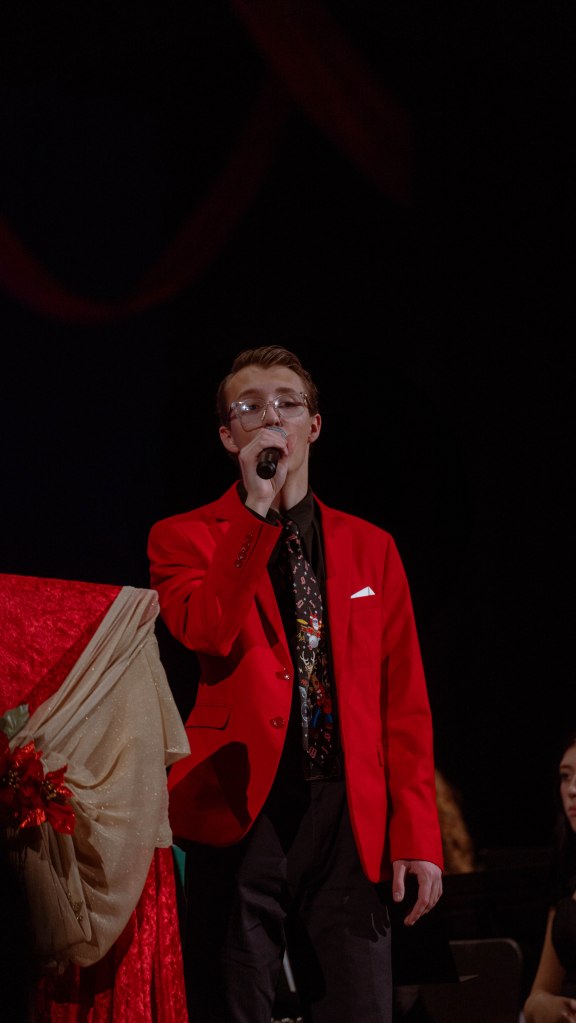
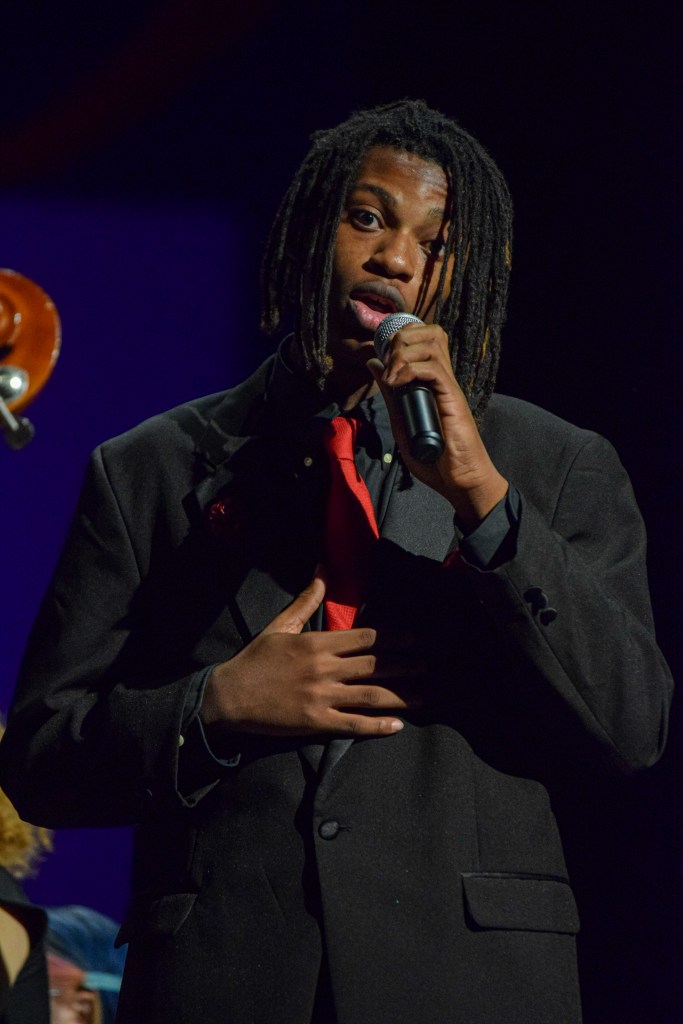
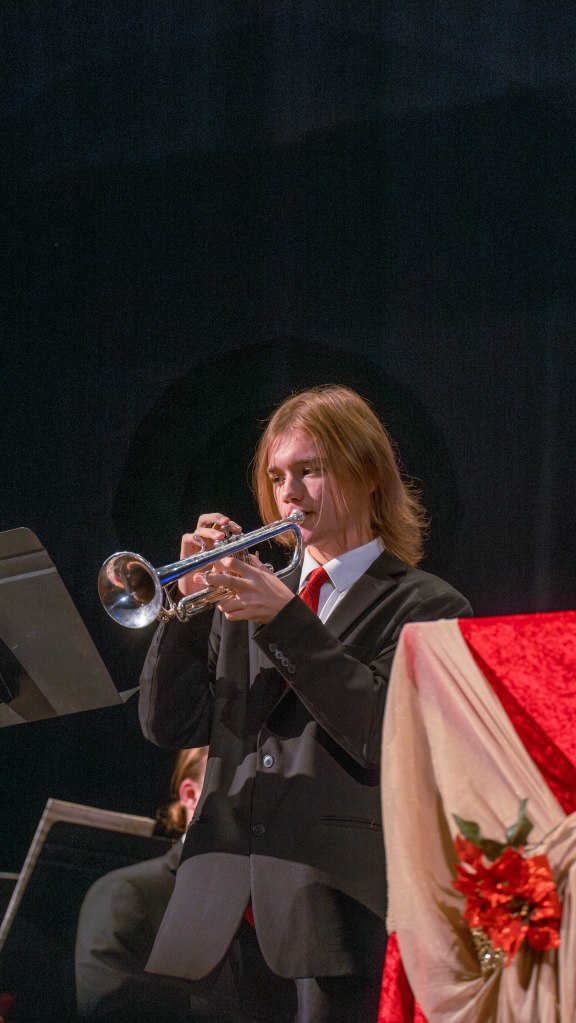
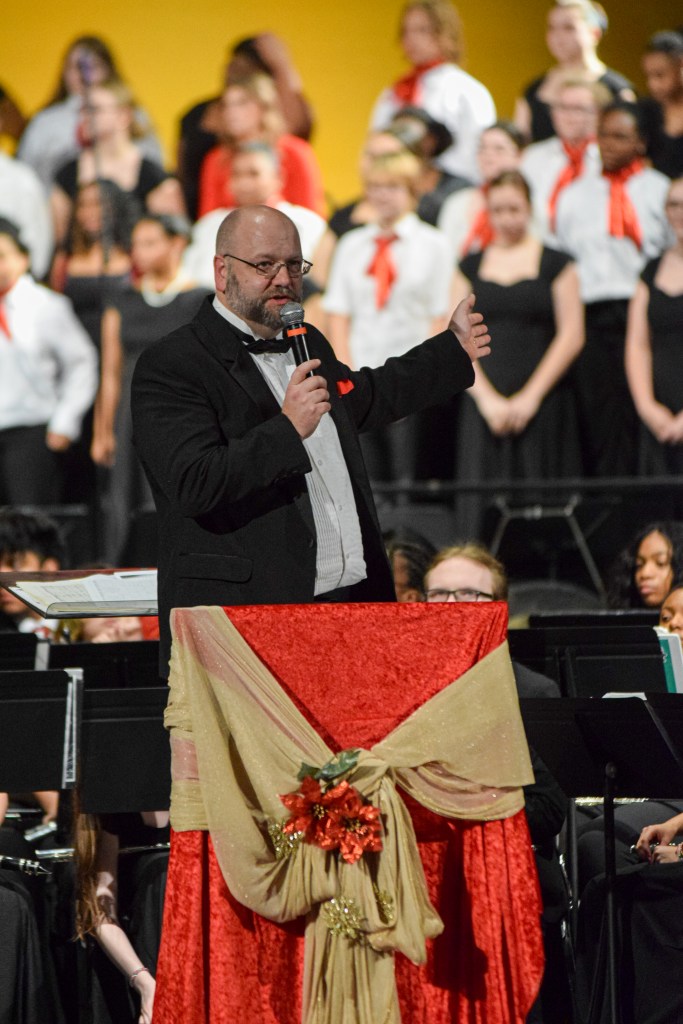
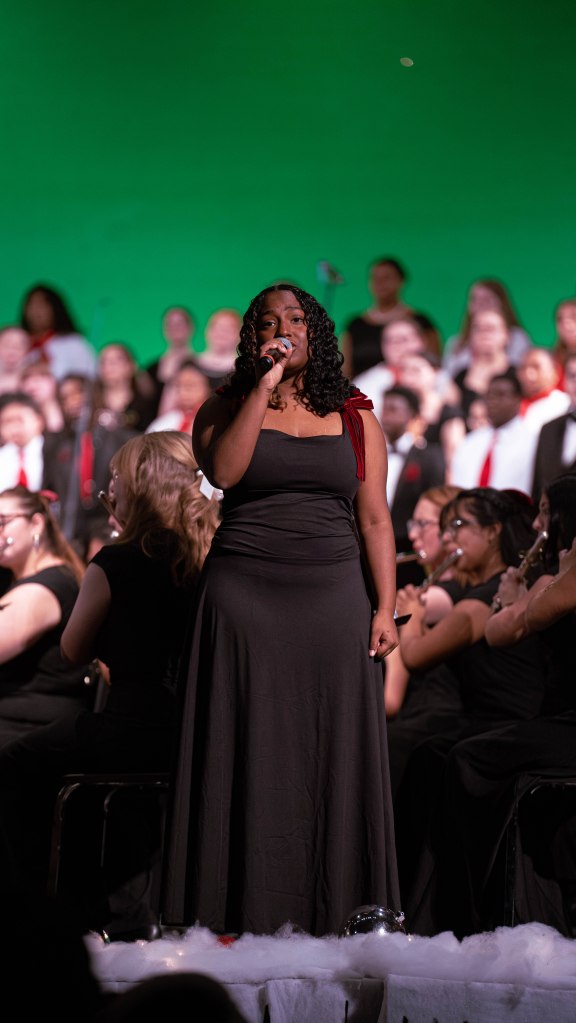
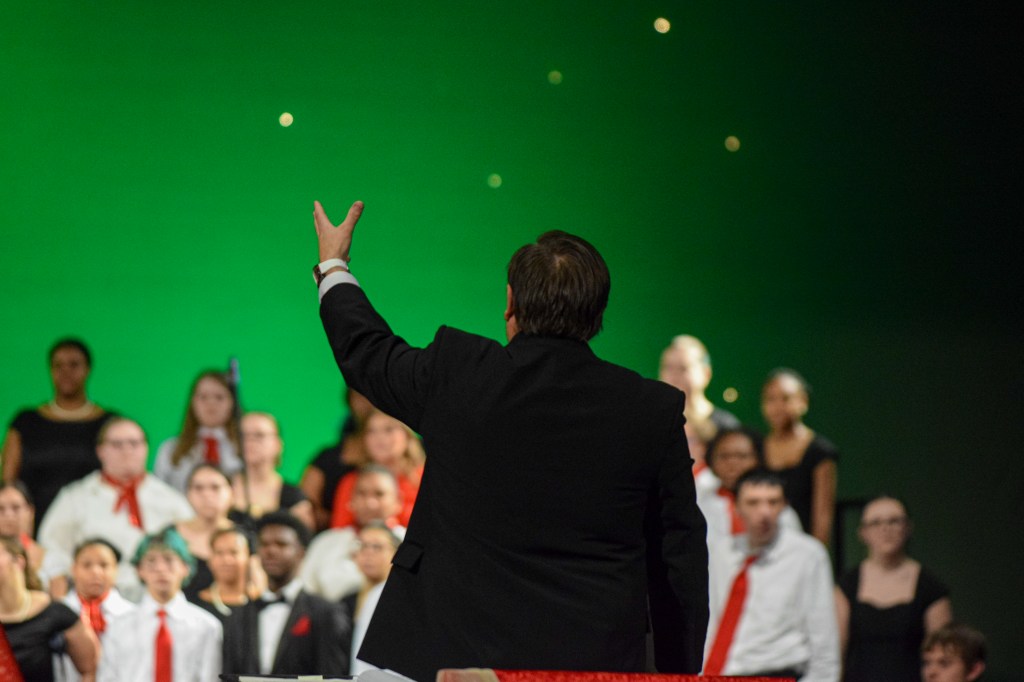
Junior Gabriel Collins sings in unison with the choir at Winter Fantasy on Tuesday, Dec. 9. Photo by Malachi Conrad. Senior Joshua Broady sings during the community performance of Winter Fantasy; the senior not only sings for the Devil’s Advocates, but also plays in the Jeffersonville band. Photo by Magdalene Conrad.Junior Sire Minggia sings to the crowd during Winter Fantasy on Tuesday night. The annual event brings all musical departments together for a holiday concert. Photo by Malachi Conrad. Senior Parker Holmes plays a solo with senior Charliegh Land. Photo by Magdalene Conrad. Senior Charliegh Land plays a saxophone solo with senior Parker Holmes during the annual Winter Fantasy concert. Photo by Magdalene Conrad. Junior Kiara Bowyer looks on as the next song is about to start. Photo by Malachi Conrad. The JHS band brass section performs the instrumental for the song “Hot Chocolate” by Tom Hanks. Photo by Malachi Conrad. Choir Director Kyle Broady gives a speech before the end of the show. Photo by Malachi Conrad. Senior Nairah Jadusingh sings for the audience at this year’s Winter Fantasy. There will be another Winter Fantasy performance on Thursday, Dec. 11. Photo by Magdalene Conrad. Band director Briston Hatchell conducts the band to a strong finish of the song at the end of the show. Photo by Malachi Conrad. The JHS choir performs for the community at Tuesday night’s annual Winter Fantasy. Musicians will perform again tonight, Thursday. Dec. 11. Photo by Magdalene Conrad.
“The Greatest Showman” is a musical about P.T. Barnum, a man who wants to build a life bigger than what he was born into. He creates a circus that gives people who feel left out, a place where they finally belong. The story focuses on following our dreams, even when others think we can’t. It also shows how success can be exciting, but it can create new problems, too.
The main character, Barnum, has a huge imagination and is always chasing something bigger. One character I really respect and admire is Barnum’s wife, Charity. She stands by her husband from the very beginning when he has nothing. She gives up her comfortable life to be right by him and support his dream. She believes in his dream from the very beginning, and that loyalty makes her stand out to me.
The cast of this movie really stands out, especially the people who bring performances to life. Out of all actors, Hugh Jackman as Barnum stood out the most to me. He brings so much emotion into his character that it’s easy to believe his character wants to make a difference. He also handles the singing and dancing so effortlessly.
Zendaya and Zac Efron also add to the movie, especially the chemistry in the scenes they share as Anne Wheeler and Phillip Carlyle, but Jackman definitely carries the whole story.
The music is a huge part of why this movie stands out. Every song has emotion behind it and helps tell the story. “Rewrite The Stars” is my personal favorite because the lyrics and harmony goes together, and every part of the song feels smooth. The soundtrack adds excitement and heart to every scene. The circus itself looks colorful and full of energy, making us wish we could see that in real life.
Even though some people say musicals can feel cheesy, I think the songs in this movie make the message even stronger. And while I didn’t like one specific choice a character makes, it reminds us that nobody is perfect, even the people that seem like they have everything. That honestly makes the movie more real.
What I like most is how everyone in the circus sticks together and lifts each other up when the world tries to bring them down. It shows how family can be people who accept us and support us no matter what. The message of confidence and belonging hits hard.
I would definitely recommend “The Greatest Showman” because it has powerful music, stunning visuals, and a story that makes us think about chasing our dreams. It leaves us feeling emotional and inspired. It reminds us to never forget where we come from and to keep going after our dreams. The message stays with us after the movie ends.
Movie Review Chart
Title: The Greatest Showman
Starring: Hugh Jackman, Zac Efron, Zendaya, Michelle Williams













 thehyphennews.com