Col. Robert Benning instructs his JROTC cadets during PT practice. Photo by Shelby Keesee.
Colonel Robert Benning walks around the classroom, detailing his freshmen on the captivating history of the earlier days of flight.
“John Montgomery’s 1911 glider was called The Evergreen…” begins Benning.
On a day at JHS, one may stumble upon Benning and pass by without a second thought. If not, they would most likely assume he’s just a typical bald man wearing military-like outfits.
However, this isn’t the case.
At first glance, no one would comprehend he’s not only spent 11 years at JHS teaching JROTC, served 25 years in the U.S. Air Force active duty, but has also majored in physics.
“They have a lasting impact because in some ways, we end up having friends for life.”
Colonel Robert Benning, JROTC Instructor
“I came into the Air Force and I had a four-year obligation. And so it was kind of, ‘I’ll do four years and get out.’ But it was about that eight or 10-year point where I kind of decided, ‘You know, I really like what I’m doing, I’m being successful, I think I’ll stay in.’ So, it was just always, always, wanting to serve my country,” stated Benning.
Benning’s first teaching opportunity was in the Air Force’s active duty.
“When I was in the Air Force, I got the opportunity in the Air Force on active duty to teach or instruct,” Benning stated. “I was in charge of training.”
Benning undeniably enjoys teaching and working with others.
“But this job, yeah, it’s teaching in the classroom. But to me, it’s so much about mentoring our youth,” said Benning. “And that’s what keeps me coming back each year. It’s being able to work with the high school students.”
Using team building exercises in the classroom, Benning attempts to increase mentorship within his students.
“My favorite thing about Colonel is he’s a mentor, he’s a life coach, he extends outside of ROTC, he helps you with every aspect of life,” stated Cadet Evan Cooper, a senior. “Academics, personally, just anything you ask him, he’ll be there for you.”
Cadets report Benning has improved their leadership skills.
“I’ve learned more leadership strategies through what he’s kind of like, taught and what he’s talked about with me over,” said Cadet Dylan Wibbels, a senior. “He seems like he likes to do right by the world, and he sticks to his moral compass.”
His students also report Benning having an impact on their daily lives, ranging from how his students go about their day, to a different, more positive view on how the world works.
“As a person, he is a big influence on my morality,” Cooper said.
Not only does Benning have a great influence on his students, but he is often described positively by them.
“I would describe him as calm, stern, collected and very intelligent,” said Cooper. “I think he’s a model example of what a man should be.”
Because of the mutual impact and likability between Benning and his students, after the students graduate, Benning keeps contact with them.
“What other things that we do is after kids graduate, we try and keep touch. Especially those that go into the military. So anytime they’re in town, we’ll take them out to lunch or dinner, and I try and keep that correspondence with as many of my students as possible,” Benning stated.
Benning’s favorite part of his job is seeing the successes of his students after graduation when an enduring impact has been made on them. He deeply enjoys the connections that are shared between the students and himself.
“They have a lasting impact because in some ways, we end up having friends for life.”
“And then you’ve got your answer,” JHS algebra and geometry teacher Cory Densford said. The time was 2:30 p.m., and Densford had taken the time to stay after school in order to help his fellow students with their questions. Many students gathered around him, some of them not even from his class while others accompanied their friends.
“I knew I wanted a job where I could help people. I decided on teaching because I had good experiences in school and I had a lot of really good role models throughout my time as a kid,” explained Densford.
It’s his twelfth year of teaching at JHS, 11 of those years also sponsoring the school’s Game Club. After studying for a career in education at Indiana University Southeast, Densford began with primary teaching, until he decided kids were just not for him. Soon after, he came to teach here where he once attended as a student as well.
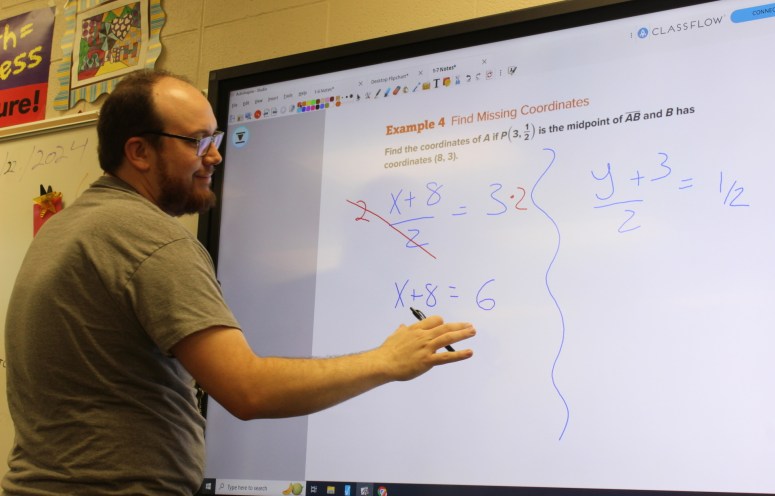
Math teacher Cory Densford presents a lesson to his geometry class. Photo by Viviana Gonzalez Chavez.
“It’s incredibly rewarding to be able to give back to the school that made me who I am,” he explained. “JHS also provides so much freedom in how you teach. It’s really easy to do what’s best for my students.”
Densford not only teaches six math classes a day but also stays after school almost everyday for homework help and to answer questions from students who’ve already gone home.
He spends a lot of time in person and online, guiding those who may struggle to keep up. From the moment he walks into the classroom to the second he walks out, students will always find him speaking with them and helping answer their questions.
“It’s one of my favorite things about his teaching style. I liked that he would put a problem and work it with us, if you had questions he would answer them and dive deeper. He was a very thorough teacher and never left me with more questions.” said sophomore Kaniyah Woodley, a former student of Densford’s.
Woodley also described times when she felt like Densford was more than just a teacher, when he was a friend, someone to have fun with. She recalls a time when cupcakes were brought in as a ‘goodbye’ party for their student teacher at the time, Garett Nash, stating, “It felt like he (Densford) was a student with us, having a good time, laughing and joking about simple things.”
She also goes into detail about times when class wasn’t so simple, when things were hard for her and her peers. Being a teacher during these times can be difficult, having to draw a line of professionalism as students begin to grow up and face harder challenges. Despite this, many classmates still felt that Densford was always uplifting.
“I have bad test anxiety and when it came to geometry tests, I was always really anxious. Mr. Densford always noticed and sometimes during the tests he would use encouraging words to help me feel less stressed about it,” she explained. “It was always very nice, especially because he never made us feel like anything less than the students we knew we could be. He never raised his voice and was always very respectful, sometimes even playful with our class.”
Having a job in which working alongside teenagers is essential, guiding them and helping them reach their goals can be demanding. He describes the struggles many teachers from all schools face: How do you motivate a kid who doesn’t want to learn?
Especially in the morning, when students are just waking up? Challenging as it may be, Densford harbors no ill feelings towards the job.
“Oh I love it… they’re all different. Day to day, period to period, kid to kid, it always keeps it interesting. It’s not the same exact thing, monotonous day in, day out, and that’s what I like about it.”
He also described the little moments in class that make it all worth it. He details prideful moments, where students triumph over their hurdles, the moment in which he succeeds as a teacher and allows students to problem-solve their way through conflicts.
“Favorite part is getting to hear kids explain something that they figured out on their own. I mean I lead them there, but they make the final conclusion. Seeing them put those pieces together and just seeing in their face like ‘Oh wow, this is so much bigger than I thought it could be,’ that’s a cool moment.”
As if to speak from experience, he also illustrates a similar incident from his very own teen years with JHS math teacher Shadd Clarke.
“I had him for two years; he’s the reason I became a teacher, it’s what made me pick teaching… It’s one of the things he’s the best at, is showing you, giving you the tools and getting you to that place. And that meant a lot to me as a kid because I had been handheld in other classes, just spoon-fed all of the material, all of the conclusions, and it never clicked why stuff worked.”
Similarly, Densford has also heavily influenced educators around him. Nash, his fellow geometry and algebra teacher, also speaks very highly of him.
In the second semester of the 2023-2024 school year Nash, through a program at IUS, was working as a student teacher with Densford for four months. Nash recalled the overall experience of working alongside Densford.
“It was fun, he shaped what I try to model my classroom around, and he helped me while I was student teaching. He gave me a lot of freedom if I wanted to try something new, experiment… he was just a good role model.”
Now his own teacher, he recognizes many similarities in the ways he teaches. Nash also details goals he has, things he’s seen happen with Densford that he, too, wishes to accomplish.
“I see kind of how the students respect him a lot, that’s kind of what I’m trying to strive for, what inspired me to become a better teacher.”
Having seen so many students grow up, it can be very nostalgic for a teacher to see them grow up into adults, seeing them achieve the things they worked so hard for. This comes as no surprise to someone like Densford, who left an uplifting impact on many of his students.
“It’s always cool seeing kids turn into the people you knew they could.”
Densford said shaping these future leaders is ultimately what his class is all about, guiding them into becoming people who can problem solve their way through any challenge.
“I want to make kids into thinkers. That’s what makes you successful in life, I think. People that can think their way through problems and not have to be handheld, it’s hard especially at first… that’s the impact I want to have on any of my kids, is that they can just pause, take a step back, look at the big picture and think about what’s going on.”
“I want to make kids into thinkers. That’s what makes you successful in life, I think.”
Math Teacher Cory Densford
by Ricky Cummins
Math teacher Cory Densford sits down, elbows on knees, helping two students with their math assignments. He also answers questions from other students about games, assignments, and sports. These activities in his daily life align with his life philosophy.
“My main goal is to help as many people as possible and be happy while doing it,” Densford said.
According to this philosophy, Densford enjoys and takes pride in helping others.
“They talk about love languages, and acts of service are mine. That’s how I show people that I love them. So with teaching, it is effortless to do that because there is so much you can do for a student to help them.”
Densford even carries this philosophy into his daily life outside of school.
“At home, my wife and I take turns doing dishes and cleaning out the cabinets. I would even do her turn if she’s stressed out. I guess the result motivates me to keep doing stuff that feeds that cycle,” he said.
Using this technique, Densford can maximize his teaching capabilities and minimize his teaching mistakes.
“Teaching has helped me a lot with stress management. It’s all about compartmentalization. I only let myself worry about stuff that I can directly affect.”
Math teacher Garrett Nash mentioned that Densford played an important role in helping him become a better teacher.
“Last year when I was student teaching, I learned many good ways to make math more comprehensible,” Nash said. “He is also one of my role models when it comes to teaching.”
2024 graduate Draco Konno mentioned that the Games Club, which Densford runs, helped him de-stress.
“It’s a great way to relax and have fun. Densford manages it in a cool, chill way to create a relaxing atmosphere.”
Densford created a similar atmosphere in the classroom, which led to the inception of the Games Club.
“My very first year teaching, I had this group of kids playing Yu-Gi-Oh, so I brought Magic in, and they taught me Yu-Gi-Oh. I taught them Magic. So, I let them come back later that day, and that was the start of Games Club,” he said. “The next year we wrote our charter, got approval, and even received some funding to buy games, and that’s how we started.”
Densford’s realistic and motivational words are his specialty.
“As a teacher, you have to find out what your insecurities are and make them your armor. Low-hanging fruit is what kids are going to pick.”
Freshman English teacher David Kummer walks into his class welcoming and greeting his students as he asks about their day. Little do his students know that they will be learning about English from a published author’s point of view.
With six published written books and 5,000 copies sold, Kummer is thinking of setting himself a new goal for the upcoming summer to finish a Trilogy of books.
“I want to write another series, but there is one I’ve been working on since high school. I’ve written it and re-writing. It’s more like a personal goal,” said Kummer. “I want to make it the best I can.”
He talks about his personal struggles in high school and how writing was used as an outlet to help in many different ways with his mental health, depression and anxiety.-
“I used writing as an outlet. I used it to work on expressing myself. In some way it improved my self confidence. Saying I’m 16 and I published a book. It was a good way to connect with other people.”
Kummer talks about his experience as a young writer in high school helped him figure out his writing for advertising. He talks about what he has learned from his experiences.
“Publishing books in high school gave me a head start on most people and let me learn from trial-and-error, specifically when it came to promoting my books. I had to make a lot of mistakes to figure out what worked, so I used high school as a time to experiment with my writing and with my advertising,” he said.
Starting in elementary school, Kummer started writing. He said his dad and encouraged his success in writing.
“My dad encouraged me by always reading what I wrote, no matter how bad the writing was or how ugly my handwriting, as you know, and he even offered suggestions on what I could do better, but also pointed out what I did well. I really enjoyed that connection, and he still reads all of my books to this day,” he recalled.
Kummer said his favorite part of writing a book is that it unlocks new emotions for him.
“My favorite part of writing books is that usually when I start with something by the time I get to the end of it, it’s like a totally different story. It’s always fun when I get to that moment and it just clicks together. This is what this book is meant to be.”.
He says it’s a shocker to place all the puzzle pieces of his books together.
“It’s like an ‘aha’ moment. It shocks me when all the puzzle pieces come together. It can take a while to put all the puzzle pieces together,” said Kummer.
Kummer said his main focus is to write and not focus on being published.
“I think everyone can get something out of writing, whether it is self confidence or using it as an outlet. I like being able to see how books influence other people.”
English Teacher and Local Author David Kummer
“If you asked me four years ago I probably would’ve said that I wanted a publishing deal or to have a big publishing company. It would be cool to have a publishing deal but I’m not willing to spend a lot of time on it. I’m in it to write, not to be published,” Kummer said.
Kummer contributes being an author outside of school but he also aligns it with being an English teacher. He talks about the advantages of being an author and teaching it from his point of view.
“Having written books, I can see things from the author’s point of view, and I’m a little better at pointing out things and then we can talk about it in class. I can see it from the reading side and writer’s side.”
Kummer said being an author and teacher has helped him put himself out to the public and break out of his comfort zone.
“I think being an author and teacher helps me in both categories. When I was younger I was a very shy introverted person. I think being a teacher forces you to be less introverted. Also, when selling a book I put myself out there,” he nodded.
Though it can be a challenge, Kummer wants his classroom environment to feel stress free and exciting for his students on a daily basis. He reduces the stress of students by creating assignments that help with their engagement as well as being patient with them.
“My goal with teaching is that I want my classroom to feel like a space where kids are stress free. I want it to be a place where kids are excited to come to class. I try to create assignments that involve engagement that helps with their real life and person. I don’t want kids to worry about me screaming at them. I want them to know what’s going on right when they walk into my class.”
Sophomore Yanqi Liang proudly described Kummer as a teacher who can be trustworthy, unique, funny, and there for his students.
“He helped me all the time so I didn’t have to worry about failing that class. He broke down and explained projects individually. He’s an outgoing person and trustworthy at times. He participated in Spirit Week and he helped me with friendships. He’s unique because he tries to be friends with his students and cares about them. He is a role model to us,” said Liang.
Kummer focuses on being patient with his students whenever he talks about wanting his classroom to feel stressless, as well as trying to make it easier to learn and acknowledge the work of his students.
“If they don’t understand parts of speech, I can change the way I teach it and see if it works that time. It does get tricky but I have to keep in mind that almost every kid is doing the best that they can. Somedays their best might not be as good as other days. If something doesn’t stick one day it might be something we will have to come back to the next day and try again,” he said.
Freshman Dana Romero eagerly agreed with Liang about Kummer being a trustworthy teacher and being a unique teacher.
“He gives me his honest opinion and makes me see past my thoughts. He listens and is patient. He doesn’t go around talking about other students’ problems. He can talk to you and not judge you; he’ll leave you with no remarks. He is an outgoing teacher and communicates and reaches out if you struggle in class. He tries to understand you instead of making assumptions. He’s an amazing teacher,” said Romero.
Kummer’s advice for current students is to let them know that it does get better being in high school. Though it can be hard at first, recalling moments back in high school can give you a good laughter.
“You don’t have to be perfect to get through high school. I want kids to understand that it does get better. It’s hard to say because you are in high school. It feels like you’re stock in a fog and you don’t know how to get it out, but it does get better. Stuff that seems impossible in high school ends up being kind of easy. You’ll look back to high school and can kind of laugh about it years down the road. You’ll surprise yourself with what you’re capable of.”
Teaching at JHS allowed him to interact with students with different life situations and accomplishments. However, he points out the thought of working in a public school and private school and describes the difference between them.
“I really like teaching at Jeff because I get to interact with kids who have been through a lot of stuff and who had really tough lives. Kids at Jeff need you in a way that they don’t need you at a private school. Just the amount of kids who say ‘hi’ to you or a ‘good morning’. That is an accomplishment,” he said.
Getting started in writing can be hard. He said that getting started in writing or reading can be hard to get past but it can be done. Especially kids in his Writing Club held at JHS.
“It’s really hard to get started. It’s true whether you are writing something or reading something. The first page of the book you’re reading or the first page you’re writing is super hard to get through. What I’m trying to tell the creative writing kids is to not worry about the first draft, just write something. Sometimes you don’t really know how you should start a story until you get to the end of it.”
Writing is held with challenges when getting started. Kummer believes that students can write and get something out of it, including the influence that books can create.
“I think everyone can get something out of writing, whether it is self confidence or using it as an outlet,” Kummer said. “I like being able to see how books influence other people.”
Having been chosen as an exchange student, people put high expectations on my adaptability, on my desires to open myself to people and be presentable to my fellow American neighborhood and people of other ethnicities.
It would be a lie to say that this adventure isn’t scary to me, to be all alone in a big English world, a world that isn’t mine nor made to be mine, but from the first time I took the flight to come here I should have known everything wouldn’t be easy.
After more than 24 hours of traveling with a connection to Belgium, in which I couldn’t rest because of the tumultuous plane that kept moving around (answer the call of Gotham was the best part of the trip, as having to binge three DC movies was so much fun). However, eating during the flight was a terrible idea — my stomach ache was my biggest misery of that adventure. But the real difficulty was to say bye to my family and friends.
This exchange isn’t about the school at any point, but if there was something I wasn’t ready for, it’s how American high schools really are.
American high school isn’t like in the movies, but it makes it even more authentic, even more realistic, even more loveable, and I cherish every minute I pass between JHS walls.
Exchange Student Sarah Baloucoune
Are American schools better than schooling in Senegal? Coming from a foreign country, the first thing that had me rolling on the floor was the reality of the American high schools, which are immensely different from how they are in the movies.
All over the world, an image is spread of the “perfect school” where everything is good and sweet with music, dances, and love stories. But in fact, it is much more complicated and different than that – and a lot more stressful, too. This makes it closer to my school in Senegal and the whole Senegalese education system than to the fantasy they want us to believe.
Senegal is a country within Africa that was marked by the colonization of the French empire. As a result, the school organization of that West African nation is inspired by the ancient French school system and modified to accommodate the Senegalese government’s desires, even if some of the lessons we are taught are more than unnecessary.
The differences between the American curriculum and overall coordination and the Senegalese school structure are multiple. One of them is that in America (or maybe just in the United States) the students have to walk through the hallways to get to their next classes. This was very weird and confusing at first because of this school’s immensity and the numerous rooms, making finding my way impossible without help or previous knowledge.
In contrast, in my home country, students are placed in the classroom with people based on their grade, and the teachers move each class period instead of the students. Teachers bring their material and teach their subject, sometimes with bags or nothing. It wouldn’t be a lie to say that the students prefer this format and take great pleasure in staying alone in the classroom when the educator is late or off duty.
Another academic divergence between the two schools is the usage of Chromebooks, which is revolutionary to a student used to writing on paper and can be seen as a blessing as much as a curse to everyone else. The positive side is that it minimizes the number of books and notebooks, and it makes rapport between the teachers and the students easier and the usage of the internet for research more practical than using books. This is pretty much better than the written notebooks, except that the computer needs to be charged to be useful.
To be honest, the usage of Chromebooks gives me “toxic boyfriend” vibes: I want to have it, it’s fancy, fast and looks so professional; however, when using it, I am much slower than with a pen. I need help to learn everything about it because there is nothing to make you understand it and without advice, you don’t learn anything. It’s just a mess to have to learn how to use a computer when people are teaching their subjects.
All those highlights of the not-so-important differences are here to show the actual gap between those two systems, being the whole organization of the schools. The biggest and most internationally known of them are the graduation system and the classes’ curriculum, those two being deeper problems covered by the Senegalese government and school accomplices.
In Senegal, to successfully graduate high school, you must pass an exam named Baccalaureate, just like in the French school system. The funny part is that to get into high school, you also have to do an exam called BFEM (brevet de fin d’étude moyenne); this time passing it or not doesn’t have a big impact on the high school experience but totally changes the university experience.
This exam was my nightmare because even before I started the ninth grade, people started putting pressure on me about it. Being constantly reminded of this left a bitter taste on my tongue, and the real preparation begins when there are 100 days left before the three days of suffering in the exam centers. It is more fierce and stressful than all of the middle school years. I succeeded in that exam, but I won’t forget how badly people put stress in my heart for an exam I was confident about for the whole school year.
The coordination of those national exams is pretty long but relatively simple since in most of the schools you don’t get to choose all your classes. As an example, in high school, you have to make one of the biggest choices of your life that will change your whole school experience, being the choice of the series. Students either choose the series S (in which you get to work more on the sciences and study the reality of the matters), or the series L (mostly turned to literature and philosophy or the study of human civilizations). Once students choose their series, most of the classes are already chosen for them.
I was placed in the scientific side but switched at the beginning of the 10th grade (first year of high school in Senegal); this was the best idea I had in a while. I may not be as good in mathematics as I would have been in series S, but my grades thank me greatly for that choice, and my mind and heart were still at ease by the end of the year. That change made me lose some school classes, but, hey, I did great that year, so that’s fine anyway (that’s also a reason why I am struggling in precalculus even if I had straight A’s my whole grade).
With all those realities, most Senegalese students fantasize about the so-called “main character high school” with all its dramas and romance, but even more because it got the reputation to be easier than in some other countries, not to say most of them. After all this intellectual talk, let me end this comparison with a little emotional note – there are a lot of more differences that I didn’t tell you about like the usage of the phones, which is forbidden in my school; the American cafeteria and its catalog of food that gives the students the choice of what to eat for lunch, which is totally different in most of my home country schools; and the freshmen who are still in middle school in the Senegalese organization.
I really am enjoying school in America, but I miss my home country school. I miss my friends and family even more, but I love this experience.
American high school isn’t like in the movies, but it makes it even more authentic, even more realistic, even more loveable, and I cherish every minute I pass between JHS walls. I will never forget the people I met here (big up to my sweet Senegalese friends all over the states and my incredible host family here).
With a new school year starting and seasons kicking off, many teams and coaches prepare for a year filled with hopeful achievements and golden medals. Through intense practice and hours of dedication that are put into these sports, student-athletes bring pride to JHS.
However, one must remember the coaches who built these players into the athletes they are today. A spotlight on several fall sport coaches reveals their backgrounds, interests, and goals for their Red Devil teams.
Girls’ Soccer Coach Julie Deuser
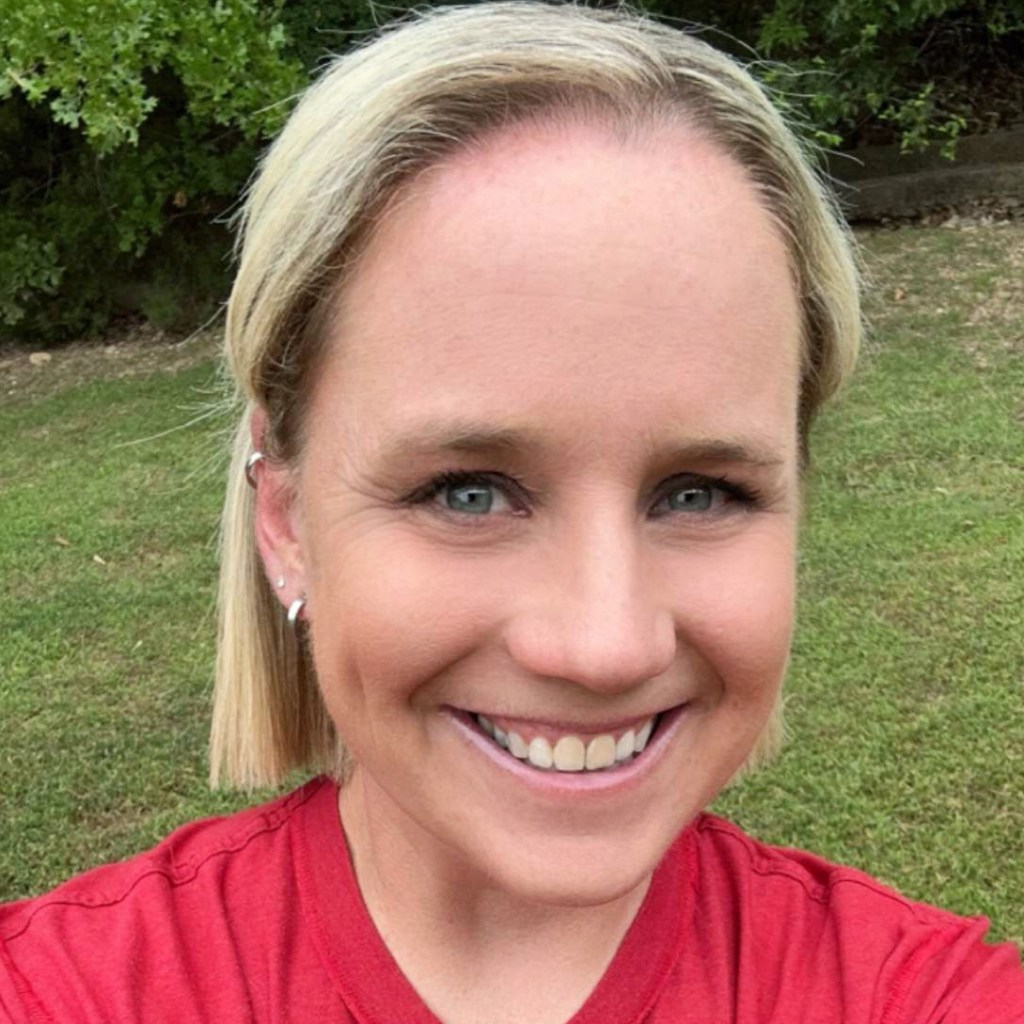
New girls’ soccer head coach Julie Deuser. Submitted photo.
Coach Deuser is a new addition to the JHS athletic team, taking over for former soccer coach Kallee Thornton. With big shoes to fill, Deuser has come in with a strong sense of determination. She has a long history of coaching at many different schools and playing for several more herself. For example, she coached at New Albany and led her team to the IHSAA Sectional Championship in 2012.
But now, she has big goals for the JHS girls’ soccer team.
“My biggest goal for this team is to see the girls grow and learn the game. I want this team to be competitive and respected in the area. We want girls to want to come to Jeffersonville to play soccer. The program is going to be transforming over the next few years. Long term, we want to win games and championships.”
“I think she’s going to take the soccer program in a positive direction,” senior and varsity player Jovie Golko. She has been playing soccer for all four years of high school and has vocalized her faith in her new coach’s ability to lead her and the rest of the team.
Head Co-ed Swim Coach Michael Pepa
Pepa is a face many students recognize from his teaching College and Careers for many freshman classes, but he is also the head coach for the JHS award-winning swim team.
Pepa had been a swimmer for many years before he was known for his coaching abilities. He started swimming in high school and he, like many, wasn’t the best when he first started. But after swimming through high school to college, he eventually became a record-holder in his sport.
With his 30 years of experience, Pepa passes wisdom onto his students. He pushes an idea of personal best, wanting each student to reach their potential.
“I love Pepa; He’s an amazing coach who built me into the swimmer I am today,” stated Romier Hunter-Lawrence, a senior swim team member.
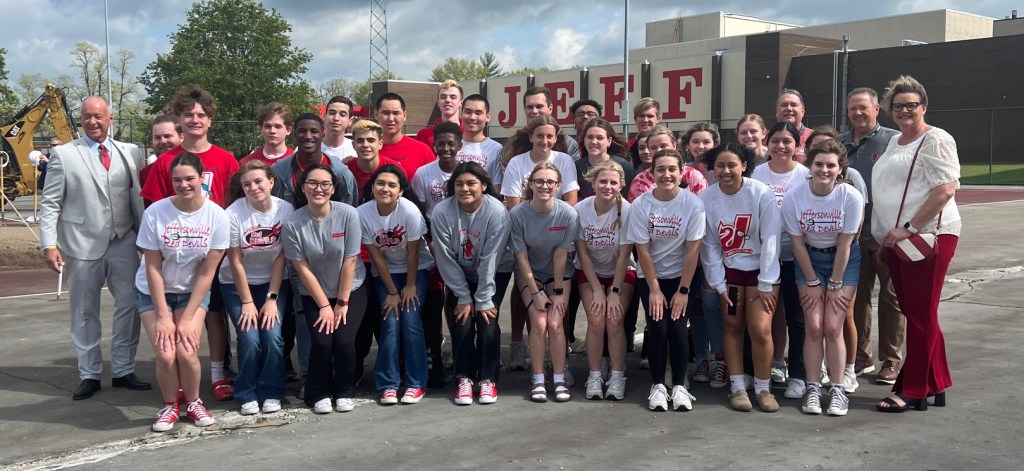
JHS swimmers join principal Pam Hall and mayor Mike Moore for the new pool facility being built. Submitted photo.
But even after 30 years Pepa has more plans and hopes for the new year, from strong talent new and old, and the addition of a new pool in the coming months. There is much to look forward to for the swim team in the coming years.
Volleyball Coach Wesly Briscoe
Originally Briscoe had no plans for becoming the coach we all know him as today. He originally wanted to do more of a journalistic view of sports. He was the news and sports editor when he attended Floyd Central High School. He even did radio and TV. It was when he went off and became a student at UofL, sitting around one day, when his mother gave him an offer to coach volleyball.
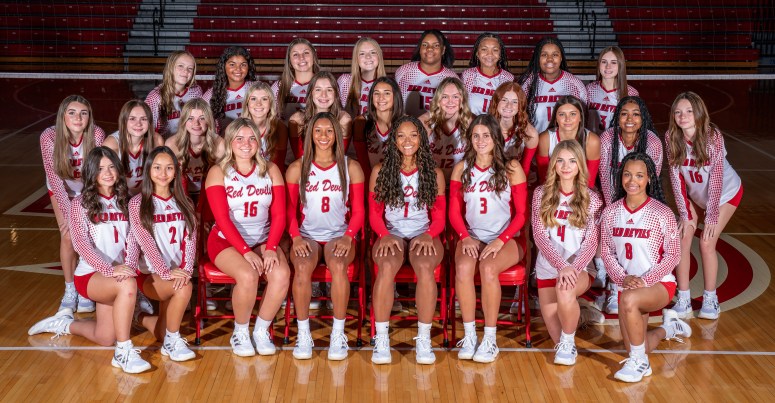
JHS volleyball team. Submitted photo.
During the first few years of this new volleyball coaching career, Briscoe walked with a “chip on his shoulder.” He said he was coaching out of spite, but he learned to change his mentality.
His new values as a coach are that coaches should lead by example. They should strive for personal growth and push the students to be the best they can be.
“You could train like a tiger in the jungle or train like a tiger in the zoo” is one of Briscoe’s mantras about pushing himself and his students to train to be the best version.
This mantra is one any student should remember if they want to join the volleyball team in the near future. As Briscoe also shared, volleyball is not an easy sport to just pick up – it will take time and practice but the results will lead the athlete to find improvement and self-pride.
Assistant Wrestling Coach Evan Myers
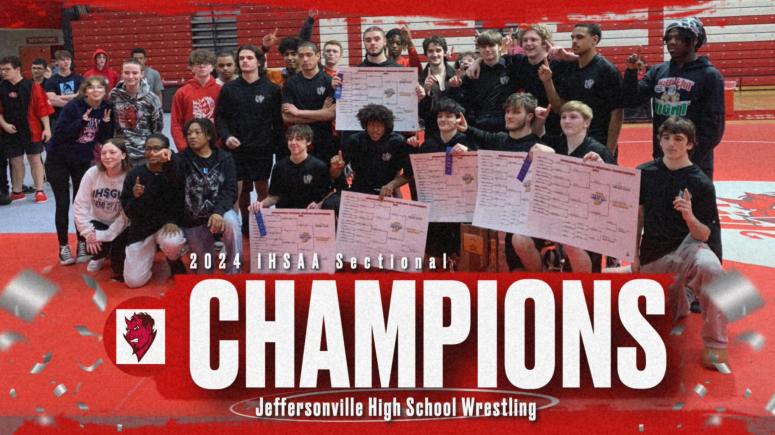
Myers has been coaching at JHS his entire coaching career and similar to a past coach on the list, Myers didn’t originally plan on being a coach. He was interested in journalism, which led him to become an English teacher. Since he wrestled while in high school, along with a strong love for teaching, he took an opportunity to be a JHS wrestling coach when he heard that the position was available.
2024 IHSAA Sectional Wrestling Champions. Submitted photo.
Myers said that personal responsibility is a key part of wrestling.. Unlike many other sports where athletes are surrounded by teammates on a field or court, wrestling has only the athlete and the opponent on the mat. This means each wrestler must carry the win or loss on his or her shoulders.
He added that the sport requires a lot of tough training from the strength that is required to pin another wrestler, which adds physical stress to the body.
However, this training can pay off, for example, for JHS senior Ben Land, who competed at National Tournaments, as well as for other wrestlers on the team.
“Great pain comes with great reward,” Myers said, believing that the best way to succeed is to work for it, as many of his students have done and have received the benefits.
Myers’s love for teaching, his students, and the sport drive him every year to push and grow the team. He has much hope for the upcoming year and for all the talent new and old that are in the team.
The focus of WJHI has always been on the subject that they are focusing on, yet turning the cameras back on those running the TV & Radio process is an important part to truly understand the work that they all do.
One of these hard workers is one of the new TV & Radio teachers, Fred Cowgill, who brings his expertise to WJHI and JHS.
As fate would have it, right after grad school, Cowgill would get a position on CNN and be “thrown on national tv,” as Cowgill put it, at the age of 22. After being a stand-in for someone who was sick, he has been on the air ever since.
After spending 44 straight years on air, Cowgill has settled down in JHS’s broadcast department and officially got the job in June. Prior to this, he worked at U of L and WLKY as a sportscaster for 38 out of the 44 years.
He started in Atlanta, Georgia, with CNN Sports, then went on to shift over to ABC Rochester New York for four years, until he made his way down to Kentucky for WLKY, in 1986.
While there, he “fell in love with the city and everything around it,” enjoying the horse racing, like the Derby that he was able to cover for 38 years straight, and the college sports that filled the town. This enjoyment led it to becoming a very personal and bittersweet departure, but as Cowgill put it, it was time for him to go.
Even though he had pursued the live broadcasting side of the industry, he still had just as much passion in teaching. Cowgill graduated with a masters in broadcast journalism, seeing this as the only way for him to get into the business, hoping that one day he would be able to teach. And he got that day after U of L asked him, and he agreed to teach part time back in the 80s. He had then left the teaching business until this past spring to teach a course in Producing Kentucky Derby stories after he retired from his job at WKLY in May.
Now, Cowgill may have been out of his broadcast job, but even in his retirement, the fire to teach had not gone out. He wasn’t sure if he would get another job, even though he was searching, there were none that checked all the boxes.
This also applied to our school when principal Pam Hall and athletic director Larry Owen contacted Cowgill in late May, informing him of the developing position, during his final week at WKLY.
He was willing to listen, but admitted, “At first, when I came over, I was ready to say no a couple times” due to the amount of work it would take for one person, yet Hall wasn’t going to let go of this opportunity. And due to her willingness to help aid the changes Cowgill suggested, he decided to take the job.
Cowgill’s reluctance to take the job was not due to him being picky; it was due to the massive workload that taking this position would have on one person. The lessons he teaches are unlike lessons from the past teachers, which forces him to take the knowledge and reverse engineer it to make an understandable curriculum.
Having to become a master in different editing programs all at the same time can be a struggle, even to those like Cowgill who have been working in this type of field for as long as he has.
This struggle has been eased due to the help from the other new production teacher, David Callan.
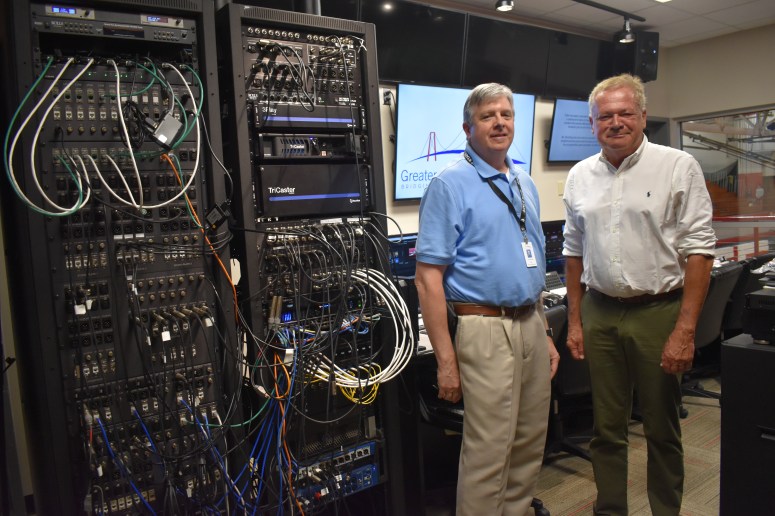
New JHS broadcasting team Dave Callan and Fred Cowgill in the WJHI studio. Photo by Bruno Diaz.
“If that basketball court was Adobe Premier, Mr. Callan could tear it apart and put it back together again, while I just play basketball on it. The same thing is true here. I can play in the neighborhood, I just don’t know how it was built,” said Cowgill.
Cowgill and Callan knew and worked with each other from 1986 when they were both on WLKY, Callan having worked there for 28 years, up until 2003 when Callan transferred to WRDB, where he worked for 21 years. Callan left on a Friday and started working at WRDB the following Tuesday.
Callan started his radio journey as a station runner for WLKY. He would run errands like picking up video tapes, film, and audio tracks.
This may sound like a small job, but this was all prior to his senior year in high school where he was able to get up close and personal to the equipment.
Callan has a total of 49 years in radio, which he’s now leading into his 50th year with working in radio at JHS, and freelance jobs, like working on and off for the Cincinnati Bengals, where he is an operator of the big screens.
Callan “blames Cowgill” for first hearing of the position at JHS when Cowgill brought along Troy Middaugh, Production Manager at Hearst Television, to help him teach the more technical side of TV & Radio. Middaugh was a past employee of Callan, and a past coworker to Cowgill, so he understood both of their abilities and thought that Callan was the one he knew to call.
“I feel honored and blessed,” Callan stated.
Callan said it was as if his planets aligned when he got the call from Cowgill, recalling how his path on WDRB was changing due to choices being made to the station by the owners.
“I helped build something great, and now they wanted me to tear it down”, so when the company was offering people of a certain age early retirement to reduce staff, he took the retirement, unexpectedly by the company, “I’m going to take the retirement, and I’m going to come over here and have fun.”
Hall described the hiring of the new broadcast team as a great moment for the program and the school.
“Any time it comes to bringing on staff to work with our Red Devils, I want to hire the best. I try to swing for the fence, every time. This school year, I was able to hit many home runs with the hires, across the broad in all subject areas. Hiring Mr. Cowgill and Mr. Callan was a grand slam!” she said.
One final project that Cowgill was keen on mentioning was one goal being worked on in TV & Radio, “I am Jeff.”
Similar to the “I am Horseracing” campaign launched in 2019 by those in the industry, in order to improve the public’s view on horseracing, yet this new plan has little to do with horses, and more to do with improving our own self image.
Cowgill stating, “There is a lot more here to be proud of, and people don’t necessarily get that.”
High school is an adjustment for any student. Every person is trying to discover who they are in a not-so-forgiving climate. It’s very stressful to transition from middle school to high school.
Freshman Isabella Stewart said, “I talked to my big sister who is already in high school. She helped me prepare for high school, and I try to prepare myself mentally. It isn’t easy making friends. Everybody is very judgy and looks mean. Work has been easy for me for the first couple of weeks.”
She added, “The food is better than my middle school food. The lunchroom is much more organized, and I like sitting anywhere I want with my friends.”
Freshman Kayla Taylor, said, “High school is harder than eighth grade because it is tough to learn the work. Jeff High is a huge school, but most of the kids and teachers are nice and help a lot.”
High school is a struggle for freshmen coming into a large school from middle school, especially when adjusting to the amount of academic work.
For example, freshman Chris Allen said, “There is a lot of work. We get new assignments each day.”
Allen said he relies on his older siblings for help in school.
“If I don’t know it I ask my older sister and brothers. I have a lot of support at home that helps me throughout the school year.”
Some classes are very easy for Allen and remind him of middle school.
“Coming into high school is tough. People try to pick on you because you’re very small and they think because you’re a freshman you can’t be good at certain things.”
JHS does have programs in place to help incoming freshmen adjust to high school life.
For example, some freshmen expressed gratitude towards their Academy principal, Holly Bernard-Bramlett, for her efforts in facilitating their academic journey.
According to her, “They are all on teams, and we have meetings to discuss any issues and touch base.”
Bernard-Bramlett assumed the role of Freshman Academy principal in 2020, acknowledging the significant influence of freshmen in high school. She emphasized that just as the freshmen were learning about high school life, she was also acclimating herself to the role.
High school is a journey of self-discovery, and every adolescent who enters it leaves changed by their experience. That is the true meaning of high school.
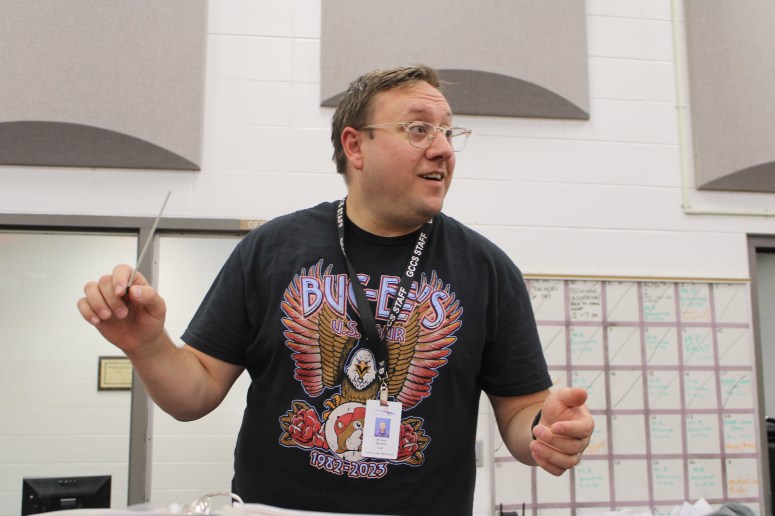
New director Briston Hatchell instructs band students after school. Photo by Esme Estrin.
JHS has two new band directors Briston Hatchell and Sidney McDonald, who are co-teaching everything music related and like jazz, band, and guitar.
Both band directors have said that they’ve considered themselves friends for a fair amount of years; both having music teaching experience before joining JHS. Hatchell said he has 10 years of teaching band, which includes several years at Floyd Central High School. McDonald has three years of teaching experience at both the middle and high school levels.
It’s definitely clear they both have a passion for teaching music, and music as a whole. Both teachers have had their lives impacted by music.
Hatchell, early in life, said he wanted to be an architect until he realized there’s a lot of math involved. While he “wasn’t good at math,” he was talented with the trumpet, so in middle school he decided he wanted to teach music.
McDonald did not take the same path as Hatchell in high school, as she really liked chemistry and ended up becoming a chemistry major in college for a year. She decided to transfer schools for a music program since she missed music and decided to do drum core, which led to her transferring to Indiana State as a music major.
Both teachers described that they love teaching, and they both put in a lot of work to make sure they are helping all their students the most they can. But it does become a very time consuming job.
An average week of teaching for them normally consists of marching band on Tuesdays, Thursdays, Fridays, and most Saturdays after school, with an open band room around three days a week so kids can practice if they would like with either of the musical directors.
A school day for them normally consists of AP music theory, guitar and then for the last three periods – 4th, 6th, and 7th – they collaborate and teach intermediate band, a big guitar class, and advanced band.
Even though they are both doing a lot for all of JHS’s music-related activities, there is still much more they want to do with an emphasis on the band program.
Hatchell said, “We want it bigger, we want more kids and, you can put this in print, we have a school of 2,300 kids and our goal over five years is 10% of the school, so that’s 230 kids, so if we get to that then I say we achieved our goal.”
He makes it very clear that they both want to be able to teach the most they possibly can. They also stated that, even though the band is pretty well funded, they do run fundraisers to help JHS music-related classes be the highest quality they can be.
Those interested in marching band can go to https://jeffersonvillebands.org to find every upcoming event involving JHS music.
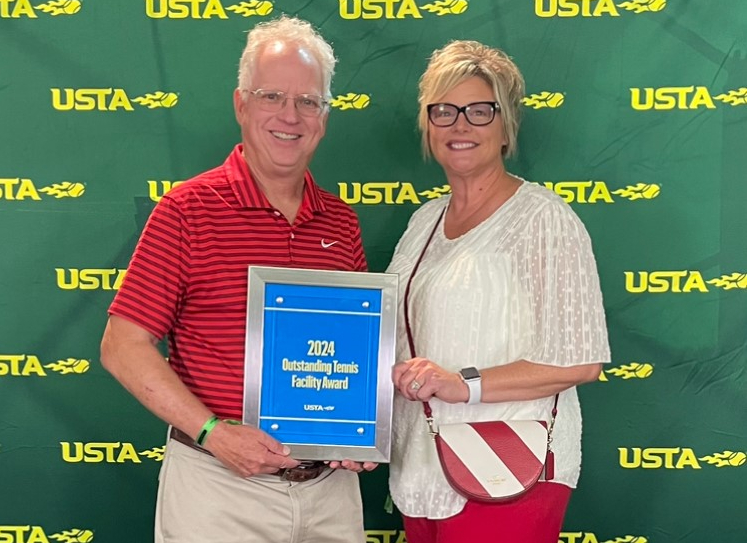
The Mark Reilly Tennis Center was recognized this Tuesday with the prestigious 2024 Outstanding Facility Award from the United States Tennis Association (USTA) at the U.S. Open in Queens, NY.
Former tennis coach Mark Reilly at the U.S. Open in New York to accept the USTA 2024 Outstanding Facility Award. Submitted photo.
The Mark Reilly Tennis Center is named after the former Jeffersonville High School tennis coach and teacher, who has also been inducted into the Indiana Tennis Hall of Fame. This award is in the Large Public Facilities category, one of the five offered.
The 12-court facility serves the community in a variety of ways, including programming like youth camps, tournaments, and promotion of tennis in the community. These factors pushed the Mark Reilly Tennis Center past other nominees to win the award.
Current tennis coach Jerid Inman said, “We have implemented year-round clinics for elementary through grade school students, launched an elementary tennis initiative to introduce tennis to 5000 elementary students, hosted numerous high school and college tournaments, and have continued to build the facility into one of the best in the nation for high schools.”
Principal Pam Hall traveled with Reilly, his family, and athletic director Larry Owens to New York this week to accept the award and said that it was an honor.
“I can’t think of a more iconic place to celebrate than on the hallowed grounds where the greats of the sport, Billie Jean King and Arthur Ashe, won open championships,” said Hall. “What an amazing day to be a Red Devil!”
Inman said, “A huge thank you goes out to the Jeffersonville Tennis CTA, the city of Jeffersonville, Jeffersonville High School, and the USTA for supporting the tennis program.”
The award will be displayed at the Mark Reilly Tennis Center.
Former tennis coach Mark Reilly and principal Pam Hall accept the 2024 Outstanding Tennis Facility Award at the U.S. Open in New York on Tuesday. Submitted Photo.
Student Council President and senior Koy Ramer has big goals he wants to meet. Ramer plans to rebuild.
“My plans for this year are mostly a rebuild year. Senior Co-President ,Madison Pritchard, and I really want to focus on bringing a lot of things back that were lost to COVID. We still haven’t seen a lot of things like the homecoming dance,” Ramer said.
Ramer wants to bring back special events that he thinks means a lot to the school and himself, Including the homecoming dance, taking place this September 28th.
“The homecoming and pep rallies, we just want to have a lot more fun events to bring back up. We really want to set a foundation for future Student Councils and presidents to be able to do more,” Ramer said confidently. Ramer wants to get back in the habit of having fun events for everyone.
Ramer felt very welcomed becoming Student Council president, especially considering he moved into the school from another district.
“It was very welcoming, coming from a school that wasn’t in Greater Clark. I came into Jeff High knowing 10 to 15 max. People only that I knew from my swim team to being able to go from knowing almost no one to being elected president to essentially becoming president of the whole student body. It was really assuring. I’m going to be able to make a change in this school.”
Ramer would recommend joining the Student Council.
“Even if people don’t know you personally, as being a part of this council you’re able to make decisions that affect everyone in the school. If there is something you really want to see you have the opportunity to bring that to council and see that get worked on and see that get changed.”
Ramer saw results, and he thinks students will be able to see them if they too join Student Council.
“I wanted a homecoming dance, and I went to (principal) Mrs. Hall and now it’s going to happen. And you are able to see real results of what you want done in this school.”
The perks of being president to Ramer is that he is allowed to make things happen that he wants done. “I’m able to bring things back that haven’t happened in a while and I’m able to make sure that everybody on this council has a voice.”
Ramer will take suggestions to Hall or the administration. He added he will take what students say into consideration.
“As a president I like that I can make things happen and make sure that every event that the Student Council wants to hold is getting to the people that can make it happen.”
Ramer is looking forward to the events that the Student Council has planned.
“I’m looking forward to homecoming short term since we haven’t seen it in many years and it’s something that students want, but long term i’m really excited to see Madison and I as Co-President able to set these plans that will not just affect our senior year but hopefully this sets a pattern for many Jeff High years. And it’s not just us making the homecoming dance this year and it starts a pattern of homecoming dances every year after this, so that every class can enjoy it.”
Ramer encouraged students to follow Student Council plans on social media, saying:
“For any readers out there, there’s a lot that we’re planning this year that I think is really exciting. People should be aware of making sure you’re listening to announcements, follow our Instagram so you know of any events that we’re planning and just keep an eye out because it may be easy to miss. We are going to be doing a lot this year that I think will be really exciting.”
The National Honor Society has big plans for this school year. Co-sponsors Justin Linde and Emmaly Rose are leading the National Honor Society as a team. Unlike last year, Linde and Rose want to put officers together, induct juniors to celebrate and honor seniors of the NHS.
Linde and Rose want to talk about roles and responsibilities. They also would like to have announced officers in September. In addition, they will be having a meeting with just the seniors.
Linde wants to be able to let the students run this group. “While running this group of academic leaders, I would like to have students involved in the NHS to take charge, be able to lead the group themselves and make decisions,” he said.
Another activity the NHS would like to have this year is another blood drive since last year was so successful. Students could potentially work the event.
Linde said he feels “excited and nervous” about the officer election coming up soon.
He would like students with a high academic ranking to be able to feel free to join the NHS. “Whoever is elected as the NHS president should be able to help support students,” Linde said.
Linde would like other students to join this group to set themselves apart from their peers. “It looks good on a college application and to be a part of this prestigious organization.”
Linde emphasized the community leadership focus of the NHS. The organization is “very community service focused, but now we have an E.C.O. club. Which shows that we can continue to support other clubs and lend voices but most of all this group sets us apart from others because we are very academically focused,” Linde said.
Linde is looking forward to officers being more involved; he stated he expects “officers being more involved in ownership, projects running smoothly, becoming more creative, new members, new ideas, and becoming better.”
“National Honor Society isn’t just another club, it’s an organization of scholars. It’s that one group, students want to join to become a leader in their community. Juniors, be on the lookout for invitations, and seniors be ready with new ideas,” stated Linde.
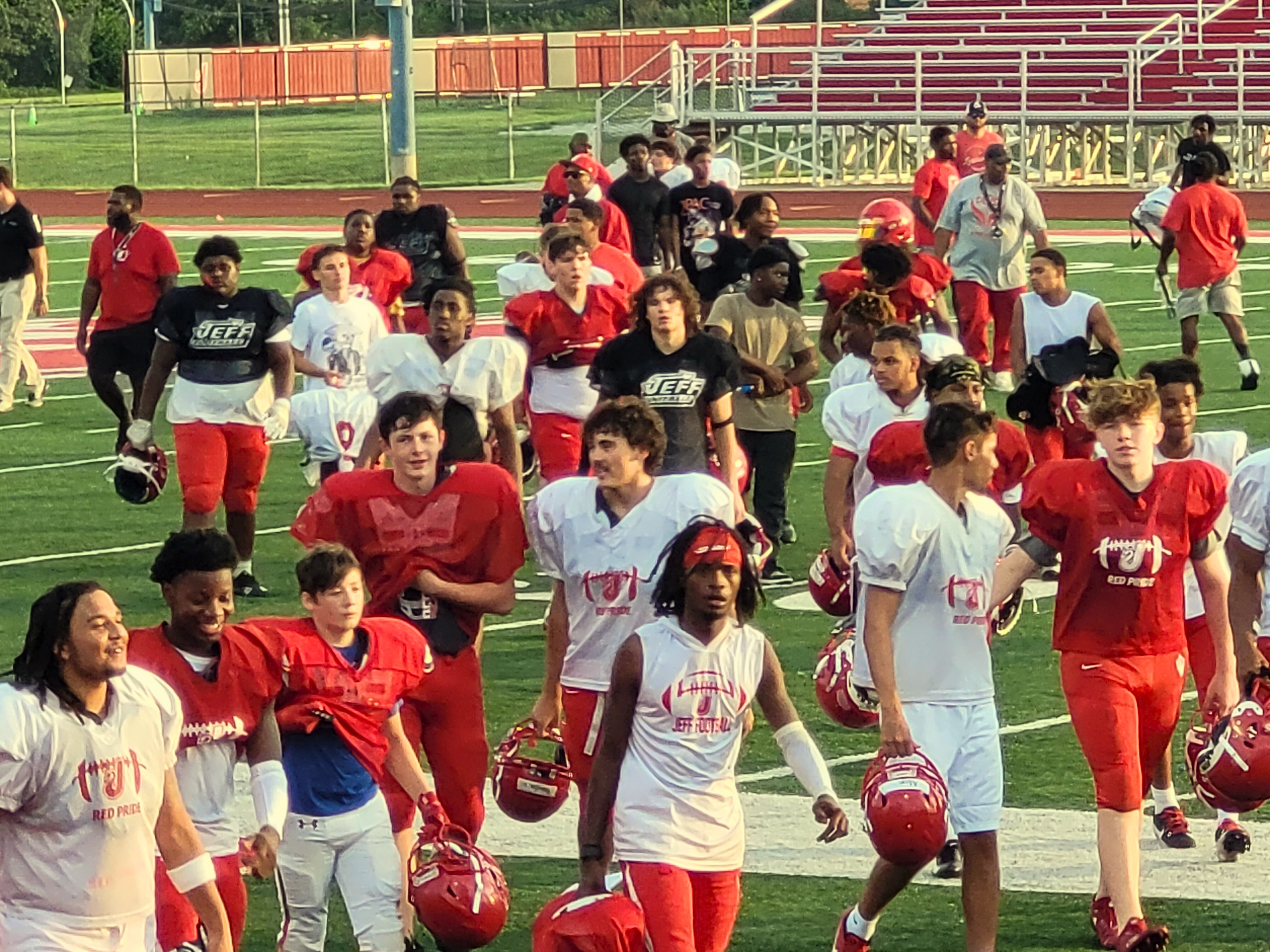
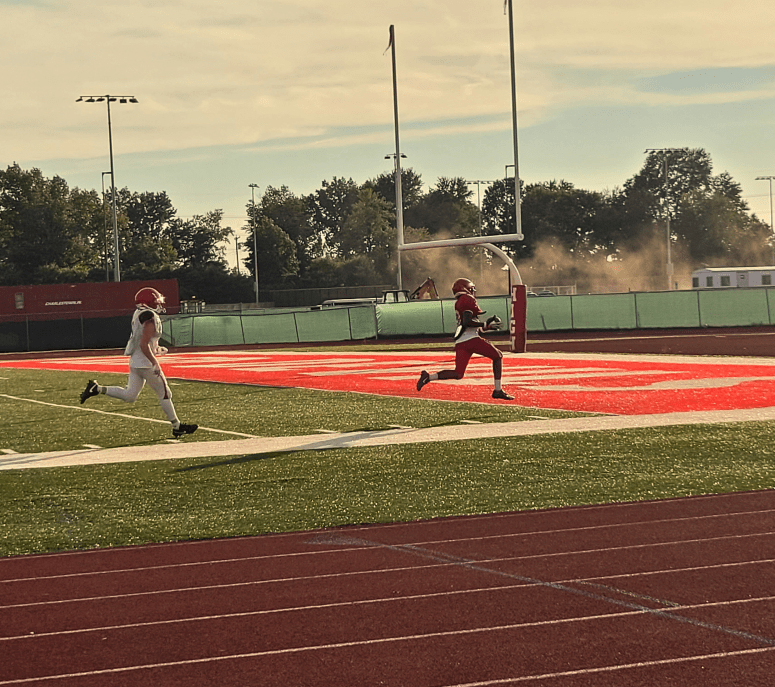
Let’s all give a large hooray and hurrah for a strong, entertaining scrimmage from the Red Devils football team.
Last Friday, August 9th, our boys’ football team held a scrimmage, and there was zero disappointment in either performance or in turnout.
“The school is doing a great job supporting the team, even though we didn’t do well last year,” Stated Raijon Laird, a senior football player who attended the Scrimmage. The Red Devils’ plan to hit the ground running this year.
The whole crowd was a sea of red and white as the school showed great pride for its Devils’ football team.
The cheers in the stadium were like waves of sound spreading across the large field.
From students, to teachers, to families coming together to show just how excited Jeffersonville High School is for this new year.




 thehyphennews.com