Guide to Surviving Freshman Year 

By: Ifrah Daber 

How sweet was 8th grade? You used to be a big fish in a small pond. You were at the top of the food chain, and now? You have been thrown into the ocean with the sharks. Welcome to Freshman Year! The school, the number of classes, the number of students— everything is vast, and now you are forced to swim. But don’t stress yet, because I, your wise upperclassman, am here to help! With my survival guide for freshman year, I will give you tips and tricks to help you get through it, so let’s get to it! 

First, you must understand the difference between quarter and semester grades. Your quarter grade is the sum of your assessments and assignments. Assessments take up 70% of your grade, while assignments take up the other 30%. So each quarter you will get a final grade, and that affects your semester grade. You have four quarters and two semesters (two quarters per semester). So if you get an A in your first quarter and a C in your second quarter, then you will likely get a B as your semester grade. Simple, right? Well, your grades determine your GPA, and depending on that, they will give you a number between 0 and 4. 0.0 GPA means you have done zero work, getting Fs across the board, and the numbers go up, representing the letter grades. 3.0 GPA means you get mostly B’s, and 4.0 means mostly A’s. I know that all sounds extremely boring, but it’s important to know. 

I could go on for many pages, but who wants to read that? Plus, there is more to school than work. One of the joys of attending a high school like Jeff’s is the number of clubs they offer. From my experience as a young freshman, my biggest problem was just being too scared to join clubs or not knowing where they were. The latter is easier to solve since a lot of clubs promote themselves on the pride slides. These are slides that should be shown to you during impact, but just in case your teachers don’t show them, don’t panic. A lot of clubs also promote themselves during morning announcements. So in the morning after the pledge, you will hear about all the essential information for the day. Also keep in mind how clubs will greatly affect your schedule. High school is the perfect time to branch out and try new things. So don’t miss out on the new opportunities that Jeff High has to offer!

Freshman year can feel overwhelming. It may feel like it will never end, but it’s shorter than you think. Many have survived the torture of freshman year, and so will you. I have put together a list of advice from different groups of people, including graduates, mental health specialists, and upperclassmen. 

The first list of advice is from your upperclassmen; some of them have been kind enough to pass down their logic to you. 

1. Don’t Date Upperclassmen. Just remember the classic rule! If the grades don’t touch, neither should you. 

2. Develop Good Study Habits. You have a decent amount of work to do and tests to complete. So developing a solid study habit now can help you in the future. If you don’t wanna fail, STUDY! STUDY! STUDY! 

3. Don’t Stand In Big Groups. It may seem like no big deal, but once you have experienced the stress of rushing to class only to end up being blocked by a sea of kids moving as fast as morning traffic, you will understand the frustration. You try to go left, you try to go right, but alas, there is no way around them. It’s annoying; If needed try to stay near the sides. don’t be those kids; no one likes traffic. 

4. Stay Caught Up! You get a lot of schoolwork during the school year, so it’s a pain for both you and your teachers to have a lot of missing assignments. So make sure to stay caught up! 

The second list of advice is from a mental health specialist; high school is a hard time for most people mentally. It is hard for a lot of people to deal with the stresses of school, so here is some advice and some resources for you. 

1. Develop a Routine With Your Mental Health In Mind. Just like your study habits, your mental health needs routine; doing certain activities every week or day can help with this. Either exercise, meditate, or do anything that works for you.

2. Don’t Be Afraid To Ask For Help! Whether it’s schoolwork or something more personal, don’t stop yourself from getting help if you need it. I have added some mental health resources at the end of the article in case you ever need someone safe to reach out to. 

The third list of advice is given by previous students, long past their freshman year. These graduates were kind enough to take their years of wisdom and pass it down to you, naive young folk. 

1. Figure Out Your Interest. High school is a great opportunity to explore your interests with a sense of security because you are likely not paying for them. So try new things; don’t be afraid to explore your interests. One of the joys of attending a high school like Jeff’s is the number of clubs they offer. From chess to archery, Jeff is filled with different opportunities to broaden your horizons. 

2. Don’t Go Exploring The Hallways During Passing Periods.You only have five minutes in the hallway. Don’t waste it on unnecessary exploration. You ain’t Dora the Explorer, so just go to class. 

Well that is all I have for you. I wish you the best of luck in your journey of discovery and hope you have a fun and exhilarating freshman year. 

Mental Health Resources: 

Suicide and Crisis Helpline: 1-800-784-2433 

National Eating Disorder Association: 1-800-931-2237 

For LGBTQ Youth: TrevorLifeline at 1-866-488-7386, TrevorText -Text START to 678-678 Substance Abuse and Mental Health Services Administration Treatment Referral Helpline: 1-877-726-4727

Student Jobs 101

By. Juan Carrillo, Lola Mays, Wesley Lanham, Rhianna Ledbetter

Getting your first job is something all parents and guardians dread, but it’s also  something teenagers can’t wait for. Getting a job means you gain more responsibility and freedom, but there are so many questions one might have about picking that one special place to work: How much do they pay? How do I apply? What’s the work like? In this, we will be discussing answers to all of these questions, as well as some tips for that first day on the job! 

Some may say it is bad for teenagers to get a job because it could add stress to the ever changing balance of school and social life. Having to balance school, work, and other activities builds your resume and helps one to develop time management skills. Speaking of resumes, that might be one thing you need for that first job. Most places hiring highschool aged people don’t require a resume, but it might be wise to offer one to show previous credentials. Points that you can add to your resume include the sports you play, hobbies, or extracurriculars. Employers like to see what you have to offer, so having a resume can show them your character and teamwork skills. 

Applying for a job may sound daunting but it’s a lot easier than you would think. A lot of businesses have online applications that you can fill out by looking up the website or by typing certain keywords into your browser. For example, if you wanted to work at a pizza place in Jeffersonville, Indiana you could type, “Pizza place hiring in Jeffersonville, IN”. You can also ask for an application in person, just by asking an employee if their job is hiring; the worst they can say is no.

One location that is perfect for a first job is Chick-fil-A, typically they begin hiring at 16 years old. The Hyphen interviewed a tenth grader who goes to JHS about her experience working there. “I like my job most of the time, customers and co-workers can be exhausting and not worth it, but it can be said the same vice versa.” The pay may vary based on location, experience, and age. That is why we recommend asking your interviewer about wages like how often you will get paid and what your pay will be. A majority of employers pay every two weeks, but some pay once a week or by the shift as well. 

Another local employer is Stone Cold Creamery, an ice cream shop located near Kroger on Tenth Street. They hire aged 16 and up. We interviewed a few students who said the hours can be demanding at times, and would not recommend working there if you are focused on school but that doesn’t take away from the friendly environment. The employee also said “It’s chill and I love basically playing Papa’s Freezeria in real life.”

Other businesses hiring 16-year-olds around Jeffersonville are Kroger, Meijer, and Rural King. These are great options if you are looking for a retail position, and if you like talking to people and enjoy walking around this job might be for you. In most cases, you will be stocking shelves and helping people with their questions. Some days you might be in different departments or working the cash register. Their paying range is around $12-16 depending on the location.

Other things you will need to know while entering the workforce is how income taxes, state and federal, will affect your paychecks. It is also important to know your rights at your job to make sure you are not being taken advantage of by your employer. Depending on your age you can only work a certain amount of hours a week. Make sure to do your proper research about federal and state labor laws concerning minors before you get a job.

Getting a job is something that can bring responsibility to any teenager. It’s part of becoming who you are and shaping your life. It’s always necessary to make sure you’re going through the correct steps of applying for a job. It is also important to have someone who is experienced to check things over on your application like your grammar and spelling and the correct information you want to be known. We hope you take in consideration the considerable amount of jobs in our article and get inspired to try to make some money.

The Newly Implemented Halo Sensors

What are they?

By: Teagan Cofie

As the teen vaping rates rise once again, High schools across the nation (including ours) have been trying to eliminate the usage of nicotine by its students. To accomplish this, schools have turned to HALO smart sensors to solve their nicotine predicament. As stated on the HALO Smart Detector’s website, HALOs have won over 60 awards and can detect flammables, hazardous chemicals, and air quality changes such as vaping and smoking and changes in temperature and humidity but will it truly help prevent vaping in schools altogether? 

One could definitely say that vaping is a large problem that our school faces in the 21st century, but it’s not just us. As of 2022, about 1 in 10 high school students currently use e-cigarettes. An Oct. 25, 2021 study found that the number of vaping teens doubled between 2013 and 2020, and the number of minors who stated they’d vaped in the past 30 days rose from 1.6% to 8.4% in the same time. But because of the implementation of HALO sensors, this number could potentially decrease and improve the well-being of our school. One review available on their website claims that prior to the installation they had over 20 EMS calls for students that they believed were suffering from effects of vaping and they said that since the devices had been in place they have not had to make any. According to feedback from our staff, they said that overall there are probably fewer kids vaping as often so they think there’s been improvement post installation. When asked about the environment before the sensors “it was so bad that there were times I would walk in the bathroom and it would look like I was in a sauna, it was literally like hazy air…it was crazy, ” said Mr. Henderson, 9th grade English and bathroom monitor. 

Based on these opinions alone it seems as though in the short amount of time the sensors have been put in place they’ve been improving the vaping issue to a certain degree, and will hopefully make a larger impact on vape use in our school. If all goes well the HALOs, the #1 vape detector worldwide that is in over 1,500 school districts throughout the country, will make this year healthier and potentially form Jeff into a smoke free campus.

How Do We Deal With Subconscious Trauma?

By: Lacy Blanton

Image: “Mind Vomit” by Saira-Jayne Jones, the Perspective Project

Imagine this: you’re mindfully strolling through life in a cheery manner. All is well until you are met with an unwelcoming memory, a memory from the past that you look back on with regret, cringe, or even resentment. 

The negative memory can be a variety of events. Was it about you saying some hurtful things to someone when you were in the heat of anger? Or was it that bitter time of feeling socially rejected by your fellow classmates at school? No matter the situation, it’s something that seems to follow you like a shadow. Frequently, the image pops into your mind and leaves you emotionally defeated.

This incident is, what I call, subconscious trauma, and from personal experience, it’s definitely not an enjoyable time when having its discouraging episodes. Fortunately, through time, I’ve found a solution in how to cope with these negative thoughts.

When feeling an episode starting to come on – i.e. thinking about a memory and sensing my emotions toward the subject: I seclude myself to a quieter room, sit down and close my eyes, turn on meditation music through my phone, and begin talking to myself.

Firstly, I admit the negative emotions I’m feeling and the trauma I’m having. Then, I focus on navigating myself through the situation by talking about a potential solution to the problem and remind the positives about myself. 

The sessions of mine are usually a tremendous success with moving forward.

Of course, there are other plentiful methods in coping through such a problem, and this is evident through the several students of Jeffersonville High School I had the chance to interview.

The following Q & A is from my interview with a Jeff High Senior:

Q: Do you have any bad memories that haunt you? If so, would you mind sharing?

A: Honestly, when my dog passed away. It really affected me.

Q: I’m sorry for your loss. What was your dog’s name?

A: His name was Shadrach. It’s a biblical name. He was the best dog I’ve ever had.

Q: How does it make you feel when the memory pops up?

A: It makes me upset and reminisce on the good times we had together.

Q: How do you cope with this bad memory?

A: Whenever I’m upset about the memory, I write. It’s very peaceful and relaxing. Whenever you write, it’s like being in your own world.

In my interview with a Jeff High Junior, the student expressed how there was indeed a negative memory that haunts them in life, and how they feel upset and even humiliated when reflecting back on the moment. In their copings, they found journaling and communicating with another person to be the most therapeutic.

 These different techniques of different students show how there is no official “right” way to cope through a personal crisis. Everyone is unique, but we struggle similarly at the same time, and that should be a comforting fact to know of.

Another helpful mechanism that many also look to is seeking mental evaluation through a professional (counselors, therapists, psychologists, etcetera). 

If one’s subconscious trauma appears more severely dire, or struggling with unhealthy coping habits, this solution is the most appropriate for that situation. 

Mental health still carries a plethora of stigma. It isn’t easy for one to reveal their vulnerability to others or even themselves. 

However, today’s climate has become more accepting in acknowledging such problems, and its door is something that will most likely continue to open as time progresses.

Barbie (2023) Review

By: London Williams

Barbie has been loved for many generations. She’s the plastic doll we’ve all grown to love. She’s fantastic, and so is this film! ‘Barbie’ came out this past Summer on July 21, 2023. Competing alongside “Oppenheimer” as one of the year’s most anticipated movies. This movie has made over 1.34 billion at the Box Office (for the US) just so far! Barbie jumped out of her box and has been crushing it at the box office ever since the release of this film! The feeling after watching ‘Barbie’ is unlike any movie I’ve ever seen. This movie is so charming and nostalgic. It has you thinking about it long after watching. It manages to have a perfect balance of relatable, real-life issues while keeping its innocent, humorous, and lighthearted approach. 

The plot of Barbie is pretty simple; Barbie has an existential crisis and goes to the real world to figure out why her perfect life seems to be falling apart. Ken tags along, and they both go their separate ways in self-discovery. Barbie runs into the mother-daughter duo that has the answers to all her problems, while Ken is convinced that the real world is run by men. (Which of course, makes him go back to Barbieland to make a world full of Mojo Dojo Casa houses and horses.) This movie perfectly handles the topic of equality. After Barbie goes back to Barbieland and sees what Ken has done she is torn and devastated, things didn’t go well in the real world, and now Barbieland is falling apart too. It feels like the “man vs. woman” situation Barbie felt in the real world. The way Barbie feels is clear and relatable for women while being easy to understand and empathize with for someone who couldn’t personally relate. 

I believe that the casting for the movie was perfect. Margot Robbie and Ryan Gosling did a fantastic job capturing their roles. It felt like Barbie and Ken came to life by how their humanization was portrayed. Robbie and Gosling took one-dimensional characters and gave them more depth and life. Margot Robbie and Ryan Gosling are already extremely beloved actors. That’s another reason I think the casting is perfect. Who wouldn’t want to see the latest Margot Robbie or Ryan Gosling film? ‘Barbie’ also features many other well-known actors, including; Will Ferrel (as Mattel CEO), Michael Cera (as Alan), Dua Lipa (as Mermaid Barbie), and John Cena (as Male Mermaid), and that’s just to name a few! The casting for all the Barbies and Kens was epic, to say the least. It felt like every time I blinked there was an actor that I recognized. They even got Nicki Minaj and Ice Spice to create the song “Barbie World”! After that song came out, it was everywhere. I found myself having the song stuck in my head before and after finishing the movie. The release of “Barbie World” was one of the perfect buildups for the premiere of this film. Some would say it was also a “full circle” moment for Nicki Minaj since she frequently associates herself with the character. The song is also great as a standalone track that worked great with the end credits of the film. Who wouldn’t want to see this exceptional movie?  

I found the maturity rating for this movie very interesting. It’s definitely PG-13, but I noticed people being confused that a Barbie movie would be rated PG-13 instead of just PG. When I went to see this movie, there was an abundance of very small children walking in. This made me wonder about its advertising approach. This could just be parents assuming it was PG or just not caring if their 7-year-old sees a PG-13 movie; which definitely isn’t abnormal, but I thought it was worth noting. When I mentioned Barbie to a few adults in my life, they actually made comments about how they were surprised about the rating. After actually watching Barbie, it’s clear why it’s rated how it is; one very subtle sex joke, its mentions of death, and its topics of womens rights and equality. It feels like Barbie was in between PG-13 and PG, and they went with PG-13 to be safe. 

This movie has many beautiful moments. A notable one is when Barbie is sitting on a bench in the park by an older woman. She tells the woman that she is beautiful, as she is crying. Barbie realizes how beautiful people and the world are. Barbie is seen by a lot of people as a vision of the “perfect woman” who lives a “perfect life”. When Barbie sees the real world it makes it clear that it isn’t true. Nothing is perfect and that is what is beautiful. Things aren’t as simple as Barbie had originally thought. Beauty is all around us, and Barbie makes us realize that. Barbie truly is a beautiful experience you don’t want to miss! 

Dolly Parton’s legacy inspires her fans

by Natalie Creagh

Country music singer and songwriter Dolly Parton sadly passed away on August 25, 2026. She was 80 years old. Parton was so much more than a music icon; she was a philanthropist, an inspiration, and a true treasure to the world. 

Dolly Parton’s Life

Born Dec. 19, 1946 as one of 12 children, Dolly Rebecca Parton lived in the Smoky Mountains in a one-room cabin in Locust Ridge, Tennessee. The family lived in poverty. Throughout the 1950s Parton starred on different radio stations and television programs as well as publishing her first single “Puppy Love” and making her debut at the Grand Ole Opry at just 13 years old. 

Into the 60s Parton signed her first record deal with Monument Records. In 1966 she married her husband Carl Thomas Dean, and the two were together for six decades. A year later Parton released her first album, “Hello, I’m Dolly,” with her country single, “Dumb Blonde.” 

In 1970 Parton was nominated for Best Country Performance in Duo or Group with Porter Wagoner for “Just Someone I Used to Know.” In November of that same year “The Best of Dolly,” Parton’s first Greatest Hits album, was released. Throughout the rest of the decade Parton earned her first Solo Grammy Nomination, as well as releasing some of her most iconic songs, including “Coat of Many Colors,” “Jolene,” and “I Will Always Love You.”

Into the 1980s, Parton released the album “9 to 5 and other Odd Jobs,” as well as starring in her first film “9 to 5” as Doralee Rhodes. The film was later turned into a musical in 2009. She also starred in “The Best Little Whorehouse in Texas,” “Steel Magnolias,” and “ Rhinestone,” where she starred alongside Sylvester Stallone. Parton also starred on Saturday Night Live as both host and musical guest. On June 14, 1984, Parton earned her star on the Hollywood Walk of Fame. On May 3, 1986 Parton’s theme park, Dollywood, opened in Pigeon Forge, Tennessee. The park was a huge hit and is still around today.  

In 1988, Parton started the Dollywood Foundation, which initially was to offer scholarships to high school students. She also created the Imagination Library, where children up until past the age of 5 could receive a free book monthly. The library expanded and is available to children across America, Canada, Australia, Ireland, and the United Kingdom. She was also a huge advocate for human rights throughout her life. 

Parton’s Influence

The news of Parton’s passing affected the community, and fans discussed her music and contributions.

AP U.S History teacher David Russell said he was introduced to Parton’s music as a child.

 “I think she’s an all around good person who wanted to do good things; I like her music.” 

Senior Wyatt Clements agreed that Parton was an icon. 

“As an ex-Kentuckian, you can’t escape her music. I never got to visit her park when she was alive,” he said. 

Sophomore Bella Roman described Parton as inspiring, adding, “My whole family listens to her.” 

And after hearing of Parton’s passing, junior Kristopher Bonilla said, “I didn’t believe it at first, but the more I heard about it I was pretty upset.” 

Principal Pam Hall said Parton’s legacy extends beyond her music. 

“I love everything she stood for,” said Hall. “She was an advocate for women’s rights and human rights. She also donated millions quietly, I think that really speaks to her character.”

It is safe to say that Parton’s legacy has inspired many people of different generations. Her kindness and creativity were truly unforgettable. She was a music icon and continues to make people happy through her music, style, and positivity. 

Youth not an obstacle for volleyball team

Red Devils face New Albany tonight

by Carter Glotzbach 

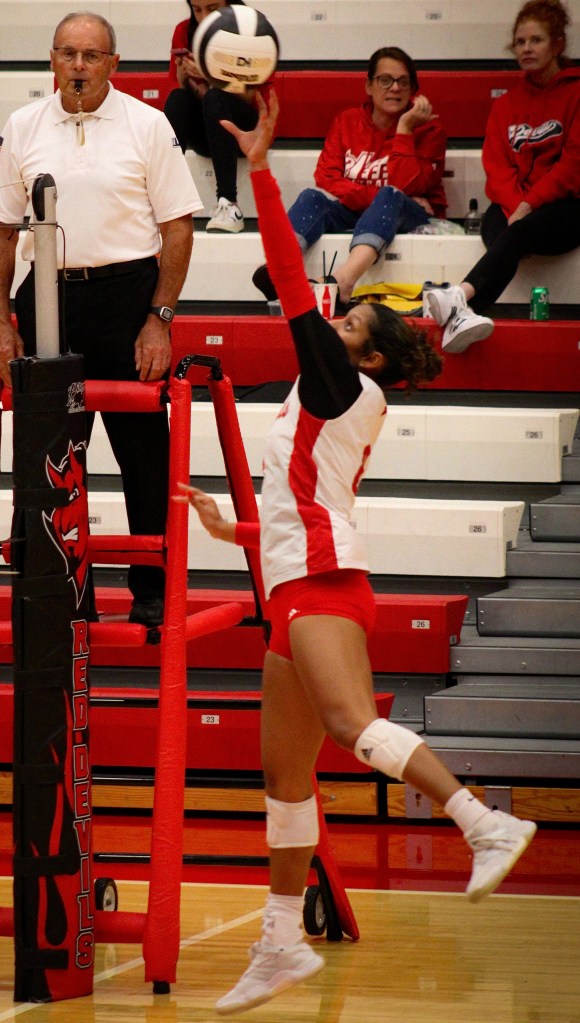
This past year JHS girls’ volleyball had one of their best seasons yet, and with a solid start to this year’s season and rival New Albany visiting tonight, it’s clear that the young team is ready to grow up.

Head coach Wes Briscoe sees new potential for growth in this year’s team. 

“This year’s team is one of my favorites, but it’s really hard to say how they stack up to last year considering how young they are. I also think that you’ll see some breakout seasons from new key players because they’re not having to wait behind older ones,” said Briscoe. 

Managers like junior Ryder Lott agree with the head coach’s sentiment. 

“I think the team is really young, but working with them I see a lot of potential in them,” said Lott.

While a younger team is usually viewed as a disadvantage, some see an opportunity. Assistant coach Mackenzie Wilkins said a younger team often provides best opportunity to teach new skills.  

“A younger team is a gift, in my opinion, because they are much more willing to learn and try new things,” she said. 

Junior Kaylee McDaniel states the team is unified despite the youth. 

“I think our team is definitely younger, but we have a much stronger bond and are more willing to play as a team,” she said. 

Junior Haliun Otgonbayar serves an ace during the JHS game against Rock Creek Academy. Photo by Isaiah Stewart.

Junior Haliun Otgonbayar agrees that the Red Devils have an exceptionally strong connection this year.

“We definitely are a tighter knit group and have a closer bond with each other. I think that definitely makes us more dedicated to the team,” said Otgonbayar.

Coach Briscoe recognizes the team’s unity, stating, “I’ve seen it a lot during practice. This year’s team has a much stronger bond than last year’s, and they are definitely more willing to play as a team.”

Players will rely on these bonds as they face local competition this season.

“Some of our biggest competitors are always at the Providence tournament, and last year they gave us some great competition. This year I hope we can make it further than last year’s team, but we’re still really young,” said Briscoe.

The Red Devils understand the strength of their schedule. 

“Providence is definitely a team to look out, for as well as New Albany, Charlestown and Floyd Central,” said McDaniel.

“I think that Floyd Central and New Albany are definitely the biggest competition that we have this year,” added Otgonbayar. 

Coach Briscoe sees the possibility of break-out performances this season. 

“I would keep an eye out for Kaylie Fuller,” he said. “She has shown a lot of potential in practice and could definitely be a high-level player with a few years of work. She’s a great practice player.”

Leadership from team veterans is expected as the volleyball team continues to play in the coming weeks.

“Jordyn Miller is a player I expect to do well this year. She’s a multi-sport athlete, but she’s definitely been working hard to earn her place on the team. Another player with good work ethic is Charlotte Hatfield — she has shown a lot of potential and worked hard in the off-season,” said Briscoe  

The Red Devils huddle up before the game against Christian Academy. Photo by Logan Vidt.

Lott said consistent play will be important as the season continues.

“I see a lot of potential in the team offensively, but I think they need to work on their consistency. If they can keep it up throughout the sets then I think they could have a top tier offense.”

JHS faces New Albany at home tonight, and will visit North Harrison on Sept. 21 before hosting Floyd Central Sept. 29.

JROTC uniforms reflect discipline, pride of cadets

by Raven Baker

The JHS Junior Reserve Officers’ Training Corps (JROTC) program has its own sense of community and discipline. 

Students train and test on military-related activities to help with starting a future in the military. Cadets also proudly wear their uniforms every Wednesday for a grade – they begin with the blues and can earn their ABU uniforms.

Cadets learn valuable life skills, teamwork, and leadership, which prepare them for both future military service and civilian life.

Junior Angel Siana, Cadet Second Lieutenant; Junior Wendy Rubio, Senior Master Sergeant; Col. Robert Benning; Junior Jocelyn Zarate, Junior Cadet Major; Junior Kameron Hayden, Cadet Second Lieutenant. Photo by Ashton Walcott.

Col. Robert Benning said uniforms are important to the tradition of the program.

“The purpose of school-issued uniforms for Junior Air Force cadets is to instill customs and courtesies, ensuring they learn to properly and proudly adhere to military standards,” said Benning. “The uniforms serve as a tool for education, preparing students for potential military careers by getting them familiar with regulations and expectations.”

Benning described several different uniform types.

“Students learn different uniform types like the OCP, which replicate active-duty wear. They also have their ABUs, which you earn with hard work put into the class.”

In addition, Benning said uniforms are tied to the grading system, “where older students grade younger ones on their uniform based on standards, which shows the importance of precision and regulation. The uniform is a key component in developing discipline and a sense of belonging within the JROTC program.”

Junior Angel Siana, Cadet Second Lieutenant

“I feel okay about the uniforms now that I’m more comfortable, though I was a bit self-conscious at first. It’s important for uniforms to be correct to set a good example for others. The uniform check is a bit lenient, but it’s preparing me for discipline.”

Junior Kameron Hayden, Cadet Second Lieutenant

“I find the uniforms comfortable, and they help me feel ready. It’s important to wear them correctly to show respect and be a good example. The uniform check is pretty simple, and it’s preparing me to be organized and disciplined.”

Junior Wendy Rubio, Senior Master Sergeant

“The uniforms aren’t bad, and I’m getting used to them; they help me with responsibility. It’s important to have them correct to show respect for the uniform and follow the rules. The uniform check requires a decent effort, and it’s preparing me for military experience and neatness.”

Junior Jocelyn Zarate, Junior Cadet Major

“The uniforms are not too bad, and I feel a bit competitive about them. Having them correct is important for assignment grades and helps me weekly. It prepares me for the future in the Air Force, and I’m part of JROTC for community service and field trips.”

Benning said the JROTC program is a class to build up discipline and physically prepare students to be ready for the military, or help them start their future. The uniforms serve the purpose of giving encouragement to students on learning discipline and how to be neater, which are positive traits to obtain. 

Benning wants his students to wear their uniform with pride, but also properly. The uniforms also serve as an educational tool. Students enjoy their uniforms knowing they’re the example for the underclassmen. They show respect to the purpose while also being comfortable.

All photos by Ashton Walcott.

Cross country program seeks support as athletes continue to excel

Editor’s Note: This story was completed before recent coaching changes with the cross country team.

by Isaiah Gatton and Elijah Lahrman

As the cross country season continues, the growing team hopes for increased support and recognition.

Former head coach Sam Mull spent 21 years involved with the program, first as an assistant before eventually becoming head coach. As a former JHS runner himself, Mull experienced the challenges of the sport firsthand.

“So when I was here, I did every sport possible, but I was mainly a runner. I did football, did basketball, wrestled, swam, cross-country, and track, but I was a track runner, mainly,” said Mull.

Mull said cross country presents a unique mental challenge because runners are constantly competing against some of the best athletes in the state and the daunting fact that it’s running.

“This is probably the toughest mental sport that you’ll ever participate in,” he said.

He explained that unlike team sports, athletes advance as individuals, and ultimately how well they do depends on them. 

“If you’re a 100-meter runner, you’re not competing against 475 other teams in the state; you’re competing against a 1000 other kids in the state. And you’ve got to advance against those thousand each week and get knocked out and knocked out until you make it to the final, final level. It’s a very, very difficult sport to advance in,” said Mull.

While the sport itself presents challenges, Mull said the Jeffersonville cross country program faces another problem: a lack of recognition and funding compared with other sports.

“We don’t get recognized as much as other team sports, such as basketball and football. Results are often overlooked or discredited. And when it comes to funding for equipment, it’s often overlooked. And I’ve had to go outside the school on many occasions to get basic equipment that schools should provide for both sports,” said Mull.

Members of the 2026-27 cross-country team pose for a photo before their first meet on August 15. Photo by Aby Lawson.

The lack of support is something athletes have noticed as well. Senior cross country runner Lizette Gonzalez said the team needs more support from the school and community in order to grow.

“The team needs more girls, more support from school, parents, friends, and others so we can thrive as a team. ‘Cause right now, our backbone is basically Mull. He’s the one that’s been getting us everything, either funding or fundraisers, or just paying out of pocket,” said Gonzalez.

Mull also had problems getting funding for his other sport, track and field, saying that the condition of the equipment isn’t up to the standard needed due to having the same hurdles for 30 years, and how the track itself is not up to the condition of other schools, suggesting that it may need to be updated to 8 to 10 lanes.

Athletic director AJ Moye said the JHS athletic programs often have to generate their own funding rather than relying on a large yearly athletic budget.

“We have to generate a lot of our own revenue. We have to generate a lot of our own funds to help out our students and help our student-athletes get better facilities, get better things,” he said.

Moye said the athletic department works to form partnerships with businesses and promote student-athletes both on and off the field.

“We show them our student-athletes; we show them not only what they do in terms of their athletic fields, but man, we show them in the classroom,” said Moye. “It’s not like every year I’m getting $250,000. So I have to go out and form partnerships, go out, market our student-athletes.”

Despite these challenges, Mull said there are positive signs for the cross country team this year. The girls’ team has grown, with Mull saying the program has more athletes this year than in any of his previous four seasons. The boys’ team, however, remains at around eight runners, a number that has stayed relatively consistent over the past few years.

“We have a lot of girls. Most girls I’ve had in the four years I’ve had the team. Boys, looks like we’re sitting at eight, which we’ve stayed at for the past couple of years, and I would like to see that grow, but we just continue to truck along with what we’ve got, keep encouraging people to come out,” said Mull.

For students who might want to try running, Mull encourages them not to discount themselves.

“It’s one of those things that you got to come out, and you just got to prove yourself day in and day out, and a lot of people find that maybe it’s not for them, but there’s another handful of those kids that also find out that it is very rewarding and they find out being much better than they thought they were,” he said.

With more students joining the team and greater support from the school and community, the cross country program has an opportunity to continue growing both on and off the course.

Junior Marcus Baker runs in the cross country team’s first meet of the season on August 15. Photo by Aby Lawson.

Junior Marcus Baker has been part of the cross-country team for three years and has contributed a lot of his efforts to the team, motivating everyone, showing up to practice, and overall being a figurehead. 

“I think cross country is a mental sport for everybody. I think it is good for people to go out and run. Get out all your personal stuff at home,” said Baker. “For me, running helps with my mental stuff, getting all my stress out.”

Baker looks past the fact that cross country can be a difficult and physical sport. Instead, he sees it as a way to decompress and hang out with friends. For him and many other runners, cross country is more than just a sport; it is also a way to improve their mental well-being and build relationships with their teammates. 

Funding is important for the continued growth of the cross country program, providing better equipment, uniforms, and transportation for the team.

“It would be cool to get some new uniforms,” said Baker. 

With more financial support from the school and community, the team could have more opportunities to improve, compete, and attract new runners. As the cross country team continues to grow each year, support from the community could play an important role in helping the program reach its full potential.

“The will to win means nothing without the will to prepare,” stated Mull.

JHS defeats Jennings County 4-0 on Saturday

Red Devils improve to 8-1-1 this season

Photos by Reilly Davis.

Digital Dispatch: Sept. 14, 2026

Senior Quentin Ross gets his hair cut by licensed barber Saffevell Ingram in the main hallway near the cafeteria. Ingram regularly visits JHS to offer haircuts during students’ lunch times. “I’ve been doing this for four years and I love being able to make people smile and feel good about themselves,” said Ingram. Photo by Kayleen Alvarado.

Seniors Jomall Owens and Jaelyn Hernandez crowned homecoming royalty on Friday

Photos by Malachi Conrad and Shelby Keesee.

Kokomo defeats JHS 34-0 on Friday

Red Devils travel to Floyd Central this Friday

All photos by Malachi Conrad, Shelby Keesee, and Mason Ridge.

JHS defeats Floyd Central 3-1 last night

All photos by Parker McCloskey.

Christian Academy defeats JHS 3-0 Thursday night

All photographs by Logan Vidt.

Digital Dispatch September 10, 2026

Beyond the title

Team captains practice positive leadership and encouragement

by Layney Derricott

When the game begins, captains are expected to be leaders. The ones who motivate and guide. But what happens behind the scenes?  Every high school team captain is also a student balancing expectations along with responsibilities.

Being a captain is more than just the title; it’s about showing up and really showing how important leadership is.

Senior Mattie Barker, captain of the girls’ volleyball team, finds leadership fundamental. 

“Leadership, to me, is something I find very important. I think of leadership as being the person on the team that everyone can trust and come to, either on the court or off. I think being the person on the court everyone looks to and comes to when they need encouragement is a very important quality,” said Barker.

Senior Mattie Barker celebrates the Jeffersonville point against Rock Creek. Barker said she encourages her volleyball teammates as a captain. Photo by Malachi Conrad.

Junior Cooper Spaulding, one of the football captains, said discipline is the key to guiding teammates, while being trusted and an encourager.

Spaulding also said keeping up a good front, checking on everyone, and being aware of their experiences, in addition to “keeping everyone in check separately, having to worry about how people will act to each other, while making sure they treat you with respect,” are key aspects of being a team captain.

Actions depend on the captain’s guidance to make sure every team member has their best demeanor. According to senior Abi Lemon, girls’ soccer captain, respect is something that’s earned.

“Being respected matters more than being liked. If you are respected, you’re liked. Respect is better to hold more authority,” said Lemon.

In addition, having the ability to be on everyone’s good side as well as holding strong authority is important, said senior football captain Jomall Owens, Jr. 

“Making sure to keep a good look out, and take care of everyone. Also while being kind and keeping up my promise to practice what I preach,” he said. 

While being a leader means looking out and supporting others, it also means staying positive and adjusting to challenging situations in specific situation, said senior soccer captain Alex Lopez. 

“The Eastern game changed my look on leadership. We were down in the game, (graduate) Elijah Cheeks pulled me aside and told me take a new approach to leading my team. Be more positive along with calmer when speaking to them,” he stated. 

Senior Alan Solorzano Lopez looks at Coach Colin Bell right before the first half of the Red Devils’ game against Franklin. The Red Devils won 6-0. Lopez said being calm is important as a leader. Photo by Parker McCloskey.

Supporting the team’s mindsets and rebuilding confidence while encouraging helps keep players focused and proud, said Barker. 

“When I notice that one of my teammates has lost confidence, I like to start by saying uplifting comments to them while playing. Like ‘Hey, great dig’ or ‘Way to find the hole in the block,’ so they keep focusing on the good things they are doing. I also will tell them to take a second and regroup, keeping up a ‘goldfish’ mindset.” 

Ultimately, a captain may wear the title, but true leadership is shown through actions. Leadership isn’t defined by the title or scoreboard — it’s defined by how JHS athletes support their teammates and respond to challenges.

Bedford North Lawrence defeats JHS 42-35

All photos by Malachi Conrad, Logan Vidt and Eva Harbeson.

Digital Dispatch Sept. 9, 2026

Class of 2027 celebrates Senior Sunrise

by Areli Hernandez

The Class of 2027 celebrated Senior Sunrise on the football field on Sept. 4. Seniors prepare for future events during their final year of high school to create memorable memories with their classmates as they approach graduation. 

Music fans review ‘Dancing Queen’

by Natalie Creagh and Aurora Grisham

Whether it’s on the radio, on their phones, or live right in front of them, music is a part of people’s lives. It’s been around for centuries, entertaining and teaching people. 

There is such a large variety of styles of music. The Swedish band ABBA just celebrated the 50th anniversary of one of their most popular songs, “Dancing Queen.” The song has become such an iconic tune with its high energy and catchy lyrics. 

What do the students of Jeff High think of “Dancing Queen,” and what type of music do they enjoy? 

Senior Lily Morrill gave “Dancing Queen an 8.2 rating: “I love this song; it reminds me of being carefree and spending time with friends.” When asked, her favorite song right now is  “The One” by Taylor Swift. 

“I like how the melody was layered to create a peaceful vibe,” said junior Jose Silva Garcia when asked about “Dancing Queen”, who said his favorite song right now is “Øutro” by Tezzus. 

“It’s (“Dancing Queen) very groovy; I give it an 8.5,” said sophomore Roberto Castro. His favorite song right now is “100 Sleepless Nights” by Pierce the Veil. 

Freshman Evan Austin, whose favorite song right now is Dolly Parton’s “Jolene,” gave “Dancing Queen an 8.5, saying, “I like the start and rhythm as well as the notes.” 

Resource Officer Tyler Robinson said, “I’m going to have to give it (“Dancing Queen”) a solid 6; it doesn’t excite me as much as others.” He added that his favorite song right now is “God I’m Just Grateful” by Chandler Moore. 

Basketball coach Sherron Wilkerson said he thinks “Dancing Queen” is a classic and gave it a 7. His favorite song right now is “Faith Under Construction” by Holy Disciples. 

It’s easy to say that the people of Jeff High have quite the taste for tunes.


We want to hear from you!

In the survey below, please choose which song you want to see reviewed next! 

City council approves one-year moratorium on data centers

by Nora Horton and Kinley Homeister

On Monday, August 3 the Jeffersonville City Council, in an 8-0 vote, approved a one-year moratorium on any data centers in the city. This comes as the topic of data centers has become contentious across the country.

Jeffersonville joins Charlestown, Clarksville, and New Albany, which have all approved one-year moratoriums on data centers. 

City Councilman Evan Stoner said the community should be cautious with adding data centers.

“To me, it would make sense that data centers are restricted from building near homes or residential buildings, parks, etc., and include strong policies requiring transparency with water and electric usage,” said Stoner. “I also do not believe it is appropriate to provide data centers tax money to build in our city. Jeffersonville doesn’t have a lot of additional land for new large-scale data centers, but without the moratorium and new updates to our UDO, smaller or medium-scale facilities could sneak in.”

AI Data Centers are facilities that host IT infrastructure that train, deploy, and deliver AI services and applications. The centers house computer systems that manage, store, and distribute data.  

Data centers store data and have many power generators, including backups in case those go out. 70-90% of data centers use a water-based cooling method, with 10-25% using air or refrigerants. Most data centers source water from community drinking water utilities. Many data centers use evaporative cooling to cool their facilities, a process in which hot air is cooled by cold water, which forms steam and pushes hot air out of the data center.

Stoner said residents have a number of worries. 

“Constituents have expressed concerns stemming from water and electricity usage of data centers, proximity to neighborhoods and parks, and perceived level of secrecy around data centers’ investment in our city and across the state,” he said. “The best way to address those concerns is through radical transparency and clear, credible information on this topic.”

Controversies have surrounded the new construction and ongoing buildings; many have spoken up across the community from both sides of the spectrum. 

Currently, there are 23 data centers in Indiana, with 89 more planned. Jeffersonville has the largest, which operates at 108 megawatts. However, a center in Elkhart set to open in 2027 will be more than 13 times larger. 

Concerns surround these data centers, with residents worried about light pollution and water consumption. Yet, there are some positive notes as well, creating hundreds of job opportunities. 

Jeffersonville City Council President Donna Reed shared her concerns about the data centers. 

“My concerns rest in how fast this technology is growing, and we really needed a pause to allow our zoning codes to catch up,” Reed said. 

Reed said these concerns led to her vote for the moratorium.

“I voted in favor of the temporary moratorium to allow time for our Planning and Zoning Department to complete additional research and create a strategy for our city growth with specific parameters and guidelines for any future proposals that fall into this distinction,” she said. “We can not ban data centers altogether based on state guidance, but we can ensure they play by the rules if they are considering Jeffersonville.”

Reed said data centers are a hot-button issue because people have taken notice.

“We live in a very connected world. Bad players can’t hide just because they are miles away, and some data centers have treated cities poorly. Those stories travel, and we have smart citizens who read about what is going on in other cities. They bring it to our attention, and we act. That is exactly how local government should work.” 

Whether a long-term plan can be made remains to be seen. If the city council can find one, there will likely be either more data centers in Jeffersonville, but with more guardrails, or no more data centers in Jeffersonville. Either way, the choice lies with the city council, and ultimately they will answer to their constituents next November.

New dance class emphasizes creative expression

by Raven Baker

JHS students can now participate in dance class for 2026-27. This class offers an open learning experience for students of all backgrounds. Whether students have been dancing for years or are completely new to it, they will find a welcoming time in this class.

Dance class helps students have a brain break throughout their day and be more physically active. The class is designed to teach fundamental dance styles and build a strong foundation in choreography. Beyond learning routines, dancers also have opportunities to join the color guard.

Dance instructor Sidney McDonald teaches her dance class. The class was added to the curriculum this year to provide a creative outlet for students. Photo by Raven Baker.

Senior McKenzie Stubblefield said the opportunity to express herself led to taking the new class. 

“I love the dance class so far this year,” she said. “I decided to join because dance is a good way to express your feelings and it’s fun. So far, we’ve learned a lot of the basics.”

Stubblefield described the class as a creative environment.

 “By the end of the year, I hope to be able to create my own dance and help others who struggle with it,” she said.

Dance instructor Sidney McDonald personally requested the class because she has experience in the subject. She hopes to connect her dancers to color guard and teach the building steps to dance. 

Bringing 17 years of personal experience to the subject, she has a well-rounded outlook on what students need to learn. By the end of the year, she wants her students to be able to give a confident performance and create strong choreography.

McDonald said her dancers will develop and present original dance pieces. This allows students to experiment with their own ideas and build confidence in their abilities, explore movement without the pressure of competition and to learn  more about dance as an art form.

,

“Elemental” Is a Mix of Vibrancy and Heart

By Lacy Blanton

“Elemental” (2023) is the newest animated film produced by Disney and Pixar. Although marketed for young viewers, the film has two adult stories to share: one of romance and the other of immigration.

In a world where the four natural elements (Fire, Water, Air, and Earth) are the anthropomorphic inhabitants comes Ember Lumen: A young Fire woman who’s the daughter of “Fireland”-immigrants, living tucked away in Firetown, a district of Element City. Her family and culture mean everything to her – evident through her goal of becoming the next owner of her aging father’s convenience store. Just when she believes her future life is all figured out, Ember meets an unlikely friend (and her very unlikely Prince Charming), Wade Ripple: a young Water man, through certain circumstances. Their relationship may appear to look doomed from the start as the societal belief of Element City is that “elements don’t mix”, but that idea may be challenged as Ember and Wade grow closer as friends, and even a little more than that. 

One of the main highlights that can draw any person into watching the film is its animation. Almost every scene was beautifully colorful; from the backgrounds, locations, and character designs. The greatest comparison of its style is of a watercolor painting – vibrant, fresh, yet so calming. Its shimmering flair never grew too overwhelming for the eyes to see and multiple scenes had something new for viewers to see, such as the Lumen’s bustling convenience shop, the ‘Cyclone Stadium’ and Brook Ripple’s (Wade’s mother) aquatic luxury penthouse.

The character designs were remarkably impressive by how much their movements were reminiscent of their real-life counterparts. The artists and animators truly embraced the concept of the characters being their respective elements in scenes of having them display their own unique abilities, to how they can struggle or benefit from another elemental force. 

Both stories of Ember’s family, and the love story between her and Wade balance with each other. Impressively, they even intertwine at times. The Lumen family’s struggles and resiliency as Fire people residing in Element City is a reflection of what many real-life immigrants in our everyday world experience. It’s something insightful and inspiring to see. 

As an animated movie: was it a rom-com, and was it romantic? Very much so! Wade and Ember had an adorably wholesome relationship thanks to their chemistry, appreciation for each other, and willingness to help lift one another up. Wade intuitively goes out of his way to make Ember happy, and the latter is always attempting to protect him from her parents’ distrust toward Water people. Being of different elements: the couple is a perfect metaphor of an interracial couple – It has its difficulties, but they make it work out of means of true love. 

The film had a way of making the audience feel for the main characters. All you wanted was for Wade and Ember to be happily together without any challenges, and for Ember to have the best of both worlds with her parents, career, and her newly found love.

Peter Sohn, the director, was inspired to create “Elemental” based on his own personal experience of being born to Korean-immigrant parents in 1970’s New York City. To hear such an inspiration that originated from childhood is a highly vulnerable yet special thing. When watching the film, you could feel the love that Sohn had poured into it with scenes or background information on the Lumen’s being native to Fireland. 

Around the time of its release, “Elemental” received generally positive reception, with merely a few mixed reviews from critics; praising the picture for its visuals but pointing out how the storytelling felt underwhelming – a very unusual detriment for a “Pixar” flick. While it doesn’t live up to the sheer masterpieces of “Wall-E”, the “Toy Story” franchise, “Finding Nemo”, or even “Soul”: “Elemental” is still an enjoyable, heartfelt picture that tells a mixed but balanced story of an opposites-attract romance, the importance of family and their sacrifices they make. No matter any accusations of “underwhelming” storytelling from critics: the vibrant animation, endearing lead characters and their bond, and the director’s inspiration outway such criticism.

As a self-declared “Pixar” fan: this wasn’t a definite favorite film from the company’s collection, but nonetheless, a charming picture that one can hold dear to them for a long time, and that can be most likely said the same for Peter Sohn. 


Abortion: A Woman’s Choice or In the Hands of Our Government?

  By: Lacy Blanton, Guest Journalist

June 2022: It was a dark time for many Americans across the nation, as on the 24th of that month, the Supreme Court had issued a decision concerning the Dobbs v. Jackson Women’s Health bill, overturning Roe v. Wade. The protection to the legal right to abortion was eliminated; with this, numerous states had begun to ban the rights and access to abortion. 

On September 15th, 2022: The state of Indiana, my home-state, fell victim to this deadly decision of a bill. The mere exceptions of legal access in Indiana are in the the cases of rape, incest, fatal fetal abnormalities, or to preserve the life and physical health of the person who is pregnant before 10 weeks after conceivement. 

I vividly remember the time it had all occurred. Ads, social media posts, news segments, and YouTube videos capturing images of those fighting in protest, or in support of this controversial bill. I recall many clinics being ushered to shut down in response, and the unwavering sound of victory at my evangelistic church. In addition, my church has recently implemented a drive to donate infant products and necessities to a pro-life organization for “mothers in desperate need”. 

I am here to express my anguish and disgust at such passing of a bill, how morally wrong it is in many ways, and how this option in mind must be the pregnant woman’s decision, not the government’s.

Many opposers will try to express how abortion is the murderous hunting of innocent unborn children. How the women who are proceeding with abortion are selfish, cold-hearted vipers. How clinics such as “Planned Parenthood” are greedy corporations who are unapologetically open about eliminating unborn life.

According to “KFF’s ‘Key Facts on Abortion in the United States’”, data before the Dobbs decision had gathered that a vast 92% of abortions occur during the first trimester of pregnancy. With this knowledge: we know that in the first trimester in a woman’s pregnancy, the embryo or fetus is a clump of biological molecules undergoing chemical reactions. Therefore, this leads us to the idea that this “baby” is not considered truly living.

Those who seek abortion as an option are a whole spectrum. They go through the procedures all for differing reasons. It is an immense injustice to label them and envision them in a negative light. “Planned Parenthood’s ‘Our Abortions, Our Stories’” shares the anecdotes of women from around the US, giving their reasons as to why they chose the path they did. One woman said in the article, “My stepfather abused me from age 8 to 17. At 15 I became pregnant and lied to my mother that it was my boyfriend’s. I had an abortion because the mental and physical abuse continued afterwards…”. Another lady said, “When I was 20 I had an abortion. Being so young and barely getting by financially, I was in no position whatsoever to have a child…”. A third said, “…At age 31, I had a 3 ½ year old son and was pregnant with my second child… My husband and I found that the baby had several heart defects. We went to see several specialists to see if his heart could be fixed after he was born. They told us that he would live and grow in utero, but would die after birth… We decided to spare him the suffering and interrupted the pregnancy at 22 weeks.”

“Planned Parenthood” is a health organization that has a 3% abortion service, with the majority of their work consisting of STD testing and treatment, cancer screenings, infertility services, and offering sex education. To get an abortion through them, the organization has you meet with your doctor, nurse, or health counselor to discuss whether abortion is the best decision for you. Even if one is adamant about going through the procedure, they emphasize that they will halt everything if you change your mind, even as far as the surgical removal. With these facts, it shows how precise and supportive Planned Parenthood is, and always looks to the best interest no matter what one decides. 

“Capital B”’s Kenya Hunter gave insight on a reproductive rights group launching a campaign, and also gave how they advocate that abortion bans are racist against the Black community in America. The group, known as “Unite for Reproductive and Gender Equity” or “URGE”, had its Georgia organizer say, “We aren’t just strictly coming from a lens of what’s happening with our wombs or with our uterus,.. [Abortion bans] have a trickle-down effect. People with low income have to bring in another child that they can’t afford. The point of the ‘Abortion Bans Are Racist’ campaign is to make sure the conversation isn’t just about abortion… but how does this further create disparities within our communities?”. Additionally, their campaign had researchers who predicted to them that with more people forced to carry out their pregnancy, this will result in increased risks in bad maternal health. As a Georgia-based news organization: Hunter points out how the state’s Black women are already three-times more likely to die from pregnancy-related complications than White women.

As of 2023, only three US states have the right to abortion in full status. These states being California, Michigan, and Vermont. 

I, like many others, find this decision from our Supreme Court to be disappointing and discouraging. This is a reminder that our country still has room for improvement regarding a human’s right. 

We cannot change the mind’s of every individual, but if we can show the Supreme Court the dangers to this passed bill, perhaps they can reconsider this injustice. 

Fortunately, we are not alone in this protest. As Kenya Hunter had discussed, URGE’s ‘Abortion Bans Are Racist’ campaign is just one of many groups fighting against this ban. 

 This isn’t based on a viewpoint that is politically-motivated, and with the harms that this ban is capable of as mentioned: it is unavoidable to point out its concerning flaws. Kaelea Lucas, the Georgia organizer for URGE, said it best; “The decision of what somebody does with their body and whether or not they are going to get an abortion ultimately should be between that person, family, and maybe a medical provider if that’s what feels comfortable to them,… But who should not be involved is the government. There should be no political reasoning for anything like abortion bans.” Banning the right to abortion sends the wrong message to so many. It silences voices, gives misinformation about clinics like “Planned Parenthood”, gives ignorance to the idea that “babies” are being “killed”, and drastically affects the Black community in health and finances. With this ban and absurd claims continuing to be established, we are going to do more harm than good toward women and their overall health. 

Women’s History Month 2023: Celebrating Storytellers 

By Lacy Blanton, Guest Journalist

March is upon us once again. With this, the annual events of this month include the highly-anticipated March Madness, the mournful (or celebratory) ending of winter, and the welcoming of spring.

Another special event arises during this time: Women’s History Month, an annual declared month that highlights the honorable contributions of women from our society. Each year within the United States, a distinctive theme is chosen by “The Women’s History Alliance”. Recognizing the diversity and different roles that women have played throughout history. 

This year’s theme is a very special one. That theme being “Celebrating Women Who Tell Our Stories”. Highlighting those who have dedicated their lives and been active through press, broadcasting, blogs, podcasts, playwrights, scholars, and much more.

I wish to recognize and honor the trailblazing female journalists, from yesterday and today, who have made and continue to create a potent bridge between women and the world of journalism.

Barbara Walters – (1929-2022)

Legendary broadcast journalist and television personality, Barbara Walters has been in the journalism world for remarkably over sixty years.    

After receiving a bachelor’s degree in English from Sarah Lawerence College, Walters would land a position in writing press releases for NBC network’s flagship station “WNTB-TV”, now known as “WNBC”. In 1961, she joined “The Today Show” as a researcher and writer, and later became the program’s ‘Today Girl’. Only handling light stories and discussing the weather. A time Walters herself described, when a woman discussing “hard news” wasn’t an idea that many took seriously. She broke that mold however in 1974 by being the first female co-host of a US news program.

By 1979, Walters had teamed up with Hugh Downs for “ABC”’s program “20/20” as correspondent and later co-host. Where she flourished until her eventual retirement in 2004. Seven years prior, she became the co-creator, co-executive producer, and co-host for daytime talk show “The View”, and later retired from her career as a noteworthy anchor and journalist in 2014.

Throughout the course of Walters’ career: she was most eminent for her interviews involving high-profiled individuals. Such as former US president Jimmy Carter and wife Rosalyn Carter, current Russian president Vladimir Putin, actress icon Lucille Ball, and ‘King of Pop’ Michael Jackson. She was also well-known in asking the most brutal of questions amidst interviews.

Barbara Walters passed away peacefully in her Manhattan home on December 30th, 2022. She was 93 years old. In death, she leaves behind a daughter, close friends, and a legacy of helping pave the way for future female journalists.

Belva Davis – 

Born in 1932, Belvagene “Belva” Melton-Davis is another phenomenal example of shaping the world of storytelling. She was the first ever African-American woman to be a television reporter for the US west coast, and worked as a radio broadcaster and news anchor for multiple stations.

Upon performing a freelance assignment for African-American magazine “Jet”, and receiving a mere $5 with no byline from it: Davis found herself writing pieces for other minority publications such as the “Sun Reporter”. 

Throughout the 1960’s, Davis worked radio stations across radio stations with “KSAN”, “KDIA”, and “KNEW”. She then ultimately landed a spot for “KPIX-TV” in San Francisco, where she was positioned for thirty years. 

Davis made herself recognizable for her coverages involving politics, race, and gender. As well as her calm, collected disposition. She has gone on to win eight “Emmy Award”’s and has been recognized by the “American Women in Radio and Television” and the “National Association of Black Journalists”.

Belva Davis is still alive and well today; having been retired since 2012. She cheerily lives in Petaluma, California with husband Bill Moore. She has two children with ex-husband Frank Davis. Despite her current age and reported diminishing memory, the journalism community still sees the versatile, talented woman who has ‘opened the heavy doors’ for so many. 

Juju Chang – 

Korean-born television journalist, Hyunju “Juju” Chang has created an impressive career for herself with backgrounds in “ABC News” and “Nightline”.

From Stanford University, Chang graduated with a bachelor’s degree in Political Science and Communications. After school, she began working for “ABC” as a desk assistant in 1984, and would later work for “ABC World News Tonight” as a producer and off-air reporter.

By 2009, Chang had made history in becoming the first Korean-American with an essential role in US morning news television through being a part of “Good Morning America”; where she was the news anchor and helped contribute news stories. She would eventually leave to work full-time for the program “Nightline”.

With her work-ethic and dedication, Chang has received numerous awards throughout the course of her career. Some of her achievements include the “Alfred I. DuPont”, multiple “Gracie’s” and “Emmy’s”, and a “Freddie” award.

Chang now lives on the west side of lavish Manhattan with husband Neal Shapiro (whom she has three children with), proudly continuing to serve as anchor for “Nightline”. She is an involved member of the Asian-American community as she is a founding board member of the “Korean American Community Foundation” and member of the “Council on Foreign Relations”.

Akoto Ofori-Atta – 

Proud co-founder and chief audience officer for the Black-led national news organization “Capital B”: Akoto Ofori-Atta is one of a kind in her work.

In her early life, Ofori-Atta earned her bachelor’s degree in Print Journalism from Hampton University, and received a master’s in Communication, and Culture and Technology from Georgetown University.

She would go on to become the associate editor and social media manager for “The Root” and hold the position of senior editor at “Essence Magazine”.

Before leaving to pursue further development of “Capital B”, Ofori-Atta was previously the managing editor for “The Trace”, where she took full accountability for partnerships, special projects, and editorial operations. She had also completed a John S. Knight Journalism Fellowship at Stanford University in 2015, focusing on issues regarding the Black press and diversity.

Today, Akoto Ofori-Atta continues to help “Capital B” flourish. Her “Instagram” account showcases the vibrant life she lives. Through promoting “Capital B”, sharing past heartfelt memories of friends and family, and pictures of her and the love of her life. She and her husband also share a beautiful baby girl together.

Shahrnaz Javid – 

Woman of words, wearer of all hats, vivid photographer, and traveling-dreamer: Shahrnaz Javid is no doubt a soul many people should aspire to be.

Born in Louisville, Kentucky and graduated from Jeffersonville High School in 2011, Javid’s background and story is one that touches many of us.

Upon graduation, Javid attended Columbia College Chicago to major in magazine writing and was under a scholarship when attending. In 2016, she graduated with a bachelor’s degree in Journalism.

Since then she has been involved in a number of enterprises as a writer and/or content creator. Several of her works include being an intern submissions editor for “Toksick Magazine”, a content creator for “The Times”, and currently holding the positions as a creative writer for “Unsaid” and contributing writer for “SVRN”. On top of that, Javid is her own boss as she is self-employed as a freelance writer and photographer.

Residing in Antwerp, Belgium with her husband and their beautiful little daughter, Shahrnaz Javid is very open about her career and life through her “Instagram” page. Upon reading and catching glimpses of her page, one can say it’s like a storybook come to life. Shots of urban European landscapes, eccentricities, lovely colors, and captions with words belonging to a poetry book. 

Shahrnaz Javid, like the rest of these outstanding storytellers, is someone who is beyond influential.

Reading and/or listening to all of their professional work is an absolute must. They are all a mix of talent, truth, and devotion combined. These five journalists did more than merely write. They created a story of their own that many more female storytellers will look up to.

The Repetition of Star Wars

by Sam Broady

Star Wars has been releasing a lot of content lately. You can watch it all on Disney Plus. But will you enjoy it? Do you like repetitive spinoffs that keep you attached to the past? Or do you like refreshing stories with new characters and expansive lore? I believe the writers should focus more on originality than formula. This was the great mistake of the Disney purchase in 2012. They continue to show their desperate merchandise intentions through all these films, series, games, and more. But Star Wars isn’t the only cash-grab franchise; that term applies to Marvel, Pixar, and the rest of Disney as well.

Let’s start with the sequel trilogy. Whether you enjoy it or not, there’s no denying its similarity to the original trilogy and its reliance on fan service. Disney didn’t plan a storyline, their writing was based on the audience’s reactions to each installment. For example, the amount of backlash that “The Last Jedi” received led to a retcon of everything in “The Rise of Skywalker”. Rey is a Palpatine instead of a nobody; Anakin’s lightsaber is fixed; Kylo has his mask back; and Rose is heavily sidelined. Fast forward to season 2 of “The Mandalorian”. The first season is its own story, but the next one is a festival of cameos from well-known franchise characters including Cobb Vanth, Bo Katan, Ahsoka Tano, Luke Skywalker, and R2-D2. Then there’s an animated series entitled “The Bad Batch”, a prime example of one cliche after the other. There are some good episodes, but most of them have no stakes and old characters are thrown into the story on occasion to keep us engaged. Next we have “The Book of Boba Fett” which is literally living in the past. There are cameos everywhere and Tatooine is an overused location that loves smashing familiar sites in your face. Which is one of the problems with the series “Obi-Wan Kenobi”. It’s nothing new; it uses shaky cam too often; and it’s the third time we’ve seen the protagonist care for a child.

There’s a pattern to be noticed here. Disney is relying too much on our familiarity with the franchise in order to get viewers. I think plenty of people would still watch their content if they took a new approach. “The Mandalorian” was the first Star Wars series on Disney Plus and it succeeded because it’s a standalone story with a completely different tone. But people don’t realize that. The final arc of “The Clone Wars” is in the top tier of television. “Andor” is such a bold take on the lore and it doesn’t feel like Star Wars at all. Clearly, Disney isn’t always lazy. “Rogue One” is a great film that tells its own engaging story without the Skywalkers. “Rebels” is a fun series with many meaningful moments such as Ahsoka’s duel with Vader and Kenobi’s confrontation with Maul. The point is that Star Wars needs to be more consistent with its quality. One day, it’s the same old content. The next day, it’s the best we’ve seen in a long time. The reason Star Wars became popular in the first place is because it was something no one has ever seen before. It’s an exploratory adventure with memorable characters and iconic imagery that blew everyone’s minds with the ambition of its filmmaking. Now, they need to continue building off of that.

The other Disney projects have the same issues. The Marvel Cinematic Universe is even more formulaic and I cannot stand how unoriginal the majority of its installments are. They’re typical superhero stories with an overuse of poor CGI. Again, not all of them are like that. It mostly applies to Phase 4 and the amount of content released isn’t helping. They need more time to craft thoughtful and passionate projects. Pixar isn’t necessarily in the same boat, but even their films have a tiring formula at this point. Sure, each installment has its own creative premise and execution. But they all have very similar messages. Whether they’re about life, family, or friendship.

The moral is that people don’t like seeing the same thing over and over. We only pay to do so because we expect something from franchises that we fell in love with. Writers like Dave Filoni, Jon Favreau, and Rian Johnson need to stay in the business because they have bold takes on storytelling in Star Wars. Dave Filoni dove so deep into the lore of the universe; Jon Favreau crafted an original and immersive western story; and Rian Johnson wasn’t afraid to take a trilogy into a new direction. I believe techniques like those are what’s most important.

Speaking Out on “The Poet X”

By Lacy Blanton, Guest Journalist

Image: HarperCollins Publishers, 2023

“Even with the tambourine and festive singing, these days, church seems less party and more prison” is one of many quotes and themes from the ingenious book “The Poet X” that simply took my breath away through amazement. 

“The Poet X” is a 2018 young adult novel written by Harlem-based author and poet Elizabeth Acevedo, published by “HarperTeen”. 

The story follows fifteen-year-old Dominican girl Xiomara Batista living in the vibrant city of Harlem, New York. A land home to thousands of Afro-Latino identities, and its culturally rich street life that her overprotective Mamí shields her from. Xiomara (who also goes by “Xio” or “X”) hides the beautiful talent of her writing in a notebook. In it, she lyrically pours out her thoughts and documents the struggles in her daily life. These struggles include frequent sexual harassment from men, questioning the authenticity of her birth-religion and Mamí making that freedom of choice difficult for her, and her confused feelings after a blossoming crush on a boy at her school. X discovers and is captured by the Black-based culture of slam poetry, which she begins to explore within her notebook. Living in a world where people try to keep her silent, X learns the power of her poetic words and fights for them to be heard. 

A feature that makes this novel compelling is how it is written from an in-verse perspective. Each chapter is reminiscent of a page from a notebook, and almost every chapter is a poem that documents X’s life. Each poem or “entry” has a style that is easy-to-follow. They’re typically short but powerfully clever nonetheless. (A huge plus for those who struggle paying attention when reading.) Other details are that each chapter is dated to a month and a day of the week. All of this helps create an atmosphere that you’re truly immersed into X’s world, that you really are reading the notebook of an impressionable but talented teenager. And with that, rooting for the main character feels essential. The shockingly realistic plot and brutal honesty is also an immense factor to the novel’s merit. The summary given above are just several of the many heavy topics that the story tackles, but all are dealt with in a respectful and believable fashion. The novel is loaded with memorable quotes that’ll make readers’ fingers snap and go “mmm” with their mouths, most likely linked to the straightforwardness. As X and her family are Latinx, there are several chapters or phrases completely written in Spanish. Additionally helping the novel contain a piece of realism and have the readers feel even more immersed in the protagonist’s culture. Above else, the message of speaking out was the true shining star. Acevedo didn’t just write this book, she made this with true love and passionate words. 

I, like many reviewers that have marveled over this book, are touched by this story. X’s passions, struggles, and life holds a mirror to mine. Not only as a person of color, high schooler, and twin, but also as a writer and poet wishing for my work to be heard. 

Since its release, many schools across the US have outright banned the book for its inclusive themes of sexuality in adolescence, and claims of it being ‘anti-religious’ and having ‘alternative beliefs’. What these schools fail to realize is that “The Poet X” was not written for controversy, spectacle, or shock. It is a daring book that tells the real lives and situations of numerous individuals. From a current teenager’s coming-of-age to a grown adult who had similar experiences to X’s growing up. Acevedo’s central message about the power of voice alongside the art that is slam poetry within this story is a message for all to hear. It is absolutely going to save and inspire many.

School Lunches

Written By: Bradley Prather

Jeffersonville High School’s lunch is not the best thing in the world. I have heard many things about their lunch, and many say it’s equivalent to prison or jail food. I believe that JHS can improve their lunches in many ways. So in my article, I will be sharing my, and others, opinions on how they can improve their lunch. I will also talk about the price of lunches and why everyone’s lunch should be free.

One big issue with the food that they serve us students is the overall quality of the food. To start off, the chicken patties that they serve are very dry and bland. Secondly, the fries they serve us are usually half frozen still and undercooked. And the biggest problem, the food is either undercooked or overcooked. Though, not all things are bad about their food, their pizza is one of the better things they serve, and seems to be one of the more popular things amongst students. Finally, we serve the same thing everyday, except for the experimental kitchen line, but they serve the same thing in that line as well.

Now, I’m going to share some opinions of students, and my own on how they could really improve what they do and make. For me, I think if they actually paid attention to how long they keep things in their ovens, the food would turn out a whole lot better. One of the things people told me was to add variety, one of the foods people said they wanted to see a lot more was chicken nuggets and tacos, which I can agree on. Cainen Skaggs, a sophomore said, “Use fresher ingredients and food.” This is a very great idea, since many people complain about the food being bland, adding more seasoning and such would greatly improve the food. A fellow friend of mine, Cooper Pickles, said, “Adding more lines, so food can get to us faster.” One main problem is how long the pizza line can take, and many people on Monday are eager for Papa Johns, so having maybe 2-3 lines for pizza would be amazing. A senior I questioned said, “Letting students sell our own snacks” Letting students sell their own snacks would be cool, it could tie along to having more variety of what you can eat, and students would really like it.

“Lunches are equivalent to gas prices” this quote describes the price of lunches best. A lot of students in the school are enraged to say the least about lunches costing more. For some students in the building, lunch is the only meal they may get to eat, and they may not have money to pay for their food. I know that some students get their food for free, but why can’t EVERYONE get their food for free in school?

The Absence of Middle School

Written By: Nathaniel Edwards

(Pictured Above: Kaydee Merrifield)

An integral part of childhood development is the knowledge and skills acquired in middle school. In elementary school, you are exposed to a small group of students, separated heavily by the grade you are a part of. However, once you hit middle school, not only are you exposed to students from various elementary schools in your district, but students in all grade levels interact with each other. This melting pot creates an environment that forces students to interact with one another, and create the social skills necessary for the real world. This integral part of development was shattered in 2020. Desks began to spread, masks blocked faces, interaction was minimized. The freshman in 2022, the class of 2026, were stripped of their entire middle school experience. For Kaydee Merrifield, this has created an issue in her freshman experience.

Kaydee Merrifield is part of the class of 2026 and a former River Valley Middle School student. For her, the Covid-19 pandemic has halted her social skills and academic knowledge. Covid-19 started, for Kaydee, during her sixth grade year. Everything went online, and she would not be back in school until July of her seventh grade year. Although, coming back to school would not be any more advantageous to these social skills and academic knowledge than staying at home. At lunch, Kaydee expected to be able to make a big group of friends and socialize with them daily, but it became impossible due to the rule of three to four students per table. Class was not much better either; desks were spread so far apart that it was impossible to turn to a neighboring desk to talk or give simple remarks. “I was really crossing my fingers to make more friends in middle school but I did not make as many as I wanted to because I could never get around people.”

Suddenly, Kaydee was a freshman in high school. “Coming to high school, it’s like somehow I got whiplash. Suddenly there’s a lot of stuff.” Everything she grew to know as normal in middle school was now irrelevant. The normal became the standards expected from Freshman three years ago. Teachers expecting these standards is detrimental to the success of the Freshman class. “My math teacher expects us to know certain things, but I didn’t get a chance to learn them.” It is not just math that has this expectation, it is almost every Freshman class. Kaydee was never a science person, but her Biology Honors instructor expects so much from her class that she is now getting constant C’s. This pressure for reaching an academic level that you did not build to efficiently is suffocating individuals’ mental health.

“I definitely became less social during Covid. I like talking to people; it takes me an hour to leave a party because I keep getting stuck in different conversations. Now, it takes me a lot longer to even introduce myself to people.” It is intimidating to come to a brand new school where you get to interact with a large assortment of people, but given that you could not socialize consistently with your own middle school classmates, Freshman year is that much more difficult.

Kaydee Merrifield has to pick up the pieces she was not taught quickly, but she is doing it successfully. She is making tons of new friends, and she has established a wonderful relationship with a new friend group. Although this year will be difficult, she continues to show that it is possible to make this situation work. All Class of 2026 Freshman are struggling with their academics and socialization, but as the year progresses, we hope all Freshman can work as hard as Kaydee Merrifield is.