Science teacher Francesca Hernandez works to make biology meaningful and fun for her students by connecting what they learn in her classroom to the outside world.
“I think science is important, and if I can help others to understand the world around them more, then that’s a win in my book,” said Hernandez.
Her interest in biology started when she was in high school and had a teacher who made learning fun for her.
“I loved biology in high school. I had a fun teacher who took us on a bunch of field trips, and I wanted to be just like her. Shout out Ms. Lyvers,” said Hernandez.
Because of her own experiences as a student, Hernandez believes students should be able to learn science in ways they can remember.
“I’m a hands-on person. If I hear something, I forget it; I try to make sure my lessons have some level of hands-on work so that it sticks in their brains.”
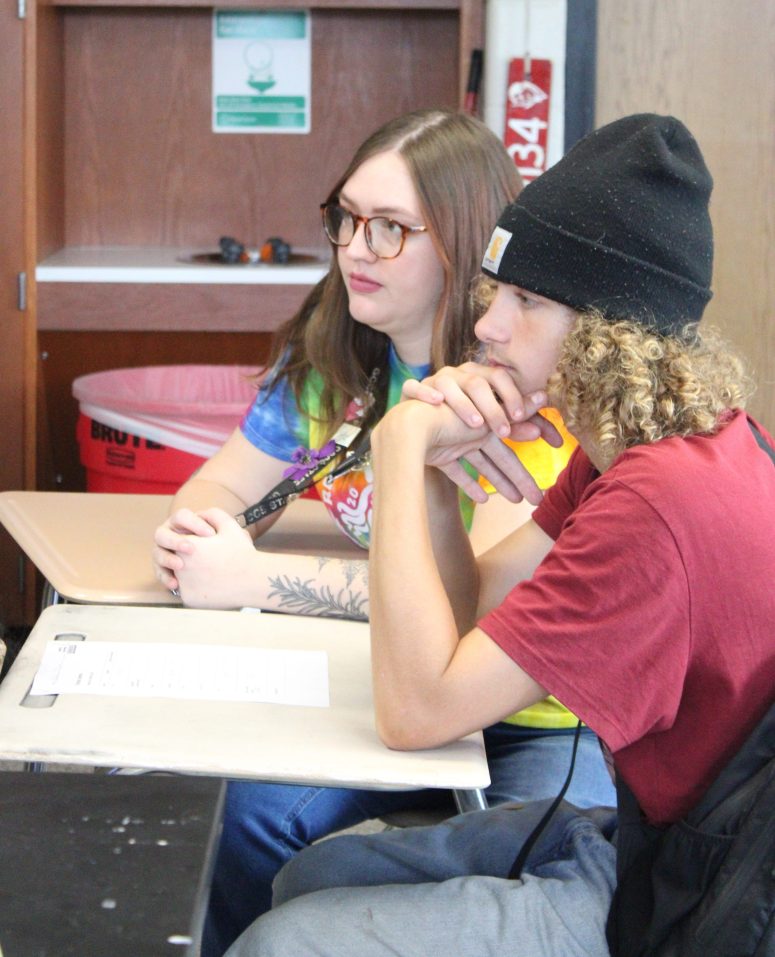
Science and biology teacher Francesca Hernandez helps a student on a map for the class assignment on Thursday. “I’ve been teaching for six years and I love getting everyone interested and involved in their environment and natural world,” she said. Photo by Kayleen Alvarado.
Her teaching also focuses on helping students understand the environment around them and their responsibility toward it.
“The hardest part is getting students to understand that everything is relative; every action we make influences our world in some way. It’s up to us to choose how we handle that responsibility.”
Her students learn this sense of responsibility during her lessons
“She makes biology interesting by applying some of the real-world experiences to the science she teaches,” said freshman Akiya Flynn. “She breaks down the topic and puts it into more understandable terms for her students.”
“I describe her teaching as she shows everything on her board and helps us understand things we need more help with by shortening it into easier forms for us to understand,” said freshman Rhaya Nord.
Environmental science is especially important to Hernandez because she believes students can better appreciate the world when they understand it
“People can’t care for the world if they don’t understand it, and they can’t understand it if they don’t know it exists.”
Hernandez also enjoys having a new classroom this year where she has more room to teach through activities and labs.
“I love my new classroom. I have windows, and I also have more space to do more labs.”
Hernandez wants her students to see that biology is more than just a class they have to take at school.
“I want the readers to pay attention to their science classes because I promise it applies to them in some way.”
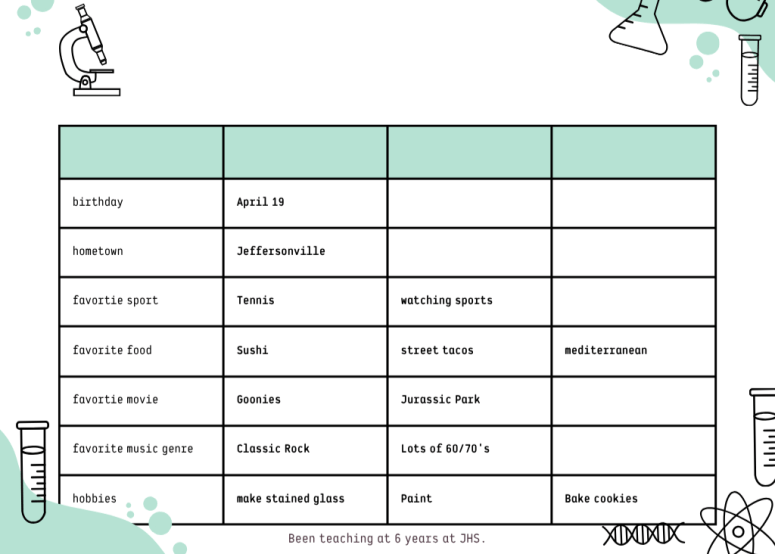
Chemistry teacher James Huffman walks behind his desk, capturing everyone’s attention with his voice. He flips through the slides on the board until he stops at a conversion equation; the students focus on him, waiting expectantly for him to demonstrate how to convert the units.
For Huffman, problems like these are more than just a chemistry lesson. He enjoys working through problems himself, but he also enjoys helping others find their way through difficult questions.
“Yeah! I like solving problems, and I like to help other people solve problems, specifically in chemistry but life in general,” Huffman said.
His approach to problem-solving is something his students notice in the classroom. Rather than just giving students an answer, he encourages them to understand how to arrive at it step by step.
“He taught us to remember formulas and learn how to do problems by putting them into steps,” junior Danna Lopez, a former student, stated.
Junior Rachel Santos also remarked that Huffman encourages students to approach difficult problems in different ways, especially when working with stoichiometry or other smaller subjects where they can’t seem to grasp the idea.
“He taught us to break down problems and try different methods, especially with stoichiometry,” Santos said.
Being a teacher isn’t what he always wanted; it wasn’t his first goal. Being an engineer was his first goal, but he wanted his life to revolve around helping people, no matter the problem.
“I would probably be an engineer. That was my first goal as a student, or I would be going the exact opposite, like I do now and be a social worker, like helping people with their problems, like life, versus solving problems as an engineer, which you know is much different.”
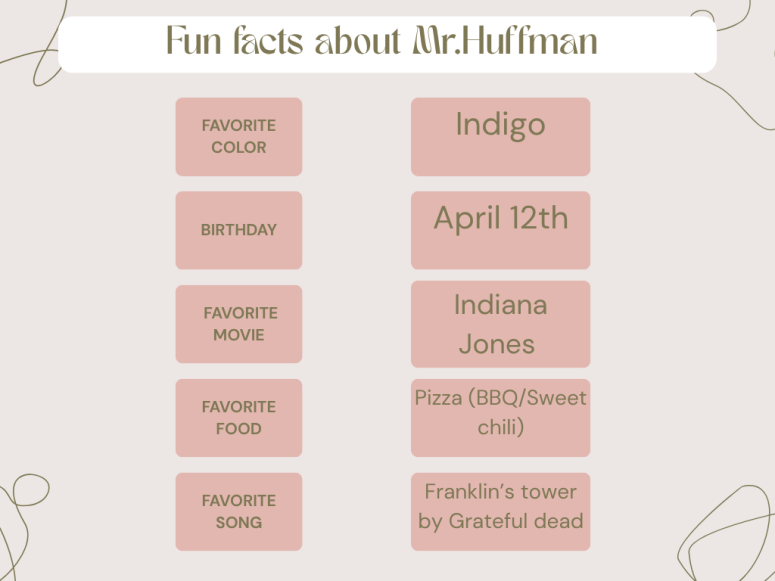
Graphic by Zihan Lin.
Although engineering was once Huffman’s goal, his interest in chemistry led him towards working with chemicals rather than engines. His experiences in his chemistry class, particularly the hands-on labs, helped him realize what he enjoyed most about the subject.
“Had an awesome teacher; I loved the labs. I loved being able to prove something with chemicals. I wasn’t as much—I don’t like to work on engines. I like to work with individual chemicals. I found that out from my chemistry teacher from high school,” he said.
His high school teacher not only helped shape his interest in chemistry, but also influenced the way he approaches teaching with his own students.
“I would say mostly due to the awesome teachers I had as a student. I had some really good teachers, and because of those good teachers. I want to do the same thing as they did.”
In Huffman’s classroom, every problem has a solution—and sometimes, the solution is simply to keep trying.
New art teacher Hayleigh Gnagie instructs her fourth-hour class on shading and showing value in their artwork.
She has been making art her whole life and has always wanted to teach and help other students express their creativity and emotions through art.
“Yes, art is something I have been passionate about since elementary school, and I want to share it with everyone else,” said Gnagie.
Because of Gnagie’s strong passion for art, she intends to share it with her students.
For example, junior William Ponsford shared what he has learned in art because of Gnagie, specifically, “how shading and hue can give art more depth perception and detail.”
Gnagie’s background includes experience with children of various age groups.
She substitute taught for several months, including for GCCS at Jonathan Jennings and Charlestown Elementary before working at Franklin Square Elementary as a specialist. Now she teaches at JHS.
“Elementary kids don’t know how to handle their feelings as well as high school kids know how to communicate their feelings well and show if they don’t understand the assignment and how I can help them understand it more,” she stated.
“By passing down art to future generations, we help ensure the human creativity, history, and ability to imagine a better world are preserved and celebrated.”
Art Teacher Hayleigh Gnagie
Gnagie also had influences growing up who helped her pursue her career and motivated her to pursue art.
“My high school art teacher made me see that I can pursue my career.”
Her students have also had a positive impact on her life.
“They make my day better by showing me different perspectives of life,” she said.
However, Gnagie has also had an influence on her student artists.
Junior Danna Lopez, an artist in Gnagie’s fourth-hour class, appreciates “the way she explains techniques, like how to grab a pencil correctly for shading.”
Art is not just a subject in school; it is a way to express and understand the world. It allows people to share their feelings, ideas, and experiences without always needing words. It can bring people together, tell stories, show different cultures, and inspire others. Gnagie said makes art more than just drawing or painting — it is a way of communicating and connecting with others.
“It’s the easiest way to express yourself without talking; also, you can use color to express your emotion,” she stated.
Since Gnagie is new this year, students shared their first impressions and what they think of her as a teacher.
“The energy I got when I first met her was that she was going to be a very creative and calm teacher,” said Ponsford.
Lopez added, “She seemed outgoing and chill.”
Gnagie feels that art is dying, so she wants to teach it to the youth so it does not.
“By passing down art to future generations, we help ensure the human creativity, history, and ability to imagine a better world are preserved and celebrated.”
Gnagie has been creating art her entire life and hopes to inspire future generations on how important art is.
“If I could give young artists one piece of advice, I would say each artist’s journey is unique – embrace yours and keep growing.”
Red Devils play Providence on Thursday in week of formidable opponents
by Austin Bainbridge
The JHS girls’ volleyball team snapped an eight-game losing streak against Madison and now faces Floyd Central today.
The Highlanders have not lost a game in over two weeks — to the same team JHS plays Thursday: Providence.
“I do feel a little underprepared, but I’m hoping we can get a win in at least one win of these two games. If we do that I’d call it a success,” said sophomore outside hitter Audrey Cheshire.
On Thursday’s sweep of Madison, the sole senior on the team, Mattie Barker, had her own student section and was thrilled about it.
“I loved my Senior Night. It was so cool seeing everybody show up just for me. It felt really special and amazing,” said Barker.
Barker, one of the most trusted backrow players on the team, is going to have to handle spikes from Floyd’s Georgia Tech commit Macy Sorg.
“That’s going to be a hard one. I just have to do my best reading her and hope for a little help for some tips or blocks up front,” said Barker.
The team expects outside hitter Jayli Burris to continue the tear she’s been on, including a 10-kill performance against New Albany.
“I think I’m going to keep it going. I don’t know why it took so long to get going, but I’m going to keep it going,” said Burris.
Even principal Pam Hall has her attention on the program this week and what a win could do for the team.
“Well, to be the best you have to play the best, and I really hope we can get one this week. That would be really big for these girls and I’d love to see it,” said Hall.
Both Floyd Central and Providence are formidable opponents, and coach Wes Briscoe is aware.
“They’re both such strong teams. Floyd is one of the best teams in the region, and they’ve really only lost to Providence around here, so this is going to be a tough one this week.”
Jeff plays Floyd Central at 7:30 p.m. at Jeffersonville.
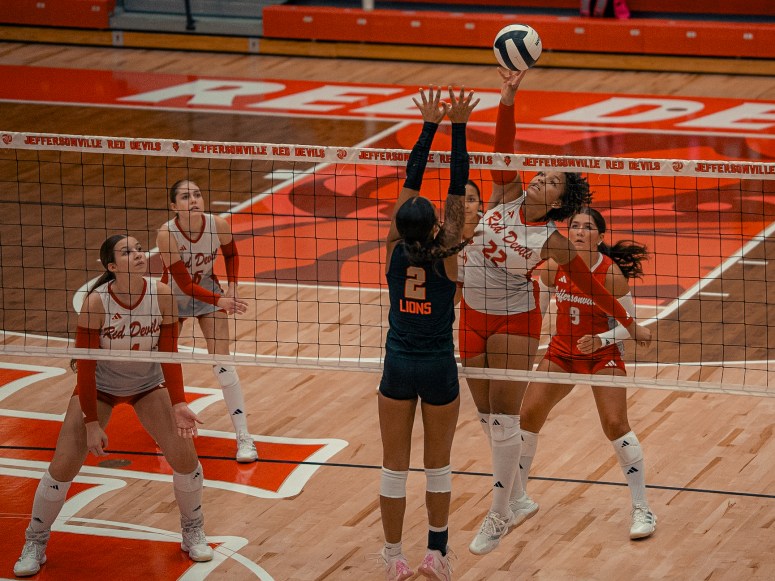
Junior Jaylianah Burris hits the ball over the net trying to score against Rock Creek. The Red Devils face Floyd Central and Providence this week. Photo by Malachi Conrad.
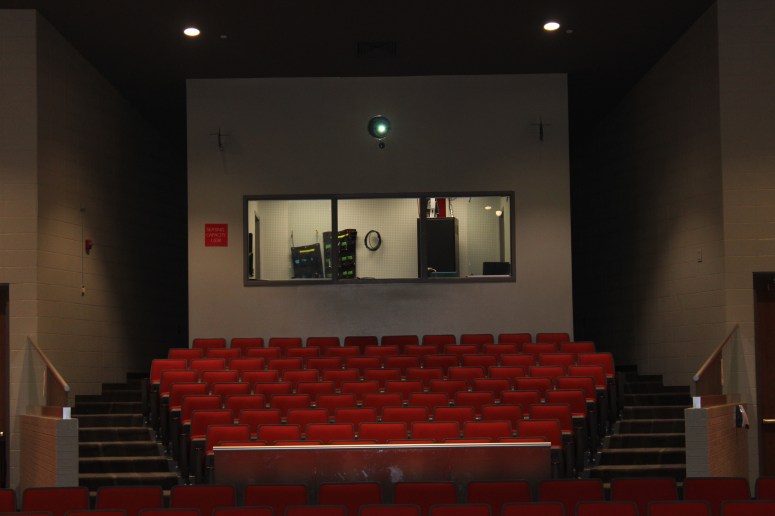
From the lights, to the set, to the props, to the costumes. The technical aspects of any performance are extremely important, and take time. There are so many parts and pieces that go into a theatrical performance.
At JHS, there are many opportunities for arts to shine. Under the stage lights lit by the crew, performances benefit from the tech department, which is student led and full of different ways to help light up the stage.
Photo by Raven Baker.
“I see it as a way to supplement what actors do on stage. They’ve done all their prep work leading up to the show and then tech comes in that last week to make sure all their work is seen and heard,” said senior Tristan Cooley, who has done tech for shows both at JHS and in the community.
Cooley said his favorite show he’s worked as a tech for is “All Shook Up” performed at Clarksville Little Theatre.
“It was my first show I got to design lights for, and I was really proud of that,” said Cooley.
Cooley said his favorite moments of a show are often when the set is completed prior to the performance.
“After all the set is made and everything is ready, I love walking into an empty theatre and feeling the space, it’s peaceful and magical,” he said.
Junior Lindsay Austin, who has worked as part of the tech crew since her freshman year, said a lot of work goes into building the sets.
“You have to be a very dependable person in tech because every rehearsal counts,” she said, explaining her favorite show to work on was “The Ballad of Little Jo.”
“I also enjoyed making the bed for ‘Once Upon a Mattress,’ said Austin. “That’s when I first met some of the now sophomores and became friends with some of them. It was also one of the last shows I got to do with a former senior, Cheyenne.”
Senior Blessing James Vonsenden, who has worked tech and acted on stage, said she enjoyed being the stage manager for “The Ballad of Little Jo” “because I was so involved — I got to know a lot more people and see the whole scope.”
Lighting is an important part of any performance. “I did the light board for “Once Upon a Mattress” last year and I really enjoyed that,” said sophomore Nataly Barragan.
Theatre teacher and director Derrick Ledbetter said tech work brings shows to life on stage.
“I think it’s like the backbone of a live show. It brings the story to life. It’s often invisible when done right,” he said. “Tech also can help build self confidence. Sometimes there are students that don’t shine physically or academically, but tech gives them that chance to shine. I think it creates a diverse extracurricular ecosystem, and it’s a place where people can explore, make friends, and feel welcome.”
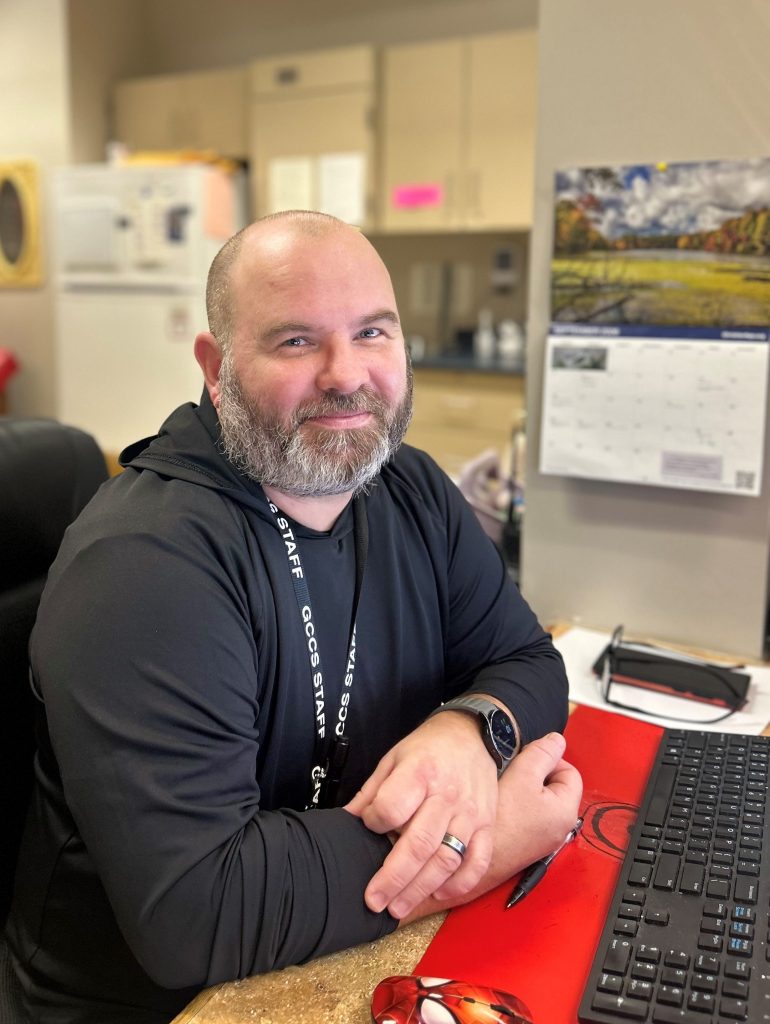
Nursing assistant Frank Marshall has dedicated much of his life to helping other people. Even though he is already retired, Marshall continues to work as an assistant nurse at JHS.
Marshall decided to continue working because he enjoys helping people and building connections.
“Since I started to work with JHS, I really started to have good connections with students and staff here. I just really enjoy working here,” he said.
He said being a nursing assistant is more than taking care of someone’s physical needs — it’s about listening to people, understanding them, and making them feel comfortable when they need help.
“Listening to students more and actually listening to them makes a small difference in how you can help them,” he said.
Working at JHS allows Marshall to interact with many different students every day. Sometimes students come to the nurse’s office because they are sick, injured, or simply not feeling their best.
“I like being able to connect with students and help them, whether they’re sick, hurt, or just having a bad day,” said Marshall.
Marshall’s friendly attitude is one quality that makes students feel less nervous while visiting the nurse.
“Marshall helped me feel more comfortable speaking up and not being afraid to say what I’m thinking,” said freshman Noah Sparks.
Even though Marshall is retired, he does not see his job as something he has to do. Instead, he sees it as something he enjoys doing. He likes having a reason to get up and come to work, and he appreciates being able to stay involved in his community.
“I enjoy coming to school every day. It gives me a reason to get up, stay involved, and continue helping people,” said Marshall.
Nurse Frank Marshall. Photo by Eva Harbeson.
His experience as a nurse assistant also allows him to help students and staff in ways that come from years of working with people.
RN Julie Simones said that Marshall’s presence and work have added to the health office this year.
“He is amazing. I’m very happy to have him as part of our nurses’ staff here at Jeff. He is really good at what he does. He has been great from the beginning,” said Simones.
His dedication has not gone unnoticed, especially by those who work alongside him in the health office.
“He is very respectful. He always knows how to help me when I need it the most. He is very, very honest as well. He is a very good nurse, he belongs here,” said junior Harper Ward.
For many students, Marshall is more than just a member of the nursing staff; he is someone they know they can count on.
“He was very good at helping me whenever I was in pain. He was calm but very patient with me. Frank has always been there for the Football team at all times. He puts his needs aside for his students. He’s amazing,” said Senior Ke’Mari Smith.
Marshall’s passion for nursing is also something he shares with his wife, giving them something special in common.
“My wife is also a nurse, so we bond over being nurses,” he said.
Their careers give them something they can talk about and understand together. Marshall said, “We understand each other. We can talk about our experiences, share stories, and support each other.”
Having a wife who is also a nurse has helped Marshall appreciate his career even more. He said nursing can be challenging, but having someone at home who understands the job can make those challenges easier.
“My wife understands what it’s like to be in nursing, so when I have a tough day, she knows what I’m going through. We can relate to each other and help each other through it,” said Marshall.
Marshall’s decision to keep working after retirement shows how much he cares about helping others. He could have chosen to spend his retirement doing something completely different, but instead he decided to continue working with people.
“I enjoy helping students so they can become better and get help quickly,” he said.
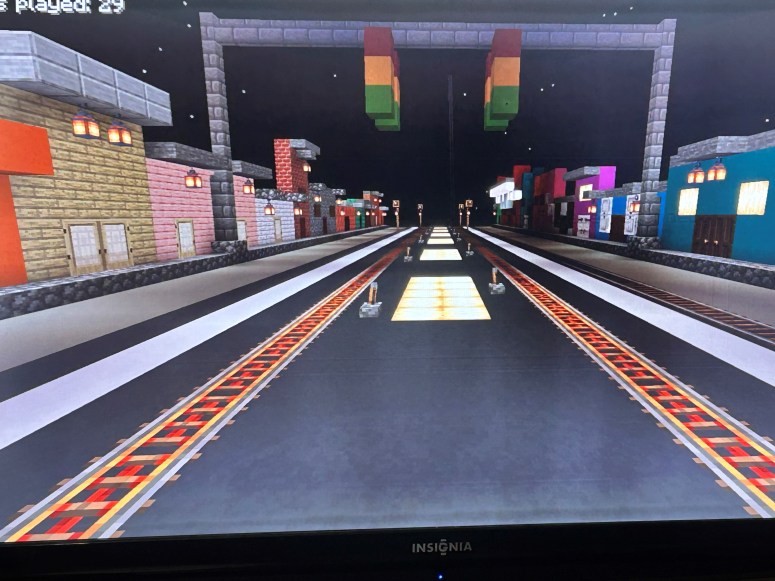
Minecraft is a game full of creativity and wonder. Released on May 17, 2009 and fully released on Nov. 18, 2011, Minecraft records show that there are “212.32 million monthly active players in early 2026, with more than 350 million copies sold across all platforms since its 2011 launch. The daily active users average 31.96 million,” according to QuantumRun Foresight.
My family and I are among those statistics.
I’ve been playing Minecraft for as long as I can remember, and it holds a deep place in my heart. Growing up, I played it with cousins — when I got a turn, of course. Before I knew it, I had a copy to call my own, and I was playing with my mom.
As the years went on, we both got better at the game: designing buildings, coming up with creative ideas, and creating furniture. Each time we played, we figured out our style and evolved from it. Eventually, it became routine that I’d come home from school, find my mom playing, talk about the buildings she built, and the ideas she had while I was away. One time, I made a world for us, and I woke up to a village she built overnight.
Throughout the years, Minecraft has always been a factor. I taught my little siblings at a young age, and they started teaching each other. Now, after I’m done with school-related work, I’ll come upstairs and find them building incredible things. My brother even built an airplane.
With each update, movie, mini TV series, and add-on, I became more obsessed.
Photo by Ayianna Maddox.
Villager News is a comedic animated series created by Element Animation that I watched on Amazon Prime Video, and eventually on YouTube. Recently, Minecraft added Villager News as an add-on feature, making villager interactions more comedic.
When I discovered this, I squealed, “Finally!”
Minecraft is a wholesome, family-fun game for all ages, whether to express creativity, obtain all trophies, or to battle and see who’s the strongest in survival.
Red Devils face Floyd Central Tuesday in Hoosier Hills Conference showdown
by Layney Derricott
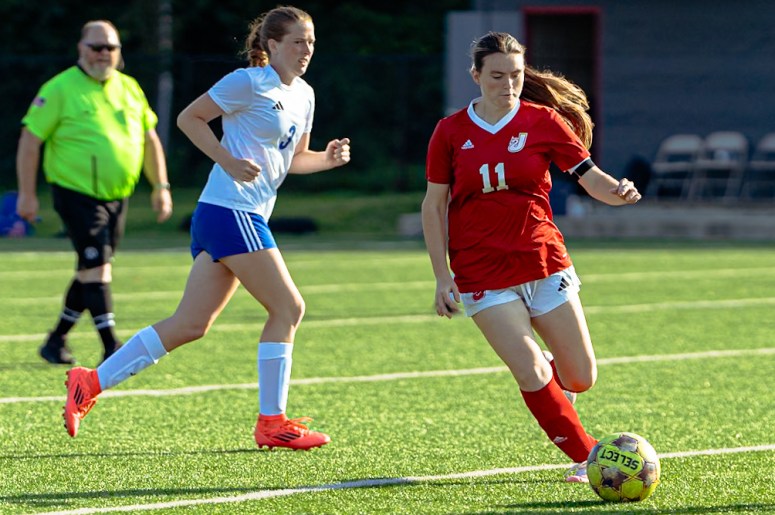
The Red Devils soccer team enters an important Hoosier Hills Conference match with Floyd Central tonight at 4-5-1 (1-3-1 in the HHC). Both teams look to add another win to their resumes, making this an exciting matchup.
Coach Rachel Foster shared that challenges are something the team will have to face and overcome while battling the Highlanders, currently 9-5-1 and 5-0 in the HHC.
“We will need to keep up our speed of play. Floyd is a fast team, and they move quickly. We will need to move just as quickly as them, beat them to the ball, and be ready when they’re attacking,” Foster stated.
Floyd Central is a high-speed team. JHS will not only have to keep up with their speed, but their attitudes as well. Senior and team captain Abi Lemon said tomorrow’s game will be a mental challenge.
Senior Abi Lemon keeps control of the ball against Jennings County. The Red Devils won 8-3. They battle Floyd Central tonight at 7 p.m. Photo by Malachi Conrad.
“Our team will have to overcome the stigma. Have the ability to deal with people commenting on the differences between the two teams, not letting negative words knock us down. Holding our heads up high with good morale,” Lemon said.
Foster said preparation for a team in an intense rivalry game is important.
“We’ve been getting the formation down, being sure to move the ball quickly. Move just as fast as Floyd will. Every year we have a new team, new people to work with, and get accustomed to.”
As the Red Devils prepare for the pace of the game, staying focused, and counting on each other, their focus now shifts to executing that preparation.
Sophomore Haylee Alvarenga said once the game starts this focus must include “making sure to stay on defense for the first half. Along with keeping up a positive attitude, to not get discouraged early on. Keeping a defensive team.”
This defensive mentality affects the team as a whole, but leadership from individual players can make just as much of an impact.
Sophomore Jacqueline Escobar mentioned one person who can be trusted to hold everybody accountable while displaying a positive attitude.
“Abi Lemon knows how to work well with everyone. She’s always available when needed, gives good advice, and knows how to bring you back down when things get intense,” Escobar stated.
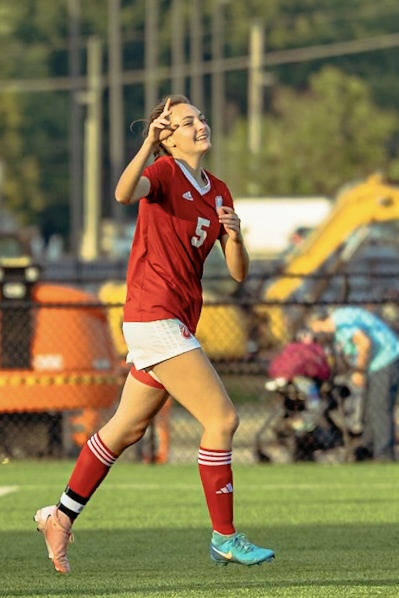
Senior Laela Rudicel celebrates her third goal of the night against Jennings County, achieving a hat trick. Photo by Malachi Conrad.
Senior and team captain Laela Rudicel said the Red Devils are prepared mentally and physically for the challenging game with the Highlanders.
Being mentally and physically ready is only one part of the challenge; the team will mainly rely on its communication throughout the game, according to senior defender Alianna Brown.
“Communicating, along with being there for each other,”said Brown. “Being able to call on anyone; specifically sophomore Sonnie Darku, to switch positions with me. Letting others know when there’s someone approaching or coming for the ball.”
Red Devils soccer takes on the Highlanders tonight at 7 p.m at the JHS soccer field.
For Coach Daniel Struck, coaching is about more than sports. Struck has said, ¨It is about helping students become stronger, more confident, and better versions of themselves.”
Struck has spent many years working with athletes and coaching different sports. He spent 28 years as a teacher and 30 years as a coach. During his time as a coach, he has worked with wrestling and football. His experience has allowed him to work with many students and help them reach their goals.
Sophomore sports performance athlete Braylen Martin said, “Coach has helped me reach my goals in track and field, allowing me to become such a stronger version of myself, and I thank him for taking that time with me.¨
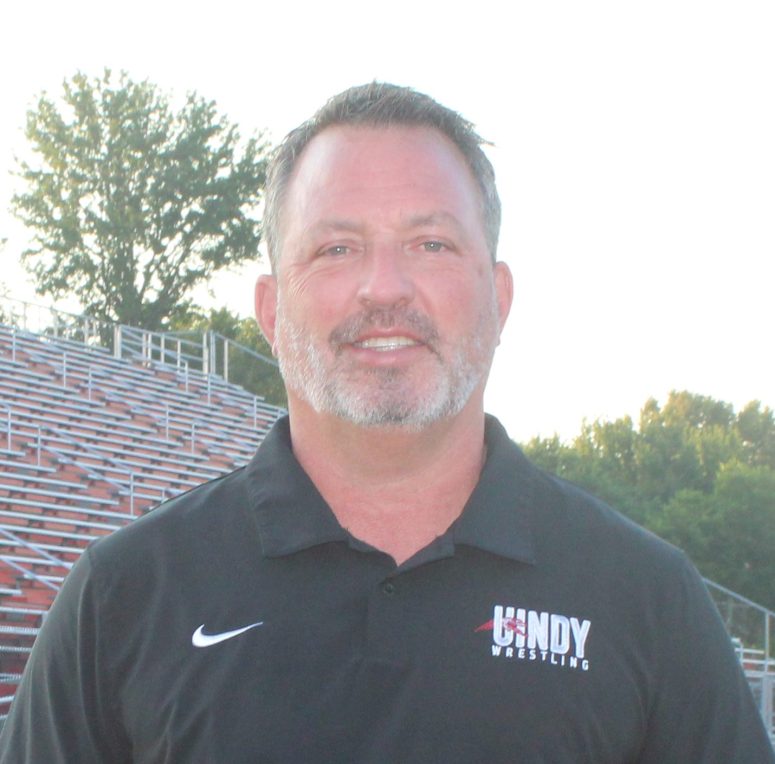
Head wrestling coach Danny Struck. Photo by Isabella Stewart.
One of the main reasons Struck coaches is that he wants to see kids become stronger and healthier. He said that training can help athletes both physically and mentally. His goal is not simply to make students better at their sport, but to teach them lessons they can use outside of athletics as well.
Junior wrestler John Steele said, “Struck is serious but very caring and is determined to help. Struck has helped redirect me when I’ve needed it and always reminds me to focus on myself.¨
Student athletes who have worked with Struck describe him as someone who cares about the people around him. Martin, for example, sees him as someone who is encouraging.
¨Struck’s humor helps make training more enjoyable and motivates me to be more active. His willingness to help students learn their rhythm shows that he focuses on individual athletes instead of treating everyone the same,” he said.
Other athletes have noticed the same qualities. Sophomore swimmer Charlie Frakes described the coach as someone who cares about his students. He added that working with him through sports has helped him become stronger and overcome challenges.
Sophomore sports performance athlete Rylan Humphreys described Struck as welcoming, understanding, and supportive. According to Humphreys, “Struck’s guidance has helped me become faster and stronger while also showing me I can accomplish difficult things when I put my mind to them.”
For Struck, the relationships he builds with his athletes appear to be just as important as the training itself. His years of coaching have given him the opportunity to influence athletes and help them develop confidence, discipline, and perseverance.
The classroom is filled with conversations about strategy, business, and the future as business teacher Laura Solomon pushes her students to think beyond the walls of JHS.
For Solomon, teaching is more than simply giving students information. Her goal is to show them how what they learn in class can be applied to their futures.
“I have a passion for what I’m trying to teach, and I hope that my students can see that passion,” said Solomon. “I can connect these topics to the real world, and I hope that helps you guys understand what we’re doing.”
Solomon teaches marketing fundamentals, strategic marketing, and finance and investments, as well as classes and programs connected to the Centra Credit Union and the Devil’s Den. Through these courses, she gives students opportunities to explore the business world while developing skills they can use after high school.
Her connection to JHS is also an important part of why she enjoys teaching.
“I think I have a pretty decent relationship with Jeff as a whole.” she said. “There is a community here because you can see students’ desire to be a Red Devil and what that means to them.”
Solomon said JHS gives students opportunities, especially through programs such as the academy system.
“This school gives you a foundation and helps you build on your future,” she said.
Business teacher Laura Solomon plans what to provide in the Devil’s Den with her finance and investment class. Photo by Isaiah Guzman.
Inside the classroom, Solomon describes herself as straightforward. She sets high expectations for her students but tries to make sure those expectations remain achievable.
“I try to set high expectations so the students are pushing themselves to be better, but not so high that they can’t do it and feel defeated,” she said. “I feel as if students don’t have enough expectations for themselves.”
She also holds her students to the same standards she would hold her own children to.
“I wouldn’t expect anything out of them that I don’t expect out of my own children,” said Solomon.
Junior Braelynn Leavell experiences those expectations firsthand. She said the class challenges her while preparing her for the future.
“It teaches me a lot about strategy and how I can apply these skills in the future,” Leavell said. “I feel as if this class is preparing me for the future.”
Leavell chose the class because she believes the skills she learns can help her achieve her goals in the real world.
“I feel like this class would help me build my business and improve my skills in the business world,” she said.
The challenging environment is something Leavell appreciates.
“I have high confidence and expectations for myself, and this class helps me challenge that,” she said. “My brain is always running in this class.”
For Solomon, keeping students engaged starts with helping them understand why the information matters.
“I think engagement is increased when the students can see the relevance in what they’re learning and why they’re learning it,” she said. “I show how these things can be helpful in the real world.”
Senior Darryl Cordova, another student in Solomon’s class, said that connection to the business world is one of the reasons he enjoys being there.
“I like this class,” Cordova said. “This is where I go to focus on the business world.”
Like Leavell, Cordova chose the class because of how he believes it will help him after graduation.
“I want a good-paying job in the future, and I think this class prepares you for that and more,” he said.
While the work can be challenging, Cordova said the class gives students opportunities to actively interact with what they are learning.
“I’m pretty confident in this class,” Cordova said. “I feel like the work isn’t stressful when you actually get to interact in a class.”
However, Solomon’s impact reaches beyond marketing and business. Both students described lessons they have learned from her that go beyond the curriculum.
“Mrs. Solomon has taught me that the real-life world isn’t scary,” Leavell said. “You just have to be willing and open-minded to it.”
Cordova said Solomon has helped him think differently about his own future and the effort he puts into achieving his goals.
“She taught me that I can either do the bare minimum for credit or do the most for my future,” he said.
Students also believe Solomon’s honesty is what separates her from other teachers. Leavell described her as realistic and willing to listen to different perspectives.
“Mrs. Solomon is real,” Leavell said. “She’s realistic. She’s able to take all opinions into consideration, and she makes points on all sides.”
Cordova shared a similar perspective.
“Mrs. Solomon is a great teacher, and she’s willing to be honest and real and raw,” he said.
Solomon’s honesty and high expectations come from her desire to help students become successful. Even when she disagrees or “bumps heads” with a student, she continues trying to build a relationship with them.
“I like being around you guys,” Solomon said. “The students I even bump heads with, I try to build relationships with and reach them. Sometimes I can’t, but I don’t stop trying.”
Before returning to education, Solomon worked in the business world. However, she eventually chose to come back to teaching because mentoring students was what she truly enjoyed.
“I left the business world to come back to teaching because this is what I enjoy,” she said. “I enjoy being a mentor and hearing from my students after they’ve graduated so I can see how they’re using my class in life after school.”
For Solomon, the lessons taught in her classroom are meant to last far beyond a grade or graduation. Through real-world experiences, high expectations and honesty, she hopes her students leave her classroom prepared not only for the business world, but for whatever future they choose to build.
Senior boys’ tennis player Camden White gets out of his car while grabbing his supplies for the first tennis match of the season. As he grabs his racket and water, he waves over to his friends that are calling him over. He realizes that this is going to be the first match to start off his last year playing tennis.
“I think after my full four years I am just done with the sport. It takes a lot of time and I want to be able to focus on my education more,” said White.
Even though White will not continue playing tennis after high school, he still has his senior year to play.
“I am most excited for overnight tournaments, because it is good team bonding and the tournaments are very competitive, so it makes them a lot of fun.”
However to White, tennis is more than about fun times.
“Although tennis is a team sport it comes down to you individually and how you win and how you play reflects on the whole team. You have to rely on yourself mentally to handle the situations.”
He’s been handling these situations since his freshman year when he started playing and has continued to rely on his mentality during tough times of the sport.
A teammate of White’s, senior KJ Westbay, said, “Camden brings good energy every day and is always positive, like always brings my attitude up when I’m feeling down.”
This shows not just how good of a tennis player White is, but a contribution to the JHS tennis team. Even with all of White’s tennis practices throughout the week he tries to make some time in his free time or hanging out with his friends. During these times, White will play pickleball with friends, and loves to golf. Though his schedule may be very busy, White loves the sport and has grown from when he started playing.
“Camden is a good leader; he’s a good leader of the sportsmanship we want to see on the team and he’s a good leader on the off season. Like I mentioned earlier he puts a lot of time in the offseason working on his game, it is a good example to the underclassmen,” said assistant coach Emma Ellis.
White has loved playing tennis for his high school career and even though he won’t be playing when he goes to college, he will always remember the skills and mindsets that the sport has given him.
“People can learn how to handle their emotions more because it puts you under a lot of pressure by yourself and it shows how you handle certain situations.”
Seniors begin planning, facing responsibility, and making decisions for their futures after high school, but throughout it all, anticipation for exciting plans continue as this school year progresses. With the help of class officers and sponsors, they hope the year will be memorable for everyone.
Class and Vice Presidents
Fourth-year class officer Camden White lists his goals that encouraged him to run for class president.
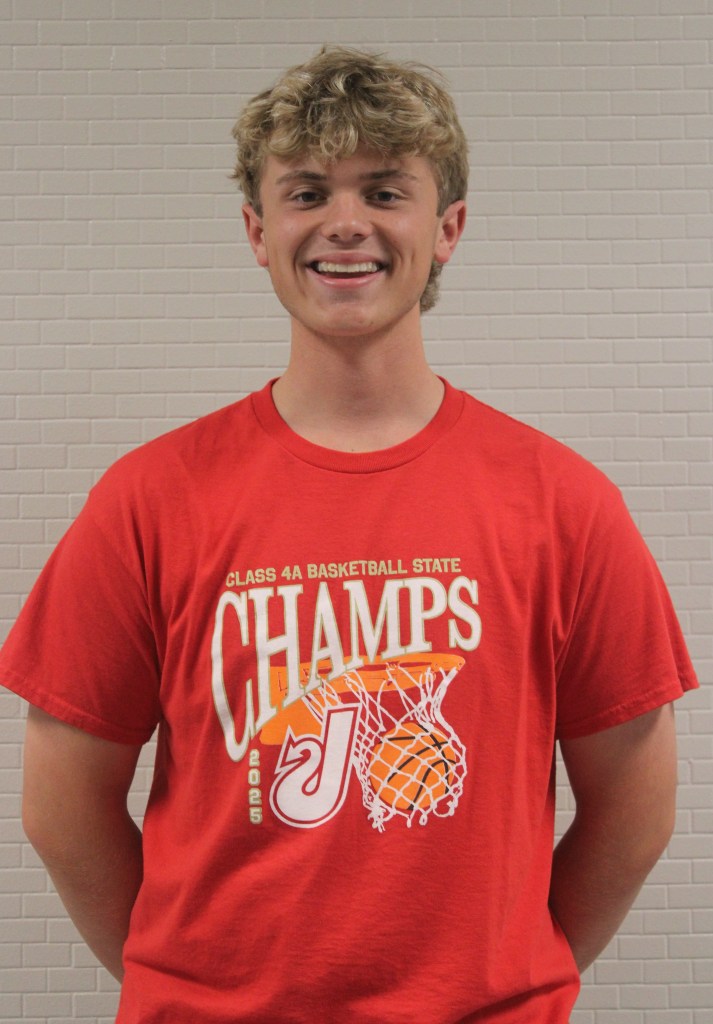
Class President Camden White reflects on personal goals. “I want to live in the moment and enjoy my high school experience as much as possible. It makes me feel very nervous that I’m graduating and that I will be stepping out into the real world,” he said. Photo by Areli Hernandez.
“I wanted to be able to take charge and make sure we had good things going on for us. I also wanted to come up with ideas for events that students would be excited about and be involved in,” he said.
As class president, White will represent the class of 2027 during graduation. He finds this responsibility both exciting and intimidating.
“I’m excited and I also think it’s kind of scary. I think it is scary having to talk in front of a lot of people but I will also like to share my experience with everyone,” he said.
Senior vice president Blessing James finds leadership in her involvement as a class officer. Her goal is to make this year exciting for all of her peers.
“I think it’s fun to be a leader of something and I also want to have a positive impact on the class and make sure everyone enjoys the things we do,” she explained. “I want people to walk away from senior year and be able to say they enjoyed it.”
James gives her advice to students who are looking to be leaders like her. She explained that it’s important to be confident and just “go for it.”
“Don’t be scared to do it. You get to know a lot more people and it’s cool to have a say in things your class will be involved with. Don’t think that the events we plan don’t matter, because they do make an impact on the class,” she advised.
Class Officer Sponsors
Through it all, commitment doesn’t only come from students but also from the contribution of sponsors. Class officer sponsor Michell Densford explained the connection she has with the students. Together, they brainstorm ideas and decide on events.
“I like planning the activities with the class officers and I get to know different students every time. We help set up events like Powderpuff and Homecoming. Students get to decide the themes for certain things and I’m the facilitator,” said Densford.
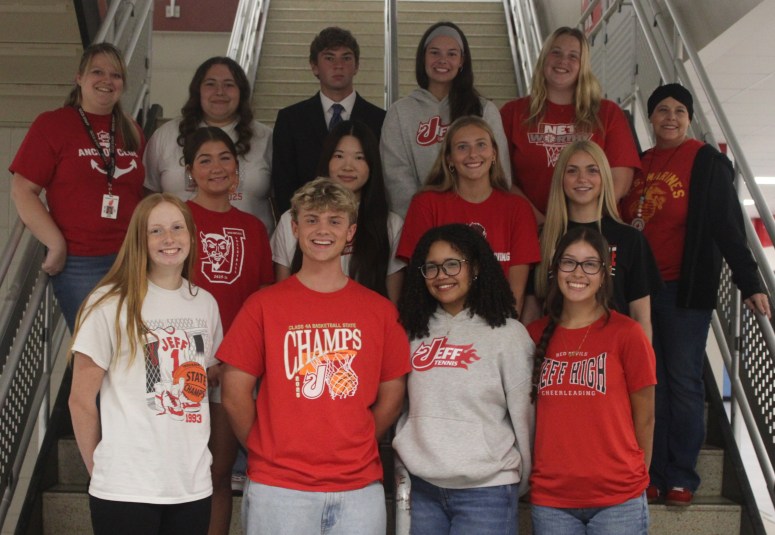
2027 Class Officers: Maddie Chandler, Camden White, Blessing James Vonsenden, and Linette Vega Sanchez. Row 2: Mattie Barker, Yanqi Liang, Macyn Jackson, and Katie Nord. Row 3: Grace Lantrip, Cort Merkley, Stella Siewert, and Lily Morrill. Sponsors, Michell Densford and Stephanie Niemi. Photo by Areli Hernandez.
Densford’s involvement also includes sharing responsibilities with her class officer partner, Stephanie Niemi. With their involvement, they’re able to facilitate a flexible schedule for events.
“Stephanie Niemi and I have been class officer sponsors before, and she encouraged me to join her. We are really good at splitting the responsibilities and we share who is responsible for each event. That way we make sure to get things done,” she said.
Niemi agreed with Densford’s view on managing students’ ideas during the school year. She explained how the students plan the events and the sponsors take care of paperwork.
“A lot of times we have to help with coming up with themes. Sometimes we have to step in with what they want to do. Densford and I do the behind the scenes stuff like: DJ, food, setups, venues, and contracts. We handle the money aspect and make sure we are staying on budget,” she said.
Niemi said she enjoys helping the class officers plan events and allows them to take the lead when planning activities.
“I like getting to help with the senior activities like Senior Sunrise and Senior Formal, and I’m excited for Powderpuff since we last did it four years ago. I like to give the officers freedom to choose those things,” she said.
Class Officers
The class officers enjoy planning events and having the freedom to make decisions, especially class secretary Linnette Vega, who voices her and her peers’ opinions.
“I wanted to have the opportunity and have a say on certain topics. I wanted to make decisions that affect the class as a whole and also wanted people’s opinions to be voiced,” she explained.
Vega anticipates future events of her senior year. She’s excited to attend high school activities and see where her friends end up.
“I am looking forward to finding out where we will be going. Seeing my friends become the people I think they can be, enjoying band events like Winter Fantasy, Anchor Club, and Prom. Overall, enjoying our youthfulness before graduation,” she said.
Class Treasurer Maddie Chandler, Class President Camden White, Vice President Blessing James Vonsenden, and Class Secretary Linette Vega Sanchez. Photo by Areli Hernandez.
Executive board member Lily Morrill intends to make this senior year fun by working hard with her fellow class officers.
“We really want to make senior year as fun as possible, so we already did the work to plan Senior Sunrise, and we’re going to work hard on other events like Senior Formal,” she said.
Morrill looks forward to the events of senior year. She values having fun and spending time with her friends.
“I’m really excited for Prom, because it is our senior prom so it’s even better than last year. I’m just excited to spend as much time as I can with friends before we all go in different directions.”
Niemi is proud of her graduated students and who they’ve become after high school. She has high expectations for this year’s class officers as well. She hopes that they give back to their community and continue to be leaders.
“I’m very pleased with where many past students are now. I’ve had a lot of interaction with the Class of 2024. I like seeing them give back to the community and coming back to the community,” said Niemi.
Niemi hopes White follows the important values and responsibilities of being a class president in his future.
“Speaking out and having communication skills are very important. People who are dependable, work ethical, and responsible are great traits that embodies the characteristics of a good leader. I hope Camden White is a demonstration of those qualities in the future,” she said.
White said that persistence is an important trait for someone in a leadership position and gives his advice to underclassmen:
“I would say to apply yourself, be involved, speak out your ideas, and keep fighting for what you want, be persistent,” he said.