by Abigail Hall
“I went with you up to the place you grew up in.”
Phoebe Bridgers opens her debut album, Stranger In The Alps, with this lyric from “Smoke Signals.” The album, released Sept. 22, 2017, explores themes such as nostalgia and childhood relationships, combining them with a wistful and melancholic sound.
Bridgers herself was born on August 17, 1994, in Pasadena, California. She wrote her first song at the age of 11, and she was in multiple bands, including Sloppy Jane, throughout her years in high school. Prior to releasing Stranger In The Alps, affectionately known to fans by the acronym SITA, Bridgers released an EP titled The Killer EP, featuring songs like “Georgia” and “Steamroller.”
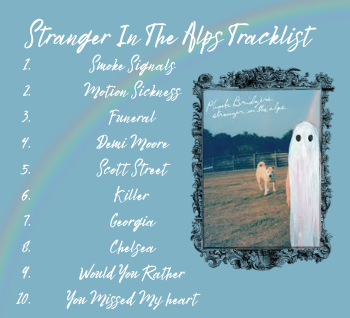
Bridgers and her fanbase, known commonly as “Pharbs,” excitedly listened to Stranger In The Alps on its release day eight years ago.
It opens with a song called “Smoke Signals.” The song starts with an instrumental opening, a mixture of bass and violin. Bridgers writes about meeting someone, a partner or significant other, and learning of their past, as well as finding out they have struggled through some of the same things, which made it seem like they were looking for each other subconsciously.
In the last verse of the track, she includes the lyric, “I buried a hatchet; it’s coming up lavender.” This symbolizes a past resentment for her situation that has grown into calm and a sense of peace, presumably with the help of the aforementioned partner. “Smoke Signals” fades out with an instrumental closing, focused on bass and bells.
An immediate bass guitar strum introduces the next song, “Motion Sickness.” Her theme of past resentment and nostalgia continues with the first lyric: “I hate you for what you did, and I miss you like a little kid.” Bridgers mentions having “emotional motion sickness” and sings about her experiences with an older person, implying her experience with being groomed.
Bridgers uses vague lyrics that could relate to many people, yet they still hold personal meaning to her. For example, one of the most iconic lyrics in the song: “You were in a band when I was born.” Reading between the lines, listeners can infer that the person she was involved with was old enough, likely an adult, to have a band while Bridgers was a baby. The words hold weight, drawing in many listeners who share similar experiences. The entire song builds up to the bridge, where her tone takes on something more angry when she sings, “You said when you met me you were bored.” The chords on the guitar gradually fade out into something more wistful.
A seemingly string ensemble transitions into the next song, “Funeral.” A heavier theme belongs to this song, as Bridgers sings about her guilt: “Wishing I was someone else, feeling sorry for myself, when I remember someone’s kid is dead.” Again, she draws in listeners with her relatable emotions, allowing people to feel less alone when they tune in. Though it seems to be about a funeral, this track is more about Bridgers and her awareness of being self-absorbed in depression, making it hard to think much about how others are feeling. She ends the song with a heavy lyric, summing up the whole song and implementing the feeling of guilt and dread all in one. “And it’s 4 a.m. again; And I’m doing nothing again.”
Skipping ahead to arguably the most notable song on the album and perhaps in Bridgers’ entire discography, “Scott Street.”
“Scott Street” begins with a soft guitar solo that completely encapsulates the feeling of nostalgia, which is the aching theme throughout the lyrics. Bridgers puts the feeling of going back to your childhood home in words, her powerful words making your heart sink with memories. A well-renowned lyric, one of the most well-known on the record, is “Do you feel ashamed when you hear my name?” Paired with the heartbreaking guitar, bicycle bells from her childhood, and train whistles in the background, Bridgers has your chest aching. Before you have time to recover, whether from her lyricism or from the memories she’d dug up, she hits you with one of the most heart-wrenching and nostalgia-ridden lyrics ever written: “Anyway, don’t be a stranger.”
While Bridgers has since released another solo album, Punisher, and multiple solo projects with bands like boygenius, Stranger In The Alps remains in the heart of many fans. Her lyricism, experiences, haunting instrumentals, and her somber voice invoke a sense of longing and sentiment in her listeners. Regardless of whether you consider yourself a “pharb” or not, this album will stick sweetly with you.
“Don’t be a stranger.”
 thehyphennews.com